MEV2023 Outlook: Crossing the Dark Forest.
Original Title: "MEV Outlook 2023: Walking Through the Dark Forest"
Original author: EigenPhi
Original translation: Foresight News
* Note: The scope of settlement transaction statistics calculated in this report is from May to December 2022, while the scope of other types of statistics is for the entire year of 2022.
One, A New Perspective on MEV
Currently, most reports and articles on the topic of MEV focus on introducing the concept and how to introduce orders into the MEV market. The issues of concern include but are not limited to the fairness of the MEV market, negative externalities brought by MEV, and centralization risks or review issues related to mechanism design. These are all directions that many blockchain protocol and application builders are working hard to address.
In addition, Amber Group and Forbes have also written extensively about a large number of long-tail MEV cases, the insider strategies of famous MEV searcher Nathan Worsley, and the two quantitative institutions Wintermute and Alameda Research that run MEV strategies. Their articles all mention the concept of "Payment for Order Flow", which seems to be a major trend that developers are working hard on, including Cowswap, 1inch Fusion mode, and Flashbots' MEV-Share. Mainstream financial institutions have also begun to pay attention to the MEV field, such as Nasdaq's news and insights column forwarding CoinDesk's article on how JIT robots and MEV promote DeFi. Of course, there are also a small number of people paying attention to the regulation of the MEV market.
In fact, beyond the widespread attention on the operation of MEV macro market mechanisms, we believe there is a micro issue worth noting: as a representative, MEV trading means that liquidity data has unprecedented opportunities and challenges.
As early as the series of events triggered by the UST-LUNA circuit breaker in May 2022, financial institutions engaged in encryption business have been targeted by users and publicly disclosed their balance situation. This situation is not common in traditional finance because the transparency and openness of blockchain ledgers allow anyone to obtain transaction data for free. Through on-chain transactions, we can obtain real-time generated and updated historical price information and liquidity data. Of course, the transparency of liquidity data can also help encrypted financial institutions establish real-time risk control mechanisms based on liquidity and realize the crisis earlier.
This report aims to draw attention to the value and risks of existing liquidity data, in order to better protect assets or design better protocols to protect users.
二、2022 年 MEV 市场概况
Translation:
II. 2022 MEV Market Overview
MEV is the most authentic representation of liquidity in the DeFi market. In 2022, MEV robots generated at least $307 million in revenue on Ethereum. Therefore, this section will provide an overview of the MEV market in 2022.
(一) MEV trading opportunities increased throughout the year
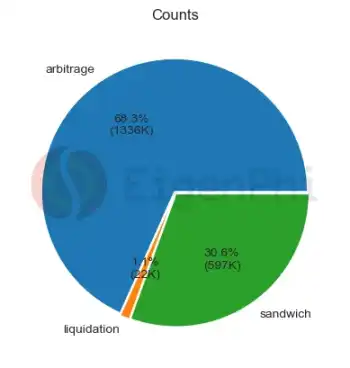
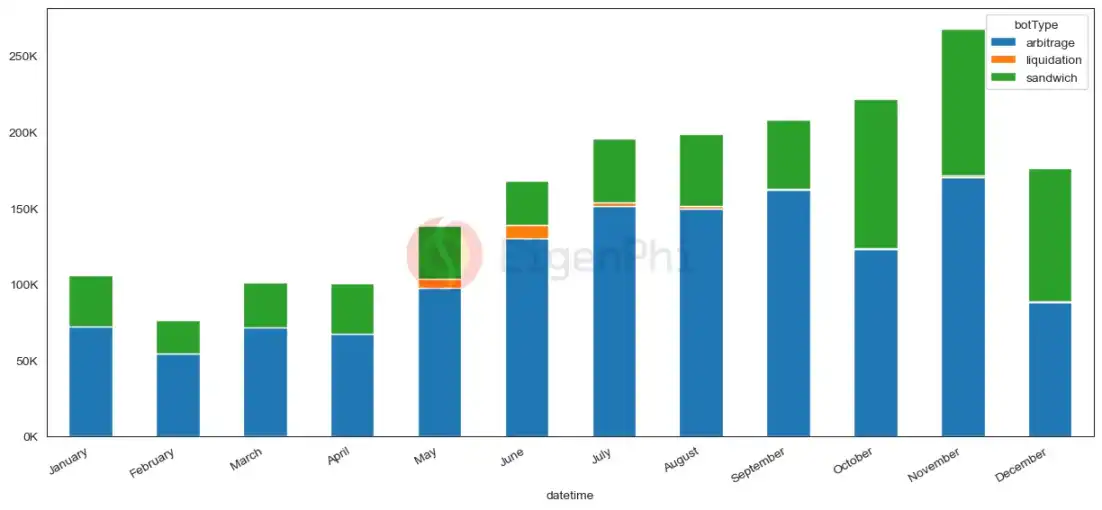
In 2022, the number of MEV transactions increases over time. Arbitrage robots are the most frequent traders, accounting for 68.3% of the market, while sandwich attacks account for approximately 30.6%. The opportunity for liquidation transactions is much smaller than the other two types of MEV, although this difference has little impact, despite its statistical range being from May to December. Therefore, compared to traditional arbitrage trading, liquidation opportunities are more likely to depend on drastic market fluctuations.
Meanwhile, the total monthly MEV is on the rise, reflecting a steady increase in opportunities for MEV seekers in the market.
(二) Market Share and Trends of Different MEV Types
Searchers can generate MEV revenue from three different types in the market, namely arbitrage profits from narrowing price differences between markets, sandwich attack profits from front-running user transactions, and liquidation profits from utilizing differences between debt and collateral values during market volatility.
Here is an overview of the revenue, cost, and profit of MEV transactions. (Note: Clearing data starts from May.)
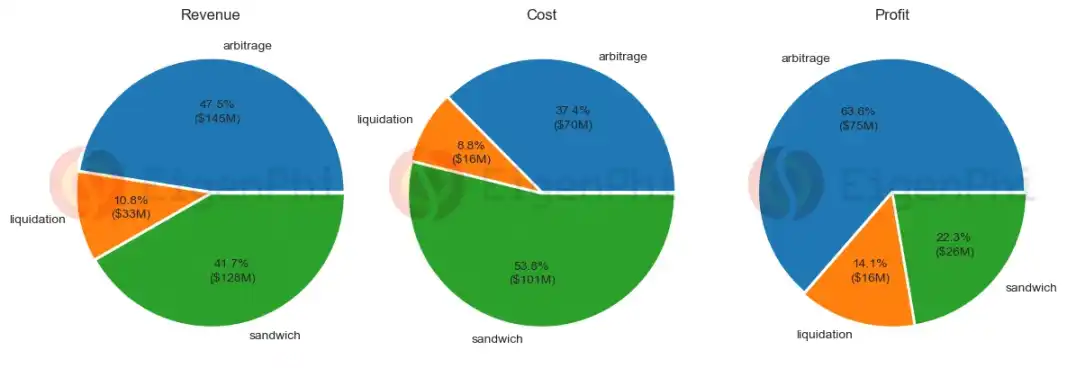
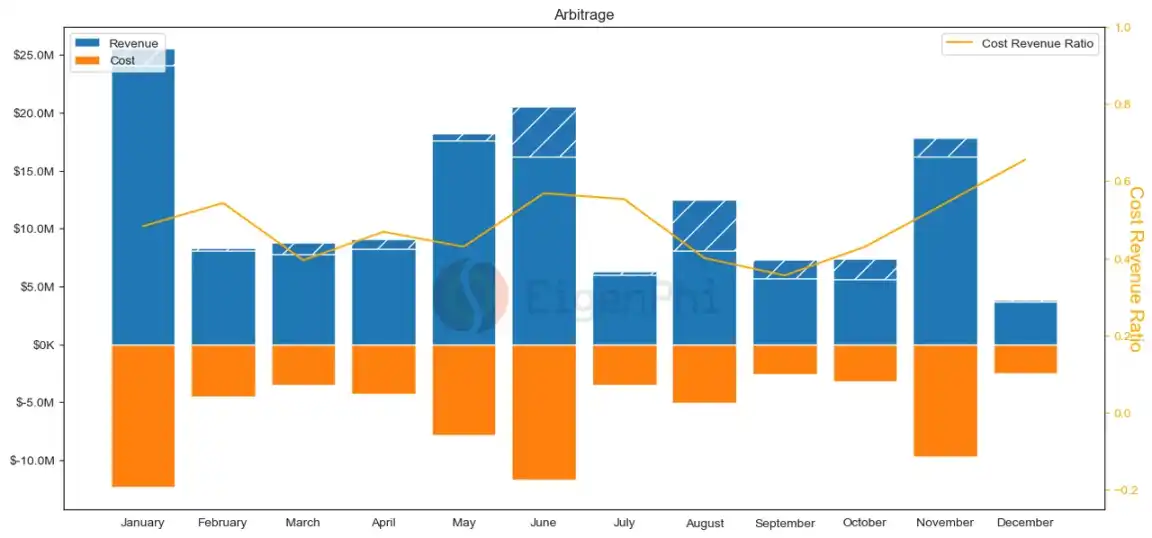
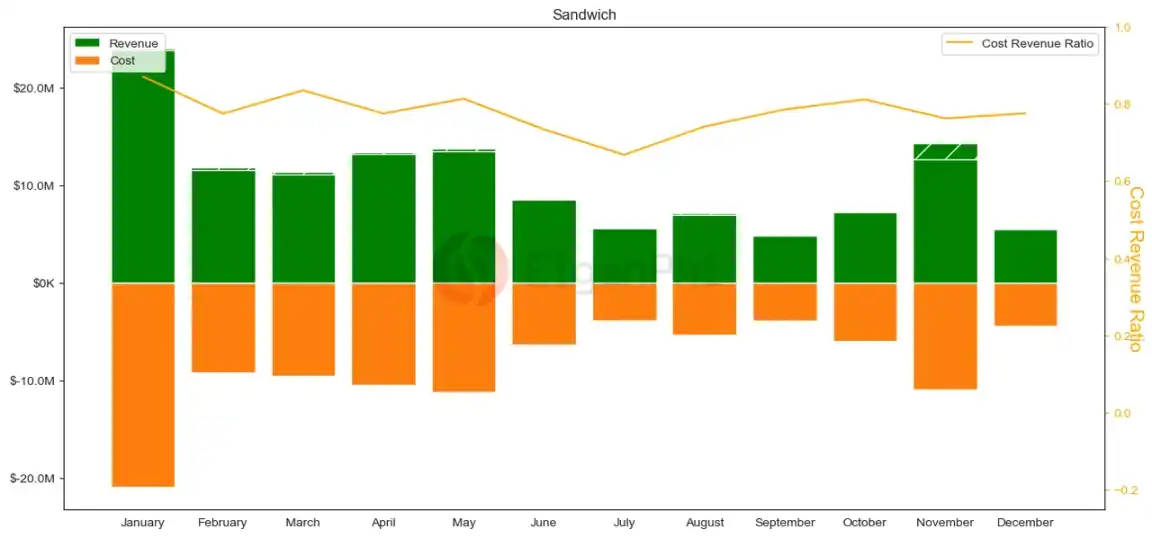
主流 MEV 机器人在 2022 年至少产生 3.07 亿美元的收入,其中,MEV 搜索者从套利交易中获得 1.45 亿美元总收入,占总收入的 47.5% 以上,从三明治攻击中获得 1.28 亿美元,占 41.7% 左右。虽然二者收入相似,但三明治 MEV 的成本明显更高,利润也低于套利交易。套利搜索者产生 7500 万美元利润,而三明治攻击只产生 2600 万美元利润。从 2022 年 5 月开始,清算交易总收入为 3300 万美元,成本为 1600 万美元,清算机器人最终从市场上产生 1600 多万美元利润。事实上,三明治攻击者向区块构建者和验证者支付了占其收入近 79% 的成本。从下图也可以看出,与套利交易相比,三明治交易每月的「成本收入比」(Cost Revenue Ratio)更高,三明治交易平均为 0.78,套利交易为 0.49。
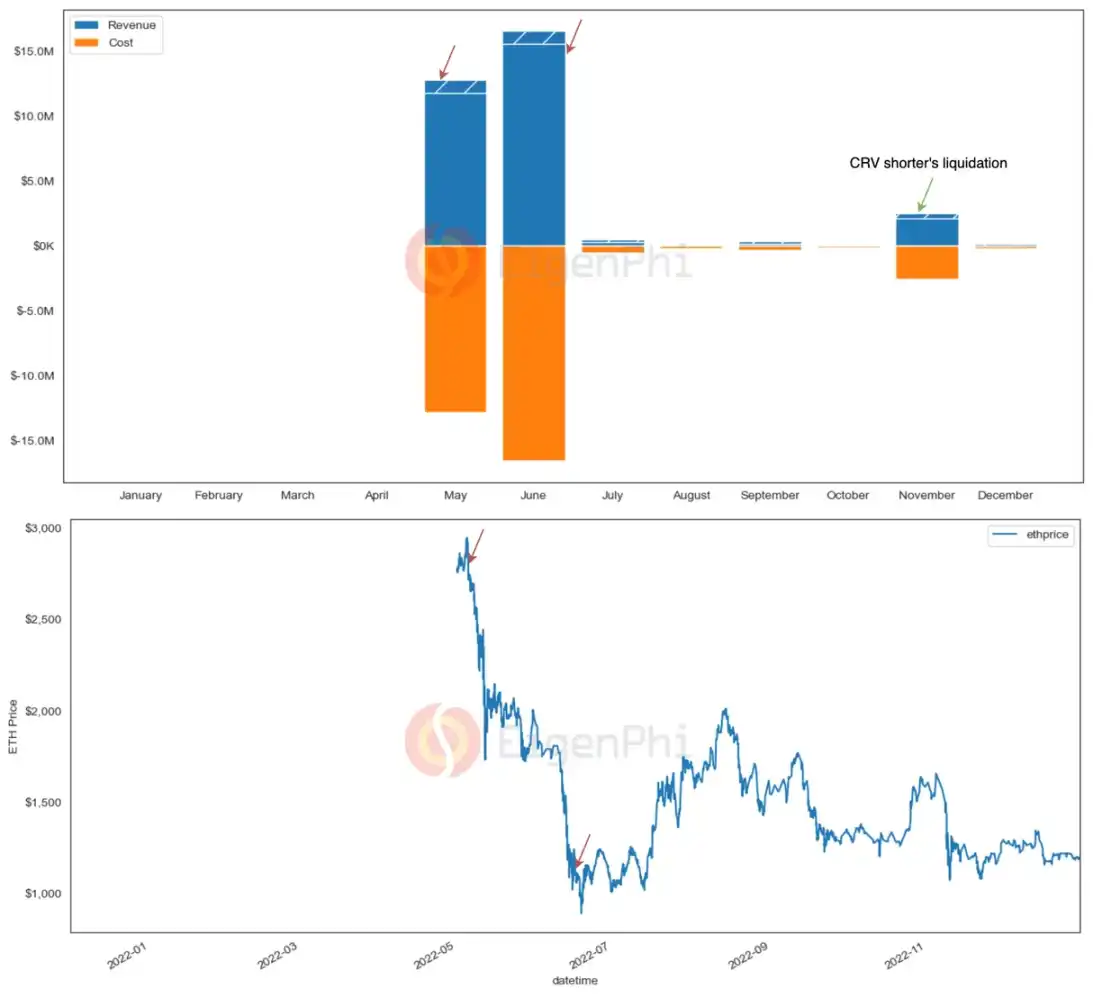
Overall, the income generated by arbitrage searchers is relatively high in January, May, June, and November, and stable in other months. Except for November, the income of sandwich robots showed a downward trend in the third and fourth quarters. In terms of monthly income generated by liquidation trading, the income in May, June, and November is significantly higher than that in other months, due to the sharp decline of ETH and the CRV short squeeze event in May and June, which led to liquidation opportunities.
(三) MEV Robot
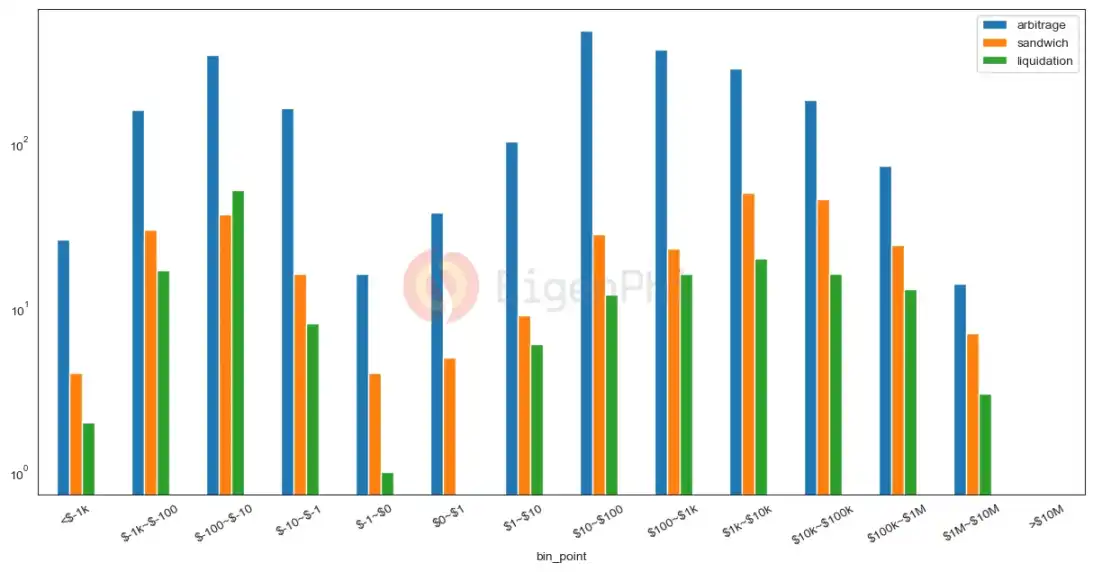
The following figure shows that a large number of robots generate negative profits, 68% of arbitrage robots generate positive profits, sandwich robots are at 67%, and liquidation robots are at 51%.
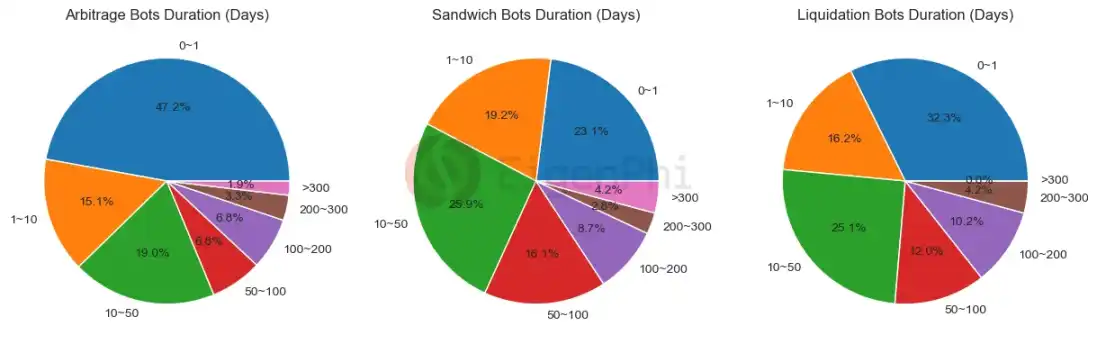
As for the lifecycle of MEV robots, a large portion of them are disposable robots, with a smaller proportion being long-term robots. Users can use disposable robots for testing, and once a viable strategy is determined, the robot will be transferred to a new address for long-term execution of that strategy. On average, the lifecycle of arbitrage robots is often shorter than that of sandwich and liquidation robots.
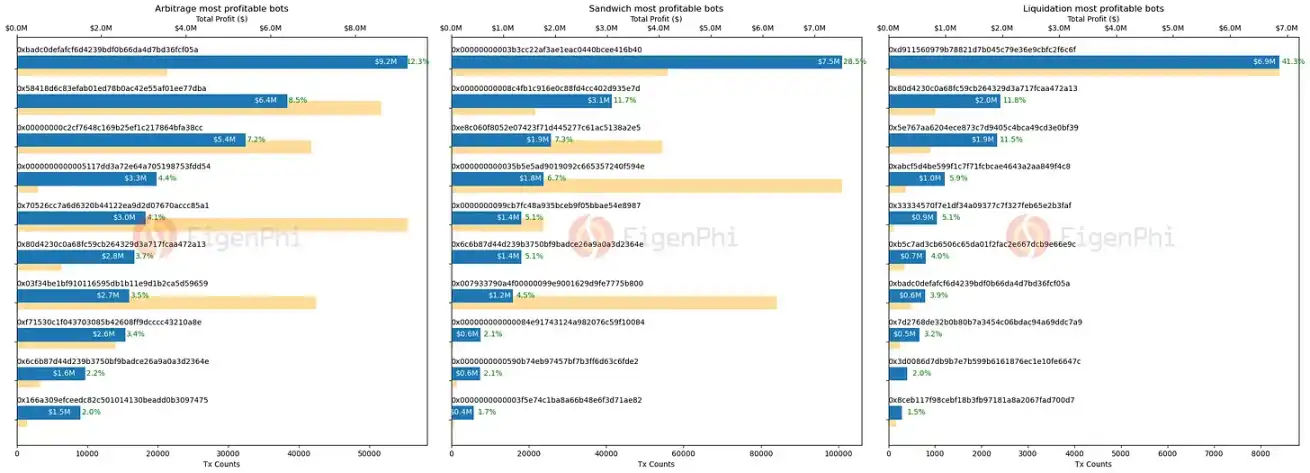
In addition, this article also ranks the top 10 most profitable robots according to their MEV robot profits and the percentage of their profits compared to the total profits of all robots. The data shows that the top 10 arbitrage robot profits account for about 51.3% of the total, the top 10 sandwich robot profits account for 74.8%, and the top 10 liquidation robot profits account for as much as 90.2%.
The competition among clearing robots is fierce, with the top two robots accounting for over 53% of profits and occupying a dominant position. Other clearing robots must find ways to surpass these top robots' strategies to gain market share. Interestingly, the most profitable arbitrage robot, 0xbad, executes fewer trades because it created the most profitable single arbitrage trade, generating over $3 million in profits through an atomic transaction during the August Nomad cross-chain bridge vulnerability period. This indicates that strategy is crucial for MEV.
(四)The Merge 前后的 MEV
Translation:
(4) The MEV before and after The Merge
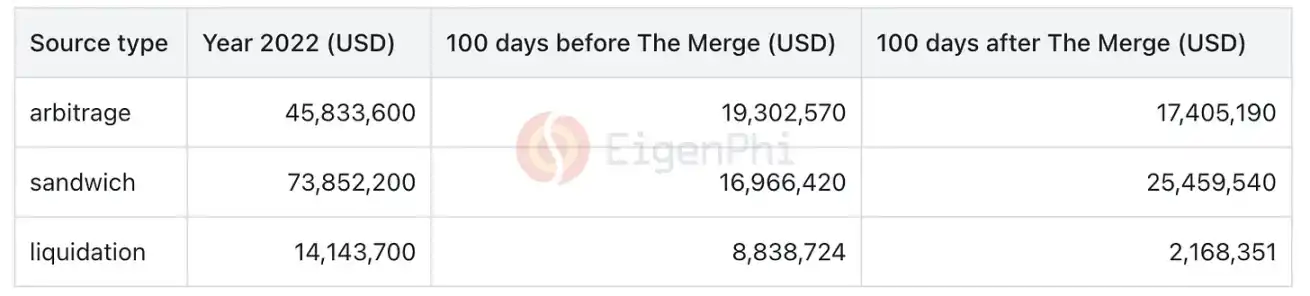
In 2022, a total of 133.8 million US dollars of MEV value will be allocated to miners or block builders responsible for collecting transactions and building blocks, with MEV values for arbitrage transactions, sandwich attacks, and liquidation transaction payments being 45.8 million US dollars, 73.9 million US dollars, and 14.1 million US dollars, respectively. Among them, sandwich attacks contribute more than half of the MEV to miners or block builders and are their main source of incentives. After the Ethereum merge, the percentage of MEV contribution from sandwich trades is also increasing.
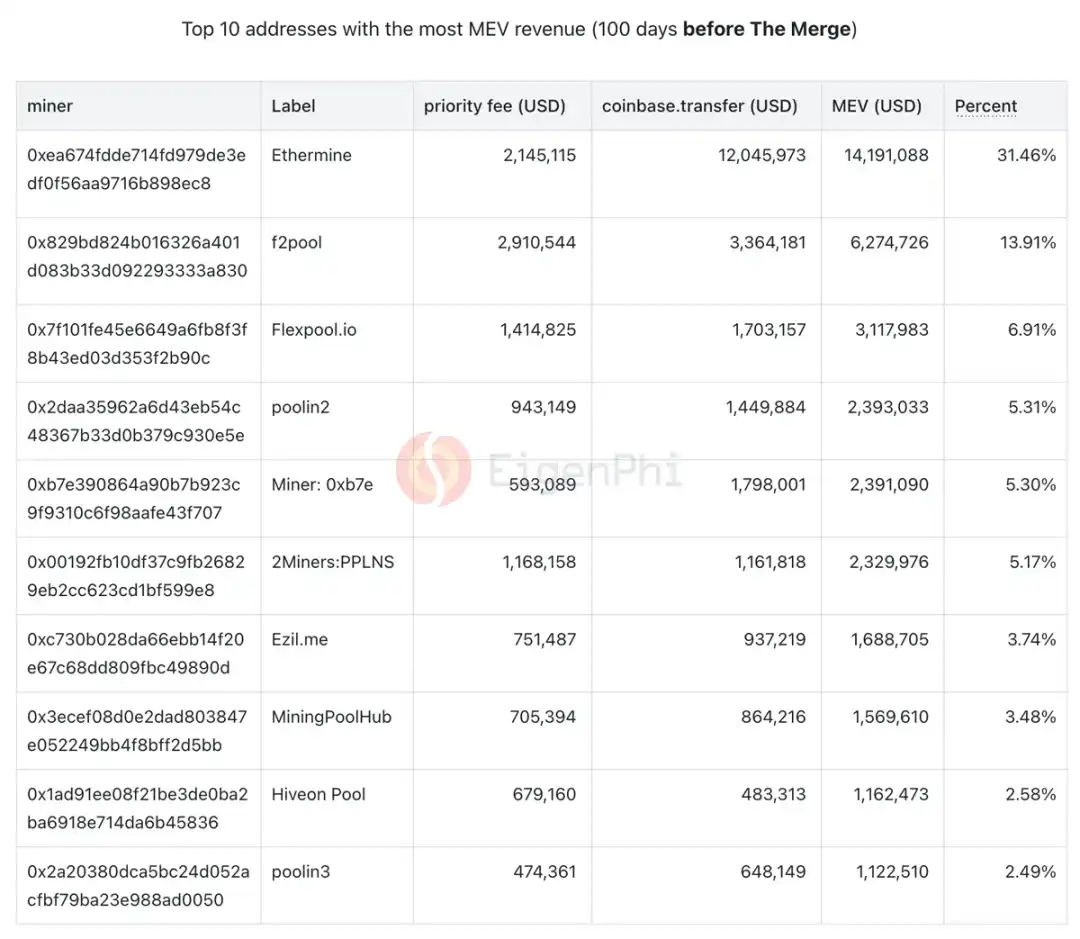
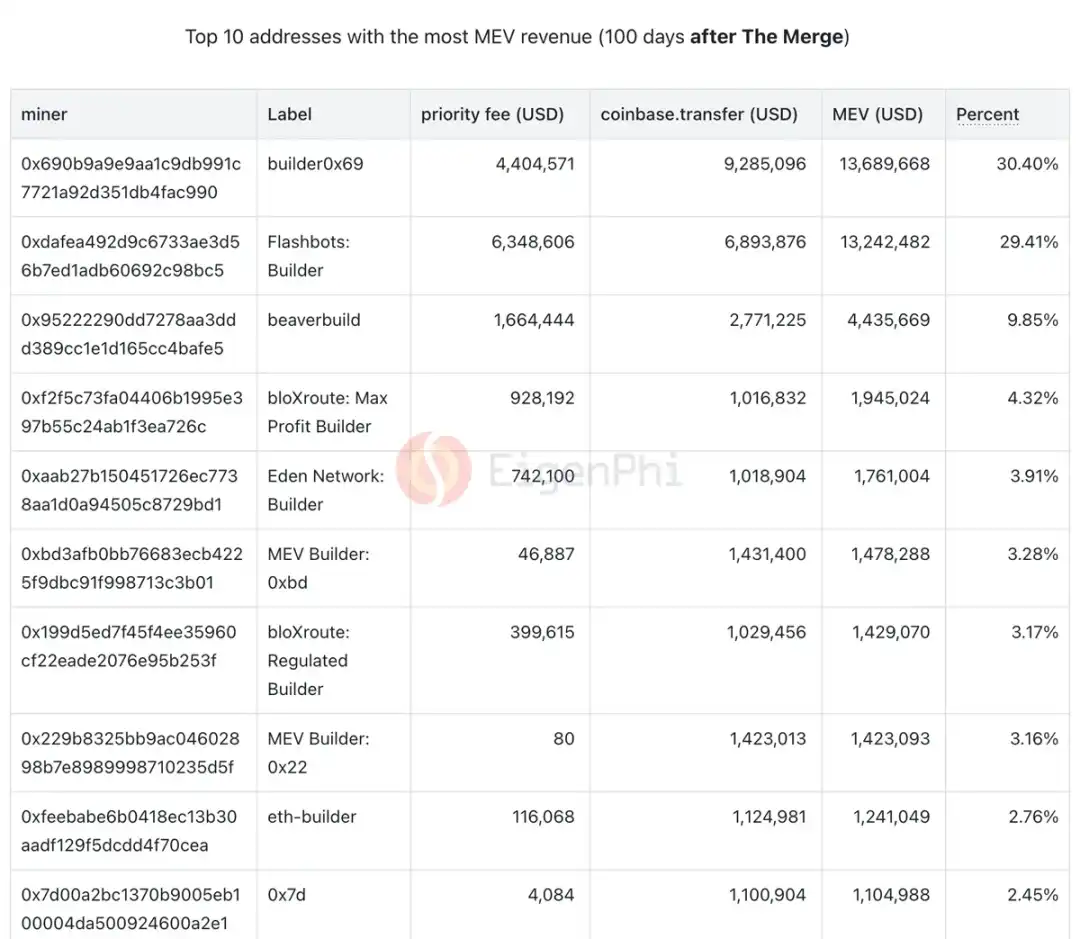
Before the Ethereum merger, Ethermine and F2Pool accounted for 31.46% and 13.91% of MEV revenue in the first 100 days. After the merger, the top two block builder addresses extracted more than half of the MEV, accounting for 30.4% and 29.41% respectively. Although changes in the off-chain auction market for block space affect the distribution of MEV, the oligopoly pattern has not changed.
(Five) Volume Calibration of MEV-related Transactions
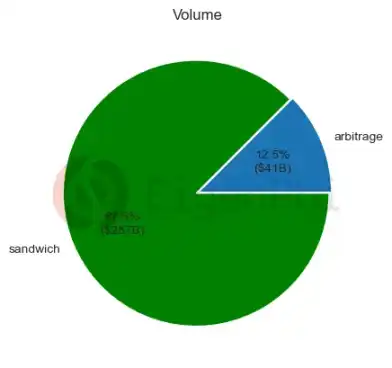
In 2022, the total MEV trading volume involving Sandwich robots was 287 billion US dollars, accounting for 87.5%, which is significantly higher than the arbitrage trading volume. Similarly, in the total monthly MEV trading volume, Sandwich trading volume has always been dominant. Perhaps due to the collapse of FTX, which caused a large number of users to flock to DEX to exchange assets, Sandwich trading growth was particularly evident in November.
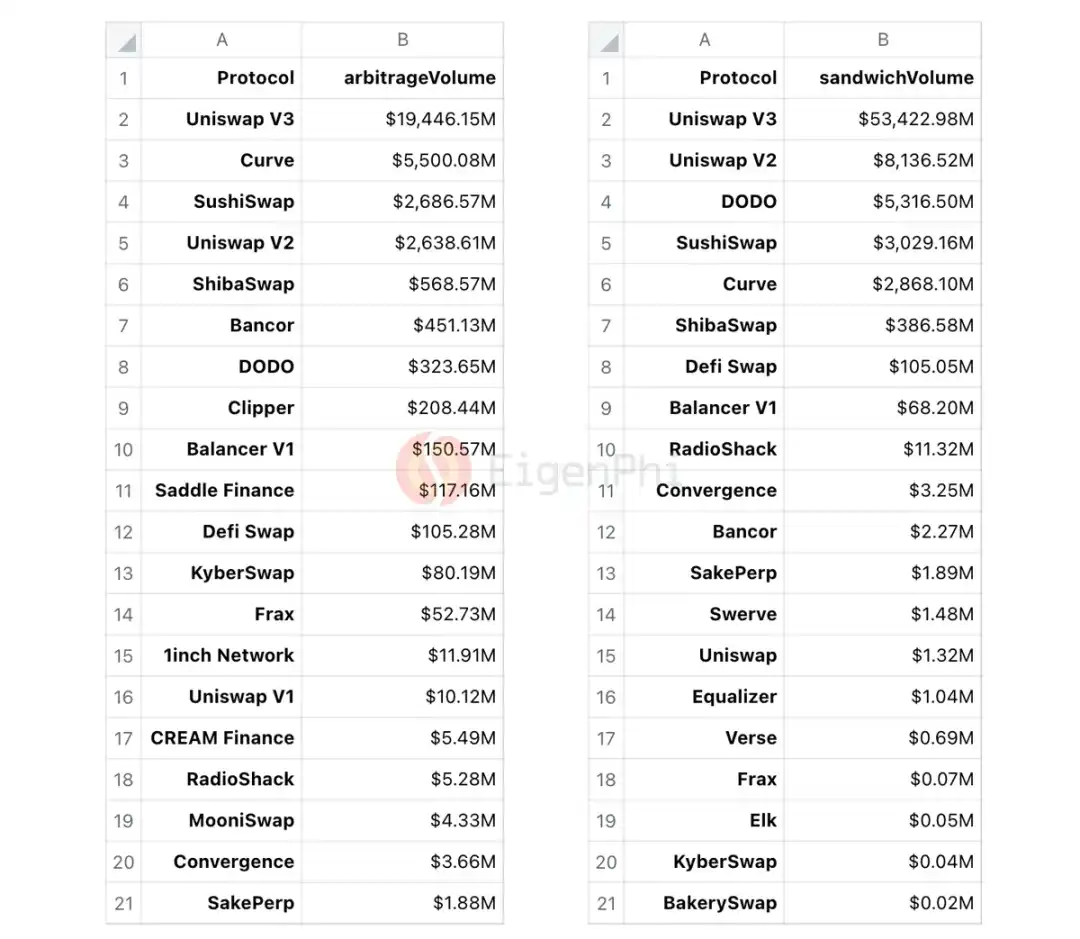
Uniswap V3 is the most popular protocol for arbitrage bots and sandwich bots, with a total trading volume of $72.8 billion. Compared to arbitrage trading volume, Uniswap V3's sandwich trading volume is an order of magnitude higher. For protocols such as DODO and Uniswap V3, sandwich trading volume accounts for almost half of the total trading volume, which is worth considering for users.
(Six) Comparison of MEV markets on Ethereum and BNB Chain
As for different blockchain platforms, the MEV opportunities on BNB Chain are much more cost-effective than on Ethereum, because the average cost revenue ratio (CRR) of arbitrage robots on BNB Chain is significantly lower than that of Ethereum. In 2022, the total revenue generated by arbitrage seekers on BNB Chain is $95 million, lower than Ethereum's $145 million arbitrage revenue, but the total profit generated by BNB Chain seekers is $90 million, higher than Ethereum's $75 million.
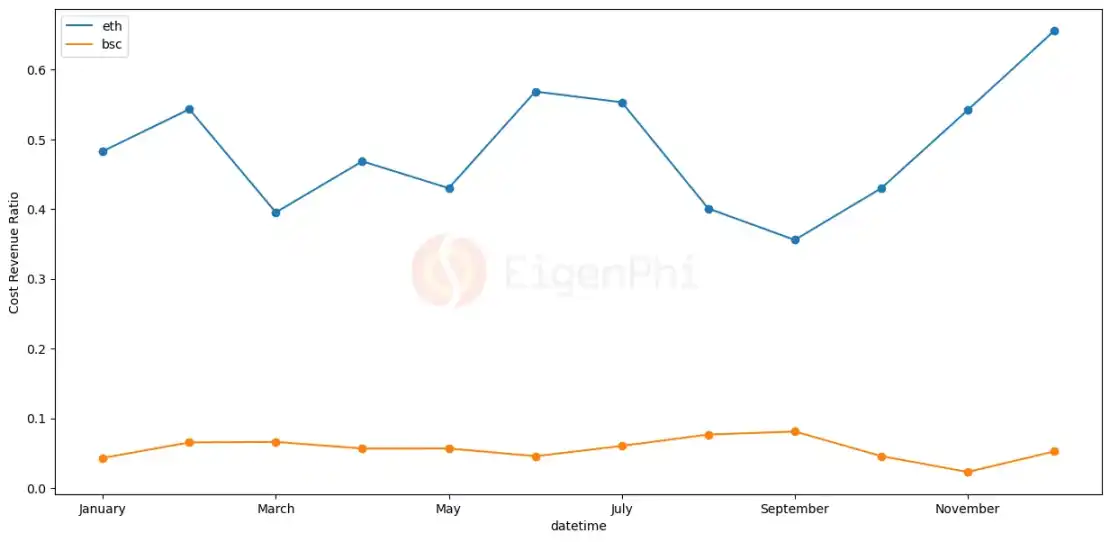
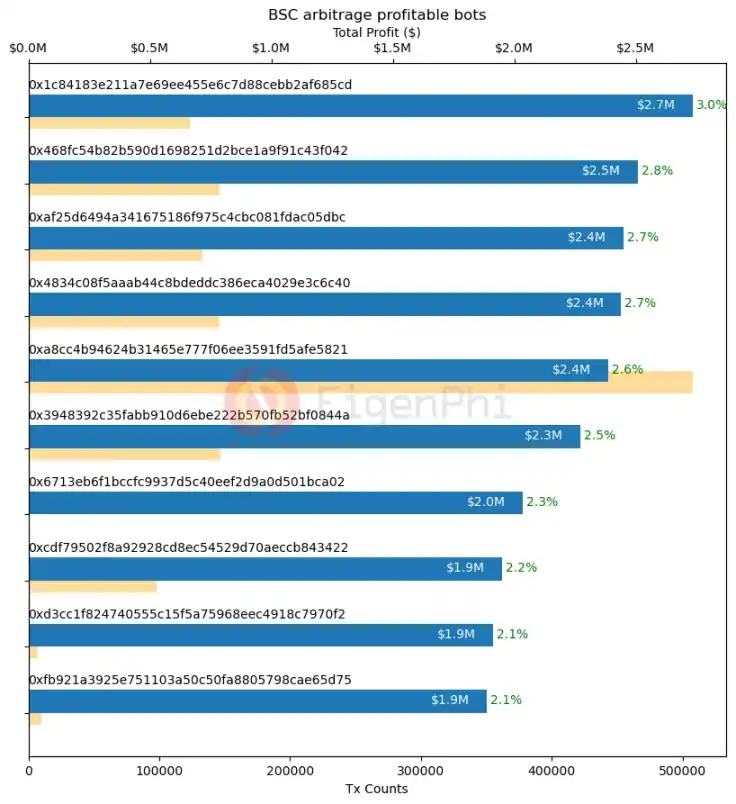
Compared to Ethereum, the competition faced by arbitrage robots on BNB Chain is not as fierce. The top 10 arbitrage robots on BNB Chain generate 25% of the profits, which is lower than Ethereum's 51.3%. Therefore, the opportunities for arbitrage robots on BNB Chain are more fair than those on Ethereum. Newcomers are more likely to find a friendly environment to explore BNB Chain.
Three, MEV Market Status and Outlook
Based on the above data analysis, this section will reveal the current main trends and future new opportunities of MEV.
(一) Current Situation: MEV Infrastructure
The most critical infrastructure in the MEV market is the auction market, which ensures that MEV robots' transactions are packaged on the blockchain. In order to achieve a fairer MEV market (at least this is Flashbots' vision), this auction market has been subdivided from the initial dark forest (Mempool) to the off-chain professional auction market provided by Flashbots' MEV-geth and other relayers.
After the merger, the Ethereum Foundation began implementing the pre-PBS plan. In the PBS plan, block builders such as Flashbots and builder0x69 bid for the right to build the next block, while validators propose the highest-priced block. This method effectively divides the process of packaging MEV transactions into two auction markets, one open to MEV robots by block builders to bid for block space, and the other open to validators to bid for the right to build the next block for builders. Block builders and validators can also route through third-party relays (such as MEV-boost) to achieve data privacy and maintain fairness. The level of competition between the two auction markets will affect the income distribution of MEV robots.
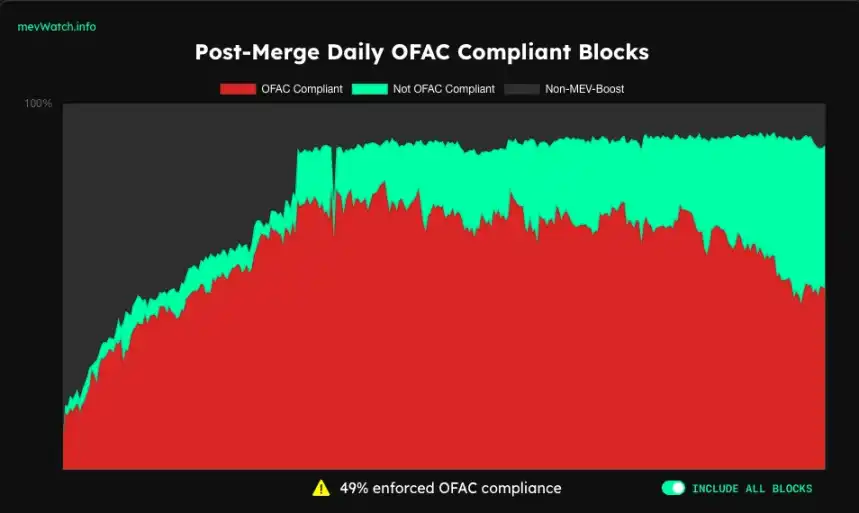
The confrontation between centralization and decentralization. As shown in the chart of mevwath.info, compliant blocks with OFAC (Office of Foreign Assets Control) regulations are in fierce confrontation with non-compliant blocks.
Financial engineering infrastructure is often overlooked by the market. The trend of MEV robots providing higher-end and professional financial engineering services for the DeFi ecosystem in the future relies on data services and financial derivative tools to enhance their performance.
闪电贷是一个受到 MEV 机器人欢迎的典型金融工具。
Translation:Flash loans are a typical financial tool that is popular among MEV robots.
(II) Discussion: Outlook for New Opportunities in 2023
In 2022, there are increasing opportunities for MEV robots to extract value from DeFi protocols, which is a strong trend. Arbitrage trading remains the dominant type in the MEV market, accounting for the majority of revenue and profits. Additionally, arbitrage robots are the most frequent traders in most months, and the proportion of income paid to rent seekers is smaller compared to sandwich robots. Comparing the total number of independent robot addresses also shows that the types of arbitrage robots are more diverse, indicating that there may be other barriers for sandwich robots and liquidation robots.
A new type of MEV robot called JIT has been on the rise in trading opportunities over the past few months. As the JIT robot provides a large amount of centralized liquidity, it seems that more and more independent exchange users are benefiting from JIT activity. Slippage data from actual exchange transactions and simulations also confirms this. Compared to other types of active liquidity management strategies, the JIT robot is trying to provide liquidity in an innovative and more capital-efficient way. It is worth considering that related parties such as AMM protocol designers are directly providing similar functions, which can connect exchange users and liquidity providers in a new way, improve user experience, and increase liquidity providers' income.
除了这些主流 MEV 机器人,另一个链下 MEV 市场在一些 DEX 和聚合器中开放。用户的交易订单以暗池订单或限价订单的形式被直接传输到这些协议创建的路由器。搜索者可以在一套拍卖规则下将这些隐形订单接入到内存池,并通过提供优化的结算服务来提取价值。订单流支付(Payment for Order Flow)业务似乎是开发者们正在努力的一个大趋势,包括 Cowswap、1inch Fusion 模式,以及 Flashbots 的 MEV-Share。虽然这种模式在很早被 Robinhood 采用时产生争议,但目前还没有明确的监管政策。
(Note: The content contains industry-specific terms and names that are not translated.)If users are rewarded for providing information, Payment for Order Flow is actually a democratization of MEV. Democratization of MEV is a topic frequently discussed in the community. Another suggestion is to distribute a portion of the validator's MEV income to the Ethereum community through liquidity staking, although this has not yet been implemented given the current rates of liquidity staking platforms such as Lido Finance. The booming MEV market has also attracted developers of DeFi protocols to consider how to use MEV to improve customer experience and protect customer interests.
Four, MEV transactions worth paying attention to in 2022
(I) The Beauty of Arbitrage
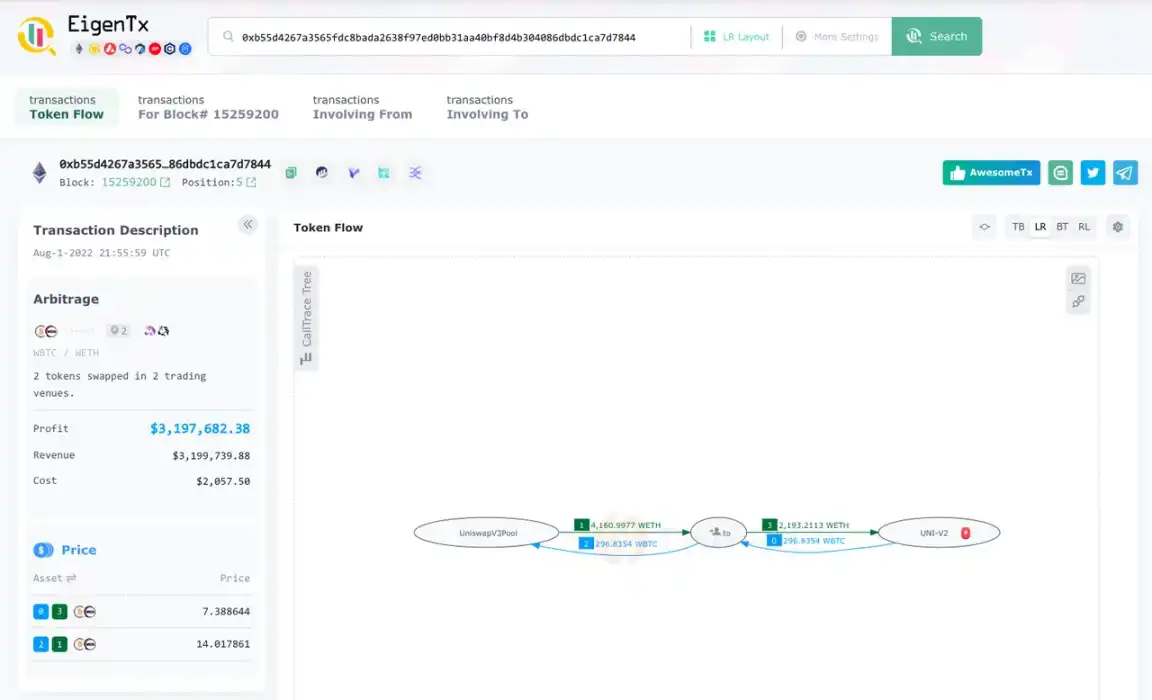
On August 1, 2022, arbitrage robot 0xbaDc made a profit of $3.197 million from a single space arbitrage between two Uniswap WETH/WBTC pools, with a cost of $2,057, by running a large exchange transaction in reverse through the Nomad cross-chain bridge vulnerability.
(二) Diversified Sandwich Trading
The sandwich attack mode is becoming increasingly complex, with a sandwich attack in 2022 that had 56 victims, as well as sandwich attacks when adding/removing liquidity.
56 transaction sandwich attack: On Uniswap V2, there were 56 transactions in a block that swapped WETH for MEME, and the sandwich bot attacked them together. This indicates that the sandwich bot does not necessarily only attack one transaction, and splitting a large order into multiple small orders does not guarantee that the trader can escape being attacked.
The sandwich attack of adding/removing liquidity: The sandwich robot attack may not necessarily be on the exchange transactions on DEX, but adding and removing liquidity may also be attacked. In previous research, the sandwich attack on adding liquidity can be regarded as a risk-free arbitrage against the slippage change before and after adding liquidity to the pool. The attacked liquidity providers and other liquidity providers may bear losses. Similarly, removing liquidity may also be attacked, and liquidity providers may also bear similar losses. Therefore, liquidity providers should set checkpoints carefully and be aware that sandwich attacks will profit from their losses.
(Three) The dilemma of leveraged sandwiches
In some skilled sandwiches, Flash Loans provide the necessary funds for leverage, and traders only need to invest a small amount of capital in front-running transactions to push up the victim's transaction price and extend potential profits. However, the downside of doing so is that the risk of sandwich bots will also increase. In particular, if the front-running transaction is packaged successfully, but the corresponding back-run transaction fails, the sandwich bot will lose money. Sandwich bots using this strategy may need to pay higher MEV costs to prioritize transactions.
(Four) Long-tail MEV Transactions
MEV types may not be limited to arbitrage, liquidation, sandwich or JIT, and the 2022 multiple attacks can also be classified as long-tail MEV.
In the Abracadabra arbitrage incident, the attacker exploited the protocol's price caching design and used the protocol's price oracle update mechanism to complete the arbitrage. In the Mongo Squeeze and CRV short-queeze incidents, the attacker manipulated market liquidity and created bad debts on the corresponding lending pools. In the Ankr attack incident, the attacker used the stolen Ankr deployer's private key to attack the token issuance mechanism and successfully gained profits.
At the same time, the large amount of capital flow that comes with trading often provides opportunities for traditional MEV robots, and large exchanges within AMMs can also bring important arbitrage opportunities. As mentioned earlier, months involving major risk events often come with higher overall arbitrage profits. In addition, the huge price changes associated with the liquidity manipulation of CRV shorts provide more opportunities for liquidation robots. For example, during the CRV short squeeze event, a liquidation robot implemented a profitable liquidation strategy during a period of drastic CRV price changes, earning over $1 million in revenue.
Five, MEV Robots and DeFi Ecosystem.
Since the concept of MEV became popular, most people's first impression of it has been negative. MEV incentivizes miners to seek rent for the demand of packaged transactions to obtain a large amount of income, and the PGA competition between MEV robots has raised the average transaction fee level of Ethereum. More importantly, MEV may also threaten the security and decentralization of the blockchain protocol itself. MEV robots can extract value by monitoring pending transactions and front-running transactions or sandwich attacks, which is a negative externality that many protocol developers are trying to mitigate.
But the fact that people must face is that due to the nature of blockchain protocols in achieving openness and transparency, MEV is fundamental. From the perspective of DeFi protocols, MEV robots can also provide various values. The most common arbitrage robots detect price differences between DEX or CEX and profit from buying low and selling high. Their calculation of liquidity pool price deviations improves the efficiency of market price discovery. Liquidation robots monitor the health ratio of collateral loans and initiate liquidation when the value of collateral drops, which helps the deleveraging process, especially during market fluctuations.
In the future, just like the JIT robots and statistical arbitrage market makers that have appeared in this market, there will be more different robots that are proficient in calculation, profit from data analysis and financial engineering, and are an important part of the DeFi system's smooth implementation of automated operation.
On the other hand, the interaction between MEV robots and other participants in DeFi protocols has become more complex and important. As revealed by the alternative sandwich robot and JIT robot, the victims of the sandwich robot are not necessarily just exchange users, but also liquidity providers. Due to the existence of the sandwich robot, exchange users may not necessarily bear more slippage losses, but may benefit from the slippage discount brought by the JIT robot.
In 2022, EigenPhi conducted an in-depth analysis of the impact of MEV on two major DEX protocols, Uniswap V3 and Curve. On Uniswap V3, the revenue scale of mainstream MEV robots accounts for 25% of liquidity provider revenue. On Curve, MEV trading volume accounts for 20% of total trading volume on most days.
According to EigenPhi's analysis, in 2022, arbitrage and sandwich robots will contribute a total of 328 billion US dollars in trading volume to DEX, accounting for 49% of the total trading volume generated on DEX that year, which is approximately 666 billion US dollars.
In summary, we can see that MEV robots have become an indispensable part of the DeFi community. Understanding the transaction relationship between MEV robots and other entities can help stakeholders better understand the long-term impact of MEV on AMM.
Original article link
Welcome to join the official BlockBeats community:
Telegram Subscription Group: https://t.me/theblockbeats
Telegram Discussion Group: https://t.me/BlockBeats_App
Official Twitter Account: https://twitter.com/BlockBeatsAsia

 Related Articles