MEV-Burn: ETH's next major upgrade, further reducing token emissions
Original title: "Why the Devs Want to Burn More ETH"
Original source: Bankless
Original compilation: Shenchao TechFlow
When EIP-1559 is implemented on Ethereum in August 2021, it will mark the beginning of the network burning ETH. The upgrade redirects and burns some of the fees users previously paid to block validators (called the base fee).
To date, post-EIP-1559, over 3.2 million ETH out of the current circulating supply of 120 million have been burned. Ethereum bulls love this move because it makes ETH more scarce and thus more valuable.
But, can we burn more ETH? The next major "ETH burning" upgrade on the Ethereum roadmap is "MEV-Burn", which Ethereum researchers Justin Drake and Dom mentioned in the Bankless podcast as a "logical continuation" of EIP-1559.
A quick introduction to MEV
Ethereum's original protocol design was naive. It assumes that users only need to send transactions to neutral block validators to build blocks, but in reality, rent-seeking opportunities in block building lead to a exploitable market. This phenomenon is known as MEV, or "Maximum Extractable Value". Fast forward to now, and a total of 566,000 ETH has been withdrawn from regular Ethereum users via MEV.
MEV has some problems.
First, MEV is the monetary value extracted from ordinary users. Second, MEV distorts the incentive mechanism for block validators to act neutrally, leading to blockchain instability. MEV bots conduct competitive attacks such as front-running, DDOS attacks, and chain reorganizations, all in an effort to earn large MEV bounties. Alternatively, ETH stakers on the beacon chain may choose to slash their collateral if the MEV bounty is more profitable than it is. While this doesn't happen often, when it does, it's bad for Ethereum.
Faster execution of transactions brings highly profitable opportunities, arbitrageurs and speculators are willing to pay huge Gas fees, and the resulting "competition cost", which is exactly the goal of MEV-Burn.
What is MEV-Burn?
MEV-Burn is just one part of the Ethereum roadmap that directly addresses the MEV problem. The solution returns MEV to ETH holders by burning the value currently being extracted by MEV participants. This amounts to an indirect redistribution of value to ETH holders, making the asset more scarce and reducing selling pressure on block validators.
MEV-Burn's secondary goal is to reduce chain instability by equalizing block builders' MEV profits. This is also known as "MEV-smoothing". Ethereum developers want the quest for MEV profits to be predictable and steady, not as is the case today.
Here's where it gets tricky - in order to know how much MEV can be destroyed, the Ethereum protocol first has to find a way to quantify MEV, based on block proposals The amount that the creator (also known as the builder) pays "neutrally" in an assumed efficient market. We don’t know these numbers today because the block building market that currently exists is an opaque off-chain market.
This is why MEV-Burn needs to complete another major Ethereum network upgrade first, called proposer-builder separation (PBS). PBS splits the traditional validator role into two separate roles: proposers and block builders. The goal of PBS is to prevent block builders from being able to simultaneously select and order transactions to be included in the block. This division of labor takes away the ability of block builders to discriminate transactions, which is the essence of MEV.
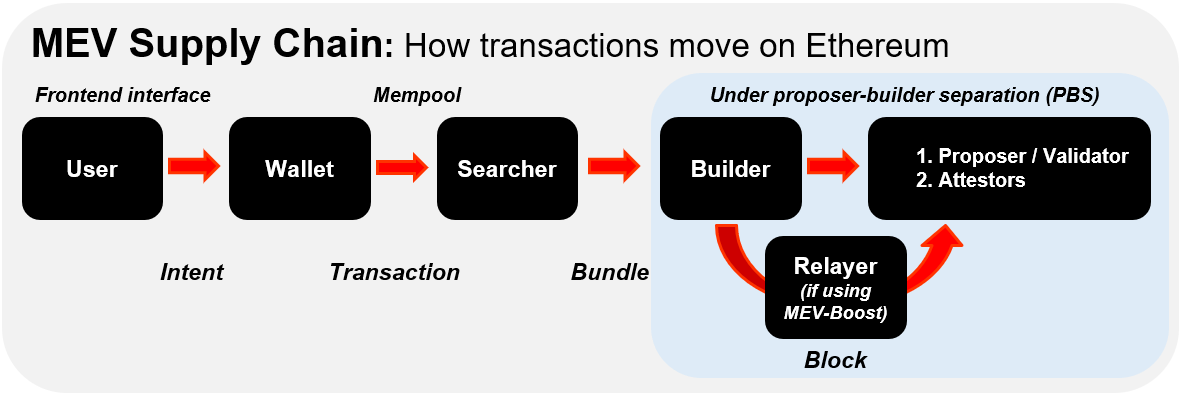
After completing PBS, block proposers will no longer be able to determine which transactions are more valuable. Proposers have no choice but to submit “neutral” fee bids for block builders for the blocks they assemble. This marketplace process will exist entirely on-chain, rather than the off-chain marketplace powered by Flashbot's third-party MEV-Boost software today.
Only after all of this has happened will the road to MEV-Burn begin. With full knowledge of neutral block proposer bids on the beacon chain, the Ethereum protocol can enforce MEV-Burn.
Benefits of MEV-Burn
Currently, Ethereum issues 686K ETH every year as a token for ETH Rewards for validators. Note that this issuance is complicated by the fact that validators earn MEV profits, which in turn increases issuance. MEV-Burn is expected to further reduce the amount of 400K-500K ETH emitted each year.
Steady MEV profits also mean getting block validators to redirect capital to staking, especially as issuance rewards increase in a bull market. This expands ETH’s economic bandwidth and preserves capital for dapp collateral such as decentralized stablecoin collateral, lending, other forms of collateral, etc.
As with many Ethereum proposals, MEV-Burn will not be ready anytime soon, but is looking at a 3-5 year timeframe. But if the reward for waiting is finally getting out of the dark forest of MEV, then the wait will be worth it.
Original linka>
Welcome to join the official BlockBeats community:
Telegram Subscription Group: https://t.me/theblockbeats
Telegram Discussion Group: https://t.me/BlockBeats_App
Official Twitter Account: https://twitter.com/BlockBeatsAsia
 Related Articles