An in-depth analysis of the current and future state of MEV: market size, value chain, and industry landscape.
Original Title: "OP Crypto Research Report: MEV Status and Future Prospects"
Original Source: OP Crypto
Foreword
Recently, Ethereum infrastructure Flashbots (MEV-Boost) completed a financing round of approximately $60 million with a valuation of $1 billion. This round of financing was jointly completed by VC, Layer 2, Angel Investors, DEX, and MEV supply chain participants.
MEV is the entire process that runs through the blockchain, and as a market derived from important infrastructure of public chains, the OP Crypto team has paid attention to many projects in the MEV direction. This article will provide a detailed introduction to the development of the MEV industry and potential opportunities from our perspective.
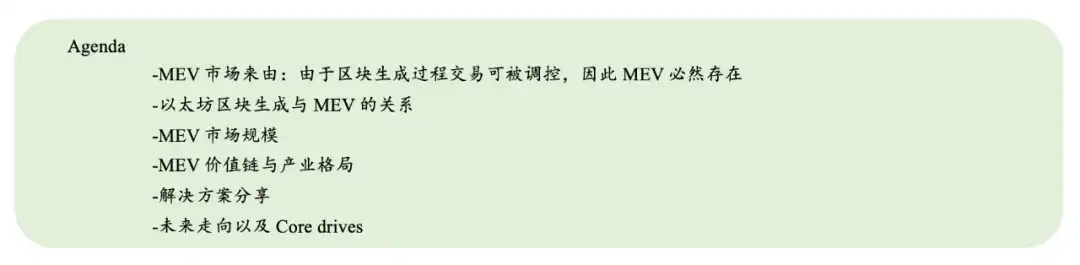
MEV Market: Where Does It Come From?
MEV has different value expressions in front of different stakeholders, but generally it is understood as Maximum Extractable Value, which measures the profit that validators can obtain when adding blocks to the chain by adding, deleting, and changing the transaction order in the block. We can conclude that MEV must exist because the transaction in the block generation process can be manipulated. In the following text, we will discuss the relationship between them in detail.
As a result, MEV has spawned various forms of profit-making methods, mainly including arbitrage, sandwich attacks, and liquidation. According to Eigenphi's data on the frequency of MEV transactions in 2022, we can see that the frequency of arbitrage trading is the highest, averaging about 68%, while sandwich attacks average about 30.6%.
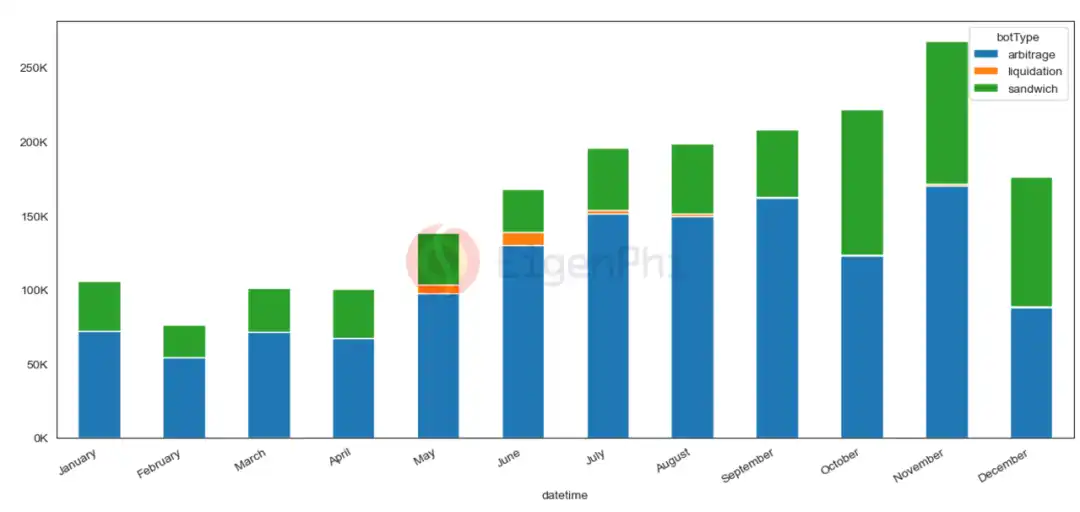
Three mechanisms of MEV:
Arbitrage: Earning arbitrage profits by narrowing the price difference between markets.
Sandwich Attack: Buy and sell ahead of the transaction intent by identifying it.
Clearing: Obtaining clearing returns by utilizing the difference between debt and collateral values during market volatility.
It is not difficult to find that both arbitrage and settlement are MEV forms that can achieve on-chain market balance, while sandwich attacks belong to unfair trading behaviors that artificially steal user transaction fruits.
MEV has its pros and cons. For example, arbitrage can improve the efficiency of DeFi, and relying on Searcher can quickly balance the price difference. However, sandwich attacks can affect user experience, causing high slippage. Moreover, since attackers can increase gas fees to gain priority transaction rights, it leads to network congestion and poor user experience.
Ethereum Block Generation and its Relationship with MEV
In the Ethereum PoW era, the main participants in MEV include Searchers and miners, with miners taking the lion's share of MEV revenue, and a large portion of miners themselves also becoming Searchers. However, since the Merge, due to changes in the block generation process (execution layer and consensus layer) and the diversity of validators (Liquid Staking, etc.), Ethereum's PoS mechanism has changed the original MEV ecosystem. The logic of block generation in Ethereum after the Merge is as follows:

From this, we can still see that the transaction sorting process is not decentralized enough: transaction sequencing seems to be jointly determined by the execution layer and the consensus layer, but the construction and verification of blocks that can be put on the chain are done by the same person, who decides the transaction sequence.
MEV Market Size
Income Perspective
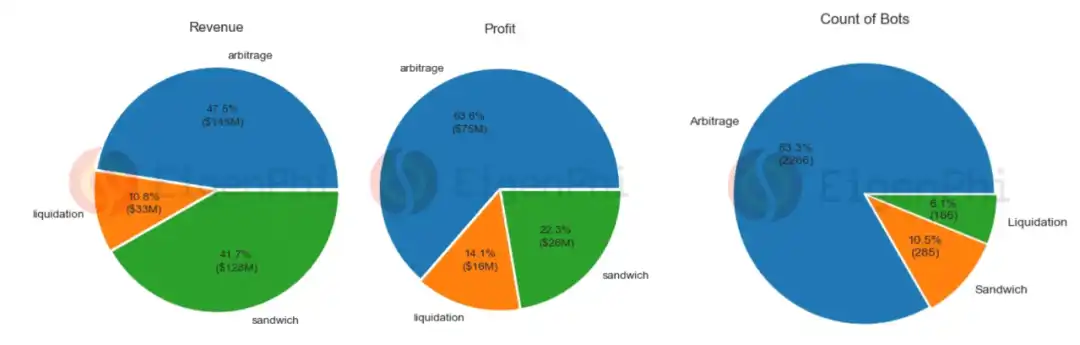
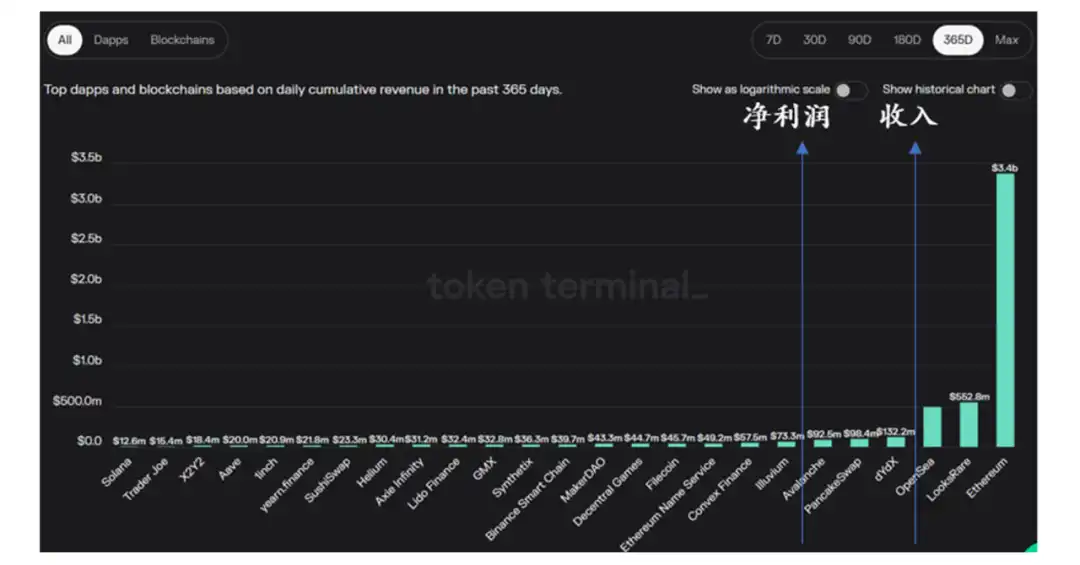
In 2022, 2717 MEV Bots generated approximately $300 million in revenue for the MEV market, with a gross profit margin of 52% from arbitrage. The revenue scale is second only to top projects such as OpenSea and LooksRare.
Using Lido DAO's execution layer APR as an example, MEV revenue accounts for the majority, about one-third of the total stETH revenue. When on-chain transactions are booming, it once accounted for nearly 70% (March 11, 2023).
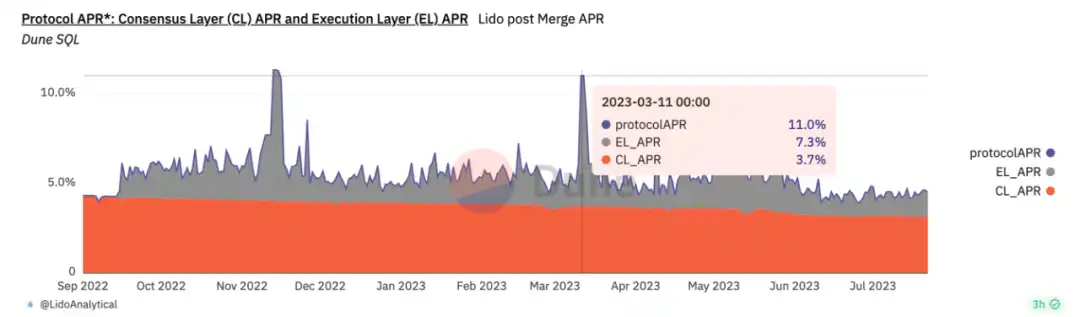
Therefore, we can speculate that when the bull market arrives, MEV revenue will still account for 70% of the total revenue of Stake. During the bull market, the scale of MEV market revenue is comparable to that of LSD market revenue.
Trading Volume Perspective
From the perspective of trading volume, the sandwich attack brought a trading volume of 287 billion US dollars to the market in 2022, which is significantly higher than the arbitrage trading volume of 41 billion US dollars, accounting for 87.5% and comparable to the annual trading volume of top DeFi projects.

From the perspective of on-chain transactions, MEV accounts for a significant portion of the transaction volume contributed by top DeFi projects.

MEV Value Chain and Industry Landscape
Based on the current combination of block generation system on Ethereum, we have outlined the MEV value chain as shown in the following diagram:
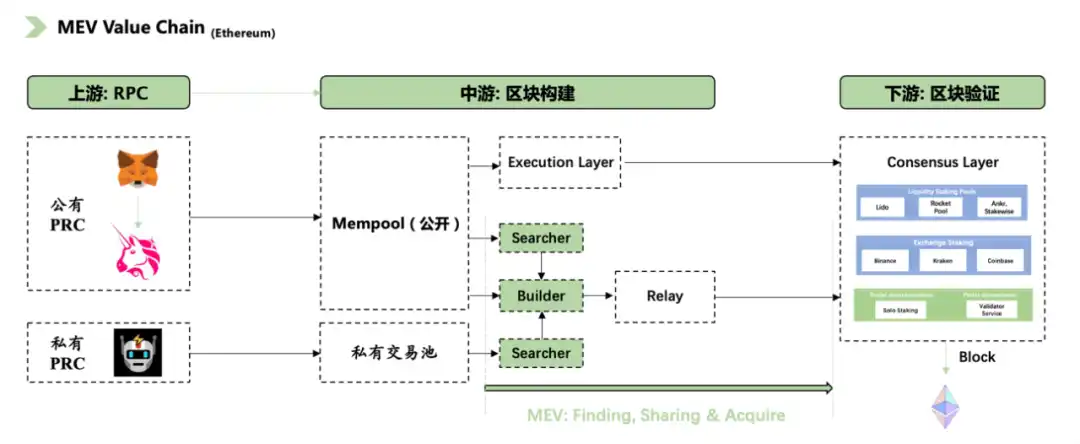
Upstream
Mainly for PRC providers, complete the signature, and then broadcast the transaction from the local to the network.
Midstream
Midstream refers to the process of block construction (transaction sequencing) in a public or private environment, and directly seeking MEV opportunities to determine the distribution of MEV profits. Currently, the mainstream solution is still Flashbots MEV-Boost, which has a slot share of up to 90% on Ethereum. Since its launch less than a year ago, the total MEV revenue obtained from MEV-Boost has reached 250k ETH (currently valued at approximately $469m).
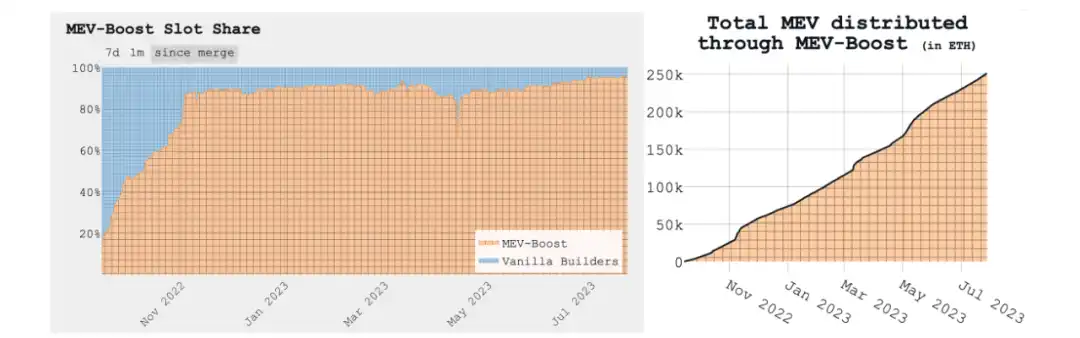
The relay mode theoretically separates the Builder from the Validator, but in fact, this also means that the Validators in the consensus layer do not participate in bundle bidding and are difficult to share in MEV revenue. However, we mentioned in the "market size" section that most of Lido's execution layer revenue comes from MEV, so we can infer that the PBS under Flashbots has not been well implemented.
Expanding to midstream stakeholders, we can see that mining pools, LSD Stakeholders, and others have deeply embedded themselves in the MEV acquisition ecosystem, with MEV revenue accounting for a significant proportion of total revenue. Conversely, as long as MEV opportunities exist, stakeholders will continue to participate in low-cost acquisition methods.
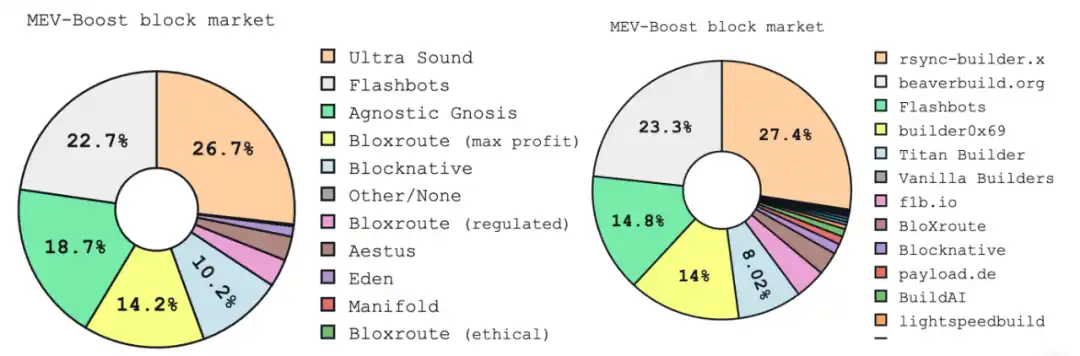
(The left image shows the pattern of Relay participants, and the right image shows the pattern of Builder participants.)
Downstream
Responsible for proposing (validating) new blocks, ensuring that users' transactions and MEV extractions are validated by the network consensus and ultimately earning MEV income. Validators come from CEX, Liquid staking, institutional staking, or individual staking. Of course, with the emergence of new mechanisms in liquidity staking, such as new staking pools based on DVT, downstream patterns may change, which will not be discussed in this article.

Solution Sharing
Flashbots
Flashbots is a research and development company aimed at mitigating the negative externalities caused by MEV (such as on-chain congestion). Flashbots has launched several products, such as Flashbots Auction (with the Flashbots Relay), the Flashbots Protect RPC, MEV-Inspect, MEV-Explore, and MEV-Boost. Here, we will focus on introducing two products: Auction (MEV-GETH) and MEV-Boost.
MEV Auction
MEV Auction is a product of the Ethereum PoW era. At that time, the participants in MEV were Searchers and miners. Flashbots Auction provides a private communication channel between Searchers and miners to negotiate transaction sequencing and pricing in a transparent and fair manner.
MEV Auction specific process is as follows:
Submit Auction: Searcher packages the transaction into Bundles and submits them to Flashbots Auction, while specifying a minimum price for the Bundles.
Miner bidding: Miners bid on bundles of interest in the auction system and specify a minimum price.
Build Blocks: Miners select one or more bundles with the highest bid from the auction system and include them in the block.
Settlement and Execution: The transactions and Bundles contained in the block will be executed in the order and price agreed upon in the auction.
In the original MEV acquisition process, Searchers need to compete for transaction priority through high Gas (if they are not miners), which leads to strong negative externalities. The essence of MEV Auction is the problem of communication and negotiation of transaction ordering. For Searchers, avoiding Gas wars can save the cost of failure, while for miners, they can enjoy MEV income to a great extent without participating in Search MEV.
However, with Ethereum's transition to PoS, Flashbots has introduced MEV-Boost.
MEV-Boost
Its essential logic is to outsource the process of constructing blocks by Validators, package blocks by Builders, and pass them to the Block Producer (also known as Validator on Ethereum) through a relay, ultimately forming a block, which is referred to as PBS in the previous context.
The specific process is as follows:
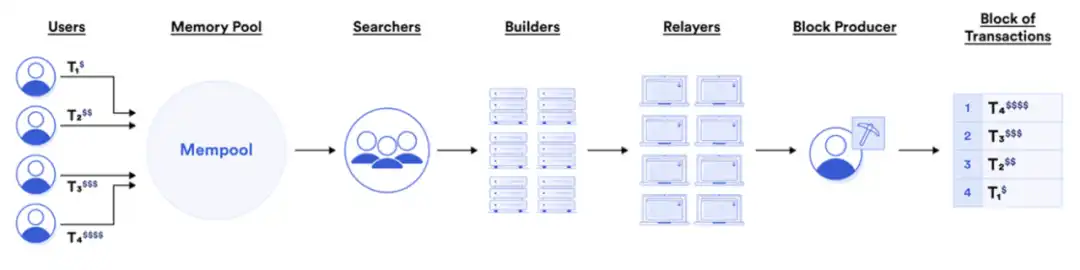
In MEV-Boost, builders also need to commit not to participate in front-running, otherwise they will be slashed. However, it is clear that this is a form of trust.
MEV-Boost essentially brings the same benefits to MEV as MEV Auction, both of which can fairly and effectively achieve transaction sequencing and create markets to freely distribute MEV income between Searchers and Validators. The difference is that Validators can completely outsource block construction work, and the existence of Builders can accelerate block generation and improve blockchain efficiency.
Shutter Network
Shutter Network is an open-source project aimed at preventing front-running on Ethereum by using a distributed key generation (DKG) protocol based on threshold encryption. The protocol hides transaction information through threshold encryption, making it impossible for attackers to determine specific details of the transaction, including whether it is a buy or sell, the tokens being exchanged, or the price.
The specific process is as follows:
The key holders collaborate to generate a public key, and only when N out of N key holders (N is called the threshold) cooperate, can the private key be generated.
A batch of transactions is encrypted by the eon public key (broadcast to users by Keypers).
Chainlink FSS
FSS (Fair Sequencing Services) is a centralized transaction sequencing solution launched by Chainlink, aimed at reducing negative externalities generated by maximum extractable value (MEV) for smart contract systems. The implementation of FSS will not change the original architecture of the blockchain, and the way it works is to sequence transactions from smart contracts. Currently, only two principles are used to sort transactions to ensure fairness: one is based on causal ordering (i.e. threshold encryption), and the other is based on time sequencing.
MEV Where to Go
The emergence of MEV-Boost has lowered the barriers to entry for Searchers and Builders. Searchers have access to powerful transaction identification algorithms and private order flows to create MEV opportunities, while Builders have a certain level of block execution capability. Searchers allocate a portion of the MEV profits to the bidding Batch, and Builders only need to select the most valuable Batch and package the block for submission to the relay to share in the profits. This is a more efficient block generation model, but it is still not decentralized enough.
MEV currently faces several important factual foundations:
As mentioned earlier, the implementation of PBS under the MEV-Boost architecture has not been very successful. Liquidity pools, institutions, or individual participants with block execution capabilities essentially hope to share the MEV cake rather than simply earn staking rewards.
PBS is currently proposed to be updated to the Ethereum architecture, but in the short to medium term, the market still needs to combat MEV, as DeFi projects need to provide users with a better on-chain trading experience to positively optimize their business models.
2. MEV schemes are numerous, but profits are limited.
MEV's significant revenue is collected by Searcher and Builder, and even technical solutions such as Flashbots have not had a good profit effect. Of course, it is precisely because of Flashbots' non-profit nature that it is difficult for later projects to make a profit.
3. Multi-chain MEV mining becomes a trend
The current MEV profit level of Ethereum is not as good as BSC. In order to maximize profits and overall chain efficiency, the single-chain builder and relay model is bound to decline. The new solution SUAVE currently serves as an independent Mempool and Builder for other chains in the form of a new chain.
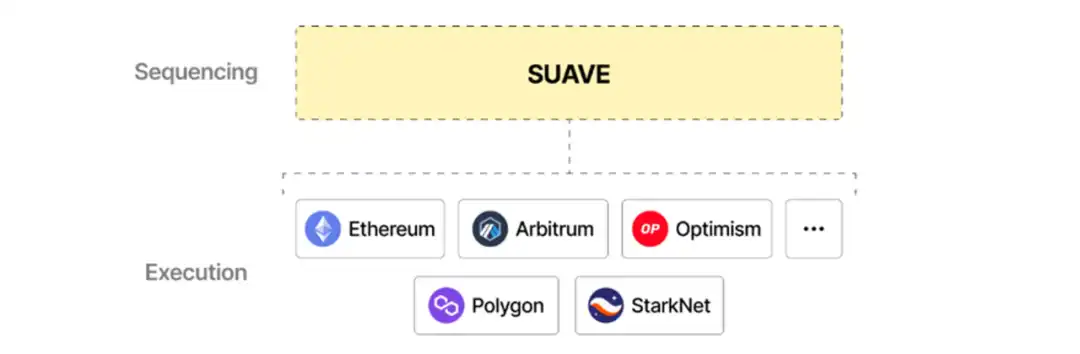
Based on the facts, we believe that the future MEV market will move towards a new pattern of multi-chain MEV acquisition and reduced ceiling revenue. Looking at the segmented track, the competition for Searchers will become more intense, testing their order and algorithm capabilities; Builders will participate in the MEV market at lower costs.
Summary
MEV is a rare strong cash flow, strong transaction-related, high-income but relatively low-risk underlying track in the blockchain industry, and its scale fluctuates with the market. From an investment perspective, the profitability of MEV-related protocol projects has become a new problem because most of the MEV profits are distributed to Searchers and Builders. We have found that there are few investment opportunities for new bidding systems/MEV protocols, and even for Searchers, institutional investment opportunities are very limited.
Original article link
Welcome to join the official BlockBeats community:
Telegram Subscription Group: https://t.me/theblockbeats
Telegram Discussion Group: https://t.me/BlockBeats_App
Official Twitter Account: https://twitter.com/BlockBeatsAsia

 Related Articles