Brief analysis of the development status and trend of MEV
原文标题:《 浅析 MEV 的发展现状及趋势 》
Original article author: 0xCousin, IOBC Capital
1. Definition and background of MEV
MEV (Maximum Extractable Value) refers to the value extracted from users by reordering, inserting, and reviewing transactions within blocks, such as arbitrage, clearing, etc. It can be interpreted as "additional revenue from adjusting the order of Tx when creating a new block".
The concept of MEVs was first proposed by Phil Daian in Flash Boys 2.0. Before the Ethereum merger, MEVs were mostly captured by miners, so they were also known as Miner Extractable Value. Mevs come from the fact that when a user submits a transaction on the blockchain, the transaction typically goes first to Mempool's publicly accessible pool of pending transactions. Arbitrageurs and miners can retrieve Mempools and find opportunities to capture MEVs.
After the Ethereum merger, the roles in the MEV supply chain changed due to the change in the mining mechanism. Before Danksharding was implemented, Flashbots proposed MEV-Boost as a PBS practice outside the protocol. Buider focuses on building blocks and maximising the benefits of each Block as much as possible, and then the most profitable blocks are submitted to Proposer. The realization of PBS mechanism has changed the interests of the block chain industry, promoted the specialization and commercialization of relevant institutions in the industry chain, and formed a new pattern of the MEV supply chain.
2. Supply chain of MEV
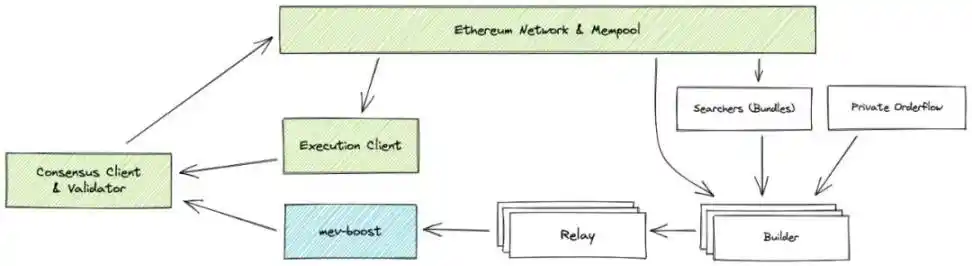
The Tx chaining process based on MEV-Boost is shown as follows (light green is the regular Tx chaining process in the figure, and the white module is the Tx chaining process of MEV) :
Source: Flashbots
Compared with the regular Tx uplink flow, the Tx uplink flow of MEV realizes the out-of-protocol practice of PBS by Flashbots MEV-Boost, and makes MEV be captured by Searcher, Builder and Validator.
Searcher: Generally the following characters (arbitrage and clearing bots, DeFi traders, Ethereum Dapps with advanced use cases) who will find all the extractable value on the chain through different methods and then bundle the trades together to provide to the Builder;
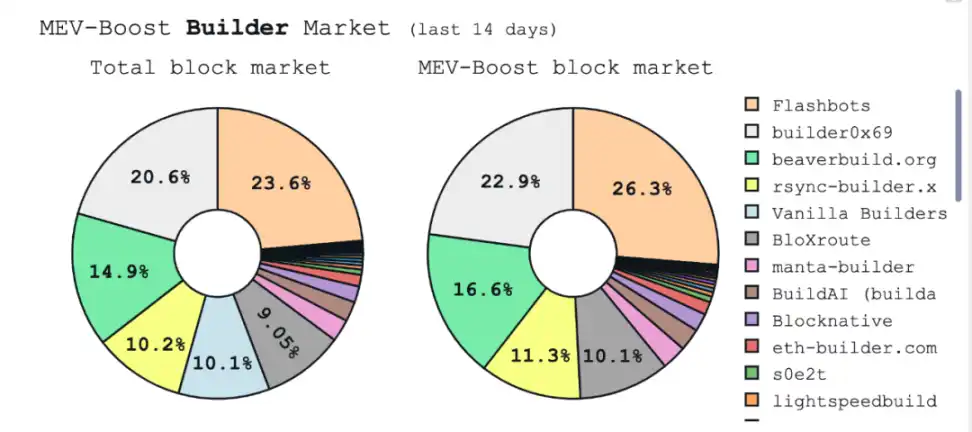
Builder: Builders tend to be professional organizations (36 active Builders in the last 14 days, with the top 6 monopolizing over 88% of the market) who select the most profitable Bundles from Searchers to be packaged into Full Block, It is sent to the Validator through the Relay. Several bundles can be combined to form a Block, which may also contain pending transactions from other users of Mempool;
Data source: MEVBoost.pics
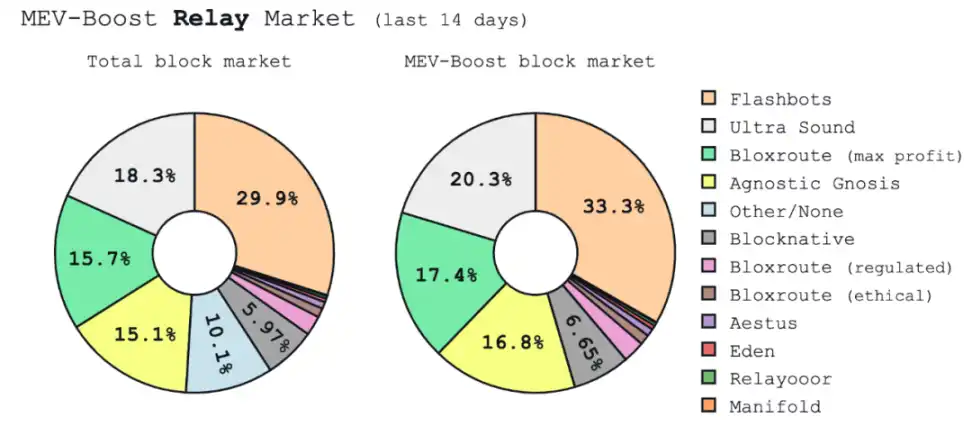
Relay: Relay is responsible for connecting the Builder and the Proposer, verifying the validity of the block submitted by the Builder and the bid, and submitting a valid maximum bid to the Proposer. Currently, it is an oligarchic regime with only 11 active relays, but relays do not participate in the sharing of MEV profits and belong to a neutral infrastructure.
Data source: MEVBoost.pics
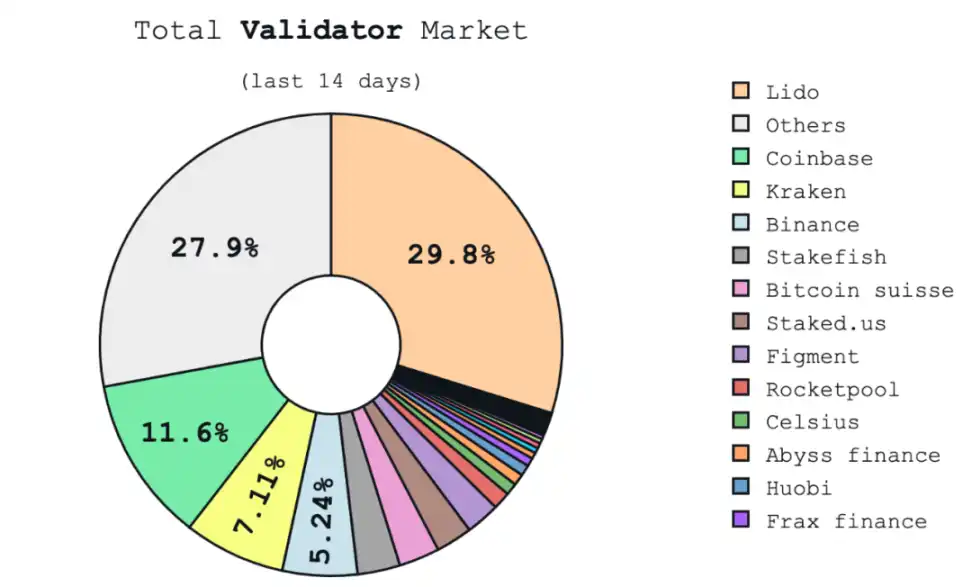
Validator: Validators are miners for ETH2.0. Validators (Proposers in Validators) are responsible for proposing blocks to the network and adding them to the chain. At present, the competitive landscape of Validator is gradually stable, and Lido has the first market share. Validators can receive both consensus rewards (block rewards) and execution rewards (MEV+Tips).
Data source: MEVBoost.pics
There are projects going on in all parts of the MEV supply chain. In the Searcher segment, there are arbitrage and clearing bots, DeFi traders, market makers, and projects for these Searchers, such as EigenPhi, a data platform that presents arbitrage cases on the chain; In Builder, there are Flashbots, BloXroute, Blocknative and other specialized organizations; As a neutral infrastructure in the MEV Supply Chain, Relay belongs to the link that needs trust. There are mainly 11 active Relay agents. There are a lot of projects going on at Validator, and the Validator network is relatively robust, and judging from recent funding, there are also new teams that want to start up on the track.
3. Classification of MEV
According to the way MEVs are obtained, they can be divided into the following categories:
Front Running: The act of executing first by paying a higher Gas Fee than the target transaction in Mempool. For example, Mempool contains a Tx of a transaction pair, which will cause large fluctuations in the Token price. Therefore, a Tx can be inserted before this Tx. Or jump start Mint NFT's Tx when a new NFT project goes live. At present, it is easy to prevent being preemptive. You only need to access a Private Transaction Pool similar to Flashboots Auction to obtain Frontrunning Protection.
Back Running: refers to the act of inserting a trade after a trade, which may be arbitrage, liquidation, etc., when a trade causes large price fluctuations. For example, if a large amount of Tx occurs on the chain, leading to the price fluctuation of a trade pair, inserting an amount after it can not only level the price of DEX, but also make profits for the arbitrageurs. Or a clearing order is inserted after the clearing line is triggered by a mortgage loan on the chain;
Sandwith Attack: A sandwich attack is actually a combination of Front Running and Back Running. Searchers search for potential large trades in Mempool, buy assets that will eventually appreciate in value before the trades take place, and sell these assets immediately after the execution of large trades to earn the difference;
Time Bandit Attack: This type of MEV mainly occurs in blockchain networks with the longest chain principle (such as the Bitcoin consensus of Satoshi Nakamoto).
From the results of these MEVs, the general Back Running MEVs are benign to the blockchain network. For example, arbitrageurs realize risk-free arbitrage by taking advantage of the difference between the two DEX + flash loan, and liquidators maintain the healthy operation of the loan agreement. Front Running and Sandwith attacks can be detrimental to other users.
4. Current situation and future of MEV
In fact, MEVs are controversial, because the existence of non-benign MEVs seems immoral. For example, Front Running, Sandwith Attack and Time Bandit Attack will destroy the transaction experience and harm the interests of ordinary users on the blockchain. So, I've been hoping for a long time that the industry will come up with a solution/product/protocol to prevent these non-benign MEVs from happening.
However, due to the open and visible characteristics of trading in Mempool and the bidding rules of Tx chain ordering, MEV is inevitable. The next best thing is to use a product/protocol that feeds back to you if your transaction cannot avoid MEV withdrawals.
There are products in the industry that can mitigate the Negative Externalities that MEVs (especially non-benign MEVs) can bring to stateful blockchains such as Ethereum. For example, Falshbots:
Flashbots Auction: Flashbots Auction provides a private communication channel between Ethereum users and Validators for efficient communication of preferred transaction order within blocks. Through such products, users of on-chain transactions can realize Pre-trade Privacy, Failed trade privacy, Finality protection, etc.
Flashbots Protect RPC: This is an RPC endpoint product that allows users to implement Front-Running Protection, which users can add to their wallets, thus making their transactions submitted to the Flashbots Auction. For users, there is no difference in perception from ordinary transactions, but the results can realize Front Running Protection, Failed trade Privacy and so on.
Mev-boost: In the PoS phase, the Validator can either order transactions from Mempool itself, package them, or select blocks with higher MEV revenue that have been sorted by Builder and pushed by MeV-Boost. With MEV-Boost, validators can make a lot more money, so most validators will choose to plug in MEV-Boost rather than do the ordering themselves.
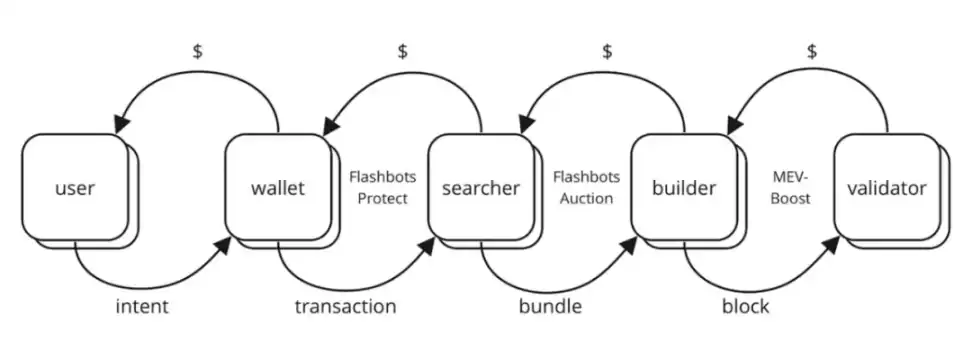
Photo credit: IOSG Ventures Jiawei
From the perspective of MEV Supply Chain, these three products respectively play a role in each link of the MEV Supply Chain.
For the future of the MEV field, combined with the current development of the MEV field, we believe that there may be the following major trends:
1. The head effect can be serious: More than 90% of the past 500 EPOChs are provided by MEV-Boost, and the series of Flashbots products are almost in the leading position in all aspects of block production during the PoS period. In the case of the First Mover of Flashbots, New entrants to the MEV space need some core competencies to capture more market share;
2. He who takes Orderflow takes the world: To have more MEV opportunities, it is important to have plenty of Orderflow. For the average transaction user, there is actually no way to completely eliminate MEVs. Even if the User uses Flashbots Protect RPC, also only prevents searchers in Public Mempool from capturing potential MEVs for their Tx, Buider in Flashbots Auction networks still have the opportunity to extract MEVs for their Tx. So, for the average user, since there is no way to completely circumvent the withdrawal of MEVs, it is better to choose a Wallet, DEX or other Dapps that will feed back the MEV revenue to the Users;
3. There is still room for growth in Multichain MEVs: pure Ethereum MEVs in the chain have probably been fully captured. However, blockchain is a Multichain ecosystem, and it is difficult to capture the MEV opportunities between Layer1 and Layer1, and between Layer1 and Layer2. There may be some room for growth of MEVs in this aspect.
4. The on-chain demand of anti-censorship transactions can always be met: According to data from MEVwatch, 57.49% of the total blocks on Ethereum blockchain after Merge meet OFAC compliance requirements, and only 35 blocks out of 100 recently have implemented OFAC compliance, which has little impact on the on-chain of anti-censorship transactions. Although most of the head pledge platforms after Merge are centralized platforms, these centralized entities are inevitably subject to legal supervision, thus challenging the anti-censorship ability of Ethereum blockchain. But even though more than 90% of validators review relay routing transactions through MEVs, those that resist review are still able to be on the chain within an hour.
Special thanks to IOSG Ventures Jiawei for your sharing and communication.
Original link
Welcome to join the official BlockBeats community:
Telegram Subscription Group: https://t.me/theblockbeats
Telegram Discussion Group: https://t.me/BlockBeats_App
Official Twitter Account: https://twitter.com/BlockBeatsAsia

 Related Articles