Blockchain is bureaucracy par excellence
Original author: Mario pandor-placeholder fund analyst & NBSP;
Original title:《Blockchains are bureaucracies par excellence》
Translator: 0 x33 & have spent & have spent
The promise of blockchain and related technologies is that these areas can be set up by minimizing the need for trust, reducing the centralization of control over data, and enabling free, vett-resistant transactions in an increasingly globalized and automated environment.
The development of blockchain is an important step in the evolution of bureaucracy. This may sound counterintuitive, as the word is often associated with inefficient and excessive paperwork. But once we understand the nature of bureaucracies, it becomes clear that blockchain networks are actually excellent bureaucracies.
What is theBureaucracy?
In both public and private Settings, the term "bureaucracy" refers to an organizational form based on written, objective rules designed to maximize procedural efficiency.
A clear description of the principles of bureaucratic organization comes from the influential German sociologist Max Weber. Among Weber's contributions to social theory, he divided legal authority into three types: charismatic, traditional and legal-rational. Although these three methods can be effectively used to analyze power operation in blockchain network, they are the most typical legal-rational authority in the bureaucracy, which is more suitable for analyzing power operation of blockchain network.
Here are some of the characteristics of the ideal bureaucratic form:
1. Official ACTS based on and bound by written rules and regulations
2. These abstract rules override personal preferences
3. Functional specialization, that is, clear division of roles
4. Perform assigned tasks regularly and continuously
5. Impersonal authority and treatment
6. Open meritocracy, no favoritism
7. Political neutrality
Astute readers may have noticed that I omitted certain principles of hierarchical command chains and recruitment as well as certain principles of behavior and management. These elements represent ways to get there, and technology offers new, promising, and better ways to do so. Currently, these are underdeveloped or less obvious in network governance, although they relate to the open source software development process, which is critical to the life of any network, but require separate analysis -- a task I intend to undertake in future articles.
I've also omitted the legal basis for bureaucracy, which is usually found in the constitution, since the exact legal definition of blockchain networks remains to be determined. Nevertheless, it is only a matter of time before they are recognized and incorporated into traditional and emerging legal structures.
What is the bureaucracy of blockchain governance?
Given that a bureaucracy is defined by protocols, the rules and procedures that govern its operations and manage information processing, the idea that a blockchain is a bureaucracy should not sound far-fetched to anyone.
At the heart of all blockchain systems, we find a highly formalized set of rules -- encryption protocols and consistent algorithms.
With these key elements, network-specific knowledge domains and domain-specific roles can be developed, leading to higher and higher levels of institutionalization -- as we see in most prominent networks. Examples include BIP programs and their equivalents, the establishment of infrastructure networks, regular updates using formal communication channels, the use of networks to create centralized commerce, and the introduction of formal voting and dispute resolution mechanisms...
But if everything is becoming more fixed and formal, why is cyber governance so messy? The reason is that in most cases, only a small part of the system is still transparently formalized. The point is that the political process before changing the rules is often unclear and therefore, of course, unstructured. Of course, there are those who argue that the lack of formal external governance is more of a feature than a bug. But it also stunts development, which in my view is more about hiding power grabs than helping to avoid them.
So what is the bureaucracy of blockchain governance? & have spent
On the chain: it's everything. Under the chain: it's getting more and more.While this does not mean that all out-of-chain governance should or can even be formalized, the gradual increase in written rules and guidelines certainly demonstrates the benefits of process clarity. At the same time, chain politics should properly be seen as the biggest problem and most compelling solution to network governance.
Overview of global
Historically, for example, universal technologies such as fully deployed mechanization or electricity have led to the emergence of organizational standards -- a new normal way of doing things. While the blockchain and decentralization consensus is sometimes described as a revolutionary universal technology, I think it is more appropriate to view them as a continuation of the information and communication technology (ICT) revolution. However, the blockchain may represent a decisive step in the emergence of ICT's native form of socio-economic organisation, which has been digitised, decentralised, globalised and semi-automated since its inception. This is a new normal way of doing things, at least in a unique area of ICT context, such as digital services and collaboration. Clearly, these forms are fundamentally different from traditional organizations that are digitally reinventing themselves.
While the blockchain network promises to become a giant global bureaucracy, with code replacing managers and users having sovereignty over their personal data. But there are a hundred reasons to be skeptical about the potential of blockchain networks to become systemically important economic infrastructure. One of the strongest criticisms is their ability to compete with the vast digital communications networks centrally managed by governments and companies.
But, regardless of which of these parallel developments is common, should we be worried that the users of these networks, or even that they will eventually include everyone on earth? That depends on how people view the basic trade-offs of a society that has been developing for some time.
To buildA Silicon Cage.
Weber sees bureaucratization as part of a broader trend in western culture to rationalize areas of social existence, that is, to replace traditional norms and values with rational calculation and management under legitimate legal authority.
This rationalization process is under way, and globalization and icts can only expand it further. The ideas of big data analysis, automation, smart contracts, and DAOs, among others, reflect a drive that continues to overrationalize all key technological and economic processes. Whenever possible, there is at least one illusion of a complete lack of human judgment and control over how the "system" treats its components.
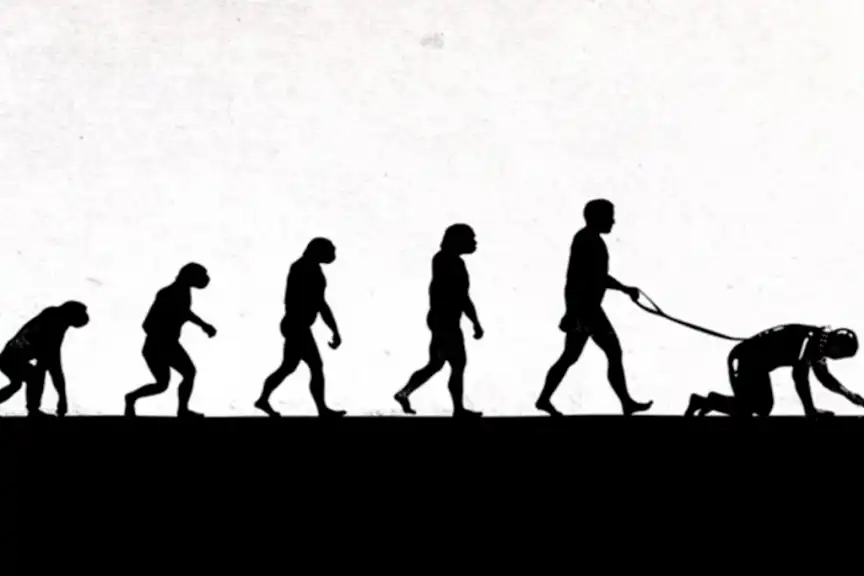
While Weber believes that bureaucracy is the most effective way to organize society, he doesn't think it's totally okay. Real bureaucracies always fall short of the desired level and can develop into overmanagement, where strict adherence to formal rules that are out of touch with actual needs can backfire. Not to mention their potentially numbing effect on human creativity. Weber It warned that these and other negative tendencies of bureaucracy could lead to a "cold, dark polar night" in which individuals are trapped in an "iron cage" of soulless, inhuman rational control.
Today, many bureaucratic functions in government and business are performed not directly by human managers but by human-controlled machines. Soon there will be serious attempts to remove human mediation and subjectivity from the management equation altogether. When this happens, the potential convergence of blockchain and artificial intelligence is challenging.
Of course, the results are still largely illusory -- everything about a decentralized network is still absolutely determined by the arbitrary preferences of specific humans. But the term "faceless bureaucracy" is no longer just a metaphor. Weber's national cage is being transformed into a global silicone cage.
Conclusion and thinking
As with most technologies, the appropriate adjective to describe the effects of bureaucratic decentralization and automation is ambivalent. Letting machines handle everyday and mundane tasks is a good way to solve some of the problems that have historically plagued bureaucracies. But it can also bring new, old or unknown additional problems.
There is, of course, another heavyweight here -- governance. The famous iron law of purnell bureaucracy (Pournelle' S Iron Law of Bureaucracy points out: "in any Bureaucracy, those who are committed to the interests of the Bureaucracy itself can always control everything, while those who are committed to the goals that the Bureaucracy is supposed to achieve have less and less influence, and sometimes are even completely eliminated."
Time will tell how far this will go in blockchain-based networks.
Welcome to join the official BlockBeats community:
Telegram Subscription Group: https://t.me/theblockbeats
Telegram Discussion Group: https://t.me/BlockBeats_App
Official Twitter Account: https://twitter.com/BlockBeatsAsia
 Related Articles