China's Great AI Migration

The original title: "China's Great AI Migration"
The original author: Sleepy
In industrial history, there is a pattern: the closer a technology is to a generational shift, the more clearly one can see where it actually grows.
In Britain in the 1760s and 1770s, just after the water-powered spinning machine was invented, factory owners headed north to the river valleys of Derbyshire and Lancashire on either side of the Pennines. At that time, Watt's steam engine had not yet entered the textile mills, and spindles were still driven by waterwheels. A few decades later, once the steam engine spread, factories gradually moved from the valleys to coalfields and the edges of cities.
Every technological generational shift begins with the invention of an algorithm, a blueprint, or a machine, and is immediately followed by a great geographical migration in search of electricity, water, and land.
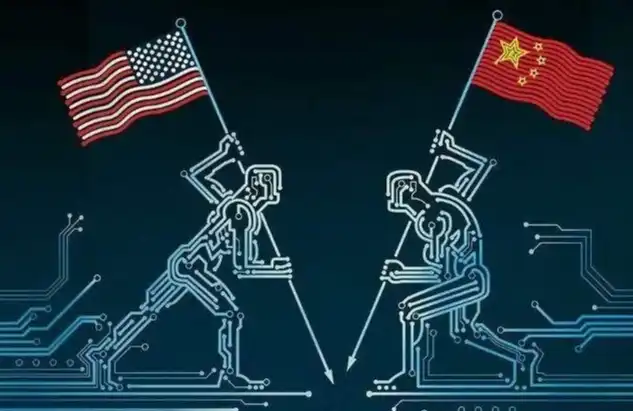
When things are calm, the global supply chain looks like a flat net, and computing power can be accessed across the Pacific. It is easy for people to develop the illusion that software and intelligence have no weight and are not picky about soil and water. But once blockades and containment occur, the cloud falls back to the ground and reveals its true nature as heavy industry: it needs electricity, it fears heat, it is picky about routes, and it depends even more on whose chips are in those rows of cabinets.
On October 16, 1964, at Lop Nur, China successfully detonated its first atomic bomb, codenamed "596." Five years earlier, on June 20, 1959, the Central Committee of the Communist Party of the Soviet Union wrote to the Central Committee of the Communist Party of China, deciding to postpone the provision of the atomic bomb teaching models and blueprint materials agreed upon in the agreement.
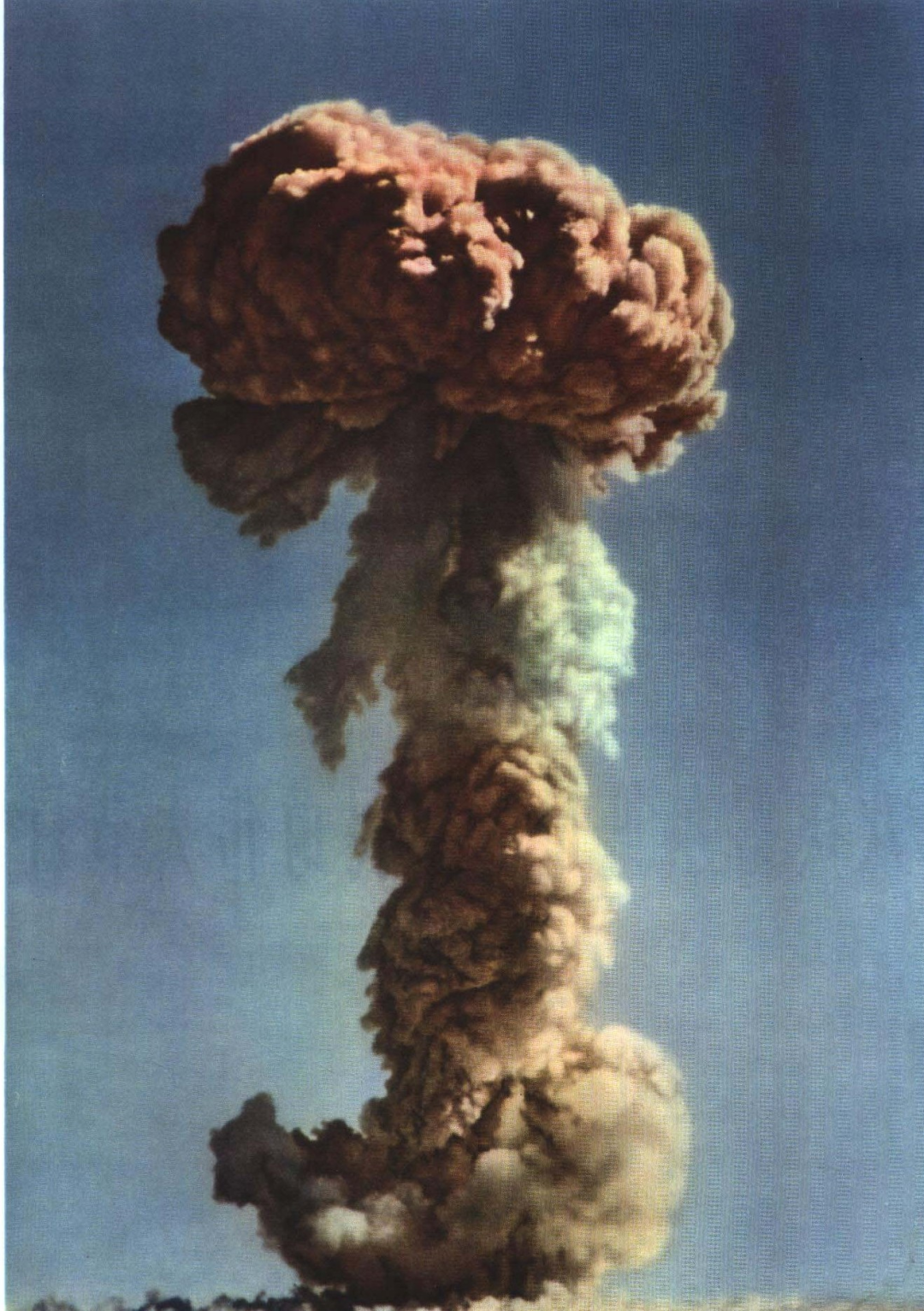
The mushroom cloud from China's first atomic bomb explosion at Lop Nur in 1964 | Image source: People's Pictorial
Almost in the same autumn, the site-selection policy for the Third Front construction was set: rely on mountains, disperse, and conceal. In actual implementation, two more words were added: enter caves. Over the following decade and more, millions of workers, cadres, intellectuals, and PLA officers and soldiers left the cities of the east and northeast and moved machine tools, blast furnaces, and laboratories into the mountains of the southwest and northwest. At its peak, more than 4 million people were involved.
More than half a century later, the world's most cutting-edge industry has become large models.
People training large models have a required daily action: save a checkpoint. Thousands or even tens of thousands of accelerator cards run continuously for months, and if even one card goes offline in the middle, training is interrupted; every so often, all the model's weights, optimizer states, and random number seeds are saved so that, if a problem occurs, training can resume from the most recent node.
The word also has another original meaning in English: border checkpoint.
In November 2026, after a grueling cross-equatorial hunt for chips, China's large model industry reached its own checkpoint.
60 Hard Drives
The story begins with four suitcases bound for Kuala Lumpur.
In early March 2025, four Chinese engineers flew from Beijing to Malaysia. Each dragged a suitcase packed neatly with 15 hard drives, totaling 80TB of data.
Their destination was a local data center in Malaysia, where their employer had rented about 300 servers equipped with advanced Nvidia chips.
For this trip, colleagues back home had started refining datasets and repeatedly debugging training programs more than eight weeks in advance. Because once the data was packed into suitcases and shipped abroad, into a foreign server room, it would be hard to start over as easily as back home. As for why they didn't transmit it over the network—the reason was that network transmission "could take months," so physical delivery was faster.
What they planned to bring back was much smaller—only a few hundred GB of trained model parameters.
This was the most primitive slice of China's first large-model compute migration: chips couldn't come in, so data flew out.
What forced engineers onto planes was the tightening chip ban over the years.
On October 7, 2022, the U.S. banned sales of Nvidia A100 and H100 to China for the first time; Nvidia quickly created A800 and H800 with reduced interconnect bandwidth specifically for the Chinese market. Just one year later, on October 17, 2023, even the downgraded versions were shut out.
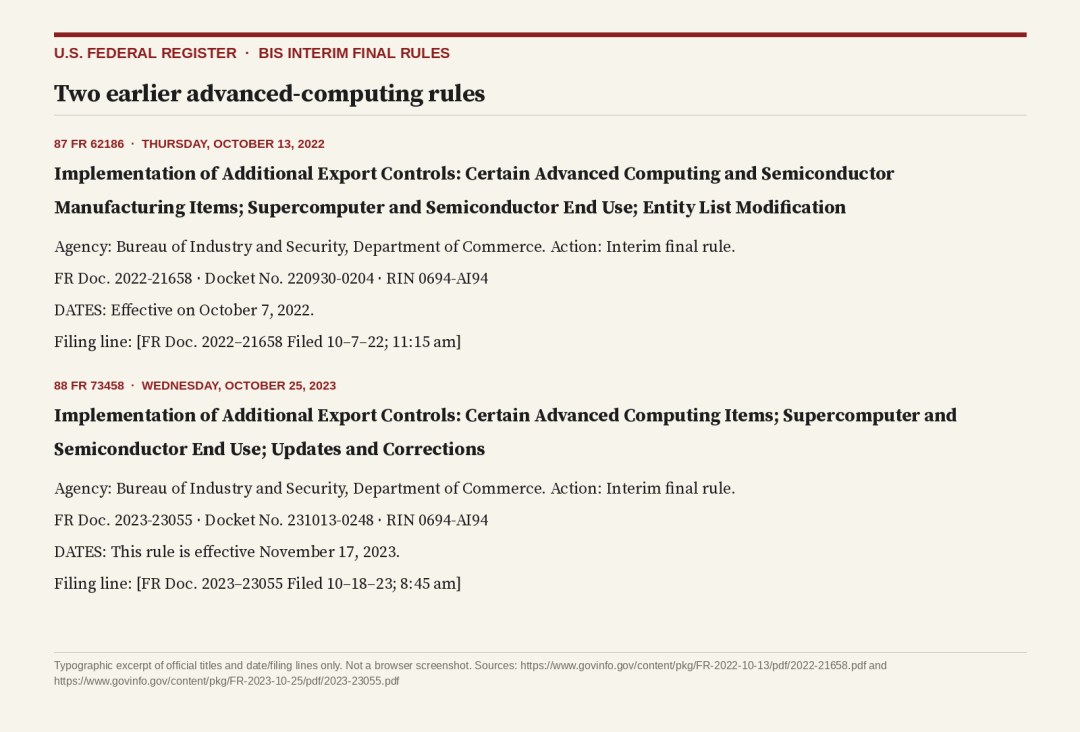
U.S. advanced computing chip export control rules in 2022 and 2023 | Source: government website
That year, chips were hard to find in the domestic market. A100 prices jumped from around 40,000 yuan at the start of the year to nearly 250,000 yuan; in the week after the October regulations took effect, H800 quotes nearly doubled, with an 8-GPU整机 being quoted by channel vendors at 2.45 million yuan.
Meanwhile, domestic compute infrastructure experienced a premature boom. Between 2023 and 2024, more than 500 intelligent computing center projects were announced across various regions, and by the end of 2024 at least 150 were already operational.
On one side, labs are holding cash but cannot buy GPUs; on the other, data centers across various regions sit empty. The reason lies in the physical threshold of large-model training: frontier models require tens of thousands of same-generation high-end GPUs interconnected through high-speed networks into one large cluster, while what is scattered across data centers in various regions is mostly fragmented, outdated inference cards or previous-generation graphics cards that cannot be linked into a single fabric.
Fortunately, U.S. export controls at the time left a gap: they governed buying and selling, but not renting.
Companies headquartered in China cannot bring chips into the country, but they can rent capacity from overseas cloud providers and data centers owned by non-Chinese operators. The industry quickly figured out a division of labor: pretraining, which is the most compute-intensive and most demanding of cluster communication bandwidth, is placed in overseas data centers; once the model is trained, the weights are brought back to China, and domestic compute pools handle day-to-day user inference.
Once the path was proven, the crude approach of carrying suitcases was quickly replaced by modern cloud infrastructure.
Later still, engineers did not even need to leave the country. Training clusters remained in data centers in Southeast Asia or Northern Europe, while algorithm teams sat at workstations in Haidian in Beijing, Yuhang in Hangzhou, or Xuhui in Shanghai, logging in remotely and typing launch commands line by line into their terminals.
The Oil Palm Forests of Johor
There is an invisible aerial corridor on Earth called the "East Asian–Australasian Flyway."
It starts from the Russian Far East and Alaska, passes through East Asia and Southeast Asia, and extends all the way to Australia and New Zealand, crossing 22 countries. Every year, more than 50 million waterbirds travel north and south along it. The mangrove wetlands on the southwest coast of Johor, Malaysia, are one of the resting stops on this route, and Tanjung Piai within them is the southernmost point of the Asian mainland.
Over the past five years, a new kind of silicon-based migratory bird has appeared along this flyway.
Johor is separated from Singapore only by the narrow Johor Strait. The red soil here has hosted several successive crops. In the 1940s, Chinese clan communities that crossed the sea from Singapore cut through the tropical jungle and planted pepper and gambier; when the British colonizers arrived, they switched the crops to rubber; by the second half of the 20th century, the hillsides were covered with oil palm trees.
Now, bulldozers have knocked down stretches of oil palm forest and planted Johor's fourth-generation cash crop: data centers.
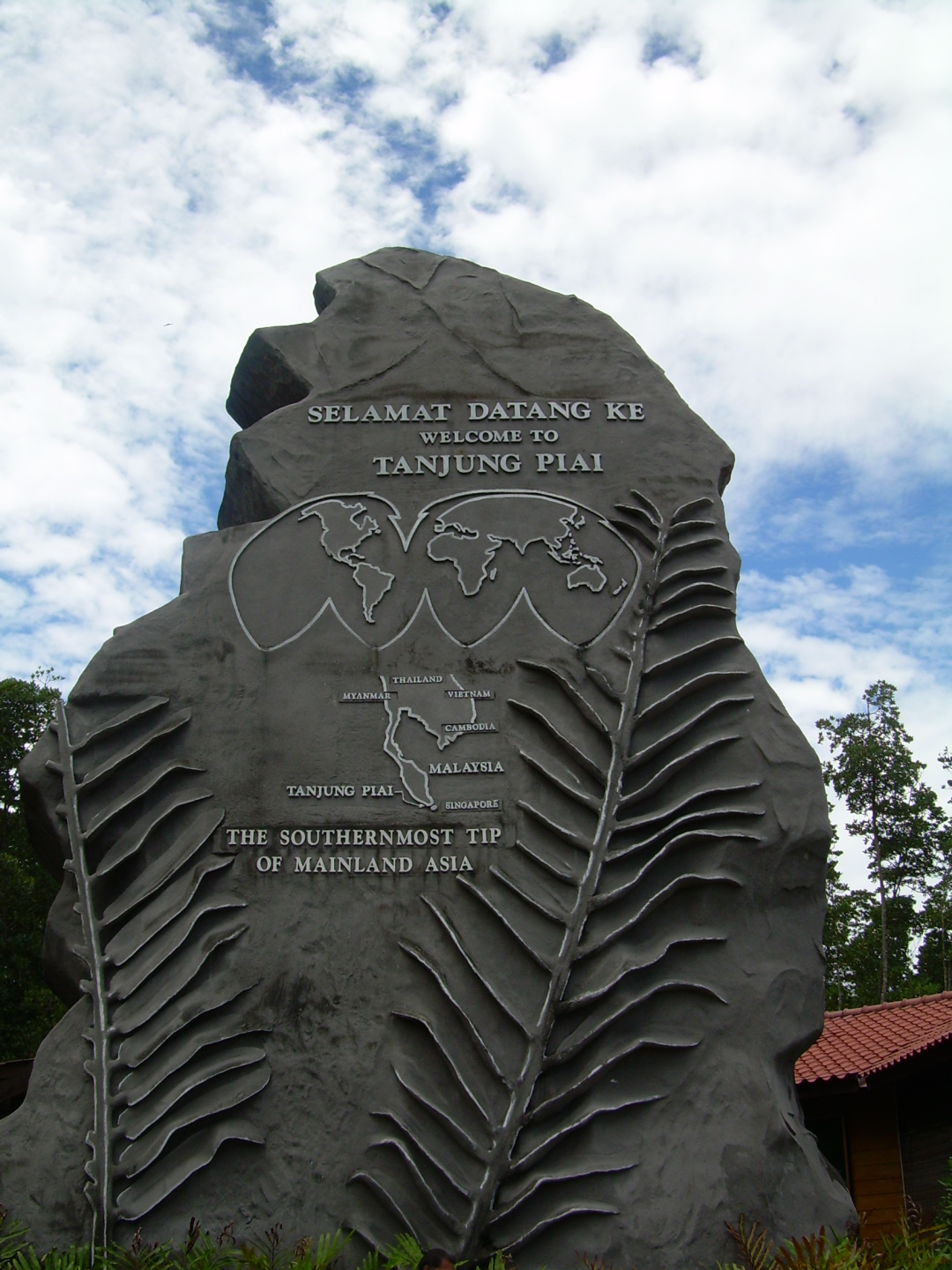
The landmark monument at Tanjung Piai, Johor, the southernmost point of the Asian mainland | Image source: D.W. Fisher-Freberg
In 2021, the entire state of Johor had only 10MW of IT load online. By the end of 2025, that figure had crossed 900MW.
What attracted them was the stark disparity in factor prices across the Taiwan Strait.
Singapore has limited land and expensive electricity, and once suspended approvals for new data centers from 2019 to 2022. Across the strait at the Sedenak Tech Park in Johor, land prices are only S$5.12 per square foot, compared to around S$6,000 in Singapore's Tai Seng area; Johor's electricity prices are also about half of Singapore's.
What surprised overseas peers even more was the delivery speed of Chinese infrastructure teams. Operators with Chinese backing can acquire land, level it, pull power, install cooling, and light up and hand over a data center in Johor in nine to twelve months. DayOne and Bridge Data Centres—which once merged with Chindata and is now owned by American capital—together account for at least 58% of Johor's online IT capacity. Among the Chinese operators in Johor, the largest customer is ByteDance.
The Causeway checkpoint connecting Johor Bahru and Woodlands, Singapore, sees hundreds of thousands of people clear immigration daily, making it one of the world's busiest land border crossings and the most famous physical checkpoint in the area; meanwhile, in data centers on both sides of the strait, another kind of checkpoint is being saved to hard drives one by one.
In November 2025, the Financial Times reported that Alibaba and ByteDance were training their latest models in Southeast Asian data centers under leases signed with non-Chinese owners. A Singapore data center operator explained to the media at the time: "Training the most cutting-edge models requires the best chips, and everything is legal and compliant."
The US think tank IFP estimated that by the end of 2026, the computing power Chinese companies can mobilize through overseas remote access will be equivalent to about 1 million H100 GPUs, with about 75% of that distributed in Southeast Asia. Since 2021, Malaysia has approved a cumulative $95 billion in data center investments.
The team that flew the farthest reached the edge of the Arctic Circle. Since May 2025, an overseas subsidiary of ByteDance has leased 2,304 Nvidia B200 chips in Glomfjord, a fjord town in northern Norway, where power comes from hydropower and temperatures stay low year-round; this single ByteDance order accounted for about three-quarters of that European neocloud's revenue that year.
But everyone knows in their hearts that a borrowed roof cannot shelter from a long rain.
Migratory birds fly south, never to settle in the south.
The 2025 of Two Companies
Facing the same computing power blockade, between 2025 and 2026, China's two most representative large-model companies, Kimi and DeepSeek, each took a different path.
On the road south to secure GPUs, Moonshot AI has been the most aggressive player. As one person familiar with the matter put it, their posture in scouring the globe for compute is "very aggressive."
In July 2025, Moonshot AI released K2 with 1 trillion parameters, completing pre-training on 15.5 trillion tokens using its self-developed MuonClip optimizer. A year later, on July 16, 2026, K3 was officially released, pushing total parameter count to 2.8 trillion, making it the world's first open-weight 3T-class model.
American AI scholar Nathan Lambert specifically noted when evaluating K3 that the model was built "in a GPU-constrained environment." When chatting with Kimi researchers, he half-jokingly mentioned that at OpenAI, an ordinary researcher might have "thousands of H100-equivalent machines" at their disposal — and the other party was "shocked."
With far fewer GPUs than their Silicon Valley counterparts, the Chinese team delivered results that the other side of the Pacific could not ignore. A November 2026 enterprise report from Silicon Valley venture firm Menlo Ventures showed that of the money U.S. enterprises spent on open-source large models, 89% flowed to Chinese models, with Kimi alone capturing 61% of the share.
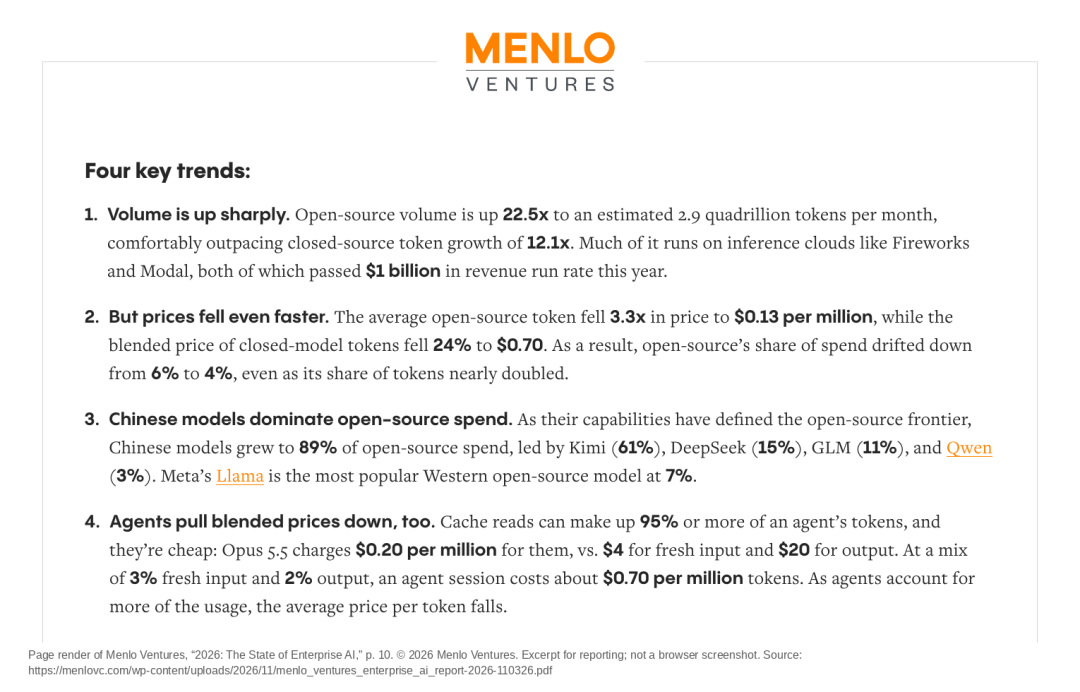
Menlo Ventures 2026 Enterprise AI Report | Image source: Menlo Ventures
The model is so strong that the most direct headache is running out of GPUs.
Just three days after K3's release, on July 19, Kimi officially posted a "Notice on Compute Shortage and Temporary Suspension of Membership Registration," saying that over the past 48 hours, user request volume had significantly exceeded estimates and was approaching the capacity limits of the existing cluster. New membership channels had to be temporarily closed, with registrations to be released in batches once a new round of compute capacity is in place.
To relieve pressure on the inference cluster, Moonshot AI used every method it could think of. They partnered with several U.S. cloud providers on revenue-sharing arrangements to host K3, leveraging the advantages of open weights to let overseas cloud providers use their own GPUs to serve overseas enterprise customers on Kimi's behalf.
But pre-training the next-generation flagship model cannot be solved through offloading. According to a late-July report from The Information, the planned K4 will be much larger than K3. Moonshot AI has set its sights on Indonesia, signing a lease worth approximately $150 million to reserve an NVIDIA Blackwell Ultra B300 cluster in an Indonesian data center, with plans to activate it as early as 2027. According to reports, these GPUs are precisely what's being prepared for K4.
While Moonshot AI was scrambling for GPUs across Southeast Asia, Hangzhou-based DeepSeek chose a different path.
In July 2024, Liang Wenfeng said in an interview with "An Yong": "The problem we face has never been money, but the embargo on high-end chips."
At the end of that year, DeepSeek released V3, completing training on 2,048 H800 GPUs, with the final training run costing only about $5.576 million. The technical report said the entire training process "encountered no unrecoverable loss spikes and did not perform any rollbacks."
On January 20, 2025, DeepSeek R1 was released, shaking the world with its reasoning capabilities powered by reinforcement learning. But after R1, when peers were rushing overseas to rent GPUs, DeepSeek did not move its main training operations abroad. The Financial Times reported in November 2025 that DeepSeek insisted on training domestically, with Huawei engineers stationed permanently at its Hangzhou headquarters.
The cost of staying put was real pain and waiting.
In 2025, Huawei sent a team of engineers into DeepSeek's offices to help it train the next-generation reasoning model R2 on domestic Ascend chips. According to the Financial Times, training ran into problems with stability, software, and slow inter-chip communication. R2's release was repeatedly delayed, and the training schedule for the multimodal generation model was pushed back accordingly.
At the time, the outside world only saw that DeepSeek had slowed down, but few understood the groundwork it was laying beneath the surface.
In August 2025, DeepSeek released the transitional version V3.1, noting in its release notes that the UE8M0 FP8 precision format used by the model was designed specifically for "the upcoming next-generation domestic chips."
On April 24, 2026, the long-refined DeepSeek V4 finally went live. In its release announcement, the company said that due to limited high-end compute, V4-Pro's service throughput was constrained, and that prices would be lowered after Ascend 950 super nodes hit the market in bulk in the second half of the year.
Looking back from that moment in the autumn of 2026, one company scrambled everywhere for GPUs and got its models into developer toolchains worldwide, while the other stayed domestic, grinding away at底层 architecture and taking the hits for domestic large-scale clusters. Together, the two paths formed the twin wings of Chinese AI during the transition period.
Until Washington decided to weld the overseas door completely shut.
4:15 PM
The doors closed one after another during the first two weeks of November 2026.
First came the verbal warnings. On November 3, the Financial Times reported that Nvidia's sales team began verbally notifying global cloud service partners that in newly signed contracts, at least 51% of capacity must be sold to non-Chinese customers. This requirement was not put in writing, yet it left data center owners in Southeast Asia looking at each other in bewilderment—outside the US, where would they find that many non-Chinese customers?
The next day, November 4, Oracle canceled a super lease with Tencent in Southeast Asia. It was a five-year deal worth approximately $7 billion, involving about 100,000 chips, and the deal fell through because US officials expressed opposition.
On November 12, Jensen Huang, who had led Nvidia for 33 years, resigned as CEO amid the turmoil. This Chinese-American entrepreneur, who had publicly said that China's AI was "only a few nanoseconds behind the US" and bluntly stated that US export controls were "largely backfiring," left the table in this sensitive late autumn.
On November 16, Monday, at 4:15 PM Eastern Time, the US Department of Commerce's Bureau of Industry and Security filed an interim final rule into the Federal Register system, titled "Addressing Remote Access to Advanced Semiconductors." It was officially published on November 19 and took effect the same day.
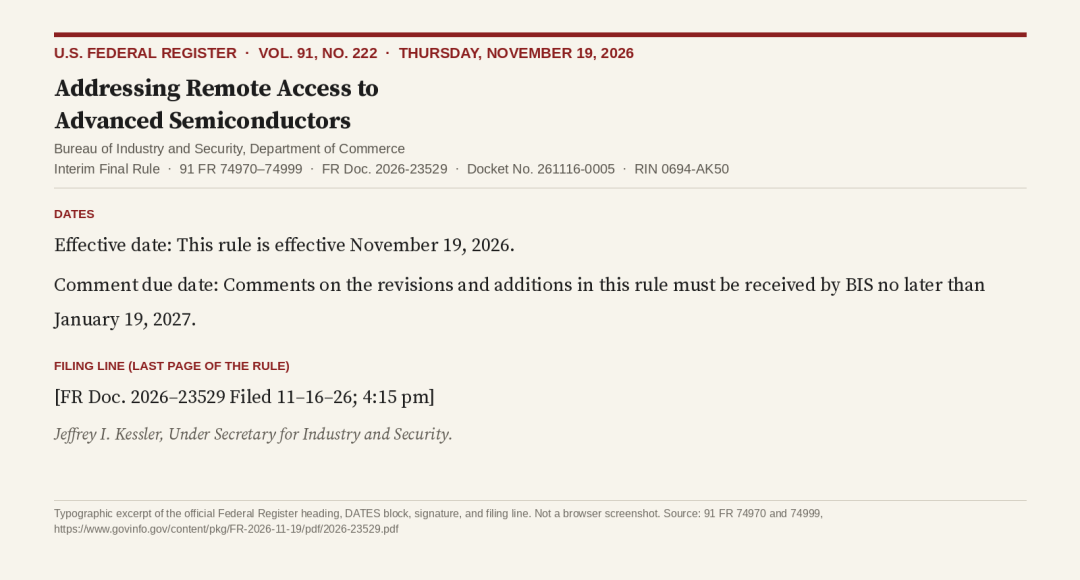
New Rule on Remote Access to Advanced Semiconductors | Image source: government website
Coincidentally, on the same day, US President Trump was attending the APEC Leaders' Informal Meeting in Shenzhen, and afterward praised his "outstanding personal relationship" with Chinese leaders.
The core provision of the new rule is just one: any data center in the world that provides more than 12 million TPP of computing power to companies headquartered in China (including their overseas subsidiaries) must obtain a license from the US Department of Commerce before advanced chips can be shipped to that data center.
12 million TPP translates to roughly 750 H100 chips, about the size of four or five server racks.
Training a frontier large model with a trillion parameters requires at least several thousand to tens of thousands of chips. Four or five racks are not even enough to make a dent.
For existing overseas data centers currently serving Chinese customers, the new rules provide a 90-day buffer period to apply for licenses, otherwise they "will face future export restrictions." Counting from the effective date of November 19, the 90-day deadline falls exactly around February 17, 2027.
The new rules include a presumption clause: if an overseas data center refuses or is unable to provide customer due diligence information, this act itself will be regarded as a "Red Flag," allowing a "presumption" that the exporter "knew."
In other words, if you can't clarify whose code is running in the server room, it is assumed you have a problem.
Five countries—Indonesia, Malaysia, Singapore, Thailand, and Brazil—were singled out: shipments of advanced AI chips to these five countries all require license approval; if the buyer is a US-headquartered company, the exporter only needs to submit monthly reports for an exemption.
Physical supply cuts followed closely. On November 17, during Nvidia's earnings call, Colette Kress, who succeeded Jensen Huang as interim CEO, confirmed: "We are no longer shipping licensed Hopper data center products to China." According to the Financial Times, TSMC and Samsung have also suspended shipments to some Chinese customers pending licenses.
China's Ministry of Commerce expressed strong dissatisfaction and announced it would take countermeasures; Foreign Ministry spokesperson Guo Jiakun stated bluntly that this is "typical economic coercion and long-arm jurisdiction."
50% Deposit
In the same week the trade rules took effect, financial leverage also began tightening the purse strings of Southeast Asian server rooms.
Many people assume that the neoclouds proliferating across Southeast Asia are backed by free-spending conglomerates, but in reality, this is a highly debt-dependent, asset-heavy business. According to Bloomberg statistics, since 2023, Asia-Pacific data center companies have obtained approximately $49 billion in loans cumulatively; a semiconductor industry research brief estimates that 70-80% of neocloud project funding comes from debt. The common practice is that server room owners use long-term leases signed with major customers to borrow from banks to buy Nvidia cards, then use the collected rent to repay principal and interest.
In this chain, the deposit ratio is the thermometer of geopolitical risk.
In the overseas computing power market, when an ordinary customer rents an Nvidia B300 server cluster, the industry-standard deposit ratio is around 15%.
When Moonshot AI signed that $150 million B300 lease in Indonesia, in order to lock in these cards that won't be delivered until 2027, it agreed to pay a 50% deposit upfront.
By early November, according to CNBC, when Moonshot AI was negotiating to lease more than 8,000 Blackwell chips in Europe, some even proposed that it must pay 30% to 50% more in prepayments than non-Chinese customers.
The new regulations on November 19 directly eliminated the counterparty for this premium.
According to The Information, after the new rules were introduced, Moonshot AI canceled the $150 million contract in Indonesia and suspended negotiations on other new deals. The batch of overseas chips prepared for K4 was thus abandoned.
More troublesome than canceling the lease was the banks' loan withdrawal.
On November 17, Bloomberg reported that a $480 million loan to Singapore cloud service provider Aolani Cloud was frozen. The money was originally intended to purchase Nvidia GPUs for a data center in Malaysia serving ByteDance. According to previous reports, the two parties had about 36,000 B200 chips in cooperation in Malaysia. The lead bank for the loan was Singapore's DBS Bank, and as soon as news of the new regulations emerged, five lenders began discussing withdrawal.
Another cloud service provider, GMI Cloud, had previously borrowed $300 million to build computing facilities in Thailand serving Tencent, and the loan term sheet explicitly stated that if Tencent was placed on a U.S. restricted list, the lenders had the right to demand early repayment.
Under high compliance pressure, Southeast Asian governments have retreated one after another. Malaysia's Minister of Investment, Trade and Industry Johari Abdul Ghani told CNBC: "If you want to stay at the table, you have to play by America's rules." Thailand's Deputy Minister of Commerce publicly stated that new projects without U.S. approval "may not be completed." Singapore's Ministry of Digital Development and Information and Ministry of Trade and Industry issued a joint statement that "companies are not allowed to use their association with Singapore to circumvent or violate the laws of other countries."
The capital market reacted quickly. On November 17, two data center concept stocks on the Malaysian stock market plunged nearly 20% intraday, and utility giant YTL Power fell nearly 10%.
On the same day in the Hong Kong market, SMIC surged 7%.
In fact, even before Washington closed the door, Beijing had already begun actively guiding the industry to turn back.
In September 2025, the Cyberspace Administration of China required companies such as ByteDance and Alibaba to stop purchasing and testing Nvidia's RTX Pro 6000D specially supplied for the Chinese market; in November, state-owned data center projects were required to use only domestic chips; western computing hub provinces such as Gansu, Guizhou, and Inner Mongolia offered electricity subsidies of up to 50% to data centers using domestic chips. By January 2026, after the U.S. conditionally allowed H200 exports, domestic customs told customs brokers that H200 was "not permitted entry."
On one side, Washington is locking down overseas data centers; on the other, domestically, the backdoor to specially provisioned chips is being firmly shut. The three-year cycle of external training and internal deployment has come to an end under the two-way decoupling across the Pacific.
GPUs Eaten Up by Users
Turning our gaze back home. To understand the urgency of this great migration at the end of 2026, one must first see the other kind of sweet yet painful torment that domestic labs are experiencing. Users are growing too fast, eating up the GPUs meant for R&D.
At 0:11 AM on March 4, 2026, Lin Junyang, technical lead of Alibaba's Qwen, posted a brief line in English on X: "me stepping down. bye my beloved qwen."
Lin Junyang's departure was officially attributed to disagreements over adjustments to responsibilities and authority, with compute power merely the backdrop. But the grievances he poured out in an industry dialogue two months earlier articulated the shared anxiety of many frontline technical leads: he said that just handling daily deliveries had already consumed the vast majority of the team's compute power, leaving precious few GPUs for genuine frontier exploration.
ByteDance is internally experiencing the same tug-of-war.
By August 2026, according to a report by LatePost, ByteDance had seriously discussed internally training a super model with over 5 trillion parameters. After taking stock of its assets, it found that existing compute reserves "could hardly support multi-line parallel R&D," and the Seed team subsequently initiated an internal structural convergence.
Why would even giants like ByteDance and Alibaba, the least short of money, feel that GPUs are insufficient?
Because 2026 is the year Chinese AI applications truly entered the daily lives of the general public. After the Spring Festival, the daily active users of ByteDance's Doubao surged past the 200 million mark. High DAU brings high inference costs and operational pressure, so much so that ByteDance, long adept at buying traffic and ad placements, had a very low ad spend budget for Doubao this year, according to 36Kr; continuing to acquire new users would make inference GPUs even tighter.
In the large model industry, pre-training and daily inference compete for the same pool of compute power. The more enthusiastically users use the service, the fewer GPUs are left for training the next-generation model.
This "happy trouble" is reflected even more dramatically in startups.
On February 16, 2026, after Zhipu AI's flagship model GLM-5 was released, a surge of concurrent requests broke through the planned upper limit. Although Zhipu had already expanded its domestic chip clusters several times and limited sales of its Coding Plan package, online services still experienced queuing and lag. Zhipu had to publicly solicit chip manufacturers, compute partners, and inference service providers.
MiniMax, which does not build its own data centers and instead purchases from cloud providers, is also sharply increasing its budget. On August 26, 2026, MiniMax signed a supplementary agreement with Alibaba Cloud, raising its annual procurement caps for the three years from 2026 to 2028 from the originally planned $115 million, $125 million, and $135 million to $300 million, $400 million, and $500 million in one go. Founder Yan Junjie admitted candidly on an overseas podcast: "For us, especially for a Chinese AI company, compute is always a constraint."
By September, even DeepSeek, long known for its engineering efficiency, began directing users to alternative capacity. It shifted requests originally routed to V4-Pro to the newly released V4.1-Flash. On November 16, "DeepSeek usage quota has reached its limit" trended on Weibo, with many heavy users hitting the cap in less than two hours of continuous conversation.
Once you understand this supply-demand relationship, you can understand why there was always a subtle sense of gathering momentum in the air in China in the second half of 2026.
During these months, various companies iterated intensively on small versions and Flash models, but only the ultra-large-parameter flagships slowed their pace. Zhipu officially announced GLM-6 on August 31 without giving a specific launch date; MiniMax's Pro version with roughly 3 trillion parameters was reportedly originally planned to debut in the third quarter but has yet to appear; DeepSeek released V4.1-Flash but has not yet released V4.1-Pro.
At the same time, the no-holds-barred API price war of two years ago has completely died down. According to statistics, in the second quarter of 2026, the average input price of domestic large-model APIs was about 48% higher than in the first quarter of 2025, and the output price was about 80% higher; DeepSeek's output price during peak hours rose to 4.5 times the original.
Zhu Xiaohu once asserted: "This year may be the last year for foundation large models."
But in our view, this conclusion exactly reverses cause and effect.
The slowdown in flagship model release cadence and the return of API prices to rationality are never because foundation models have hit a ceiling, but because Chinese large models have walked out of the laboratory and truly entered hundreds of millions of real-world scenarios and the toolchains of global developers.
According to research institute Epoch AI, from 2022 to mid-2026, China accounted for only about one-tenth of the world's newly added AI compute; but statistics from Hugging Face, the world's largest open-source community, show that between February 2025 and February 2026, more than 40% of model downloads across the platform came from models developed by Chinese teams.
With one-tenth of the world's incremental computing power, it has supported more than 40% of global open-source model downloads and daily API calls from hundreds of millions of users in China.
Moreover, the rigid constraints on computing power have instead forced Chinese engineers to develop hard skills in architecture optimization and systems engineering. A industry expert quoted by Caixin judged that a small model deeply tuned through harness can achieve nearly 90% of the capability of a large model at about 4% of the cost.
As Dylan Patel of SemiAnalysis commented a few days before the new regulations took effect in November: "In terms of capability, Moonshot is probably as good as American labs; they just have a big gap in compute and deployment."
Now, this group of engineers who best understand how to economize on GPU usage is collectively moving back to the foundation of domestic chips.
Precision Alignment
Moving from Nvidia's CUDA ecosystem back to domestic computing power foundations is not a relocation that can be completed with an administrative order; it is first and foremost an extremely hardcore, bit-by-bit底层 engineering battle.
In the words of chip and framework engineers, the first critical hurdle after returning home is called "precision alignment."
Ideally, the same model architecture fed the same batch of training data, run on Nvidia GPUs and on Huawei Ascend NPUs, should produce two loss descent curves that overlap as precisely as two sheets of tracing paper.
But in the real engineering world, as long as there is the slightest difference in the numerical precision of the underlying hardware or the reduction order of communication operators, the two curves will diverge significantly.
iFlytek is one of the earliest Chinese companies to master this painstaking work.
In its April 2026 investor relations activity record, iFlytek laid out the objective gap between the two generations of hardware: the Ascend 910B single-card memory then in main use was 64G, while Nvidia H200 was 141G; memory bandwidth was 1.6TB/s on one side and 4.8TB/s on the other. Out of the box, iFlytek's training efficiency on 910B clusters was only about 30% of that of Nvidia A800 clusters of the same scale.
iFlytek worked deeply with Huawei, rewriting and tuning operator by operator. In 2025, they managed to raise the training efficiency of long chain-of-thought reinforcement learning from 30% to 84%, and the full-chain training efficiency of Ascend-native MoE models to 93%. Even so, an objective adaptation cycle still exists. iFlytek wrote in the record that when a new mainstream algorithm emerges internationally, it can be implemented directly on Nvidia cards, but on domestic cards it requires additionally solving a series of issues such as operator library efficiency optimization, typically taking 3 to 6 more months of adaptation cycle.
In October 2026, iFlytek Chairman Liu Qingfeng said: "We don't want iFlytek to be the only one training on domestic computing power."
Liu Qingfeng didn't have to wait long. DeepSeek, which chose to stay the course that year, paved this road a long way forward this autumn.
Looking back, the R2 migration setback DeepSeek experienced in 2025 was not a defeat, but rather the most valuable pathfinding exploration for China's entire large-model industry.
On the day DeepSeek V4 was released in April 2026, Ascend chips achieved inference support at the first opportunity, and its expert-parallel core kernel completed validation on both NVIDIA and Ascend hardware. By July, a research team led by Huawei with participation from institutions including Shenzhen Hetao College disclosed that on a cluster of about 1,000 Ascend 910C chips, they had fully completed full-parameter post-training of the DeepSeek V4-Pro 1.6 trillion parameter model, running continuously for about one month, iterating over 1,500 steps, with "no skipped steps and no NaN" throughout, model compute utilization stable at 34.9%, and 27 seconds per step.
On September 30, the day before National Day, DeepSeek officially announced the open-sourcing of a full set of underlying core components for the Ascend platform, from the TileLang compilation tool and compute libraries to distributed communication libraries, corresponding one-to-one with the NVIDIA versions.
To accommodate the memory access characteristics of domestic chips, DeepSeek even proactively modified the KV cache memory layout in its signature FlashMLA attention implementation, packing values and scaling factors together, solely to make Ascend chips move memory fewer times.
In the past Silicon Valley paradigm, model companies always wrote code following the hardware architecture defined by NVIDIA; but in Hangzhou in 2026, top model labs began proactively restructuring their own underlying operators for the characteristics of domestic chips.
Moreover, Huawei and DeepSeek are jointly building a 128-card supernode based on Ascend 950.
SemiAnalysis's lab powered up and benchmarked a Huawei Ascend 950PR test chip this year. Power consumption 203.3 watts, core temperature 56 degrees Celsius, with only just over 5GB of the 128GB onboard HBM high-bandwidth memory used; at full load it draws about 600 watts, and on the compute-intensive matrix multiplication that most tests raw capability, its measured utilization reached 41.5% of the theoretical peak—for comparison, NVIDIA's classic H100 is 46.8%.
Beyond DeepSeek, the entire fleet of Chinese large models is completing a transfusion of their underlying code. Moonshot AI's Kimi K3 introduced quantization-aware training starting from the supervised fine-tuning stage; Zhipu's GLM-5, on its very first day of release, simultaneously completed adaptation to seven domestic chips including Huawei Ascend, Cambricon, Hygon, and Kunlunxin; in the code repositories of major laboratories, pure CUDA operators are becoming increasingly rare, while cross-platform approaches like TileLang are becoming more common.
The two technology trees on opposite shores of the Pacific are growing their own independent root systems from the most fundamental levels of precision formats and memory layouts.
Winter in Ulanqab
On February 17, 2022, four government departments including the National Development and Reform Commission jointly issued a document, launching the construction of national computing hub nodes in eight regions—Beijing-Tianjin-Hebei, the Yangtze River Delta, the Guangdong-Hong Kong-Macao Greater Bay Area, Chengdu-Chongqing, Inner Mongolia, Guizhou, Gansu, and Ningxia—and planning 10 national data center clusters. The "East Data, West Computing" project was fully launched from that day.
History sometimes produces striking coincidences. Almost exactly five years later, around February 17, 2027, happens to be the 90-day deadline set by new US regulations for existing overseas data centers.
Five years ago, when the document inscribed western and northern place names like Horinger, Qingyang, Gui'an, and Zhongwei, many assumed it was merely a routine energy allocation project—eastern land and energy were growing increasingly tight, while the west and the northern frontier had endless wind and sunshine.
Five years later, when the doors of overseas server rooms close, people look up to realize that the bases receiving China's AI migration northward have already been laid out in advance across the northern grasslands, loess plateaus, and southwestern mountain caves.
In Qingyang, Gansu, intelligent computing centers have risen one after another on what were once loess plateaus, where Alibaba's Qwen, Zhipu, and Kimi's training and inference tasks run around the clock.
In Gui'an, Guizhou, Tencent built its core data center directly into a mountain cave, where the thick rock mass maintains a constant temperature of 15 degrees Celsius year-round; more than 80% of Huawei Cloud's newly added Ascend cards have been shipped to Gui'an, which also hosts Huawei's largest deployment of CloudMatrix384 Ascend super nodes. Over half a century ago, roaring Third Front factories were hidden in Guizhou's towering mountains; over half a century later, in the same mountains, rows upon rows of domestic computing power blink with indicator lights.
In Horinger, Inner Mongolia, on October 14 this year, the world's first Ascend 950DT ten-thousand-card pool was officially announced, then undergoing system integration testing, with a single building capable of housing a 30,000-card cluster.
And in this great migration northward, the busiest relay station is called Ulanqab.
Ulanqab means "red mountain pass" in Mongolian. It is about 350 kilometers from Beijing, less than two hours away by high-speed rail. With its high altitude and an annual average temperature of only 4.3 degrees Celsius, for much of the year the cold outdoor air can be used directly to cool server rooms.
On the rolling grasslands south of the city, data centers stand one after another. The "Starry River" campus built here by Envision Group has a total planned capacity of 800MW, with the first phase of 120MW delivered within a year, at a construction cost only one-fifth that of comparable US projects.
One crop Ulanqab was once famous for is the potato. Envision founder Zhang Lei says he wants to make large-model tokens "as cheap as potatoes."
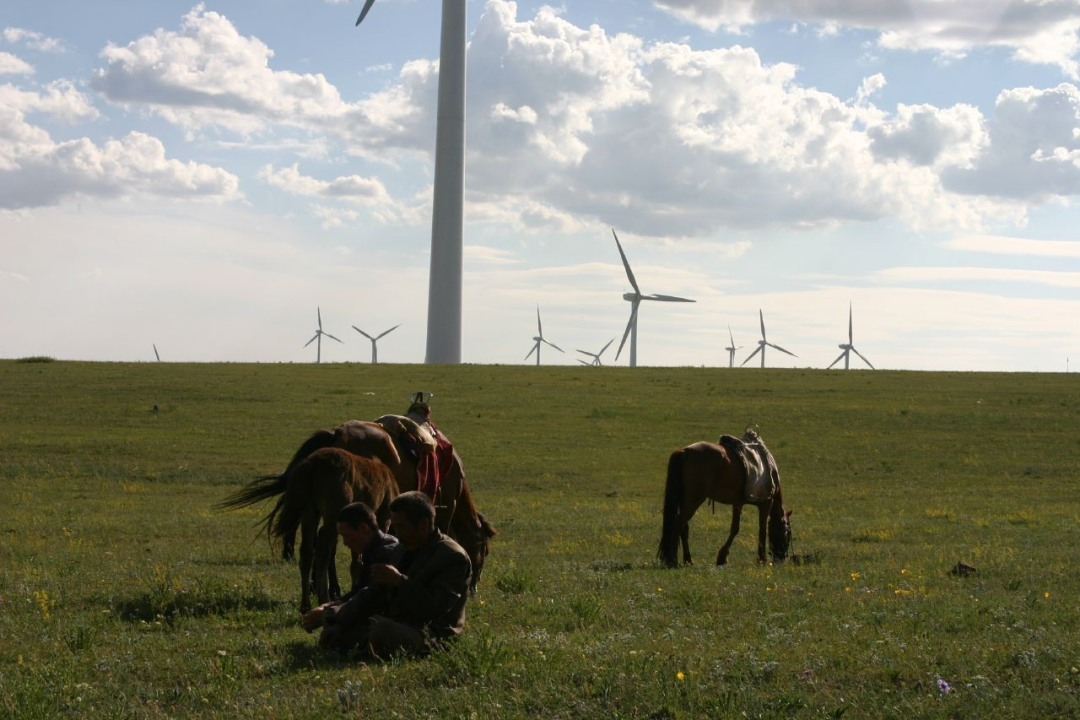
Huitengxile Grassland wind farm in summer 2007 | Image source: Steven Buss
In late November in Ulanqab, nighttime temperatures often drop to minus ten degrees. The northern winds sweep across the grasslands south of the city, pushing hundred-meter-tall wind turbines slowly rotating; the current flows along transmission lines into temperature- and humidity-controlled server rooms, lighting up row after row of newly installed racks.
In the south, the hot and humid rainy season at the Johor Strait continues.
By the calendar, migratory birds will not return north until next spring; this time, computing power has gone ahead of them.
-END-

Original link
Welcome to join the official BlockBeats community:
Telegram Subscription Group: https://t.me/theblockbeats
Telegram Discussion Group: https://t.me/BlockBeats_App
Official Twitter Account: https://twitter.com/BlockBeatsAsia

 Related Articles