Pearl, the next 'store of value' token after ZEC

Last night, investment firm Syncracy published a bullish note on Pearl, pushing the PoW project's token PRL close to an all-time high. Syncracy disclosed that it had built a large PRL position over the past two quarters. It believes that as long as data centers can mine Pearl while running AI inference, PRL has the potential to become a new store-of-value asset and capture some of the capital that would otherwise flow to Bitcoin.
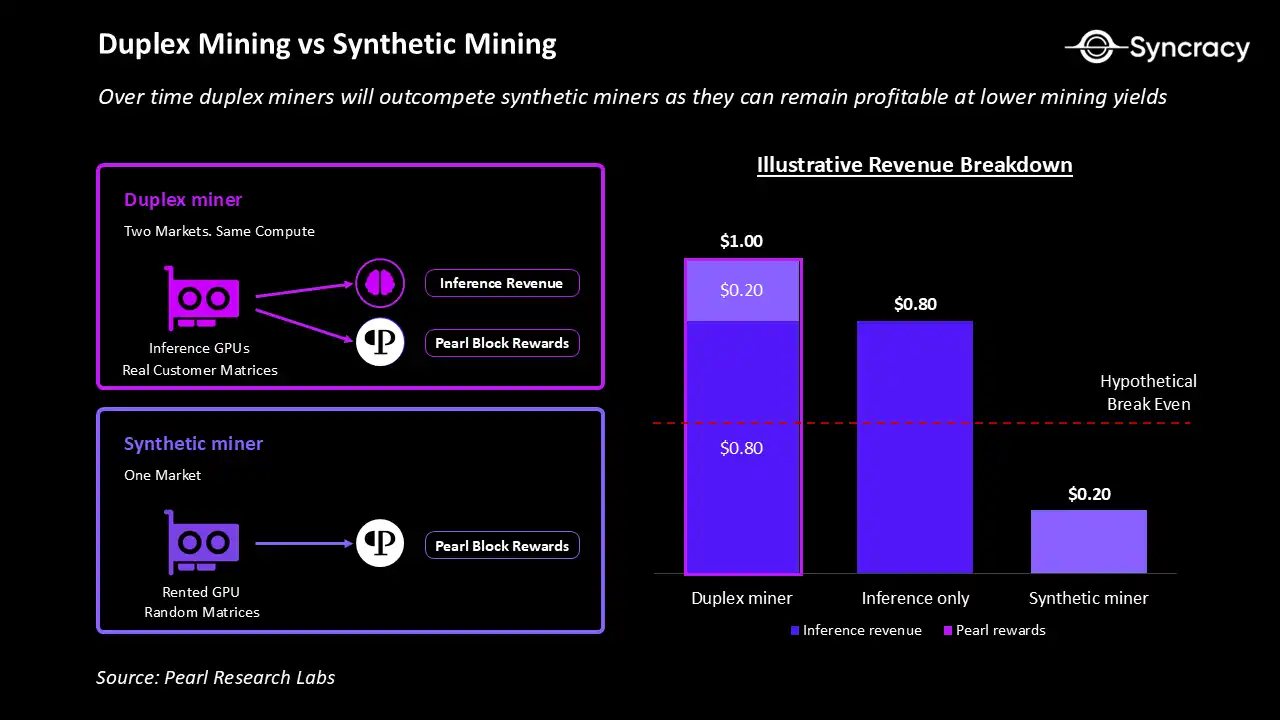
Earning Twice from One GPU
Pearl is a public blockchain launched in April this year. Like Bitcoin, it uses proof-of-work, where miners compete with computing power for the right to record transactions and receive new coins for mining blocks. Bitcoin mining machines repeatedly compute hashes until they find a result that meets the difficulty requirement. Pearl, instead, replaces the computation used in mining with matrix multiplication—multiplying two numerical tables according to certain rules. This happens to be the computation that large models perform extensively when processing requests.
For example, when you send a long article to a chatbot and ask it to write a summary, the inference service provider must first feed the article to the model. The model converts the input into numbers and then performs round after round of matrix multiplication with the model parameters to generate the summary. These multiplications are work the provider would have to do anyway to deliver the answer. After integrating Pearl, as long as the computation meets the protocol requirements, the provider can use part of the results to participate in the block lottery. If selected, the provider submits a zero-knowledge proof along with the block, allowing nodes to verify that it performed the required computation without recalculating the entire batch of multiplications.
The results of the same batch of multiplications are also sent to the next layer of the model and continue to be used for generating the summary. The provider charges customers inference fees and can also earn PRL for successfully producing blocks. This is "dual mining." Two revenue streams come from the same batch of computation.
This design comes from a paper published in 2025. Co-founder Omri Weinstein was formerly a senior research scientist at NVIDIA, with research interests including the computational complexity of matrix multiplication. Another co-founder, Ilan Komargodski, is a cryptography professor at Hebrew University. The two co-authored the paper with NVIDIA researcher Itamar Schen, and later worked with third co-founder Idan Sugarman to turn the research into the Pearl network.
Currently, the computing power supplied to Pearl mainly comes from GPUs dedicated to mining. Blockworks estimated in early November that consumer-grade GPUs contributed about 82% of the computing power, while blocks that can match real AI model computation account for less than 1%.
Token Concentration
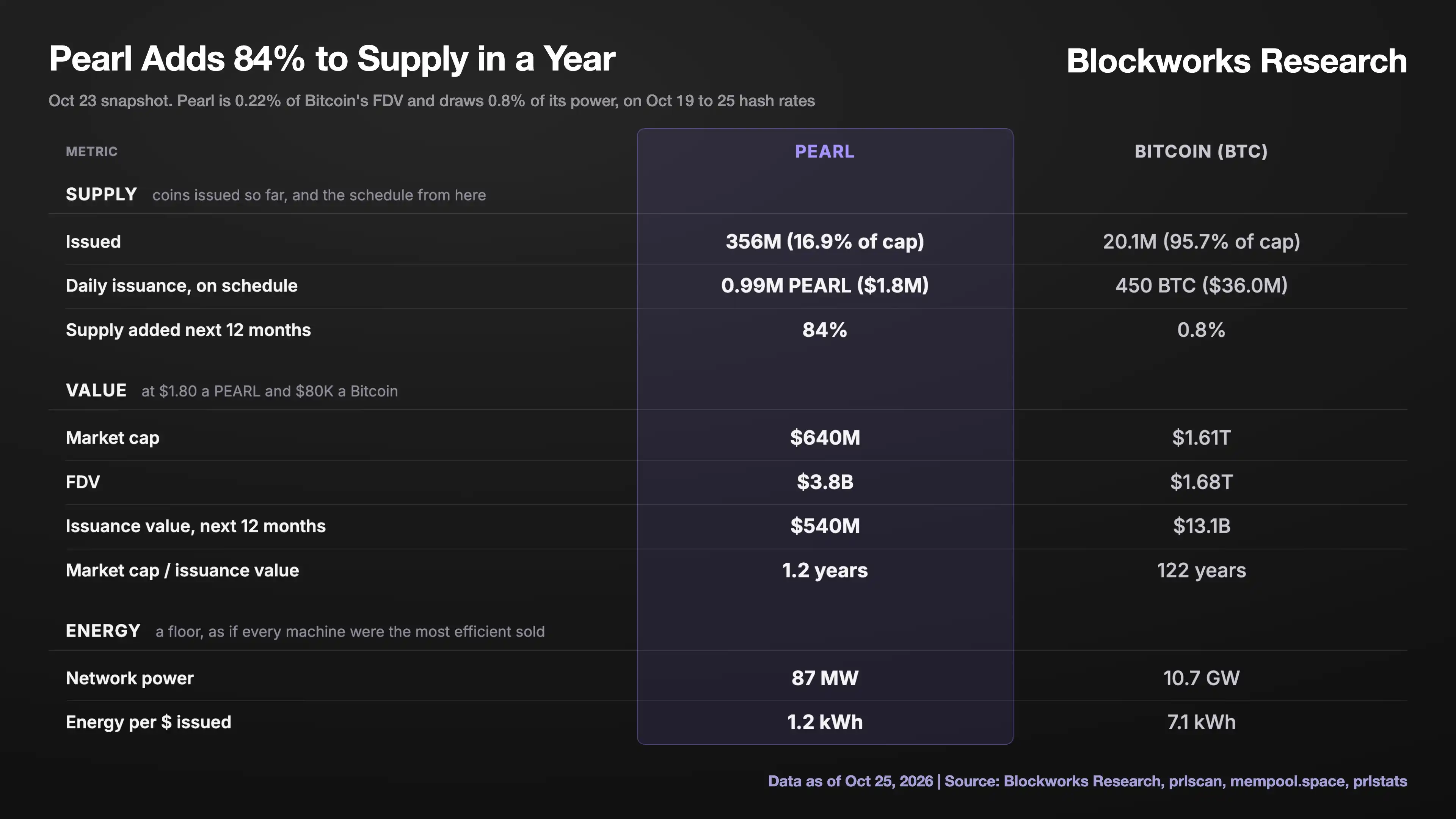
PRL has a maximum issuance of 2.1 billion tokens, with all new coins generated through block rewards. When the mainnet first launched, mining difficulty was set low, and after hash power flooded in, a block could be mined in just tens of seconds. Before mining difficulty rose, miners mined approximately 122 million tokens in the first six days, nearly one-third of the current circulating supply. The project whitepaper mentions that part of the intent behind the low initial difficulty was to give the core team resources for R&D and infrastructure. "Mining is open to everyone—whoever understands the software earlier and gets machines ready has a better chance of capturing this batch of coins."
According to project disclosures, the company on behalf of the team and shareholders holds approximately 72 million PRL tokens, with shareholders directly holding another approximately 26 million, totaling approximately 98 million—equivalent to about 26% of mid-November circulating supply. Pearl Research and the team have committed to locking up at least half of their holdings until May 2027.
In Blockworks' on-chain snapshot from early November, approximately 40% of issued PRL had not been transferred on-chain since being mined, with the vast majority originating from the first few weeks. According to the issuance schedule, approximately 300 million more PRL will be mined in the 12 months from that point—equivalent to 84% of the then-issued supply.
Bull Case
Bitcoin's long-term challenge is that the block subsidy halves roughly every four years. Miners rely on newly issued BTC and transaction fees to pay for electricity and equipment. Maintaining the same revenue after a halving requires either price appreciation or increased fees to fill the gap. AI data centers are also competing for power and facility space. For mining farms, the same resources could be used for AI business, so Bitcoin mining must offer sufficiently high returns to keep them around.
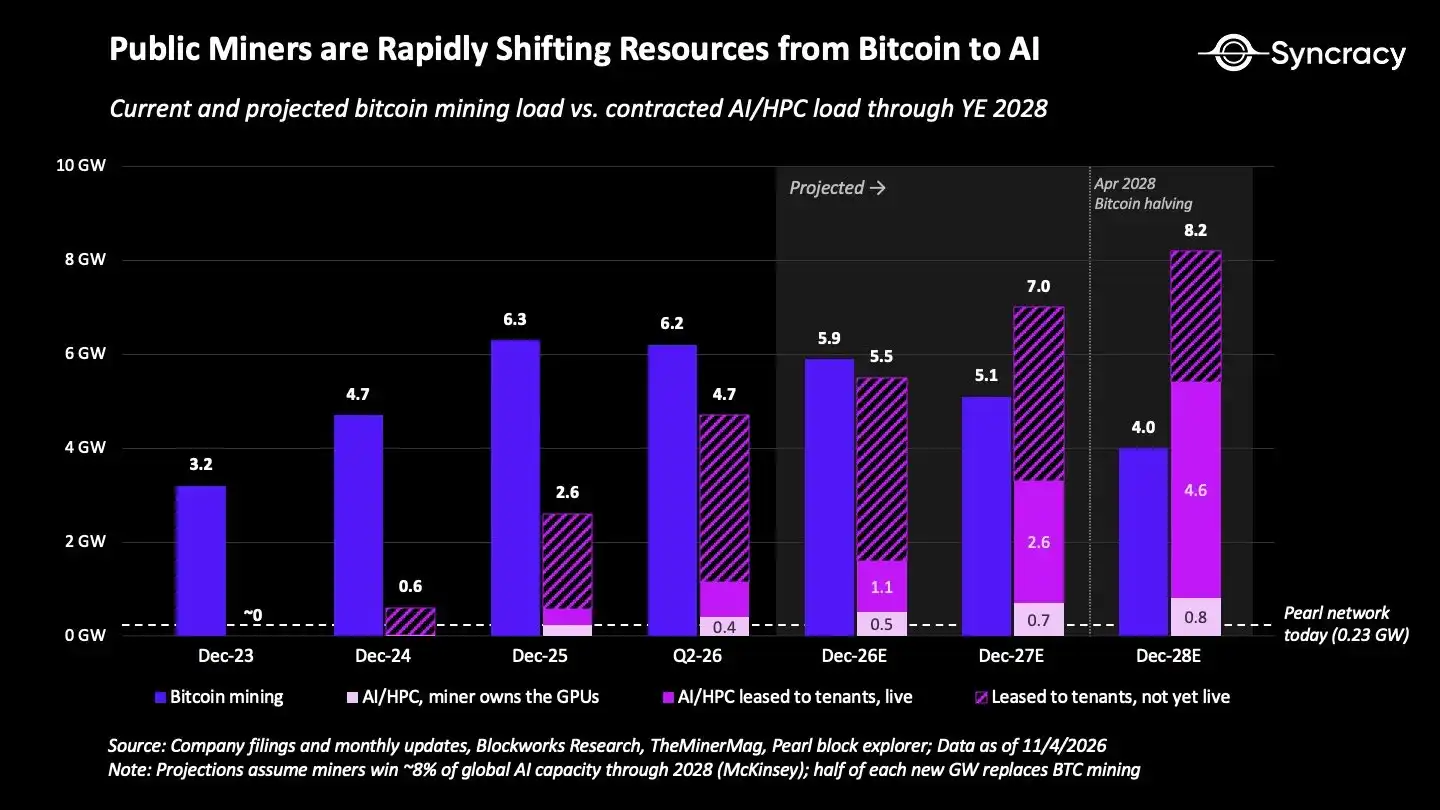
Pearl also has to account for the opportunity cost of mining. Bitcoin mining farms must decide whether to use facility space and power to mine BTC or for AI business. Inference providers connected to Pearl can first take downstream orders, then use a portion of that compute for mining. If, after mining begins, GPUs take three fewer orders per hour, the PRL mined must cover the profit from those three orders plus additional electricity costs. PRL's block rewards also decrease over time. The bull case bets that "dual mining" displaces few enough orders that inference providers are willing to continue mining even at lower mining yields.
Syncracy also views quantum migration as a long-term challenge for Bitcoin. Even if quantum-resistant signatures are adopted in the future, Bitcoin would still need to coordinate how old addresses migrate and how old coins that no one can move should be handled. According to Syncracy, Pearl's mainnet already provides quantum-resistant support.
For the AI industry, dual mining has the potential to lower inference prices. If mining coin revenue covers inference losses and still leaves a surplus, service providers can use part of it to offer discounts to customers. The planned "FP8 upgrade" aims to make Pearl compatible with the digital format commonly used in data centers, bringing more inference computations into mining. According to Blockworks' estimates, this optimization is expected to reduce the inference throughput loss caused by mining from about 10% to 15% down to 0% to 3%. This greatly reduces the opportunity cost.
Together AI made an attempt. In May, it launched a Gemma inference interface capable of mining PRL, using expected mining rewards to压低 quotes. A few months later, this interface was removed from its on-demand inference services. The project team Pearl Research Labs is also engaged in the inference business. According to Blockworks, the company completed a $55 million equity financing in late October, and there is another $75 million investment vehicle for expanding GPU compute power.
In Syncracy's scenario analysis, inference providers join mining to earn extra money; the more compute power they put in, the easier it becomes for PRL's "store of value" narrative to attract buyers. Rising coin prices in turn increase miner revenue and attract the next batch of service providers. Even if this cycle ultimately only allows Pearl to capture a small portion of the capital from Bitcoin that is willing to pay for the "store of value" narrative, for a much smaller token, it is still a considerable source of new buying demand.
Bearish View
Pearl's mechanism is reflexive. A decline in the PRL coin price could trigger a "death spiral." The lower the coin price, the harder it is for mining coins converted into dollars to make up for the profit lost from taking fewer orders, and the more incentive inference providers have to shut down mining and reserve GPUs for customers. After compute power withdraws, if buyers who were originally optimistic about Pearl's compute growth reduce their purchases, and exiting miners also sell their stored coins, the coin price will come under greater pressure. If the price falls further, mining becomes even less worthwhile.
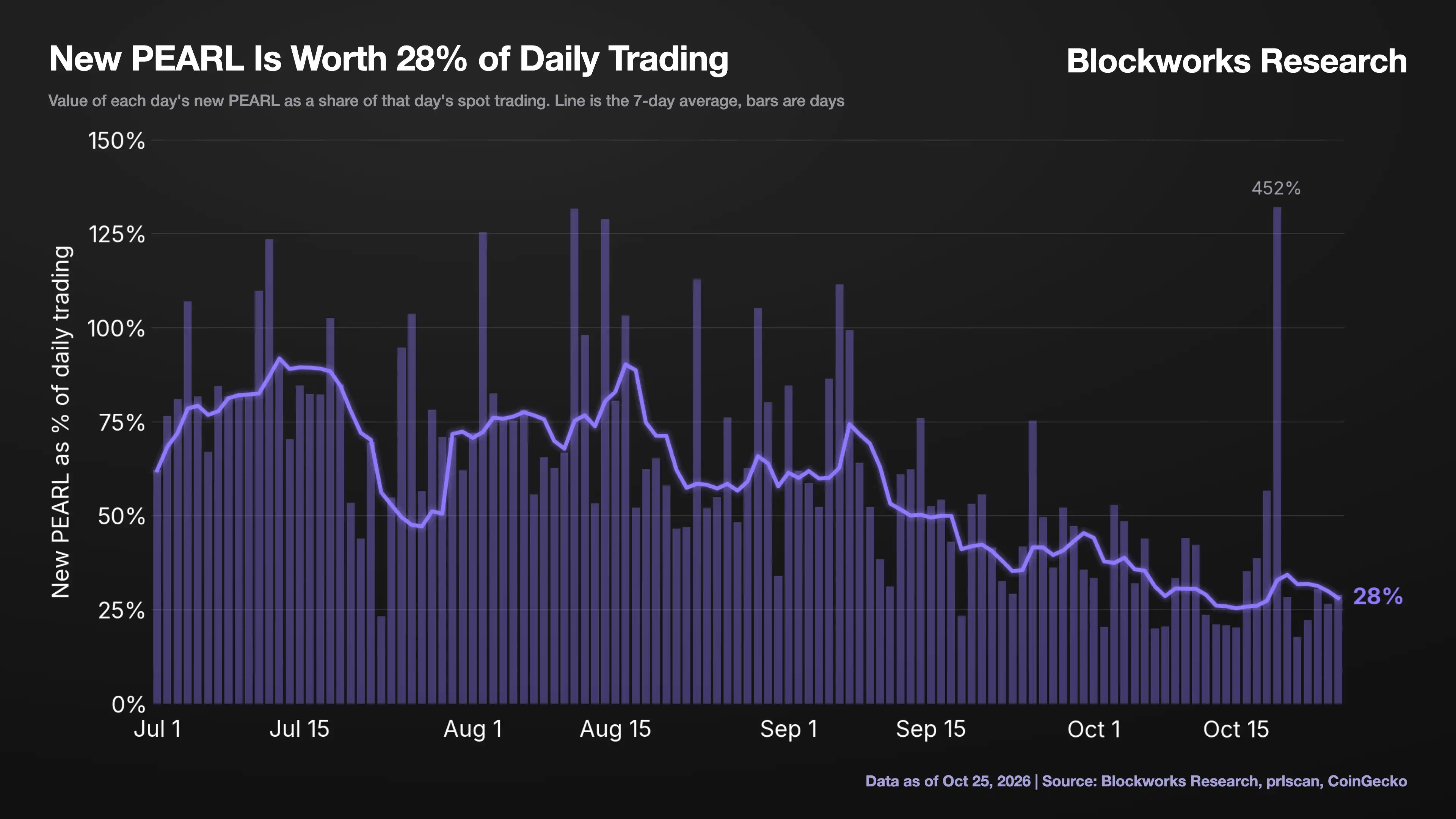
Even if compute power stabilizes, newly mined coins are also a continuous source of selling pressure. Full-time miners need cash to pay electricity bills, and inference providers participating in mining also have reason to convert mining coins into dollars to offset inference expenses. Blockworks estimates that the PRL mined each day, converted at the coin price at that time, was equivalent to 28% of daily trading volume.
Shareholders of Pearl Research Labs make money from the cash flow of the inference business. PRL holders, by contrast, have to profit from an increase in the coin price. The company can sell mined PRL to lower prices for customers, use discounts to win more orders, and the sold coins are absorbed by the token market. For the inference business to directly create buying demand for PRL, customers would still need to actively buy coins in order to purchase compute power.
Pearl's hashpower also depends on the team's ability to keep pace with upgrades in AI chips and models. When the industry adopts new computing formats, developers must upgrade the protocol accordingly and then coordinate miners to switch. FP8 is one example. It can allow more data center chips to participate in mining and may also disqualify some older graphics cards from mining. To treat such a chain as a long-term store-of-value network, holders must believe the team can continuously complete such upgrades and that enough miners are willing to keep up.
Belief Asset
Tokens like PRL, whose main selling point is value storage, are essentially "belief assets." Looking at PRL is the same logic as looking at ZEC, XMR, or even some cult memes. Privacy transactions have utility value, and dual mining also has technical value. The difference in the premium the market assigns to these assets' "value storage" narrative lies in token structure, the capital strength behind them, KOL influence, and whether the team can truly continue to operate the project.

"Privacy version of Bitcoin" created the hundredfold myths of ZEC and XMR. "Bitcoin of the AI era" currently looks like a good story as well.
Welcome to join the official BlockBeats community:
Telegram Subscription Group: https://t.me/theblockbeats
Telegram Discussion Group: https://t.me/BlockBeats_App
Official Twitter Account: https://twitter.com/BlockBeatsAsia
 Related Articles