Syncracy goes heavy on Pearl: mining while running AI, can its computing power surpass Bitcoin before 2030?
Original title: Pearl Thesis – Beyond the Bitcoin Standard
Original author: Ryan Watkins
Editor's note: Can the same GPU run AI inference and collect fees from customers while simultaneously mining and earning block rewards? Pearl, a heavy bet by crypto investment firm Syncracy over the past two quarters, is wagering on exactly that equation. If mining adds almost no cost, every cloud provider already selling AI inference services could become a Pearl miner. Syncracy has even laid out a timeline: by 2030, the computing and energy inputs into the Pearl network are expected to surpass those of Bitcoin.
The other side of this bet is Bitcoin's security budget. Bitcoin's block subsidy halves every four years. According to Syncracy's estimates, if transaction fees cannot fill the gap, maintaining dollar-denominated block subsidy revenue would require the coin price to double every four years—roughly 19% compound annual growth. Meanwhile, the same data center and the same power capacity could secure higher-margin, longer-duration contracts by pivoting to AI. Data cited in the piece shows that from 2026 to 2028, 44% of listed miners' power capacity is already contracted for AI and high-performance computing. For miners, who gets the power ultimately depends on which business is more profitable.
Pearl wants to turn this either-or choice into two revenue streams. Modern AI inference requires massive matrix multiplications, and Pearl seeks to make that same computation also generate the proof-of-work needed for mining. If a cloud provider has already covered its costs through inference services, it may continue to supply compute even if the coin price falls and mining revenue drops to a level where dedicated miners are forced to shut down. Together AI has already launched an inference service that mines PEARL while handling customer requests, using the mined tokens to subsidize inference pricing. This gives "one unit of compute, two revenue streams" an observable commercial case study.
For now, however, Pearl still has ground to cover before this model works. According to Syncracy's conversations with miners, about 80% of mining is still done on consumer-grade GPUs. Whether the planned FP8 upgrade can compress the overhead from roughly 5% to near zero, and whether inference providers are willing to onboard at scale as a result, are the two gates that will determine whether this equation adds up. At the same time, general-purpose GPUs can be redirected to other uses at any moment. Even if Pearl's computing and energy resources surpass those of Bitcoin, one question remains: how durable a security guarantee can these resources provide to the network?
Syncracy disclosed its own holdings in the article and also provided a lower investment threshold than "replacing Bitcoin." By its judgment, even if PEARL's market cap reaches only a low-to-mid single-digit percentage of Bitcoin's market cap, from the current starting point it would already be a considerable return. For readers, the most noteworthy data point next is how much hashpower after the upgrade actually comes from AI inference tasks that customers are paying for. This will determine whether Pearl can continuously obtain hashpower through the expansion of AI data centers, and whether this growth can withstand the test of a decline in coin price.
The following is the original text:
For the first time in years, Bitcoin is facing such a test. The test concerns its long-term vitality: as the world's premier digital store of value, can Bitcoin maintain this position over the long term? The current price and market recognition are not the issue.
Bitcoin faces two structural challenges. First, quantum computing could potentially break Bitcoin's existing signature schemes. Second, as the block subsidy declines and AI gains the upper hand in competing for the same data center infrastructure, Bitcoin's long-term security budget will come under pressure.
At present, Bitcoin has yet to offer solutions to these two problems. Neither constitutes an imminent threat in the short term, but as the 2030s approach, their importance will only grow. Bitcoin has already grown to its current scale, and society as a whole needs to be confident that it can deliver on its promise over the long term.
We believe that Bitcoin's delay in addressing these issues has created an opportunity that comes once in a generation, with potentially trillions of dollars in value waiting to be redistributed.
Over the past 18 months, we have seen an increasing number of projects position themselves as competitors to Bitcoin, and investor interest in this theme has also been heating up. The most competitive projects usually target one of Bitcoin's hard problems, namely the quantum threat, and add some features to differentiate themselves. However, many of them are old projects trying to regain market recognition, and so far none has been able to solve both problems at the same time.
After reviewing the entire market, we believe we have found the answer.
Pearl.
A Once-in-a-Generation Opportunity at the Intersection of AI and Money
Over the past two quarters, Syncracy has built a sizable PEARL position. We believe this is a once-in-a-generation opportunity at the intersection of AI and money.
Pearl's core idea is simple: let the same set of data center infrastructure simultaneously handle AI inference tasks and provide security for a monetary network. If every AI cloud service provider can mine Pearl at near-zero additional overhead, then plugging into mining is an easy calculation. The cryptocurrency born from this is expected to grow in tandem with this historic AI infrastructure expansion, eliminating the problem of Bitcoin competing with AI for resources. If executed well, measured by hashpower and energy input, Pearl could become the world's largest cryptocurrency in just a few years.
Pearl originated from academic research. The theory of "useful proof of work" has been proposed for years, and some even call it the "holy grail" of distributed consensus. However, this idea has generally been considered difficult to implement. Previous schemes either brought excessive additional overhead or gave miners incentives to bypass truly useful computation.
In 2025, Omri Weinstein and Ilan Komargodski broke through these limitations, laying the foundation for what would later become Pearl. Omri was formerly a senior research scientist at NVIDIA, and Ilan Komargodski is a cryptography professor at the Hebrew University. The two proved that arbitrary matrix multiplication, the core operation of modern AI, can be converted into proof of work with negligible additional overhead.
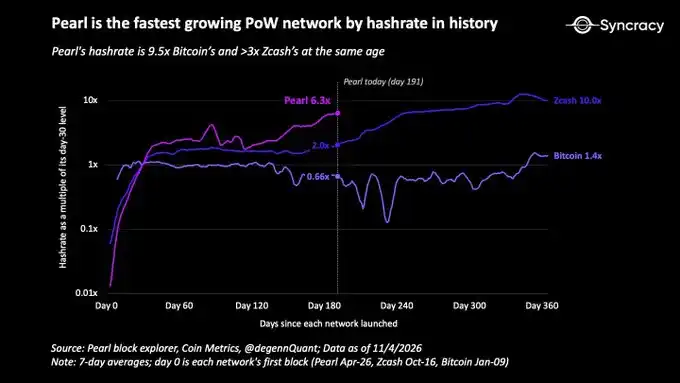
A year later, the two teamed up with a third co-founder, Idan Sugarman, to launch Pearl in a manner similar to Bitcoin. Today, Pearl has become the fastest-growing proof-of-work cryptocurrency to date.
Pearl and the Trends of the Era
Over the next decade, two forces will profoundly affect global financial markets. The first is the dilution of the dollar's purchasing power and the resulting demand for new stores of value. The second is AI and an unprecedented scale of infrastructure buildout around it.
U.S. fiscal deficits are rising structurally, and since the COVID-19 pandemic, the federal debt burden has also been climbing at an accelerating pace; it is against this backdrop that the dollar's purchasing power is being diluted. At the same time, recurring trade frictions and geopolitical conflicts continue to weaken confidence in the United States as a counterparty. Together, these changes have awakened market interest in non-sovereign store-of-value assets, whose total value has exceeded $32 trillion.
In the past, Bitcoin has been the asset with the greatest elasticity for exposure to this theme. Its relatively small market capitalization means capital can more easily move its price, and compared with physical assets such as gold and silver, it also has structural advantages. Bitcoin's scarcity can be verified, verification costs are low, and transfers are convenient. Perhaps equally important, in an increasingly digital and cross-border world, Bitcoin is more intuitive to people.
While the dollar's purchasing power is being diluted, the world is also undergoing a historic AI infrastructure buildout. AI differs from previous software waves in that it requires a large amount of physical infrastructure, including GPUs, data centers, and power. These are all necessary inputs for processing training and inference tasks.
The scale and speed of this buildout cannot be overstated. Goldman Sachs estimates that from 2026 to 2031, AI infrastructure investment will reach approximately $7.6 trillion. At the same time, the pace of construction far exceeds that of any large-scale project in history. It is no surprise that over the past three years, infrastructure assets providing the "shovels and picks" for AI have become the hottest trading theme in financial markets.
We believe Pearl sits at the intersection of two trends—dollar purchasing power dilution and AI—making it one of the assets best suited to the current market environment. At the very least, Pearl offers a creative, asymmetrical risk-reward way to participate in this once-in-a-generation AI data center expansion. If things go well, it has the potential to become a true competitor to Bitcoin and a better fit for the AI era.
Latecomers Rise to the Top
In emerging technology sectors, pioneers rarely end up as the ultimate winners. Many projects arrive too early, before supporting infrastructure is in place and before regulation becomes clear. Others are weighed down by architectural decisions made under early-stage constraints. In either case, latecomers can learn from early experience and build on the foundation laid by pioneers. The most successful projects, such as Hyperliquid, tend to first find a wedge in the market that they can go deep on, then gradually scale from there until they achieve their ultimate goal.
From this perspective, Pearl's launch is well timed. First, Bitcoin took nearly two decades to prove that proof-of-work can serve as a credible foundation for digital money. Along the way, Bitcoin taught the world the value of scarce, non-sovereign assets. Businesses such as exchanges, custodians, and wallets grew up around it, forming an entire industry. It also drove a revival of open-source cryptography, and since then, major progress has been made in privacy and scaling technology.
Pearl can inherit all of this while designing its own network from scratch. For example, quantum-resistant support is already live on the mainnet. Native privacy features are in development and may launch in 2027. AI agent-assisted programming and formal verification are expected to make upgrades faster and safer. Top exchanges and custodians are also stepping up their support. Pearl's mining economics are being built on this round of unprecedented AI infrastructure expansion. In the long run, the same infrastructure could also become the backbone of a global forward computing power market, which we will discuss further below.
This leads to our second point. Pearl is addressing Bitcoin's biggest structural flaws—problems that only gradually emerged after Bitcoin had been running in the real world for years.
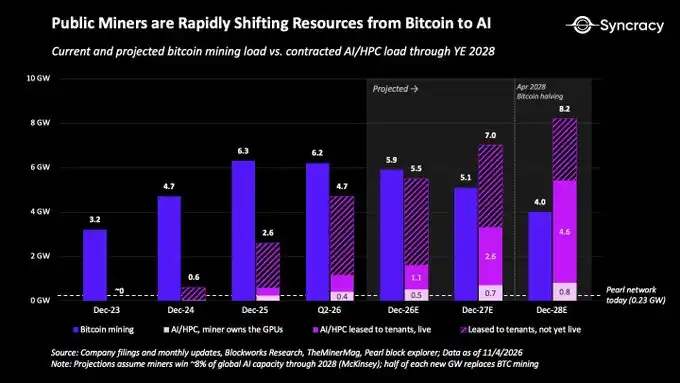
Chief among them is Bitcoin's long-term security model. As block subsidies decline and AI offers alternative uses for the same scarce resource, Bitcoin's hashpower is facing structural pressure. **Between 2026 and 2028, listed mining companies have already contracted up to 44% of their power capacity (measured in megawatts) to AI and high-performance computing (HPC) operations.** This trend is accelerating.
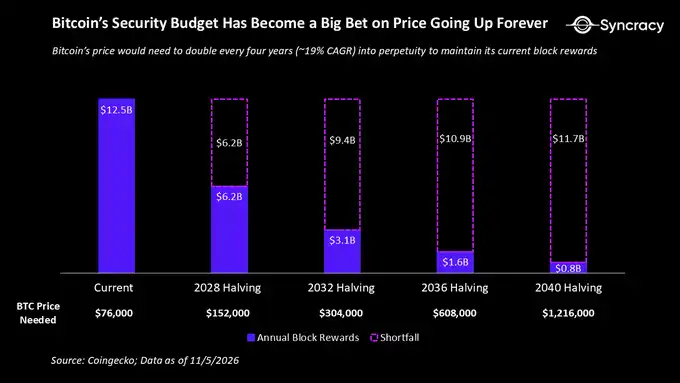
The logic behind this is straightforward. Bitcoin mining was already difficult, with low profit margins and significant cyclical volatility. At the same time, by Bitcoin's design, the issuance of new coins halves every four years. To keep the value of mining rewards unchanged, the price of Bitcoin would have to double every four years indefinitely, equivalent to a compound annual growth rate of about 19%. For an asset with a market capitalization already in the trillions of dollars, this is extremely difficult to achieve. Mining companies can use the same electricity and data center resources to take on AI business, thereby obtaining higher-margin, more predictable, and longer-duration revenue.
Initially, Satoshi Nakamoto envisioned that Bitcoin's transaction fee market would gradually develop and eventually replace the rewards from new issuance. But Bitcoin failed to scale, ultimately primarily assuming the function of a store of value, and the fee market did not mature as envisioned. The payment network failed to develop, and no application ecosystem formed on top of Bitcoin. As a result, Bitcoin's security budget has become a massive bet that the coin price will rise forever. For a store-of-value asset, this foundation is quite fragile, because what matters most for such assets is long-term survival.
To some extent, Bitcoin's long-term security problem stems from the difficulty its developer community has in driving changes. In theory, if the community were willing to introduce permanent inflation or attempt to scale for payment use cases, this problem could potentially be solved. However, the community chose a strict philosophy centered on protocol ossification. This improved stability and enhanced user confidence, but made it harder for Bitcoin to adapt to external changes in a timely manner.
We believe that for any blockchain hoping to serve as money, stability is an important long-term goal. But has Bitcoin ossified too early? The reality is that the world keeps changing, and powerful new technologies are emerging everywhere. Quantum computers capable of breaking Bitcoin's signature scheme are already on the horizon. AI has the potential to automate cryptanalysis and accelerate the discovery of classical-computing-based attack methods. AI agents are expected to push transaction demand up by orders of magnitude, while the number of transactions Bitcoin processes per second is almost the same as it was 17 years ago.
These changes bring both opportunities and problems that need to be proactively addressed. Migrating to quantum-resistant signatures alone would require one of the largest coordinated actions in Bitcoin's history. Even if the community can reach consensus on which quantum-resistant signature to adopt, how to handle all the already lost Bitcoin remains an unresolved issue. This includes the 1 million BTC held by Satoshi Nakamoto, about 5% of the total supply. In addition, if quantum-resistant signatures are added without a corresponding increase in block capacity, Bitcoin's throughput will almost certainly decline further, making it unacceptably slow for payments.
We hope Bitcoin can figure out a solution. At the same time, we are also preparing for another future and remain open to "latecomers surpassing the incumbents." We have already seen this script play out in Hyperliquid's rise above its predecessors, and we profited from it. If it happens again here, we would not be surprised.
The P-Day Is Approaching
What drew us to Pearl's investment thesis was both the scale of the potential returns and how quickly they could materialize. Our judgment revolves around a concept we call "P-Day," the day Pearl's hashpower surpasses Bitcoin's. We believe this day could arrive before the end of this decade, meaning Pearl is poised to become the world's most secure proof-of-work cryptocurrency within just a few years.
Hashpower matters because in proof-of-work networks, it is the clearest and most easily measurable proxy for security. Simply put, hashpower represents how much computational resource miners devote to extending the honest chain, and it also reflects how much computational power an attacker would need to overpower that chain. Hashpower has its limitations as a security measure—for example, hardware availability, full-node decentralization, and miner concentration are equally important. Nevertheless, in proof-of-work systems, hashpower remains the quantitative data closest to a real-time security metric.
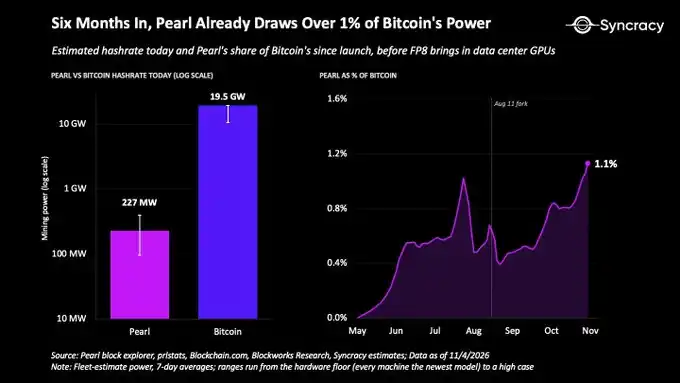
Note: Bitcoin and Pearl perform different computations, so their raw hashpower units cannot be directly compared. This section uses "hashpower" as a unified term for the computational and energy resources that provide security for each respective network.
Why might Pearl reach P-Day so quickly? The answer starts at the GPU kernel layer. Think of a kernel as a highly optimized small program that precisely instructs the GPU on how to complete a specific computation. For Pearl, this code is responsible for enabling the GPU to efficiently perform matrix multiplication. Matrix multiplication is the core of modern AI inference, so the kernel is where Pearl plugs into the AI technology stack.
GPU kernel development is one of the most underappreciated core capabilities of the Pearl team and, in the long run, could become a significant strategic advantage. The team has assembled a group of world-class inference optimization engineers focused on maximizing the speed of the matrix multiplication that supports Pearl mining.
The immediate goal is to drive the overhead of Pearl mining down to near zero. At that point, AI cloud service providers can complete inference tasks their customers have already paid for while mining PEARL at zero incremental cost. If the team can achieve this, plugging into Pearl mining becomes the obvious choice for every cloud service provider.
Even more noteworthy is that Pearl may even achieve "negative overhead"—that is, developing kernels faster than inference providers' existing solutions. Although this is not the core of the investment thesis and would likely take years to realize, early evidence already suggests this possibility is worth watching.
Just two months ago, the team developed a general matrix multiplication (GEMM) implementation optimized for the Blackwell architecture. On some workloads, its speed was about 15% faster than the strongest competing operator. Recently, the team also introduced the PearlQuant optimization solution, significantly reducing the VRAM required to handle long-context AI tasks and increasing peak throughput by 24% in a Blackwell benchmark test. These two achievements act on different parts of the inference technology stack, but together they present a possibility for Pearl's future: the fastest way to run AI can also mine Pearl along the way.
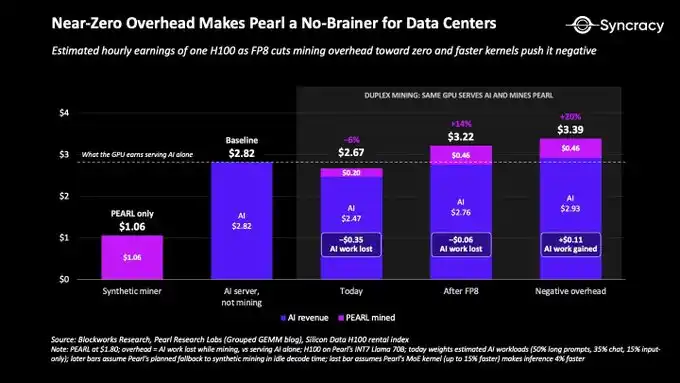
As Pearl's mining overhead declines and related operators begin to cover the latest AI hardware and inference numerical formats, we expect its computing power to climb rapidly.
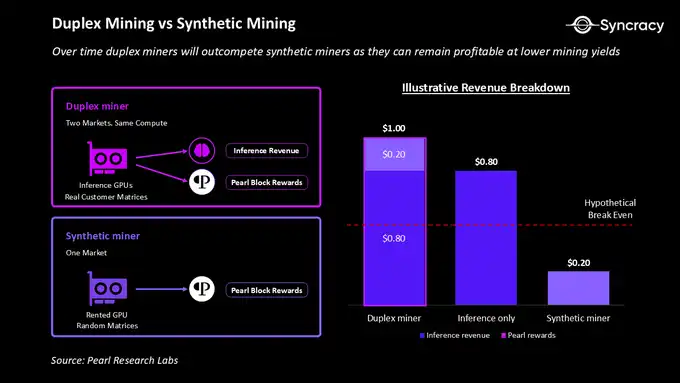
At the core of this logic is the "duplex miner." These miners are service providers operating AI infrastructure and can earn two revenue streams from the same GPU workload—one from providing useful inference services and the other from mining PEARL. The other type is the "synthetic miner," whose sole purpose in doing matrix multiplication is to earn block rewards. In the long run, the economics will favor the former. Even if mining yields fall low enough to force synthetic miners to shut down, duplex miners can still be profitable.
We believe the planned FP8 upgrade will be an important catalyst for this shift. Currently, Pearl mining uses integer matrix multiplication, while modern AI data centers increasingly run inference tasks using low-precision floating-point formats such as FP8. Therefore, according to what we have verified with miners, about 80% of Pearl mining is currently done by consumer-grade GPUs, most of which are located in China. Enterprise-grade GPUs used by emerging GPU cloud service providers have not yet become dominant.
The FP8 upgrade is expected to reduce the current mining scheme's roughly 5% extra overhead to near zero and will also make the network's existing consumer-grade GPUs uncompetitive. As this change occurs, we expect the share of computing power from useful inference tasks in data centers to continue rising, the share of synthetic mining computation to decline accordingly, and the network's total computing power growth rate to accelerate significantly.
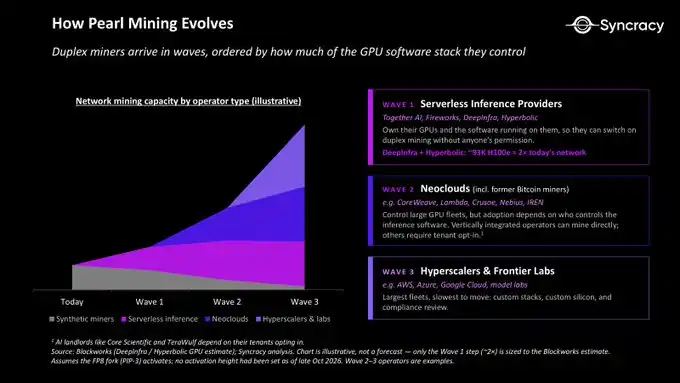
The first wave of adopters is expected to be serverless inference service providers such as Together AI, Fireworks, DeepInfra, and Hyperbolic. They control the software stack and also operate large-scale GPU resource pools. Blockworks estimates that DeepInfra and Hyperbolic alone control about 93,000 H100-equivalent GPUs that could be used for mining after the FP8 upgrade. Once these resources are connected, they would be enough to nearly double Pearl's current total network computing power overnight.
Going forward, we expect adoption to expand upward along the industry chain, covering emerging GPU cloud service providers, including companies transitioning from Bitcoin mining, and ultimately extending to hyperscale cloud service providers and frontier AI labs. These institutions control computing power orders of magnitude higher than the first batch of adopters, but introducing them is much more difficult due to their use of proprietary software stacks, long-term commitments to customers, and extremely large operational scale.
Specifically for Bitcoin mining companies, companies like IREN that are transitioning into full-stack AI computing power operators may be attractive partners for Pearl. Enterprises such as Core Scientific and TeraWulf that are transitioning into AI infrastructure lessors will likely depend on whether tenants are willing to connect.
In the short term, we expect Pearl mining adoption to remain primarily concentrated among serverless inference service providers. However, given the team's industry relationships, we believe that in the long term, Pearl is positioned to connect to larger-scale platforms.
For example, just weeks after mainnet launch, emerging GPU cloud service provider Together AI, valued at $8 billion, announced an exclusive partnership with Pearl. The first product launched by the two parties is an inference service endpoint that can mine PEARL while processing customer requests. The mined PEARL is used to subsidize inference pricing. Together positioned this integration as the first of several Pearl-supported products.
As of now, according to our verification, Together has not sold its mined PEARL on a large scale. This detail is important because a common concern in the market about Pearl is that excessive early issuance will create too much selling pressure in the coming quarters. We believe Together's approach provides a reference for judging future partnership models and alleviates this concern to some extent.
Through conversations with miners, we have increasingly realized how powerful proof of work is in driving adoption. Mining largely generates an "IKEA effect": miners tend to assign higher value to what they produce themselves. Participation in proof-of-stake blockchains is too easy to generate this feeling. Proof-of-work miners must compete day after day to maintain their share of rewards and continuously optimize their mining configurations. We believe this creates a real sense of ownership.
A sense of ownership is important because the most passionate communities in crypto are often built on ownership. In many ways, crypto operates similarly to religion. Shared belief leads holders to actively spread the word, and economic participation reinforces their identity. Mining provides Pearl with a powerful mechanism to turn AI infrastructure operators into believers and holders.
From a longer-term perspective, as Pearl gets closer to becoming the world's largest distributed computer, the AI industry that provides computing power for it may gradually come to view PEARL as its own native store-of-value asset. If this judgment holds, a global race to accumulate PEARL could erupt, with institutions and individuals possessing large-scale GPU clusters potentially participating.
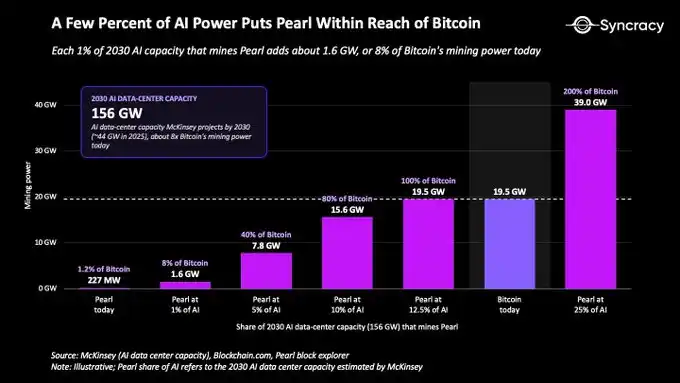
As previously mentioned, Pearl is already the fastest-growing proof-of-work network to date. According to our estimates, only a small fraction of the world's AI data centers would need to participate in Pearl mining to bring about P-Day. We believe that day may come sooner than anyone expects. As P-Day approaches, the landscape of the digital store-of-value market could undergo dramatic change.
Returns Come with Risks
Pearl's investment thesis faces several short-term risks. For example, could an excessively high initial issuance suppress price increases? Can Pearl reduce mining costs enough for AI data centers to adopt it at scale, thereby expanding participants beyond pure mining miners? These questions are indeed important, but they more reflect that the network is still in its early stages, with impacts concentrated in the short term.
More noteworthy are structural risks. These issues will take years for the market to digest. Some of the risks mentioned below may only become important after PEARL's price is much higher. Even so, they are worth unpacking because they reveal the most fundamental logic underlying the Pearl investment thesis.
"Useless Work" Also Has Value
Bitcoin-specific application-specific integrated circuits (ASICs) can only mine Bitcoin. This adds an extra layer of security to Bitcoin's block reward mechanism. If miners launch a 51% attack on Bitcoin, the ASICs in their hands would depreciate. Destroying Bitcoin is equivalent to economically self-destructing.
Pearl has weaker constraints in this regard. Miners who use GPUs to launch a 51% attack on Pearl would lose future block rewards, but the hardware itself still retains considerable value because these GPUs can be repurposed for other scenarios. Since the hardware still has uses outside the network, all else being equal, Pearl is less secure than Bitcoin, and looking only at hash rate may also overestimate the true economic cost of launching an attack.
The counterargument is that as Pearl reaches a sufficiently large scale, this gap could narrow significantly. If Pearl becomes deeply integrated into the inference industry, mining rewards would become a meaningful revenue item in GPU economics. At that point, data centers not participating in Pearl mining would be at a structural disadvantage relative to peers that do participate. In this equilibrium state, attacking Pearl would simultaneously destroy future block rewards and part of the GPUs' own economic value. Therefore, the difference between Bitcoin and Pearl ultimately lies in the degree of this dependence. The value of Bitcoin ASICs comes almost entirely from Bitcoin, whereas only part of the value of GPUs participating in Pearl mining comes from Pearl.
At Pearl's current scale, virtually no rental market in the real world can provide the number of GPUs needed to attack it. In addition, hyperscale cloud providers with sufficient compute capacity must handle customer workloads and fulfill contractual obligations. Mobilizing GPU clusters to launch an attack is not economically realistic. Therefore, discussing a 51% attack on Pearl is more about discussing a theoretical risk.
It is worth noting that Bitcoin's reliance on specialized hardware is itself one of the important reasons for its hash rate drain and security budget pressure. Bitcoin is competing with AI for energy and is losing. Pearl, by contrast, can gain compute power from this round of AI expansion. We believe that in the long run, Pearl is expected to build a larger and more durable security foundation than cryptocurrencies that rely on specialized hardware, such as Bitcoin and Zcash, and the short-term trade-offs are therefore easier to accept.
Do we still need proof of work?
Proof of useful work (PoUW) is a remarkable technical achievement. We can leverage the largest infrastructure construction wave in history to avoid billions of dollars in new compute and energy infrastructure investment. Pearl can expand in sync with AI while avoiding unnecessary energy consumption in the process.
If one holds that proof of work is a necessary condition for cryptocurrency, this logic is quite compelling. But from the birth of Bitcoin's genesis block in 2009 to 2026, consensus mechanism design has made tremendous progress. Proof of stake (PoS) has become a credible alternative that does not require extreme levels of compute and energy. It also enables blockchains to provide absolute finality for transactions and push performance to higher levels. So what value does proof of useful work still have?
The biggest benefit of proof of work lies in its objectivity. Anyone in the world can independently verify the state of the chain by finding the chain with the greatest cumulative work. Proof of stake has a certain subjective component: new nodes need to download the current state from other nodes and trust that what they provide is indeed the latest state. In practice, on mature networks such as Ethereum and Solana, new proof-of-stake nodes have a high degree of confidence in finding a trustworthy starting point. Many operators, such as block explorers, have strong incentives based on economic interests and reputation to maintain reliable, promptly updated nodes. However, if the goal is to maximize security and reduce assumptions about the trustworthiness of others, grounding the process in the fundamental laws of the physical world is more advantageous than relying on social consensus.
Staunch supporters of proof of work also argue that assets using this mechanism have an advantage in supply distribution. Miners must compete to maintain their share of rewards, and thin profit margins often force them to sell coins, thereby dispersing new supply into the market. Under proof of stake, stakers can obtain a certain percentage of rewards over the long term simply by continuing to stake, without bearing much expense. In other words, proof-of-work token issuance has a real cost, while proof-of-stake tokens can be issued at almost zero cost. If part of an asset's value comes from the cost of creating its supply, proof of work has a clear advantage.
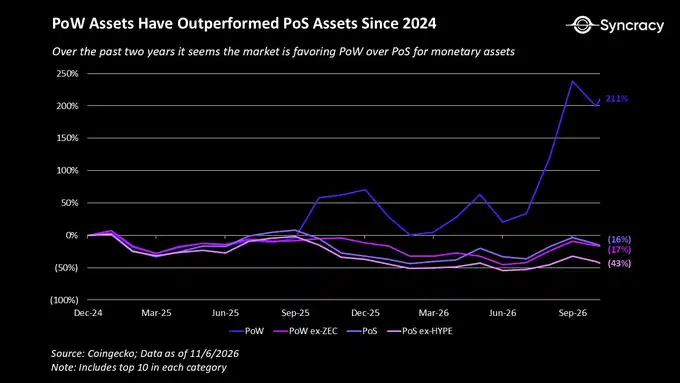
Frankly, there is no standard answer as to which consensus mechanism is better. Networks like Ethereum believe the trade-off is worthwhile, and so they transitioned from proof-of-work to proof-of-stake, hoping to achieve roughly the same results with greater efficiency. So far, the market seems to prefer proof-of-work for monetary assets. We see this as a signal that Pearl is heading in a favorable direction.
Pearl may never ossify, and that is by design
Matrix multiplication itself is stable, but the numerical formats AI uses to perform this computation are constantly evolving. This means Pearl needs to periodically update its consensus algorithm so that miners can still provide security to the network while performing economically valuable computation.
This has already been reflected to some extent. Since April, Pearl has completed four forks and plans another fork to support FP8. We expect that as Pearl matures, the frequency of forks will decrease. However, because it is tightly coupled to the development of frontier AI, the protocol will not gradually ossify like Bitcoin.
Bitcoin's consensus algorithm is largely ossified because it does not need to keep up with any off-chain technological changes. SHA-256 in 2009 is exactly the same as SHA-256 in 2026. Bitcoin can adapt to growing network hashpower solely through its difficulty adjustment algorithm.
The reason to pay attention to this is that stability is a fundamental attribute for a monetary network to build user confidence. Knowing that the monetary infrastructure you rely on will not change overnight helps people sleep better at night.
However, protocol ossification has its limits. First, complete ossification is impossible. Even Bitcoin will eventually need to address quantum computing and potentially more fundamental cryptographic changes. Bitcoin may also need to add new features as market demands change. Furthermore, if ossification makes it difficult for the network to respond in a timely manner to external changes that could have catastrophic consequences, ossification itself becomes a security risk.
Perhaps having an active core developer community dedicated to continuously improving the network is a trade-off worth making. Developers are ultimately still constrained by full nodes, because full nodes decide which software and consensus rules to accept. As long as each upgrade preserves the core attributes of the monetary system, such as the supply schedule, users may not mind. AI agent-assisted programming and formal verification are also expected to make network upgrades increasingly safe.
Ultimately, it is worth asking: in this extraordinary period of accelerating technological change, is it really a bad thing to have a team of top AI researchers and mechanism design experts dedicated to making Pearl the best monetary network in the world?
There are strong reasons to believe that AI is the first paradigm shift in computing since the birth of Bitcoin. It may require blockchains to redesign some underlying mechanisms from both technical and ideological perspectives, and we would not be surprised by this. Most past projects that claimed to be "better Bitcoin" made adjustments on top of Bitcoin, striving for similar results. Pearl, on the other hand, has the opportunity to make fundamental changes and move toward a result that is different from Bitcoin and potentially better.
Pearl Lacks Practical Use Cases
As mentioned earlier, there is a credible path for Pearl to surpass Bitcoin in security in the coming years. But is security alone enough to make Pearl a differentiated asset? If users' experience with the asset and network feels the same as before, how much difference does enhanced security make to them? What users directly perceive are specific features; security is often imperceptible.
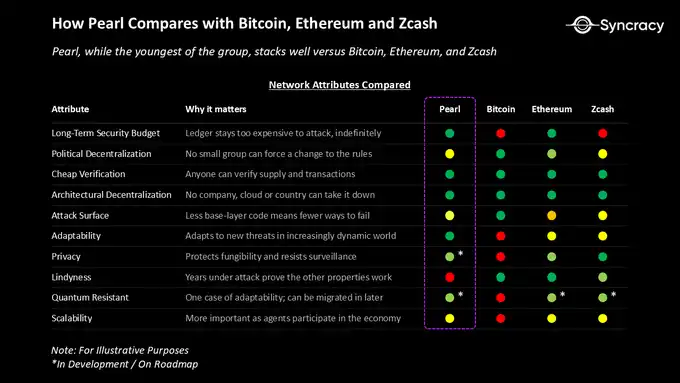
Ethereum has smart contracts, making money programmable. Zcash has privacy features, allowing users to transfer anonymously. Today's Pearl is almost identical to Bitcoin, with its primary use being the transfer of assets on a public, transparent ledger.
This simplicity is not a problem in itself. In fact, on the scale of civilizational evolution, store-of-value tools may be better the simpler they are. Programmability and privacy features can broaden cryptocurrency's use cases and bring in more users, but they also expand the blockchain's attack surface. What makes Bitcoin special is that it minimizes these risks as much as possible, giving users greater peace of mind. Therefore, from certain angles, Pearl at this stage is precisely a Bitcoin competitor focused on store of value.
However, what features Pearl will have in the future remains undetermined. It has only been live for five months, and the network is still in its early stages of development.
We believe this ultimately represents an opportunity. As mentioned earlier, as a latecomer, Pearl can draw on the strengths of already mature technologies and integrate them according to its own needs. The team has publicly stated that native privacy features are under development and believes that any future digital store-of-value tool should treat privacy as a baseline configuration.
Pearl's more ambitious vision may be to establish a forward computing power market. If our assessment of Pearl's computing power growth rate is correct, by the end of this decade, Pearl could possess the world's largest distributed GPU cluster. In such a scenario, this infrastructure could be used to sell future computing power. Buyers could lock in computing power usage rights months or even years in advance, with Pearl verifying computing power delivery and settling agreements on-chain.
This vision has enormous potential because it could give PEARL a more substantive role in the AI economy. This carries even more weight in a world where economic output increasingly depends on computing power.
Currently, useful computation can produce PEARL, but holding PEARL does not directly allow one to purchase useful compute power. Pearl's native compute marketplace can bridge this gap, making PEARL a settlement asset for forward compute. In this way, AI labs can lock in compute power on the open market, reducing their reliance on custom agreements with hyperscale cloud providers and emerging GPU cloud service providers.
None of these proposals have been finalized. We expect that teams will gradually disclose more details across various aspects in the coming months and over the next few quarters. There is still significant room for expansion in the network's practical utility.
Beyond Bitcoin Standard
"There's a war going on outside no man is safe from.
You can run, but you can't hide forever."
— Mobb Deep
Over the past three years, we have spent a great deal of time researching the intersection of AI and blockchain. We have encountered many interesting ideas and have actually traded several of these projects. But to date, none has combined a credible path to implementation with such asymmetric potential returns as Pearl.
Frankly, when we first encountered this idea, we found it somewhat heretical. Can AI infrastructure really create a currency "harder" than Bitcoin? Does the market really need such a project? However, the deeper we researched, the more this investment thesis made sense to us.
What makes Pearl a particularly special opportunity is that it rarely brings together three conditions: a timely external environment, a credible path to scale, and enormous potential returns. Essentially, this is an opportunity to reimagine currency in the AI era.
This opportunity exists because quantum computing and security models are raising fundamental questions about Bitcoin's long-term survival. Entering 2026, Bitcoin still has no answers to two issues. This gives new competitors a multi-year window to capture market share.
This opportunity also stems from the once-in-a-generation AI infrastructure expansion the world is currently undergoing, the scale of which could potentially exceed any buildout in history. Standing in 2026, Pearl has the opportunity to leverage this infrastructure to create a cryptocurrency with security surpassing that of Bitcoin. The measure here is the computational and energy resources deployed by the two networks.
At the core of Pearl's investment thesis is its latecomer advantage—the ability to absorb the lessons of predecessors and integrate the best technologies that the industry has developed to date.
As the marginal cost of Pearl mining approaches zero, its hashrate growth will outpace any cryptocurrency in history and could potentially surpass Bitcoin within just a few years.
Alongside hashrate growth, Pearl can simultaneously integrate advanced features such as quantum resistance and native privacy. Bitcoin does not yet possess these two capabilities, which will give Pearl a distinct advantage.
As the network evolves, Pearl has the opportunity to address the demand side, giving the token practical utility beyond mining and holding. Once the network aggregates enough GPUs, it can host an open compute marketplace where users can use PEARL to acquire AI compute and settle transactions.
Ultimately, we believe the digital store of value market represents a multi-trillion-dollar opportunity, and its market share will likely continue to follow a power-law distribution, with a few winners capturing the lion's share. Bitcoin has led this market since its inception, but we believe this space is entering a period of transformation, opening room for new assets better suited to the future environment.
From an investment perspective, even if Bitcoin retains the top spot, Pearl has the opportunity to deliver substantial returns. Relative to its current starting point, even if Pearl's market cap reaches just a low-to-mid single-digit percentage of Bitcoin's market cap, that would already be an excellent outcome.
How far Pearl can ultimately go, only time will tell. The one thing we can be certain of is that one of the largest experiments in the cryptocurrency space in years has only just begun.
Welcome to join the official BlockBeats community:
Telegram Subscription Group: https://t.me/theblockbeats
Telegram Discussion Group: https://t.me/BlockBeats_App
Official Twitter Account: https://twitter.com/BlockBeatsAsia
 Related Articles