Those who invested in Anthropic, what happened to them later?
The original title: "What Happened to the People Who Invested in Anthropic"
The original author: Sleepy
At 9 AM Beijing time on November 19, Anthropic set its IPO price at $83 per share, above the previous range of $70 to $78. ANT will officially begin trading that evening.
The offering size was also increased at the last minute, from 825 million shares to about 980 million shares, raising $81.3 billion. By initial offering size, it surpassed SpaceX's $75 billion in June this year, becoming the largest IPO in history.
According to Bloomberg, the subscription multiple was already close to 7 times before the order book closed. On a fully diluted basis, the offering price corresponds to a market value of about $1.5 trillion, roughly 50% higher than the $965 billion of the May H round.
Its revenue curve is almost vertical. In 2023, Anthropic's revenue was $41 million, $386 million in 2024, and $4.585 billion in 2025. In the first three quarters of this year, it was $33.24 billion, with the third quarter alone nearing $17 billion. By the end of October, its annualized revenue was about $81 billion. The prospectus claims Claude is the fastest-adopted technology in enterprise history.
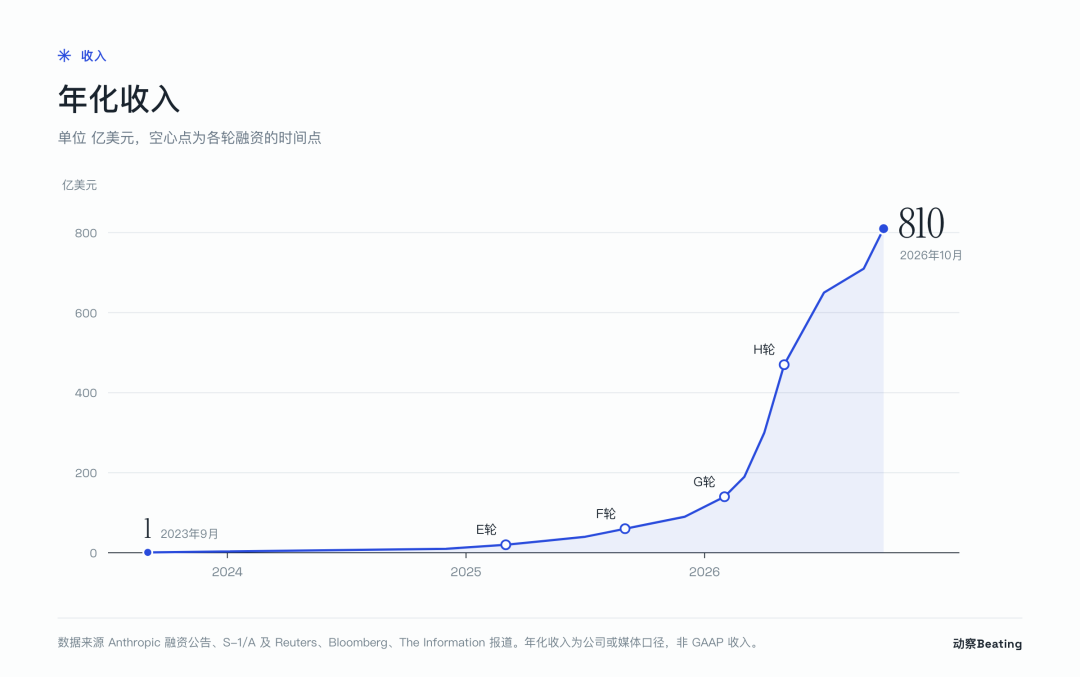
Five years ago, its first external financing was only $124 million. The lead investor publicly said he was extremely afraid of AI.
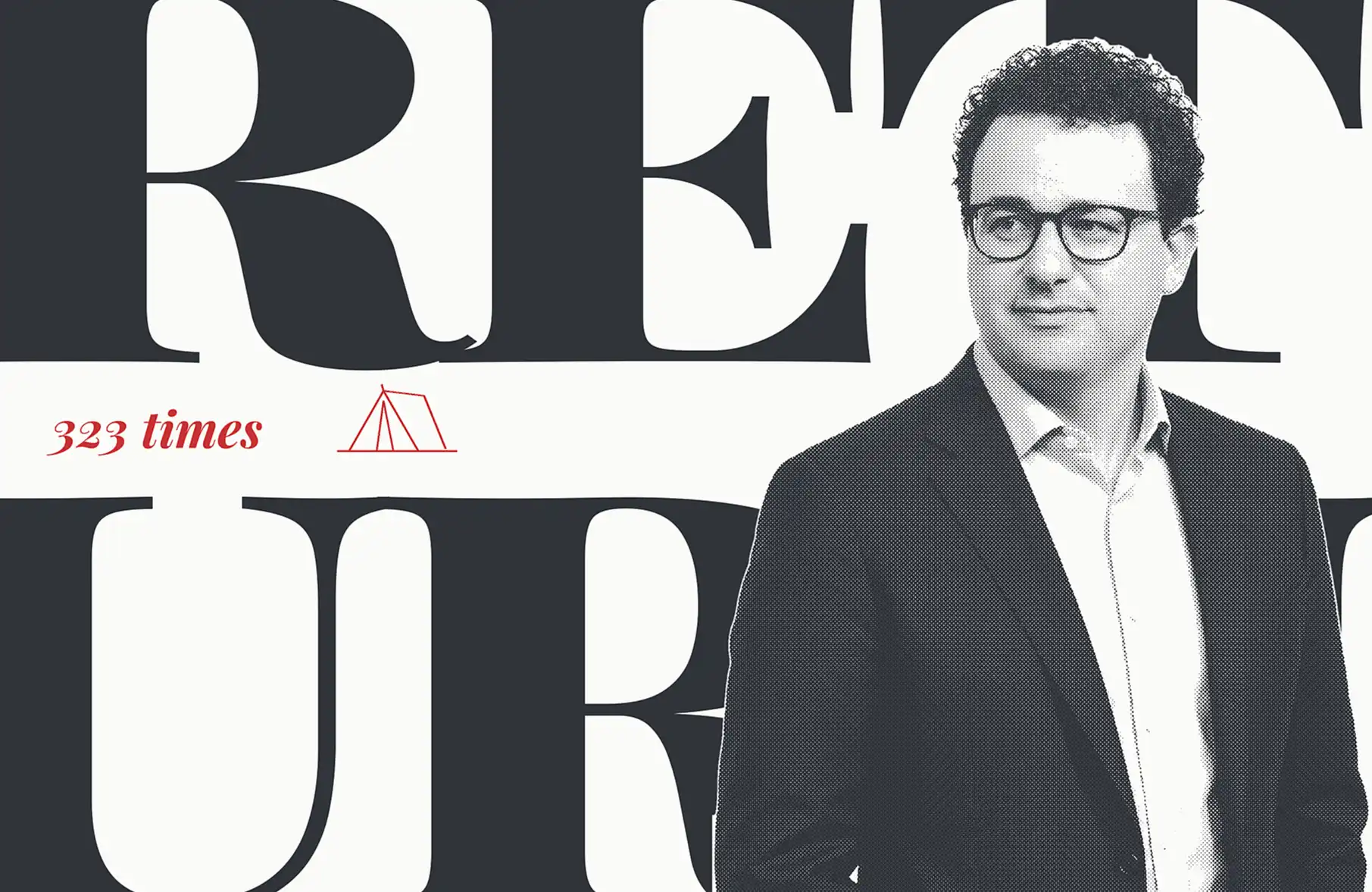
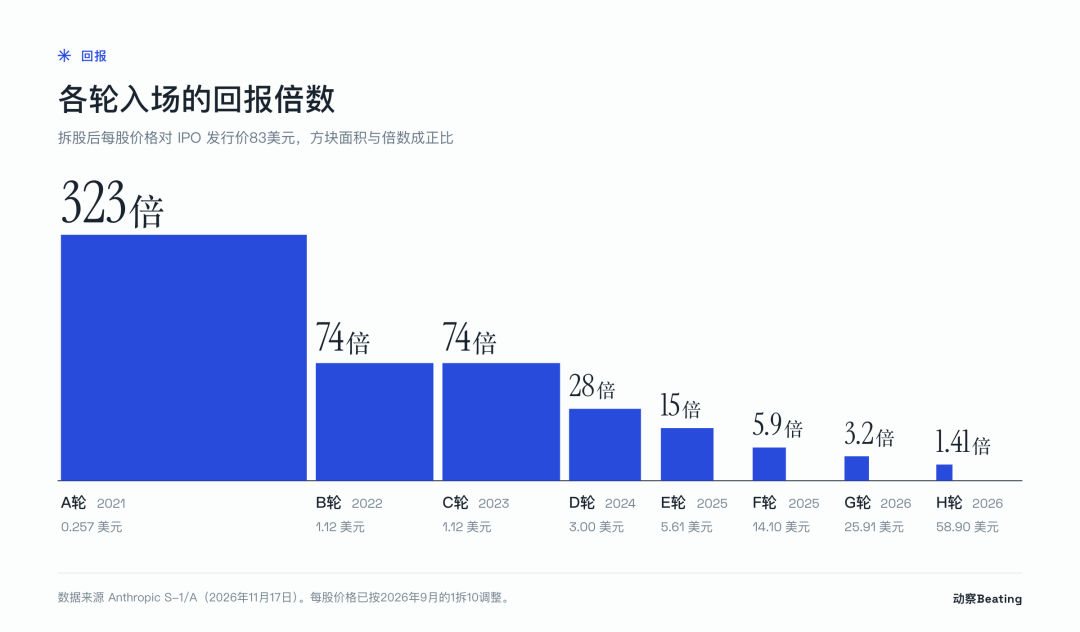
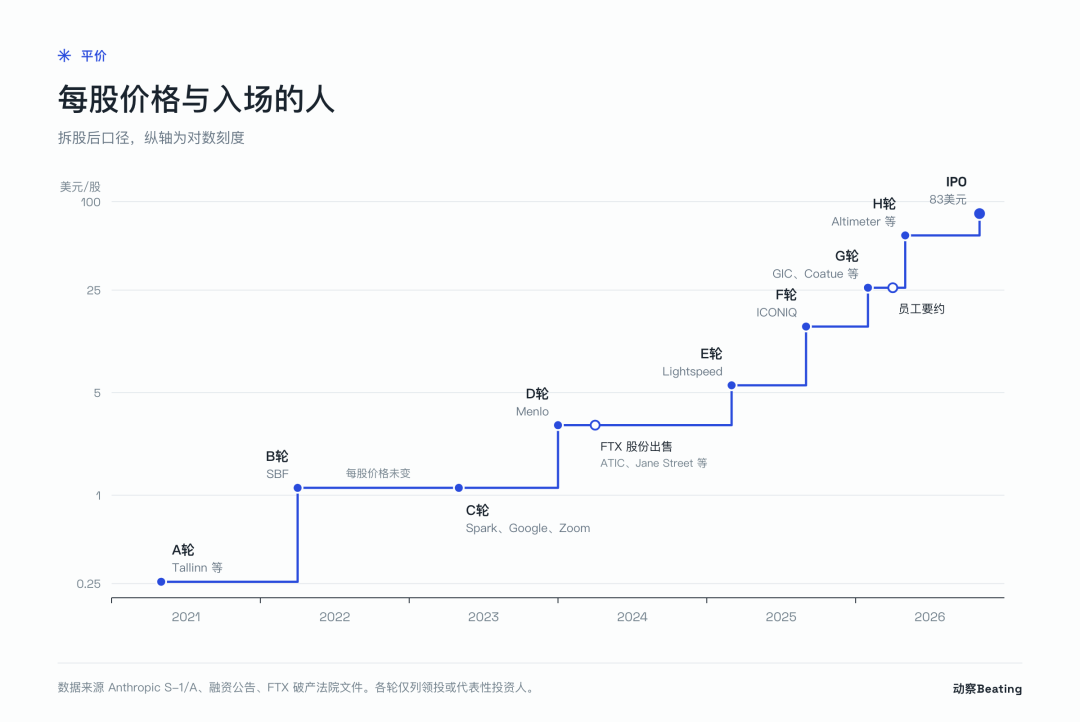
This S-1 shows the per-share price of every round for the first time. On a post-split basis, the 2021 A round was $0.257 per share, and the May 2026 H round was $58.9. At the offering price of $83, $1 from the A round is worth $323 today, and $1 from the H round is worth $1.41.
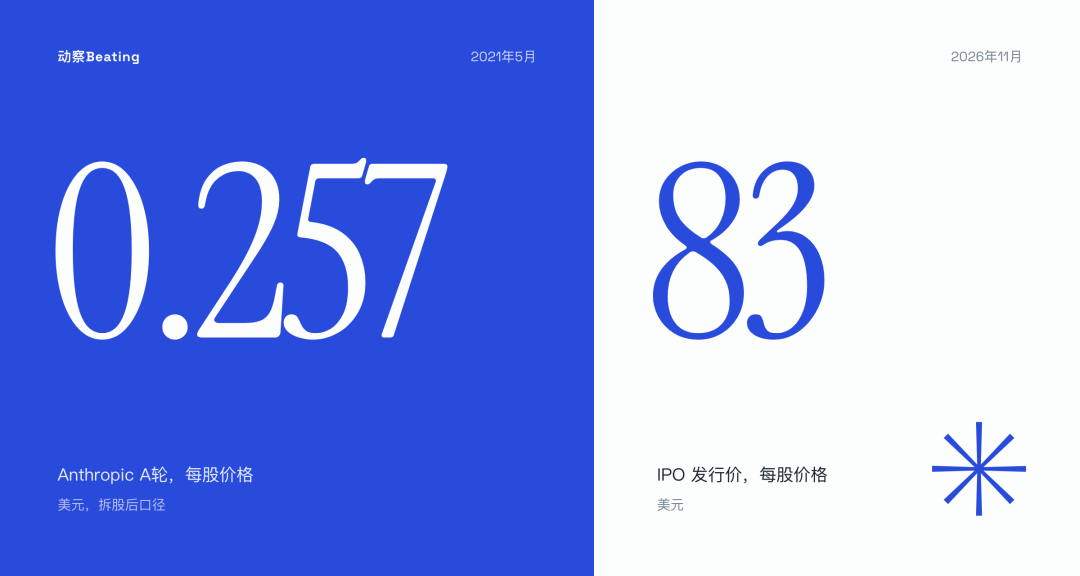
The earlier the money, the more afraid it was; the later the money, the more certain it was.
The afraid money made 323 times, and the certain money made 41%.
In between are five and a half years, eight rounds of equity financing, more than $40 billion in cash from two cloud vendors, a lawsuit with the Pentagon, and a person sentenced to 25 years in prison. Before the listing, all shareholders had invested about $137.3 billion in Anthropic in total, at a weighted average cost of $11.5 per share.
Money has memory, and it has personality too.
Beating finished reading this S-1 and its three amendments, and cross-referenced public reports from the past five years, trying to answer a simple question.
What happened to those who invested in Anthropic?
Non-capitalist money
In the spring of 2021, according to SF Standard, Dario pitched to Eric Schmidt and others from inside a tent in his sister Daniela's backyard.
At the time, no one thought this was a good business. Daniela later recalled that AI was not an exciting investment direction back then.
The person who helped make connections, Anjney Midha, was a friend of co-founder Tom Brown. He said on the 20VC podcast this year that he introduced Anthropic to 22 VCs, and 21 rejected it. According to the show summary, they originally wanted to raise $500 million in the first round, but ultimately scaled it down to just over $100 million.
On May 28, 2021, Anthropic announced the completion of a $124 million Series A funding round. It was led by Skype co-founder Jaan Tallinn, with participation from Dustin Moskovitz, Eric Schmidt, James McClave, and a Swiss organization called the Center for Emerging Risk Research (CERR).
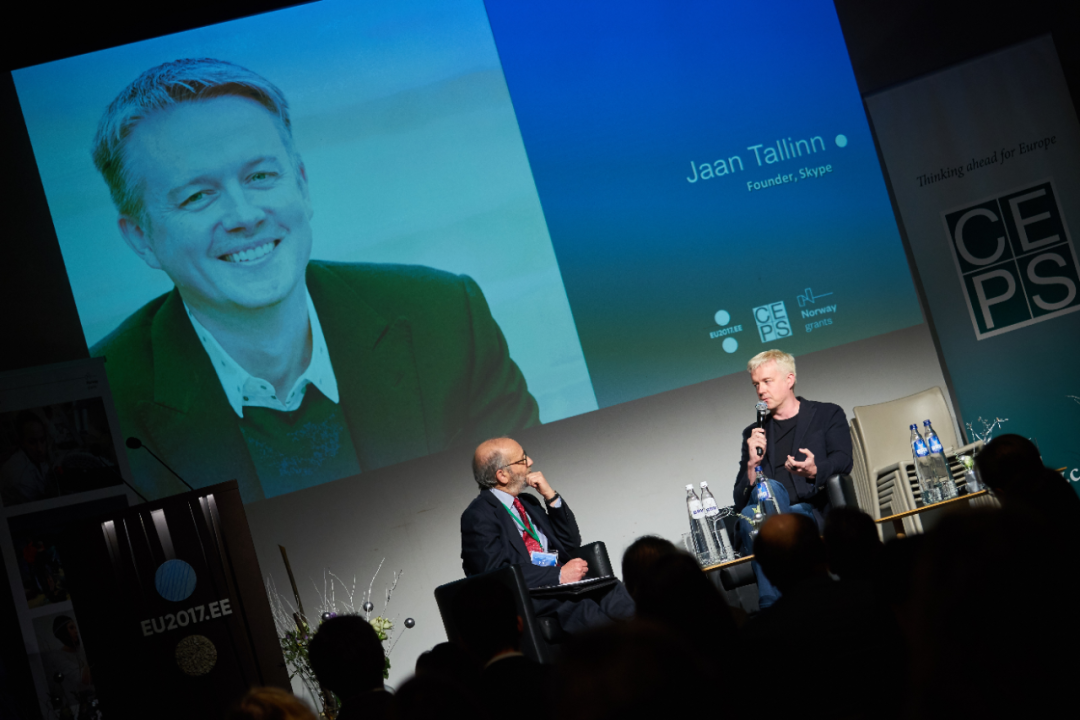
Jaan Tallinn at the Digital Europe seminar | Image source: Valdek Laur
There were almost no professional VCs on this list.
Tallinn is one of the oldest funders in the AI safety circle. According to WSJ, he has donated about $170 million to the AI safety field over the past decade. Moskovitz is a Facebook co-founder and the largest funder of the effective altruism movement. CERR is a nonprofit with an EA background. According to EA Forum materials, it later evolved into today's Macroscopic Ventures.
Tallinn and Dario knew each other very early. He told The Generalist in October this year that he had been hanging out with Dario since 2012. According to Semafor, the two met in the MIRI (Machine Intelligence Research Institute) circle. Interestingly, Dario at that time strongly opposed the views of the MIRI faction and belonged to the "empiricist" camp that believed in experiments and data.
In 2018, Dario wrote a long article titled "Big Blob of Compute," the core of which was to push Richard Sutton's "The Bitter Lesson" to its extreme: compute and data will crush all精巧 designs. Tallinn's reaction after reading it was, oh no, this is an engineering problem, not a scientific one.
So when he heard that Dario was leaving OpenAI, he immediately sought him out.
Tallinn said that before investing, he asked Dario to first get several offers from VCs to confirm that he was merely replacing money from VCs that would have invested anyway, rather than causing a company to exist that otherwise wouldn't have. So he said the first round essentially became "non-capitalist money."
His approach to investing was also unlike an investor's. According to a 2023 Semafor report, he gave up his own board seat to Luke Muehlhauser, an AI safety researcher at Open Philanthropy, because he wanted someone who could represent the things he was worried about. He told The Generalist that he doesn't need to be accountable to other investors, so he doesn't need to maximize his returns.
Non-capitalist money ultimately earned the highest return capitalism can offer.
At the offering price, shareholders in this round collectively held about 488 million shares, worth about $40.5 billion; a $1 million investment is worth about $323 million today.
How much Tallinn invested has never been disclosed. He does not appear in the prospectus's list of major shareholders, indicating a stake of less than 5%. The WSJ wrote a profile of him in September this year, estimating his net worth at about $12 billion. The article's headline was also quite interesting: a man terrified by AI is about to make billions more from it.
He has never concealed this tension. In 2023, he told Semafor that Anthropic is the lab he has seen that takes safety most seriously, but they are dealing with dangerous things, and he isn't sure they should be doing it.
That year, he also said something: "Plan A failed."
According to Semafor's report, he was referring to the plan to steer AI labs toward safety through investment. In March of that year, he signed the open letter from the Future of Life Institute (FLI) calling for a six-month pause on training, but Anthropic did not sign. Co-founder Jack Clark later explained to him that the company's policy is not to sign petitions.
Fear is also a kind of conviction.
Moskovitz went further. In early 2025, he and his wife Cari Tuna transferred their Anthropic shares into a nonprofit vehicle, citing the appearance of avoiding conflicts of interest. He said on social media that all these shares are in the foundation and he personally does not benefit. In November of the same year, the couple renamed their philanthropic organization Open Philanthropy to Coefficient Giving. Also in 2025, Moskovitz stepped down as CEO of Asana. He remains an observer on Anthropic's board.
Donating the shares did not shield him from scrutiny. In September this year, a blogger posted a long thread on X alleging that Anthropic's doomsday narrative was inflating the equity value of Moskovitz and his circle, and that this money was in turn funding organizations that evaluate Anthropic. The post received nearly 5 million views. The named evaluation organization METR denied receiving money from Anthropic.
Predecessor
Eric Schmidt is the least EA-like person on the Series A list.
The former Google CEO invested "tens of millions of dollars" in 2021. Bloomberg estimated in October this year that he holds about 1% of Anthropic, worth roughly $15 billion based on the fully diluted valuation corresponding to the issue price.
This investment is also quite interesting. It was Cami Clark who introduced him to Dario. She dated Schmidt for three years starting in 2011, began dating Dario in 2014, and later became Dario's wife. In 2018, three years before Anthropic was founded, Schmidt visited the couple's apartment. Fortune, recounting this episode, joked that in Silicon Valley, staying on good terms with an ex pays off.
In October this year, on the podcast In Good Company hosted by the CEO of Norway's sovereign wealth fund, Schmidt denied that AI is in a bubble, citing among his evidence that Anthropic's revenue growth rate was more than twice the fastest pace he achieved while running Google.
At that time, Anthropic's IPO was still a month away.
Beyond the Series A list, there is another name that only surfaced this year. According to a May report by the FT, Google DeepMind CEO Demis Hassabis was also an early angel investor in Anthropic, which had never been publicly disclosed before. The FT also mentioned that Dario has always regarded Hassabis as a role model.
As for James McClave, he appeared in both the Series A and Series B announcements. Five years later, it is still hard to find more information about him in public reports.
This is probably the most classic look of an early investor.
Legacy
On April 29, 2022, Anthropic announced a $580 million Series B, led by Sam Bankman-Fried.
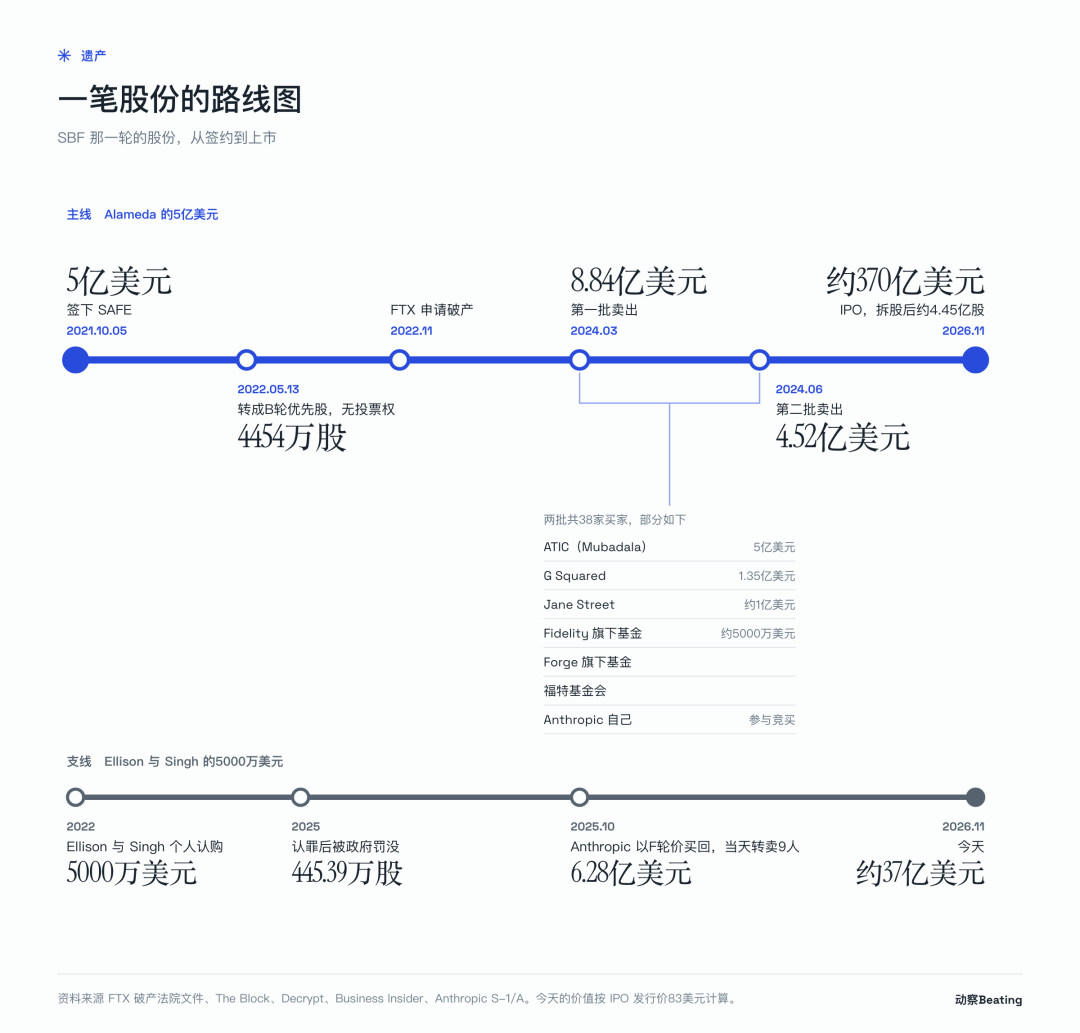
According to a report cited by Fortune, SBF and Anthropic were connected through a mutual acquaintance shortly after Dario left OpenAI. The entity putting up the money was a vehicle under Alameda Research controlled by SBF, with an investment amount of $500 million. The agreement for this money was signed as early as October 5, 2021, as a modified SAFE, and in May 2022 it converted at $11.2261 per share into about 44.54 million Series B preferred shares, accounting for about 13.56% of Anthropic at the time.
In the same round, Alameda co-CEO Caroline Ellison personally invested $10 million, and FTX engineering director Nishad Singh invested $40 million.
The prospectus contained a detail that almost no one noticed at the time. The Series B preferred shares were non-voting stock and could not participate in any board elections.
Half a year later, FTX collapsed.
One of Anthropic's largest external shareholders went bankrupt overnight. According to Fortune, Anthropic referred to Alameda in its 2023 fundraising deck as a "silent investor" and expected that these shares would be disposed of in the bankruptcy proceedings.
In February 2024, the Delaware bankruptcy court approved the sale of these shares. In March, the first batch of about 29.47 million shares sold for $884 million to 24 buyers. The largest was ATIC, under Abu Dhabi sovereign fund Mubadala, which put in $500 million. SBF and Ellison's former employer Jane Street bought about $100 million, a Fidelity fund bought about $50 million, and the Ford Foundation was also on the list.
According to Decrypt, the bidding list even included Anthropic itself, along with several SPVs named after Anthropic. In June, the remaining approximately 15.07 million shares were sold for another $452 million, with G Squared as the largest buyer, and a fund under Forge also purchased some.
The two batches totaled $1.336 billion, equivalent to about $30 per share, exactly matching Anthropic's early 2024 Series D price.
A bankrupt estate desperate to repay debts exchanged $500 million for $1.336 billion—a respectable exit.
But what if they hadn't sold?
After the stock split, these shares became approximately 445 million shares. At the issue price, they would be worth about $37 billion today, roughly 28 times the selling price at the time. ATIC's $500 million would now be worth about $13.8 billion. Jane Street's $100 million would be worth about $2.7 billion. According to Bloomberg Línea, in Q3 2025, Jane Street's private investments contributed approximately $830 million in trading revenue, most of it from Anthropic.
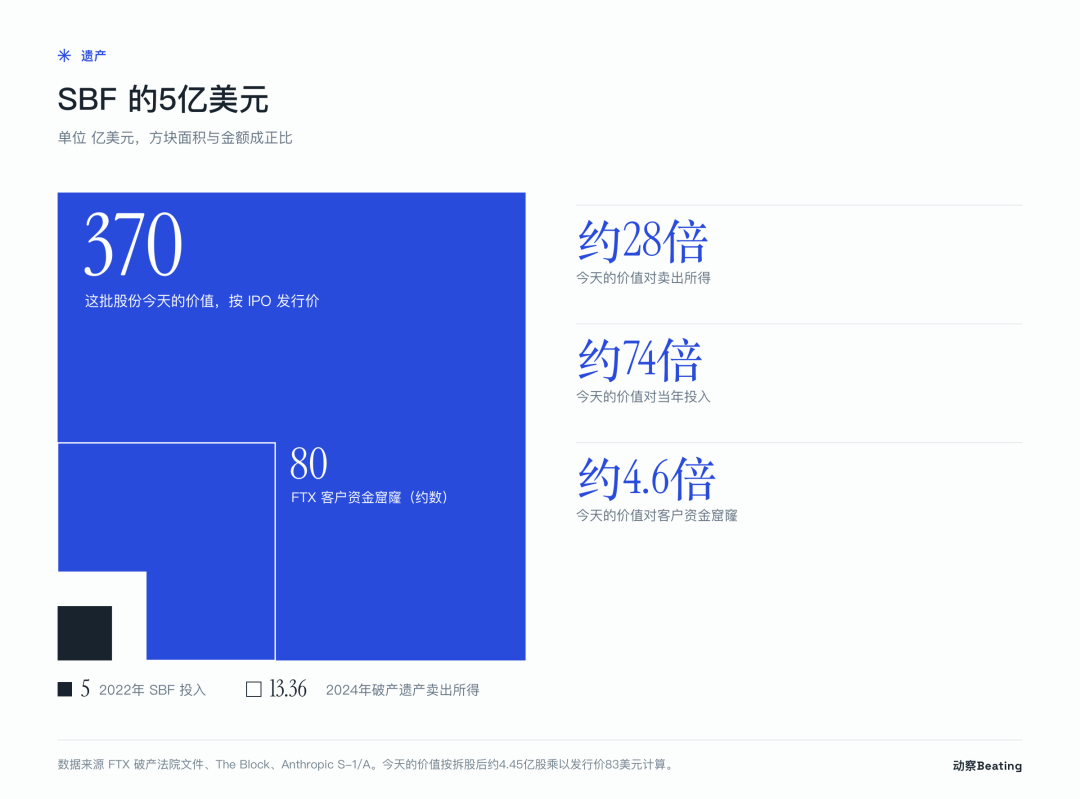
FTX creditors later recovered about 119% of their claims, with some categories higher. The money from selling Anthropic accounted for roughly 10% of distributed funds. And the value of these shares today is more than four times the approximately $8 billion customer fund hole from back then.
SBF himself has been using this to defend himself. On October 31, 2025, he posted an approximately 30-page document on X titled to the effect of "FTX Was Never Insolvent," claiming that if bankruptcy lawyers hadn't taken over, FTX would be worth over $100 billion today, with Anthropic being one of the core assets he listed. He said handing FTX over to bankruptcy administrator John Ray was the biggest mistake he ever made. Just this week, the NYT interviewed him in prison, and he once again complained about the decision to sell the shares.
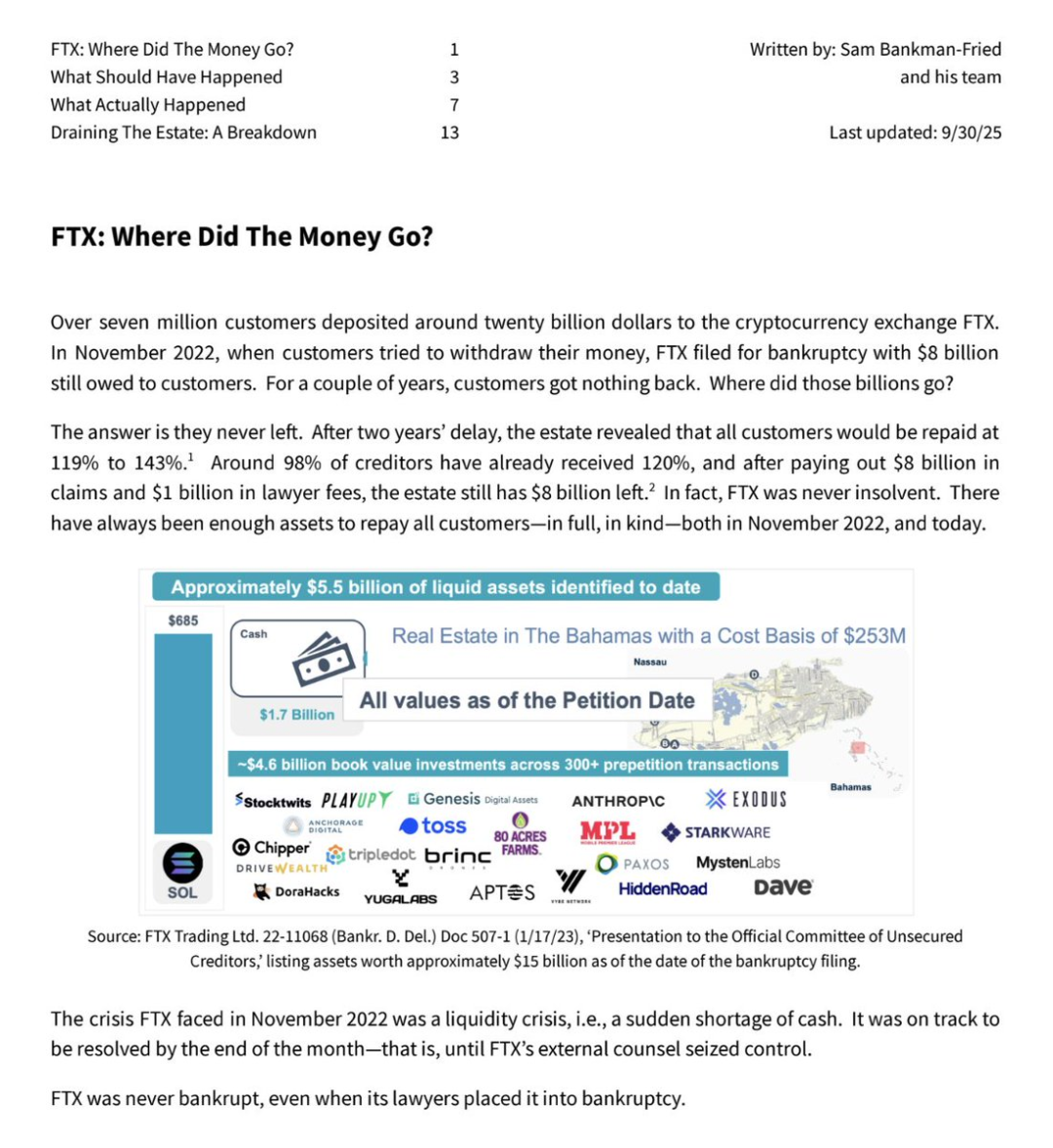
SBF publishes "FTX: Where Did The Money Go?" | Image source: X
The court did not accept this logic. On June 12 this year, the U.S. Second Circuit Court of Appeals unanimously upheld his conviction, 25-year sentence, and approximately $11 billion forfeiture order. The ruling stated that whether the assets the defendant purchased appreciated in value is irrelevant to whether he committed fraud.
He submitted a pardon application to the Department of Justice. Trump said in an interview in January this year that he had no plans to pardon him. In July, the U.S. Senate unanimously passed a non-binding resolution stating that he should not be pardoned under any circumstances. On September 10, his lawyers filed a petition for a writ of certiorari with the Supreme Court, case number 26-349, and the federal government's response deadline was extended twice, now to December 16.
When ANT opened for trading, his case was still in the queue.
The $50 million of Ellison and Singh had an even more convoluted ending. After the two pleaded guilty, these shares were forfeited by the government. The prospectus disclosed a transaction: in October 2025, Anthropic bought back 4.4539 million Series B preferred shares from the U.S. government at the Series F price, and resold them the same day to 9 investors for a total of approximately $628 million. The prospectus stated only that these shares were forfeited from their previous holders in a legal proceeding to which Anthropic was not a party. It did not name the original holders, but the share count precisely matches the $50 million subscription amount of the two that year.
At the offering price, these shares are worth approximately $3.7 billion, nearly six times the government's selling price. According to Business Insider, this money did not go into FTX's bankruptcy estate.
Ellison was sentenced to two years in prison and was released in January this year. In August, she joined Manifund, a nonprofit that connects charitable founders with donors, which had also received funding from FTX and Alameda back then. Singh did not serve prison time.
Par Value
After FTX collapsed, Anthropic needed new money.
In April 2023, TechCrunch obtained its financing deck at the time. Anthropic planned to spend up to $5 billion over the next two years training a model Claude-Next that would be 10 times more powerful than the strongest AI at the time, and would spend $1 billion in the next 18 months alone. The deck stated that the company that trained the best models of 2025 and 2026 would lead so far ahead that no one could catch up in subsequent cycles. At that time, Claude was still in closed beta, with only a dozen or so partners.
According to a report by The Information at the time, this round targeted $300 million at a $4.1 billion valuation. In the end, it announced a $450 million Series C in May 2023. Spark Capital led the round, with participation from Google, Salesforce Ventures, Zoom Ventures, Menlo Ventures, Factorial Funds, and Ashton Kutcher's Sound Ventures.
The Series C round was priced at $11.23 per share, exactly the same as the Series B a year earlier—a flat round.
During that year, Anthropic launched its first commercial product and generated revenue for the first time. Why the per-share price didn't rise by a single cent was not explained in the prospectus.
Even so, according to Business Insider, many investors at the time still considered the price expensive.
Spark partner Yasmin Razavi wrote two lengthy internal memos to persuade her partners to approve the investment. She later told Forbes that it was a major shift in thinking.
Razavi, 37 this year, was born in Tehran to a doctor mother and a father in the steel business. As a teenager, she went to Canada to visit her brother studying there and decided not to return to Iran—partly because she didn't want to sit for Iran's university entrance exam. What followed was the University of Toronto, McKinsey, Index Ventures' London office, Harvard Business School, and Snap's monetization team.
According to Bloomberg, the $75 million check was the largest in Spark's history. Razavi thus joined Anthropic's board and has served there ever since.
Today's Anthropic board has six members, and Razavi is the sole investor representative. According to Newcomer, under the terms at the time, Spark's right to appoint a director was originally set to terminate once Anthropic's annual revenue exceeded $1 billion. The prospectus shows that among all VCs, only Spark, alongside Dario and Daniela, signed the company's right of first refusal agreement and voting agreement.
Spark is mentioned more than 50 times in the prospectus. Because Razavi is a director, every Spark investment must be disclosed as a related-party transaction—revealing that although Spark never appeared on the public lists for the E through H rounds, it actually invested in every round. $75 million in Series C, $75 million in Series D, $100 million in Series E, $62 million in Series F, $25 million in Series G, $440 million in Series H—totaling $777 million.
At the offering price, the $75 million from Series C is worth about $5.5 billion today—roughly 74x. Spark's entire position is worth about $10.2 billion.
This money has already flowed into the pensions of U.S. public employees. The Los Angeles City Employees' Retirement System (LACERS) committed $33.3 million to Spark Growth Fund IV, and by the end of 2025, that investment was already worth $70.3 million, with a net IRR of 43.6%, back when Anthropic's valuation had not yet risen to half of what it is today.
Interestingly, more than half of Spark's money was invested in the most expensive Series H round, funded by its newly raised Growth Fund VI this year. At the issue price, that portion is only about 1.41x.
The other participants in the same round each have their own stories.
Sound Ventures was introduced to Anthropic through Salesforce Ventures. According to Bloomberg, in 2023, Guy Oseary and Kutcher spoke with Dario for several hours. Since Sound had already invested more than $400 million in OpenAI, Kutcher first sought Sam Altman's approval before investing in Anthropic.
Sound invested $35 million in the Series C round, and subsequently added about $400 million. Oseary is Madonna's manager, and he said Madonna has been written off countless times, and Dario is that kind of person too. Based on a $1.4 trillion valuation, Bloomberg estimates that Sound's investment is worth about $7 billion. Kutcher himself left Sound this year to start his own new fund focused on AI infrastructure and energy.
Zoom invested about $51 million in the Series C round, and at the issue price, that portion is now worth about $3.8 billion, and this year it added another approximately $300 million. At September's share price, that is roughly equivalent to one-tenth of Zoom's own market value.
SK Telecom invested $100 million in August 2023, and since then has only added to its position and never sold. At the issue price, that investment is worth about $3.2 billion. The market has begun trading this Korean telecom operator as a proxy for Anthropic. According to TelcoDR, Morningstar reclassified it as an AI stock, and its price-to-earnings ratio rose from about 11x to about 60x.
Salesforce Ventures invested about $50 million in early 2023, and has followed on in every round since. By the end of July this year, Anthropic had come to account for about 45% of the value of Salesforce's entire strategic investment portfolio, or about $5.1 billion.
Rules
Menlo Ventures also joined the Series C round, but only invested about $10 million.
Menlo partner Matt Murphy recalled on the podcast The Peel in October this year that, at a valuation of about $4.5 billion at the time, a venture capital fund could not change its fate unless it could make ten times its money. The problem was that Menlo's growth fund had a rule: it did not invest in companies without revenue.
But Menlo changed the rule for it.
How does an institution with a main fund of only $750 million lead a $750 million financing round?
The turning point came at Menlo's LP annual meeting in November 2023, when a sharing session by an Anthropic executive won over the LPs present. Subsequently, Menlo raised its first-ever SPV, about $500 million in size, almost as large as its main fund. The Series D was negotiated at the end of 2023 and closed in early 2024, at a valuation of about $18.4 billion, with Menlo leading the round and committing more than $500 million, its largest investment in its 50-year history.
Raising this SPV was not easy. According to Murphy on the podcast, Anthropic only allowed Menlo to share the previous year's revenue with LPs and did not permit any projections, so several large state pension funds refused to participate. Host Turner Novak said on the program that among the LPs that joined that round, three would each make more than $1 billion.
Menlo partner Venky Ganesan recalled that period as a lonely time, when almost no one wanted to invest.
According to a Newcomer report, Menlo has invested a total of about $1 billion in Anthropic, about 10 times its second-largest investment. Bloomberg estimated in June this year, based on a $965 billion valuation, that Menlo's stake was worth about $14 billion. At the issue price, it was about $19.7 billion. Murphy said this is Menlo's largest return in history.
Murphy had watched Google's growth up close at Kleiner Perkins. It took Google 5 years to go from 0 to $1 billion in revenue, 8 years from $1 billion to $10 billion, and another 11 years from $10 billion to $100 billion, 19 years in total. He said Anthropic followed the same curve but took only about one-third of the time.
This institution has actually just emerged from a trough. Newcomer disclosed that Menlo's 2015 and 2018 funds performed mediocrely. In June of this year, Menlo announced at its 50th anniversary that it had closed a $3 billion new fund, its largest fundraising ever.
Lightspeed's story is another kind of rule-breaking story.
It first approached Anthropic in January 2023, when the company had fewer than 100 people, no product, and no revenue. Before that, Lightspeed had already missed out on OpenAI, ElevenLabs, and Hugging Face.
According to Newcomer, in April 2023, Ravi Mhatre and Bejul Somaia had global partners clear a Monday schedule, even pushing off portfolio company board meetings. Somaia hosted a 7-hour meeting, with partners in Europe and Israel staying up past local midnight. The meeting discussed only one question: if AI really would change everything, what would it mean to act on that judgment.
Lightspeed invested $100 million in the D round. A few days before Christmas 2024, it proactively offered to lead the E round. The initial plan was $2 billion at a $60 billion valuation, ultimately expanded to $3.5 billion at a $61.5 billion valuation, with Lightspeed itself contributing $1 billion.
Partner Isaac Kim later recalled that the $1 billion was wired on the day DeepSeek was released.
During those days, the entire market was questioning the moat of U.S. large models.
Lightspeed later co-led the F round, also contributing $1 billion. Based on a rough estimate of approximately $2.1 billion across the publicly disclosed D, E, and F rounds, at the issue price, this portion is worth just over $23 billion. In December 2025, Lightspeed raised over $9 billion, the largest in its 25-year history.
Lightspeed partner Guru Chahal also said something to the effect that every round of Anthropic seemed absurdly expensive at the time, and in hindsight seemed absurdly cheap.
Landlord
In this IPO, who made the most money?
Looking at absolute returns alone, the answer is Amazon and Google.
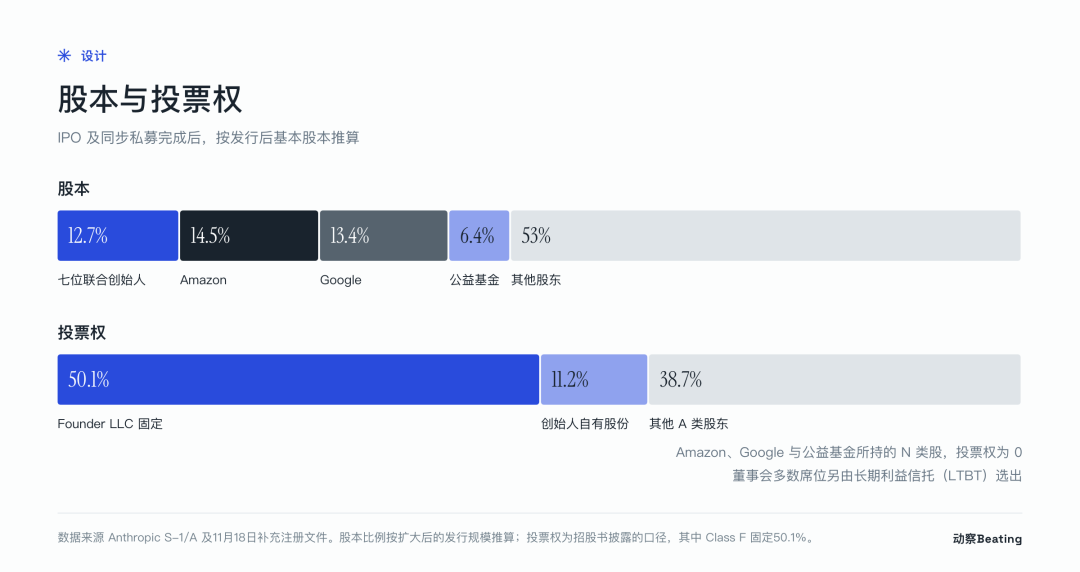
Amazon began investing in Anthropic in September 2023 through convertible bonds, completing $8 billion by the end of 2025, and this year invested another $10 billion in equity, for cumulative cash of approximately $18 billion. After the IPO, it will hold approximately 1.92 billion non-voting Class N shares, representing about 14.5% of total shares outstanding post-issuance, worth approximately $159.4 billion at the offering price.
That's not all. Amazon's stake is capped, with the excess held in the form of notes. If fully converted, Amazon would hold approximately 24%, worth approximately $289.2 billion. Before the IPO, Amazon had the option to waive this cap; it chose not to.
Google's path is similar. It entered at approximately $300 million at the end of 2022, and has since invested approximately $33.6 billion cumulatively through convertible bonds, preferred stock, and this year's large capital injection, including $10 billion in the concurrent private placement in this IPO. After the IPO, it holds approximately 1.77 billion shares, representing about 13.4%, worth approximately $147.3 billion at the offering price.
Together, the two hold approximately 28% of the equity, without a single voting right.
Where will this money ultimately go?
The prospectus shows that Anthropic has committed to spending at least $110 billion on AWS between May 2026 and April 2036. Between April 2026 and July 2033, it has committed to spending at least $121.3 billion on Google, plus an additional $125 billion to $150 billion in TPU purchase intentions. According to CNBC, Anthropic's various purchase commitments total approximately $895.4 billion. Jensen Huang said on a podcast this year that the growth of TPU and Trainium over the past two years has essentially all come from Anthropic alone.
The money invested by the big companies comes home in the form of compute orders.
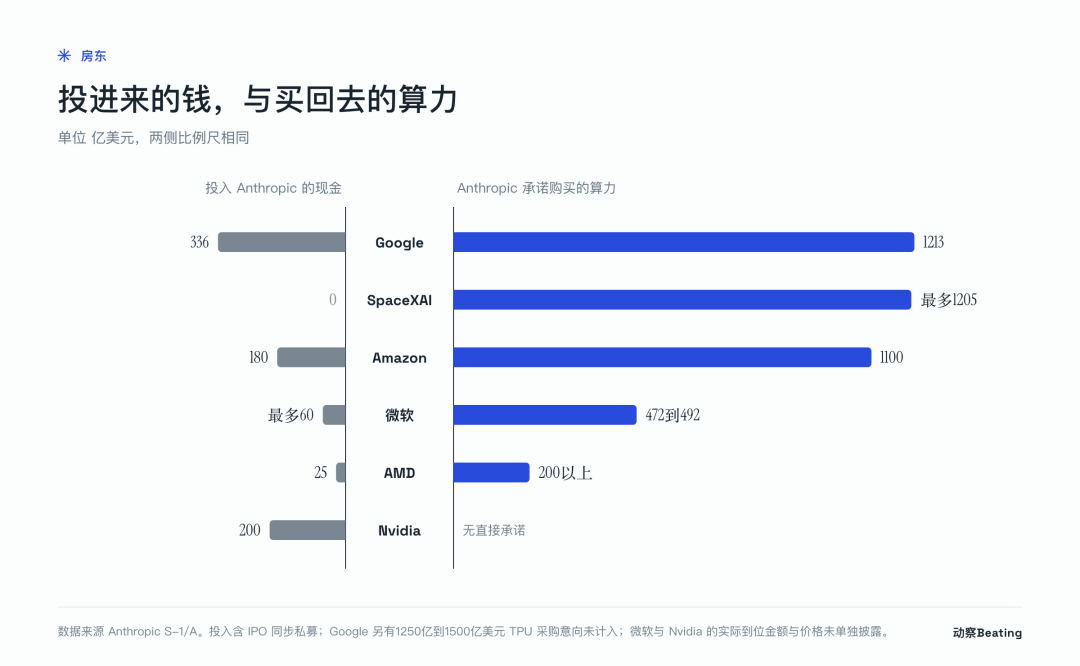
They come home quickly. In Q3 2025, Amazon recognized $9.5 billion in pre-tax gains from the upward revaluation of Anthropic. In Q2 this year, Amazon's operating income was $27.5 billion, yet net income was $62.6 billion; the financial report said non-operating gains mainly came from its investment in Anthropic. Alphabet never names Anthropic; its 10-Q only states that its non-listed equity accounted for under the measurement alternative "primarily consists of an investment in a private company," valued at $128.2 billion as of the end of September.
Fortune reported in April this year that about half of the two companies' impressive AI profits came from this equity stake. Accounting expert Robert Willens' assessment is that these companies can control or influence the value of one of their own assets.
Landlords have their own anxieties too.
The risk factors in the prospectus make it clear: Amazon, Google, and Microsoft are simultaneously investors, customers, distribution partners, and competitors of Anthropic. Google has its own Gemini, and in April this year, Google DeepMind even formed a "task force" to catch up with Claude Code, with Sergey Brin personally involved. Microsoft holds about 24% of OpenAI. Amazon also invested $50 billion in OpenAI this year. According to The Information, after renegotiations between the two sides, starting next year, Amazon's own products will pay per token to use Claude, and Amazon is evaluating alternatives including OpenAI.
On Anthropic's side, it has diversified its compute orders. In May this year, it announced the lease of Musk's entire Colossus 1 cluster in Memphis, exceeding 300 megawatts, approximately 220,000 Nvidia GPUs. Musk had previously publicly called Anthropic "anti-human" and "evil." The prospectus shows that the contract cap with Musk's SpaceXAI is $120.5 billion, approximately $3.1 billion per month at full capacity.
In November 2025, Nvidia announced an investment of up to $10 billion in Anthropic, with Microsoft investing up to $5 billion, while Anthropic committed to purchasing $30 billion in Azure compute, a figure that later rose to $47.2 billion to $49.2 billion. In March this year, Jensen Huang said at a Morgan Stanley conference that the investment in Anthropic might be the last one. In April, he admitted on Dwarkesh Patel's podcast that not investing in Anthropic earlier was his mistake. He said Nvidia didn't have spare cash at the time and assumed VCs could sustain Anthropic's compute needs, but Google and Amazon invested first, binding Anthropic to TPU and Trainium.
The prospectus shows that Nvidia will purchase another $10 billion in the concurrent private placement alongside the IPO.
That Phone Call
The tensest moment for shareholders and Anthropic wasn't at the financing table—it was in Washington.
In February of this year, Anthropic publicly stated that its technology should not be used for mass domestic surveillance or fully autonomous weapons. The Pentagon demanded a "any lawful use" clause in the contract, with a deadline of 6:01 AM Beijing time on February 28. Before the deadline arrived, Trump posted on Truth Social demanding that all federal agencies immediately stop using Anthropic's technology. About an hour and a half later, Defense Secretary (now called War Secretary) Hegseth announced that Anthropic would be designated a "supply chain risk," barring any contractor doing business with the U.S. military from having commercial dealings with it.
That defense contract was worth about $200 million, which according to Bloomberg data accounted for only about 1% of Anthropic's revenue.
Shareholders reacted differently. According to Semafor, two people familiar with the matter said Amazon CEO Andy Jassy discussed the matter when meeting with Hegseth but did not speak up for Anthropic. Some investors also said that Anthropic itself asked them to say nothing. According to Reuters, citing seven people familiar with the matter, Lightspeed and ICONIQ proactively contacted Anthropic executives to find a de-escalation plan, and some investors were leveraging their Trump administration connections. One investor's take: it was a question of ego and diplomatic finesse.
According to Fortune, at that time Anthropic's shareholder roster included about 270 other investors.
The litigation dragged on for over half a year. On March 26, Judge Rita Lin of the Northern District of California issued a preliminary injunction. On August 27, the same court issued a summary judgment largely siding with Anthropic, finding that the government's actions constituted retaliation in violation of the First Amendment. But on September 25, the D.C. Circuit Court of Appeals ruled 2-1 to deny Anthropic's petition for review of another finding. Anthropic has filed for en banc review, with no result yet.
Revenue didn't stop. The Reuters report noted that Anthropic's annualized revenue rose from $14 billion to about $19 billion within a few weeks.
Another call took place in June.
According to WSJ, Jassy told Treasury Secretary Bessent and other officials that Amazon researchers used Anthropic's newly released model Fable 5, about a week after its launch, to obtain information that could be used for cyberattacks. Subsequently, on June 12, the U.S. Commerce Department imposed global export restrictions on Fable 5 and Mythos 5. Anthropic could not identify in real time whether users were foreign nationals, so it had to suspend both models for all customers. It was not until June 30 that Commerce Secretary Lutnick sent a letter lifting the restrictions, after a suspension of about 18 days.
Fortunately, the Series H closed on May 28 at a $965 billion valuation, so there was no down round. According to public materials we found, no investor lowered its valuation of Anthropic during either of these two episodes.
Taboo
In October 2024, during OpenAI's $6.6 billion funding round, it asked investors not to invest in several competitors, and Anthropic was on that list.
Later, in the case brought by Musk against OpenAI, Sam Altman's statement was that investors holding OpenAI confidential information would lose their information rights if they made non-passive investments in competitors, and he said this was industry practice.
This taboo was broken in January this year. FT reported that Sequoia would participate in Anthropic's Series G. Sequoia has held OpenAI since 2021 and also holds xAI. In 2020, it gave up a $21 million investment and board seat in Finix due to a conflict of interest with Stripe, the first time in Sequoia's history. The person who led that Finix investment at the time was none other than today's co-head Pat Grady.
According to TechCrunch, former head Roelof Botha had always avoided Anthropic and had warned about the risk of excessive capital concentration. In the fall of 2025, he was replaced in a surprise vote, with Alfred Lin and Pat Grady taking over. A few months later, Sequoia invested in Anthropic.
According to TechCrunch statistics, by February this year, at least a dozen OpenAI VCs had also invested in Anthropic. In AI industry investing, almost no one considers loyalty anymore.
On February 12, Anthropic announced a $30 billion Series G at a post-money valuation of $380 billion. GIC and Coatue led the round, with D. E. Shaw Ventures, Dragoneer, Founders Fund, ICONIQ, and MGX co-leading, and more than thirty institutions including Sequoia, Accel, and General Catalyst participating. More than three months later, on May 28, the Series H arrived: $65 billion at a post-money valuation of $965 billion, led by Altimeter, Dragoneer, Greenoaks, and Sequoia.
The prices for these two rounds were $25.91 and $58.90 per share, respectively. Based on the offering price, the multiples were 3.2x and 1.41x.
According to reports, Sequoia invested approximately $2.5 billion to $3 billion in Anthropic for a stake of about 1%. Pat Grady acknowledged that not entering earlier was a mistake for Sequoia. In an interview with TIME, he said that for SpaceX, OpenAI, and Anthropic, Sequoia's long-term target is a market capitalization of approximately $10 trillion.
$10 trillion is nearly seven times the fully diluted valuation of this IPO.
ICONIQ missed earlier rounds, later returned to lead the Series F, and co-led the Series G and Series H, with cumulative investment exceeding $6 billion—its largest deal ever. It secured a $3 billion allocation in the Series F and turned around to raise funds from the ultra-wealthy clients it serves. The blog it wrote for the Series H was titled "Tripling Down on Anthropic," with a byline noting it was written by Claude and edited by humans.
Coatue began engaging with Anthropic as early as early 2023, when it had no revenue, and did not invest until the Series F in 2025, putting in $250 million. It invested $2.5 billion in the Series G—Coatue's largest single investment in a private company at the time—and another $2 billion in the Series H, for a total of $4.75 billion. According to Bloomberg, at a $1.4 trillion valuation, this investment is worth approximately $10.5 billion. Coatue has a CTEK fund for wealthy individuals with a minimum investment threshold of $50,000, and Anthropic is its largest holding.
In November 2025, Coatue founder Philippe Laffont said at a CNBC event that keeping ordinary investors out of pre-IPO gains is somewhat unfair.
In fact, retail investors had already gotten on board in another way long ago. In February 2024, Fundrise's innovation fund aimed at ordinary people held 218,000 shares of Anthropic, worth about $7 million at the time, backed by more than 42,000 retail investors. After the stock split, this batch of shares was worth about $180 million at the issue price. According to reports, this fund once traded in the secondary market at a premium of 1,000% to 2,000%.
Altimeter's Brad Gerstner had a more dramatic turnaround. In November 2025, on his own podcast, he pressed Sam Altman, roughly asking how OpenAI's revenue of about $13 billion a year could support computing commitments of more than $1 trillion. Altman replied "that's enough," and said that if he wanted to sell OpenAI shares, he could help find buyers. About half a year later, Gerstner led the H round of OpenAI's largest competitor. This week he also announced that he would subscribe for $5 billion in the IPO, five times his previous largest IPO investment.
Founders Fund invested $1.25 billion in the G round, its first position in Anthropic. In September this year, Peter Thiel compared effective altruism to "a cult with a good side" on a podcast.
Who else invested
The investors whose names can be called are only a corner of this roster.
The prospectus shows that the F round had 202 investors, the G round had 261, and the H round had 305. Ranked by entry price, this roster is roughly as follows.
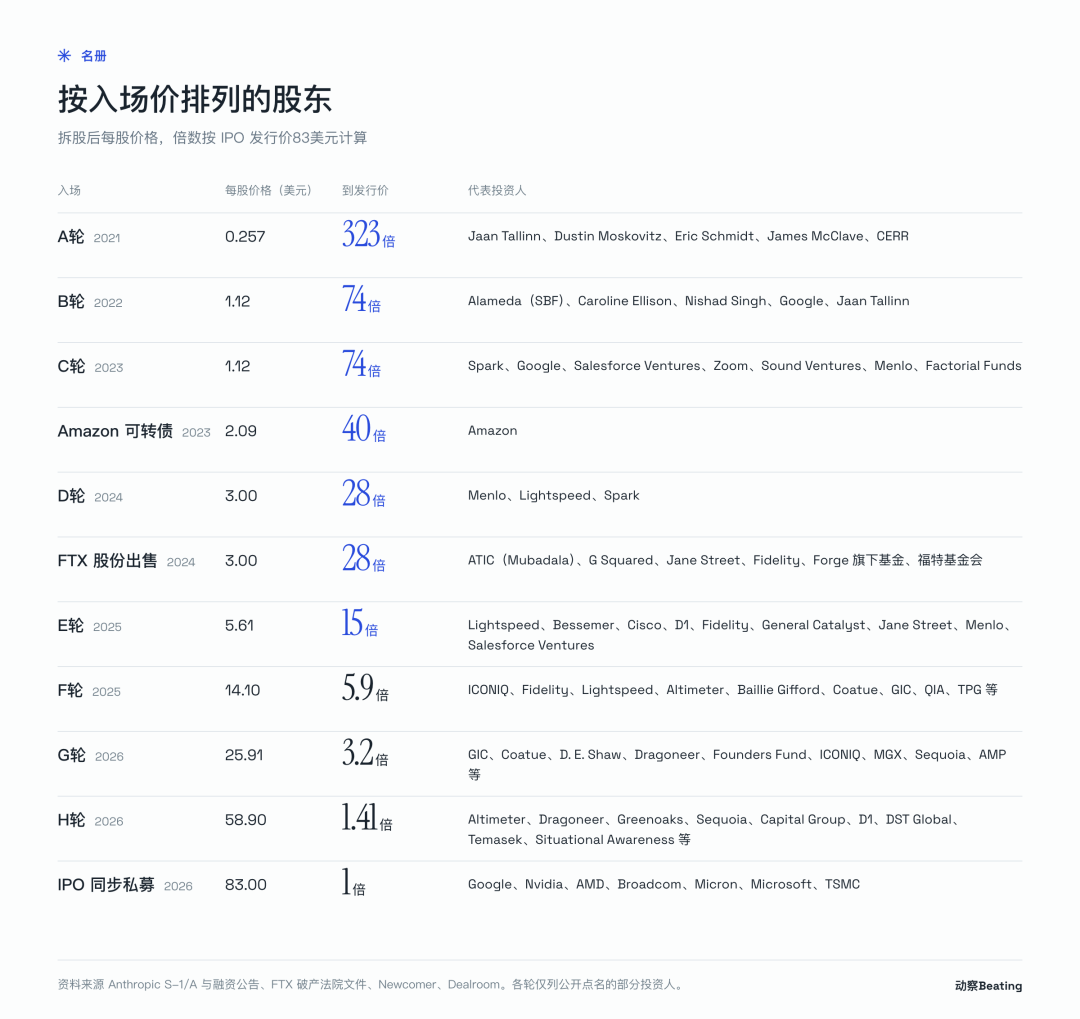
The youngest name is Leopold Aschenbrenner.
He graduated first in his class from Columbia University at the age of 19 and was fired by OpenAI in April 2024, when he was on the superalignment team. After that, he wrote a 165-page long article titled "Situational Awareness" and used the name to launch a fund. Earlier, he briefly worked at SBF's FTX Future Fund. According to TNW, he is engaged to Dario's chief of staff Avital Balwit.
He bought Anthropic earlier than most institutions. According to FT, this fund built its position in February 2025, when Anthropic was valued at about $60 billion, and in May this year, it appeared again on the H round investor list. Roughly estimated at the E round per-share price, the earliest part of the position is about 15 times at the issue price.
The fund itself experienced far more dramatic fluctuations. It started in 2024 with approximately $225 million, rose 439% in the first half of this year, and briefly swelled to about $45 billion in early July. Subsequently, its leveraged public market positions were hit by margin calls, and the entire public portfolio was sold to Citadel, shrinking its size to approximately $10 billion.
Fortunately, the Anthropic stake was preserved. According to Bloomberg, this portion is worth approximately $5 billion, roughly half of the fund's remaining assets. Based on the ratio between the issue price and the Series H price, it is now worth approximately $7 billion.
Another often-overlooked name is Anjney Midha. He connected Anthropic with 22 VCs back then, and according to Dealroom, he himself is also one of Anthropic's founding investors. He later served as a partner at a16z and then left to found AMP. In the Series G round in February this year, AMP invested $300 million. What AMP is currently doing is building a shared power grid for AI compute.
There are also people getting on board on the board of directors. Netflix co-founder Reed Hastings is a director of Anthropic, and his donor-advised fund plans to subscribe for up to $300 million in the IPO. Novartis CEO Vas Narasimhan is also a director, and Bodhi LLC, wholly owned by him and his wife, invested $10 million at the highest price in the Series H round in May this year, approximately 1.41 times the issue price.
More ordinary people got on board through mutual funds. According to Bloomberg, several funds under Capital Group collectively hold Anthropic shares worth at least $9 billion, and it is also a co-lead investor in the Series H round. Fidelity holds at least $2 billion, of which its flagship fund Contrafund, with $174 billion in assets, held approximately $600 million at the end of September. In the UK, several listed investment trusts under Baillie Gifford also hold Anthropic, and after raising valuations in April this year, Anthropic once accounted for 7.4% of US Growth Trust's assets.
Among the strategic investors in the Series H round, there are also three memory chip manufacturers: Micron, Samsung, and SK hynix. The $26 billion from the concurrent private placement in the IPO came from Google, Nvidia, AMD, Broadcom, Micron, Microsoft, and TSMC, all buying non-voting Class N shares at $83.
Sovereign wealth funds have almost all arrived. Singapore's GIC has invested over $4.5 billion cumulatively, holding about 1%. Temasek appeared in the G and H rounds, the Qatar Investment Authority in the F and G rounds, and Abu Dhabi has two faces: ATIC and MGX. The H round also saw the first appearance of DST Global, whose founder Yuri Milner was an early investor in Facebook.
There are also some names that kept increasing their stakes every round but are rarely mentioned individually. General Catalyst has invested in four consecutive rounds since the E round; CEO Hemant Taneja said this was a quadruple-down and the largest single investment in General Catalyst's history. Dan Sundheim of D1 was a co-lead investor in the H round. Factorial Funds invested about $50 million in the 2023 C round at the same price as Spark, Sound, and Menlo; by our rough estimate, that stake is now worth about $3.7 billion at the issue price.
Design
Whether money is picky about its origins is a question Anthropic itself has not answered well.
When it sold FTX shares in 2024, it blocked Saudi money on national security grounds. According to Newcomer, CFO Krishna Rao joined after the D round, and he and Dario at one point wanted to block all funds from the Middle East, China, and Russia.
That ban did not last long. In July 2025, Dario explained to employees in an internal Slack message why he was accepting capital from Gulf states. According to WIRED, he acknowledged that doing so would benefit "dictators" and that he was not happy about it. But he said the principle of "not letting any bad people benefit from our success" is hard to apply when actually running a company, and that staying at the frontier requires this money.
Half a year later, Abu Dhabi's MGX became a co-lead investor in the G round and also participated in the H round.
In fact, Abu Dhabi's money got on board even earlier. In 2024, it was ATIC that bought the largest block of Anthropic shares from the FTX estate. It belongs to Mubadala, and Mubadala is one of MGX's founding shareholders.
Anthropic has a whole set of designs for its shareholder register. According to Newcomer, it once explicitly told investors that it hoped each VC's stake would be below 2% to avoid excessive influence. According to Fortune, in late April this year, Anthropic asked investors to report their desired allocations within 48 hours, and 10 institutions together requested about $200 billion. In the secondary market, some SPVs are nested more than four layers deep, charging a 20% one-time fee plus a 2% annual management fee. In May, Anthropic listed several platforms, including Forge, as unauthorized channels, then later removed Forge from the list, and a fund under Forge was one of the buyers of the FTX shares in 2024.
The result is that in this S-1's major shareholder table, not a single VC appears.
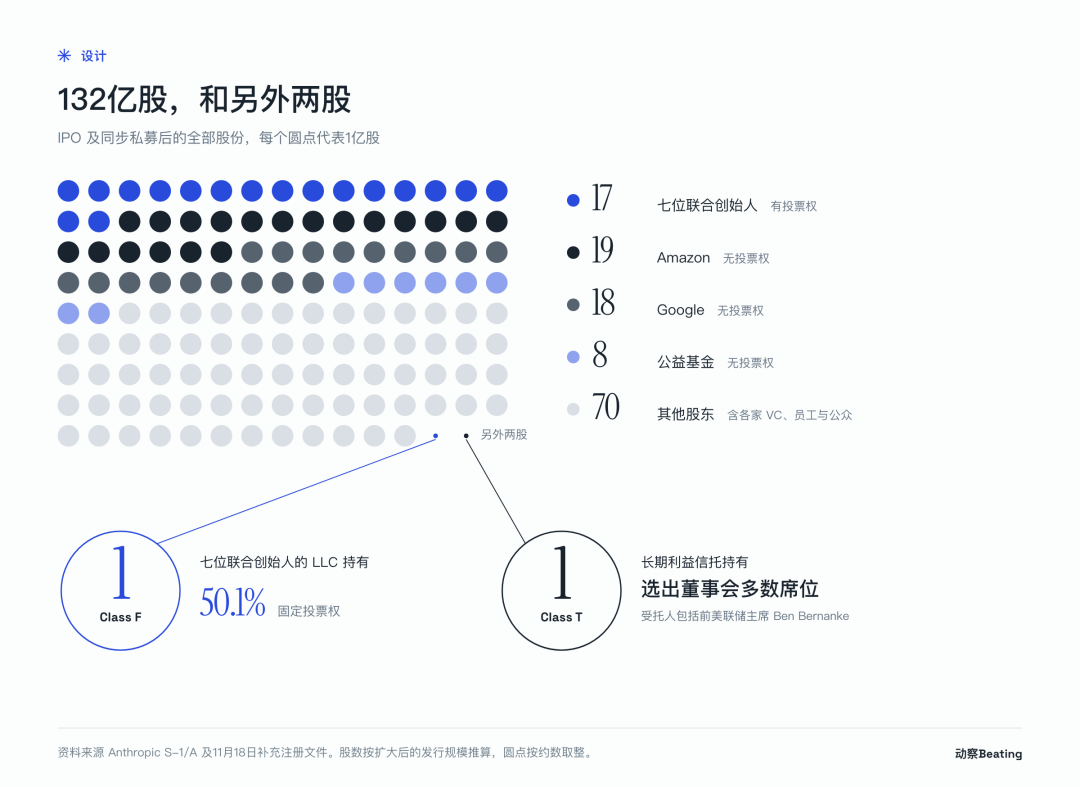
The seven co-founders hold one Class F share through a Founder LLC, permanently possessing 50.1% of voting power. As long as at least three of the seven remain in the LLC, this 50.1% persists. According to Fortune's interpretation, a co-founder only needs to retain 2% of the Class A shares held at the time of listing to remain in the LLC—meaning that even after donating 98% of their shares, they can still participate in controlling the vote.
The majority of board seats are elected by an entity called the "Long-Term Benefit Trust" (LTBT). It holds one Class T share with no economic rights and currently has four trustees, including former Federal Reserve Chairman and 2022 Nobel Economics laureate Ben Bernanke, who joined in June this year. The other three are Neil Shah, CEO of the Clinton Health Access Initiative; Richard Fontaine, head of a think tank and former McCain foreign policy advisor; and Christopher Stubbs, a Harvard physicist involved in discovering the accelerating expansion of the universe.
The prospectus states that, to date, the search, interviewing, and selection of trustees have been carried out in close cooperation between the trustees and company executives. The trust's operating expenses are also provided by Anthropic—$8.425 million in the first nine months of this year.
The prospectus also contains a rarely noticed clause. As long as the Class T share remains, Anthropic must provide prior written notice to the LTBT before transferring control of an AI model that exceeds a capability threshold set by the board.
There is also a passage in the risk factors. The company's decisions to slow AI development for safety reasons, delay or restrict model releases, or even forgo commercial opportunities may not maximize shareholder value. One example cited is this year's Mythos model, which was initially released only as a restricted research preview. Another example is its choice not to build image and video generation models.
Rarely does a trillion-dollar prospectus remind its buyers in this way.
Sold Too Early
Not everyone waited until today.
In June 2025, Anthropic bought back employee shares for the first time at $5.61 per share, corresponding to a $61.5 billion valuation, in a $157 million offering; Dario and Daniela both sold some. In the tender offer this April, a group of existing shareholders bought approximately 180 million shares at $25.91 per share, totaling $4.66 billion. Sellers included Dario and Daniela, CFO Krishna Rao, and Daniela's husband, Open Philanthropy co-founder Holden Karnofsky. The prospectus shows that Karnofsky has worked at Anthropic since January 2025, with cash compensation of approximately $430,000 in 2025.
According to Bloomberg, the buyer had originally prepared $5 billion to $6 billion, but employees held onto their shares and refused to sell, so only $4.66 billion was ultimately transacted.
More than a month later, the Series H price was 127% higher than this tender offer. The IPO issue price is about 3.2 times that tender offer price.
A considerable portion of the shares in employees' hands is destined to be given away. The prospectus shows that Anthropic has operated a donation matching program since November 2021, under which employees pledge to donate equity to charity and the company matches it with additional shares on a proportional basis.
For employees who joined before May 2024, the matching ratio is 3 to 1, with up to half of their equity eligible for donation; for employees who joined afterward, it changed to 1 to 1. As of the end of September, the upper limit of matching shares the company may issue for this purpose is 553 million shares, worth about $45.9 billion at the issue price, of which 84% comes from that group of veteran employees, who account for only about 20% of total employees. In the first three quarters of this year, the company recognized about $2.1 billion in expenses for donation matching alone, accounting for about 6% of operating expenses.
The voting rights on shares employees donate into two donor-advised funds (Daffy and Dechomai) are exercised by Dario on their behalf, except for the portion he and his family donated themselves.
Seven co-founders each sold 3.378 million shares in this IPO, about $280 million each. After the IPO, each of them still holds about 240 million shares, worth about $19.7 billion at the issue price. The largest shareholder is not Dario, but Tom Brown. All seven have pledged to devote 80% of their respective wealth to charity, a commitment that is not legally binding.
Anthropic has also injected 847 million shares into a wholly owned philanthropic fund, equivalent to 5% of the fully diluted share capital, worth about $70.3 billion at the issue price, more than the holdings of the three co-founders combined. Each time the stock price rises 50% above the previous milestone, it will receive up to an additional 2%.
What do they believe now?
Five and a half years later, these investors' judgments about AI have diverged. By order of entry and identity, they can roughly be divided into five groups. Each group tells a different story and bets in a different direction.
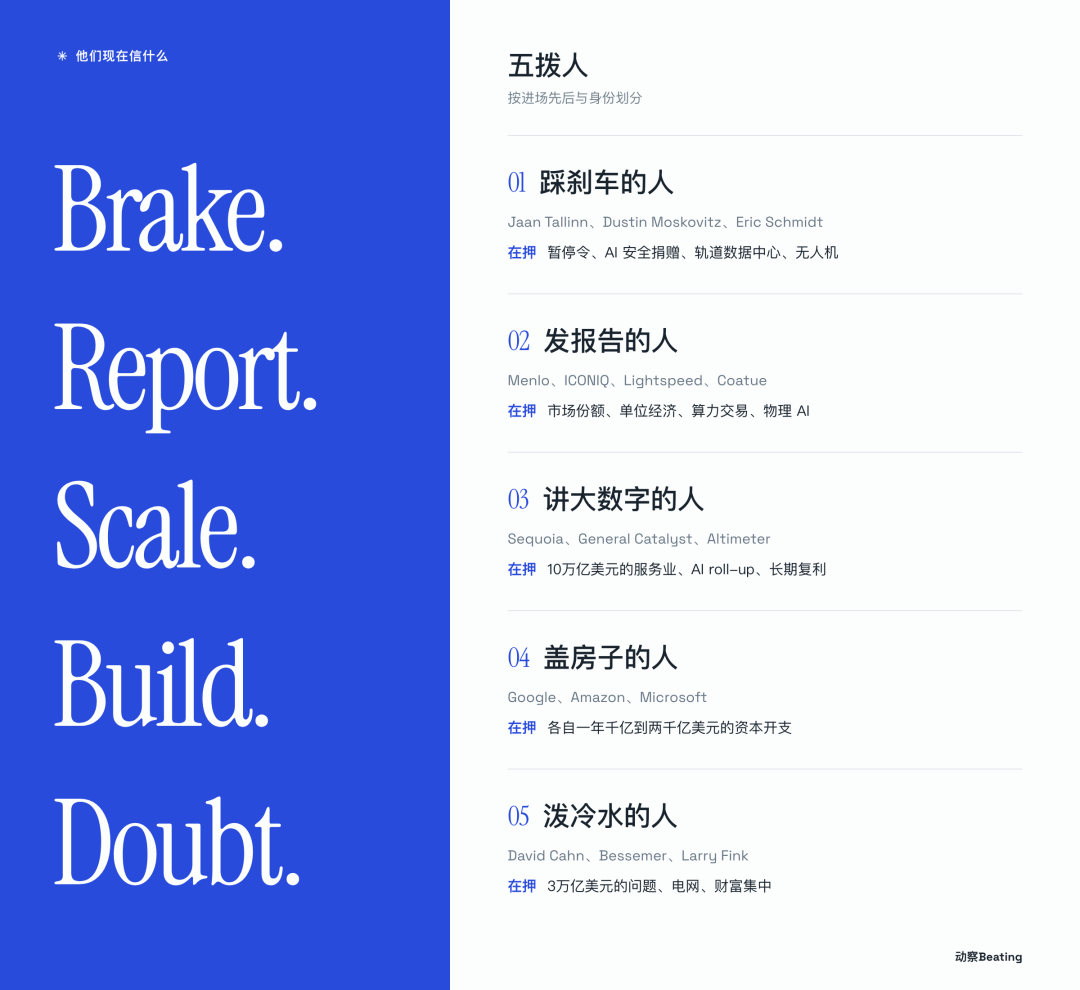
The ones hitting the brakes
The group that entered earliest now most wants to slow AI down.
In an interview with The Generalist, Tallinn said that ideally, a moratorium is needed right now, and if it were up to him, he would have stopped earlier. Last October, he reportedly signed FLI's "Superintelligence Statement," calling for a ban on developing superintelligence until broad scientific consensus is reached. He plans to donate the proceeds from the IPO to AI safety organizations, and his investment firm Metaplanet is already planning how to spend the money.
In an interview with Stratechery last year, Moskovitz said these technologies are truly dangerous, and he believes quite bad things will happen. He admitted that many of the solutions he had previously envisioned now seem naively outdated. According to Forbes, in 2025, he and Tuna directed over $100 million toward AI safety through Coefficient Giving.
Schmidt is the least likely among this group to hit the brakes. His TED talk was titled "The AI Revolution Is Underestimated," and he co-authored "The Superintelligence Strategy" with Alexandr Wang and Dan Hendrycks, proposing MAIM (Mutually Assured AI Malfunction)—any country that unilaterally races for AI dominance will invite preventive sabotage from adversaries. His own bets are in the physical world: he serves as CEO of rocket company Relativity Space, reportedly motivated in part by putting data centers into orbit, and as CEO of drone company Swift Beat, signed a production expansion memorandum with Ukraine's Ministry of Defense. In July of this year, he also signed a statement warning that AI will cause mass unemployment.
The Report Publisher
The VC who bet on Anthropic now loves publishing market share reports more than anything.
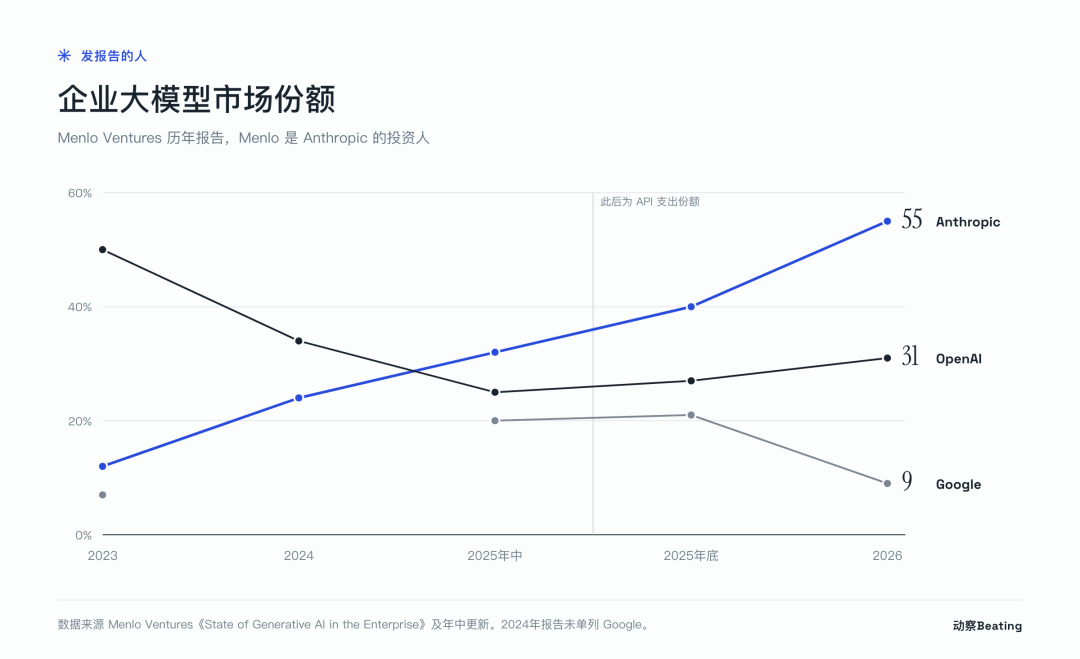
Menlo publishes an annual enterprise AI market report and notes in it that it is an investor in Anthropic. According to its data, Anthropic's share of the enterprise large model market grew from 12% in 2023 to 24% in 2024, 32% by mid-2025, 40% by the end of 2025, and 55% in this month's report. OpenAI is at 31%, and Google is at 9% (starting in 2025, the metric changed from usage rate to API spending).
In the same report, open-source models account for about 19% of tokens but only 4% of spending, and of the spending on open-source models, 89% flows to Chinese models, with Kimi at 61%, DeepSeek at 15%, and GLM at 11%.
Menlo now treats "small C-round checks close to the team, heavy D-round bets" as its standard playbook, replicating it across Suno, Wispr, OpenRouter, and Lovable.
ICONIQ's annual survey charts a different curve. Among the AI companies surveyed, the share using Anthropic models rose from 54% in June 2025 to 51% in January this year, then to 81% in July, surpassing OpenAI's 71% for the first time. Its focus now is unit economics; boardroom questions have shifted from "What's our AI strategy?" to "Is AI actually making money?"
Lightspeed's Ravi Mhatre says 2026 is the year AI goes "from demo to deployment." Just this week, Lightspeed led the round for Compute Desk, a company that trades compute as a financial asset. Its investment memo notes that if compute trading reaches the same level of financialization as oil, annual trading volume could reach $20 trillion to $40 trillion.
Coatue says Anthropic has built a "token factory" and that all enterprise workflows can ultimately be reduced to code. Its next focus is physical AI.
The People Talking Big Numbers
The late money is talking about bigger markets.
Sequoia's Pat Grady co-wrote an article with colleagues earlier this year titled "2026, This Is AGI," arguing that agents capable of working autonomously for extended periods are functionally AGI. At AI Ascent in April this year, he said a $10 trillion services market is waiting to be captured, with U.S. legal services alone representing a $400 billion market.
General Catalyst's roll-up thesis targets the roughly $16 trillion global services industry, while the entire software industry is only about $1 trillion. Its approach is to acquire traditional services companies itself, then use AI to push profit margins from 5%–10% to 30%–40%. Its portfolio company Long Lake has already taken American Express Global Business Travel private for $6.3 billion.
Altimeter's Gerstner calls Anthropic a cornerstone stock that can compound over the long term. The $5 billion he subscribed for in the IPO is itself a number about the future.
The Builders
Landlords talk about capital expenditure.
Google's 2026 capex guidance is $175 billion to $185 billion, Amazon's is about $200 billion, and Microsoft's was $115.9 billion in the last fiscal year. To raise this money, Alphabet even issued $20.5 billion in new shares to the market in June this year, and another $10 billion in a private placement to a Berkshire Hathaway affiliate.
Sundar Pichai told the BBC last year that there is an "irrational element" in the AI investment boom, and no company is immune, including Google. Andy Jassy said in this year's Q3 earnings report that Amazon has never had a business with revenue exceeding $1 trillion, but in the next five to ten years it may have two.
The Naysayers
Some are also asking, can revenue keep up with investment?
Inside Sequoia, David Cahn wrote the famous "AI's $600 Billion Question" in 2024. According to reports, in July this year he upgraded that question to $3 trillion: 2026 AI infrastructure investment of about $1.5 trillion would require about $3 trillion in revenue to break even. Cahn himself this year invested in Form Energy, a company doing long-duration energy storage.
What Bessemer flags is the speed of the physical world. Building a data center takes 12 to 18 months, connecting to the grid takes 5 to 7 years, and transformer lead times can be as long as 5 years. Larry Fink wrote in this year's shareholder letter that AI may concentrate wealth in the hands of a few companies and investors.
At this month's Cerebral Valley AI Summit, about 80% of the audience believed AI is in a bubble, and two-thirds of them expected the bubble to burst in 2027. But on Anthropic's IPO, almost everyone was optimistic, expecting its first-day market cap to be between $1 trillion and $2 trillion.
Everyone thinks it's a bubble, and everyone wants to buy.
Hemant Taneja of General Catalyst has an explanation for this. He told TIME last year that bubbles are a good thing, because bubbles can organize capital and talent.
Slow Down
Finally, back to Jaan Tallinn. The Estonian who led the Series A round in 2021 and gave Anthropic its first outside funding.
He grew up in Estonia under Soviet occupation. He told The Generalist a small story: around age thirteen, he was cornered by a group of people in a building and ended up jumping out of a second-story window about one and a half stories high.
Later, he became one of the founding engineers of Skype. When eBay acquired Skype in 2005, he made a large sum of money from it.
In 2009, at a Panera Bread near Millbrae, California, he talked with AI risk researcher Eliezer Yudkowsky for four hours. After that, he began donating money to the AI safety field.
Later still, he attended a talk by Demis Hassabis and Shane Legg in Oxford. He missed DeepMind's Series A—by only about two weeks, according to him—so he invested a convertible note between the Series A and Series B rounds. In 2014, DeepMind was sold to Google. More than a year later, a group of people worried about Google monopolizing AI founded OpenAI in San Francisco. A few years after that, a group of people with doubts about OpenAI left and founded Anthropic.
He invested in two of them.
He also likes to dance. About twenty years ago, he started freestyle street dancing at nightclubs. He has a dance coach in London who later became a good friend, and the two occasionally perform together. There are two spots he frequents in Tokyo, and in New York he often goes to a bar called Pianos, where he says he can guarantee he won't be the best dancer there.
He says he learned to dance using "reinforcement learning from human feedback." RLHF—the technique that Anthropic's founders helped pioneer back when they were at OpenAI, and which the prospectus lists among the team's representative achievements.
Earlier this year, on a podcast, he said his p(doom)—the probability he assigns to AI causing human extinction—had at one point been as high as 80%. By October, he said it now felt a few percentage points lower, but he wouldn't give a specific number. He said it's a number he's working hard to push down, and he doesn't want to nail it down.
His favorite movie is "Before Sunset."
That movie is about two people reuniting in Paris with only an afternoon together; the male lead has a flight to catch in the evening. They keep walking and talking, from a bookstore to a café, from the café onto a boat, then into the car taking him to the airport, and finally to her apartment. At the end of the film, the female lead dances and reminds him that he's going to miss his flight.
He smiles and says, "I know."
Beijing time on the evening of November 19, ANT began trading.
Original link
Welcome to join the official BlockBeats community:
Telegram Subscription Group: https://t.me/theblockbeats
Telegram Discussion Group: https://t.me/BlockBeats_App
Official Twitter Account: https://twitter.com/BlockBeatsAsia

 Related Articles