Why does Tencent's computing power account show up in cash flow first?

On November 18, Tencent released its third-quarter financial report. Company revenue continued to grow, while operating profit has declined. After the European market opened, shares of Tencent's major shareholder, Dutch investment company Prosus, fell as much as 7.4%.
Revenue was approximately RMB 207.3 billion, about 1.6% below the market consensus cited by Reuters. The financial report's explanation of revenue includes changes in the gaming business. Domestic gaming revenue continued to grow, while international gaming revenue declined due to the high base in the same period last year. In the same report, cloud services actually accelerated, driven by AI-related demand.
Turning to the cash flow page, Tencent presented two scenarios. Under the company's disclosed methodology, free cash flow has been negative for two consecutive quarters. Adjusting for prepayments to computing power suppliers, both quarters still showed a cash surplus. Which line item did this money go into, and what is its relationship to the capital expenditure that surged during the same period?
Capital expenditure multiplied several times over — how much was actually paid in the quarter?
Tencent lists capital expenditure and capital expenditure payments in different locations. The former appears under "Other Financial Information," primarily covering IT infrastructure such as computer equipment and software, as well as data centers, office space, and certain intellectual property. The latter appears in the free cash flow explanation, recording the money actually paid for capital expenditure during the quarter. Looking at procurement scale and looking at the bank account means reading two different columns of numbers.
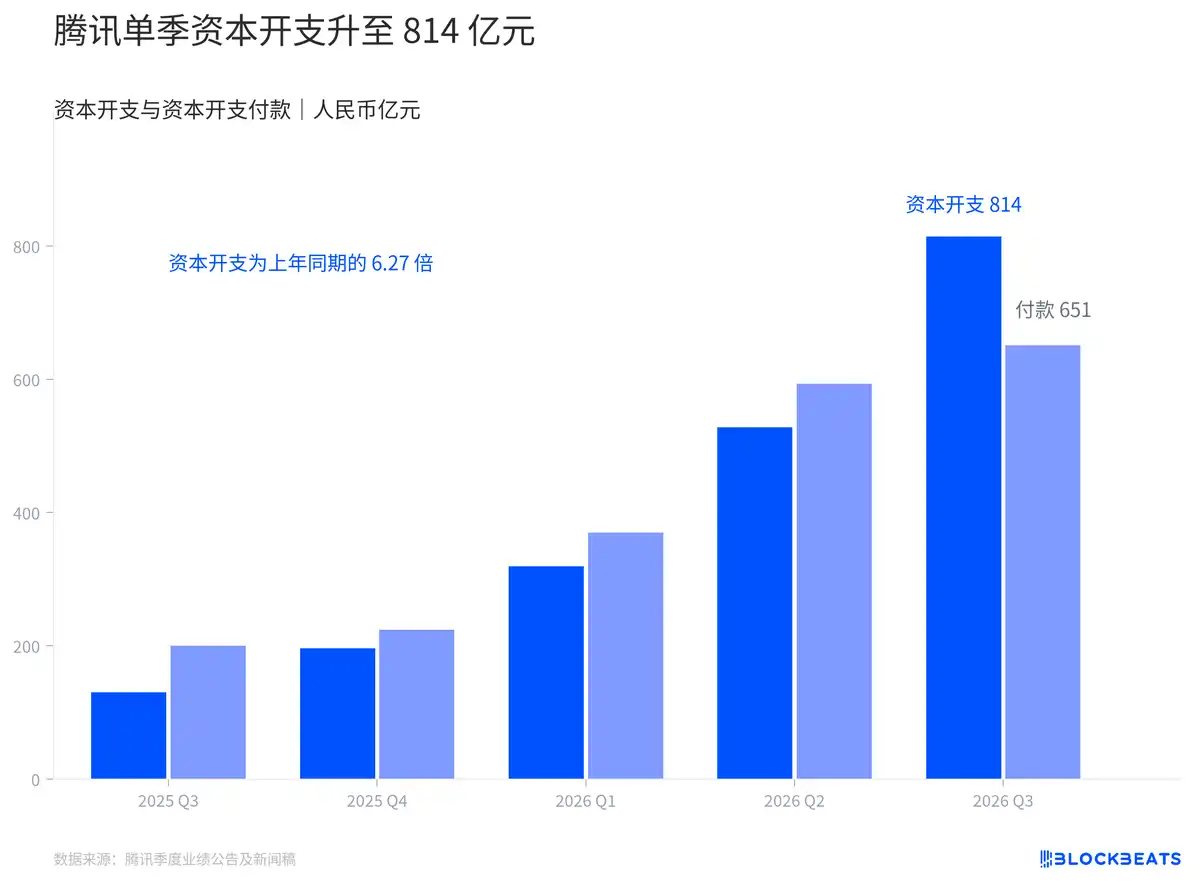
Tencent's quarterly capital expenditure rose to RMB 81.4 billion
Looking back over the past five quarters, both columns of numbers have been rising, but the sequence has changed. In the second quarter, actual payments exceeded capital expenditure, while in the third quarter the reverse occurred. Companies can recognize capital expenditure and make corresponding payments in different quarters. Tencent's public disclosures provide totals for both columns, showing timing mismatches, but public information is only available at the aggregate level.
Taking the third quarter as an example, capital expenditure was approximately 6.27 times that of the same period last year — meaning for every RMB 100 invested last year, approximately RMB 627 was invested in the same period this year. Actual payments also grew, though at a relatively smaller rate. This difference is especially important in cash flow, because Tencent has another pool of money for building computing power that appears in operating activities.
Why has cash flow been negative for two consecutive quarters?
In the third quarter, Tencent paid large prepayments for computing power procurement in operating activities. According to the company's explanation, the procured computing power serves both the Hunyuan model and the AI office assistant WorkBuddy, as well as the company's products and external cloud customers. Prepayments are first deducted from cash generated from operating activities and counted into the starting point of free cash flow. Reading further down the financial report, capital expenditure payments, media content payments, and lease liability payments are then deducted from this starting point.
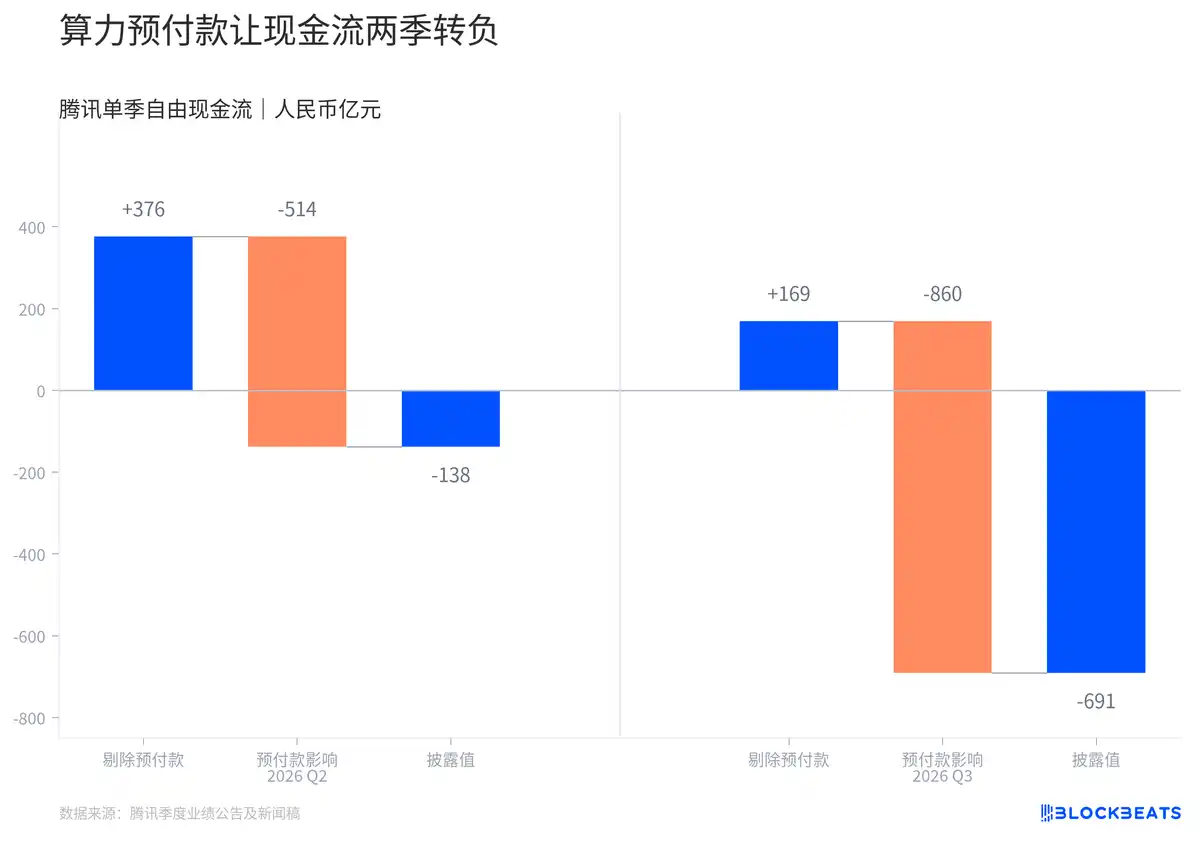
Computing power procurement prepayments turned Tencent's free cash flow from positive to negative for two consecutive quarters
Tencent disclosed free cash flow excluding computing power prepayments in both quarterly earnings reports. Subtracting this figure from the actually disclosed value, the cash impact of prepayments in Q3 was approximately RMB 86 billion, exceeding the cash that could be retained before deducting prepayments and also exceeding the capital expenditure payments for the quarter. The orange segment in the chart represents the difference between the two cash flow scenarios, directly showing the impact of upfront payments on cash for the quarter.
There is another layer of change that is easily overshadowed by the large prepayment figures. Even under the company's stated exclusion methodology, the free cash flow retained in Q3 was already less than half of Q2. The cash gap widened between the two quarters, partly due to increased computing power prepayments and partly because the cash balance after deducting this impact was also declining. Both changes can be observed simultaneously from the two sets of figures provided in the earnings reports.
What impact did new AI products leave on the income statement?
The profit performance at the beginning of the year painted a different picture. Tencent's net profit attributable to shareholders grew 21% year-over-year in Q1, but only 0.8% in Q3. Net profit attributable to shareholders is also affected by investment gains, share of profits from associates and taxes. To see how much the core business earned after investing in new products, operating profit is closer to answering this question.
Tencent also provided investors with another comparison. Excluding contributions from new products such as Hunyuan, Yuanbao, coding assistant CodeBuddy, WorkBuddy and WeChat AI assistant Xiaowei, then looking at adjusted operating profit. This allows the operating impact of these products in the period to be isolated from Tencent's overall operating performance.
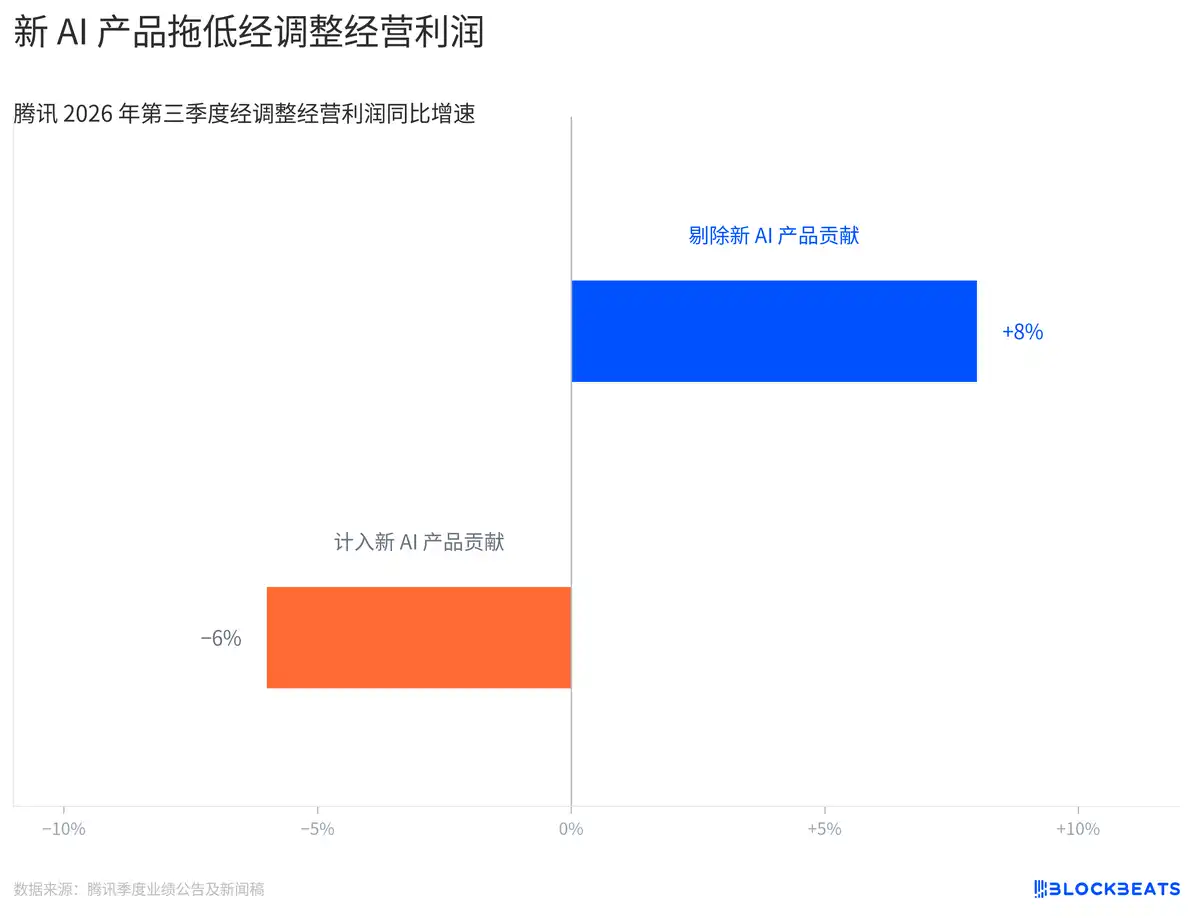
Adjusted operating profit grew year-over-year after excluding new AI product contributions, but declined year-over-year when included
The difference in quarterly profit before and after exclusion was approximately RMB 15.2 billion, equivalent to the amount by which the group's adjusted operating profit increased after removing both the revenue and related operating costs of these products.
Under Tencent's disclosed profit margin methodology, after including these products, the adjusted operating profit retained per RMB 100 of revenue dropped from approximately RMB 40 to approximately RMB 33. Each methodology uses its corresponding revenue as the denominator. This comparison puts the operating impact of new products on the table, while computing power prepayments have their own separate payment schedule.
Q3 net profit attributable to shareholders still managed slight growth, with taxes providing some buffer. Tencent explained in its Hong Kong Stock Exchange announcement that the decrease in income tax expense for the quarter was mainly due to reduced taxes at an overseas subsidiary. The company stated that excluding this factor, the group's income tax expense would have increased year-over-year. For readers who only look at net profit, this is an easily overlooked detail—the decline in operating profit occurred before this tax change.
Tencent's AI business is already showing revenue clues. Cloud service revenue grew 35% year-over-year in the third quarter, and the company attributed the growth to demand for AI-related services and international expansion, noting that it allocated more computing power to model invocation and GPU leasing. What the earnings report presents is growth for the cloud service segment as a whole; revenue and profit broken out separately for WorkBuddy or GPU leasing, as well as how long it will take for procured computing power to pay back the investment, still lack comparable disclosure.
In Tencent's earnings report, computing power suppliers were paid first, and the revenue brought in by cloud customers enters the topline as services are delivered.
Welcome to join the official BlockBeats community:
Telegram Subscription Group: https://t.me/theblockbeats
Telegram Discussion Group: https://t.me/BlockBeats_App
Official Twitter Account: https://twitter.com/BlockBeatsAsia

 Related Articles