Cisco's revenue surges 24%, where does this increment come from?

On November 12, Eastern Time, Cisco released its first-quarter earnings report for the new fiscal year, with quarterly revenue hitting a record, and the company also raised its full-year outlook. During the Q&A session of the earnings call, an analyst pressed whether, in addition to large cloud providers buying equipment, network upgrades in enterprise campuses also contributed to this upward revision. CFO Mark Patterson broke down the increased outlook into two parts by customer.
This calculation starts with the revenue already booked. Cisco sells switches, routers, as well as security and collaboration products, and also provides technical services. Several business lines are growing, and together they pushed quarterly revenue up 24%. But when comparing the dollar amounts for this quarter and the same period last year, almost all of the increment came from the networking business.
Who took the lion's share of the new revenue?
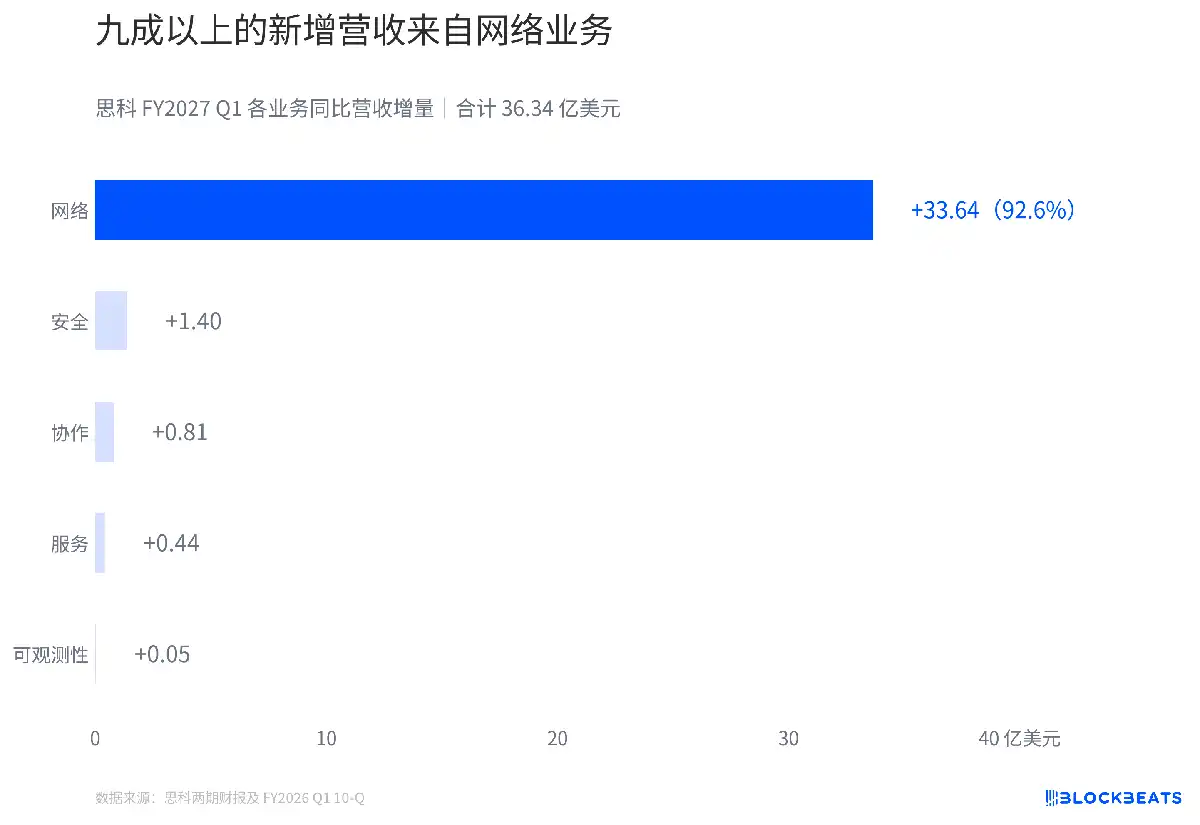
Subtracting the original amounts from the two periods' financial reports, for every $100 of new revenue Cisco generated, about $93 came from the networking business. Security was the second-largest source of increment, and collaboration, services, and observability also grew. After excluding networking, the remaining categories combined left only a single-digit share of the increment. This calculates the composition of new revenue. Networking accounted for about 60% of total revenue this quarter.
Large cloud providers are adding equipment to AI clusters, and enterprises are also upgrading networks in offices and campuses. Both types of purchases bring revenue to Cisco's networking products. Patterson said on the call that AI infrastructure revenue achieved triple-digit growth, and both data center switching and campus networking recorded double-digit growth. The financial report groups these products into the broader networking category, and the publicly disclosed segment amounts are only enough to calculate how much increment the networking business contributed. To determine how much should be attributed to AI clusters and how much to campus refresh, more granular revenue disclosure is needed.
This distinction also affects how to understand next quarter's base. Networking equipment sells quickly and immediately amplifies product revenue in the quarter. Under Cisco's accounting policy, hardware revenue is generally recognized when control transfers, while subscription services are usually recognized gradually over the contract period. Campus refresh and data center expansion can widen the revenue gap in the current quarter, while changes in service revenue may be spread across multiple quarters. Contracts signed in the same quarter may also be reflected in revenue in different quarters.
Earning less gross profit per hundred dollars, why is operating margin still rising?
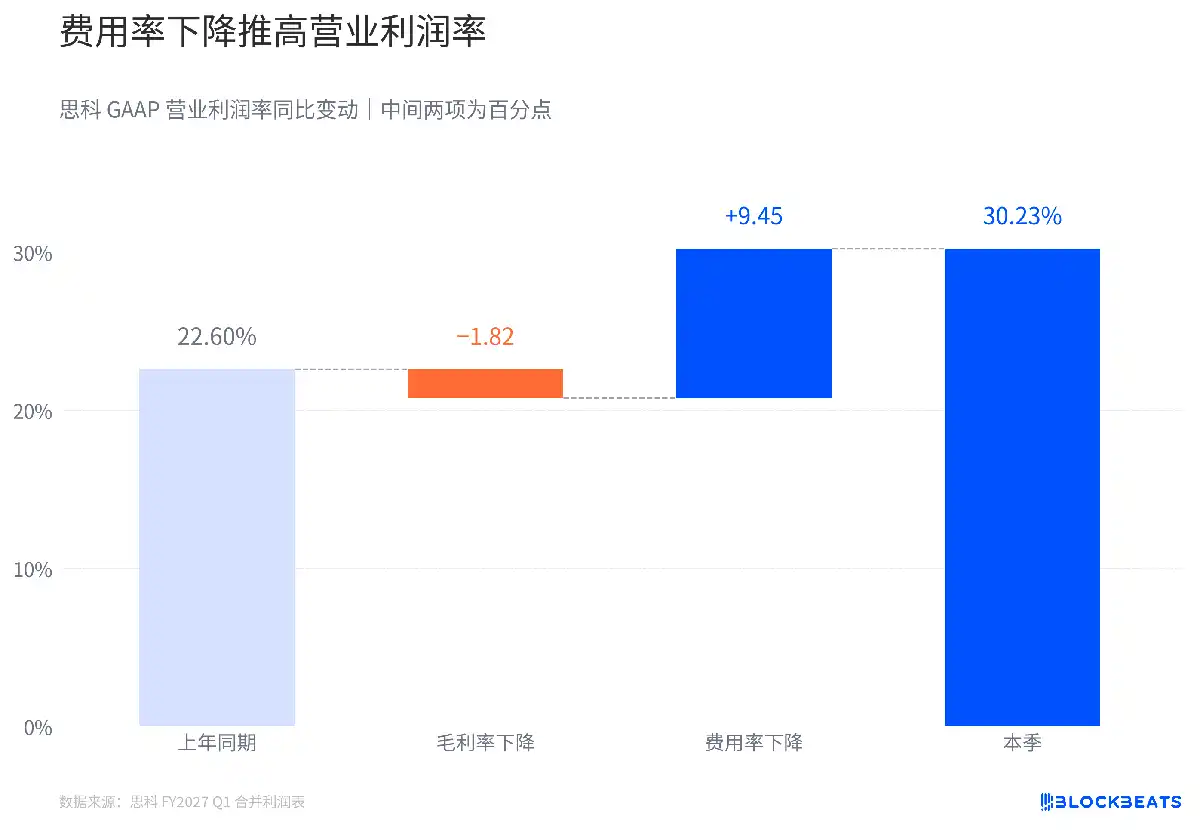
A look at the gross margin gives this earnings report a different impression. Product gross margin declined, while service gross margin recovered somewhat. Faster-growing product revenue also accounted for a higher share of total revenue, and product gross margin is lower than service. Taken together, under US GAAP, for every $100 Cisco sold, it retained about $1.8 less in gross profit than a year earlier. Because the amount sold was larger, the company's total gross profit this quarter still increased.
The difference lies in the next line. After deducting cost of sales, Cisco still has to pay for R&D, sales, and administrative expenses. R&D expenses rose slightly this quarter, sales and marketing spending declined, and restructuring and other charges also fell notably. Even as revenue scaled up, these operating expenses combined actually came in about 3% lower. Comparing at the same revenue scale, the decline in expense ratio freed up 9.45 percentage points for the operating margin, enough to offset the gross margin decline.
The reduction in restructuring charges only explains part of the change. On an adjusted basis excluding restructuring and other items, operating expenses actually rose slightly, but the increase was far smaller than revenue growth. The adjusted operating margin also rose from 34.4% to 37.8%. Even though selling more products diluted the average gross margin, the incremental gross profit was still enough to cover the added adjusted operating expenses.
We can also break down the decline in expense ratio. Assuming operating expenses this quarter had stayed at the same dollar amount as the year-ago period, revenue growth alone would have diluted the expense ratio from about 43% to about 34.5%. Recalculating with this quarter's actual expense amount, the expense ratio would decline further. Most of the positive change in the waterfall chart comes from revenue scale expansion, with the absolute decline in expenses contributing the remaining improvement.
Who contributed the extra $2.5 billion expected for the full year?
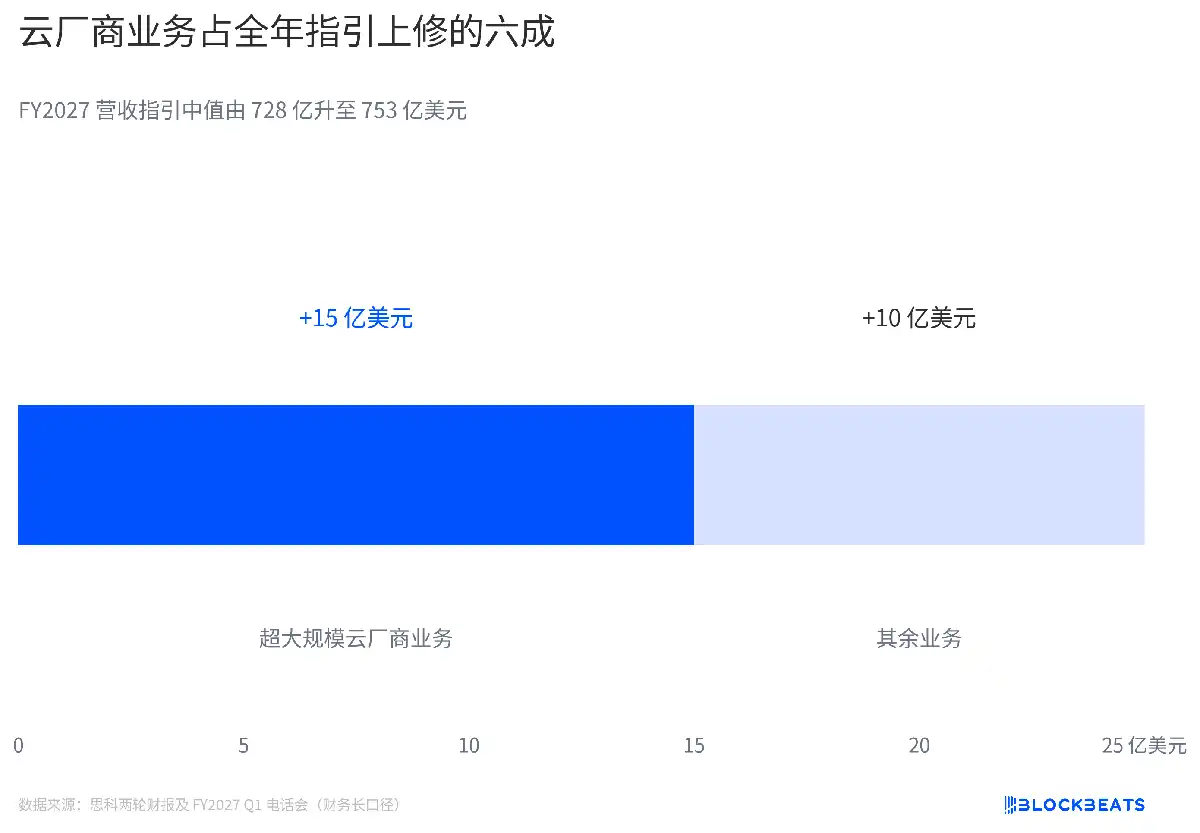
At the previous earnings release, Cisco's revenue guidance midpoint for the new fiscal year was $72.8 billion. This time the company raised the midpoint to $75.3 billion. This compares two estimates for the same fiscal year, reflecting management's new judgment after another quarter on how much revenue can be recognized for the full year.
Patterson provided the breakdown during the Q&A session. Of the $2.5 billion upward revision, hyperscale cloud providers accounted for 60%, with the remaining portion contributed by other customers. He attributed the latter to broader demand, with campus networking just one component. The first chart breaks down quarterly revenue already booked by product and service, while this chart breaks down full-year expectations by customer. The same switch, under the former categorization, falls into the networking business; under the latter, it depends on who placed the order.
The earnings report also provided another set of numbers. Cisco expects AI infrastructure revenue from hyperscale cloud providers to reach $9 billion this fiscal year, up from the previous expectation of $7.5 billion. This metric defines both customer and product, while the call's breakdown used the customer dimension. The upward revision amounts are the same in both places; the attribution in the third chart is taken from Patterson's direct explanation of the overall guidance.
The company's range also changed. The lower bound of the new guidance is $74.8 billion, already above the previous upper bound of $73.4 billion. Patterson's customer breakdown on the call used the difference between the midpoints of the two ranges.
Of every $10 Cisco adds to its full-year guidance, $4 comes from customers outside hyperscalers.
Welcome to join the official BlockBeats community:
Telegram Subscription Group: https://t.me/theblockbeats
Telegram Discussion Group: https://t.me/BlockBeats_App
Official Twitter Account: https://twitter.com/BlockBeatsAsia

 Related Articles