CPI and AI Earnings Set Market Pace: This Week's Hot Assets Outlook | WEEX VIP Weekly Report (November 2–8, 2026)
Summary

Last week, the Democratic landslide in the U.S. midterm elections triggered concerns over tighter AI regulation and data center policies, leading to a sharp sell-off in the U.S. tech sector, with the Nasdaq plunging over 5% in a single day and entering a technical correction. The crypto market experienced a strong correlated decline as cross-asset risk appetite plummeted, with Bitcoin briefly falling below the $76,000 mark before showing some resilience.
Last week, BTC and ETH first declined, then rebounded, and subsequently fell back, posting weekly losses of approximately 4.5% and 6.5%, respectively. Early in the week, they tested support at $76,000 and $2,200, rebounded above $81,000 and $2,400 after the election, and pulled back on Thursday amid the tech stock sell-off. The overall market is in a phase of orderly deleveraging and defensive repositioning. Spot ETFs still saw predominantly large outflows throughout the week, with institutional confidence retreating again after a period of tentative probing.
This week, the market's core focus is on the October CPI inflation data to be released on Tuesday, as well as subsequent PPI and tech giant earnings guidance. Amid persistent policy uncertainty following the election and ongoing concerns over AI capital expenditure, the market remains highly sensitive to the Fed's future path. Under the dual pressure of tightening expectations that have not been fully relaxed and valuation pressures on risk assets, U.S. stocks and crypto and other risk assets are likely to maintain high-level volatility in the short term, accompanied by defensive cross-asset portfolio rebalancing.
This Week's Watchlist:
•Spot: BTC ETH ZEC HYPE GOLD(PAXG) QQQ SPY AMZN AMAT CSCO
•Perpetual Contracts: BTC ETH ZEC HYPE XAUT QQQ SPY AMZN AMAT CSCO
I. Overall Market Performance Last Week
Last week, the Democratic landslide in the U.S. midterm elections gave them control of Congress, triggering policy uncertainty, particularly concerns over tighter AI regulation and data center construction. The market initially saw a brief rebound, followed by a sell-off in risk assets, with overall risk appetite contracting significantly.
•U.S. Treasuries continued to exert pressure: The 10-year Treasury yield fluctuated at a high range of 4.84%-4.95%, edging slightly lower during the week but still weighing on growth stock valuations.
•Gold and crude oil diverged: Safe-haven sentiment and falling yields supported a sharp rebound in gold, which returned above $4,000; crude oil was pressured by expectations of geopolitical easing, plunging over 11% during the week.
•U.S. stocks showed sharp divergence and pullback: Composite pressures dragged down the tech and semiconductor sectors, but traditional value and defensive sectors were relatively resilient or posted modest gains, supported by expectations of policy gridlock after the election.
• The crypto market exhibited synchronized risk-off reactions: sentiment and liquidity transmitted in tandem, with BTC and ETH rising first before falling, posting weekly declines of 4.47% and 6.50% respectively; however, as safe-haven assets such as gold significantly outperformed risk assets, this indicates the current market remains dominated by defensive capital rotation and de-risking behavior, with no comprehensive destructive trend yet formed.
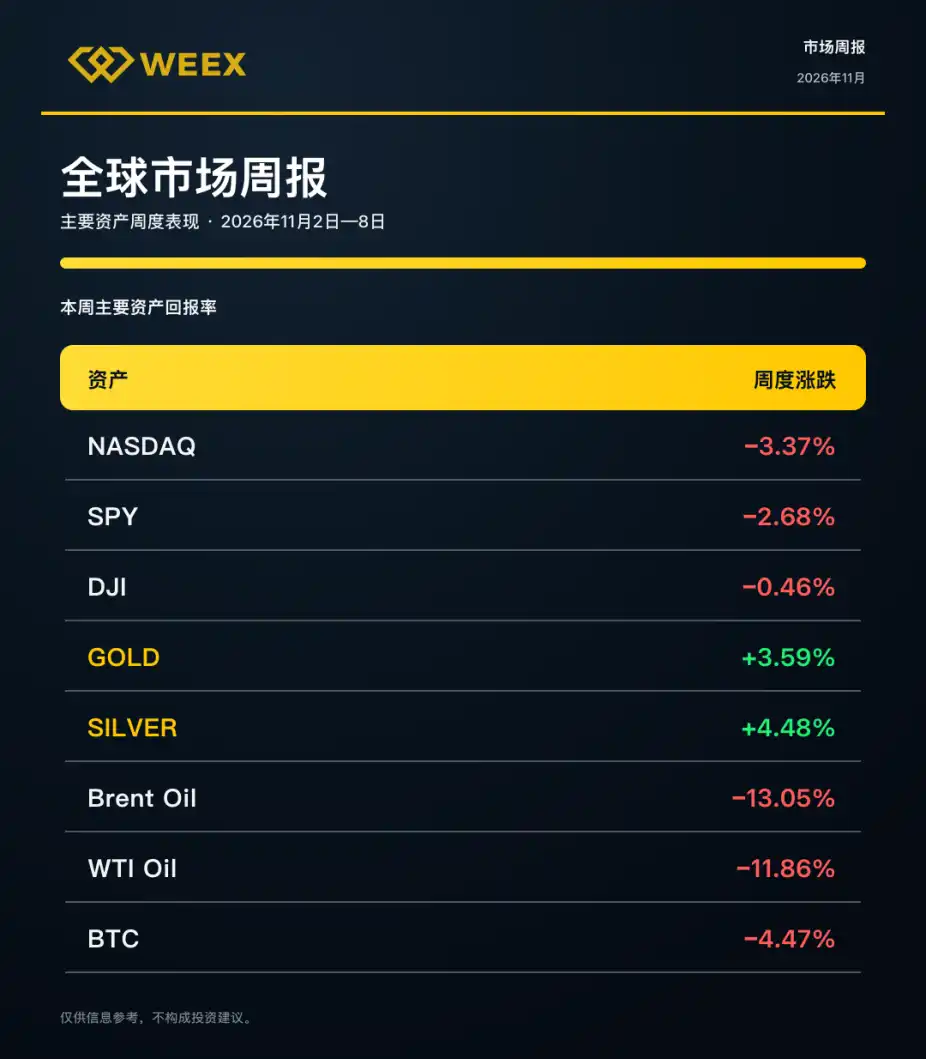
For investors, amid rising macroeconomic volatility and valuation pressures, high-Beta tech exposure should be reduced, allocations to defensive assets such as cash and wealth management products should be increased, and drawdowns should be controlled through staggered entry and hedging. VIP users in particular should first establish a defensive base position before selectively adding risk assets.
II. Crypto Market Performance
Last week, the crypto market dipped, rebounded, then fell back again, coming under overall pressure. The early-week decline continued, with a brief post-election rebound, but on Thursday, as the Nasdaq plunged over 5% and tech stocks sold off, risk appetite plummeted and the market fell in tandem. BTC spot ETFs saw net outflows of approximately $1.28 billion last week, with a weekly decline of 4.47%; ETH fell even more sharply, as institutional capital remained cautious.
Total crypto market capitalization fell from approximately $2.7 trillion during the week to around $2.54 trillion, with a single-day maximum evaporation exceeding $120 billion. The Fear & Greed Index remained in the fear zone for 6 days, and stablecoin market capitalization contracted by approximately 1.55% in tandem to around $290.8 billion. Capital and sentiment broadly converged, with the market dominated by wait-and-see and defensive positioning, showing no clear recovery.
Looking ahead to this week, the market may continue to experience high-volatility oscillation. Attention should be paid to the impact of employment and inflation data on interest rate expectations, as well as the aftermath of US tech earnings reports. If risk appetite does not recover, BTC may continue to test support near $75,000; if sentiment and capital stabilize, there is room for a rebound, but overall defensive trading will likely remain dominant, with a short-term trend breakout unlikely.
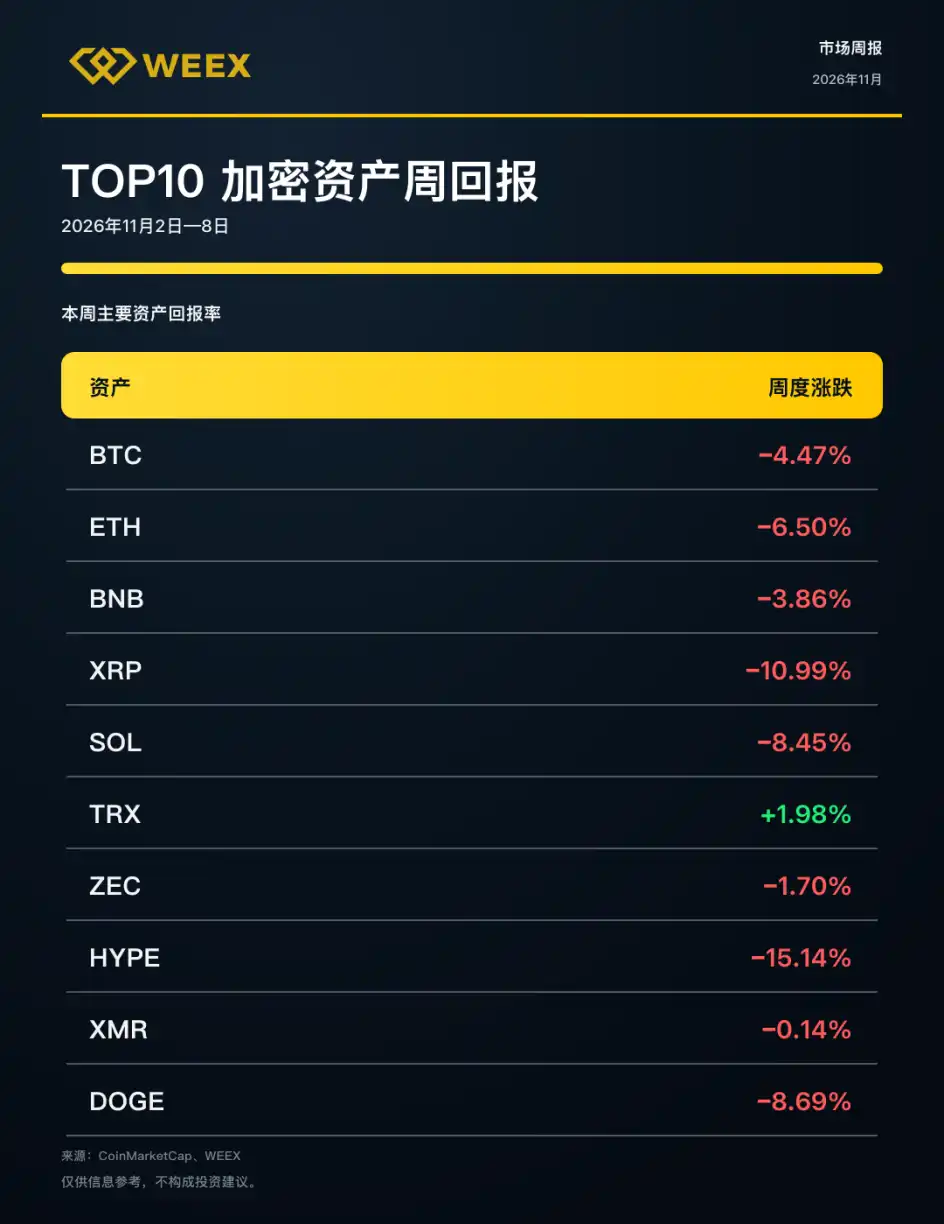
• BTC fell approximately 4.47% last week, showing relative resilience but still under pressure. During the week, it dipped, rebounded, then fell back; on Wednesday it briefly rebounded to near $80,500, but on Thursday it quickly fell back below $76,000 as the Nasdaq dropped sharply. The Fear & Greed Index remained in the "Fear" range (approximately 25-37), indicating cautious market sentiment, with institutional capital broadly withdrawing and the broader market mainly oscillating in search of a bottom.
• ETH fell approximately 6.5% for the week, significantly underperforming BTC. Spot ETFs saw net outflows of approximately $365 million, with major capital continuing to redeem, lacking independent incremental support, and prices came under pressure as broader market risk appetite declined.
•SOL significantly underperformed BTC and ETH. Spot ETFs recorded approximately $26 million in net outflows, with price pressure mainly driven by risk-asset correlated selling and insufficient relative momentum.
•HYPE sharply underperformed the broader market. Spot ETFs continued to see net outflows, compounded by a broad decline in risk appetite, with clear signs of main capital withdrawal.
•ZEC showed relative resilience. Spot ETF flows leaned toward outflows, but it held up relatively well, with periodic capital attention still present in the privacy sector.
•XMR posted a weekly decline of approximately 0.14%, nearly flat, significantly outperforming the broader market, demonstrating the relative defensive attributes of privacy coins during market turbulence.
•TRX rose approximately 2% for the week, one of the few assets with positive returns this week.
III. TradFi Market Performance
Last week, U.S. equities were shaped by the midterm elections' "divided government," OPEC+ maintaining quotas that sent crude oil plunging, the Fed's restrictive stance, and strong October nonfarm payrolls. Midweek volatility surged, with Thursday marking the largest single-day decline since April 2025, as the VIX spiked to 28.18 and capital rotated from high-valuation growth into utilities, consumer staples, and high-dividend defensive sectors.
Leading tech and AI sectors saw sharp drawdowns: the Nasdaq plunged 5.52% on Thursday, entering a technical correction, while the Philadelphia Semiconductor Index fell 12% in a single day, with AMD down over 17% and Nvidia down over 9%. Triggers included doubts over AI capital expenditure returns, expectations of tighter data center regulation, a wave of tech giant debt issuance, and widening cash flow gaps. Although there was a rebound on Friday, valuation compression and cautious sentiment persisted, with the leadership logic shifting from mega-cap AI to earnings visibility.
This week, focus on October CPI, PPI, Fed officials' speeches, as well as earnings from CoreWeave, Nebius, Cisco, and the Anthropic IPO roadshow. Market sentiment may shift from AI enthusiasm toward earnings and balance sheet discipline; users should consider allocating toward defensive high-quality, positive cash flow, and dividend names, and accumulate tech leaders on pullbacks in tranches.
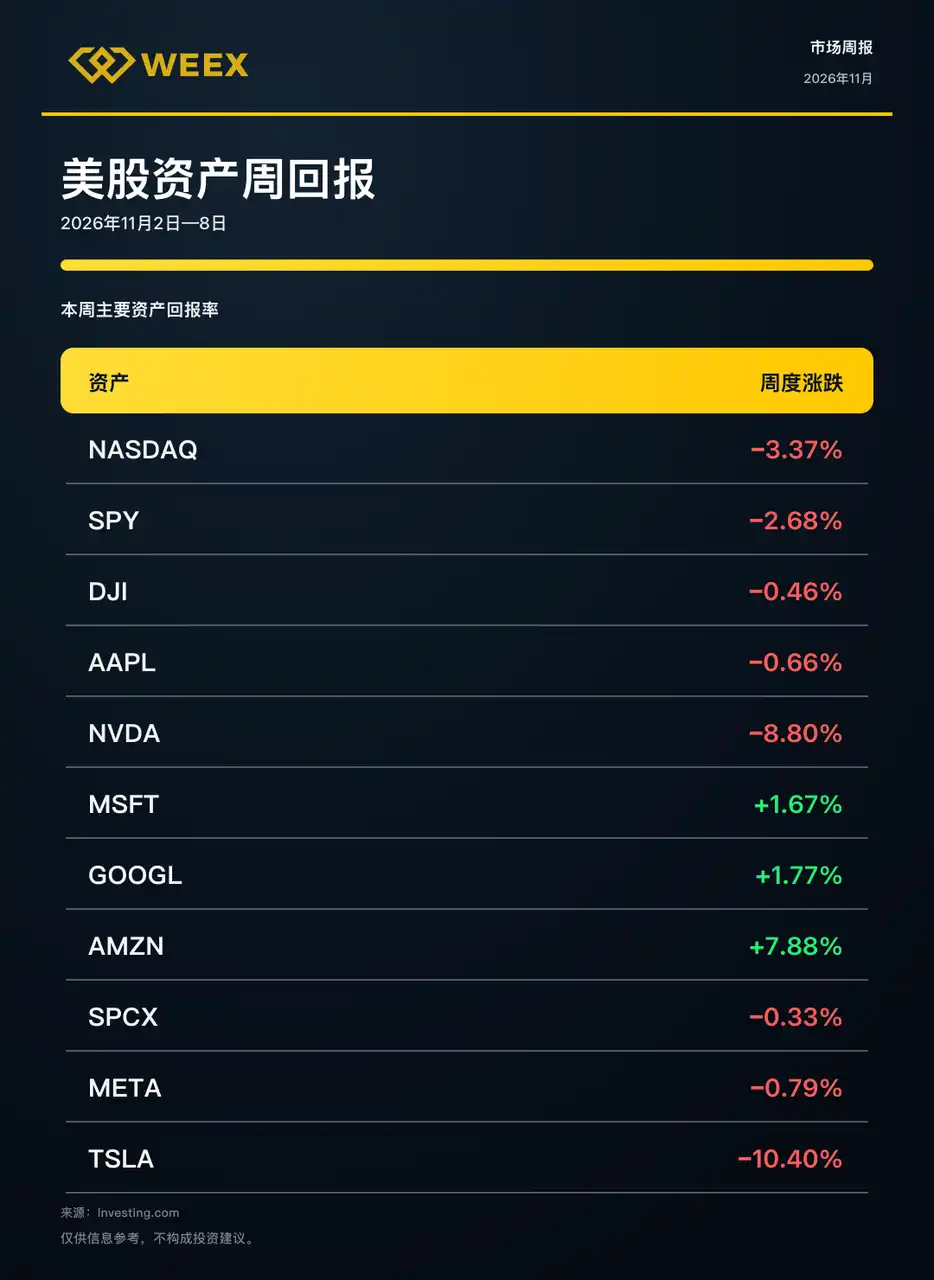
•NASDAQ, SPY, and DJI all closed lower last week. The week saw an initial dip, a rebound, then a sharp selloff—Democrats' midterm election wins on Wednesday triggered a rally, while AI regulatory concerns on Thursday sparked a chip stock selloff, pushing the Nasdaq into technical correction. The Dow was relatively resilient, overall reflecting that tech weighting dragged on the broader market amid contracting risk appetite.
• SPCX and TSLA fell approximately 0.33% and about 10.4% respectively last week. Both came under pressure on Thursday amid a broad AI sector selloff, with a notable technical rebound on Friday. SpaceX benefited from a recovery in aerospace sentiment, while Tesla was weighed down by EV demand and valuation concerns, reflecting heightened volatility in growth stocks amid policy uncertainty.
• META traded in a choppy range last week, tracking the broader tech sector. AI advertising and metaverse investments continued, but with a lack of strong catalysts, investor观望 sentiment dominated, exerting a neutral-to-cautious influence on the social and digital advertising sector.
• AAPL reported better-than-expected earnings last Monday, but rising memory costs weighed on gross margin expectations. The stock came under pressure before stabilizing modestly, indicating that the hardware giant remains subject to cautious market assessment amid supply chain cost pressures and its AI services transition.
• NVDA dropped over 9% in a single day last Thursday, with the AI chip sector bearing the brunt (dragging AMD, AVGO and others into sharp corrections). The primary driver was concerns over a slowdown in data center construction following the Democratic election victory, which sharply cooled sentiment in the AI hardware sector and weighed on the broader tech growth narrative.
• MSFT's cloud and AI business resilience supported relative outperformance, with weekly volatility smaller than peers. Azure growth expectations remain solid, providing a stabilizing influence on the software and enterprise cloud services sector.
• GOOGL's search and cloud businesses remained steady, with AI model progress drawing attention. The stock followed the broader market in falling first and rebounding later during the week, offering relative defensive support for the internet advertising and cloud computing sector.
• AMZN significantly outperformed the broader market last week. AWS and e-commerce resilience stood out, with a rapid recovery after Thursday's selloff and notable capital inflows, boosting sentiment in the e-commerce and cloud computing sector.
IV. Asset Allocation
Last week, the U.S. tech sector and crypto assets came under synchronized pressure, with volatility rising notably. Market focus centered on CPI and PPI data, AI infrastructure-related earnings, and the MSCI index review, as investors reprice inflation pressures, AI capital expenditure returns, and overall risk appetite.
Against this backdrop, assets including QQQ, BTC, ETH, as well as CRWV, CSCO, AMAT, NBIS, and CBRS, are poised for more active trading windows, with the main theme revolving around "whether a recovery can materialize after the AI selloff."
We recommend an allocation that balances liquidity and defensiveness, moderately controlling risk asset positions and avoiding excessive concentration in a single sector. If CPI and PPI data indicate cooling inflation while the aforementioned AI infrastructure companies signal steady demand, tech stocks and BTC may see recovery trades; conversely, if inflation runs hot or AI guidance continues to reveal capital expenditure pressures, QQQ, BTC, and ETH should still guard against a second leg down, and it would be prudent to wait for market sentiment and liquidity conditions to stabilize before adjusting positions.
V. Week Ahead
5.1 Key Economic Events
U.S. equities face a dense data test this week. Monday's September wholesale sales MoM is expected to turn positive, reflecting a rebound in inventory destocking; Friday's PPI will verify the low-speed resilience of producer-side costs. The bond market is closed Wednesday for Veterans Day, which could amplify equity volatility.

The highlight is Tuesday's October CPI data. Dragged by prior oil price gains, headline CPI YoY is expected to rise to 3.3%-3.5%, while core CPI YoY is expected to hover at a high 3.1%-3.2%. Meanwhile, close attention must be paid to whether core MoM exceeds the 0.2% consensus line. If the data broadly beat expectations, it would confirm the risk of sticky inflation or even a second reacceleration, posing a decisive obstacle to the Fed's subsequent policy path and potentially triggering a repricing of expectations for a policy pause or pivot.
We take the trend in services costs within the inflation sub-components and changes in jobless claims as key focus clues. By assessing the tug-of-war between "inflation stickiness" and "employment resilience," we use this as an investment reference for subsequent asset allocation and risk hedging.
5.2 Individual Stock Earnings
This week's U.S. earnings focus on AI and energy themes. Monday features traditional leaders CEG, OXY, and KKR; Tuesday sees a cluster of quantum and cloud computing names (CRWV, RGTI); Thursday caps off with semiconductors and software (AMAT, CSCO). Overall expectations are on the strong side, with many revenue growth highlights, but loss-making stocks still require scrutiny of execution.
Focus on AMAT and CSCO. AMAT is expected to post EPS of $4.06 and revenue of $10.3 billion, with AI equipment demand potentially driving a record high; CSCO is expected to post EPS of about $1.32 and revenue of about $18.1 billion, with cloud and network security businesses becoming key. Guidance and gross margins from both will serve as market bellwethers.
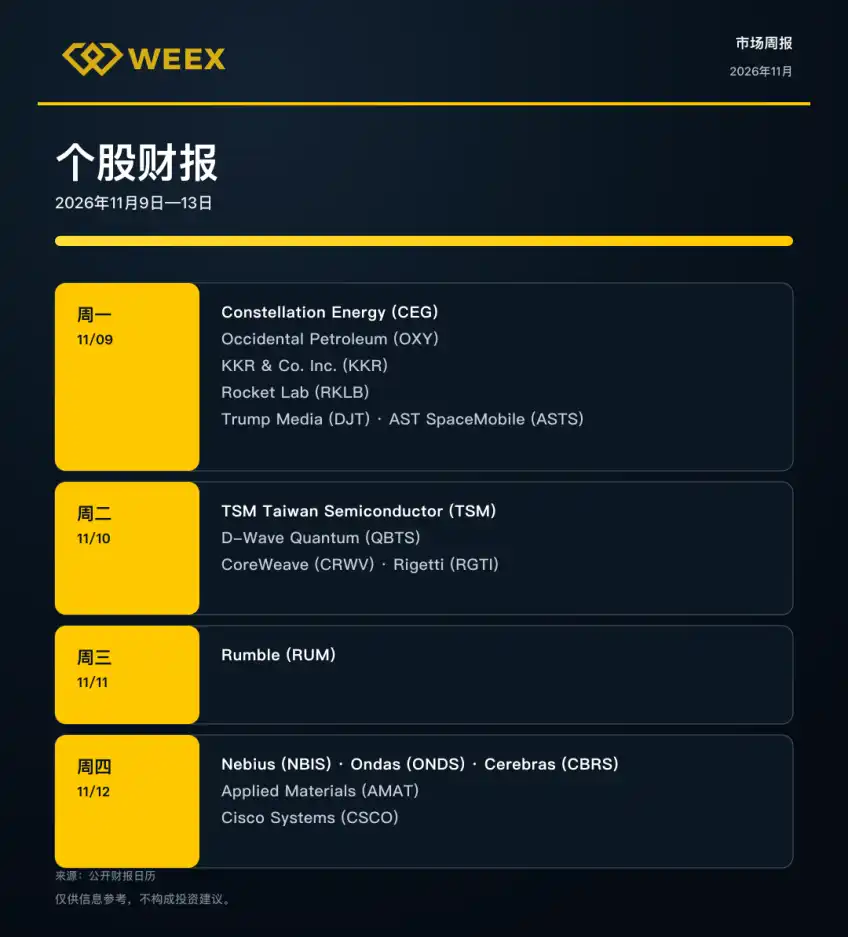
We focus on whether individual stock revenue beats expectations, the magnitude of guidance raises, gross margin trends, and AI-related order visibility, as the basis for subsequent position adjustments.
5.3 Token Unlocks
The crypto market this week should watch multiple token unlocks exceeding $10 million, among which Rain (RAIN) releases about $121 million, the most prominent, while Allora (ALLO), Janction (JCT), and Aztec (AZTEC) unlocks each exceed $10 million in market value.
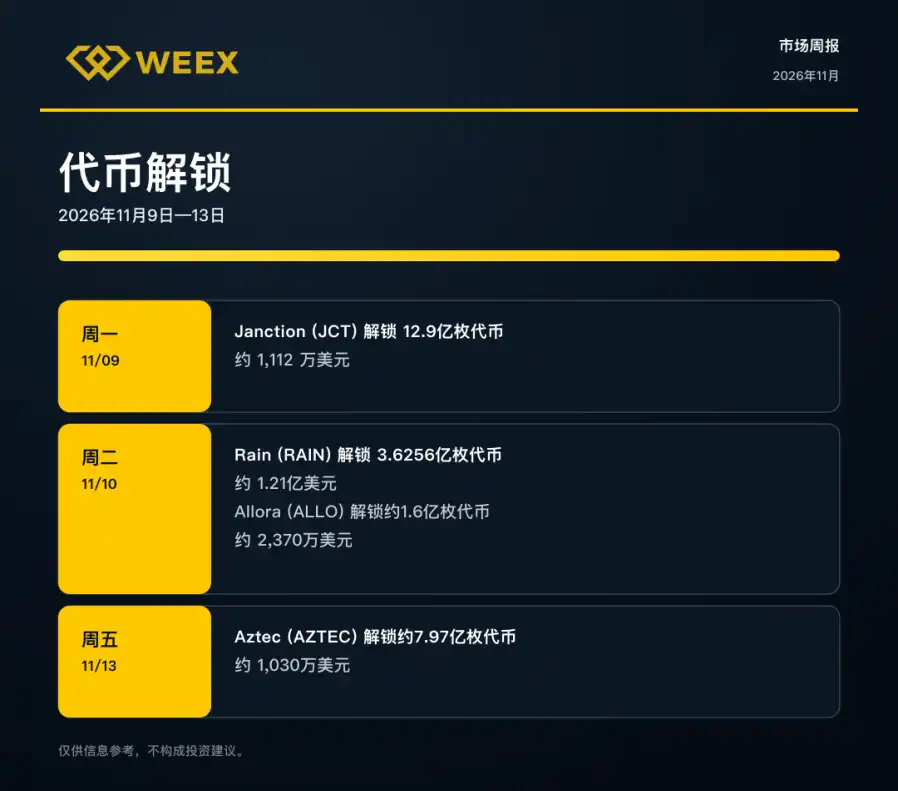
Current market sentiment is cautious with heightened volatility. Large token unlocks can easily trigger short-term selling pressure and liquidity shocks. Investors should closely monitor post-unlock price and trading volume changes.
Disclaimer
This report is provided by the WEEX research team for informational and discussion purposes only and does not constitute any investment, legal, or tax advice, nor does it guarantee returns. Digital assets and derivatives are highly volatile and illiquid, which may result in loss of principal; forecasts do not represent future results. Investing involves risk. Please conduct independent research and make your own decisions. The WEEX platform assumes no liability for any losses. Unauthorized reproduction or distribution without attribution will be pursued in accordance with the law.
Welcome to join the official BlockBeats community:
Telegram Subscription Group: https://t.me/theblockbeats
Telegram Discussion Group: https://t.me/BlockBeats_App
Official Twitter Account: https://twitter.com/BlockBeatsAsia

 Related Articles