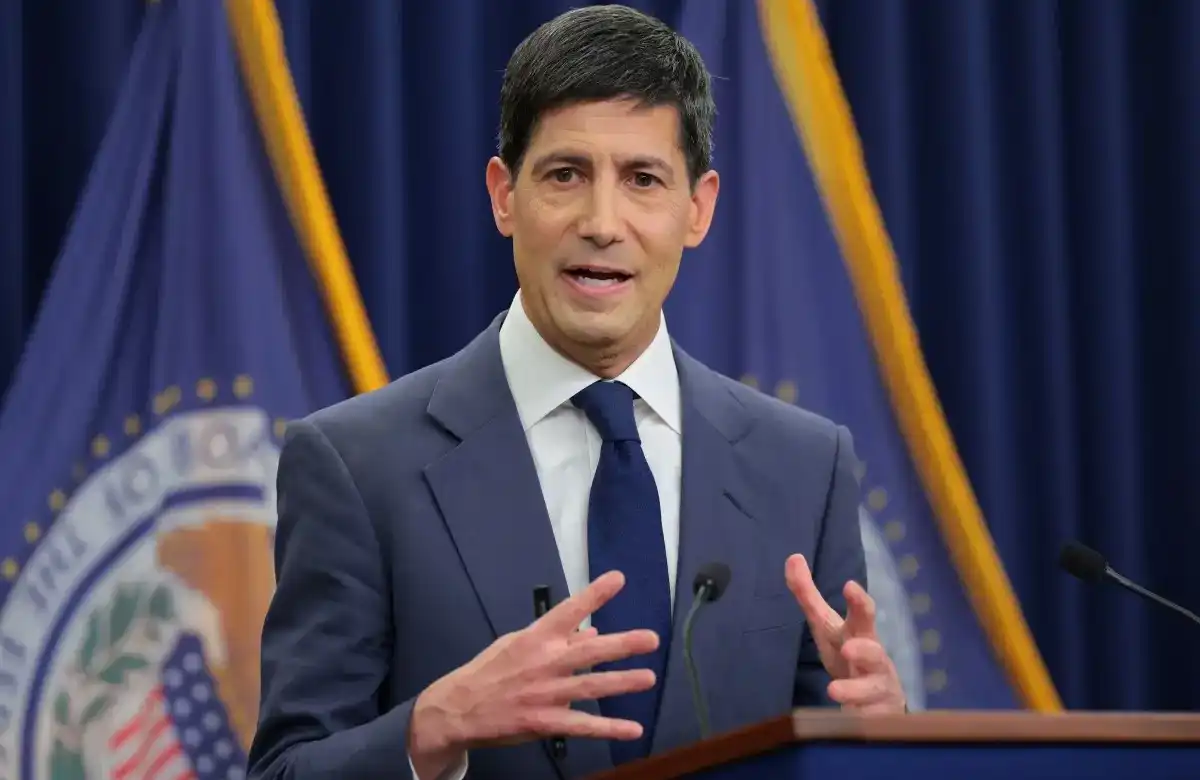
Will the Fed raise rates next week? Tonight's CPI may seal the deal.
Original title: "Will the Fed hike next week? Tonight's CPI will seal the verdict"
Original source: Wall Street See
A single decimal point may directly determine whether the Fed hikes next week: core CPI at 0.2% month-over-month means holding steady, while 0.3% triggers a hike. Divisions within the Fed are clear, and the bond market, dollar, yen, and equities are all on high alert. Goldman Sachs warns that if the data is benign and the Fed chooses to hold steady, the bond market's concerns about a "policy mistake" will far outweigh the damage from hiking amid above-target inflation. Tonight's August CPI report will be the most market-moving inflation reading in years. A single decimal point is enough to determine whether the Fed launches another hike in this cycle next week—and this gamble has already forced economists at Wall Street's top institutions to calculate to the third decimal place.
Money markets are currently pricing about a 70% probability of a 25-basis-point hike at the September 16 FOMC meeting. Last week's strong nonfarm payrolls data and rising Middle East geopolitical tensions together pushed up hawkish expectations. Fed Governor Waller previously laid out the clearest policy reaction function to date: if August inflation data shows the disinflation process continuing, he leans toward keeping rates unchanged; if the data runs hot, he would support a hike. Fed Chair Warsh said at the Jackson Hole conference that unless inflation moves toward the 2% target fast enough, the policy job is not done.

Mainstream Wall Street forecasts cluster around core CPI at 0.2% month-over-month, but that is precisely the outcome the market finds hardest to price. According to JPMorgan's market intelligence team, 0.2% (rounded) means holding steady, while 0.3% means a hike. Bloomberg chief US economist Anna Wong said her team is calculating PCE inflation forecasts to the thousandth of a percentage point to judge the policy implications of this "one of the most closely watched CPI reports in history." Tonight's data will directly reshape market pricing for the rate path in September, October, and even December.
Institutional forecasts: core CPI clustered near 0.2%
Major Wall Street institutions' forecasts for August core CPI are highly concentrated, but subtle differences matter greatly.
According to JPMorgan, August core CPI rose 0.21% month-over-month, equivalent to about 2.37% annualized, barely holding at 2.4% after rounding. On core PCE, JPMorgan expects a 0.20% month-over-month increase and 3.2% year-over-year. The bank also noted that 13 of the past 17 CPI readings came in below expectations, with the current inflation surprise index in the weakest 10% range of the past decade, so it maintains a below-consensus forecast and continues to hold short positions.

Bank of America Securities forecasts core CPI to rise 0.22% month-over-month, core PCE to rise 0.24%, equivalent to an annualized rate of about 2.9%, with the year-over-year rate expected to climb to 3.4%. BofA economist Stephen Juneau believes this result will not be enough to reassure the Fed about the inflation trend, and is sufficient to support the FOMC raising rates again at its September meeting.
Goldman Sachs, meanwhile, forecasts core CPI month-over-month at 0.22%, and expects this to translate into a 0.22% month-over-month gain in core PCE. Goldman specifically highlights three key components: used car prices are expected to rise 0.5%; housing rent (OER) and the rent sub-component are expected to rise modestly by 0.22% and 0.23% respectively; airfare prices are expected to surge 4.0%, reflecting the ongoing pass-through of jet fuel costs.
Citi's forecast is more dovish, projecting core CPI month-over-month at 0.18% and core PCE at 0.19%, and believes this result would support the Fed holding steady in September.
Polymarket prediction markets show a median economist forecast of 2.4% year-over-year, with the market pricing notably higher odds of a below-expectations reading (2.3% and below) than an above-expectations reading (2.5% and above).

Warsh and Waller: Two Signals, One Game
Divisions within the Fed make the interpretation of this CPI data more complex.
Chair Warsh's speech at Jackson Hole was hawkish, explicitly stating that unless core inflation clearly converges toward the 2% target at a sufficient pace, the Fed still has more work to do. This wording was interpreted by the market as signaling extremely low tolerance for inflation.
Waller's remarks were relatively more moderate, constituting a clear counterbalance. He said he is seeing signs of cooling inflation, with three-month core inflation improving significantly, and that if August data continues to show cooling, he would support holding steady in September.
The specific reference he gave was: if the three-month annualized core inflation rate falls to 2.8%, "that is acceptable." But he simultaneously retained the position of supporting a rate hike if the data comes in hot. Waller also downplayed the inflationary pull from energy prices and tariffs, arguing that wage growth is consistent with the path back to target, and proposed that core PCE may not be the best indicator for measuring inflation trends, arguing that underlying inflation is actually "performing better" than what the core data suggests.
Goldman Sachs FICC co-head Anshul Sehgal described Warsh and Waller's remarks as "two starkly different interpretations," arguing that whether this cycle requires rate hikes remains undecided and depends largely on energy price trends and geopolitical developments. His view: This cycle is unlikely to see more than three rate hikes, and the 1-year forward 1-year rate priced at 435 basis points implies about two and a half hikes, which "sounds roughly right."
Bonds and Rates Markets: 0.25% Is the Threshold Between Hiking and Holding
Rates traders have trained their sights on the precise decimal of core CPI.
Bank of America rates strategist Meghan Swiber's scenario analysis shows: if core CPI comes in at 0.1% month-over-month, 2-year Treasury yields are expected to fall 10 to 5 basis points; if 0.2%, fluctuations of about ±5 basis points; if 0.3%, yields will rise 5 to 8 basis points. She noted in particular that a soft print would trigger a larger rally than the selloff a hot print would cause — because hike expectations are already well priced in, and the market overall holds relatively heavy short positioning.
Goldman Sachs macro trading desk's Brian Bingham noted that the Fed has fallen into its "most contradictory predicament," potentially letting government data rounding determine the direction of policy. He also worries that if data comes in moderate and the Fed chooses to hold steady, the bond market's concern over a "policy misstep" will far exceed the damage from hiking in an above-target inflation scenario.
Bank of America Securities historical data shows that 90% of hawkish Fed surprises occurred when the market had priced in within 3 basis points two days before the meeting, meaning that if pricing is too aggressive by then, the Fed actually not hiking could become the bigger surprise.
FX Market: Dollar at Lows, Data May Intensify Two-Way Swings
The dollar enters this key report languishing near four-month lows.
Goldman Sachs FX strategy head Mike Cahill believes that if the data comes in hot (around 0.25% month-over-month) with sufficiently broad distribution, the Fed will find it hard to avoid hiking, as it would break through the range delineated by Williams and Waller. If the data comes in soft (0.18% to 0.20%), the Fed can comfortably hold steady without triggering an adverse market reaction. He attributes the dollar's recent weakness to three factors: the Fed's dovish tilt, the Treasury's policy preference for letting the exchange rate serve an adjustment function, and the independent strengthening of currencies including the renminbi, yen, and won.
Bank of America FX strategist Alex Cohen noted that under the market consensus scenario (core CPI at 0.2% MoM), the dollar will trade in a two-way range, as whether there will be a September rate hike remains uncertain. If the data comes in soft, the dollar's decline will exceed its gain in a hot scenario, with DXY estimated to fall at least 0.5% to 0.75%, and October and December rate hike expectations will also retreat sharply. If the data comes in hot, rate hike odds will approach 90%, and the dollar will initially rebound, but if the Fed subsequently fails to follow through, the erosion of dollar credibility will deepen further, and the dollar may instead weaken in tandem with long-end Treasuries.
On the yen, after USDJPY recently broke below the 155 range, Goldman Sachs G10 spot trading desk's Luke Molyneux believes that if the data meets expectations and supports holding steady, USDJPY is likely to extend its decline, targeting the low 152.10 area; if the data comes in hot, it may briefly rebound to the 157.50 to 158.00 range, but will still be viewed by the market as a selling opportunity.
Equities and Risk Assets: Upside Skewed Higher, but Volatility Will Persist
In the equity market, JPMorgan's market strategy team believes the risk-reward ratio is overall skewed to the upside.
If the data supports holding steady or a "hawkish hold," tech, momentum, and cyclical sectors are expected to be the main drivers of a rebound. JPMorgan positioning tracking data shows that hedge funds have increased overall exposure for four consecutive trading days over the past week, with the weekly net increase reaching the highest level since late June (+1.3 standard deviations), and releveraging capacity remains ample, constituting a potential upside catalyst.
But JPMorgan also noted that market moves will remain range-bound before the data release, which is the direct reason the bank recently adjusted its short-term rating to "tactically neutral." The options market currently implies about a 1.0% single-day move for contracts expiring on September 11.
The biggest tail risk is that core inflation comes in significantly above expectations. If so, October and December rate hike expectations, currently at about 27% and 54% respectively, will be rapidly repriced, posing substantial pressure on the stock market.
The Paradox of a Single Number: Precise to Three Decimal Places
Another deeper implication of this report is that it represents an extreme stress test of "data-dependent" monetary policy itself.
Bloomberg chief US economist Anna Wong wrote that her team has been running core PCE forecasts to three decimal places of precision to determine which side this rate decision leans toward. This was cited by FX trader Brent Donnelly and forms a thought-provoking contrast with Warsh's own earlier remarks — Warsh in his 2025 speech criticized "data-dependent" policy as having limited value, arguing that excessive focus on the second decimal place of government data reflects "false precision and analytical laziness."
Yet, as Donnelly pointed out, "we are in this situation right now." Tonight's figures may become the most delicate game between the Federal Reserve's policy credibility and market expectations.
Original link
Welcome to join the official BlockBeats community:
Telegram Subscription Group: https://t.me/theblockbeats
Telegram Discussion Group: https://t.me/BlockBeats_App
Official Twitter Account: https://twitter.com/BlockBeatsAsia

 Related Articles