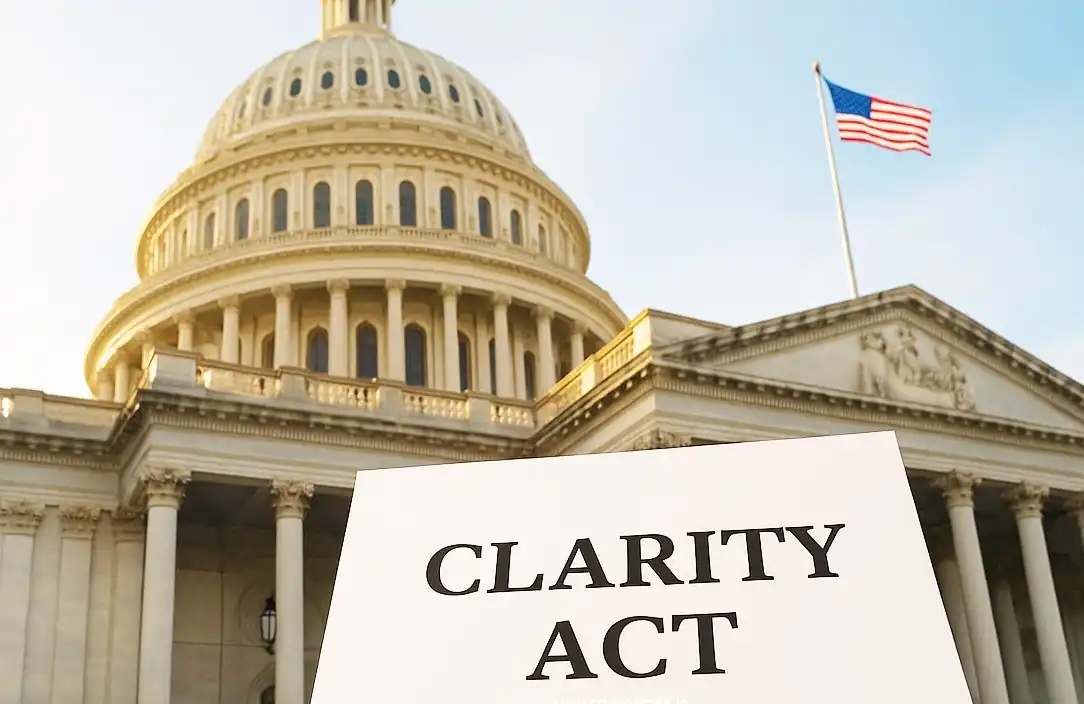
CLARITY Act: Only 60 Votes Away from Passage, Market Odds at Just 17%
At 2:15 p.m. Eastern Time on September 15, the U.S. Senate will vote on a bill.
This vote does not decide whether it becomes law, only whether senators can begin formal debate on it. But it may very well be the end of the road for this bill.
To clear this hurdle, 60 votes in favor are needed. Republicans hold 53 seats.
The bill's full title is the Digital Asset Market Clarity Act, numbered H.R. 3633. It does only one thing: make clear whether a token falls under SEC or CFTC jurisdiction.
This issue has been fought over for a decade. In July 2025, the House passed it 294 to 134, with 78 Democrats voting in favor. Then it stalled in the Senate for 14 months.
On September 10, Republicans released another new version
On Thursday, Republican Senator Cynthia Lummis unveiled the updated full text, about 630 pages. She said the text "reflects the hard bipartisan work during the August recess," incorporating more than 100 changes demanded by Democrats (other accounts say 114 to 115).
What actually changed comes down to just three areas.
First, "nominally decentralized" protocols must register. If a trading protocol is not truly decentralized — meaning some person or group has the right, through contracts, arrangements, or relationships, to directly or indirectly control or materially alter its functions, operations, or consensus rules — then it must register with the CFTC and assume Bank Secrecy Act obligations. A carve-out remains: participating in governance or security committees does not itself count as "control"; only protocols that can be manipulated by a specific entity do. The CFTC's subsequent rulemaking will focus on spot and cash digital commodity markets.
Second, the scope of DeFi has been narrowed. The relevant protections cover only spot and cash transactions in digital commodities, explicitly excluding prediction markets. This provision targets opposition from Native American tribes with gaming interests.
Third, credit unions' authority is clarified. Federal credit unions may use digital assets or distributed ledger systems to conduct any business they are already legally authorized to conduct.
What was not changed is the key part.
The ethics clause was not touched at all. It remains the White House-endorsed version from July: the president, vice president, members of Congress, and other senior officials and their spouses may not issue or sponsor digital assets, expiring on January 20, 2029, not retroactive, and enforceable only by the Department of Justice — state attorneys general and private lawsuits have no enforcement power.
BRCA (Protecting Noncustodial Software Developers from Being Treated as Money Transmitters) and the stablecoin yield provision also remain at the July version.
How Long Has This Road Been
The seven Democrats are Alsobrooks, Booker, Cortez Masto, Gallego, Hickenlooper, Warner, and Warnock. At the time, Gallego said directly that the ethics provision was "not a serious proposal."
Since the release of the new text, not one of these seven has publicly softened.
What Exactly Is This Vote About
To be clear first: this is not the final passage vote. Cloture is a procedural motion to "end debate"; passing it only means formal debate can begin and amendments can be introduced.
The arithmetic is short. Republicans have 53 seats; if all fall in line, they are still 7 Democrats (or independent senators) short.
The trouble is that Republicans are not unified either. Media reports name Rand Paul and Josh Hawley as opposed, on substantive grounds; Tillis has said he will not support it unless the ethics provisions are strengthened. If all three bolt, the number of Democratic votes needed rises to more than 10.
The Senate does not reconvene until September 14, and the vote is on the second day after reconvening. That leaves both sides less than 5 days.
So the real meaning of this vote is: if it cannot clear 60, this bill is basically finished in 2026. The Senate is out of session for most of October, and November 3 is the midterm elections. Some media outlets have done the math: after this vote, there are only a handful of working days left in this session for the bill to complete the process.
How Much Is the Market Pricing In? First, Look at Polymarket
The main market has only one question: Will the CLARITY Act (H.R.3633) be signed into law within 2026?
How this curve collapsed: in February it was still 82%, before the August recess it fell to 65%, after the vote was postponed it dropped to 17%, and on September 10 it was still 17.5%.
Now look at the sub-markets. There is a trap here that must be made clear first: the market asking "how many senators vote yes" settles based on "the Senate's first final passage vote," not the September 15 vote—the market rules explicitly exclude procedural motions, cloture, and amendment votes. In other words, these numbers measure "if this step passes, how much further can it go."
The 29% figure needs to be read alongside 17.5%. The probability of reaching a final passage vote and securing 60 votes is 29%, but the probability of actually becoming law this year is only 17.5%. That gap corresponds precisely to the steps still ahead: floor debate, amendments, a second cloture vote, reconciliation with the House version, and presidential signature.
There is also a market betting on specific individuals. Note again: settlement is based on "final passage vote," not the September 15 vote. So the numbers below are not about "will he vote to advance" but "will he vote yes on final passage" — if there is no final vote at all, everything settles as No.
The most striking are the last three rows. Tillis and Gallego are co-negotiators on the ethics provisions, yet the market gives them only 20% and 15.5% respectively. One of them won't support the bill unless the ethics provisions are strengthened, and the other said in July that the ethics text "is not a serious proposal."
There is also a discrepancy here: Polymarket gives Rand Paul 38.5%, but media reports say Paul opposes the bill on substantive grounds. The market's pricing and the lawmaker's public stance don't align — that divergence itself is worth noting.
Money is talking too. On Polymarket, 6 identified wallets have collectively bet over $3.6 million on "No," with two newly created anonymous accounts placing roughly $818,000 and $677,000 respectively. These "No" positions were only just established before the vote.
On the other side, only two cross-market veterans, TwoEyes and Geminae.Columbae, still hold Yes positions, with a cost basis corresponding to about a 20% probability of becoming law, now sitting on unrealized losses of about $11,800. But they simultaneously hold approximately $19.92 million in crypto longs on Hyperliquid — this looks more like buying political insurance for their massive longs than a bet on this bill.
Other estimates: Galaxy Research puts it in the "low double digits," around 10%.
There's also a leak. The Rollup host Andy said on X that sources from Capitol Hill put the real probability at just 3% to 5%, and that Washington insiders broadly believe it won't pass — but no one can say so publicly because the industry has already poured in tens of millions of dollars and 18 months. This is unverified, but it's the most widely circulated "inside line" right now.
What happens if it passes
One sentence: the industry gets a durable statute, not the mood of whichever administration is in power.
Specifically, four things.
One, the division of labor between the SEC and CFTC is written into law. Tokens on decentralized, mature blockchains (once BTC and ETH meet the "mature blockchain" standard) fall under CFTC oversight of the spot market; "investment contract assets" that still depend on team efforts or fundraising fall under the SEC, with a path laid out for transitioning from SEC to CFTC oversight. The decade-long fight over whether tokens are securities or commodities will get a statutory answer.
Two, intermediaries must play by the rules. Digital commodity exchanges, brokers, and dealers must register with the CFTC, with requirements for customer asset segregation, qualified custody, disclosure, and market surveillance—an institutional response aimed squarely at the kind of collapse seen with FTX. The July merged text also made a structural adjustment: changing registration from "provisional registration" to a "notice of intent" process, and adding new registration categories for digital commodity pool operators, digital commodity trading advisors, and their associated persons (this provision comes from the July 22 version and is not in the September 10 revision).
Three, developers and self-custody get a legal floor. BRCA gives non-custodial software developers a safe harbor: they are not treated as money transmitters just for writing code and maintaining a network. After the DOJ prosecuted the Samourai Wallet developers, the nature of this provision changed completely—it amounts to adding a statutory shield against the enforcement logic that "publishing code is illegal." The new text also incorporates self-custodial wallet protections derived from the Keep Your Coins Act.
Four, the ethics clause takes effect, but it is very soft. Senior officials and their spouses may not issue or sponsor digital assets, it expires on January 20, 2029, it is not retroactive, and only the DOJ can enforce it.
What happens at the market level? Tokens explicitly classified as "digital commodities" get a clarity premium, and compliant exchanges gain a moat. But do not take cloture passage as meaning everything is smooth sailing—the developer safe harbor and self-custody protections are precisely the two provisions most likely to be used as bargaining chips during the amendment stage.
If it fails, it is not "maintaining the status quo"
This is the point most easily misread.
Failure does not mean standing still; it means legislative power shifts from Congress to the regulators.
The SEC has already taken a step first. In August 2026, it proposed Regulation Crypto Assets, containing four parts: a startup exemption (up to $5 million per offering, for a maximum of 4 years), a fundraising exemption, and a non-exclusive conditional safe harbor for investment contracts under the Howey test, and it preempts certain state registration and qualification requirements.
CFTC Chairman Michael Selig, in an August 20 interview with Bloomberg Television, also put it bluntly: "Building market structure is very important. We can achieve it through regulatory rulemaking, or we can achieve it through legislation." Legislation is the most reliable way to lock in market structure, but agencies also have considerable authority under existing regulations, and they will use it when they need to.
What's the difference? Statutory law gives safe harbors and federal preemption; agency rules give comment letters, enforcement actions, and court subpoenas. The former is more durable, the latter is more easily overturned by the next administration. And some scholars point out that whether the severely understaffed CFTC even has the capacity to write rules, register institutions, build systems, and supervise markets is itself a question mark.
The legislative window will also effectively close. The more likely direction is splitting the bill: no longer pursuing one big comprehensive bill, but legislating separately on stablecoins, asset tokenization, perpetual contracts, and prediction markets. According to Capitol Hill sources, this is the more realistic path in the long run.
And one more thing won't stop: enforcement. The Justice Department's prosecution logic against non-custodial developers, FinCEN's regulatory ambitions in the self-custody space, the SEC's stance on unregistered digital assets — none of these will pause just because a bill dies. This is the most underrated cost of "failure": not a neutral outcome, but active enforcement without the shield of statutory protections.
How the industry is arguing right now
It's not monolithic — there are at least six camps.
The first, and currently the most influential: pessimistic, but convinced this is a negotiating posture.
Paradigm's Vice President of Government Affairs, Alexander Grieve, has been widely quoted. He believes those putting the odds at "near zero" are misreading leaks from anonymous staffers — lawmakers expressing pessimism to reporters in order to squeeze final concessions out of the White House or Senate leadership. His evidence: bank lobbying and advertising money are still flowing, and no one spends money on a corpse.
He acknowledges the calendar is indeed a problem, but adds:
"But this thing is not dead, absolutely not."
The second camp, Coinbase's Brian Armstrong: clarity will definitely come, legislation is just one path.
He said on CNBC that if the bill passes, the industry gets durable legislation; if it doesn't, the SEC and CFTC will still issue rules anyway. His judgment is that "clarity could come on or within a day or two of September 15." He also said Coinbase's "must-have provisions" have been resolved, and the remaining core disagreement is just the ethics rules.
One more piece of context: In January of this year, Armstrong briefly withdrew his support, saying he would "rather have no bill than a bad bill."
The third camp, those opposite to Armstrong: negotiate, don't flip the table.
Kraken CEO Arjun Sethi advocates resolving legacy issues through negotiation rather than abandoning years of bipartisan progress. a16z Managing Partner Chris Dixon, Ripple CEO Brad Garlinghouse, and White House crypto advisor David Sacks hold similar positions.
Ledger Global Head of Policy Seth Hertlein's words represent the mindset of many: it's hard to imagine a more favorable environment in the future than now — if it can't get done now, it either won't get done in the future, or will have to be done under very unfavorable conditions.
The fourth camp, academic and regulatory skeptics: the bill itself is flawed, and it should be revised whether it passes or not.
Columbia Law School's CLS Blue Sky Blog published a piece on September 10 titled "Shadow SEC Statement No. 14: Reject the Clarity Act," offering four reasons for opposition: the ethics provisions are so loose they seem to endorse the Trump family's past transactions; it won't bring clarity but instead favors incumbents; the severely understaffed CFTC can't handle this job; and the long list of SEC exemptions for network tokens and ancillary assets.
The fifth camp, law enforcement and consumer protection: loosening, but not over.
The National Sheriffs' Association (NSA) has shifted from "opposed" to "neutral." It previously called the bill "harmful" and the BRCA's language "bad policy." Now no major police organization publicly opposes it.
But prosecutors' groups (NAAUSA, NDAA) still oppose the BRCA, and BRCA's key vote Cortez Masto has yet to publicly change her position.
The sixth camp, the head-on collision between banks and crypto: stablecoin yield.
The American Bankers Association continues to call for closing the "stablecoin interest and yield" loophole, and community banks worry about deposit flight. JPMorgan's Jamie Dimon opposes stablecoin yield, while Goldman Sachs' David Solomon publicly supports it. This battle line, alongside the ethics provisions, is a reason why even Republicans might defect.
Traders Are Blunt About Their Stance
Over $3.6 million is betting on "No," with two large positions built just before the vote, while long-term Yes holders are sitting on unrealized losses.
The industry discussion on X is a different mix: "Clarity will come regardless of whether it passes," interspersed with a flurry of bets on price action after passage or failure.
Outside Pressure Is Still Mounting
Treasury Secretary Scott Bessent took to X on September 9 to urge senators to support advancing the motion. He shifted his argument—from "market structure" to national security, saying that abandoning legislation would signal that the U.S. is unwilling to lead in digital assets and could forfeit enhanced tools to combat illicit activity.
White House crypto adviser Patrick Witt called on all senators, regardless of party, to vote yes first to keep the process moving.
On the industry side, political funds aimed at influencing congressional elections have exceeded $190 million. Ripple Chief Legal Officer Stuart Alderoty directly called the offices of senators who have not yet taken a position and those who have announced opposition, demanding that lawmakers meet ordinary token holders rather than industry executives or lobbyists, citing that "67 million Americans hold crypto assets."
Some Unanswered Questions
This revision is a technical tweak. The four things truly blocking the bill remain untouched: the ethics provision targeting Trump family crypto interests, the BRCA developer liability exemption, stablecoin yield, and the newly surfaced vertical integration regulatory authority this week. The first three are old issues that have been on the table since July; the fourth is new.
So September 15 is more of a positioning vote: it does not determine the bill's fate, it determines who is on the list.
If passage means writing rules into law and failure means handing rules to agencies, then the real stakes in this fight are self-custody and developer liability—whether there will be a statute standing in the way in the future.
There are three questions that cannot be answered right now.
Will the 7 to 10 Democratic votes missing from those 60 appear in the final 5 days?
The White House has been silent for more than a month on the bipartisan ethics proposal from Tillis and Gallego—will it speak before the vote?
And—if this bill really stalls on September 15, will the industry accept a fragmented path of breaking it into pieces, or will it, like in January, once again take the hard line of "no bill is better than a bad bill"?
Time will tell.
Welcome to join the official BlockBeats community:
Telegram Subscription Group: https://t.me/theblockbeats
Telegram Discussion Group: https://t.me/BlockBeats_App
Official Twitter Account: https://twitter.com/BlockBeatsAsia

 Related Articles