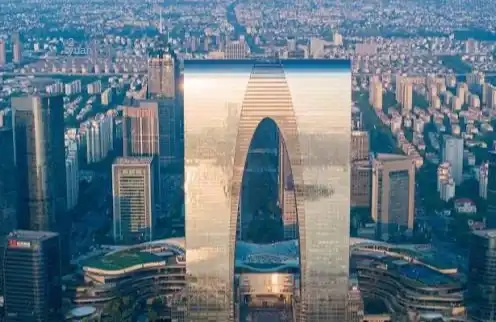
The thirty million yuan invested by Suzhou 18 years ago has grown into the lifeblood of AI

Author|Sleepy, Daria
Editor|Cozzy
The most profitable investment in Suzhou happened during the global financial crisis.
In the fall of 2008, Lehman Brothers collapsed, causing almost all venture capital activities in China to come to a standstill. Stop-loss orders were triggered, and investors adopted a wait-and-see approach, leading to a freeze in the primary market. It was during that window that the state-owned venture capital platform of Suzhou Industrial Park, Yuanhe Holdings, invested approximately 30 million RMB in a startup.
The founder, named Liu Sheng, an undergraduate of Tsinghua University and a Ph.D. graduate from the Georgia Institute of Technology, had worked in optical communication in North America for many years, with stints at Lucent and Opnext. In 2008, he returned from Silicon Valley, registered Sunrise Technology in Suzhou, and aimed to develop high-speed optical modules.
In the investment circle of 2008, optical modules were not just a niche market but an area that almost no investors were looking at. Domestic players in optical communication in China were mostly focused on the telecom market and low- to mid-range manufacturing. According to LightCounting's report, in 2010, among the top ten global optical module manufacturers, only one was a Chinese company—WTD, which was later merged into InnoLight Technology, barely making it to the bottom of the list. At that time, the consensus on the need for "a large number of high-speed optical modules for cloud computing data centers" was still a far cry from reality.
Eighteen years later, this investment grew into InnoStar Suzhou. By the Dragon Boat Festival in June 2026, the stock price soared to 1367.88 RMB, with a total market capitalization of 15 trillion RMB, ranking among the top ten A-share companies, surpassing Moutai.
The Artery of AI
Optical modules are crucial in the entire AI industry. Without them, AI is just a pile of overheating silicon chips. When signals leave the chip and need to be transmitted between data centers via optical fibers, optical modules are essential.
Computing power is the heart, and optical modules are the arteries.
Among the A-share companies, Guan Xin Yisheng, InnoStar Suzhou, and Fiberhome Telecommunication are collectively known as "Yi Zhongtian." These three optical module giants control the most critical segment of the global AI computing power supply chain. Two of the three companies are based in Suzhou, with InnoStar Suzhou's operational headquarters located in Suzhou Industrial Park, and Fiberhome Telecommunication's operational headquarters also situated there.
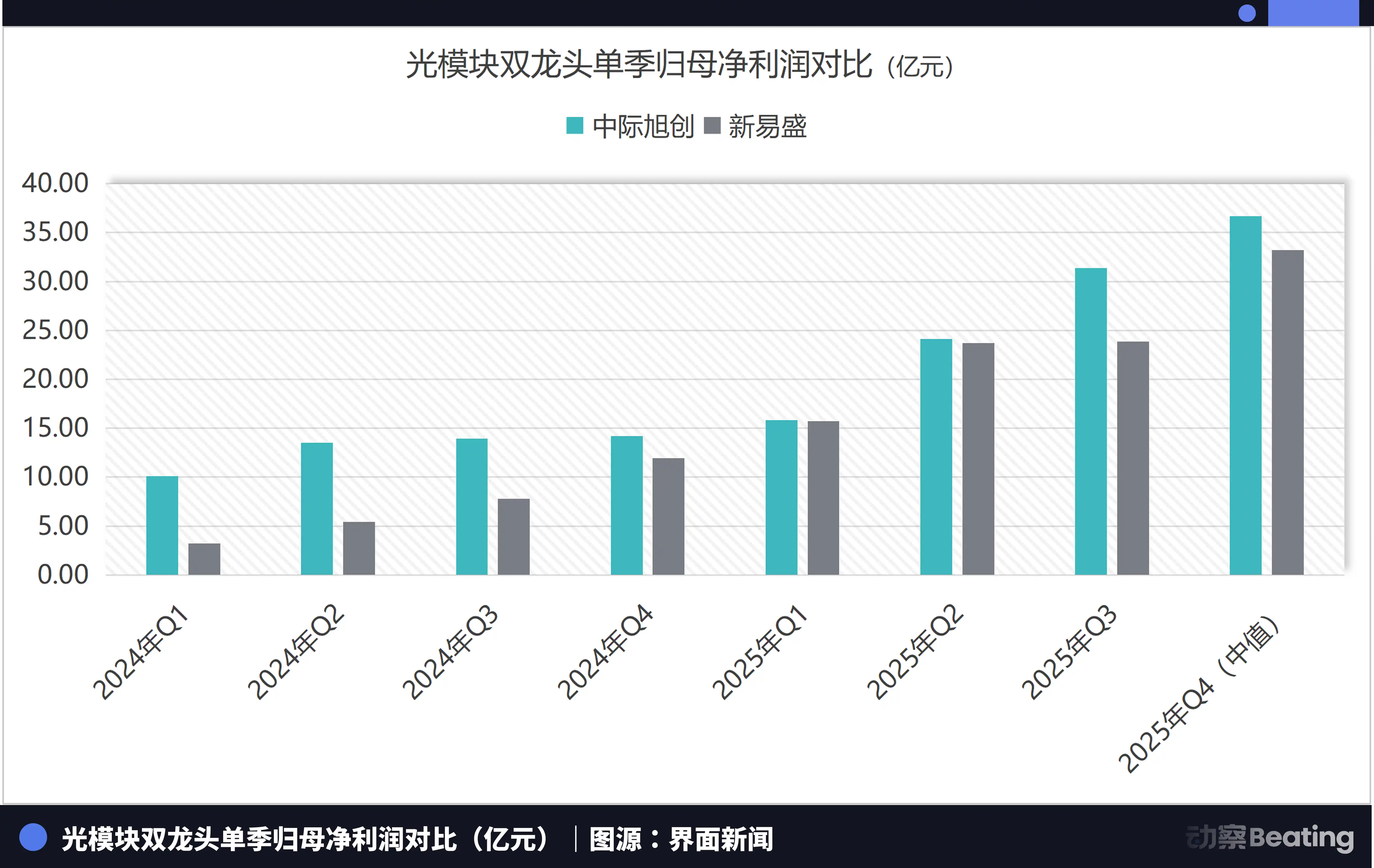
In addition, Suzhou-based companies like Linktel Technologies, which produces high-end optical communication test equipment, saw their stock prices surge more than twenty times above the IPO price within two months of going public in 2026, claiming the title of A-share king. Source Photonics, a leading player in VCSEL chips and an industry chain company invested in by InnoStar Suzhou, saw its stock price touch 1712 RMB before the Dragon Boat Festival, nearly quadrupling in six months.
When we dissect the AI data center, what Suzhou has hit upon is not just a few companies but a series of interconnected nodes.
Upstream, we have companies like InnoLight Technology focusing on optical chips, followed by TF-Optics specializing in optical components. Hisense Broadband packages these components into high-speed optical modules and delivers them to data centers worldwide. Finally, Luxsens Technology tests whether these high-speed optical communication devices can operate reliably.
According to a report by Xinhua Daily, the total market value of A-share listed companies in Suzhou has exceeded four trillion, ranking fourth nationwide, only behind Beijing, Shanghai, and Shenzhen.
While six small dragons from Hangzhou appeared on the Spring Festival Gala and went viral, humanoid robots from Shenzhen danced, and three GPU companies from Shanghai shared the grand story of domestic substitution. These stories are attractive, novel, and visually appealing, making it easy for people to remember a name in a short video of just over ten seconds.
Yet Suzhou tells a different story.
A fiber optic company in Wujiang saw its sales grow by over 35% year-on-year in 2026, with its production capacity already scheduled through 2027. Several industry chain enterprises in Suzhou jointly invested in and started building the country's first 8-inch silicon photonics mass production line. The Suzhou optical communication industry has formed a cluster worth hundreds of billions, with more than 50 innovation alliances led by enterprises. In the first quarter of 2026, the industry scale grew by over 60%.
In this wave of AI computing power surge, real money and silver flowed first to the place where blood vessels were being created.
For Suzhou, when a leading optical module company grows, it brings not only market value but also suppliers, test equipment vendors, optical chip companies, funds, and talent. Its orders will become the production capacity of upstream and downstream companies, its IPO will become the credit of the local capital market, and its industry judgment will in turn become clues for Suzhou's next round of attracting investment.
Beyond the investment returns on the books, what Suzhou has gained is an industrial chain that can continue to roll.
In 2024, the whole world suddenly discovered optical modules and rushed into the secondary market to snatch chips. Suzhou’s name was already registered early on the first page of Luxsens Technology’s business registration, as it was an early shareholder established in 2008.
Squatting on the Ground to Choose Projects
So why did Suzhou hit the jackpot?
Some say it's foresight, insight, and vision. But all of these are too much like a hindsight bias.
It takes standing high to have foresight, but Suzhou is not standing at a high point; it is squatting on the ground, examining each project and meeting each person face-to-face before making a judgment.
The person who made that decision for the city was Dai Yu, in charge of the Xuchuang project at Yuanhe Holdings. Years later, she recalled in a media interview that her initial contact with Xuchuang came from the park's "Leading Talents Program," where a group of high-end talents brought the project back to the country. Yuanhe carefully selected Xuchuang for investment.
Later on, Yuanhe made additional investments round after round through three different-stage funds and a debt platform, and brought Datat Capital from Dongsha Lake Fund Town on board for additional support. Restructuring documents show that Yuanhe's system holds a total of over 7% of Xuchuang's equity.
Yuanhe entered the project on the eve of the 2008 financial crisis and stayed until 2017 when Xuchuang was listed through a reverse merger with International Equipment, traversing an entire economic cycle in between.
Around 2011, Xuchuang's 40G product obtained Google certification, paving the way to engage with Amazon and Huawei. In 2014, Google Capital led a $38 million Series C round, marking Google's first investment in China. Xuchuang originally planned to go public on the US stock market, but in 2015, Chinese concept stocks faced a valuation winter. They made a U-turn, dismantled the red-chip structure, and returned to the A-share market to seek a way out.
In 2017, International Equipment acquired 100% equity of Xuchuang for 2.8 billion yuan through a reverse merger. Wang Weixiu, the controlling shareholder of International Equipment, decided to boldly delegate power to the Xuchuang team. New Fortune magazine described this decision as having a "broad vision." By 2026, Wang Weixiu and his son Wang Xiaodong's wealth had soared to 97.8 billion yuan, rising from 161st place to 30th in the rankings last year. As a small business owner of a motor winding equipment company, he nearly reached a wealth of a trillion yuan by acquiring a Suzhou optoelectronics startup and being willing to delegate power.
In 2025, International Xuchuang achieved a revenue of 38.2 billion yuan and a net profit of 10.8 billion yuan, doubling its performance. In the first quarter of 2026, the quarterly revenue was 19.5 billion yuan, a year-on-year increase of 192%, with a net profit of 5.7 billion yuan, a growth of 262%. Already deep-rooted, Xuchuang further invested in a string of industrial chain companies through its subsidiaries such as Jingyan Intelligence, Aoke Optoelectronics, and Leixin Optoelectronics, and also invested in the new A-share stock king Yuanjie Technology.
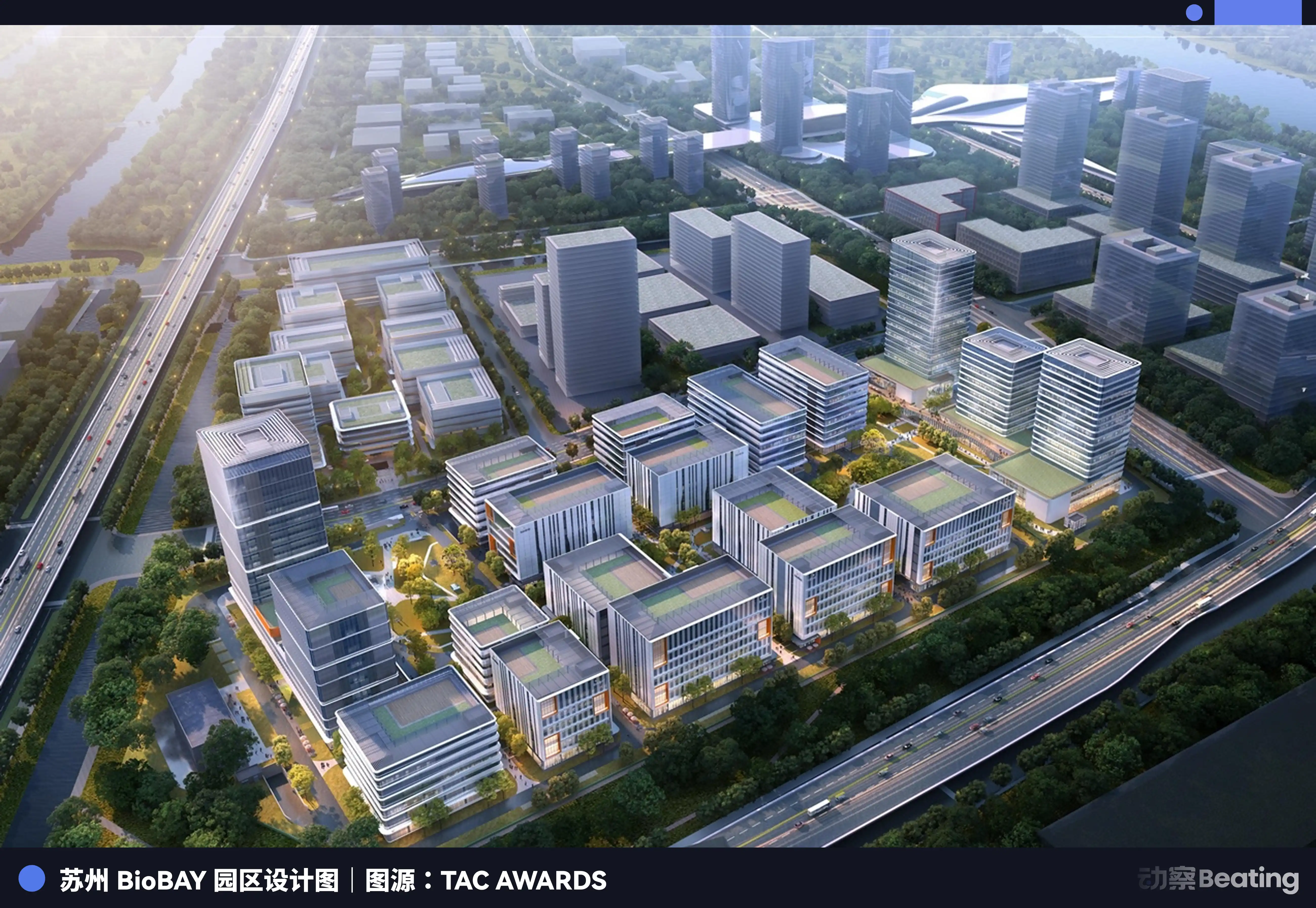
Looking back at Suzhou's investment record over the past twenty years, Xuchuang is not an isolated case. In 2006, "innovative drugs" were not yet a keyword in the capital market when Suzhou established BioBAY, which today houses hundreds of pharmaceutical companies and has nurtured over thirty listed companies. In the same year, with industrializing nanotechnology still a distant goal, Suzhou started to attract national-level nanotechnology research institutions. In 2008, the investment team traveled to Cambridge, UK, and brought back the startup company Speech AI from iFLYTEK to Suzhou. That year was nine years before the country issued the "New Generation Artificial Intelligence Development Plan."
Biomedicine, Nanotechnology, Voice AI, Optical Modules. These are the four tracks that Suzhou bet on when others couldn't see clearly.
Supporting this strategy is a not-so-sexy but extremely solid system. In 2006, Suzhou Industrial Park established the first technology investment promotion center in the country. By 2022, all staff in the investment promotion sector have a graduate degree or above, mostly in science and engineering. Currently, Suzhou has 212 investment promotion agencies, with over two thousand full-time staff. Among them, 119 are state-owned enterprises, free from bureaucratic constraints, able to recruit based on market-oriented compensation, directly take equity stakes in companies, and undertake activities that the government desires but cannot accomplish through administrative means.
In terms of investment decisions, Suzhou has also devised the concept of "Anchor Tenant Funds," allowing industry leaders to act as fund managers with government co-investment. In the biomedicine anchor fund, SDIC Bio and Corning Deco directly serve as fund managers, participating in project screening and post-investment management. With over a dozen anchor funds, a total of over $20 billion has been invested.
Therefore, Suzhou's success in gambling is not due to luck but rather transforming "gambling" into a robust system. They use knowledgeable individuals to screen projects, industry veterans to make judgments, and patient capital of over ten years to place their bets.
This is not just foresight.
Three Generations
This kind of steadfast effort comes from being poor.
During the early days of reform and opening up, Suzhou had a weak industrial foundation. The equipment was old, the structure was outdated, and there was a lack of access to raw materials and markets. Therefore, they could only do what they could and learn from whoever was willing to teach them.
The "Shanghai Sunday Engineer" was a product of that era. Suzhou's township enterprises took advantage of the spare time of the engineers from Shanghai's state-owned factories on weekends and invited them to guide production. By 1988, there were over 15,000 township enterprises. In 1992, township industrial output accounted for over 70% of the city's total.
Even after reaching this stage, when the country designated economic zones and established economic and technological development zones, Suzhou was left out.
They couldn't wait for policy dividends.
People in Kunshan stopped waiting. They pooled together half a million, set up the country's first self-financed development zone, bore the risks themselves, and ran advertisements in Shanghai to attract investment. Relying on the clear yet somewhat humble positioning of "engaging in industries that Shanghai doesn't want to do" and "Shanghai manages from zero to one, while Suzhou manages from one to ten," Suzhou firmly integrated into Shanghai's dominant industrial chain, completing the initial industrial accumulation.
Subsequently, Suzhou learned the "door-knocking" investment promotion approach from Singapore, establishing investment promotion offices worldwide to actively engage with companies. By 2012, Suzhou's actual utilization of foreign investment accounted for 8.1% of the national total, a 131-fold increase from 1990.
Later, as production costs rose and environmental capacity reached its limit, labor-intensive industries began to leave. Once again, Suzhou had no choice but to squarely face the pain of transformation.
In Taicang High-Tech Zone, within a 25-square-kilometer area along Nanjing Road, there are over 800 small and medium-sized foreign-funded enterprises, forming a complete automotive industry chain. In a 20-story building in Shengze Town, the Silk Road·Nanhua Cross-Border E-commerce Industrial Park, 86 textile enterprises are housed, covering everything from raw materials and fabrics to finished products and sales, all within the same building.
These industrial clusters were not planned; they grew slowly over decades, business by business, order by order.
In the 1980s, he learned engineering skills from Shanghai engineers on weekends. In the 1990s, he invested half a million to bet on a development zone. In 2008, he invested thirty million to bet on an obscure overseas returnee to develop solar modules.
When no one believed in it, he used his own money to buy something that was still worthless. The same action was repeated by three generations three times.
The visionary chose the track from a high point. Those with no choice squatted on the ground, picking up what others didn't want, cleaning it up, and waiting for it to become valuable. Suzhou's pragmatism is the survival strategy of a prefecture-level city that did not receive a special economic zone license. This strategy has been employed for thirty years, becoming ingrained in its bones. When Dai Yu was presented with Xilinx's business plan in 2008, the decision-making process she used was the same as the one used by the person from Kunshan who invested half a million thirty years ago.
This thing isn't valuable now. But it's worth the bet.
Then let's bet.
Flywheel Effect
And what happens after winning the bet?
A single investment turns into a trillion-dollar company, just the first level of return.
It begins to reshape an entire city's industrial structure. The capital market becomes more active, the industrial chain more complete, AI has real manufacturing scenarios, and young people have more reasons to stay.
At this point, the relationship between the city and the company reverses. In the early years, Suzhou helped companies onto the stage, and as these companies grew, they became the reason for Suzhou to continue attracting projects, talent, and capital.
Suzhou's figures on paper look impressive. By 2025, the total industrial output value of large-scale industries will reach $4.89 trillion, ranking second nationally. The output value of high-tech industries will grow by 6.7%, accounting for 56.2%, a 1.5 percentage point increase from the previous year. 12 enterprises will have their A-shares publicly listed, ranking first nationwide, with a number surpassing that of Beijing, Shanghai, Guangzhou, and Shenzhen. For every ten new listed companies nationwide, one will be from Suzhou. The per capita disposable income for all residents will reach $12,508, exceeding $14,000 in urban areas, ranking only behind Shanghai, Beijing, and Shenzhen nationwide. And yet, Suzhou is just a prefecture-level city.
Among the top ten cities by GDP, Suzhou's service industry accounts for only 52.9%, ranking last. While other major cities have long been transitioning to the service industry, Suzhou is still striving to manufacture things.
Suzhou has 160,000 industrial enterprises, 34 major industrial categories, and 514 sub-categories. It is one of the cities with the most complete industrial categories in the country and even globally. For industrial AI, this means data—high-quality, continuous, scalable production data is generated in the workshop every day. While other cities may start by looking for data to develop industrial models, Suzhou doesn't need to search. Its factories themselves are the source of data, with trained models returning to the same production line for validation and iteration. The production line is both the source of AI learning and the endpoint of AI monetization.
Considering the foundation of 48.9 trillion, even if AI brings only a one or two percentage point efficiency improvement, each percentage point corresponds to billions of absolute increment.
Suzhou has also turned computing power into a public service. The industrial park has established a computing power public service platform where companies submit their requirements. Within 24 hours, vendors are matched, contracts are signed within a week, and a 20% subsidy is available. The operator of the platform described it as being similar to ordering takeout—choose the flavor, quantity, delivery time, and place the order with a single click. For a small company that is just starting out and cannot afford large-scale computing power, whether they can "order takeout" is the difference between life and death.
Once the flywheel starts to spin, what do ordinary people gain?
Let's look at some data. In 2025, there were 415,000 new urban jobs, accounting for nearly 30% of the entire Jiangsu Province. Additionally, 283,000 college graduates stayed in Suzhou. They did not come for the sake of a brilliant founder's name but because there are real jobs, housing, and a good life here.
In the workshop of Bozhong Precision, AI defect identification has achieved zero leak and reduced the false positive rate to 0.1% for blade batteries. Workers on the production line no longer need to stare at the screen with their naked eyes but instead are starting to learn how to operate the algorithm system. In the laboratory of Magpie Technologies, an AI cluster has reduced the biological molecule construction cycle from six to ten months to six to eight weeks, freeing up researchers to conduct innovative experiments that they didn't have time for before. Efficiency has increased, people have not been replaced but have started to do more valuable work.
Recently, Suzhou has been piloting an interesting initiative, allowing key enterprises to independently assess talent. You don't have to run to a government office to prove that you are worthy of being recruited; if the boss says you're good, the government agrees. This indicates that Suzhou understands one thing: the value of talent is not determined by the government but by the person hiring. This initiative is actually based on the same logic as the Chain Master Fund, which is to entrust decision-making to those who understand the value the most.
Aiming to Enrich the People
On the last trading day before the Dragon Boat Festival in June 2026, InterJoy Ascend's single-day trading volume exceeded $30 billion. This level of liquidity was unimaginable back in 2008.
Prior to this, Liu Sheng once said, "If Ascend had not secured funding before the second half of 2008, this company might not exist today."
With a market capitalization of $1.5 trillion, annual revenue of $38.2 billion, personal net worth of $26.6 billion, and an entire industry chain from optical chips to silicon photonics integration, with countless beams of light running through global data centers every second, all started when a person named Dai Yu in a state-owned platform in Suzhou stumbled upon Ascend's business plan, signed it, and transferred the funds.
In 2026, Suzhou launched another "AI + Manufacturing" program. The goal is to break through a value-added industrial output of over $5 trillion, nurture 150 industrial giants, and propel the total computing power to 40,000 PFLOPS. The plan, as always, lacks grandeur, lacks a genius narrative, lacks blockbuster products, and is filled with terms like output value, computing power, and datasets.
Perhaps the next investment has already been approved on a document at Yuanhe. Which track to invest in, which dark horse to bet on, who signed the document, no one outside knows.
In 1936, a young man named Fei Xiaotong spent two months in Kaixianggong Village in Wujiang, Suzhou. He later wrote "Peasant Life in China," the pioneering work of Chinese sociology. What he saw in that village is exactly the same as Suzhou today—a group of people without any initial advantage creating their own opportunities. When the silk industry declined, they tried to start a silk reeling factory themselves. With no capital, several families pooled their resources. With no technology, they went to study in Shanghai.
Fei Xiaotong later summarized his lifelong work in four words: aiming to enrich the people.
When he said this, he probably wouldn't have imagined that ninety years later in a neighboring workshop in that village, a disregarded $30 million investment would grow into a $1.5 trillion company.
But he probably wouldn't be surprised either.
Sources:
[1] InterJoy Ascend's Market Cap Surpasses $1.53 trillion, Decrypting the Capital Path Behind, 21st Century Business Herald
[2] Liu Sheng: The Spiritual Code of the Optical World Leader, Tsinghua University Alumni Association
[3] InterJoy Ascend's Market Cap Surpasses Moutai: Half of A-Share Market Cap Top 10 Are Tech Stocks, National Business Daily
[4] A-Share "Aesthetic" Shift, InterJoy Ascend Market Cap Surpasses Moutai, Financial Union
[5] AI Computing Power Demand Surges, InterJoy Ascend's Q1 Net Profit Soars by 262%, Securities Times
[6] InnoLight Technology Corporation Announced Series C Funding of $38 million, InnoLight Technology Official Website
[7] A-Share "Suzhou Sector" Market Cap Exceeds $4 trillion, Suzhou Municipal People's Government
[8] Nation's First 8-Inch Silicon Photonics Chip Production Line Commences Construction, Suzhou Municipal People's Government
[9] Actively Embracing the "Wind," Suzhou Optical Communication Enterprises Empower the Chain, Mingcheng Suzhou
[10] 2025 Statistical Communiqué of Suzhou's National Economic and Social Development, Suzhou Bureau of Statistics
[11] Suzhou Launches Eight Major Actions for "AI + Manufacturing," Suzhou Municipal People's Government
[12] Suzhou Industrial Park's Scientific and Technological Investment Promotion Work Starts Early, Strengthens Teams, and Changes Thinking, Industrial Park World
[13] BioBAY: A Growth Sample of Suzhou's "Number One Industry," Suzhou Industrial Park/China Newsweek
[14] Introduction to Suzhou Nano Institute of Chinese Academy of Sciences, Suzhou Institute of Nano-Tech and Nano-Bionics, Chinese Academy of Sciences
[15] Why Has Suzhou Become the Strongest Prefectural-Level City? 21st Century Business Herald
[16] Jiangsu Kunshan Development Zone: From Self-Funded Industrial Zone Development to Steadily Progressing towards a Livable and Business-Friendly New City, Study Xi
[17] Suzhou Industrial Park Public Computing Power Service Platform, Suzhou Industrial Park Public Computing Power Service Platform
Welcome to join the official BlockBeats community:
Telegram Subscription Group: https://t.me/theblockbeats
Telegram Discussion Group: https://t.me/BlockBeats_App
Official Twitter Account: https://twitter.com/BlockBeatsAsia