「ByteDance Stock Speculation Made Me $30 Million and Led to My Resignation」 First Reevaluation: It All Started with Two Hard Drives
Original Title: "Pinduoduo Buys Hard Drive, Surprisingly Leads Me to Storage | How Ordinary People Trade with 'Local Information'"
Original Author: Leto Bao, Former ByteDance Employee
Editor's Note: In the past two days, a post titled "Byte Employee Earns 30 Million RMB from Stock Investment" has sparked discussion on social media. The protagonist of the story is the administrator of an early ByteDance internal US stock investment group.
According to the post, he achieved financial freedom through investment and left two sentences before resigning:
1. Working a job can only maintain the current lifestyle; only investment can lead to a better life
2. The probability of achieving financial freedom through investment is much higher than sticking with ByteDance until 4-1
For more details, see: "How Hot Is the Stock Market Right Now? Byte Employee Earns 30 Million RMB from Stock Investment and Just Resigned"
Yesterday, the protagonist Leto Bao opened a personal Twitter account and gained 38,000 followers in a single day. This article is his first tweet, systematically reviewing his trading mindset and logic in the US stock market. The following is the original text:
All the information below was shared in the Byte US stock group last year, including trading targets, position gains and losses, all of which can be verified
Last August, I originally just wanted to buy two hard drives.
At that time, I was setting up a small quantitative platform myself, trying to pull some tick-level market data locally for storage. I needed a place to store the tens of terabytes of data, so I ordered two Seagate high-capacity drives on Pinduoduo. Looking back later, this hard drive was the starting point of my storage journey over the past two years.
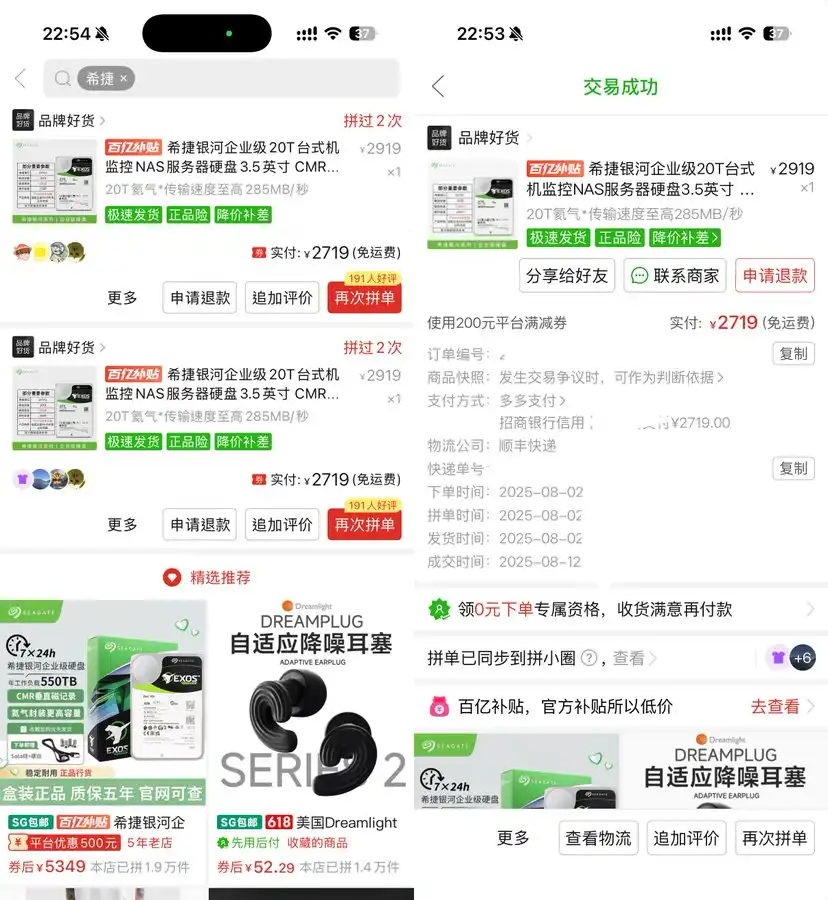
Hard Drive Prices Started Changing Daily
After receiving the hard drive, I saved the link, intending to buy more if needed. After a few days, I checked again, and the price had increased. A few days later, it rose again. The same model, same store, adjusted prices several times in one week, and they only increased without any decreases.
An industrial product with large production capacity and high standardization, the retail price should not continue to rise unilaterally like this. I see it as a signal worthy of deep exploration, rather than a simple price hike by merchants.
I used a slow-buy approach and price comparison tools like Keepa to plot the price trend of this product over the past few months. I also compared it with several other high-capacity models from Seagate and Western Digital. The conclusion was unanimous: it's not an issue with a single model; the entire line of high-capacity mechanical hard drives is experiencing a price hike, and it is a sustained, unilateral increase, unlike short-term fluctuations caused by promotions.
At this point, it can be reasonably confirmed that there is a larger underlying reason behind this.
Following this thread, it leads to AI grabbing hard drives
As I delved deeper, the logic became clearer.
While the market pays more attention to AI's demand for graphics cards, its demand for storage is equally significant. Large model training and inferencing generate massive amounts of data that need to be stored long-term. Long-term, low-cost data storage mainly relies not on SSDs but on high-capacity mechanical hard drives. The drives used in data centers are known as nearline enterprise hard drives, and they are being extensively purchased by major cloud providers such as Microsoft, Amazon, Google, Meta, and others.
Seagate happens to be riding this wave of demand. Its key HAMR technology can significantly increase the capacity of a single drive, perfectly aligning with data center needs. In a situation of limited production capacity, manufacturers prioritize supplying higher-profit enterprise orders, squeezing the supply to the retail end. The price increase I observed on Pinduoduo is fundamentally driven by the procurement demand of AI data centers, transmitting all the way to consumer prices.
I checked Seagate's financial report at that time: revenue for the most recent quarter grew by 39% year-over-year, with record-high gross margins. The market is also starting to price the data storage sector as a part of the AI industry chain.
After confirming the logic, I bought 500 shares at just over $150 each and shared the reasons for my purchase, the cost, and the position in the company's internal US stock trading group.
What gave me confidence to increase my position was the subsequent 13F filings
Being clear in my own thinking was not enough; I needed to confirm if institutional funds were also making the same judgment.
US stocks have a very useful public dataset: institutions with assets over $100 million must disclose their US stock holdings every quarter, known as a 13F filing. This is equivalent to a legal, public institutional holdings record that anyone can access.
Instead of immediately increasing my position, I wanted to observe the trend for another quarter or two. A single quarter's change could be accidental; it's only after several consecutive quarters in the same direction that it becomes more reliable. By the time the November filing came out, which was the 13F for the third quarter, I connected Seagate's institutional holdings over the past year into a trendline, and the direction was already very clear:
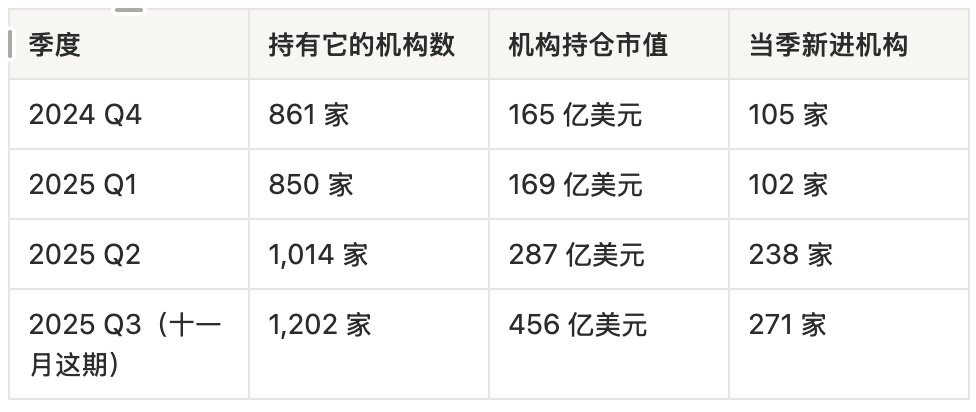
In the second half of 2024, this stock was basically ignored, with the number of institutions holding it remaining at over eight hundred, even experiencing a slight decrease. A significant turnaround occurred in the second quarter of 2025, followed by further acceleration in the third quarter: the number of institutions holding it increased from over eight hundred to over twelve hundred, with the number of new institutional investors entering each quarter also on the rise.
It is worth noting that the market value of the holding surged to $45.6 billion within a year, with a significant portion of the increase attributed to the stock price itself rather than entirely new funds. However, indicators of "breadth" such as the number of institutions and new positions added each quarter better illustrate the situation. The continuous quarterly growth in these numbers indicates that this was not the bet of one or two funds but rather a group of professional funds consistently entering the market.
Upon confirming this, I had more confidence to significantly increase my position and began to diligently research the storage sector. Subsequently, I also started to further increase my positions in $STX and $SNDK through LEAPS CALL options.
Looking back now
The day I bought the hard drive, Seagate closed at over $150; today, it is over $965, more than a sixfold increase, surpassing Palantir at one point last year to become the S&P 500's best performer for the full year. Just from the initial 500 shares, the unrealized gain is approximately $400,000, and the additional purchases made later are not included in this calculation.
The ultimate outcome of this trade involving two hard drives was somewhat unexpected when looking back now.
Summarizing this approach
In fact, it is not complicated:
· Anomalies in everyday items (price increases, shortages, queues) often signal earlier than news and financial reports. In some cases, ordinary individuals receive signals earlier than professional institutions.
· Do not stop at the impression of "it seems to be getting expensive." By plotting the price as a curve, you can generally determine whether it is a trend or noise.
· Further inquire: Is there a long-term, structural demand behind this? Then find a publicly traded company that directly benefits and occupies a key position in the industry chain.
· Finally, validate institutional sentiment with 13F filings and observe trends over several quarters, not just a single quarter.
This approach does not guarantee success every time, but it can at least ensure that purchases are based on logic rather than gut feelings.
Lastly, Addressing the Risks
This was a successful instance. I have also experienced situations where I focused on a price surge signal only to later find it was just a short-term fluctuation. These situations were not shared in the group but were equally real, demonstrating a clear survivorship bias.
The above is a personal retrospective and does not constitute investment advice; trade at your own risk.
However, I agree with this approach: pay attention to anomalies encountered in daily life, dig deeper to find the underlying public companies, and then use 13F filings to see if institutional investors agree. Next time the price of something you frequently buy increases for no apparent reason, you can consider this: who pocketed that money, and has that company already gone public.
Original Post Link
Welcome to join the official BlockBeats community:
Telegram Subscription Group: https://t.me/theblockbeats
Telegram Discussion Group: https://t.me/BlockBeats_App
Official Twitter Account: https://twitter.com/BlockBeatsAsia