UBS China AI Industry Chain Latest Research: Optical Interconnect and SiC Heating Up, Sileafocus Bets on Rubin PCB

TL;DR
· After researching five Chinese technology hardware companies, UBS found that AI infrastructure demand remains a common theme.
· Sheng Hong Technology plans to invest no more than 18 billion yuan in fixed assets by 2026, with the Rubin platform being the incremental focus for PCB.
· Several key figures come from management communications, but actual realization will depend on mass production, certification, and external constraints.
In research material released by UBS on June 26, the demand within the Chinese AI hardware chain was described in more detail: AI infrastructure demand remains strong, expanding beyond just the GPU itself to include PCBs, optical interconnects, liquid cooling, SiC substrates, and optical communication materials.
The key takeaway from this material is not the order changes of a single chip company, but rather that multiple links have simultaneously provided a more optimistic timeline and capacity targets. Bitmain has placed the GPU roadmap to 2028, Sheng Hong Technology plans to invest no more than 18 billion yuan in fixed assets by 2026, and Tianyue Advanced's management mentioned SiC orders saturation and selectively increased prices for some urgent orders from small customers.
These contents are mainly from management communications and company guidance in the UBS research and are not formal profit forecasts. They are more like a demand thermometer for the AI hardware chain, reflecting industry heat but not directly equating to realized revenue and profit.
Domestic GPU Scheduled for 2028, Sheng Hong Technology Betting on Rubin PCB
The timeline provided by Bitmain is one of the most direct signals of domestic AI computing power in the research material.
The company told Caijing that the BR20X is expected to be commercially launched in 2026, with the BR30X/BR31X expected to be commercially launched in 2028. In the UBS material, management communications further mentioned that the BR20X series GPU is planned to be launched in the second half of 2026, with upgrades in computing power, memory capacity, and interconnect bandwidth compared to the previous generation.
Catching up in domestic GPUs is not just about single-chip computing power but also whether memory, interconnects, packaging, and software ecosystems can keep pace. For AI training and inference clusters, bottlenecks often occur between chips, between servers, and at the system scheduling level, rather than just in theoretical computing power.
The constraints are also clear. Advanced processes, advanced packaging, customer mass production rhythm, and software ecosystem adaptation will all affect the subsequent landing of BR20X and BR30X. External export restrictions will continue to affect the pace of the local AI hardware supply chain.
Closer to short-term orders and capital expenditures is Sheng Hong Technology's PCB guidance.
The management stated that the AI PCB raw material costs remain stable overall, with a relatively smooth cost pass-through for next-generation products, expecting the gross margin for the 2026 fiscal year to stay roughly the same as in 2025. The AI revenue proportion is expected to increase from below 50% to 60%-70%.
The Rubin platform is the most prominent increment. Research materials indicate that Company A maintains the majority share in NVIDIA's Rubin compute tray HDI, consistent with the GB300 platform situation, with an overall customer share target of about 50%. Since this information has not been publicly validated, it is more appropriate to understand it as management's target and seller research information. If realized later on, NVIDIA's new platform iteration will continue to drive the high-end PCB supply chain in China.
The expansion figures also need to be more precise. Public information shows that Company A's total investment in 2026 will not exceed 20 billion RMB, with fixed asset investment not exceeding 18 billion RMB, mainly directed towards Huizhou Factory 10-13. This scale indicates that AI server PCBs have been included by the management in the core capacity direction for the next few years.
The material plan for the orthogonal backplane required for Rubin Ultra is still not fully finalized. The company stated that the relevant adoption is not delayed, but they are still evaluating various material and supplier combinations, including Q-glass and PTFE. The order direction is clearer, but the process and material route are still being selected.
Photonics Interconnect and Liquid Cooling Begin to Emerge as AI Cluster Supporting Needs
As AI clusters continue to grow, the importance of interconnectivity and heat dissipation is rising. Company B and Company C provide two pieces of supporting evidence.
UBS research materials indicate that Company B holds approximately an 88% market share in the independent scale-up photonics interconnect solution market, focusing on LPO, NPO, and other solutions, serving large-scale GPU and ASIC clusters. Its optical computing processor adopts a 3D TSV vertical stacking of electronic ICs and silicon photonics to offload some computing tasks to the silicon photonics layer, reducing latency and reducing reliance on advanced processes.
The focus of these solutions is not "optical computing replacing GPUs" but rather, as AI clusters grow larger, the interconnect bottleneck becomes more prominent. If LPO, NPO, and silicon photonics packaging can be steadily mass-produced, they may provide incremental space for large-scale clusters in terms of bandwidth, power consumption, and latency.
Company C's AI infrastructure layout comes from photonics and liquid cooling. Public reports indicate that Company C Optoelectronics acquired a controlling stake in Shenzhen Tongsheng Optoelectronics Co., Ltd. in June 2026, entering the field of hollow-core optical fiber cables. Management's target in the UBS survey indicates that the optoelectronics business is expected to make a more significant contribution to the P&L statement starting in 2027, with revenue potential of about 10 billion RMB.
On the liquid cooling front, the management's goal is to become the largest shareholder of Yuans Tech, with the liquid cooling business expected to achieve revenue in the tens of billions of yuan scale in the 2026 fiscal year. The cold plate, manifold, and UOD single machine value is approximately $40,000 to $50,000. These figures lack public announcement validation and should still be understood at a target and guidance level.
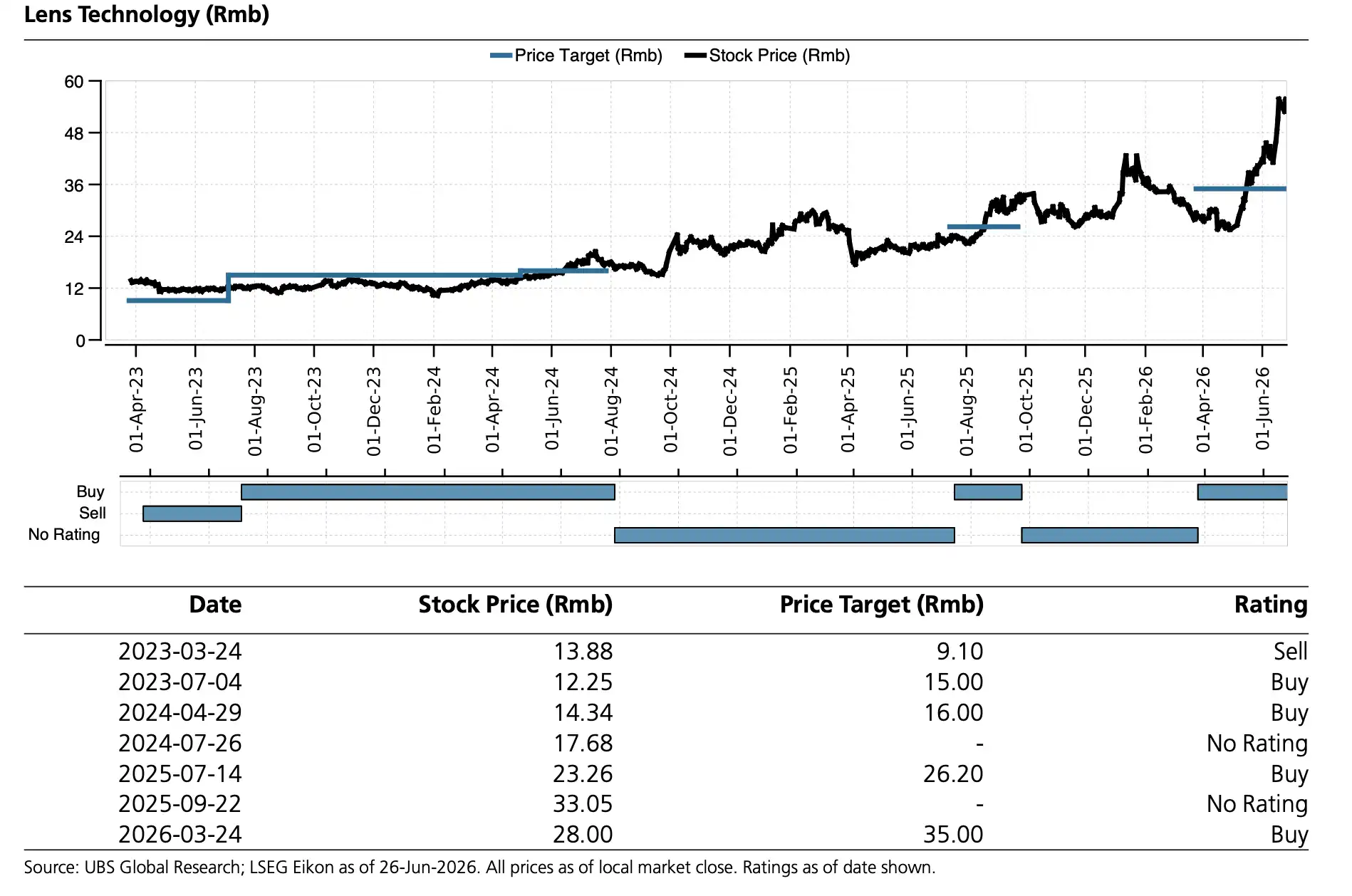
BlueThink Technology's stock price historical trend with target price, historical rating, and target price adjustment records.
SiC Order Saturation, 8-Inch Shipment Target Raised to 50%
In the power device chain, Tianyue Advanced's signal is closer to "supply and demand tightness has already affected some prices."
A company press release once cited Fujitsu economic data stating that by 2025, its global SiC substrate, 6-inch, and 8-inch market share ranked first, with an 8-inch share of 51.3%. Management communication in UBS research materials further stated that current demand is strong, orders are saturated, first-quarter 2026 prices overall stable, but selective price increases are implemented for small customers' urgent orders.
The management's goal is to have 50% of shipments come from the higher-margin 8-inch SiC substrate in 2026 to drive margin expansion. If this target is achieved, it will directly impact the company's product mix and profitability.
SiC has been mainly driven by electric vehicles, photovoltaics, and energy storage in the past. Now, high-power AI servers and data center power systems are also beginning to emerge as new demand sources. HVDC, SST, AI glasses, advanced packaging, etc., are also listed as potential drivers.
The key point here is not a sudden shift in SiC demand from automobiles to AI, but that AI data centers are further expanding the demand boundary of power semiconductors. Order saturation and selective price increases indicate that supply tightness has begun to impact prices in certain customer and urgent order scenarios.
Whether prices can continue to rise will depend on the ramp-up of 8-inch capacity, customer validations, and downstream demand trends. If capacity expansion outpaces order growth, the elasticity of price increases may be weakened. If data center demand materializes faster than expected, Tianyue Advanced's margin improvement potential will become clearer.
Order Direction Clear, Challenges Still Lie in Mass Production and Limitations
This set of research information collectively points to a shift: AI hardware demand is spreading outward along GPU, PCB, optical interconnect, liquid cooling, and SiC. The Chinese supply chain has provided a more proactive capacity and product roadmap in multiple aspects.
However, it is not suitable to be described as "Comprehensive Breakthrough of Domestic AI Hardware." Bitfily Technology's GPU roadmap is still constrained by process technology and ecosystem. Sheng Hong Technology's share related to Rubin is pending platform mass production and material solution implementation. Sino-Integrated Optics' photonic interconnect and optical computing require validation from large-scale customers. Lightconnect Technology's contributions to optical communication and liquid cooling are mainly anticipated in 2026-2027. Tianyue Advanced's sustainability of selective price increases will depend on 8-inch production capacity and realization of data center demand.
The most significant external restrictions are still in advanced process technology, advanced packaging, high-end GPUs, and cloud vendor capital expenditures. The closer the AI hardware chain is to these positions, the more susceptible it is to policy and supply chain constraints.
The most valuable aspect of these developments is that AI infrastructure orders are spreading to more hardware segments. The boundaries that need to be preserved are equally clear: most of the figures are still management targets and research information, and actual implementation will depend on customer mass production, material finalization, and the external environment.
Welcome to join the official BlockBeats community:
Telegram Subscription Group: https://t.me/theblockbeats
Telegram Discussion Group: https://t.me/BlockBeats_App
Official Twitter Account: https://twitter.com/BlockBeatsAsia
 Related Articles