Latest Disclosure! Where Did Trump's $1.4 Billion Crypto Ledger Come From?

On June 30, former President Trump submitted his 2025 annual financial disclosure report to the Office of Government Ethics in the U.S. The 927-page document reportedly contains information about his financial activities, including a significant involvement in cryptocurrency. During the first year of his second term, Trump received over $1.4 billion in income from various cryptocurrency-related businesses. This amount includes funds from three different sources, flowing into the Trump family accounts through at least three layers of legal structure.
Contrary to what some may assume, this story is not about "the President trading crypto for profits." Not a single penny of the $1.4 billion came from Trump personally trading on exchanges. Instead, it resembles more of a brand licensing income statement, where the President's name and image were the commodities sold.
Where Did the $1.4 Billion Come From?
The $1.4 billion cryptocurrency income is divided into three main parts. The largest portion is $635 million, coming from meme coin licensing fees.
The second part is $515 million from the token sale of World Liberty Financial (WLF). The third part is $65 million from the sale of equity in a WLF holding company.
When combined, these three sums amount to over $1.2 billion, with the remaining funds spread across smaller crypto asset projects such as Bitcoin holdings (reportedly over $50 million according to Bitcoin Magazine) and Ethereum holdings ($5 million to $25 million).
All three income streams share a common feature: neither Trump himself nor his immediate family directly operate any of the crypto projects. Their involvement leans more towards brand licensing. Understanding this point is crucial to comprehending the entire disclosure.
What Is the Business Model Behind Each Income Stream?
The $635 million meme coin licensing fee. According to NBC News, disclosure documents reveal that CIC Digital LLC recorded $635,068,835 in royalty income, with the related party being an entity named Celebration Coins. CIC Digital is held by the revocable trust of Donald J. Trump.
Here's how it operates. On January 17, 2025, just three days before Trump's inauguration, the $TRUMP meme coin was launched on the Solana blockchain. With a total supply of 1 billion coins, only one-fifth was publicly offered, while the rest was held by Trump-affiliated companies. The issuer was Fight Fight Fight LLC, a joint venture between CIC Digital and Celebration Cards LLC.
Trump himself does not issue coins or operate trades. What he does is authorize the use of his name and likeness by the entity on this issuance chain and receives a licensing fee accordingly. The $635 million is precisely this brand usage fee.
According to CoinDesk, as of May 2025, transaction fees for $TRUMP coin have generated over $320 million in additional revenue for its creator. During the same period, the coin has experienced an 87% decline from its peak. The amount lost by coin buyers and earned by the coin issuer are parallel figures.
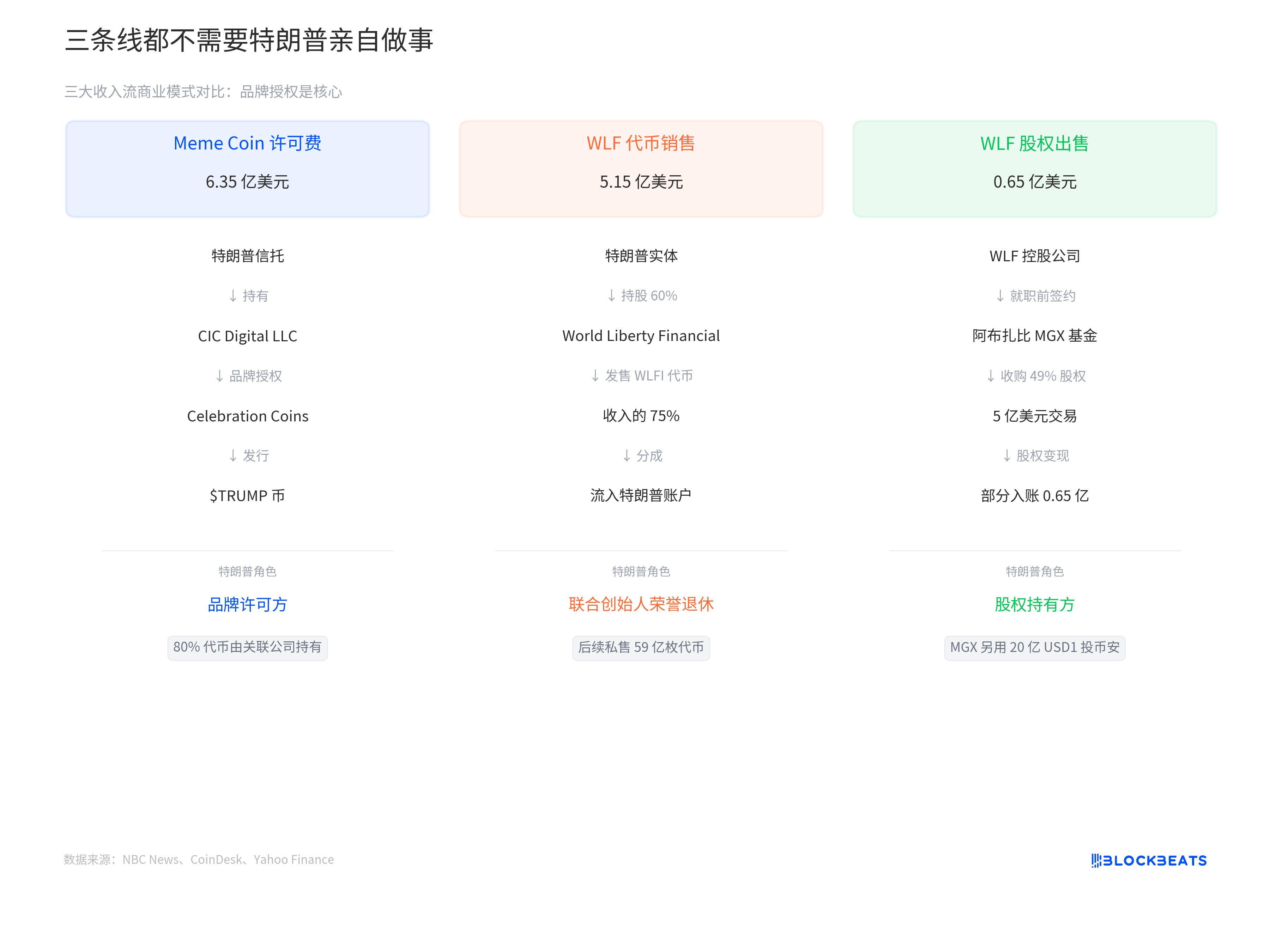
A $515 million WLF token sale. World Liberty Financial is a DeFi platform co-founded by the Trump family and partners in 2024. According to Yahoo Finance, Trump's entity holds a 60% stake in WLF, with Trump himself owning 70% equity in that entity.
WLF launched the governance token WLFI, with a total supply of 100 billion tokens, a quarter of which were publicly sold. As reported by CoinMarketCap, the token sale ultimately raised around $550 million.
The key detail lies in the revenue share ratio. WLF's disclosure documents show that three-quarters of the token sale revenue directly flows to the Trump entity, with the rest going to the Witkoff family and co-founders Zak Folkman and Chase Herro.
The $515 million is the number that was sliced to Trump's side based on this ratio.
The management team of WLF is also notable. The CEO is Zach Witkoff, the son of White House Middle East Envoy Steve Witkoff. Trump's three sons, Eric, Donald Jr., and Barron, are co-founders. Trump himself and Steve Witkoff hold the honorary title of "Co-Founders Emeritus," ostensibly no longer involved in day-to-day affairs.
According to Unchained Crypto's May 2026 report, WLF later privately sold 59 billion WLFI tokens, with 80% of the initial public purchasers' holdings still locked up.
A $65 million WLF equity income. CNBC reported that this money came from the sale of shares in the WLF holding company. According to CoinDesk's February 2026 report, an Abu Dhabi-related entity secretly signed an agreement before Trump's inauguration to purchase nearly half of WLF's shares for $500 million.
The $65 million recorded in the disclosure document regarding the transaction's association is not entirely clear yet, but it is part of WLF's equity realization.
In March 2025, WLF also issued a USD1 stablecoin, pegged to the dollar and backed by U.S. Treasury bonds and cash equivalents. According to Phemex, by the end of the first quarter of 2026, the circulation of USD1 had reached nearly $4.5 billion. As per ABC News, the Abu Dhabi sovereign wealth fund MGX used $2 billion of USD1 to participate in a Binance investment deal.
First Term Lost, Second Term Fully Recovered
$14 billion is a figure that needs to be put into historical context to be understood.
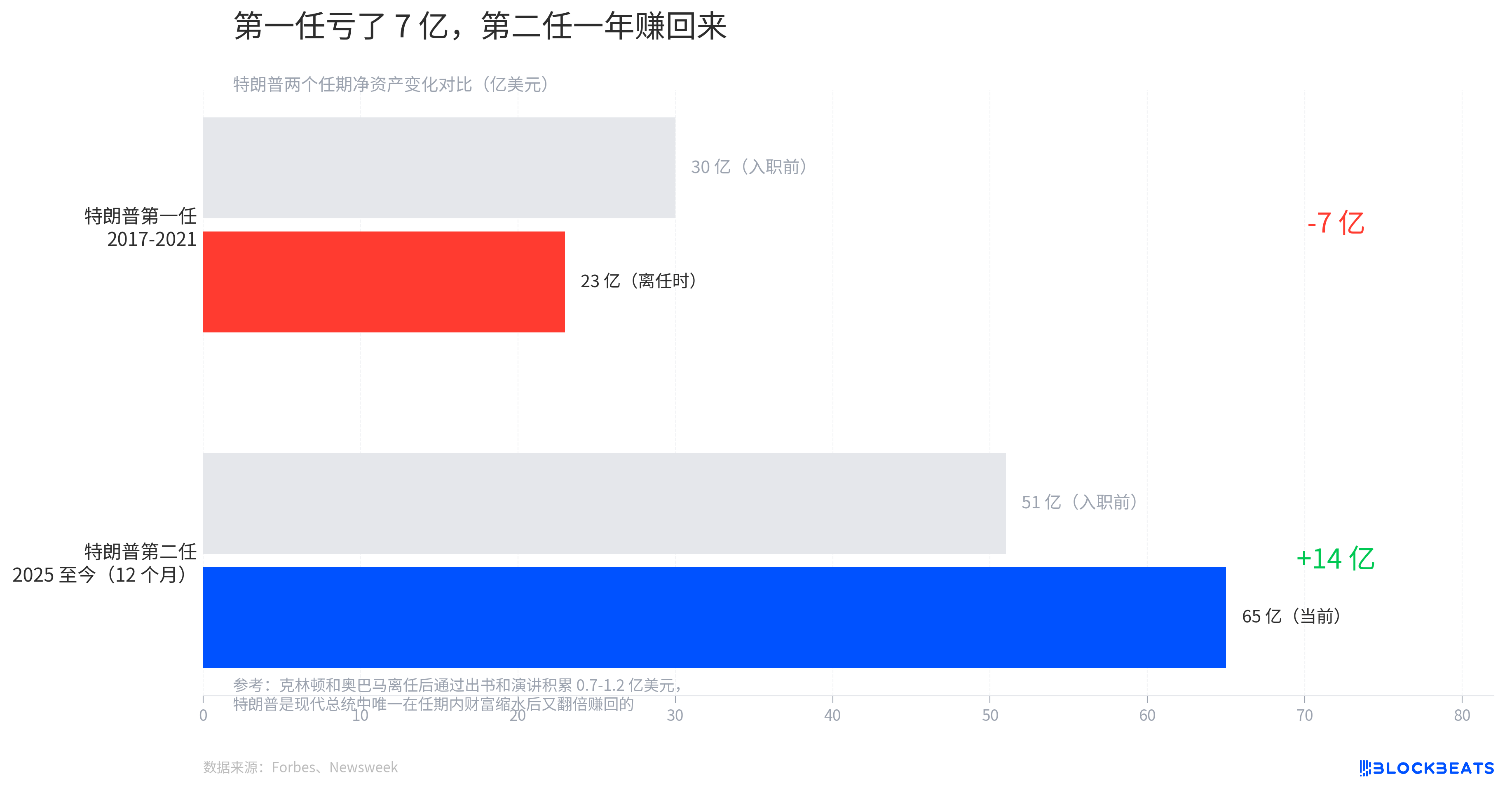
According to Forbes' estimate, Trump's net worth rose from around $5.1 billion in 2025 to $6.5 billion in February 2026. The crypto business was the core engine of this growth.
The wealth changes during the terms of past U.S. presidents provide a reference point. Clinton had a net worth of about $1.3 million when he entered the White House and accumulated around $120 million through book deals and speaking engagements after leaving office. Obama followed a similar path, starting from a million-dollar level and rising to the tens of millions level over a dozen years. Bush Jr. started from a higher point, but his increase was slower.
The commonality among these former presidents is that their wealth growth mainly occurred after leaving the White House, relying on book royalties and six-figure speaking fees per engagement. Trump's $14 billion surge happened during his term in office and took 12 months.
A more notable comparison comes from Trump himself. His experience in the first term was completely different. According to Newsweek, his net worth was around $3 billion when he took office in 2017, and it shrank to about $2.3 billion when he left office in 2021. He is the only modern U.S. president whose wealth declined during his term in office.
In the first year of his second term, he doubled the losses of his first term in profits. The difference is not in a change in business acumen but in a change in monetization tools. The previous round was hotels and golf courses; this round is tokens and licensing fees.
There is also a detail in the 927-page document. According to the disclosed records, on July 18, 2025, Trump signed the GENIUS Act, establishing the first federal regulatory framework for a dollar stablecoin. The signatory operates one of the fastest-growing stablecoins in the market.
Trump's 927-page disclosure document makes one thing clear. Cryptocurrency has been the single largest source of income for this administration, larger than real estate, larger than golf courses, larger than any traditional business line.
Welcome to join the official BlockBeats community:
Telegram Subscription Group: https://t.me/theblockbeats
Telegram Discussion Group: https://t.me/BlockBeats_App
Official Twitter Account: https://twitter.com/BlockBeatsAsia