After the Web3 Grants 2023 funding round, here are some projects worth keeping an eye on:

Original Title: "Reviewing the Web3 Grants 2023 Donation Rounds, What Interesting Projects Have We Found?"
Original Source: Pure Truth, ChainFeeds
Web3 Grant can be understood as a portion of the protocol's revenue or native token used to incentivize protocols, projects, or research that are beneficial to the entire Web3 ecosystem or a specific ecosystem. For projects, grants not only provide financial support but also mean endorsement and diversified support. For large protocols, grants help retain developers, thereby promoting the development of the entire ecosystem.
This article selects the most representative 4 Grants, namely Ethereum Foundation Ecosystem Support Program (ESP), Gitcoin Grants, Optimism RPGF, and Uniswap Foundation Grants, trying to find "hidden gems" from their projects and research donated in 2023.

Ethereum Foundation Ecosystem Support Program (ESP)
The Ecosystem Support Program (ESP) is a subsidiary of the Ethereum Foundation that focuses on providing financial and non-financial support to teams within the entire Ethereum ecosystem.
In April 2015, the Ethereum Foundation launched DEVgrants, aimed at providing value for key components of Ethereum's core software, its development process, or critical parts of its ecosystem (public services, APIs, ABIs); according to public information, DEVgrants only announced the first batch of donation projects, with no further updates. In March 2018, the Ethereum Foundation launched Ethereum Foundation Grants, aimed at expanding support for projects that perform well in scalability, practicality, and security. In November 2019, the Ethereum Foundation launched a new ecosystem support program (ESP), shifting from DEVgrants, which focuses on developer ecosystems, to funding with a focus on scalability, towards general support for building tools, infrastructure, research, and public products.
ESP 2023 Funding Round:
First quarter: 63 projects, $12,910,616.53.
Q2: 56 projects, $9,218,158.34.
Third quarter: 98 projects, 8945982.74 US dollars.
Fourth quarter: not yet disclosed.
Spotlight: Projects that have received funding more than twice
From the number of donated projects, "Community & Education" is the category with the most projects, which is in line with the development stage of Ethereum's overall technology maturity and ecological focus. The second is the focus on "Cryptography & Zero-Knowledge Proof", which ranks second in the number of projects, and there are multiple long-term ESP-funded projects and research in this category.
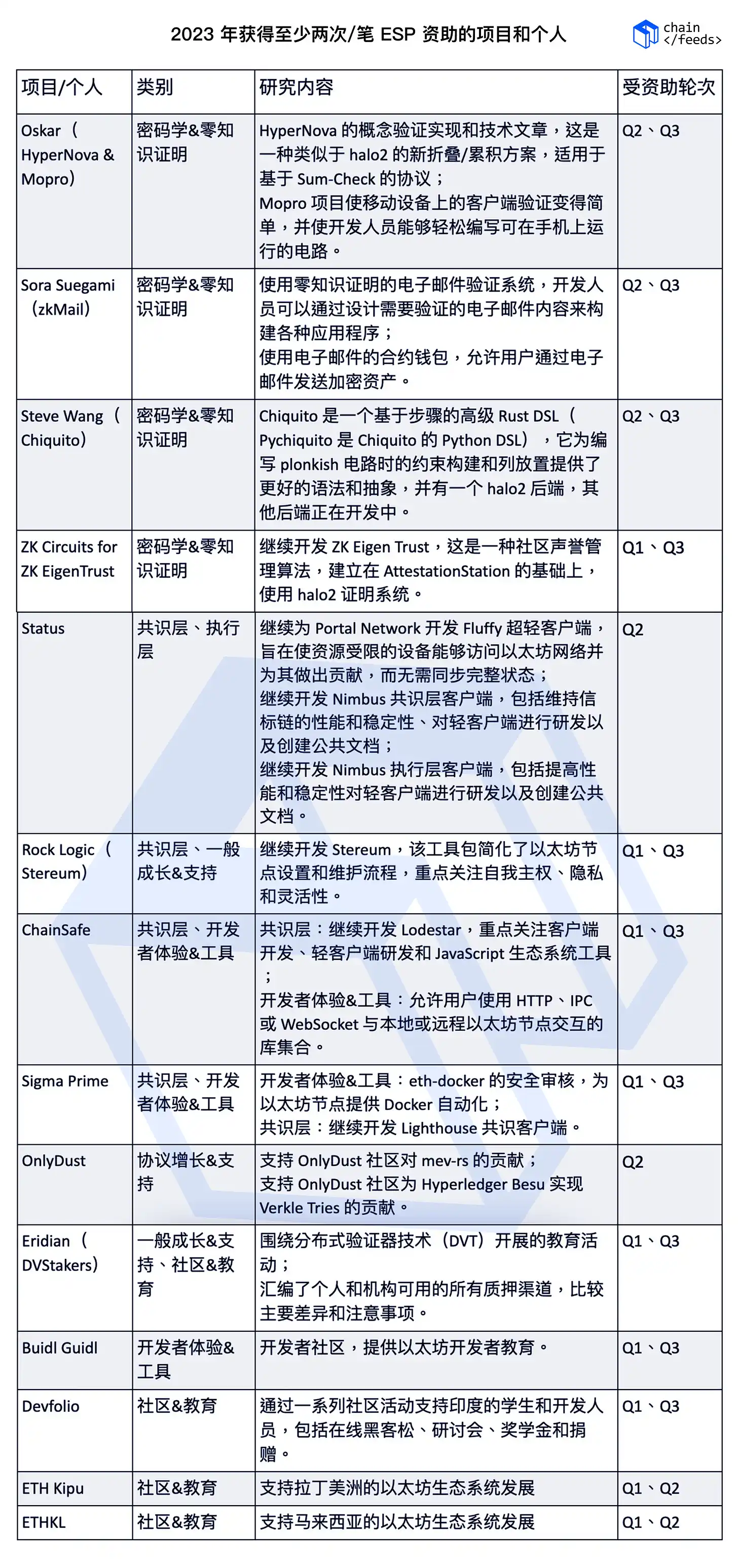
Here are the projects and individuals who have received at least two ESP sponsorships in 2023:
Gitcoin Grants
Gitcoin was founded in 2017 with the initial goal of supporting the development of open source projects and monetizing open source software through bounty programs. In 2018, one of Gitcoin's founders, Vitalik, published a paper on Quadratic Funding, which means that the more donors there are, the more funds the project can receive. In 2019, Gitcoin launched Gitcoin Grants and became the first project to implement Quadratic Funding. From 2019 to 2022, Gitcoin Grants raised $700,000, $2.8 million, $13.2 million, and $21.4 million for public goods.
Gitcoin Program Alpha Round and Gitcoin Program Beta Round are two testing rounds of Gitcoin Grants Stack, which is built on the decentralized and customizable donation solution Allo protocol developed by Gitcoin. Gitcoin Grant 18 and Gitcoin Grant 19 are regular funding rounds for 2023, some of which will take place on the Public Goods Network. Gitcoin Grant focuses on Web3 open source software, Ethereum infrastructure, climate solutions, and Web3 community and education.
Gitcoin 2023 Funding Rounds:
Gitcoin Grant 19: 471 projects, $1.09 million.
Gitcoin Grant 18: 480 projects, $1.68 million.
Gitcoin Program Beta Round: 468 projects, $1.857 million.
Gitcoin Program Alpha Round: 150 projects, $1.667 million
Spotlight:Public Goods Network
Public Goods Network (PGN), led by Gitcoin, is committed to creating sustainable and recurring funding for public goods on L2. PGN is built on Optimism's OP Stack and plans to allocate the majority of sequencer fees to public goods projects. This means that PGN does not rely on external donations, but is self-sufficient through the intrinsic fees generated by user interactions within the network.
It is worth noting that the PGN project plans to use Contract Shared Revenue (CSR) in the future to meet developers' needs for sustainable income sources. The CSR protocol EIP-6969, proposed by Slingshot CTO zkCole, aims to incorporate economic incentives for developers at the protocol layer. EIP-6969 proposes a new gas fee allocation mechanism based on EVM L2, allowing a portion of gas fees to be used as rewards for contract developers. Once EIP-6969 is included in the Ethereum upgrade in the future, PGN may achieve significant development through economies of scale.
The PNG mainnet will be launched in July 2023. According to L2BEAT data, the current TVL of the PNG network is 1.57 million US dollars, with a total of 4200 addresses. It is still in the very early stages of development. According to PNG's official plan, after the mainnet has been running for 6 months, fees will be evaluated and allocated based on accumulated data. We look forward to more data and allocation rules being disclosed.
Optimism RPGF
Retroactive Public Goods Funding (RetroPGF or RPGF for short) is a project funding program that encourages projects related to Optimism. RPGF creates a financing cycle in the form of a startup company for public goods projects through protocol-generated revenue (profits from the sorter), retroactive public goods funding, and results oracle. The core of RPGF is Vitalik's retroactive view, which is that it is easier to agree on what is already useful (was) rather than what will be useful (will be).
RPGF 2023 Funding Round:
RetroPGF Round 2 (Q1): 195 projects, 10 million OP tokens.
RetroPGF Round 3 (Q3): 501 projects, 30 million OP tokens.
Spotlight:Protocol Guild
Protocol Guild, which received the most donations in RetroPGF2 and RetroPGF3 (totaling over 1.22 million OP), was founded in 2022. Protocol Guild is a collective of Ethereum contributors dedicated to enhancing incentive measures for managing core protocols. By maintaining a registry of its members on-chain, Protocol Guild enables ecosystem sponsors to directly fund members, support their work, and public interests.
Protocol Guild was established with the aim of piloting a new donation mechanism to gather all protocol contributors into a financing mechanism and maintain continuous updates. In terms of execution, Protocol Guild's large donations will be released to members within a year, while small/regular donations can be withdrawn by members at any time. The weight that each member can withdraw is calculated based on their contribution time to the ecosystem.
Uniswap Foundation Grants
Welcome to join the official BlockBeats community:
Telegram Subscription Group: https://t.me/theblockbeats
Telegram Discussion Group: https://t.me/BlockBeats_App
Official Twitter Account: https://twitter.com/BlockBeatsAsia