Gitcoin Grants Round 19 Project Funding Complete Guide
Original Title: "Gitcoin Grants Round 19 Donation Complete Guide"
Original Source: Biteye
Gitcoin is a donation platform for open-source software, where users can support various decentralized open-source projects through Gitcoin, and early-stage projects can also receive donations on Gitcoin to sustain their operations.
Well-known projects such as Uniswap, 1inch, MaskNetwork, ENS, and others have participated in Gitcoin Grants, earning Gitcoin the nickname "Ethereum's Arsenal."
In each round of Gitcoin Grants, in addition to receiving donations from users, projects also receive funding from the Ethereum Foundation through Gitcoin's Quadratic Funding model. This allocation method, approved by Vitalik Buterin, has significantly boosted the community impact of Gitcoin Grants.
https://www.youtube.com/watch?v=HJljTtLnymE
Gitcoin Grants donation activities have been held 18 times to date (16 rounds + Alpha Round + Beta Round). Throughout the process of helping projects grow, donors have also received rewards such as token airdrops, attracting more and more users to enter the world of Web3 through Gitcoin.
Gitcoin has been exploring more efficient donation methods, aiming to transition from Quadratic Funding (i.e., QF's centralized grants) to GitcoinDAO: creating a decentralized and customizable donation protocol.
Through the Gitcoin Alpha Round in January 2023 and the Gitcoin Beta Round in April, Gitcoin improved its donation process and conducted Gitcoin Grants Round 19 from November 15 to November 29, 2023.
https://www.gitcoin.co/blog/announcing-gitcoin-grants-19
Next, Biteye will briefly introduce the differences between Gitcoin Grants 19 and previous donations, and has carefully selected some high-quality projects for everyone.
Table of Contents
1. Gitcoin Grants Round 19 Introduction
2. Gitcoin Grants Round 19 Donation Guidelines
3. Gitcoin Grants Round 19 Donation Tutorial
4. Gitcoin Grants Round 19 Project Recommendations (Ongoing)
Gitcoin Grants Round 19 Introduction
1. Gitcoin Grants Round 19 is the 19th round of the Gitcoin Grants series. Since 2023, Gitcoin has tested a new matching mechanism called the Grants Stack through Alpha Rounds and Beta Rounds, transitioning from centralized donations to a community-driven donation model initiated, voted on, and managed by the community. This helps recipient projects establish a strong on-chain reputation while matching funds to projects that are more favored by users.
https://www.gitcoin.co/grants-stack
2. Donations in GG19 are divided into Program Rounds and Community Rounds. Projects selected need to meet eligibility criteria such as "have not raised significant external funding through venture capital, token issuance, or NFT sales."
https://gitcoin.notion.site/GG19-Eligibility-50843c8b3ab44ad297731a00efa6e389
3. Program Rounds are specific grant rounds directly managed and supervised by the Gitcoin Grants Program Team (GPT, formerly PGF). Projects selected in these rounds need to align with Gitcoin's mission and values, emphasizing transparency, decentralization, and community engagement.
This round consists of three parts with a total matching pool of $600,000:
Ethereum Infrastructure ($200,000 USDC)
Web3 Community & Education (200,000 DAI)
Web3 Open Source Software (200,000 DAI)
4. Community Rounds are match pools set by external partners, with this round's setup providing a more decentralized and community-driven approach, allowing external entities to lead and participate in governance.
This round consists of nine parts, with a total match pool of around $640,000:
- Arbitrum Citizens Retrofunding Round 1
- Meta Pool
- Global Chinese Community
- Token Engineering Commons (TEC)
- Open Civics
- Climate Solutions
- Web3 Social
- Meta Gov - Governance Research
- 1inch LatAm
5. Gitcoin Grants Round 19 runs from 12:00 UTC on November 15 to 23:59 UTC on November 29. Follow Biteye's official Twitter for the latest donation updates.
https://twitter.com/BiteyeCN
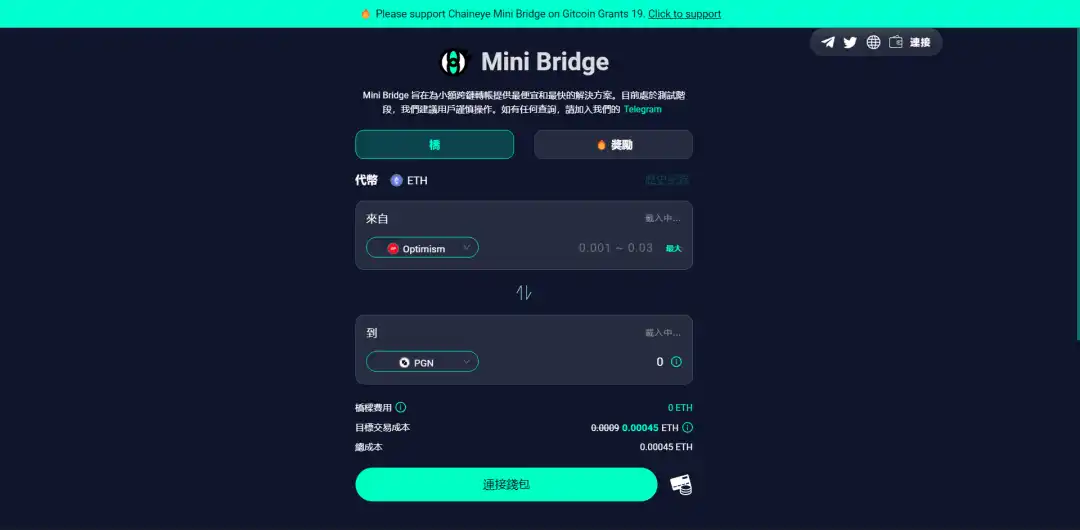
Gitcoin Grants Round 19 supports multi-chain donations: Arbitrum, Optimism, PGN, and others, where PGN stands for Public Goods Network, a specialized L2 for donations.
Donating using OP and PGN will significantly reduce network fees. You can use Minibridge to quickly bridge assets to the target chain:
6. The anti-sybil mechanism for Gitcoin Grants Round 19 still uses Gitcoin Passport. Passport, as a verification method, has been adopted by projects such as Linea and Link3, and it is recommended that everyone pay close attention to it.
https://passport.gitcoin.co/
Users can log in and link their social media and wallet to increase their weighting. Since Gitcoin Passport resets every 90 days, users need to relink before making a donation.
Users who reach a score of 15 points or higher in this round are eligible for additional matching funds. You can learn how to set up Gitcoin Passport in this tweet.
In addition, you can use the Chaineye Gitcoin Dashboard to view the current donation status of projects in various categories. You can quickly find popular projects in different sections based on donation amount and number of donors:
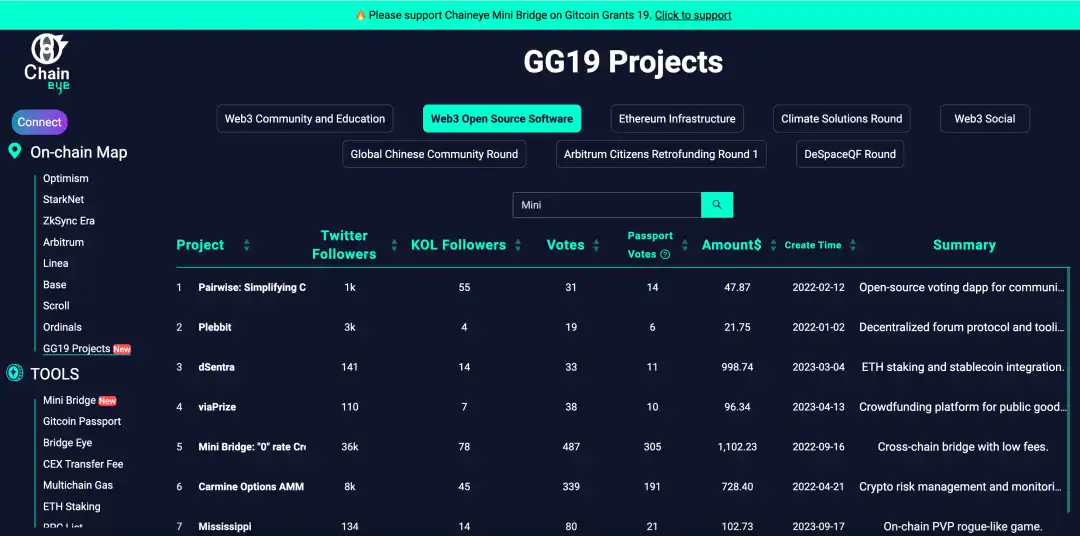
(Use the Gitcoin19 Dashboard to view the current project donation status)
Gitcoin Grants 19 Donation Recommendations
Biteye, based on the donation status of the past few rounds, has summarized the following donation recommendations:
1. Although Gitcoin does not have a donation amount limit, the minimum amount for each project is at least greater than 1U. On the other hand, due to ETH price fluctuations, you can choose to donate in DAI; if donating in eth, considering price fluctuations, it is recommended to donate 0.001eth or more; (Note: Some project teams airdrop based solely on whether a donation is made, while others use the donation amount as a weighting factor)
2. Gitcoin donations are good on-chain interactive behaviors. Optimism and Celestia have used "User's Gitcoin donation on the mainnet" as one of the weighting factors for airdrops. Donation is also a low-cost way to increase Passport scores.
3. Using MiniBridge to cross funds to the PGN chain donation can minimize network fees and interact with the officially recommended PGN chain;
4. It is not advisable to donate too late, as donating in the last few days is prone to network congestion, leading to missing the donation window;
5. Verify your passport to 15 points or above before donating; within the 15-25 range, a higher weight will be obtained as the score increases;
6. It is recommended that multi-account users pay attention to the diversity of donations, and you can adopt a 2+1 donation method, which includes donating to 2 target projects and 1 random project.
Gitcoin Grants Round 19 Donation Tutorial
If you are already familiar with the donation process, you can directly view the recommended projects in Part Four for donation, or you can read the concise guide from Biteye founder Teddy:
If you are not yet familiar with the Gitcoin donation process, you can first check out the previous Alpha Round donation video, and we will update Gitcoin Grants 19 as soon as possible:
Gitcoin Grants Round 19 Donation Project Introduction (Being Continuously Updated)
The Web3 OSS Grant is mainly aimed at open-source projects and is dedicated to developing or advancing the broader Ethereum and Web3 industry. Open-source software mainly includes concepts related to Web3, DeFi, NFT, etc., and projects in these sectors have had a precedent of airdropping to donors.
Mini Bridge is a "zero-fee" cross-chain tool with advantages such as supporting multiple chains and fast confirmation. It was developed by the Chaineye team for the scenario of small amount transfers by users. Chaineye is the award-winning project at the 2023 Shanghai Ethereum Summit, receiving funding support from Gitcoin, Optimism, and Arbitrum.
Mini Bridge has also been selected for the Global Chinese Community Round at GG19. Feel free to reach out to us!
https://explorer.gitcoin.co/#/round/10/0x6726fe9c89fb04eaef388c11cf55be6aa0a62fb9/0x6726fe9c89fb04eaef388c11cf55be6aa0a62fb9-26
As a protocol, Umbra defines a simple standard to achieve private transfers on Ethereum through smart contracts. Umbra currently supports the mainnet and multiple L2s, and will further deploy across multiple chains with the available funds.
Hey.xyz (formerly Lenster) is a decentralized, permissionless social media application. Hey.xyz runs on the Polygon network, allowing users to seamlessly interact with dApps, pay no fees, and have no content ever removable by anyone, not even admins. Hey.xyz is powered by the Lens Protocol, a decentralized social graph established by Aave.
JediSwap is a DEX built on StarkNet—StarkNet is an Ethereum Validity Rollup that achieves unlimited scalability for web3 while relying on Ethereum's security. JediSwap is a fully community-driven project, and anyone can start contributing to JediSwap by joining the JediSwap Discord.
A one-stop revoke authorization platform where users can use Revoke to immediately revoke token authorization upon receiving an attack report.
The dm3 Protocol is a lightweight information transmission protocol based on Web3 technology, focusing on secure end-to-end encryption, decentralization, scalability, and interoperability. The dm3 Registry is based on ENS, with dm3 configuration profiles added as text records to ENS names.
OmniBTC is a decentralized cross-chain exchange and lending platform designed to connect and unify all on-chain liquidity. Supporting over 17 chains and 20+ DEXs, it allows users to seamlessly swap any token across any chain.
Reason for recommendation: The project has some airdrop expectations and a relatively large community.
Glo Dollar is a fully-backed stablecoin pegged to the US dollar, supported by cash reserves and US Treasury bonds at a 1:1 ratio. Similar to other stablecoins, the reserves supporting Glo Dollar earn interest at scale, with the difference being that Glo Dollar's interest is primarily used to alleviate extreme poverty.
When the Glo Foundation earns income from the reserves, the income is donated to GiveDirectly's basic income program, helping people escape extreme poverty.
Currently, 20 organizations have adopted, donated to, or partnered with Glo, integrating charity into their operations.
Reason for recommendation: Innovative concept, promising vision.
2. Web3 Community and Education
The Web3 Community and Education grant focuses on non-software projects driving the Web3 space forward, including building new communities, providing educational resources, creating content, user protection, and engaging in inclusive and diverse advocacy.
Biteye is a leading Web3 research community in Asia, generating forward-looking research content and tools through community and AI-driven means to help community members explore the Web3 rabbit hole.
This is a decentralized reputation system that creates achievements and on-chain records for Web3 users through badges. On EtherScore, dApps can develop reputation-based services such as curated social networks, fair airdrops/ICOs, DeFi, and DAO governance.
Reason for recommendation: Anti-sybil attack has always been one of the focuses of project airdrops, and this project can effectively identify real user identities.
For the Crypto-native Alpha Exploration community, exploring early and nascent projects and sharing them with the public and Discord, providing support to projects through guidance on marketing strategy, event development, and educational content direction.
Recommendation: Has a certain level of influence in the Crypto Twitter community.
(3) Ethereum Core Infrastructure, Research, and Development
Ethereum Core Infrastructure, Research, and Development are aimed at supporting the Ethereum ecosystem. This category includes the following areas: core client development, tooling providers, and auxiliary products demonstrating ecosystem ideals.
L2BEAT is an analysis and research platform specifically focused on Ethereum Layer 2 (L2) scaling solutions, aiming to comprehensively compare various Ethereum L2 systems and provide educational services to the community with an objective insight.
EthStaker is a bridge between infrastructure builders and users, providing guidance and technical support for ETH infrastructure, aiming to help Ethereum users securely stake their ETH through creating guides, educational videos, educational content, and technical support.
The community has already set up validators for various testnets, testnet faucets, and has planned devconnect events.
Reason for recommendation: Ethereum staking is one of the key directions for the future of blockchain, and the related infrastructure and educational community are worth paying attention to.
ZK Email is an open-source SDK, library, and protocol (https://prove.email) that supports on-chain anonymous proof of email content, which is useful for proving identity in scenarios such as Twitter account proofs, GitHub contribution proofs, and anonymous KYC proofs. The project is currently highly open-source.
Biteye and Mini Bridge have been selected for the Web3 Community Education and Open Source Software & Global Chinese Community categories, and we welcome your support in these three categories!
https://explorer.gitcoin.co/#/round/424/0x98720dd1925d34a2453ebc1f91c9d48e7e89ec29/0x98720dd1925d34a2453ebc1f91c9d48e7e89ec29-51
https://explorer.gitcoin.co/#/round/424/0xd4cc0dd193c7dc1d665ae244ce12d7fab337a008/0xd4cc0dd193c7dc1d665ae244ce12d7fab337a008-39
https://explorer.gitcoin.co/#/round/10/0x6726fe9c89fb04eaef388c11cf55be6aa0a62fb9/0x6726fe9c89fb04eaef388c11cf55be6aa0a62fb9-26
Original Article Link
Welcome to join the official BlockBeats community:
Telegram Subscription Group: https://t.me/theblockbeats
Telegram Discussion Group: https://t.me/BlockBeats_App
Official Twitter Account: https://twitter.com/BlockBeatsAsia

 Related Articles