Gitcoin Beta Round Donations are Open – Here's Your How-To Guide
Original Article Title: " Gitcoin Beta Round is Live! Over 214 Projects, Running Until May 9th, A Comprehensive Overview of Five Major Grant Categories "
Original Article Author: Shouyi, Biteye Community
Gitcoin is a donation platform for open-source software, where users can support various decentralized open-source projects through Gitcoin. Early-stage projects can also receive donations on Gitcoin to sustain their operations. Well-known projects such as Uniswap, 1inch, Mask Network, ENS, and others have participated in Gitcoin Grants, earning Gitcoin the nickname "Ethereum's War Chest."
In each round of Gitcoin Grants, in addition to receiving user donations, Gitcoin also utilizes a Quadratic Funding model to allocate Ethereum Foundation funds to high-quality projects. This allocation method, endorsed by Vitalik Buterin, has significantly boosted Gitcoin Grants' community impact. The Gitcoin Grants donation event has been held 16 times to date (15 rounds + Alpha Round), providing rewards such as airdrops to donors while aiding project growth, leading more and more users into the world of Web3 through Gitcoin.
Gitcoin has been exploring more efficient donation methods, aiming to transition from matching grants (i.e., centralized handouts in QF) to GitcoinDAO: creating a decentralized and customizable grant protocol. Through the Gitcoin Alpha Round running from January 17, 2023, to January 31, 2023, Gitcoin refined its donation process and has now launched the Gitcoin Beta Round running from April 25, 2023, to May 9, 2023!
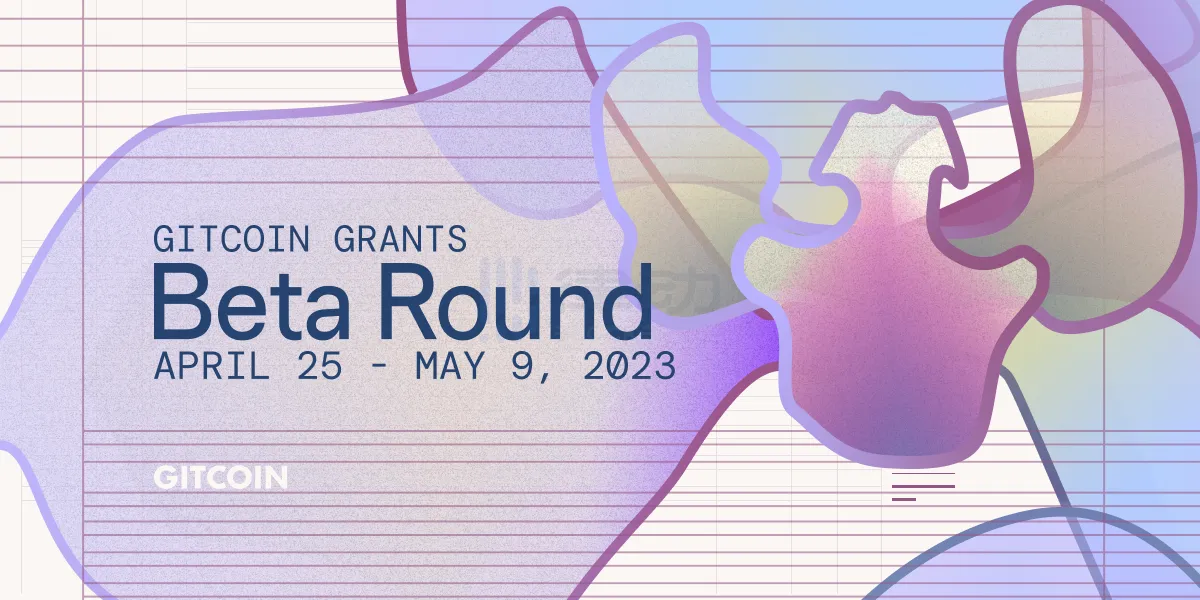
Announcing: The Gitcoin Grants Beta Round | Gitcoin Blog
Next, Biteye will briefly introduce the Gitcoin Beta Round and its differences from previous grants, and has carefully selected some high-quality projects for everyone.
Table of Contents
1. Introduction to Gitcoin Beta Round
2. Gitcoin Beta Round Donation Suggestions
3. Gitcoin Beta Round Donation Tutorial
4. Gitcoin Beta Round Recommended Projects (ongoing updates)
1. Introduction to Gitcoin Beta Round
1. The Gitcoin Beta Round is the second round of Gitcoin Grants Quadratic Funding, divided into Core Rounds and Featured Rounds. The Core Rounds are jointly decided by GTC token holders and community core contributors, supporting categories including Climate Solutions, Ethereum Infrastructure, Web3 Community & Education, Web3 Open Source Software, ZK Tech, and a DEI (Bonus Round). The total matching pool is $1.25 million, still using quadratic funding.
2. Featured Rounds are matching pools set by external partners, including DeSci, Advocacy, Metacrisis, Token Engineering, Greater China, Web3 Social, and The Sybil Resistance (Curated Round).
3. Projects in the Gitcoin Beta Round Core Rounds must meet the general eligibility for the Beta Round and the specific eligibility for the Core Round.
4. The Gitcoin Beta Round will run from April 25 to May 9. You can join the official TG to stay updated on donation-related news. The donation page for the Gitcoin Beta Round is the same as the Alpha Round.
5. The Trust Bonus has been removed for the Gitcoin Beta Round and replaced with Gitcoin Passport. Users can log in and link their social media accounts and wallets to increase their weight. Only users who reach a specific score will be eligible for matching donations. You can learn how to set up Gitcoin Passport in this tweet.
II. Donation Recommendations for the Gitcoin Beta Round
Biteye has summarized the following donation recommendations based on past donation trends:
1. While Gitcoin does not have a donation amount limit, the minimum amount for each project is at least greater than 1U. Alternatively, due to ETH price volatility, you can choose to donate in DAI. If donating with ETH, considering price fluctuations, it is recommended to donate 0.001 ETH or more. (Note: Some project teams airdrop based solely on whether a donation is made, while others use the donation amount as a weight.)
2. Gitcoin donations are considered positive on-chain interactions. Optimism has previously used "User donating on the mainnet through Gitcoin" as one of the criteria for airdrops.
3. In the past, Gitcoin donations could be made through zkSync, saving on fees and enabling zkSync interaction. However, this time, only ETH chain donations are supported.
4. Donations should not be left until the last minute, as donating in the final days may encounter network congestion, leading to missing the donation window.
5. Verify your passport to a score of 15 or higher before donating.
6. Considering the high gas fees for mainnet donations, participants can join when gas fees are relatively low, such as below 20. Gas fees are typically lower around 7 a.m. Beijing time.
3. Gitcoin Beta Round Donation Tutorial
If you already know how to donate, you can directly check out the recommended projects in Part Four for donation
If you are not familiar with Gitcoin's donation process, you can first watch the donation video for the Alpha Round, and we will update the Beta Round as soon as possible:
4. Gitcoin Beta Round Donation Project Introduction (Ongoing Updates)
(Click on the project name to enter the project donation page)
(I) Web3 Open Source Software
Open Source Software is mostly related to Web3, DeFi, NFT, etc. These projects in these tracks have had airdrop precedents for donors
1.ChainEye
ChainEye is an open-source full-chain analysis tool with over 100,000 users. It currently has features including BridgeEye (Cross-chain bridge comparison tool), On-chain & CEX transfer fee lookup, Multichain Gas fee lookup, Multi-chain stablecoin lookup, ETH 2.0 lookup, and an OnChain Map feature. The Onchain Map supports viewing dashboards and user guides for Optimism and Starknet ecosystems. Recently, Chaineye launched a Goerli testnet faucet, allowing users to claim 0.1gETH daily, providing free gas to over 4000 users within 2 days.
2.Umbra
As a protocol, Umbra defines a simple standard for private transactions on Ethereum through smart contracts. Umbra currently supports the mainnet and multiple L2s, and will leverage funding to further deploy on multiple chains.
Lenster is a decentralized, permissionless social media app built by the Lens Protocol. Lenster operates on the Polygon network, allowing users to seamlessly interact with dApps without any fees, and no one can censor any content from the application, not even administrators. Lenster is backed by the Lens Protocol, a decentralized social graph established by Aave.
4.Taho
Taho is an open-source and community-governed decentralized Web3 wallet with expectations of community governance, openly positioning itself against Metamask to carve a slice of the latter's market share.
5.JediSwap
JediSwap, a DEX built on StarkNet — StarkNet is an Ethereum Validity Rollup that achieves unlimited scalability for web3 while relying on Ethereum's security. JediSwap is a fully community-driven project, and anyone can start contributing to JediSwap by joining the JediSwap Discord.
DefiLlama focuses on professional analysis of DeFi project TVL data, categorizing current DeFi and public chains and tracking their TVL in the long term. DefiLlama's homepage also features Airdrops, recommending protocols that may have airdrops to users. (There were token rumors during a previous team internal dispute.)
7.xlog
xLog is an on-chain open-source blog community that defines its own product with the slogan Write.Own.Earn., aiming to leverage the advantages of Web3 to provide creators with more income opportunities, thus attracting more high-quality creators to join.
8.omnibtc
A decentralized cross-chain swap and lending platform designed to aggregate on-chain liquidity, enabling fast and low-cost cross-chain transactions. Currently deploying OB PASS to the SUI and ARB chains, where holders can enter DC verification for special identity.
(2) Zero-Knowledge Proof Technology (ZK Tech)
Zero-Knowledge Proof Technology is currently in the spotlight, and products around this trend can be a key focus in this funding round.
1.ZeroPool
ZeroPool is a privacy engine built on zkSNARKs, researching and creating privacy technology under full open-source licenses, and can run on EVM, Substrate, NEAR, and more.
(3) Web3 Community and Education
Web3 Community and Education will focus on software-agnostic projects that contribute to the advancement of the web3 space.
To be updated
(4) Climate Solutions
Climate Solutions mostly consist of public welfare products with low coin issuance probability and airdrop probability. Biteye only introduces innovative projects, and users can choose whether to donate.
1.TaterDAO
A project dedicated to bringing real-world assets on-chain to better quantify, identify, create, and develop climate solutions.
(V) Ethereum Infrastructure
Ethereum Infrastructure is to support the Ethereum ecosystem. This category includes Core Client Development, Tooling Providers, and Auxiliary Products showcasing ecosystem ideation.
To be Updated
In addition to Core Rounds, users can also choose to support Featured Rounds categories such as Token Engineering, Greater China, Web3 Social, etc. The Sybil Resistance is a category that supports "witch hunting" and is also an interesting setting.
(VI) Greater China
1.ChainEye
ChainEye is an open-source all-chain analysis tool with over 100,000 users. It currently features BridgeEye (cross-chain bridge comparison tool), On-chain & CEX transfer fee lookup, Multichain Gas fee lookup, Multichain Stablecoin lookup, ETH 2.0 lookup, and OnChain Map functionality. The Onchain Map supports viewing dashboards and user guides for Optimism and Starknet ecosystems. Recently, Chaineye launched a Goerli testnet faucet, offering 0.1 gETH per day, providing free gas to over 4,000 users in just two days.
ChainEye has been shortlisted in the Web3 Open Source Software and Greater China categories, and we welcome your support in both categories!
Original Article Link
Welcome to join the official BlockBeats community:
Telegram Subscription Group: https://t.me/theblockbeats
Telegram Discussion Group: https://t.me/BlockBeats_App
Official Twitter Account: https://twitter.com/BlockBeatsAsia