Bankless: Revisiting the Ethereum Rollup Roadmap
Original Title: Recapping the Rollups Roadmap
Original Author: Bankless Guest Author: Arjun Chand
Translation: Sharon, BlockBeats
Editor's note:
In recent times, the flourishing of the Solana ecosystem has led to more discussions in the Ethereum community about ecosystem development and blockchain scalability. With less than a month to go before the Cancun upgrade, Ethereum scalability is now a clearly visible future. In this article, Bankless guest author Arjun Chand reviews the development roadmap of Ethereum Rollup, which BlockBeats has translated below:
Scalability has always been one of the most controversial topics in the cryptocurrency industry. After multiple speculations, the community has settled on the Ethereum development roadmap centered around Rollup. But why choose this path?
With the resurgence of blockchain chains like Solana, it is now a great opportunity to re-examine why the Ethereum community chose Rollup and modularity to achieve global scalability.
Today's article focuses on the key concepts and development of guiding Ethereum's scalability efforts towards a roadmap centered around Rollup. Let's delve deeper into this topic together.
Ethereum's Decentralized Scaling Vision
The ultimate goal of Ethereum is to become a globally coordinated financial layer. In order to achieve this goal, it must support different types of applications and be accessible to all types of users.
In 2020, Vitalik pointed out an urgent problem with the Ethereum network: when he placed a bet on Augur, he had to pay a gas fee of $17.76. These high fees indicate that Ethereum is struggling to scale in the face of increasing demand. As a result, it has become a platform "for the few, not the many" and has deviated from its original goal.
The problem is obvious - Ethereum needs to be able to process more transactions at a lower cost. However, the solution may be more complex as many factors must be considered and balanced.
One major consideration is optimizing three attributes: decentralization, security, and scalability. These three together form the "scalability trilemma," which is the "impossible triangle" dilemma that any blockchain faces.

The scalability trilemma can be understood as a balancing act - an improvement in one attribute usually means a trade-off in another attribute.
With the passage of time, many blockchain projects that have been labeled as "Ethereum killers" have been facing the trilemma, which often sacrifices decentralization and security while pursuing scalability.
However, for the Ethereum community, compromising decentralization has never been an option. This is because it is closely related to security and endows the Ethereum network with neutrality, censorship resistance, and permissionlessness, which are equally important properties as the properties in the scalability trilemma.
In the demand hierarchy of Ethereum, if decentralization, security, and scalability form the "physiological" needs, then neutrality, censorship resistance, and permissionlessness can be said to form the "safety" needs. These two levels can be referred to as the "basic needs" of the Ethereum network.
After recognizing these priorities, the Ethereum community has adopted a long-term development approach that may sacrifice certain aspects of the scalability trilemma in the short to medium term, but enables Ethereum to "grow strong enough to help all of humanity."
This strategy is called modular blockchain theory. It involves executing transactions on L2 scaling solutions, also known as Rollups. Since these transactions occur outside of Ethereum, they can be faster and cheaper. However, since their data returns to L1, they inherit Ethereum's extensive security.

Why choose Rollup to scale Ethereum?
By the end of 2020, the Ethereum community had reached a basic consensus and adopted Rollup as the main scaling solution for the medium and short term future, forming an Ethereum development roadmap centered around Rollup. The key factors that have made Rollup the preferred solution include:
1. Forward compatibility with Eth2 (PoS) - Companies behind Rollups such as Arbitrum and Optimism were launched in 2018 and 2019 respectively. At that time, Ethereum was still using the PoW consensus mechanism, while PoS was still in the proposal stage. Rollups are compatible with both PoW and PoS, providing the Ethereum developer community with the flexibility needed in terms of the timeline for critical network upgrades (such as transitioning from PoW to PoS).
2. Technical Feasibility - By 2020, Rollup had achieved substantial development. As Vitalik pointed out in his forum post, the OptimisticRollup team (such as Optimism and Arbitrum) had already launched their testnets in early 2020 and released a roadmap for mainnet launch in 2021.
Meanwhile, zkRollup solutions such as zkSync and Loopring have already been deployed and have users on their mainnets, albeit with limited functionality. This progress has given the Ethereum community confidence in the maturity of Rollup technology and its potential to effectively scale Ethereum starting in 2021. In contrast, other scaling solutions such as execution shards still require several years to develop.
The urgency to adopt Rollup has further increased for the state of the Ethereum mainnet during the previous bull market. Gas fees hit new highs, causing users to spend tens of dollars on each transaction. In addition, some applications, especially those with non-financial purposes, have been forced to shut down due to high fees.
These factors have collectively influenced the Ethereum community to firmly adopt Rollup as a predictable future scaling strategy, recognizing its immediate impact and long-term potential.
Although the direct benefits of Rollup are obvious, the growing Rollup ecosystem also brings some challenges. With a user-centric approach, the Ethereum community has raised some key questions, and here is an overview of the progress made in addressing these issues.

Ethereum Rollup Roadmap Status
We are in a multi-Rollup ecosystem, and many Rollups have made significant progress.
In this case, Ethereum is being extended through Rollup, serving as the underlying layer for settlement and data availability. All Rollups inherit Ethereum's security and use it to confirm transactions and store data.
Regarding security, Ethereum is undoubtedly one of the safest blockchains in the ecosystem. Over 33.5 million ETH are used to secure the network, providing over 67 billion USD of economic security at the current ETH price of 2000 USD per ETH.
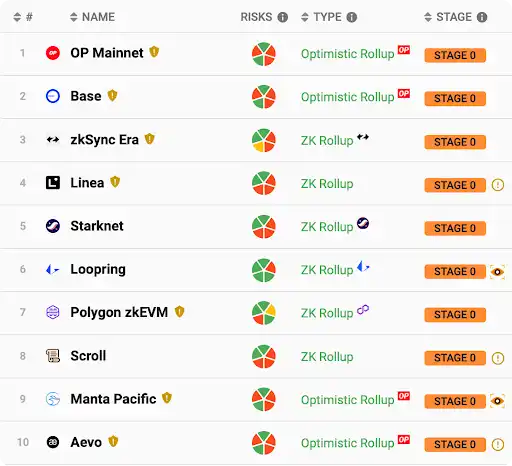
However, with TVL in L2 already exceeding $16 billion and collateral reaching a historic high, the community has expressed some concerns about the centralization and operator extraction of MEV in Rollup sorters. Although many Rollups have attracted a large number of users, as L2BEAT's analysis of Rollup maturity shows, most of these systems are still in the early stages of development.
Another key area of positive development is to enhance data availability. A critical part of this effort is Danksharding, a key feature in the Ethereum roadmap's "surge" phase. Danksharding aims to significantly reduce the cost of verifying transactions on Rollup on Ethereum, thereby promoting the network's scalability. To this end, some innovative projects, such as Celestia and EigenDA, focus on providing cheap and decentralized data availability layers for Rollup.
Before the full implementation of Danksharding, the Ethereum community is undergoing proto Danksharding, also known as EIP-4844, as an intermediate step. This step introduces some concepts of Danksharding, such as blob, in a simplified form. Proto Danksharding is expected to be implemented soon, while the complete Danksharding will take several years.
Welcome to join the official BlockBeats community:
Telegram Subscription Group: https://t.me/theblockbeats
Telegram Discussion Group: https://t.me/BlockBeats_App
Official Twitter Account: https://twitter.com/BlockBeatsAsia