Bankless: Bitcoin now needs applications.

Original Title: "Bitcoin Needs Apps"
Author: Jack Inabinet
Translated by: Luccy, BlockBeats
Editor's Note:
With the upcoming Bitcoin halving event, the security budget of Bitcoin will be reduced, which may lead to the loss of miners and an increase in on-chain attack frequency.
To avoid future security crises, Bankless analyst Jack Inabinet believes that the Bitcoin network must increase transaction fee revenue. However, he also pointed out that the premise of increasing transaction fees is that Bitcoin must first give people a reason to use it, and the simplest way to achieve this goal is to create an environment where people can develop applications.
Bitcoin has a major issue, which is security budget.
Miners who ensure the security of the Bitcoin network rely on block rewards from inflation and user transaction fees to generate income, but the emission rate of Bitcoin is reduced by approximately half every four years.
The next Bitcoin halving event is scheduled for April 2024. The resulting reduction in block emissions will make miners more reliant on transaction fees for income. Bitcoin's security budget will decrease, while transaction fees will not increase accordingly.
The contraction of Bitcoin's security budget will lead to the loss of miners, reduce the amount of computing power protecting the network, and make it more economically feasible to launch attacks on the chain! Although it may not be an urgent issue, in the long run, how Bitcoin should bear the cost of security is the most concerned issue for the network.
Ethereum commentator Anthony Sassano recently joked about Bitcoin's security issues on Twitter, listing alternative solutions to protect the Bitcoin network security in case transaction fees are not enough to compensate for the decrease in BTC issuance.
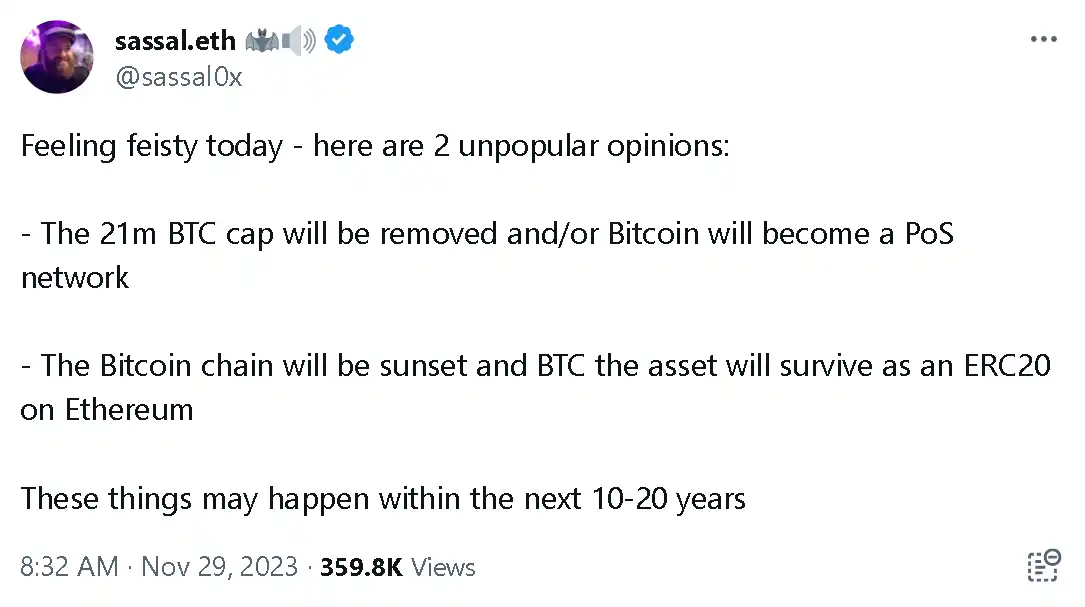
The proposed actions above can help Bitcoin avoid future security crises. However, the conservative community is unlikely to consider alternative solutions to the existing network, as implementing these solutions would require compromising on core principles.
In order to ensure its future development and reduce its reliance on block subsidies, the Bitcoin network must increase its transaction fee revenue. However, in order to do so, Bitcoin must first give people a reason to want to use it.
Without a doubt, if Bitcoin supporters want to increase transaction revenue and avoid adopting more radical proposals, they will face a tough battle, but they don't have to do so because by 2023, transaction revenue on the network will double.
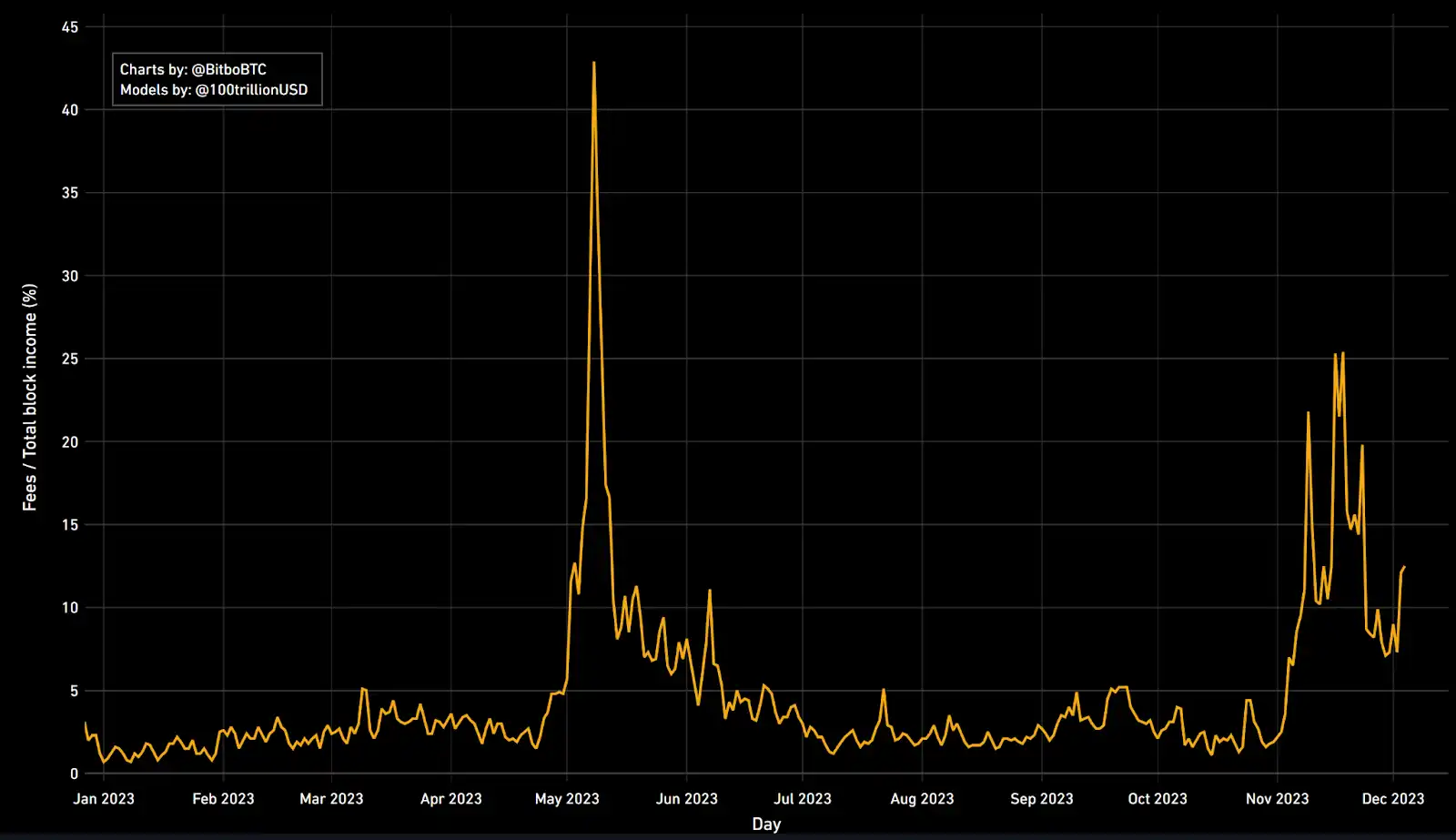
Source: BiTBO
The surge in transactions is attributed to the birth of useful primitives such as Ordinals and BRC-20, which are built using the Taproot upgrade of Bitcoin, inspiring the utilization of the chain.
Unfortunately, as demonstrated by the fact that transaction fees account for less than 10% of Bitcoin block rewards over a 6-month period, the usage intensity of these applications is inconsistent and entirely dependent on speculative activity.
Fortunately, experiments are currently underway to bring other forms of vitality to Bitcoin, which may result in more consistent trading activity.
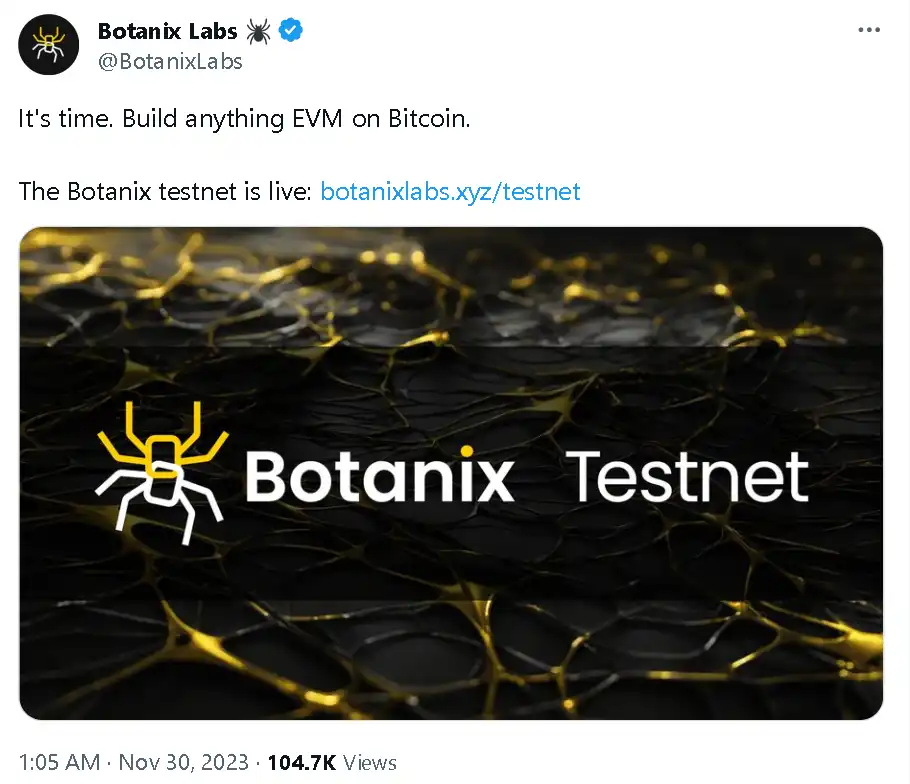
Botanix is using L2 technology to bring EVM to Bitcoin and has just launched its testnet. The support for EVM allows developers on Botanix to write and deploy applications using the popular cryptographic coding language Solidity and be compatible with existing Ethereum infrastructure such as the MetaMask wallet.
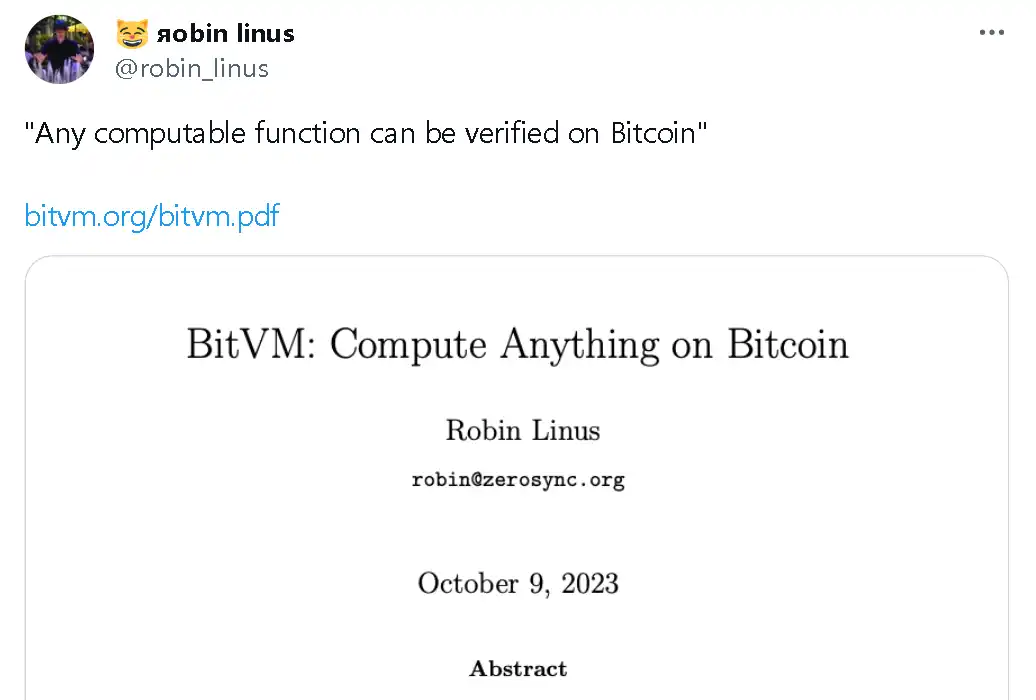
BitVM is another solution aimed at making Bitcoin programmable by enabling Turing-complete Bitcoin contracts at layer 1.
Although BitVM does not require forking and will not bring additional complexity to the Bitcoin network, this solution is severely limited by the design of the two parties involved, which means that BitVM cannot support large-scale decentralized applications with multiple transaction parties.
Bitcoin Improvement Proposal 300 hopes to bring programmability to Bitcoin through sidechains. However, this proposal would add additional complexity to Bitcoin and must be implemented through a soft fork. Given Bitcoin's longstanding conservatism, this upgrade is unlikely to occur.
Conclusion
Although traders flipping JPEGs and imitating garbage coins may not be the ultimate innovation example, the emergence of emerging use cases that generate a large amount of transaction fee revenue indicates that Bitcoin may be able to achieve self-sufficiency without block rewards.
What Bitcoin needs now is a real use case that guides people to conduct repeated transactions on the chain. The simplest way to achieve this goal is to create an environment where people can develop useful applications.
"Original article link"
Welcome to join the official BlockBeats community:
Telegram Subscription Group: https://t.me/theblockbeats
Telegram Discussion Group: https://t.me/BlockBeats_App
Official Twitter Account: https://twitter.com/BlockBeatsAsia

 Related Articles