Should we consider PBS as sacred?

Podcast source: "Uncommon Core 2.0"
Hosts: Hasu, Strategic Lead of Flashbots, and Jon Charbonneau, Co-founder and Managing Partner of DBA
Hasu and Jon invited Mike Neuder from the Ethereum Foundation and Chris Hager from Flashbots to discuss the design philosophy of proposer-builder separation (PBS). They first delved into the past and present implementations of PBS, including MEV-Geth and MEV-Boost on Ethereum. Then they discussed the future of PBS - whether it should be treated as sacred, proposals for protocol enforcement by PEPC, PBS on L2s, and how to prevent censorship. The following are the key points of the content, as compiled by BlockBeats.
PBS, short for Proposer-Builder Separation, is an important concept in blockchain design. It mainly refers to the separation of proposers and block builders' roles in on-chain governance. Proposers are only responsible for proposing, while the complex block building work is outsourced to specialized builders. The purpose of this division of labor is to lower the threshold for participating in consensus and make the network more decentralized.
PBS was originally applied during the Ethereum proof-of-work era. At that time, miners could outsource block construction work to "searchers" using software such as MEV-Geth. Searchers could construct optimized blocks with higher transaction fees and share them with the proposing miners. Prior to the POS merge, due to the limited number of miners, this collaborative approach could establish a certain level of trust through a reputation mechanism. (Note: MEV, Miner Extractable Value, refers to the value that miners can extract.)
PBS Design Philosophy Behind the Scenes
From a more macro perspective, PBS reflects a pragmatic design philosophy. It recognizes that specialized division of labor and outsourcing demands among blockchain participants are inevitable, and attempts to regulate this demand through protocol design to make it more fair and decentralized. This design approach, which takes a pragmatic rather than idealistic approach to market demand, is worthy of attention.
PBS also demonstrates the advantages of modular and layered design. It outsources the construction of complex blocks to external builders, keeping the core network simple and providing scalability for different application scenarios. This also enables PBS to be applied to Ethereum's scaling solutions and layer-two solutions.
Of course, PBS also needs to balance decentralization, stability, and regulation. But overall, PBS represents a positive exploration of design in blockchain, which uses economic incentives to guide participants to form specialized divisions of labor and achieve optimal task allocation while maintaining a simple basic protocol, making the entire network healthier. These design concepts behind PBS will also be applied more in other public chains, promoting the development of the industry.
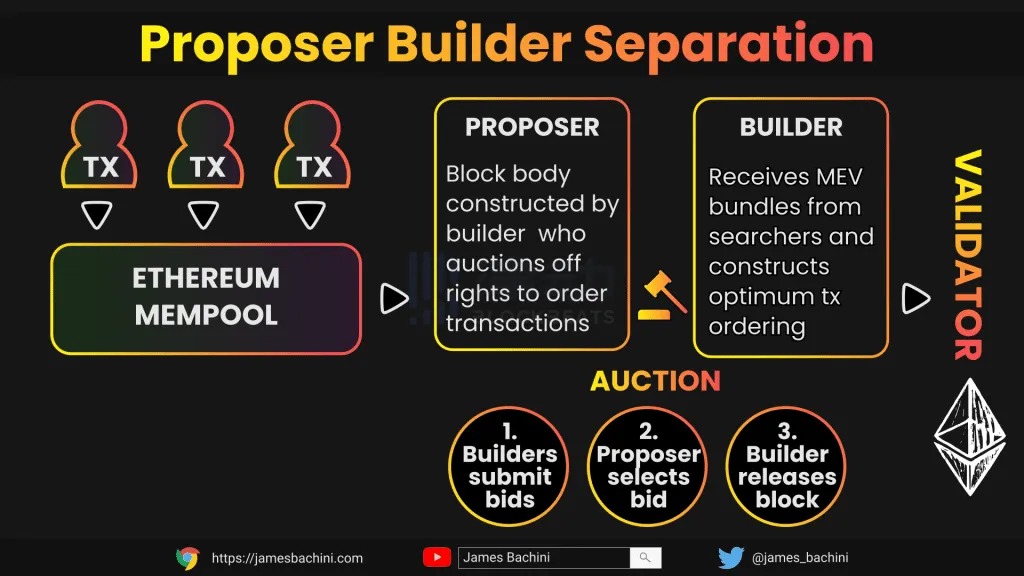
As the Ethereum POS merge approaches, PBS has become a focus of community attention. To this end, Flashbots has launched MevBoost as the first implementation of PBS. It introduces the role of "relay" as an intermediary between proposers (mainly validators) and builders. The role of the relay is to ensure that the fees paid by the builder to the validator are not stolen by the proposer, and also to ensure that the validator does not commit to using the block before seeing its actual content. Currently, about 95% of Ethereum validators obtain blocks through the relay in MevBoost.
PBS Advantages
The biggest advantage of PBS is that it allows the network to remain relatively simple and decentralized. Without PBS, validators would need to build blocks themselves, which would undoubtedly increase the barrier to entry and lead to network centralization. On the other hand, PBS also allows the network to leverage the expertise of builders to optimize block efficiency. For example, PBS can assist in on-chain scaling by delegating the complex work of block construction to builders, greatly reducing the workload of validators.
Of course, PBS also has certain issues. The main concern is the centralization of the relay role. Currently, only 8-10 relays provide most of the PBS services for the Ethereum network. These relays operated by centralized institutions may become a threat to network stability. In addition, PBS may also bring certain legal regulatory issues, and relevant parties need to bear the responsibility of transaction review.
Internal PBS: Solution or New Problem?
Therefore, the Ethereum Foundation is researching how to incorporate certain forms of PBS into the Ethereum protocol, known as Enshrined PBS. The goal of Enshrined PBS is to reduce reliance on relays, with its most basic requirement being a commitment-reveal mechanism and an unconditional payment mechanism. The former can ensure that validators commit to using the block before seeing its actual content, while the latter can ensure that payments can be executed even if the builder does not reveal the block content.
Of course, the built-in PBS also faces many technical challenges, which may bring new complexity and uncertainty. On the other hand, even with the introduction of built-in PBS, certain forms of external relay services may still exist because they can provide additional services such as more flexible payment methods and delay optimization. Therefore, there is still controversy over whether the built-in PBS can completely solve the problem of external relays.
At the same time, PBS is also being used in the design of Ethereum's layer 2 scaling network. Compared to the Ethereum mainnet, the layer 2 network has greater design space and flexibility, allowing for different forms of PBS. For example, the layer 2 network can limit the number of serializers, or it can establish more specific block sorting rules according to its own needs. Therefore, the specific implementation of PBS in the layer 2 network may be very different from that in the mainnet. However, overall, the application of PBS in the layer 2 network is also highly anticipated.
Welcome to join the official BlockBeats community:
Telegram Subscription Group: https://t.me/theblockbeats
Telegram Discussion Group: https://t.me/BlockBeats_App
Official Twitter Account: https://twitter.com/BlockBeatsAsia