The Power Machine behind Ethereum: MEV and PBS
Source: Hash Hunter
原文作者: Masterdai

Who controls the past, who controls the future; He who controls the present controls the past. -- 1984
2007 年,加拿大皇家银行的交易员胜山发现了一件令他感到困惑的事情,当他在交易终端按下买入键的一瞬间,所有的订单消失了。而在区块链的世界里也发生了一件相似的事情。
2022 年 6 月, Scott Bigelow 在以太坊主网上面部署了一个加密合约并往里存入了 0.035 个以太币,只有他一个人知道取出合约内存款的密码。而就在他往合约发送密码信息的一瞬间,合约里的以太币消失了。

There is no doubt that they all met a false start. The orders Katsuyama wants to place are distributed across different exchanges. Due to the geographical location, the arrival time of each order on the exchange is slightly different. High-frequency traders know the first purchase order in advance through the faster fiber optic network, so they can buy Katsuyama's order before it can be placed on other exchanges.
Scott's password information was known only to him, but before his transaction information was broadcast by each node, a false start sniffed his password in the memory pool, copied his password, and stole the money from the contract at a higher gas rate. These preemptive robots are just the tip of the predator iceberg. Different from high-frequency trading in traditional finance, more sophisticated and cruel strategies have emerged in the dark forest of blockchain, which has no access mechanism, and have been widely applied in various fields of defi and nft.
This paper will show the role of mev robots and flashbots in Ethereum from the perspective of underlying principles. The impact of pbs architecture on subsequent crypto ecology and the evolution prediction of future roles. It is divided into three chapters:
The first chapter is the principle interpretation.
The second chapter describes the ecological pattern, investment and entrepreneurial opportunities of MEVs.
Chapter 3 is the prediction and prospect of the future constructor-proposer separation architecture.
1. Industrial chain
To fully understand the current pbs ecology (proposer-builder separation), we can look at it from the perspective of a single stroke of the pen on the client side: "What happens when a user clicks to interact with a decentralized application and then becomes fully established at the consensus layer?"
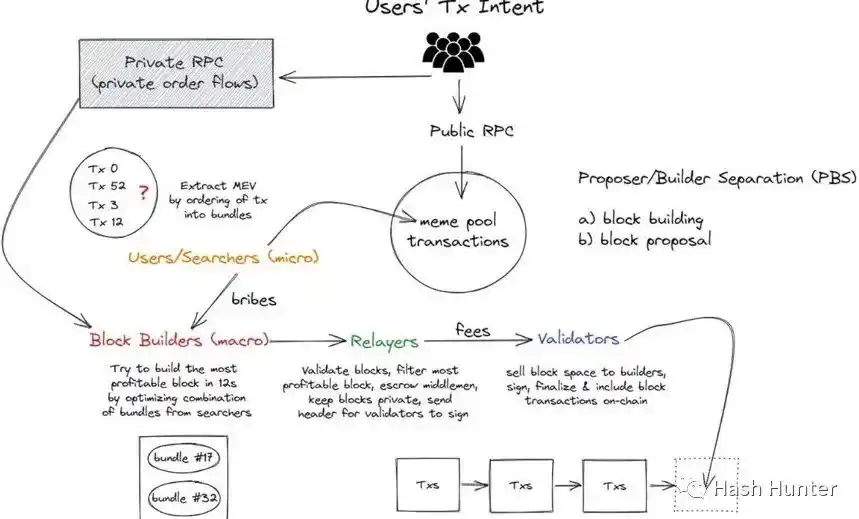
To make it easier to understand, I've broken these steps down into steps:
transaction: When we make a money transfer in a wallet or a token exchange on a decentralized exchange or a mint nft, the data structure on the chain is similar.

The above figure shows the information needed to mint an nft contract. The most important information is data. 0x1249c58b in data is the call to mint () function. And if we replace the data in data with 0x then represents a normal transfer. Through these data and value data, we can clearly judge the intention and function of the user's transaction.
Memory Pool (mempool) : When a user invokes a service remotely using a public node (e.g. metamask uses infura's Ethereum node by default), transactions run into the memory pool. The memory pool is a buffer when the node receives the transaction and contains it into the block. Its function is to help the node to check all kinds of transactions and judge the legality and validity of the output and signature of the transaction.
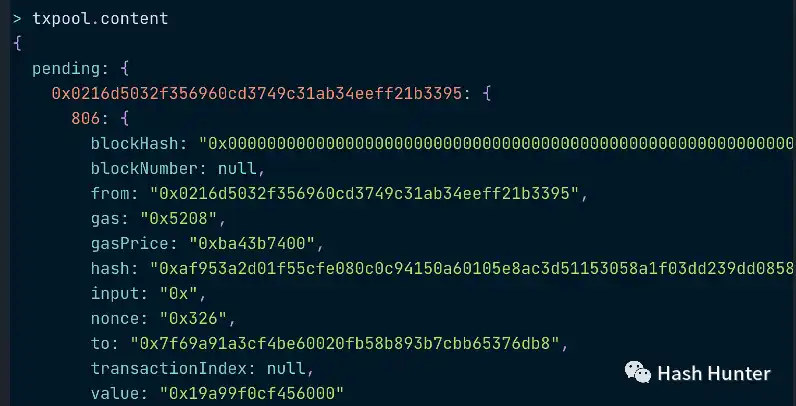
The transactions in the memory pool are different for each node, but the data they contain is public to the entire blockchain network. In other words, as long as someone can set up nodes on cloud servers around the world, he can get access to most of the memory pool data. The misuse of memory pool data is extremely unfriendly to the average user. As in the case I described at the beginning, the arbitrageurs can profit from knowing the user's intention to trade in advance. This profitable process is called mev (maximum extractable value).
seacher: Also known as Ethereum robot operator. Arbitrageurs and nft-mint robots that we know so far can all be categorized as searchers. Searchers are closely related to flashbots. After flashbots open source their auction components, searchers can send bundles of their own transactions or those of the memory pool together in order, and assign a block builder to include the bundle's transactions in the block. Thus avoiding sniffing its transactions in the public memory pool.
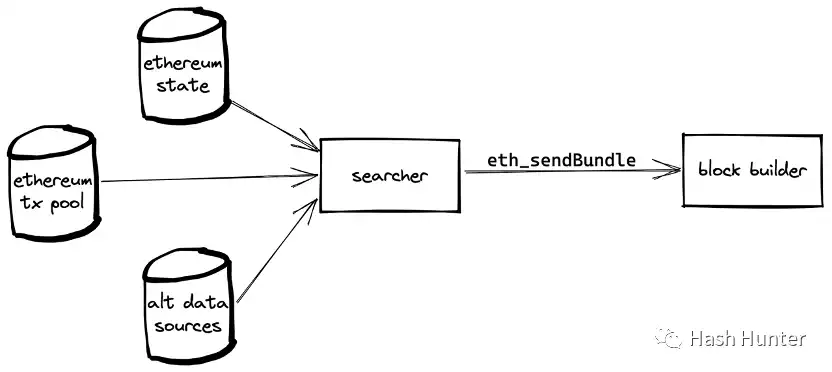
Flashbots In effect, it created a new transaction information channel that enabled some users to communicate directly with block builders. For example, in the following example, I use flashbots to pass the above mint transaction directly to the block builder so that my mint information is not known in advance.
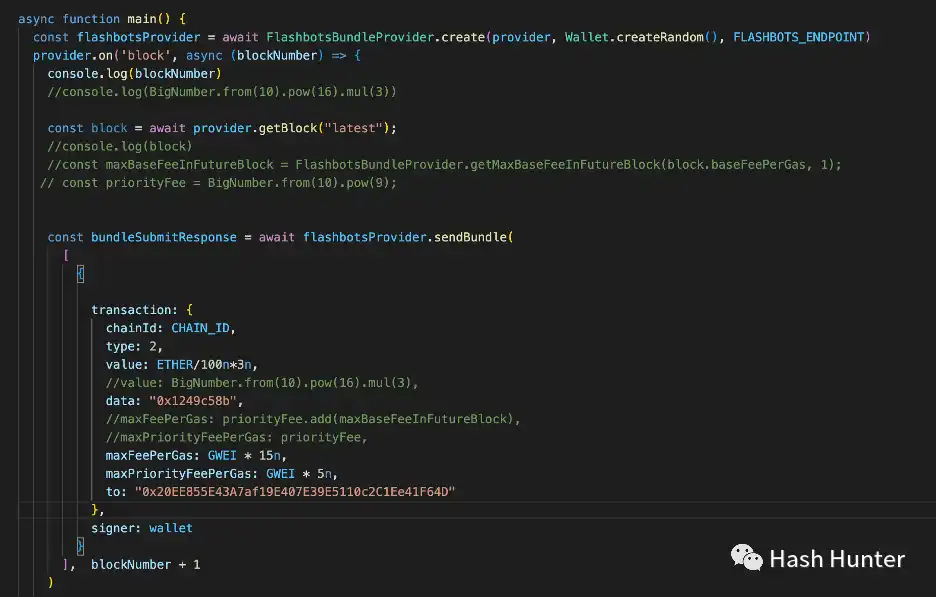
Searchers also have to pay a price to make their bundles more attractive. For example, by increasing the cost of gas, or simply transferring ether to the builder's coinbase address.
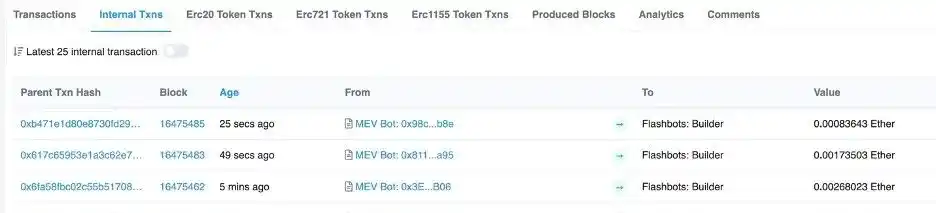
Through the bundle mechanism, searchers have the ability to change the order of transactions on a small scale. And the mechanism can ensure that orderly transactions have the possibility of not being cut in line. By arranging and combining external transactions and self-generated contracts to invoke transactions, there are a variety of attack strategies in the mev domain. Examples include false start, run back, sandwich attack, jit bot, Time Thief attack, tertiary Thief attack, etc.
· Jump the gun: Gain profits by taking the lead and copying the trading strategies of rivals. For example, preemption of mint to nft with higher gas costs in front of ordinary users, preemption of mint share of human users, etc.
· Run behind: Gain profit by scrambling for the next position in a trade. After the bot creates new trade pairs on uniswap by monitoring certain tokens, it creates bulk buy trades after it has deployed the pool. The strategy is to be the first to buy the token. Similarly, a robot can become the first mint nft person by monitoring the transaction in which the nft contract mint () is activated by the nft project side. nft existing on the market; Most Mint-grabbing robots are designed according to this principle and architecture.
· Sandwich Attack: When a user wants to exchange for tokens A on a decentralized exchange, the bot can create two transactions and use the bundle function to sandwiched the victim's transactions between them. The bot's first transaction buys token a, the victim's transaction then pushes up the price of Token a, and the third transaction sells the same amount of token a for a profit. Profit depends on the slip point set by the victim exchange.
· Jit Bots (just in time) : This mode appears in uniswap v3's token pool because v3's centralized liquidity nature allows users to set up a single lp within a small interval. When a user wants to make a large number of token transactions in v3, it immediately initiates a transaction to add liquidity and a transaction to destroy liquidity. Sandwiched in a user's transaction to capture the liquidity revenue generated by that transaction. This mode requires the jit robot to calculate in advance the changes in the position before and after trading, so that the user's trades fall within its designed liquidity range.
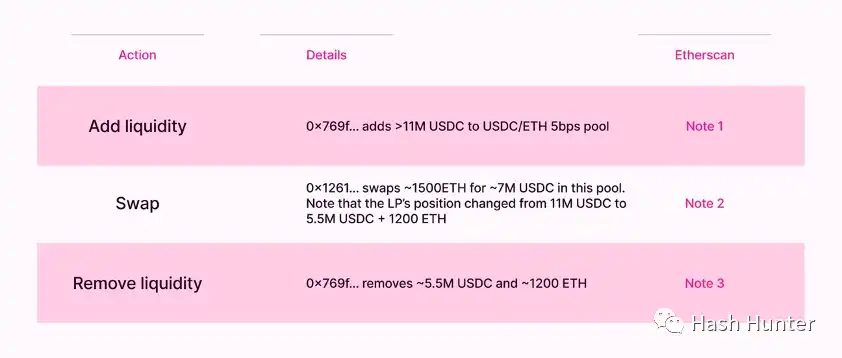
As space is limited, I am not in this article introduces detailed methods and steps of the attack, interested readers can access here (https://www.mev.wiki/attack-examples). Not all searchers are arbitrageurs. We can also use these mechanisms to do some good.
· Transfer service: Some hackers will use the nft in the user's stolen wallet for phishing, usually the eth in this wallet is not enough to pay for the transfer of gas. When the victim wants to transfer to gas, the hacker uses a script to transfer the gas fee. We can use flashbots to retrieve the nft from the stolen wallet of the private key before the hacker takes the gas bill you transferred into. Set up a transaction into the hacked wallet and a transaction out of the hacked wallet, put both transactions in a bundle and send them to the block builder. Since the two transactions are contiguous on the block, the hacker has no way to stop you from transferring out the stolen nft. When a searcher finishes building a bundle, he can send the bundle to his designated block builder.
· block builder: Thanks to the open-source architecture of the block builder by flashbots in November 2022, we can see the architecture design inside the block builder. A complete block build client consists of two different nodes, including a block build specification for the geth execution layer node, and a modified prysm consensus layer node.
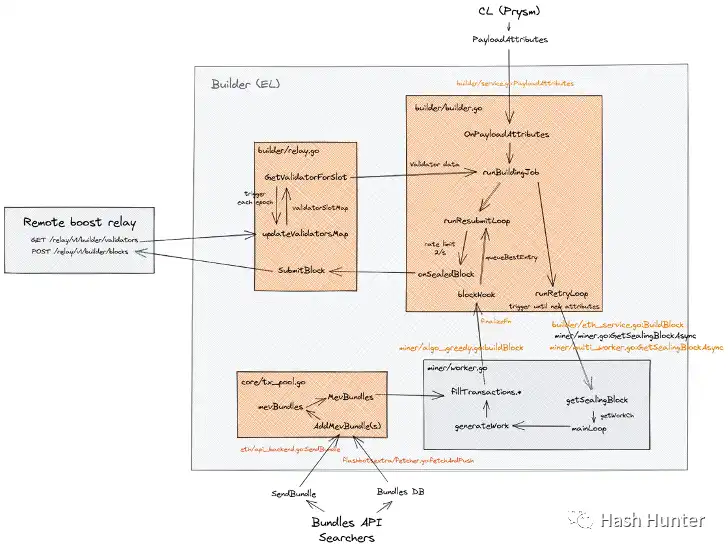
The block builder needs to open an rpc endpoint so that searchers can send bundles to the specified builder. The builder itself is divided into two modules, geth and prysm. The miner module uses an algorithm to select bundles that meet its program requirements, and selects transactions from the memory pool and stuffs them into the created blocks. The builder module, in constant communication with the repeater and miner modules, starts generating block data, including the block's hash value, payment address, and additional information (usually with the builder's name). A transaction is set up to send the proceeds of the entire block by transfer to the receiving address of the verification node.

relay: Block builders need a trusted third party to send blocks to verifiers without being leaked, and the same verifiers need a trusted relay layer to help them ensure block legitimacy. Of course, the characteristics and characteristics of different Repeaters are different, and a verifier uses mev-boost to access multiple Repeaters to get the most block options.
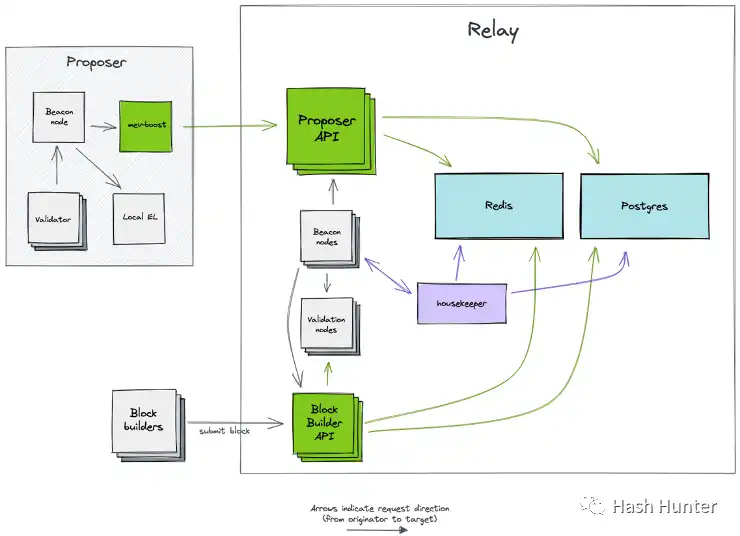
From the above architecture, we can see that the repeater also needs to run consensus layer nodes and execution layer nodes to receive and send block information. There are two apis outside the repeater that interface with the block builder and mev-boost. Such an architecture minimizes communication and trust costs between proposer and builder without compromising block information.
Proposer: After the Ethereum merger, a new consensus layer was added to the network. The proposer's architecture consists of four clients: the execution node, the consensus node, the verifier (32eth), and the mev-boost. This is the underlying architecture of most Ethereum node pledge providers today. The original node pledge consists of the first three pieces of software, and mev-boost can be thought of as a plug-in that coordinates communication between the two nodes and gets additional block information from the secondary layer.
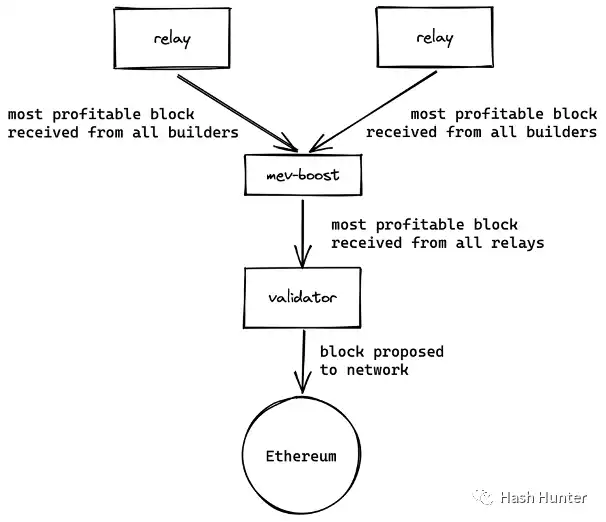
Such an architecture essentially strips away the proposer's ability to build blocks, allowing the proposer to simply propose blocks from mev-boost and add them to the beacon chain. Similarly, mev-boost can connect multiple relay layers to maximize the benefits of the proposer. Ultimately, the revenue generated by the searcher and the block is paid to the proposer, the Ethereum pledge, through the entire architecture.
Transaction chain:
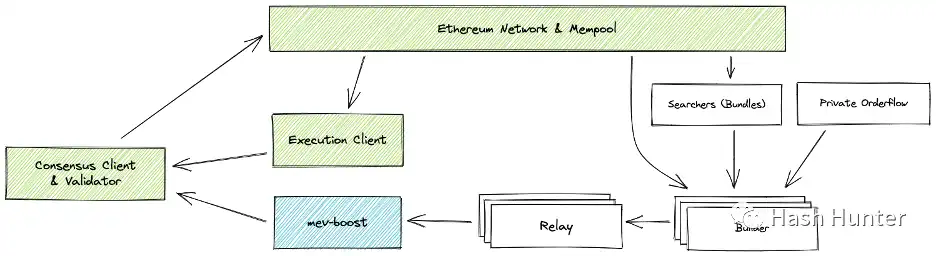
When a user initiates a transaction, it first goes into the public memory pool, and if it is an ordinary transaction, it waits for some time before being put into the block that the block builder creates, or if it is a searcher's transaction, it goes into the block as a bundle. After passing through the relay layer, it is finally signed by the block proposer and broadcast to the network. Users can also use the block builder's private node to avoid the public memory pool.
Revenue chain: The searcher searches the memory pool for a transaction that captures a profit, scoops it up, combines it with the transaction it created and puts it into a bundle. The searcher's profits go directly to his wallet, and in order for the transaction to be packaged into the block builder, the searcher pays the block builder a fee (via gas or coinbase transfer).
· Block builder's benefits = Transaction costs (gas) + Searcher pays handling fee - gas cost of destruction
· Block builder's profit = transaction fee (gas) + commission paid by searcher - gas fee for destruction - Block Builder's fee to verifier (cost)
· Mev-boost revenue = The last transfer in the block. = block builder's fee to verifier
Taking block 16489407 as an example, ethscan shows that his overall block reward is 0.129830707718222266 Ether, which is not his actual block construction profit, but just the transaction cost - gas cost of destruction. From the flashbots address, you can query the coinbase.transfer record. You can see that the searcher paid two transactions of 0.16601722521 ether. Of course, there are actually 6 bundles in this block, but the remaining 4 bundles are paid in the form of gas fees. I won't go into the details here, but a future article will explain how to calculate the mev revenue of a block.

For the last transfer in this block, the builder gave the verifier a transfer of 0.295569746890668 Ether.

Through calculation, we can get:
Block builder's revenue = 0.129830707718222266 +0.16601722521=0.29584793292 ether
Block builder profit = 0.29584793292-0.295569746890668 =0.00027818602 ether
As we can see from this, the profits for block builders are not as high as we thought, and it is still the node validators with mev-boost installed who reap most of the benefits of MEVs. It should be noted that the income here does not include the income from the node pledge. The income of a nodal pledge is divided into consensus income and mev-boost income. The Mev-boost revenue is cash to the verifier, and if the pledgor is lucky he will receive eth revenue directly from the billing address after installing the boost. However, the income of the consensus layer has an account period, which can be taken out only after the upgrade of Shanghai.

In terms of the overall technical architecture and link, the existing pbs architecture design is not simple. Pbs itself was also a transition for Ethereum before the scourge. The collusion between the relay layer and the build layer and the centralization of the block builder are not completely solved. This is one of the main reasons flashbots came out with suave later.
2. Ecological pattern and investment opportunities
In the previous chapter, the chain of MEVs is classified and sorted through the implementation of the underlying architecture. Projects in the ecosystem tend to occupy multiple areas and directions to monetize and create, although the field is still in its very early stages and there is no clear business model or track head player. To judge these early projects, I have roughly divided them into several tracks (not involving node pledges) and measured them in three ways: whether they can be profitable, whether they are ready for large-scale commercialization, and whether they are sustainable. Searchers: There are arbitrageurs, sandwich attackers, and liquidators, depending on what they do and how they make money. Its profitable areas include decentralized trading, lending, nft trading, flash lending, and more. eigenphi shows, by its data, that the searchers themselves have an extremely unequal distribution of revenue.
搜索者:根据其功能和获取利润的来源,其中也分为套利者、三明治攻击者以及清算者。其盈利领域涵盖了去中心化交易、借贷、nft 交易、闪电贷等等。从 eigenphi 所提供的数据中可以看到,搜索者本身的收益分配极度不对等。
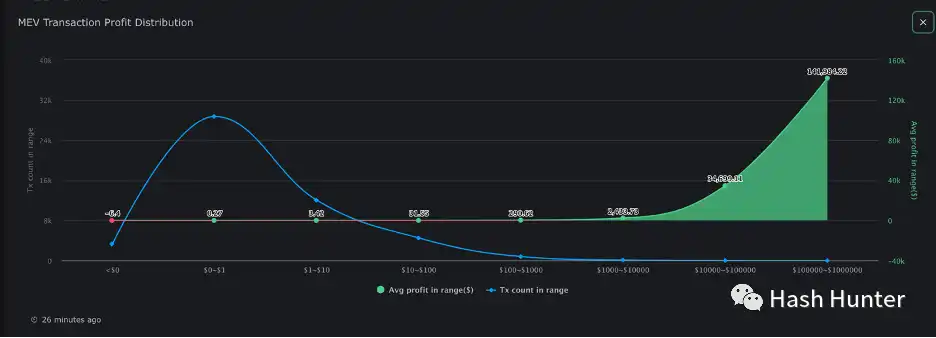
Most arbitrage profits are concentrated in the position of $0.27, while only a few arbitrage profits can exceed $1,000. Searchers also run the risk of being trapped by peers and reverse arbitraged (Salmonella tokens). Nathan Worsley said in his mevday talk, "This is a field that requires very top talent to work in teams. With 20 small teams taking the majority of the market share, arbitrage strategies are becoming increasingly complex and competitive."
The reason for the fierce competition among searchers is largely due to the openness and non-access of blockchain network. On the one hand, they need better servers and faster information transmission channels to get the latest memory pool data, on the other hand, they also need clever algorithms and strategies to make themselves gain profits while not being captured by others. There is no doubt that the searcher space is a profitable and sustainable racetrack, but it is a space that is less likely to be commercialized for the general public and more like quantitative trading in the crypto space. For large investment institutions, the returns from investing in an on-chain quantitative trading team may not be very high. But for small start-up teams and individuals familiar with quantitative trading and smart contract development, it may be a relatively good practice to break into the crypto space. For example, start a crypto quant fund and promise xx% returns. Of course, the field is not static. It can always be seen from the data of jit robots' transaction surge in recent days.
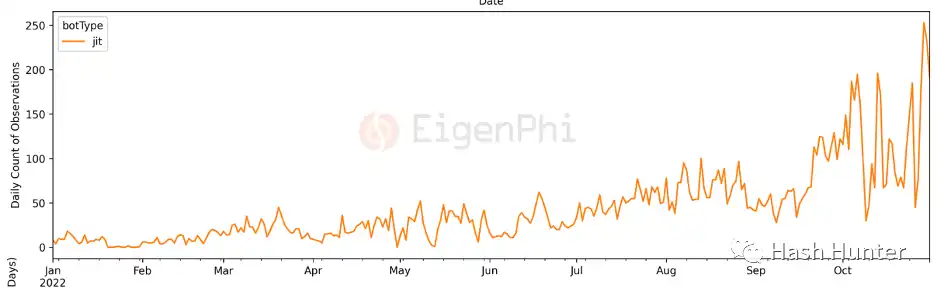
With the increasing number of on-chain trading users and the emergence of various new defi protocols, there will be plenty of new profit opportunities. This is a test of the team's own execution and understanding of on-chain protocols.
Builder: Based on current on-chain data, the builder market is facing fierce competition. And there are more and more node service providers entering this market.
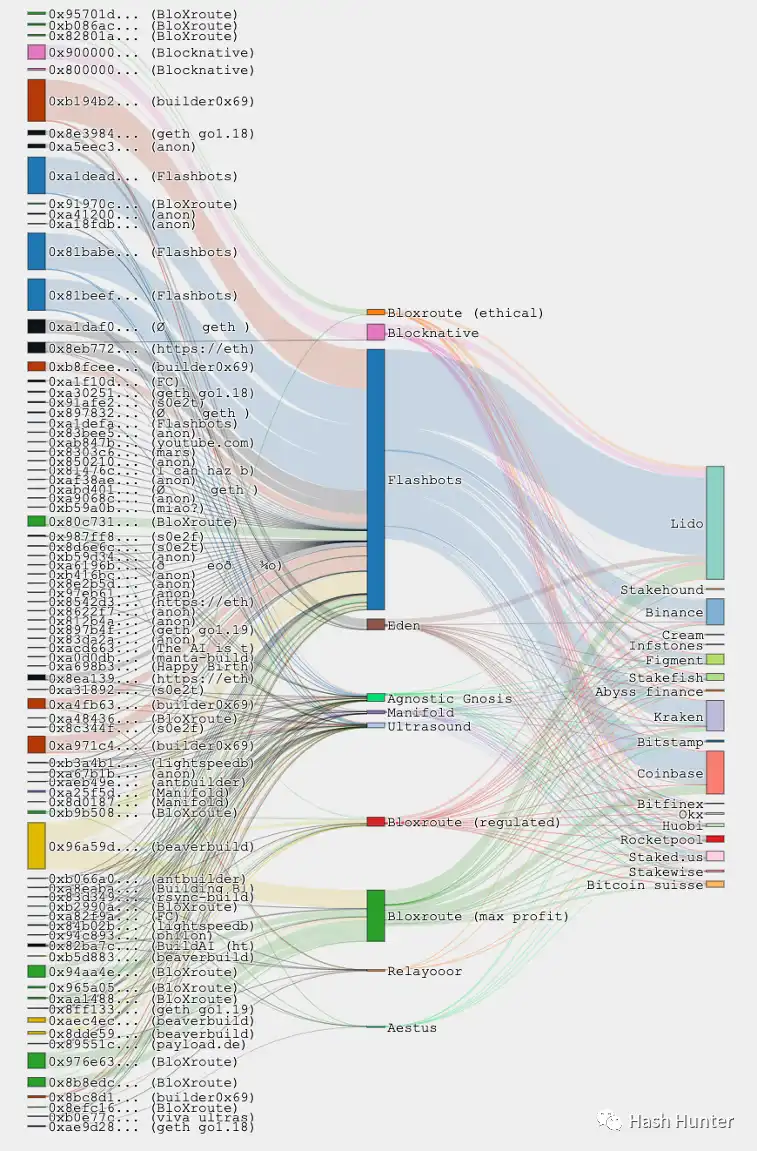
For example, there are BloXroute, manifold, blocknative, beaverbuild, 0x69, edennetwork, lightspeed, eth builder, and so on. In the figure above, the leftmost part is the number of blocks occupied by the builder, the middle is the number of blocks occupied by the relay layer, and the right is the number of validators. flashbots is not the largest block builder, but the largest relay service provider at present. In December, I collected data from 600,000 blocks since the merger.
The block builder 0x69 is gaining market share and tends to overtake the flashbots builders. It is important to note that block share does not represent the profits of its block. The mev revenue paid to the verifier is determined by the block builder, which means that the builder can quickly gain the verifier's favor through subsidies. These project parties also provide repeater services. At present, the largest market holder of repeater is flashbots. At present, there is no profit data of repeater. Ultrasound and Agnostic are the only Repeaters not running their own block building service.
bloXroute, manifold, blocknative and eiden network are among the few projects in this sector that have raised funds in the public market. eden network and manifold offer block building and repeater services only, while bloxroute and blocknative offer block building as well as other services. Bloxroute provides different trunk interfaces, such as profit maximizing and regular trunks, depending on the requirements of the verifiers. In terms of functionality, bloxroute is closer to verifier users and project parties, such as providing node protection services and faster transaction initiation services. blocknative, on the other hand, is more for searchers and defi project parties, such as memory pooling and transaction simulation services.
Market size
我们可以通过未来区块的生产量测算市场规模,现有的区块构建者构筑每一个块的利润大约在 0.0005 个以太。以太坊平均一天的区块产出大约为 7000 个区块。那么未来在以太坊的整体的区块构建利润为 1200 个以太,这个收益实际上是非常低的(整体执行层层的收益在 25 万个以太左右),这也是这些项目方会有其他业务来作为收入的原因。影响区块构建利润的因素有很多,当前的数据并不能代表未来。例如区块构建者为了抢占市场主动降低利润,或者现有交易量不足从而影响捆绑包的数量等等。从整体利益链条来看,区块构建者的收益更为可控。其技术架构也具备了大规模部署和运行的可能。对于项目方而言,在构建区块服务的基础上可以添加更多的付费服务,使得区块构建和中继服务成为一个吸引开发者和协议层导流的选项(类似 web3 基础设施免费提供节点调用)。
SAAS 服务:市场上也存在一些给搜索者和研究者提供服务的商业模式,例如提供 mev 数据分析 eigenphi 和上文提到的内存池数数据服务的 blocknative。另外一种则是更快的私人节点调用服务和节点隐蔽服务,使得搜索者能够隐蔽快速的进行节点调用和通信。
Anti-mev services: There are also decentralized exchanges that are resistant to false start and sandwich attacks, such as private trading services offered by 1inch and cowswap. Similar to a private rpc service, a transaction from the user is sent to the block builder separately so that the transaction does not pass through the memory pool.
Order feedback service: This mode is more common in the traditional stock exchange market. Robinhood makes money from this service, when individual investors place orders through its software. Robinhood will give the orders to market makers, who will pay him cash when they trade in the market. On-chain transactions can also follow this principle, such as the rook protocol. Users can place an order on rook's own decentralized exchange, but instead of executing the transaction directly on the chain, the transaction is now auctioned internally to rook's keeper. Once the bid is successful, the custodian has the right to put user transactions into its bundle, which can be used for mev activities and profit. At the end of this transaction, the user receives a portion of the rook token from the auction, and the custodian receives the profits from the mev. At this stage, the custodian is actually acting as a searcher, only the source of the order is not the memory pool of the past, but the private dark pool created by the rook protocol itself. From a value allocation point of view, the user can get a portion of the mev revenue while completing the order.
· Crypto dark Pool services: I also envisage a business model where a new decentralized protocol can build a protocol-specific block building layer and relay layer while building the transaction service. All transactions made by users using the protocol will go into the dark pool. Searchers need to pay a fee for exclusive order flow to arbitrage. The protocol layer, on the other hand, could pass on fees paid by searchers to users, such as airdrops and gas-free services, thereby attracting more users to dark pools.
· Example: Wallet provider could set up a dedicated dark pool node so that all transfers and transactions using the wallet can be executed through the dark pool: User a trades token A for token b on sushi swap; User b will exchange b tokens for a tokens on uni swap. An instant combination of these two orders would result in an a-b exchange rate imbalance between uni and sushi. The arbitrageurs can auction off these two orders and bundle their arbitrage strategies to achieve flash arbitrage and so on. Of course, the two trades would have to be of a certain magnitude to achieve an exchange imbalance between different pools. It is also possible only when the trade size reaches a certain order of magnitude, such as when a market maker auctions off 20 user orders to make a huge arbitrage. Of course, there are plenty of risks to this model, such as trading losses for the users themselves and over-centralization of the block builders.
SUAVE: By building a network of independent memory pools and blocks, all future order flows and blocks are publicly bid for and accessed by searchers and verifiers across a multi-chain architecture.
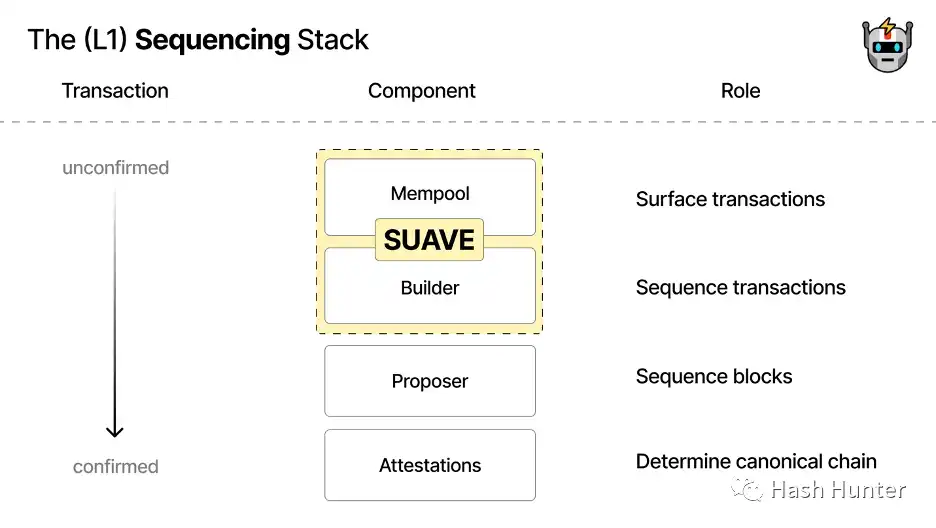
The architecture of suave is still under discussion, and I think it is very likely that suave will launch its own dedicated node client. If the existing pbs design is used, communication with L2 nodes must be added using the existing architecture in order to implement communication with L2. In other words, deploying multiple chain nodes for authentication of transaction messages is a cumbersome and complex design that would make it easier to redevelop a lightweight node client compatible with all evm ecosystems to achieve the modular functionality described in its documentation.
From an overall benefit distribution perspective, the majority of mev profits currently go to searchers and node validators. Users are often victims rather than beneficiaries. From an investment point of view, anti-MEV and order flow trading is likely to be a relatively reliable and high certainty business model in the future. On the one hand, the revenue captured by mev can be used to attract more ordinary users to participate, and on the other hand, it can also allow searchers to join in and amplify the value of order flow.
There is no doubt that flashbots is a leading player in the field, open-source most of the architecture and code that is currently available and leading the way for the industry. I think the opportunity in this space is not about arbitrage and collateral, but who has the ability to build blocks and distribute trades. The value of this capability lies not in the economic layer but in the power layer of the Ethereum ecosystem as a whole -- whoever controls the sequencing of transactions within the block controls the distribution of power, and whoever controls the distribution of power can reshape the distribution of benefits and values in the overall network. While the value of past user token flows has been allocated through smart contracts and individual transactions, future value has been allocated through block builders combining these order flows. In other words, we will move from the era of competing for single-ratio transaction value to the future era of competing for block space resources.
3. Outlook and worry about the future
In the days of classical physics, people's perceptions of things were continuous. When we go from point a to point b, we must pass through countless intermediate moments. Time is continuous, and so is the change in distance. It was not until Planck in 1901, in his paper "On the Law of Energy Distribution in Normal Spectra," that he hypothesized that energy was not continuous but partible.
The reason many users have trouble understanding MEVs is that, from our human perspective, we assume that the order we send can be executed simultaneously in a chronological order, in a continuous sequence. From the perspective of a block network, a user's intentions and actions are arranged in discrete orders. The searcher can capture the transaction after the user has sent it and reorder it for profit. At a macro level, we can approximate that the searcher realizes the ability to manipulate time on a small scale through the bundle. To take an inappropriate example, from the user's point of view, one's own transaction is attacked by a sandwich, which is almost immediately preemptive by a searcher from both the future and the past. The examples described in this article all occur on Ethernet chains, but one thing I know for sure is that MEVs are bound to occur as long as the block contains an uncontiguous and indivisible sequence of orders.
The trend of centralization:
The impact of block building power on future protocol layers is profound. As 1984 says, "Whoever controls the past controls the future; whoever controls the present controls the past." From January 3 to 27, more than 80% of blocks were created by just five block builders.
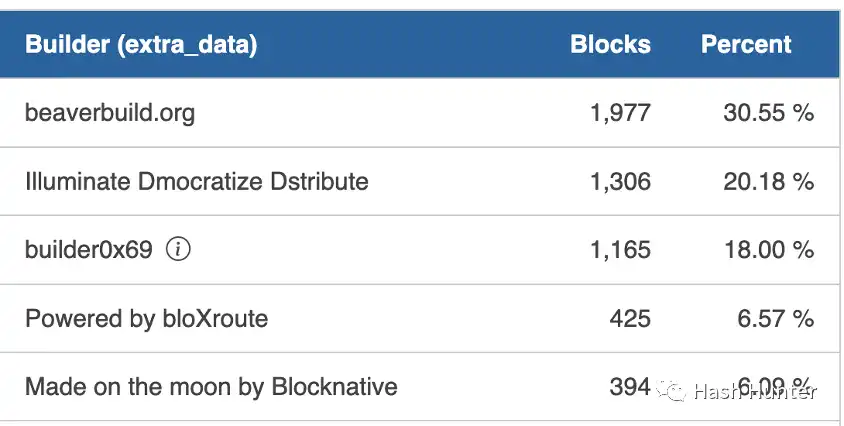
It is worth mentioning that there is a special feature in the block building client that allows the builder to blacklist certain addresses from being included in the block. This means that the future builder has the ability to review transactions, and if some user initiates a transaction that does not meet his specifications, his transaction will be in pending state and never reach the real network. Tornado-cash events are node-level reviews initiated by major node-service providers, while builders initiate pool-level reviews. Of course, the impact of this kind of review will be mitigated by future block building becoming more decentralized as more users and project parties participate. However, the potential harm caused by the centralization of block building cannot be underestimated. The author has conceived several possibilities for the reader's reference.
Enforcer block: Assuming the majority of future builders and node servers are controlled by a single entity, we will officially enter a blockchain network governed by entity law. All transactions (smart contracts, transfers, authorizations, interactions) deployed here are reviewed and approved multiple times. The node caller checks the wallet address and ip of the transaction originator and verifies that they are correct. Initiated transactions enter the surveillance pool of private memory, and searchers perform enforcement functions to determine the legality of the content of the transaction. The content and information of the transaction is graded and labeled, included in the bundle and then sent to different builders. The builder can put different levels of transactions into blocks with different priorities based on the type and functionality of the transaction, which are then broadcast for verification by validators. Transactions that do not conform to the entity rules are discarded in the memory pool and are not allowed to be salvaging by any searcher or builder until the user cancels. In this case, hacking and theft would be minimized, but users would lose maximum access to the blockchain network, stifling innovation and the expression of information.
Enterprise blocks: Assuming that future builders and nodes are monopolized by a few business giants, we will enter the era of zero-sum competition for block resources. Although users and developers are relatively free, they are restricted by multiple giant agreements and cannot flexibly choose the objects to trade, and even the order flow of users is exploited and exploited in the dark pool by auction with real prices. We will face the greatest degree of malicious commercial competition, such as builders selling review and build rights for profit. Some protocols can delay and block user transactions of competitors by buying out their order flow. For example, when a user buys or sells on an nft exchange, when he places an order, the transaction is placed at the end of the block by the counterparty. The counterparty's user can snap the nft before the original user's transaction fails. The dex protocol can also invalidate counterparty transactions by making transactions with the builder, putting all counterparty transactions into one block, causing a temporary imbalance in the token pool. In this case, commerce still exists, but users and developers are forced to take sides by rules that stifle commercial innovation.
Falsifying history: In the case of too much concentration of builders and nodes, the pledge proof chain can be used to remove past unwanted blocks by reorganizing attacks. And the working proof chain can remine blocks from the past by changing the timeline with a time Thief attack.
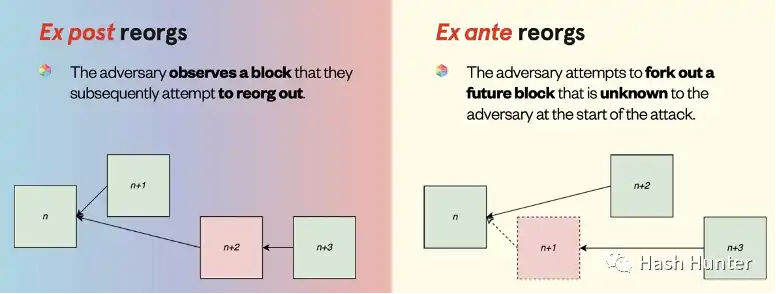
In this case, the power machine has the ability to change the past, thereby removing history to their detriment.
Breaking reality: Transactions on existing blockchain networks are focused on functions such as money transfer, contract deployment, and trading tokens, with no real impact on the real world. If there is a product that is highly integrated with iot devices and blockchain networks in the future, then the manipulation of orders will interfere with the parameter Settings of some devices in the real world and thus affect people's lives in the real world. There has already been one such incident in the traditional cybersecurity industry: the Colonial Pipeline ransomware incident in May 2021, which indirectly led to a shortage of jet fuel on several North American airlines.
Light up the dark forest
The above example is a very extreme course of events, and the subsequent rollout of the suave architecture and influx of participants mitigated the effects of private order flow abuse and builder centralization. The premise here is full free market competition and protection for pioneering innovators. It is hard to imagine how closed and dark we would be without the open source of code from various domain participants and the open access of mev data from various institutional researchers. The continued contribution of developers and researchers to code and data is a light at the end of the tunnel.
A truly open and fair mev marketplace: allow all searchers and builders to participate, and give users the freedom to choose where their transactions go. Searchers and builders are able to compete and maximize feedback to the users of the protocol layer. Protocols use order flow to maximize efficiency and block resources.
Perhaps the centralisation of the crypto world in the future is inevitable, just as the open ideals of the early Internet run counter to the closed ones of today. But this does not mean that we can deny the pursuit and yearning for the decentralized network in the future. History is an upward spiral, and it is the constant innovation and trial and error of pioneers in the past that brings experience and lessons to the later generations. As Nietzsche said: "He sinks, he falls". You keep mocking him, but remember, he falls above you. His joy turns to sorrow, but his light follows your darkness.
A fair market competition environment is the soil for breeding innovation, and a more effective profit distribution mechanism and decentralized architecture is the cornerstone for achieving the realization. The searcher and block building technology is neutral, and its impact on the environment depends on how people use it. In other words, whoever controls the present controls both the future and the past. Achieving the conditions to light up the dark forest depends on more than capital; It's not just up to the plan, it's up to everyone right now.
Original link
Welcome to join the official BlockBeats community:
Telegram Subscription Group: https://t.me/theblockbeats
Telegram Discussion Group: https://t.me/BlockBeats_App
Official Twitter Account: https://twitter.com/BlockBeatsAsia
 Related Articles