Why did Visa choose to trial stablecoin settlement functionality on Solana, the "rebirth through nirvana"?
Original Title: "Why did Visa choose Solana for 'Rebirth'?"
Original Source: BitpushNews
Visa announced on September 5th that it will begin sending USDC to selected merchants through the Solana blockchain in a pilot program. On September 14th, Visa released a research report stating that it plans to test whether Solana has the ability to meet the needs of modern enterprise financial operations when using stablecoin settlement functions on Solana. On September 1st, 2023, MakerDao founder Rune compared many public chains and believed that Solana is the most suitable as the new chain for NewChain. Why do Visa and MakerDao choose Solana? What are the characteristics of Solana technology itself?
Solana 为何受到欢迎?
Why is Solana so popular?
Regarding why Visa chose Solana as the underlying payment public chain, Visa explained in a research report released on September 14 that "Solana's unique technological advantages, including parallel processing with high throughput, low cost of localized fee markets, and high elasticity of a large number of nodes and multi-node clients, together create a scalable blockchain platform with a remarkable payment value proposition. These are part of the reasons why Visa decided to expand the stablecoin settlement pilot program to include transactions on the Solana network."
Regarding why MakerDao believes Solana is the most suitable public chain, on September 1st, MakerDao founder Rune posted on the forum stating that Cosmos is not built around efficiency like Solana, which means that the cost of maintaining and sustaining performance will be higher. As for Aptos, Sui, and other public chains, they are simply not suitable. Regarding the reasons for choosing Solana, Rune mainly cited three: first, the technical quality of Solana's codebase is very good and is very consistent with NewChain's goal of solving Maker's technical debt; second, Solana already has two clients, which is crucial for flexibility, and Solana's ecosystem has survived the FTX crisis, proving the resilience of the public chain; third, there are already examples of Solana's codebase being forked and adjusted for application chains, which will help MakerDao build its own application chain in the future.
Overall, Visa and MakerDao chose Solana mainly because of its technological advantages. These technological advantages are mainly reflected in high throughput, low cost, and high scalability. So what makes Solana's technology different? The following text will further explore the technology principles and advantages behind Solana.
The Technology Principles and Advantages Behind Solana
Solana's main feature in blockchain technology innovation is the introduction of a new consensus mechanism based on the Proof of History (PoH) algorithm and a fast synchronization engine. Unlike traditional consensus algorithms that rely solely on cryptographic techniques, PoH uses a decentralized clock to establish the order of transactions and events on the Solana network. By efficiently tracking the order of these transactions, it improves the overall efficiency of the network, which is different from other blockchains that may have unclear transaction orders.
Specifically, the PoH algorithm generates a series of verifiable timestamps that are stored in the blockchain ledger. Each timestamp contains the hash value of the previous timestamp and creates an event chain that can be effectively verified. This mechanism allows nodes in the network to reach consensus on the order of operations. PoH is not just a theoretical concept, it is also a timing system used to verify the order and passage of time between events.
The Proof of History (PoH) algorithm of Solana has the following advantages:
1) Scalability: PoH allows for parallel processing of transactions, creating a reliable and verifiable sequence of events, enabling Solana to achieve high transaction throughput;
2) Speed: Solana eliminates time-consuming operations by using decentralized clocks and historical timestamps, allowing for low-latency transactions and nearly real-time confirmations.
3) Security: PoH ensures that the event sequence in the blockchain network is verifiable, making it more difficult for attackers to manipulate transaction order or conduct double-spending attacks, thereby improving the overall security of the network; 4) Efficiency: Parallel processing of transactions and Solana's high throughput implementation help improve transaction efficiency and reduce marginal costs.
Solana 如何构建起良性开发生态
Solana How to Build a Healthy Development Ecosystem
The reason why Solana was able to rise from the ashes after the FTX incident and become increasingly popular in the competition of public chains is not only related to the superiority of its underlying public chain technology, but also to its own high-quality development ecosystem. This seems to be rooted in Solana's genes from the beginning and has been continuously developed, forming a virtuous cycle.
The core team of Solana has a background in high-tech companies such as Qualcomm and Google, which ensures the high quality of Solana's underlying code and the fast development speed of the project. Compared with the development progress of Ethereum, Solana's launch speed is very fast, and it has already been listed on multiple centralized trading platforms.
After the practical application of Solana's technology and with the support of SBF, its market value has skyrocketed, making it an important player in the cryptocurrency market. In 2020, SBF, the founder of FTX, had a significant influence in the cryptocurrency market. He actively promoted Solana and took a series of measures, such as hoarding coins and boosting prices, which quickly increased Solana's market value and attracted a large number of users. According to Coinmarketcap data, in October 2020, the lowest price of SOL was $0.31, while in November 2021, it reached $259.69, an astonishing increase within a year.
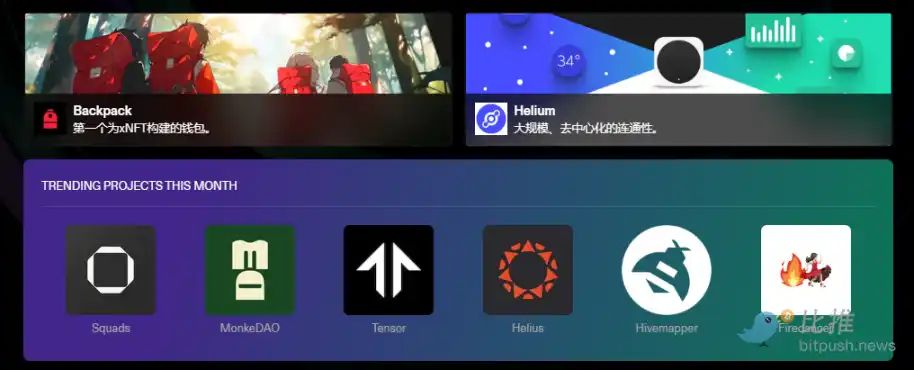
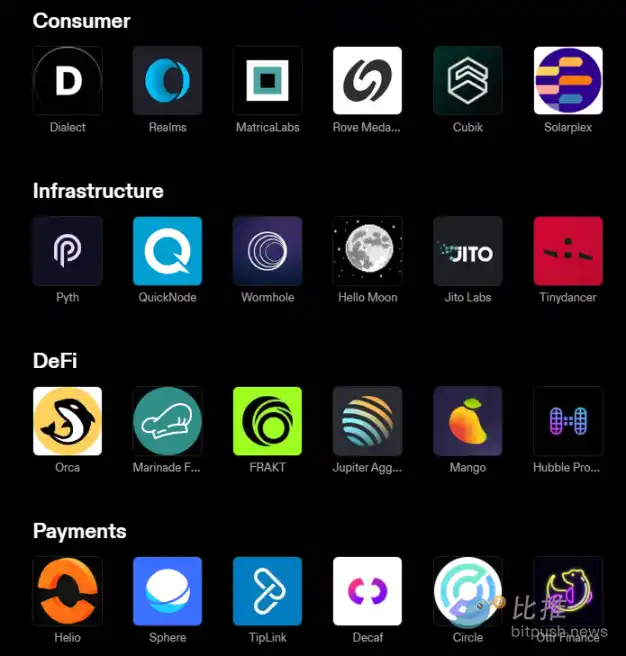
After attracting widespread attention in the market, SBF further incubated a series of Solana ecosystem projects, building a basic application ecosystem for Solana. These projects include the decentralized order book matching engine Serum, the first automated market maker decentralized trading platform Raydium, the first lending protocol Oxygen, and the custody bridge Sollet, among others. In addition, stablecoins USDC and USDT have also been integrated into Solana.
Solana relies on its Silicon Valley background and is committed to building a high-quality developer ecosystem, attracting core developers from large technology companies. Solana mainly cultivates the developer community by recruiting core developers in the technology field and holding hackathons and other activities. These activities include short-term flash events called "Hacker House Series," which are judged by investors and founders from around the world.
The high-quality development ecosystem has further driven the emergence of some star projects on Solana. For example, the team behind the Ethereum star project Ox, Phantom, has developed an excellent wallet on Solana. In addition, the emergence of the NFT project Magic Eden has enabled Solana to have its own NFT community. The core team of Magic Eden also has a background in Silicon Valley Google. It took less than two months from the launch of the Solana market to the NFT market share reaching 90%. Subsequently, the fitness app STEPN also went online on Solana, attracting a large number of new users to enter Solana. Among STEPM's 5 million registered users, about one-third are new users outside the encryption circle.
Summary
Solana has emerged from the shadow of the FTX bankruptcy issue, thanks in large part to its excellent underlying technology. In addition, Solana has attracted a surge of users by building a strong development ecosystem, leading to a thriving ecosystem. However, Solana's previous downtime issues have also been criticized by the market, and further testing will be needed in the future.
Original article link
Welcome to join the official BlockBeats community:
Telegram Subscription Group: https://t.me/theblockbeats
Telegram Discussion Group: https://t.me/BlockBeats_App
Official Twitter Account: https://twitter.com/BlockBeatsAsia

 Related Articles