Nansen Solana Research Report: Good situation coexists with challenges
Original Title: "Solana: Past, Present, and Future"
Source: Nansen
Author: Sandra Leow
TL;DR
· Since the beginning of this year, the total locked value (TVL) of Solana has almost doubled, reaching 30.95 million SOL. Despite facing challenges such as network interruptions and the FTX/Alameda incident, Solana has achieved 100% normal operating time from the beginning of the year to now, demonstrating the network's significant improvement and recovery capabilities.
· Solana has introduced solutions such as state compression and isolated fee markets to address prominent issues in its technology stack. For example, state compression technology has reduced the cost of NFT minting on Solana to 1/2000 of its original cost.
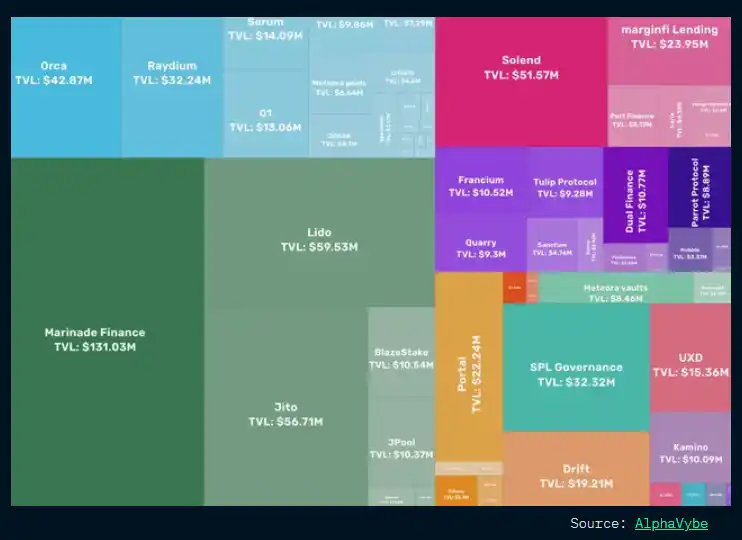
· The field of liquidity collateral is developing rapidly, with Marinade Finance, Lido, and Jito in the lead. Only 3-4% of pledged SOL is locked in Solana's liquidity collateral protocol, and there is huge growth potential.
· People are becoming increasingly interested in the adoption and payment channels used by businesses, especially with the integration of USDC settlement on Solana by Visa, the growth of liquidity staking on Solana, and partnerships with entities such as Shopify.
· Other potential driving factors for Solana include the successful implementation of the Firedancer vision and the continuous development of consumer-facing applications utilizing Solana's advantages.
· However, potential challenges such as uncertainty surrounding FTX/Alameda's holdings of SOL may pose temporary risks to its growth trajectory.
Solana's positive momentum and risk-positive momentum
良好势态
Positive Momentum
More companies are adopting the Solana Virtual Machine (SVM)
If more institutional participants recognize Solana's continuously improving technology stack (high TPS for high-end blockchain, solved downtime issues, and cost-effective on-chain storage) and decide to publicly collaborate and utilize the Solana network, Solana's reputation will continue to grow. Some examples of this adoption include: Visa introducing Solana as a settlement layer to facilitate cross-border USDC payments, and the new payment system Solana Pay (in collaboration with Mastercard) on Shopify. Solana's key value proposition is its cost-effectiveness and speed relative to other products in the market (with a TPS of approximately 3,000, which is 30 times that of Ethereum and Layer 2).
Solana developers are executing their Firedancer vision, and interest in SVM is growing day by day.
Firedancer can be said to be one of the most exciting upgrades for Solana. It may promote significant optimizations for validator clients and should run more efficiently than the current Solana Labs client.
As of now, the narrative of cryptocurrency is mainly 97% Ethereum Virtual Machine (EVM) and 3% SVM. If SVM continues to occupy market share of EVM, the upgraded and improved hardware/bandwidth efficiency of Firedancer may help accelerate the adoption of SVM.
JitoSOL and the growth of other mobile staking tokens
Jito Labs is the latest "success story" of Solana in the field of liquidity staking. The growth of JitoSOL has staked over 2.4 million SOL within a year, which is an impressive feat for the Solana ecosystem and has benefited many dApps. Ethereum has over 40% of staked ETH deposited in liquidity staking protocols, while Solana only has about 3-4% of staked SOL. If Solana's staked SOL can successfully grow a small portion of it in LSD form, it may help increase the total TVL of the Solana ecosystem. Solana's staking yield is currently twice that of Ethereum's, and historical risk statistics are also very close.
More consumer-facing applications recognize the advantages of Solana
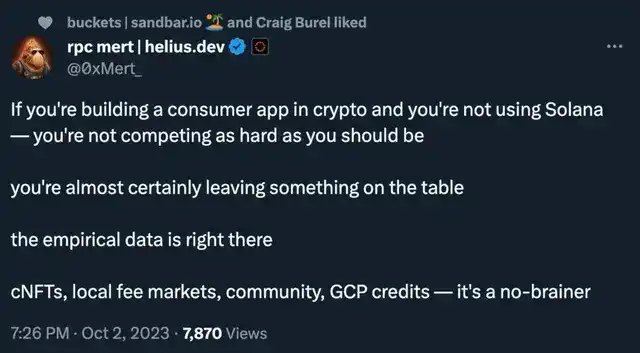
When building consumer-facing applications, Solana has proven to be the most usable chain. The blockchain provides a mature technology stack optimized for retail adoption. Solana's cNFT is suitable for large-scale NFT minting factories, which have been optimized to provide the lowest possible cost, and the local fee market aims to eliminate unnecessary congestion in the network, while the high TPS environment provides the speed needed to drive these applications.
Launch native tokens for Solana-centric protocols
The encryption community often wonders why most Solana DeFi applications have not yet launched their own native tokens. The answer is simple: protocols typically want their user base and activity to reach a certain threshold before releasing tokens. The history of DeFi protocol tokens shows that native tokens often become overinflated and typically come with a sell-off plan. However, the issuance of native tokens by DeFi protocols is often a necessary step in the lifecycle of the protocol.
Risk
If Galaxy chooses to completely liquidate its SOL holdings in a short period of time, the price of SOL will drop to the level after FTX
If Galaxy sells all of its SOL positions in FTX/Alameda in a short period of time, the SOL price may experience negative reactions due to the sale to the public market (assuming that its SOL holdings may be traded off-exchange at a certain percentage). If the price of SOL retraces to the level after the FTX incident, this may cause market panic.
If there is another network outage, it will damage Solana's reputation.
So far this year, Solana has maintained a 100% uptime, which is a very positive record for the network. If there are any network interruptions in the future, this will have a negative impact on Solana's reputation and confidence in its recent technical upgrades.
Lack of cross-chain bridge infrastructure and native assets
Macro Data
TVL
The TVL of Solana is 30.95 million SOL, compared to 25.12 million SOL at the beginning of the year. Since the beginning of this year, Solana's TVL (measured in USD) has almost doubled and, as shown in the chart, continues to rise steadily.
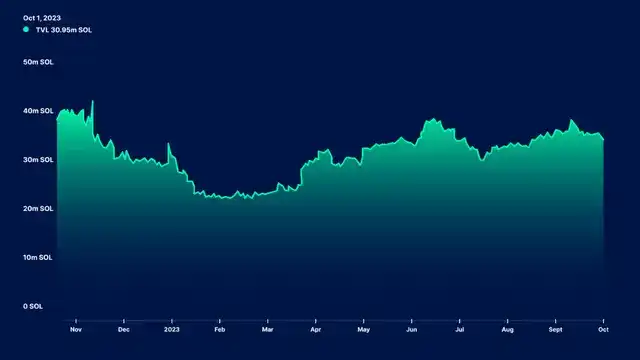
Solana has dealt with some urgent issues in the past, such as the FTX/Alameda incident, downtime caused by network outages, and spam transactions clogging the network. However, most of these issues have been resolved through improvements in the technical stack, which we will delve into later in this report. It is worth noting that Solana has maintained 100% uptime since the beginning of the year.
DeFi Velocity
TVL can be used to measure chain activity and adoption per 1 US dollar of trading volume, as TVL is often misunderstood without considering subtle differences in user behavior. In terms of "DeFi Velocity," Solana remains one of the most active chains with a ratio of 0.71 of trading volume to TVL per 1 US dollar (over the past 7 days).
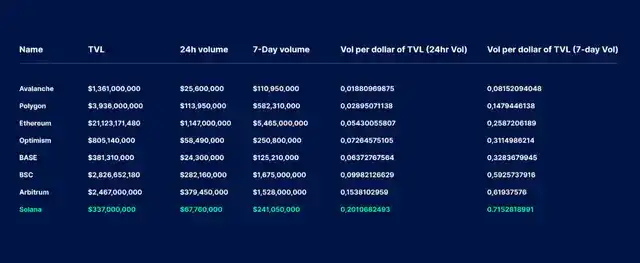
"DeFi Velocity" refers to the value of "24-hour DEX trading volume/blockchain lock-up volume". The higher the value, the more active the DeFi ecosystem. Taking Solana as an example, for every $1 of liquidity, the weekly trading volume is approximately 0.71 times (as of October 2, 2023). Compared to networks such as Arbitrum, Binance, Base, Optimism, and Ethereum, Solana has provided the highest DeFi Velocity in the past 24 hours and 7 days. Interestingly, some chains report higher TVL numbers, but the DeFi efficiency is much lower than Solana, indicating lower on-chain economic activity.
Let's narrow down the scope and consider the DeFi Velocity across chains on a monthly basis from a longer-term perspective.
日交易量
translates to
Daily Trading Volume
in English.
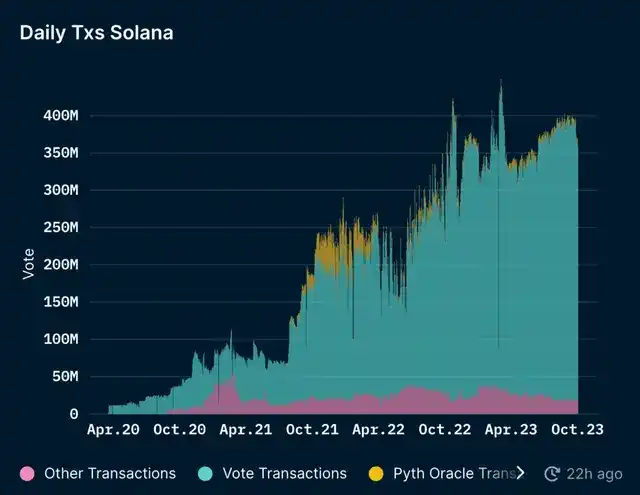
This year, the daily trading volume of Solana has remained relatively stable, with an increase in voting transactions. Trading on Solana is a combination of voting and non-voting transactions. The voting transactions link to the voting accounts owned by validators, including configuration, registration, vote collection, and new vote signatures.
Decentralization
According to customer diversity
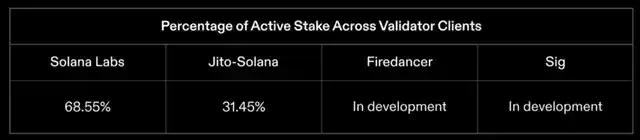
Having a diverse range of clients is crucial for reducing any single point of failure in a given blockchain.
Solana is developing over 4 different validator clients for the Solana network. In addition to Solana Labs, the proportion of validators running through Jito-Solana Client is also increasing, accounting for almost one-third of the total validator token volume. Since the Solana Foundation's last validator health report in March, the number of validators using Jito has almost doubled.
Currently, people are working hard to create more complete or lightweight validator clients on Solana, including Jito Labs, Firedancer, Sig, and Tinydancer. For more detailed information about validator clients, please refer to the latest report from the Solana Foundation on network validator health here.
By region
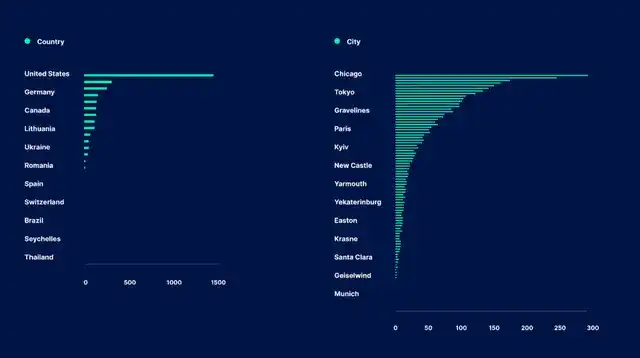
There are a total of 2,919 nodes distributed across 31 countries and 211 cities worldwide. The country/region with the highest number of nodes ranked by quantity is the United States, followed by Germany, Canada, and Lithuania. The United States has 1,370 nodes, which is almost half of the total number of nodes. The geographical concentration in the United States may bring slight risks, but it is worth noting that the nodes are distributed among different validator clusters in the United States.
Satoshi coefficient
The Nakamoto coefficient is a measure of the minimum number of independent entities required to collectively shut down a blockchain. The higher the coefficient, the more decentralized the blockchain. In a typical proof-of-stake network (such as those listed below on Nakaflow), the Nakamoto coefficient is defined by the percentage of node operators who collectively control over one-third (33.33%) of all equity on the network. Since its inception, Solana's Nakamoto coefficient has continued to grow and has remained relatively stable at 30-31% over the past year. However, it should be noted that the Solana Foundation controls approximately 20% of the shares and delegates them to small and medium-sized validators.
When measuring the degree of decentralization, relying solely on the Nakamoto coefficient is not enough. Other indicators should also be considered, such as geographic diversity, data center ownership, and validator client diversity. The Firedancer upgrade and Jump Crypto's "Firedancer" client are promoting client diversity, which we will study in the later part of the report.
Catalysts, Driving Forces, and Risks
Alameda / FTX Sell SOL
FTX is the largest holder of SOL, with over 71.8 million SOL locked and held (worth approximately $1.16 billion). This represents 17% of the circulating supply of SOL (as of writing), or approximately 13% of its total supply. One disclaimer is that not all accounts are known, which may change some data points. Special thanks to SolanaFM for providing the data points.
What we know is:
Alameda and FTX jointly hold approximately $1.3 billion worth of cryptocurrency assets, including SOL, BTC, ETH, and APT.
Its hot wallet address is:
· 9uyDy9VDBw4K7xoSkhmCAm8NAFCwu4pkF6JeHUCtVKcX
· 6wEMcwrcF5AP9jpHWQcPxHXciWA2g217Qq81CTWjbgBw
· 6b4aypBhH337qSzzkbeoHWzTLt4DjG2aG8GkrrTQJfQA
· Hot wallet address holds 6.98 million SOL.
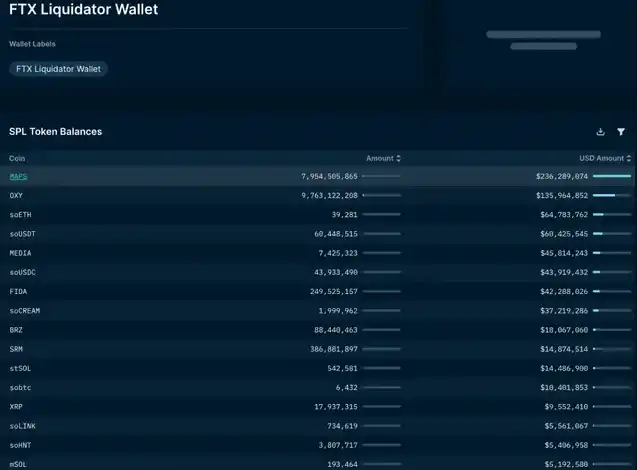
Its collateral wallet has a total of three, holding a total of 65 million SOL.
其中质押账户有 6100 万枚 SOL,其中包含锁定质押的 SOL 5200 万枚;
Among the pledged accounts, there are 61 million SOL, including 52 million SOL locked in pledge.Additionally, there are 3.8 million SOL tokens currently in a locked state.
Galaxy Digital is pushing for Alameda and FTX to sell their shares, but it is unclear when this process will take place. The tokens sold have a weekly limit of $100 million (including hedging) to limit price fluctuations.
We are not sure:
52 million SOL tokens locked through collateralization will be unlocked by 2027, and one Alameda/FTX account will have 7.5 million SOL tokens unlocked on March 1, 2025. However, the FTX liquidator has the authority to liquidate all SOL tokens held by FTX/Alameda, even if they are locked.
We cannot determine the impact of SOL liquidation or sale on the market, as Galaxy Digital may conduct as many off-exchange transactions as possible. Galaxy Digital can also choose to sell in bulk, fully liquidate SOL, or use other alternative methods that we may not be able to verify on-chain. Another point worth noting is that FTX/Alameda's off-exchange trading of SOL may alleviate some buying pressure in the market.
Ecological Highlights
Recently, the ecological development trend of Solana has been positive:
September 2023: Visa introduces USDC settlement on Solana. This is noteworthy when considering future payment architectures and other use cases involving interactions between public blockchains and private (or public) financial entities.
September 2023: The founder of MakerDAO is considering using Solana SVM as the new native chain for Maker. This is part of Maker's "Endgame" upgrade plan, which is expected to take 2-3 years and will be divided into 5 phases.
August 2023: Solana Pay integrates with Shopify.
June 2023: Tensor NFT launched a compressed version NFT market and occupied the majority of NFT market share on Solana. Tensor and Magic Eden accounted for almost 90% of the entire Solana NFT trading volume.
Starting from April 2023: With the adoption of Backpack Wallet on Solana, users have found the interaction with wallet infrastructure to be more seamless. Backpack Wallet also comes with numerous plugins such as Jito Stake, Solend, and Drift Protocol, as well as games that users can directly interact with on the wallet interface.
Development and Cooperation
Solana's State Compression
State compression is an on-chain solution that can significantly reduce storage costs. It refers to storing a large amount of data off-chain (such as NFT data in this example) and using a Merkle tree to keep its "footprint" on-chain. This compression-friendly data structure allows developers to store smaller data on-chain and update it directly in the Solana ledger, reducing data storage while still retaining Solana's underlying layer.
Comparing the cost of casting NFTs with and without the use of state compression technology, the cost of casting 1 million cNFTs on Solana before and after the use of cNFTs is only $113, with a cost of $253,000 before cNFTs and the use of state compression. In contrast, a similar scale of collection costs $33.6 million on Ethereum and $32,800 on Polygon.
If there is no state compression upgrade, minting collections on Polygon is actually much cheaper than on Solana. Clearly, Solana has gained a significant advantage in compression technology, which greatly reduces the minting and transaction costs of NFTs.
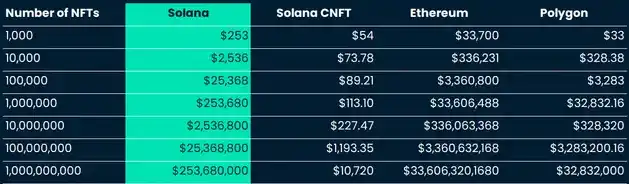
Source: Flipside
For an in-depth article on NFT compression and its technical workings, please refer to Helius' article.
Solana's state compression technology has been applied throughout the ecosystem, benefiting many projects from the upgrade. In summary, Drip Haus and Mad Lads have become the top two series in the compressed NFT field, with a total of 7.4 million and 5.9 million NFTs minted, respectively.
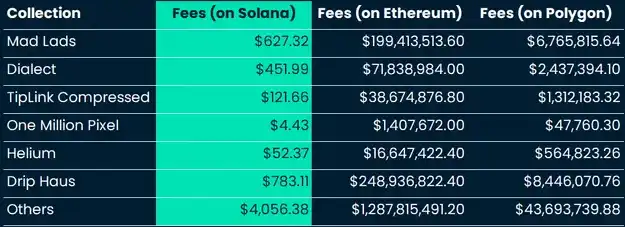
Source: Flipside
Note: The fees are estimated values and depend on the price of each asset within the given time frame. The above fees are calculated based on the prices of Solana, Ethereum, and Polygon on October 2, 2023.
Here are some interesting use cases of Solana state compression so far:
DRiP
DRiP has recently reached a milestone, having minted its one millionth Solana NFT, and is hailed as the largest NFT collection on all chains. The content within the link is not translated and is preserved as is.
As far as the background is concerned, DRiP provides its users with free NFTs every week. The artist community on Solana created the NFTs, and the credit for minting NFTs of this scale goes to Solana's state compression.
Mad Lads
Mad Lads is the first xNFT (executable NFT) collection, which is a new token standard that allows code to be tokenized.
In short, xNFT can be seen as a dApp that users can access directly from their wallets. It is similar to the plugin function on Google Chrome. Additionally, xNFT is a programmable dynamic asset that runs on the Solana blockchain using the React xNFT framework. In contrast, conventional NFTs are static and non-programmable.
Backpack is a wallet and platform that supports Mad Lads. Backpack is the place where Mad Lads NFT is first minted and managed, and it is also the execution environment for xNFT.
Crossmint
Crossmint is an NFT infrastructure that allows developers to seamlessly build NFT applications.
Dialect
Dialect is a messaging platform on Solana that is popular for its compression capabilities, allowing creators to mint NFTs and distribute them to users on the platform.
To understand the technical components of large-scale in-app sticker production, please refer to Solana's case study on Dialect here.
Essentially, the introduction of state compression reduces infrastructure costs (such as the provision and storage of "text" or NFTs in this example, as well as commodity costs) to almost negligible numbers.
Dialect has abandoned its first NFT series and allows users to request zero fees. This is objectively impossible on Ethereum or any other L1/L2.
DePIN's narrative benefits from state compression technology. DePin stands for Decentralized Physical Infrastructure Networks. Over the years, we have seen explosive growth in the DePIN network, from graphics to energy to logistics, some of which are unique to Solana. Kuleen Nimkar, head of dePIN at the Solana Foundation, also said that dePIN is reshaping traditional infrastructure models, providing opportunities similar to today's gig economy. Over time, we can see people earning extra income by contributing hardware to the dePIN protocol.
Helium
Helium is a decentralized wireless network that supports various hotspots in over 170 countries/regions and provides 5G services to some cities in the United States. Helium initially built its own hotspots during the development of the network and then turned to open source its hardware specifications.
Helium casts each hotspot as an NFT - supported by Solana's state compression technology. The cost of minting an NFT is only a fraction of a cent compared to an uncompressed token. Helium is one of the earliest DePIN businesses. Hivemapper is an example, a decentralized mapping network that recently started using Helium to verify the location of each driver.
Hivemapper
Hivemapper is a decentralized map network that essentially builds and distributes its own hardware dashcams. Hivemapper also controls the entire manufacturing and distribution process, giving it complete autonomy over its supply chain.
Hivemapper provides tokens to drivers who have installed "dashcams" and collects map data while they drive.
Render Network
Render Network enables individuals to contribute their unused GPU capacity to help render motion graphics and visual effects for projects. It recently announced an expansion from Polygon to the Solana blockchain.
QUIC
QUIC has replaced UDP (User Datagram Protocol), which was Solana's previous transaction propagation protocol. Solana previously used a protocol based on raw UDP to handle transaction messages from client to main validator client. UDP was unable to handle certain transaction filtering within the network, which had led to network downtime issues in the past.
QUIC is currently used as the default transaction ingestion protocol, which can better control the data flow to avoid problems like spam attacks. QUIC is designed for fast asynchronous communication, like UDP, but with session and traffic control similar to TCP (Transmission Control Protocol). This upgrade provides more control over network traffic and is more optimized for data ingestion, thus solving Solana's downtime problem. Since the deployment of QUIC, Solana has maintained 100% uptime.
Local Fee Market
The Solana network has introduced priority fees on top of its existing base fees. The local fee market allows any user to send priority fees to validators. Previously, users had to send spam transactions to the network to ensure their transactions were prioritized, leading to network congestion. Additionally, the number of invalid or duplicate messages sent by users or algorithms may also increase the total cost. Clearly, priority fees are important for block inclusion and transaction queue sorting. Priority fees only increase the cost of network spam attacks.
Priority fees can also be used as a proxy for measuring activity occurring within a network. The increase in priority fees (as a percentage of total fees) can also be attributed to the growth of economic activity on the network (such as large-scale NFT minting, DeFi activity, etc.).
Currently, the priority fee is calculated based on the estimated amount of computing resources required for the transaction. For example, compared to a large NFT minting factory that is happening at the same time, simple transactions in DeFi activities require lower total priority fees. Therefore, it will be dynamically adjusted based on the type of transaction taking place.
Solana liquidity staking
Liquidity staking is one of the most important economic activities in DeFi, and has even surpassed lending on several DeFi metrics. As seen on Ethereum, almost $20.22 billion worth of ETH is locked in liquidity staking protocols (such as Lido, RocketPool, etc.), which accounts for about 40% of the total ETH liquidity staked (see Nansen's article on Mapping the Ethereum landscape). However, on Solana, only about 3-4% of the equity SOL is in Solana's liquidity staking protocol. Solana has a huge opportunity to leverage its liquidity staking space to increase the capital efficiency of its tokens, thereby increasing the total TVL and ecosystem.
How does the equity on Ethereum compare to the equity on Solana? We have studied the liquidity staking of Lido on both chains, as well as the historical average volatility, maximum drawdown, and risk-return ratio. Currently, for very similar risk configurations, Solana's investment return is almost twice that of Ethereum.
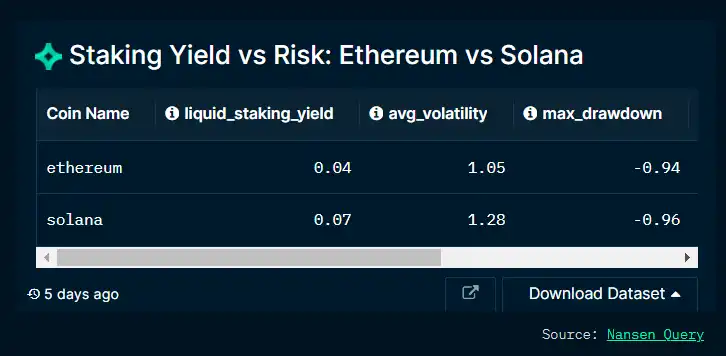
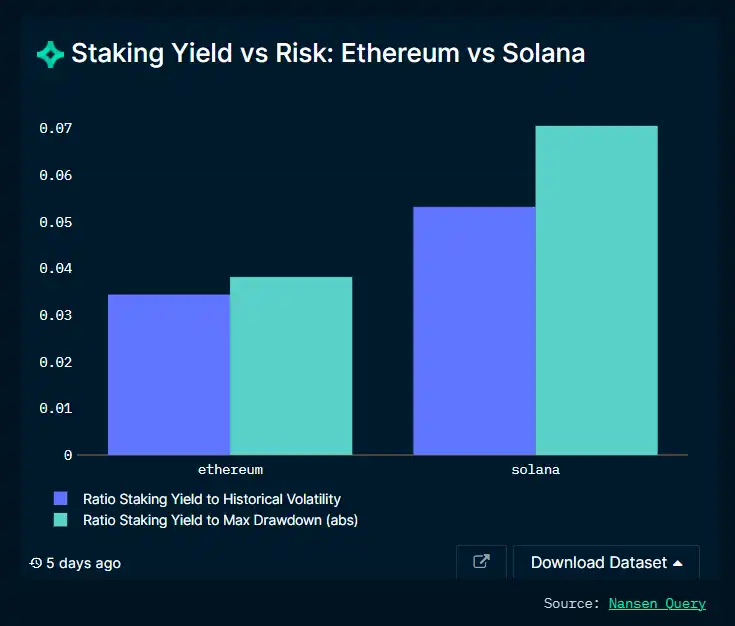
Currently, a total of 295.7 million SOL tokens have been staked on the Solana network, but the use of liquidity staking derivatives is still very limited. The liquidity staking field on Solana was impacted by FTX (a cryptocurrency trading platform), with the highest total locked value (TVL) of liquidity staking reaching 12.8 million SOL, but dropping to 5 million SOL during the market crash. However, since then, liquidity staking activity has fully recovered and returned to the level before FTX, with over 12 million SOL staked.
We also see new liquidity providers participating in the liquidity staking protocol, such as Jito, an equity delegation service provider. Since its launch in late November last year, Jito has accumulated over $44.86 million (2.3 million SOL) in TVL. In addition, the growth of liquidity staking derivatives (LSD) and DeFi use cases is also significant. Some DeFi protocols allow users to deposit their SOL LSD tokens and use them as trading collateral (in perpetual contracts) or for lending/borrowing activities on lending platforms.
Marinade Finance still holds the majority market share in the Solana liquidity staking field, locking up over 5.47 million SOL tokens, followed by Lido and Jito. It is worth noting that more liquidity staking protocols such as Marinade, Socean, Lido, BlazeStake, and Jito are emerging, all offering different reward plans to attract more users to stake SOL tokens.
Marinade's new project "Marinade Native" allows users to smoothly delegate their mortgage rights while retaining withdrawal rights. As part of their incentive plan, Marinade also announced the "Marinade Earn" program, which will run from October 1, 2023 to January 1, 2024. Users holding mSOL or Marinade Native tokens during this period will receive a reward of 1 MNDE/SOL (approximately 3 months). There is also a referral system where referrers can receive a reward of 1 MNDE/SOL through their unique referral link.
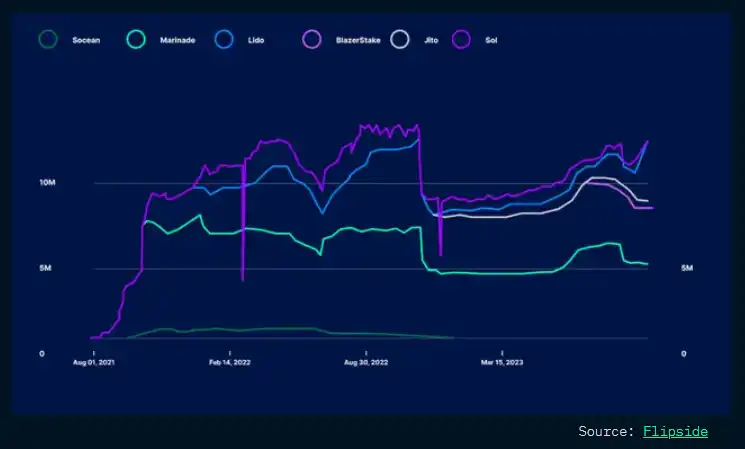
Speaking of "newcomers", Jito reached its historical highest total locked value (ATH TVL) of $57.5 million on October 2, 2023. Currently, 2.4 million SOL tokens are staked, and it has been on an upward trend since its launch. In the third quarter, the total locked value (TVL) increased by 100%, from 740,000 SOL to 1.62 million SOL.
Jito is the first staking product on Solana that includes MEV rewards. Users can stake their Solana tokens in exchange for LSD token JitoSOL.
JitoSOL has two main advantages:
· JitoSOL provides users with additional rewards for MEV transactions occurring on Solana.
· Jito is mortgaged on a validator specially designed to improve network performance through software.
According to the deposit amount of JitoSOL, there are over 750,000 SOL in the top-ranking projects, with the following market shares:
· Marginfi - 250,000 SOL
· Drift Protocol - 225,000 SOL
· Squads Protocol - 146,000 SOL
· Orca - 51,000 SOL
· There are 30 other projects available.
BlazeStake is another new project entering the market. Since its launch, its total locked value (TVL) has experienced over 10 times growth, increasing from $631,000 to $10.68 million at the time of writing. SolBlaze has launched its native token BLZE and plans to introduce new features to its platform, including BLZE Gauges and incentive programs for staking. The estimated annual percentage yield (APY) for staking on the SolBlaze platform is approximately 9.37% (with approximately 2.13% coming from BLZE).
Hyperledger Solang
Solana is known for its use of Rust or C programming languages for smart contracts. Recently, Hyperledger Solang has been introduced to allow developers from EVM chains to deploy their dApps on Solana without having to learn a new language. Hyperledger Solang lowers the barrier for developers, making Solana a more easily buildable blockchain. However, it is currently unclear how this will affect developer activity on Solana.
Upcoming Catalysts
Emerging Solana DeFi Applications
Phoenix
Phoenix is a decentralized limit order book on Solana that supports spot asset markets. It is built by the Ellipsis Labs team, which recently completed a $3.3 million financing led by Electric Capital. Phoenix is essentially betting on the growth of Solana's native assets. The Phoenix project is the gateway to their decentralized trading platform, and the team believes that market creation should be permissionless. All market events (placing limit orders, canceling limit orders, trades, etc.) are recorded on the chain, so traders can easily query real-time and historical status of all Phoenix markets.
Drift Protocol
Drift Protocol is a derivative trading platform on Solana. Drift v2 has recently accumulated a trading volume of over $1 billion and an open interest of $4.9 million. The total locked value of Drift has grown by over 50% in the past month (measured in USD and SOL). Overall, Drift Protocol has achieved strong growth in all metrics.
除了高层次的统计数据外,Drift 还推出了 CONNECT,这是一个开源的 Metemask 插件,允许 Metamask 钱包的用户在 EVM 链和 Solana 之间建立桥接。此外,Drift 还计划未来支持无需许可的预测市场,这仍处于初步讨论阶段。
Translation:In addition to high-level statistical data, Drift has also launched CONNECT, an open-source Metamask plugin that allows users of Metamask wallets to establish bridges between EVM chains and Solana. In addition, Drift plans to support permissionless prediction markets in the future, which is still in the preliminary discussion stage.
Squads Protocol
Squads Protocol has just launched its new platform, which is the exclusive comprehensive multi-signature platform of the Solana ecosystem. Squads Protocol has obtained $600 million in assets and a total trading volume of $950 million.
Kamino Finance
Kamino is an automated liquidity solution that allows users to earn profits by providing liquidity to centralized liquidity market makers. In the third quarter, Kamino Finance facilitated over $1 billion in transactions and generated $1.25 million in fees for its depositors. Kamino Finance's v2 is highly anticipated and is planned to be launched in the fourth quarter.
DeFi protocol's point system
The points system allows protocol testing of different incentive mechanisms, so protocols can evaluate what is effective and what is not. So far, the system has largely been tried and tested by the NFT protocol led by Tensor and Blur. We also need to see the adoption of these points systems in Solana DeFi applications.
MarginFi
MarginFi is a lending market that has introduced a points system in the Solana DeFi space, and other protocols have followed suit. The points system was inspired by the famous NFT platforms Blur and Tensor, but has been improved and applied in DeFi protocols. Following MarginFi, some Solana DeFi protocols have started to launch their own points programs, including Cypher, Solend, and Jito.
MarginFi's system has launched a point system similar to Swell Network, where every borrowed dollar is equivalent to accumulating 1 point per day, and every lent dollar is equivalent to accumulating 4 points per day. Borrowing earns more points because it is the main driving factor for the success of the lending agreement.
Cypher
Cypher experienced explosive TVL growth before, but then suffered from platform security vulnerabilities. Despite the exploitation of the vulnerabilities leading to setbacks, Cypher later resolved most of the issues and restarted operations.
The Cypher point system is allocated to trading, lending, and borrowing on the platform. As for the way points are accumulated in spot and perpetual markets:
· Perpetual market
Creator trading volume: 20 points for every $1 of trading volume.
Trading volume for eating orders: 15 points are accumulated for every 1 US dollar of trading volume.
· Spot market
Creator trading volume: 10 points for every $1 of trading volume.
· Loan market
Borrowing: For every $1 borrowed, earn 5 points per day.
Loan: For every $1 loaned, earn 1 point per day.Solend
Solend has adopted a unique approach, where Solend Points have the lowest reward pool and are divided by "seasons". Season 1 will start with 100,000 SLND and will grow as more partners are attracted and transactions are achieved.
· Loan/lending market
Every day, 10 million points are allocated and distributed according to the ratio of supply and borrowing. The borrowing amount is twice the supply amount.
· Leveraged trading
For every $1 of leveraged trading volume, you can earn 10 points.
Jito
Jito launched Jito Points on September 28th, allowing users to compound their jitoSOL assets. The bonus/points distribution is as follows:
· The reward for providing liquidity in any JitoSOL/xSOL trading pair is increased by 1.5 times.
· JitoSOL/SOL liquidity provider earns 2.5 times the points
· JitoSOL/USDC and other volatility trading pair providers receive 3.5 times the points
Potential strategies (non-financial advice):
Provide JitoSOL liquidity on these integrated protocols:
· Kamino Finance
· Meteora
· Orca
· Raydium Protocol
· Drift Protocol
Firedancer: When will we reach over 1 million transactions per second?
Conclusion
So far, Solana's development represents a broader evolution of blockchain, full of hope and occasional challenges, but constantly evolving. Like any emerging technology, the road ahead is full of uncertainty. The upcoming liquidation of FTX/Alameda SOL holdings by Galaxy may represent a potential inflection point on Solana's timeline. However, Solana's commitment to innovation, adaptability, and user-centricity suggests promising development prospects for this blockchain competitor.
Welcome to join the official BlockBeats community:
Telegram Subscription Group: https://t.me/theblockbeats
Telegram Discussion Group: https://t.me/BlockBeats_App
Official Twitter Account: https://twitter.com/BlockBeatsAsia

 Related Articles