Correlation between Bitcoin price and mainstream assets: Observations and analysis over a ten-year period.
The original title:
The original author:With the giants stepping up their pace to enter the Bitcoin industry, Bitcoin's financial asset properties have become increasingly strong. Although Bitcoin is considered an independent asset with its own price trend, as it further becomes an important component of the global financial system, its correlation with traditional assets will inevitably increase.
We have explored the correlation between Bitcoin and risk assets (US stocks), safe-haven assets (US bonds and gold), and the global macroeconomic cycle (commodity index) over the past decade from 2012 to present. We focus on analyzing the correlation between Bitcoin and other assets after Bitcoin successfully broke through and stabilized at $1000, with emphasis on the period after 2017.
In the early stages, Bitcoin went through a period of exploration and imitation. This was because when Bitcoin first appeared, people did not fully understand its nature and potential. The value and purpose of Bitcoin were not clear during this stage, and mainstream investors and institutions were cautious about it.
However, over time, the decentralization and fixed supply limit of Bitcoin have attracted more and more attention and trust, gradually shaping Bitcoin and ultimately gaining mainstream recognition. Especially since 2017, the price of Bitcoin has shown a stronger correlation with four traditional assets: US stocks, US bonds, gold, and commodities.
From exploration and ambiguity to clear positioning and maturity, the evolution of Bitcoin over the past decade has not only witnessed its price curve growth, but also its increasingly prominent position in the global asset market.

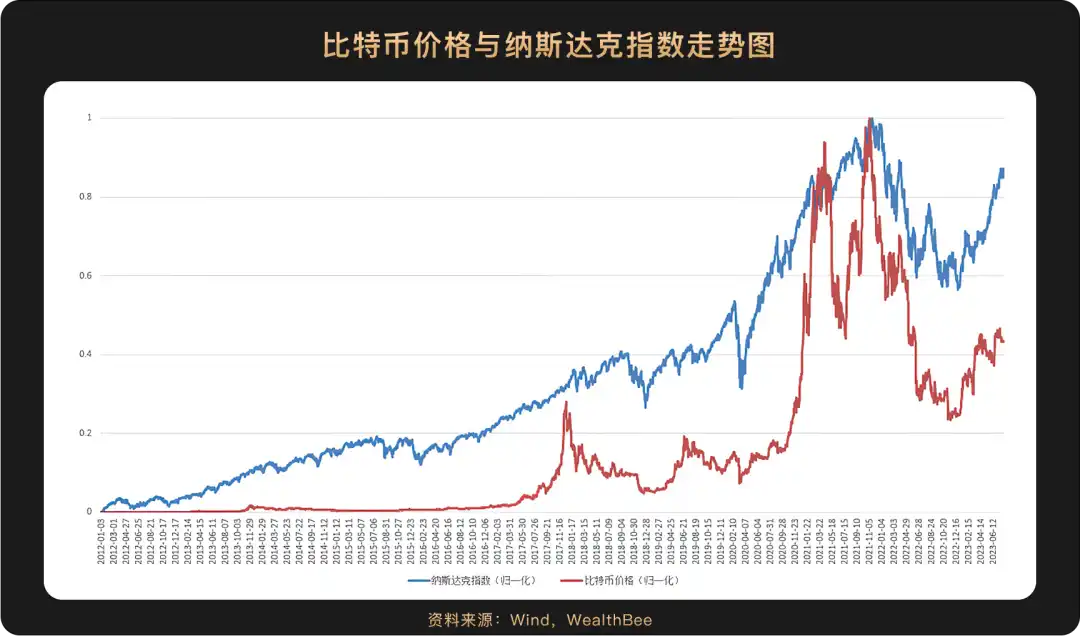
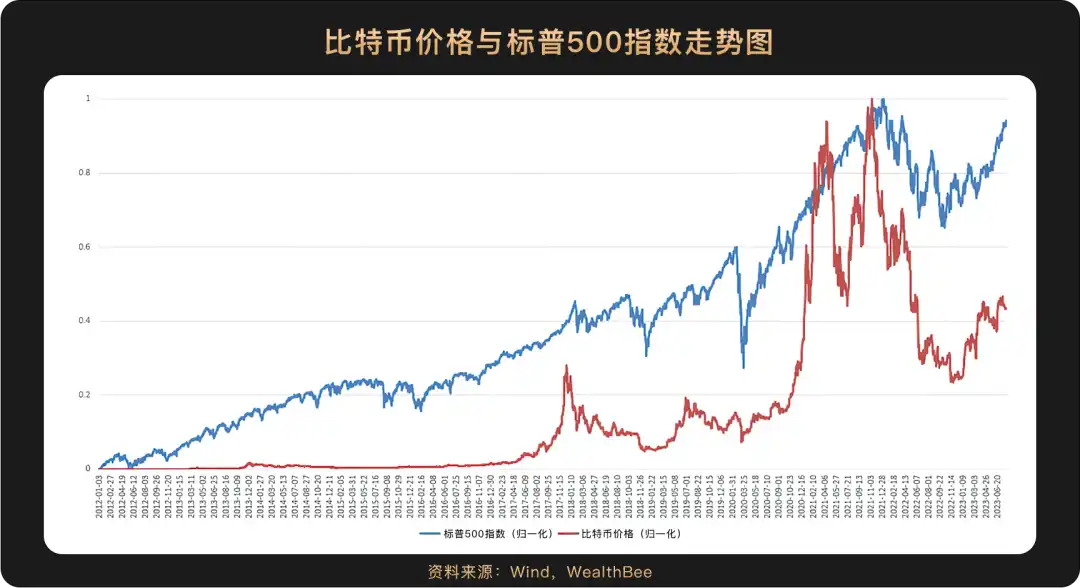
From the chart, it is clear that there is a high correlation between the US stock index and the price trend of Bitcoin. We take the year 2017 when the Bitcoin price broke through $1000 as a boundary. After calculation, the correlation coefficients between Bitcoin and NASDAQ and S&P 500 before 2017 were 0.6996 and 0.7217 respectively (Pearson correlation coefficient).
The two reached their respective highs around the end of 2017, and reached their highest points within the statistical time period near the end of 2021, followed by a synchronous decline and rebound. After 2017, the correlation coefficients between Bitcoin and Nasdaq and S&P 500 were 0.8528 and 0.8787 (Pearson correlation coefficient), respectively. Comparing the two, it can be found that the correlation between Bitcoin and US stocks is gradually strengthening. After 2017, the correlation coefficients are all greater than 0.8, which belongs to the strong correlation category.

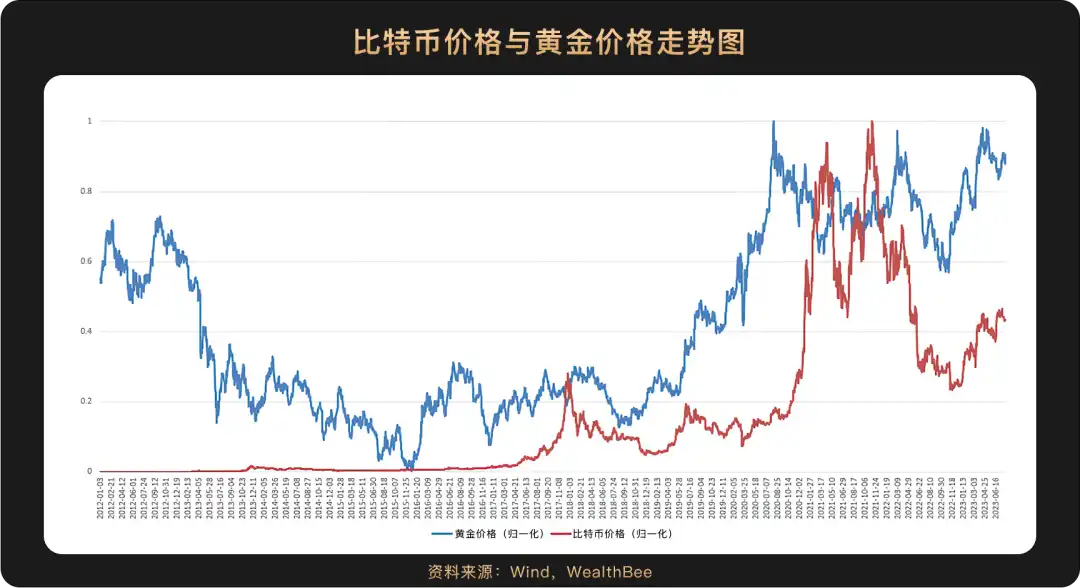
We choose London spot gold (XAU) as the anchor for analyzing the trend of gold prices. Gold is a typical safe-haven asset. As shown in the chart, before 2016, the price of gold was gradually decreasing, while the price of Bitcoin was slowly rising. Then, the two trends showed convergence, and in 2018, both reached a phase high. In August 2020, the price of gold reached its highest point and then fell back, but the price of Bitcoin continued to rise rapidly, entering a bull market. The peak of the Bitcoin price coincided with the periodic low of the gold price (2021). However, after November 2022, both reached a bottom and rebounded, showing consistency in their trends.
Similarly, we choose 2017 as the watershed. Before 2017, the correlation coefficient between the two was -0.6202, indicating a more obvious negative correlation trend. After 2017, the correlation coefficient between the two is 0.6889 (Pearson correlation coefficient), indicating a moderate linear correlation.

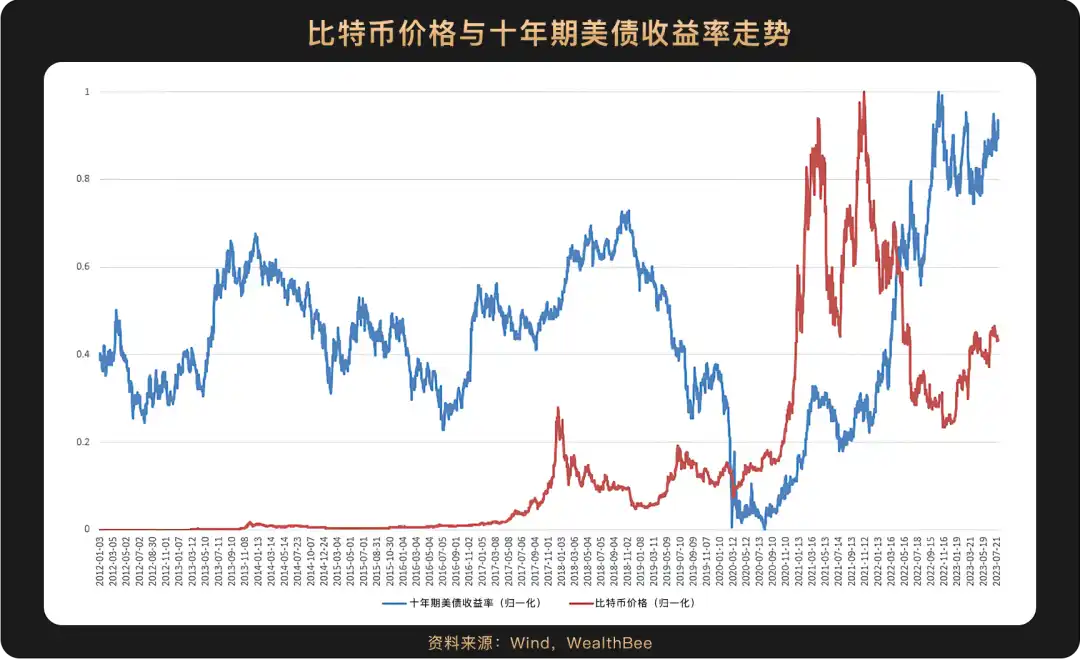

We have chosen the most representative 10-year and 2-year US Treasury bonds, which are considered to represent long-term and short-term risk-free interest rates, respectively. Like gold, US bonds are typical safe-haven assets. As shown in the graph, both the 10-year and 2-year yields have shown poor correlation with the price of Bitcoin. Especially for the 2-year US bond, the yields in 2020 and 2021 were extremely low, but the price of Bitcoin continued to rise. Examining the correlation between the two since 2017, the correlation coefficients between Bitcoin and the 10-year and 2-year US bonds are -0.1382 and -0.1756 (Pearson correlation coefficient), respectively, which belong to the low correlation category and show negative correlation.

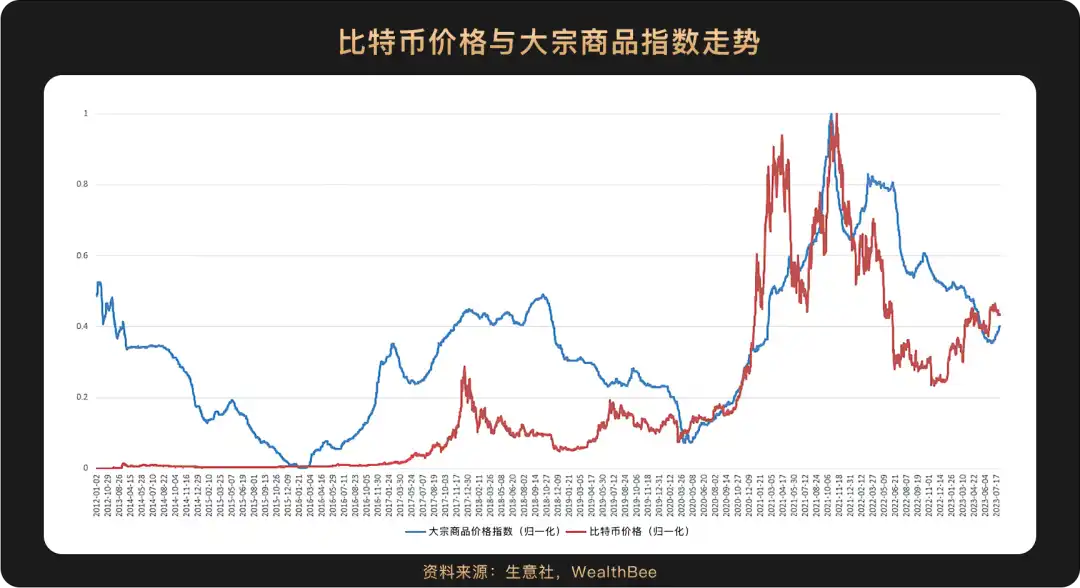
The factors affecting commodity prices are numerous, but they generally reflect the global macroeconomic cycle. As can be seen from the chart, the correlation between the two is relatively high, both experiencing sustained increases after hitting bottom and rebounding in the first half of 2020, and reaching their respective peaks almost simultaneously in November 2021 before beginning to decline in sync. A correlation test shows that the correlation coefficient between the two since 2017 is 0.7184 (Pearson correlation coefficient), indicating a moderately high correlation.

According to the above calculations and analysis, after 2017, the ranking of Bitcoin's correlation with other assets is "US stocks > commodities > gold > US bonds". It has a high correlation with risk assets and macroeconomics, but a low correlation with safe-haven assets. Therefore, we can consider Bitcoin as a type of risk asset.
Fundamentally, the price change of a financial product is influenced by two factors: changes in fundamentals and market risk appetite. When the global economy is doing well, i.e. when commodity prices are rising, market risk appetite naturally increases, and therefore Bitcoin, like other risky assets such as US stocks, also rises. Recently, the US economy has continued to be strong, and with the widespread application of AI models, it will become the main driving force for productivity improvement in the next 10 to 20 years. With the improvement of productivity, interest rate cuts will also be more accommodating to more liquidity. Therefore, we have reason to believe that the risk appetite of global investors will gradually increase, and there will be more investment funds flowing into the market, and the price of Bitcoin is likely to perform well.
Original article link
Welcome to join the official BlockBeats community:
Telegram Subscription Group: https://t.me/theblockbeats
Telegram Discussion Group: https://t.me/BlockBeats_App
Official Twitter Account: https://twitter.com/BlockBeatsAsia
 Related Articles