Primitive Ventures Founder Dovey Wan: Who Is Footing the Bill for This Round of Crypto Bull Market?
Original Article Title: "Who Will Pay for the Bull Market"
Original Article Author: Dovey Wan, Primitive Ventures
Editor's Note: This article was written by Dovey Wan, Founder of Primitive Ventures. Dovey Wan is one of the few individuals in the Chinese crypto community who can bridge conversations with mainstream Western institutions. Known for her sharp commentary and keen insights, she has invested in projects that have become the infrastructure of today's crypto world, including Cosmos, Celestia, Movement Labs, among others. However, she is also often caught in the whirlwind of public opinion due to rumors of "conflicts of interest." Yesterday, Dovey Wan made a rare move by publishing a lengthy article discussing Bitcoin's cyclical nature and the current market's divergence, which is a deep retrospective of her article from six years ago, "The Bull Market Coming from the West." The original article is as follows:
"The Bull Market Coming from the West" has been nearly 6 years since its publication. After two cycles, Crypto has finally fulfilled many items on the "wish list" of the past decade. Events described in the article are rapidly unfolding: institutional investors are allocating to Bitcoin, various products linked to TradFi are fully integrated, Circle went public in a high-profile manner, the U.S. president publicly endorsed and even personally shared memes. According to the old script, this should be the standard opening of a "high-beta bull market." However, as this cycle unfolds, what we see is the collapse of volatility, market catalytic events being preempted, and an industry that should be full of "surprises" losing its excitement as assets become fully financialized and mainstream.
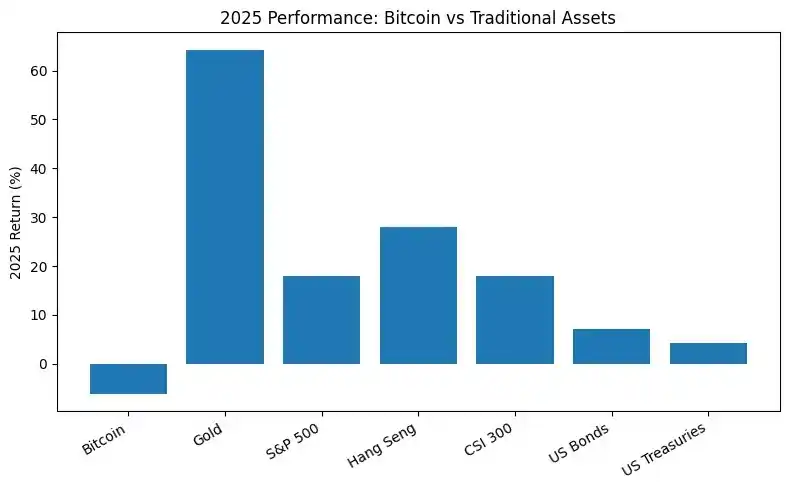
Across asset classes, even against the backdrop of policy friendliness and institutional dividends, BTC significantly underperformed gold, U.S. stocks, Hong Kong stocks, A-shares, and other major TradFi assets in 2025. It is one of the few assets that did not hit a new high in sync with global risk assets.
The Significant Divergence of Offshore and Onshore Funds
To understand the fund structure of this cycle, we first need to break down BTC's three key highs in this cycle:
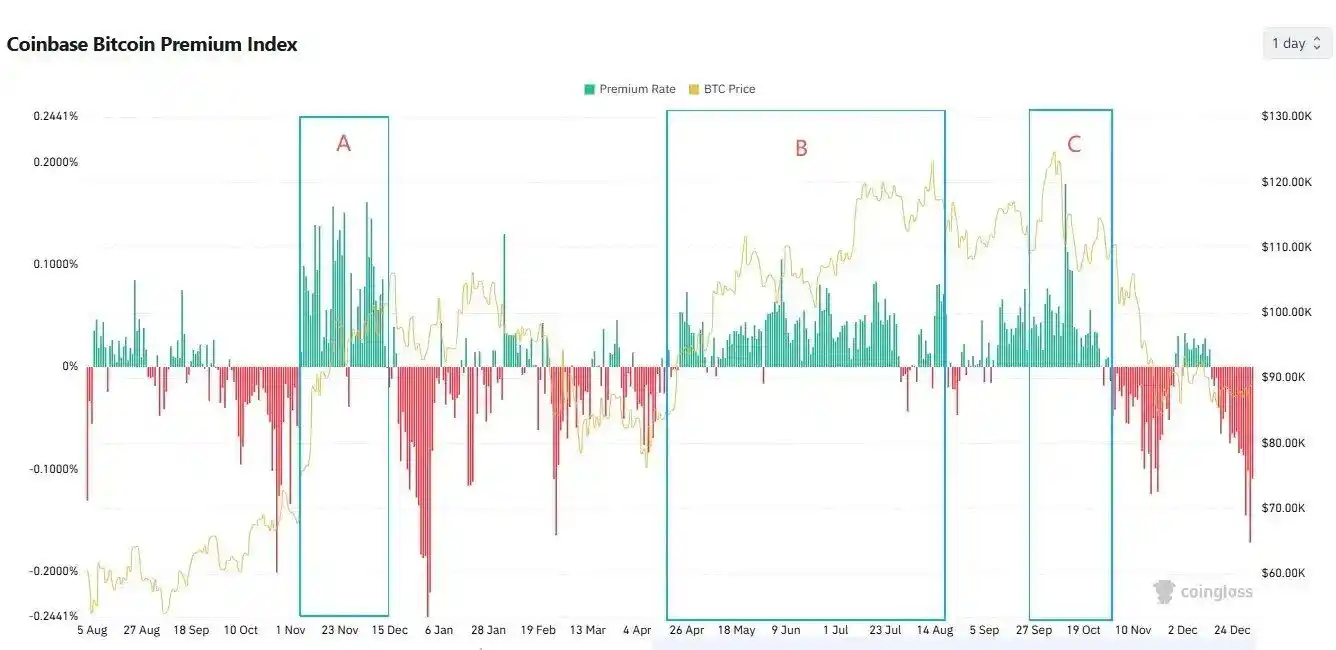
Phase A (November 2024 - January 2025): Trump's election and expectations of improved regulation triggered onshore + offshore FOMO across the entire market, and BTC first broke through $100,000.
Phase B (April 2025 - mid-August): After a deleveraging pullback, BTC surged again, breaking through $120,000 for the first time.
Phase C (Early October 2025): BTC records the local ATH of this cycle so far, followed shortly by the 10·10 Flash Crash, entering a correction period.
Looking at the combination of spot and derivatives, three phases share several common features:
Spot: Onshore Mainly Buying, Offshore Mostly Selling at Highs
The Coinbase Premium maintains a positive spread during the A/B/C three peak phases, indicating that buyers at the high are mainly from onshore spot funds represented by Coinbase.
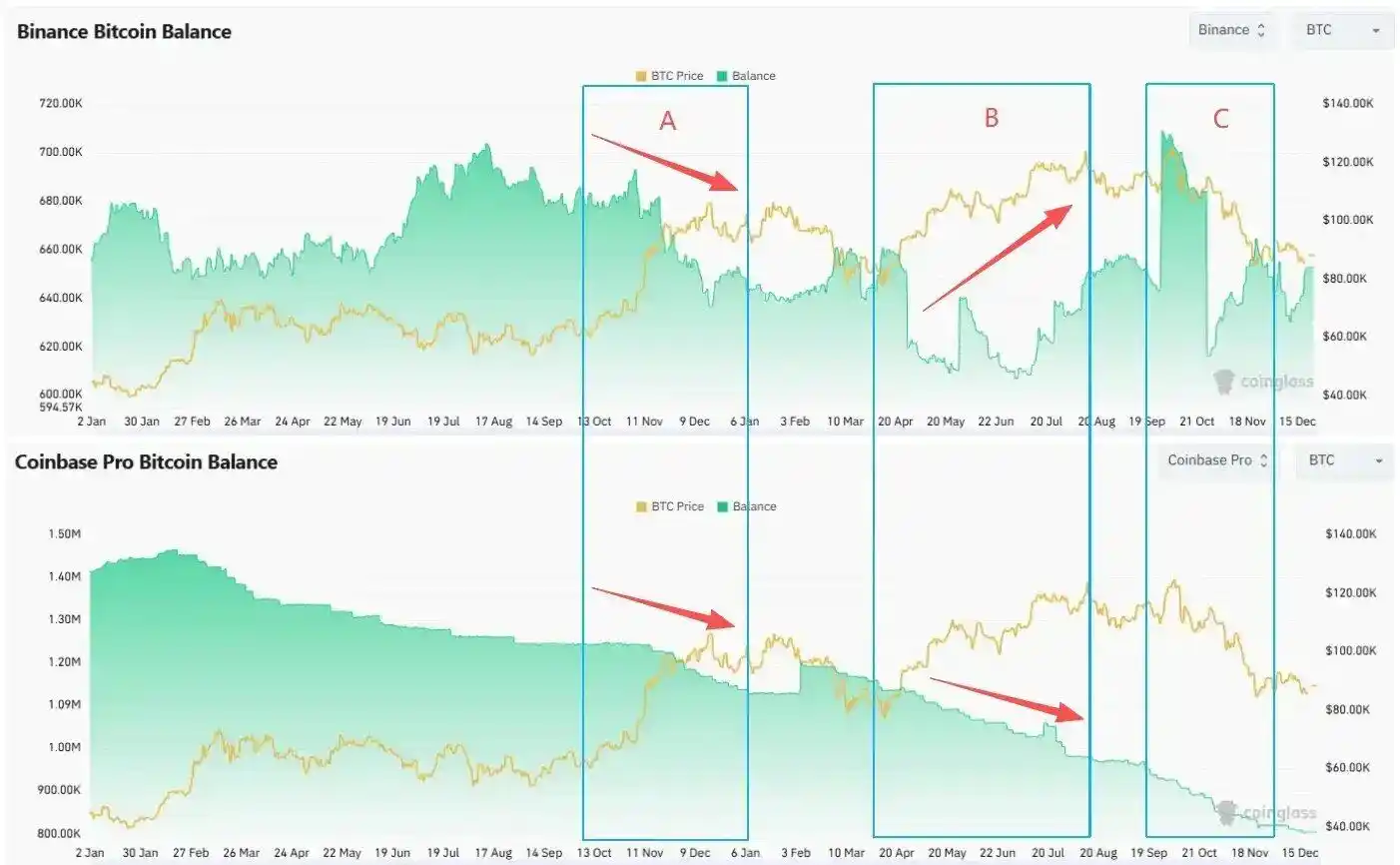
The Coinbase BTC Balance continues to decline during the cycle, reducing the available chips on the CEX side. In contrast, the Binance Balance significantly increases with price rebounds in the B and C phases, corresponding to the potential selling pressure from offshore spot.
Derivatives: Active Offshore Leverage, Onshore Institutions Continuously Deleveraging
The BTC-denominated offshore OI (using Binance BTC OI as an example) continues to rise in the B and C phases, with leverage ratios increasing. Even after the 10·10 deleveraging event's short-term drop, it quickly rebounds to a high level, even setting new highs. In comparison, the onshore futures OI represented by CME has been declining since early 2025 and did not recover synchronously when the price hit new highs;
At the same time, there is a divergence between BTC's volatility and price, especially in August 2025 when BTC first broke $120,000. Deribit's DVOL was at a low point, indicating that implied volatility did not provide a premium for the new high, showing that the options market's pricing of trend continuation tended to be cautious.
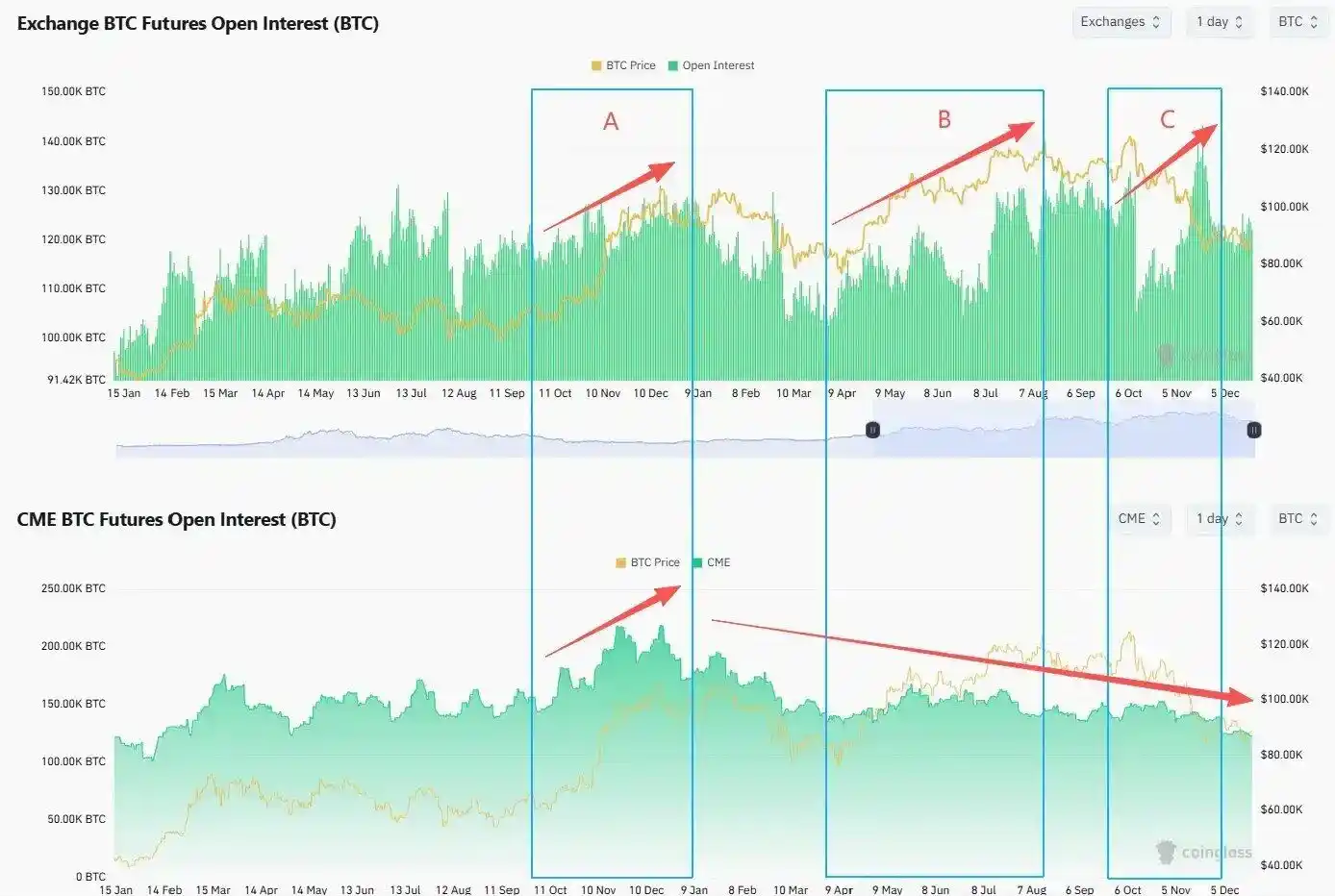
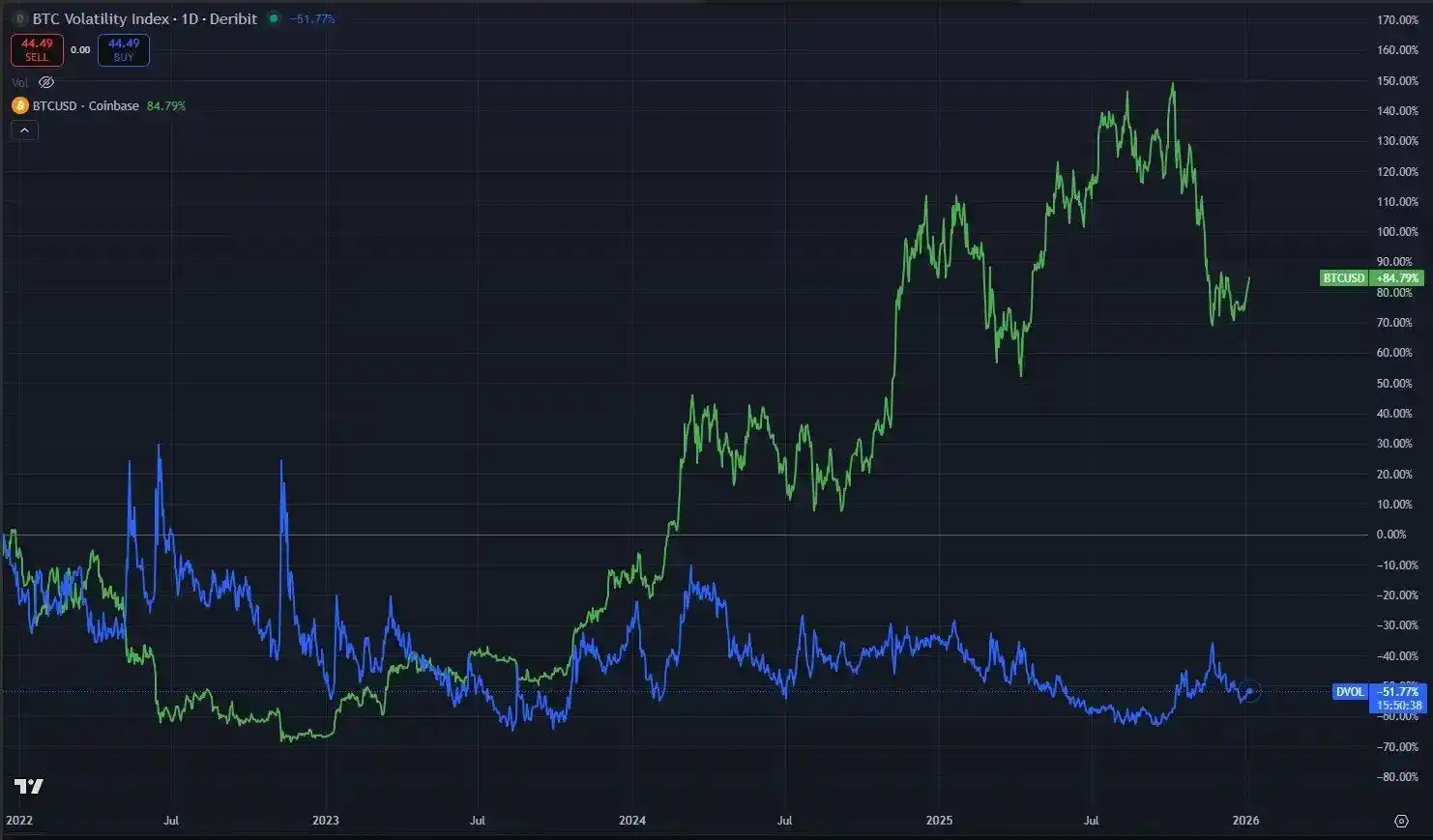
Spot trading represents asset allocation behavior, and the divergence of behavior on both sides reflects a difference in long-term confidence in the asset. CME and options players are the smart money most sensitive to the smell of blood, with extremely keen instincts. The trading setups on both sides and control of timing make it easy to distinguish between right and wrong.
The "Institution" with Foolish Money?
At the beginning of 2025, two key policies laid the foundation for onshore buying:
· Repeal of SAB 121: Banks no longer need to recognize BTC held in custody as a liability on an equal footing, enabling large custody banks such as BNY Mellon and JPM to engage in BTC custody.
· Effective date of FASB Fair Value Accounting (January 2025): Companies holding BTC are no longer required to only impair its value without recognizing gains, but can measure it at fair value based on market price. For CFOs, this transformation changes BTC from a "highly volatile intangible asset" to a "reserve asset option" that can be accurately reflected in financial statements.
These two changes provided the accounting and compliance prerequisites for subsequent DAT, corporate treasuries, and some institutional fund allocation behaviors. Therefore, in the first quarter of 2025, we also started receiving a large number of financing pitches from new entry DAT players. The core competency of the DAT founding team is only one: fundraising ability. Institutions are not smarter than retail investors; they just have lower funding costs and more financial tools for continuous funding.
According to Glassnode statistics, the amount of BTC held by DAT companies increased from about 197,000 in early 2023 to about 1.08 million by the end of 2025, with a net increase of about 890,000 over two years. DAT has become one of the most important structural buyers in this round. The operating logic of DAT can be summarized as NAV premium arbitrage:
· When the stock price is at a premium to the net asset value of its held crypto assets, the company can use ATM issuance or convertible bond issuance to fundraise at a high valuation;
· The raised funds are used to purchase BTC and other crypto assets, increasing the per-share coin value, further supporting the stock price premium;
· During the uptrend, the larger the premium, the easier the financing, and the more incentive for the company to "buy more as it rises";
Take MSTR as an example, its large-scale increase in holdings and the issuance of the largest convertible bond in 2024–2025 were highly concentrated during BTC's strong upward trend, approaching or hitting historical highs:
· In November–December 2024, when BTC surged into the $100,000 range, MSTR completed the largest single issuance in history of $3 billion 0% convertible bonds;
· Subsequently, it purchased over 120,000 BTC at an average cost above $90,000, forming significant structural buying pressure around $98,000.
Therefore, for DAT, high-position accumulation is not chasing the uptrend but rather the inevitable result of maintaining stock price premium and balance sheet structure.
Another often-misunderstood concept is ETF flow. ETF investor structure exhibits the following characteristics:
· Less than a quarter of the assets are held by institutions (narrowly defined 13F filers), so non-institutional funds still dominate the overall ETF AUM;
· Within institutions, the main types are Financial Advisors (Advisors, including wrap accounts and RIAs) and Hedge Funds: Advisors focus on medium-term asset allocation, with a smooth buying pace (passive funds);
· Hedge Funds are more price-sensitive, leaning towards arbitrage and medium- to high-frequency trading, with an overall de-risking post-Q4 2024 highly consistent with the CME OI downtrend (active funds).
A closer look at the ETF's fund structure reveals that institutions are not the majority. These institutions do not use their own balance sheet money, and client-managed accounts and hedge funds are certainly not the traditional "diamond hands."
Regarding other types of institutions, they are not necessarily smarter than retail investors. Institutions' business models boil down to two things: earning management fees and earning carry. The top-tier VC funds in our industry had a 2016 vintage top-tier Crypto VC DPI of only 2.4x (meaning investing $100 in 2014 resulted in $240 million in 2024), significantly underperforming Bitcoin's price surge over the past 10 years. Retail investors' advantage always lies in trend-following, being able to quickly change course after understanding market structure changes without being path-dependent. Most institutional investors perish due to path dependence and the regression of their self-iterative capabilities, while most exchanges perish due to misappropriation of user assets and security vulnerabilities.
Absent Retail
From the website traffic of several top CEXs like Binance, Coinbase, etc., it can be seen that since the peak of the 2021 bull market, overall site visits have been continuously declining, with no significant recovery even when BTC hit new highs, sharply constrasting with the popularity of platforms like Robinhood next door. For more information, you can refer to our article from last year titled "Where are the marginal buyers."
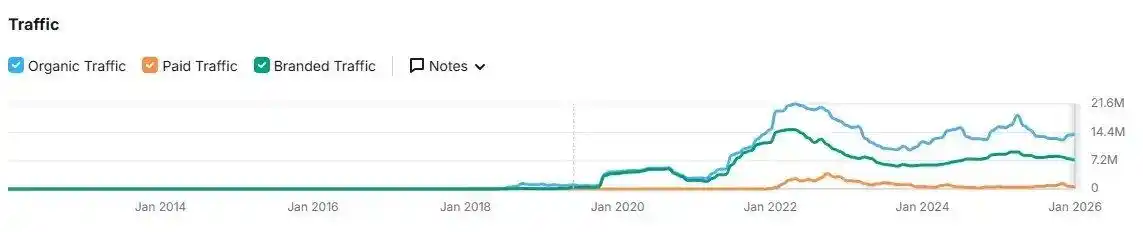
Binance Traffic
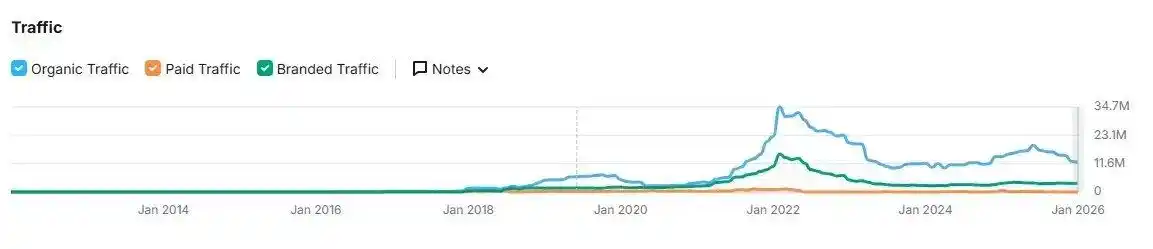
Coinbase traffic
The 2025 'wealth effect' is more concentrated outside of crypto. S&P 500 (+18%), Nasdaq (+22%), Nikkei (+27%), Hang Seng (+30%), KOSPI (+75%), and even A-shares have all risen by nearly 20%, not to mention Gold (+70%) and Silver (+144%). In addition, in this cycle, Crypto faced a 'kill': AI stocks provided a stronger wealth effect narrative, while the US stock market's 0DTE Zero-Day Options offered an even more casino-like experience than perpetuals. Moreover, some new retail investors are engaged in betting and gambling on various macro political events in Polymarket and Kalshi.
Furthermore, even the high-frequency trading-oriented South Korean retail investors have withdrawn from Upbit in this round and turned to fully embrace KOSPI and US stocks. In 2025, Upbit's average daily transaction volume dropped by ~80% compared to the same period in 2024, while during the same period, the South Korean stock market's KOSPI index rose by over 70%–75% for the whole year. South Korean retail investors' net purchases of US stocks reached a record $31 billion.
Emerging Sellers
In the current environment where BTC and US tech stocks are increasingly moving in sync, a significant gap appeared in August 2025: BTC, after reaching a peak in August following ARKK and NVDA, fell behind and experienced a 10/11 crash, which has not recovered to this day. Coincidentally, at the end of July 2025, Galaxy disclosed in its financial report and press release that it had facilitated the phased sale of over 80,000 BTC on behalf of an early BTC holder within 7–9 days. These signs all indicate that Crypto-native funds are undergoing massive turnover with institutions.
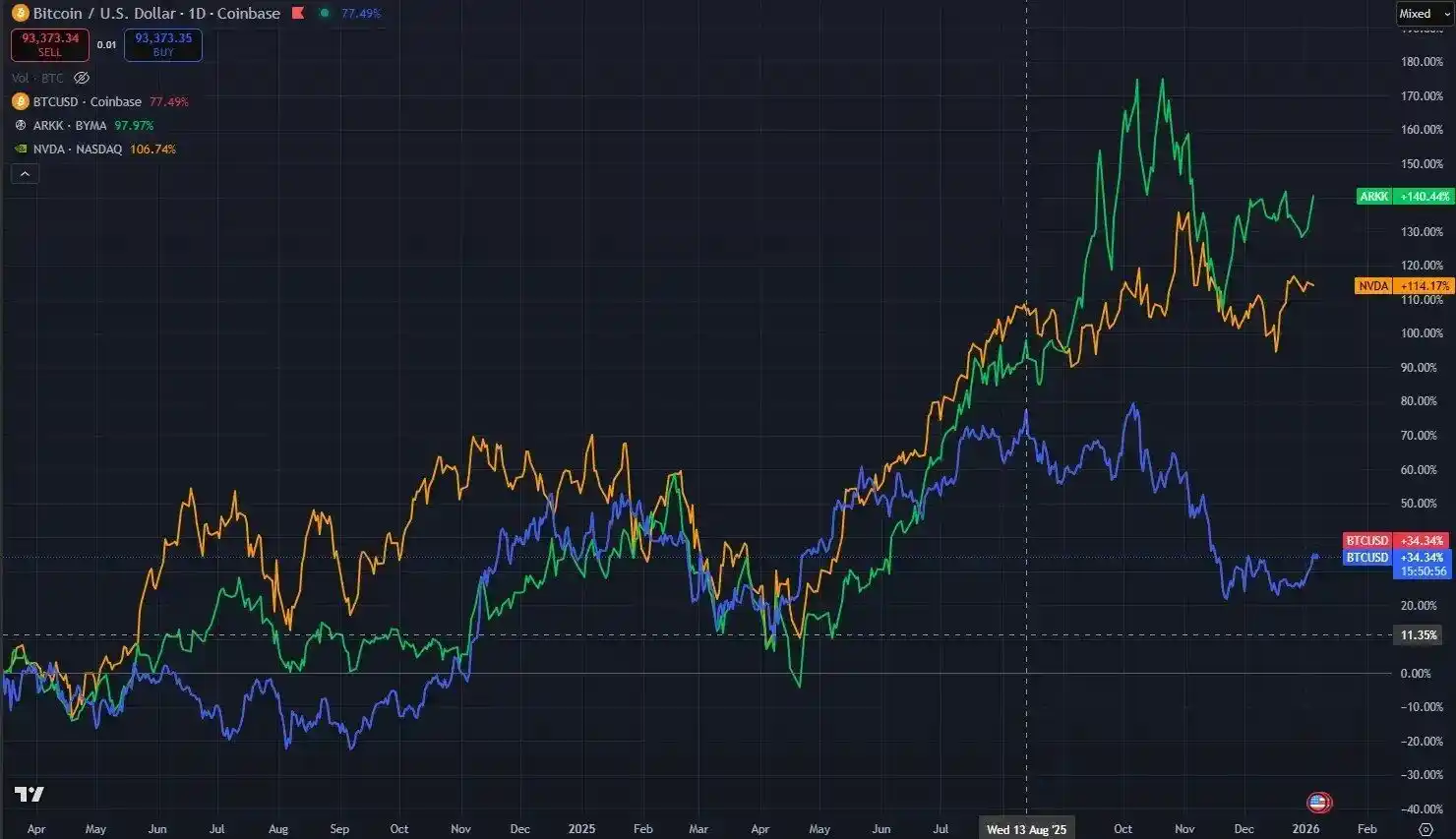
In the current maturation of BTC wrapper products (such as IBIT), a comprehensive financial infrastructure has provided OG BTC whales with the best channel for liquidity exits. OG behavior has transitioned from 'market sell directly on exchanges' to utilizing BTC structured products for exits or asset rotation, entering the broader world of TradFi assets. Galaxy and the largest business growth in 2025 have come from assisting BTC whales in transitioning from BTC to iBit. iBit's collateral mobility far surpasses that of native BTC and is more secure and well-guarded. As asset mainstreaming continues, the high capital efficiency of paper Bitcoin far exceeds real Bitcoin, making it an inevitable path for the financialization of other precious metals.
Miner: From "Covering Electricity Bills" to "Raising CAPEX for AI"
From the halving around 2024 to the end of 2025, it was the most sustained and significant downward cycle of miner inventory since 2021: by the end of 2025, miner inventory was about 1.806 million BTC, with the hash rate falling by about 15% year-on-year, showing signs of industry consolidation and structural transformation.
More importantly, the motivation for miners to sell coins this time has gone beyond the traditional "covering electricity bills" scope:
· Under the so-called "AI escape plan" framework, some mining companies have transferred around $5.6 billion worth of BTC to exchanges to raise capital expenditure for building AI data centers
· Companies like Bitfarms, Hut 8, Cipher, Iren, among others, are transforming their existing mining farms into AI/HPC facilities and signing long-term compute power lease agreements for 10–15 years, viewing electricity and land as "golden resources in the AI era"
· Riot, which has always adhered to a "hold BTC long-term" strategy, also announced in April 2025 that it would start selling its monthly BTC output
· It is estimated that by the end of 2027, approximately 20% of Bitcoin mining power capacity will be diverted to run AI
Financialized Paper Bitcoin
Bitcoin and the cryptographic digital assets it represents are undergoing a slow-motion migration from value-driven active trading dominated by crypto-native funds to passive allocation and balance sheet management represented by ETFs, DATs, sovereign, and long-term funds, with managed positions often being financialized paper Bitcoin. The underlying asset Bitcoin has gradually become a risk asset accessory bought by weight in various portfolios. The mainstreaming of Bitcoin is completed, but it is accompanied by a leverage cycle and systemic fragility similar to traditional finance.
1. Fund Structure Aspect: Incremental buying pressure comes more from passive funds, long-term asset allocation, and corporate/sovereign balance sheet management. Crypto-native funds have a reduced marginal role in price formation and are net sellers on most occasions when selling on highs.
2. Asset Property Aspect: Its correlation with US stocks (especially high-beta tech and AI themes) has significantly increased, but due to the lack of a valuation system, it has become an amplifier of macro liquidity.
3. Credit Risk Aspect: Through DAT equities, spot ETFs, structured products, and other proxies, cryptocurrency has become further highly financialized, with significantly improved asset circulation efficiency, but it is also more exposed to DAT unwind, collateral discount, and cross-market credit squeeze risks.
The Road Ahead
Under the new liquidity paradigm, the traditional narrative of "Four-Year Halving = One Full Cycle" is no longer sufficient to explain BTC's price action. The dominant variables in the coming years will come more from two axes:
· Vertical Axis: Macro liquidity and credit environment (interest rates, fiscal policy, AI investment cycle);
· Horizontal Axis: DAT, ETF, and the premium and valuation levels of related BTC proxies;
Within these four quadrants:
· Loose + High Premium: High fomo stage, similar to the environment at the end of 2024 to the beginning of 2025;
· Loose + Discount: Macro relatively friendly, but DAT/ETF premiums are squeezed out, suitable for structural rebuilding by crypto-native funds;
· Tight + High Premium: Highest risk, DAT and related leverage structures most prone to sharp unwind;
· Tight + Discount: True cycle reset;
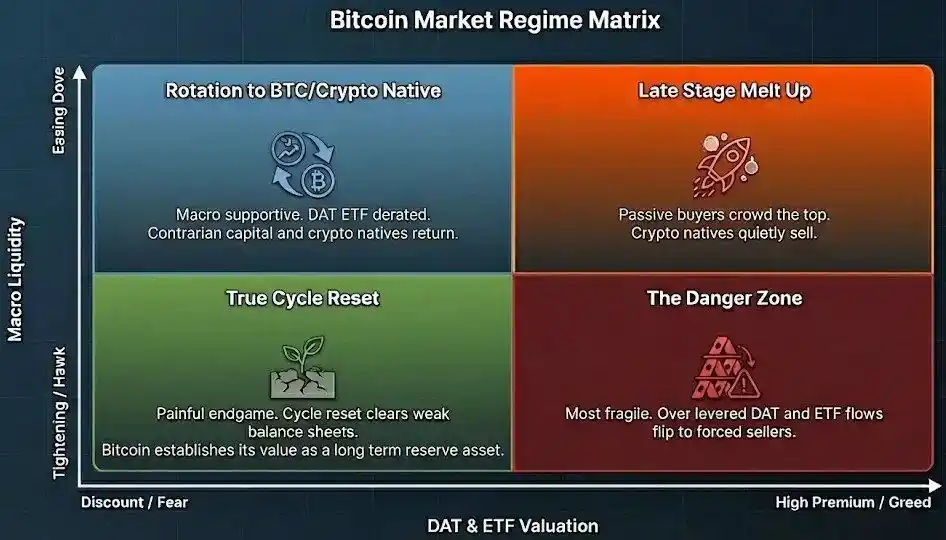
By 2026, we will gradually move from the right-hand range to the left-hand range, getting closer to the "Loose + Discount" or "Slightly Loose + Discount" grids in our framework. In the meantime, 2026 will also see several key institutional and market variables:
· SFT Clearing Service and DTCC 24/7 Tokenization: Bitcoin will further financialize, becoming part of Wall Street's core collateral; liquidity fragmentation caused by time differences will be eliminated, depth will increase, while leverage limits and systemic risks will also rise.
· AI Trading Enters "High Expectation Consumption Period": In the second half of 2025, there were signs of AI leaders "continuing to perform well but stock price reactions dulling," with simply exceeding expectations no longer corresponding to linear gains. Whether BTC, as a high beta tech factor, can continue to ride the tailwind of AI capital expenditure and profit upgrades will be tested in 2026.
· Further Decoupling of BTC from the Altcoin Market: BTC is attracting ETF flows, DAT balance sheets, sovereign, and long-term funds; while alts are attracting a more niche, higher-risk preference fund pool; for many institutions, reducing BTC exposure is more likely to mean returning to better-performing traditional assets rather than "shifting from BTC to alt."
Is Price Important? Indeed, it is. Bitcoin's crossing of $100,000 has leveraged its price to transform this young asset, with only 17 years of history, into a national-level strategic reserve. Besides price, the next journey of the crypto asset is still long. As I mentioned in my 2018 post when Primitive was founded in "Hello, Primitive Ventures,"
"Through our exploration of the crypto industry in recent years, we have seen the powerful distributed consensus among individuals and the continued dissipation of information, giving crypto assets incredible vitality. It is the fundamental desire for individual freedom and equality, as well as asset and data determinism, that has shown us the increasing entropy and the possibility of crypto immortality."
When the capital market and cultural trends intertwine, there will be a more potent economic and productive relationship revolution beyond cultural trends themselves. The populist finance represented by crypto is a typical product of the intertwining of "capital markets + cultural trends."
If in the coming years, we can see the crypto rail as the sole super-sovereign and global liquidity infrastructure, generating a significant amount of settled cash flow, users, and balance sheet applications, allowing some ETF/DAT victories to flow back onto the chain, transforming passive allocation into active usage, then what we are saying today will not be the end of a cycle, but more like the starting point of the next round of true adoption. From "Code is the law" to "Code is eating the bank," we have already gone through the most challenging 15 years.
The beginning of a revolution signifies the decline of old-age beliefs. Worship of Rome has turned Roman civilization's dominance into a "self-fulfilling prophecy." The birth of a new god may be random, but the twilight of the old god is already foretold.
Sidebar: This article is a deep retrospective of the post "Bull Market from the West" from six years ago. Thanks to all of you who have been on this journey since 2017, or even earlier. Together, we have witnessed Bitcoin's transition from narrative to sovereignty, from the fringe to the mainstream, and also experienced those beliefs that can only be understood by being there in person.
Welcome to join the official BlockBeats community:
Telegram Subscription Group: https://t.me/theblockbeats
Telegram Discussion Group: https://t.me/BlockBeats_App
Official Twitter Account: https://twitter.com/BlockBeatsAsia