'OP Stack', a competitor launched by zkSync, can it win the battle of L2 scaling?

On the evening of June 26th, zkSync announced the launch of ZK Stack, a modular open-source framework for building custom zkRollups. The framework aims to give developers complete autonomy, from choosing data availability models to using their own project's token for decentralized ordering. ZK Stack provides two key functionalities: sovereignty and seamless connectivity. These zkRollup chains operate independently, relying only on Ethereum L1 for their activity and security, while cross-chain bridges facilitate interconnectivity between each chain, enabling trustless, fast, and inexpensive interoperability.
The launch of ZK Stack inevitably reminds people of the scalability solution OP Stack previously launched by the Optimism team. As a standardized open source module, developers can assemble a customized chain through OP Stack to serve any specific blockchain use case. The design of OP Stack allows for easier code forking than current efforts, as developers can easily abstract the various components of the blockchain and modify it by inserting different modules.
Before the mainnet token was launched, the zkSync team announced a product similar to the Optimism and Arbitrum ecosystems, called ZK Stack. Many people believe that ZK Stack is the team's trump card in competition with OP Stack and Arbitrum Orbit. What are the characteristics of ZK Stack? And how does it compare to OP Stack in terms of advantages and disadvantages?
ZK Stack
The zkSync team shared the initial draft of ZK Credo last week, which elaborated on the key properties of decentralized blockchain networks and the necessity of ZK as the foundation of the emerging value internet. The launch of ZK Stack is based on the team's vision for scalability.
According to the official documentation, ZK Stack is a free modular open-source framework designed to build custom ZK-driven L2 and L3 based on zkSync Era code. The core of ZK Stack provides two key features: sovereignty and seamless connection, giving creators unrestricted autonomy to customize and shape all aspects of the chain. Overall, ZK Stack has three main characteristics: open source, composability, and modularity.
ZK Stack is developed under the fully permissive MIT/Apache open source license, ensuring its free availability for developers to contribute to and use as they see fit. Additionally, the use of ZK Stack to build a superchain allows for seamless connectivity in trustless networks, with low latency and shared liquidity. Furthermore, ZK Stack can assist developers in customizing and shaping their own Hyperchain, from selecting sorters and data availability patterns to defining their own token economics.
Paradigm Shift
For the zkSync core team, ZK Stack is also an important paradigm shift. Prior to this, the team focused on building mature ZK technology and launched the EVM-compatible ZK Rollup - zkSync Era earlier this year. The launch of ZK Stack marks a certain degree of shift in the team's focus from technology to community. The team hopes that with the release of more Hyperchains, the number of core contributors to the zkSync ecosystem will significantly increase, making the community the true owner of the zkSync ecosystem network.
Similar to OP Stack, deploying a Hyperchain for their application will be a simpler process for developers, and it can achieve asynchronous connections with other protocols in the ecosystem for various interoperability functions. In the ZK Stack documentation, the team listed several potential use cases for Hyperchain.
1. When building games or social networks, a lightweight sorter is needed that is not burdened by other dApps and use cases;
2. When building a DeFi application chain that values low-latency sorting;
3. When building an internal private chain within the enterprise and hoping to maintain interconnection with the Ethereum ecosystem;
Scalability
Aside from its scalability, ZK Stack's most notable feature is its strong interoperability. ZK Stack allows developers to build their own sovereign chains without sacrificing interoperability and composability. Each Hyperchain can seamlessly integrate into the zkSync ecosystem, supported by shared provers and fractal scaling, forming a complete liquidity network.
Through the architecture of ZK Stack, smart contracts on different Hyperchains will be able to asynchronously call each other across chains. Users can quickly transfer their assets in a few minutes without trust and without incurring any additional costs. At the same time, the Superchain itself will have complete autonomy, able to join other ecosystems and take away its own on-chain assets.
ZK Stack team announced that they will be making modifications to the code repository in the coming weeks to make it easier to check out, configure, and deploy instances of ZK Stack. The ultimate goal is to achieve one-click deployment, similar to OP Stack.
OP Stack
Next, let's review the OP Stack, which has already been released and adopted by many teams. In October 2022, Optimism, a second-layer expansion solution for Ethereum, launched the modular open-source blueprint OP Stack. The Optimism team sees it as the next evolution stage of scalability architecture, suitable for various highly scalable and highly interoperable blockchains.
OP Stack is unique to the entire Ethereum community and is a standardized open-source module that developers can use to assemble a blockchain that serves a specific use case. The design of OP Stack allows developers to fork Optimism's code more easily by abstracting the various components of the blockchain and inserting different modules to modify Optimism's code. For example, when an Optimistic Rollup wants to transform itself into a ZK Rollup, it only needs to replace its fraud proof module with a validity proof module for the settlement layer.
Related reading: "Exploring OP Stack: Optimism's Vision for Modular Expansion."
Open Garden
OP Stack first proposed the concept of "Open Garden", which allows OP chains to enjoy atomic cross-chain combinations as long as they voluntarily choose to enter the same shared sequencer set. If an OP chain does not want to run its own sequencer, it can pay a certain fee to use the Optimism shared sequencer it trusts, which also opens up a profit model for Optimism.
According to this vision, the OP chain is called Superchain. The OP chain will be fully interoperable on Optimism and connected by the same technical structure. With OP Stack sharing modules to increase configuration flexibility, developers are repeating the recycling of reusable code previously used by other developers, making the code more powerful and more resistant to hackers and bugs.
"Web3 Giants" Support
Shortly after the launch of OP Stack, it received support from the "Web3 giants". In February of this year, Coinbase announced the launch of a multi-chain L2 platform built on OP Stack. This partnership aims to upgrade the Optimism mainnet, Base, and other L2s to an initial superchain structure and share bridging and sorting. As a blockchain on the OP platform, Base will return a portion of transaction fee revenue to the Optimism Collective treasury.
Base, built on the OP Stack, provides the security and scalability needed to support decentralized applications. Leveraging the underlying security of Ethereum, users can enter Base from Coinbase, Ethereum L1, and other interoperable chains. Additionally, Base offers full EVM equivalence at a very low cost and is committed to driving developer platform growth. Developers on Base can easily build decentralized applications by accessing Coinbase's products, users, and tools, seamlessly integrating with Coinbase's product suite, and accessing $80 billion in assets to serve platform users.
Related reading: "BASE: An Ethereum L2 built on the open-source OP Stack, incubated by Coinbase."
论Stack,OP 和 Sync 哪家强?
translates to
On the Strengths of Stack, OP, and Sync
Except for Coinbase, OP Stack, which has the first-mover advantage, has also been favored by "leading public chains" such as BNB Chain. On June 19th, BNB Chain announced the launch of a new scaling solution, opBNB, and launched the opBNB testnet. With the surge in trading volume of GameFi and other projects, BSC often faces network congestion and high gas fees, and the original design and architecture can no longer meet scalability needs. In this case, opBNB emerged, providing new possibilities for solving BSC's scalability issues.
opBNB is a layer-two scaling solution built on top of BSC, which is also compatible with EVM and implemented based on the Bedrock version of OP Stack. Similar to how Bedrock works, opBNB processes transactions off-chain and then publishes transaction data on-chain, thereby achieving on-chain data compression and improving scalability.
Users interact with the opBNB network through applications or directly through contracts on opBNB; Sequencers aggregate transactions, calculate state transitions, and submit them to the rollup contract on BSC; Provers generate cryptographic proofs to demonstrate the validity of these state transitions; Verifiers check the proofs to verify the correctness of the opBNB state.
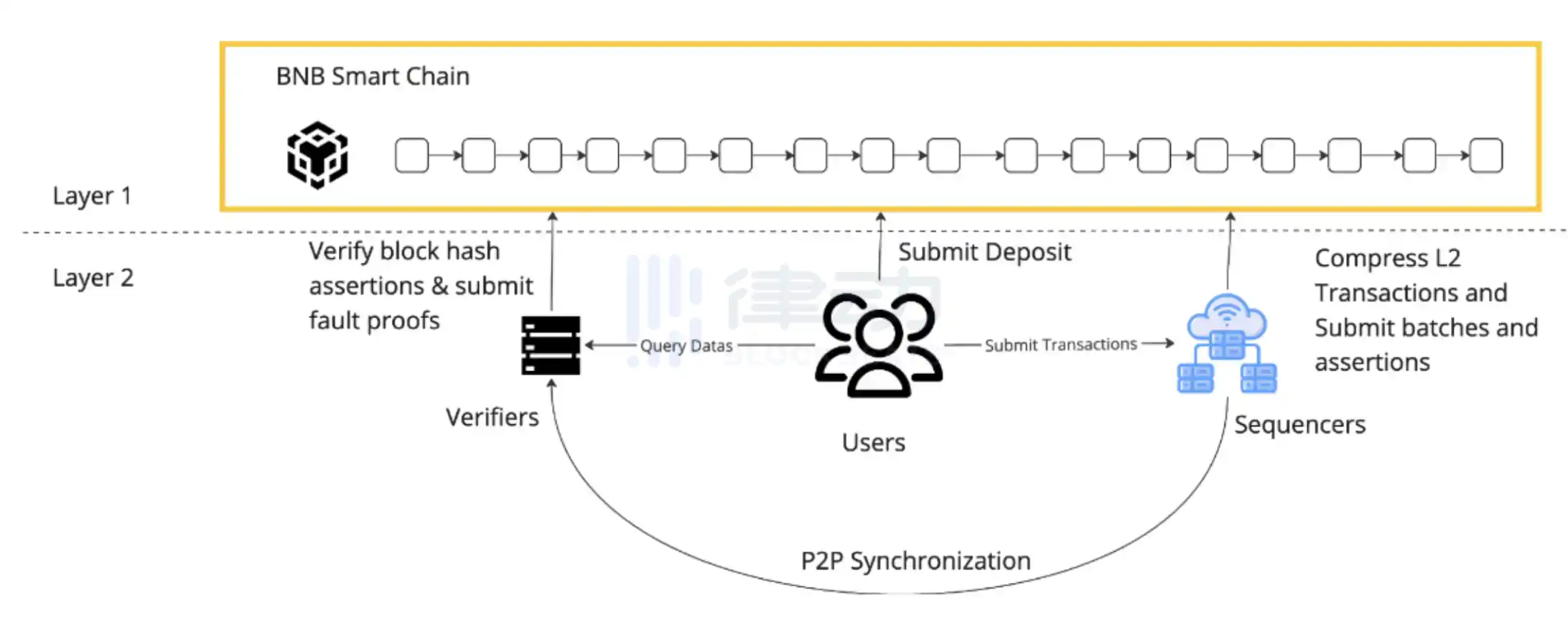
Unlike Base, the Layer 2 solution of Optimism and Coinbase, opBNB is built on BSC instead of Ethereum. BSC's performance is inherently better than Ethereum, so opBNB's performance is not only better than BSC, but also better than other scaling solutions such as Optimism. According to official descriptions, opBNB has a block time of 1 second, a gas fee for transfers as low as $0.005, and can process over 4000 transactions per second (TPS), making it more performant than existing scaling solutions.
Related reading: "Interpreting the expansion plan opBNB, how does Layer2 improve the competitiveness of BNB Chain?"
Other than public chains like BNB Chain, there are many application development teams that choose to develop their own application chains based on OP Stack:
On March 1st, the gaming digital economy platform Cocos-BCX and NodeReal announced a global strategic partnership to jointly develop the first Rollup Layer2 on BNB Chain centered around Web3 gaming, based on Optimistic (OP) Stack. This partnership will combine Cocos-BCX's leading Web3 gaming expansion solutions and NodeReal's comprehensive blockchain infrastructure to support over 1.6 million game developers in the development of 2D/3D games, metaverse, artificial intelligence (AI), and extended reality (XR) fields.
On April 20th, a16z Crypto announced the launch of a new Optimism Stack rollup client called Magi. Magi is an OP Stack rollup client developed in Rust, which performs the same core functions as the reference implementation (OP-node) and works with execution nodes such as OP-geth to synchronize with any OP Stack chain, including Optimism and Base.
On June 22nd, NFT trading platform Zora announced the launch of ZORA NETWORK, a Layer 2 network based on OP Stack. The network provides artists, creators, and communities with a faster and more efficient Ethereum extension, and will directly integrate all existing Zora tools. Zora Network has issued a Layer 2 NFT minting platform based on OP Stack, targeting NFT creators, brands, and collectors, providing a series of NFT creator tools, and reducing minting costs to below $3.
So, has the OP Stack with the first-mover advantage already won the scalability battle against the ZK Stack in L2?
After the announcement of ZK Stack, the community also made a detailed comparison of the two from a technical perspective. Blockchain researcher Haotian (@tmel0211) pointed out in a tweet that HyperChain does not need to maintain state and consensus, and can directly rely on the security of Ethereum. In addition, compared with the interaction fraud proof of OP Rollup, HyperChain can use ZK proof to directly verify state changes between chains, without waiting for the underlying state changes of Ethereum, so the efficiency of inter-chain interaction has also been greatly improved. In contrast, OP Stack still has limitations in asynchronous cross-chain calls. Its state changes need to wait for the underlying verification of Ethereum.
As we can see, on one side is the OP Stack with the first-mover advantage, and on the other side is the ZK Stack with technological superiority. The battle for L2 scaling has just begun. Undoubtedly, regardless of who ultimately wins, the narrative of multi-chain scaling around Ethereum is gradually becoming an important driving force for the new cycle of encryption.
Welcome to join the official BlockBeats community:
Telegram Subscription Group: https://t.me/theblockbeats
Telegram Discussion Group: https://t.me/BlockBeats_App
Official Twitter Account: https://twitter.com/BlockBeatsAsia