From Binance Incubation Camp to the US Nasdaq, Injective's Eight Years

November 6, 2026, New York, Times Square, Nasdaq.
At 9:29 a.m., the giant screen on the exterior wall of the Nasdaq building began a countdown.
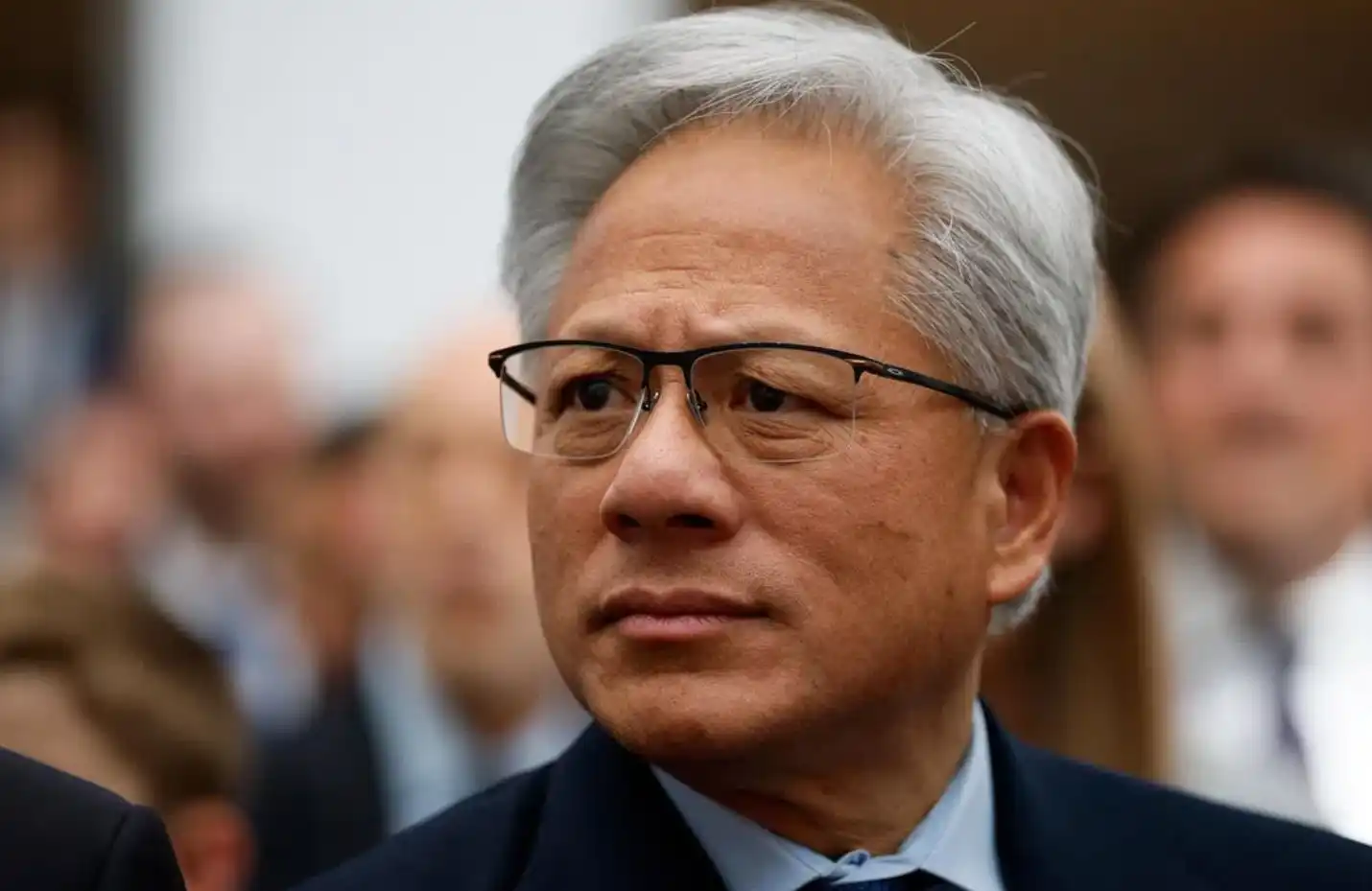
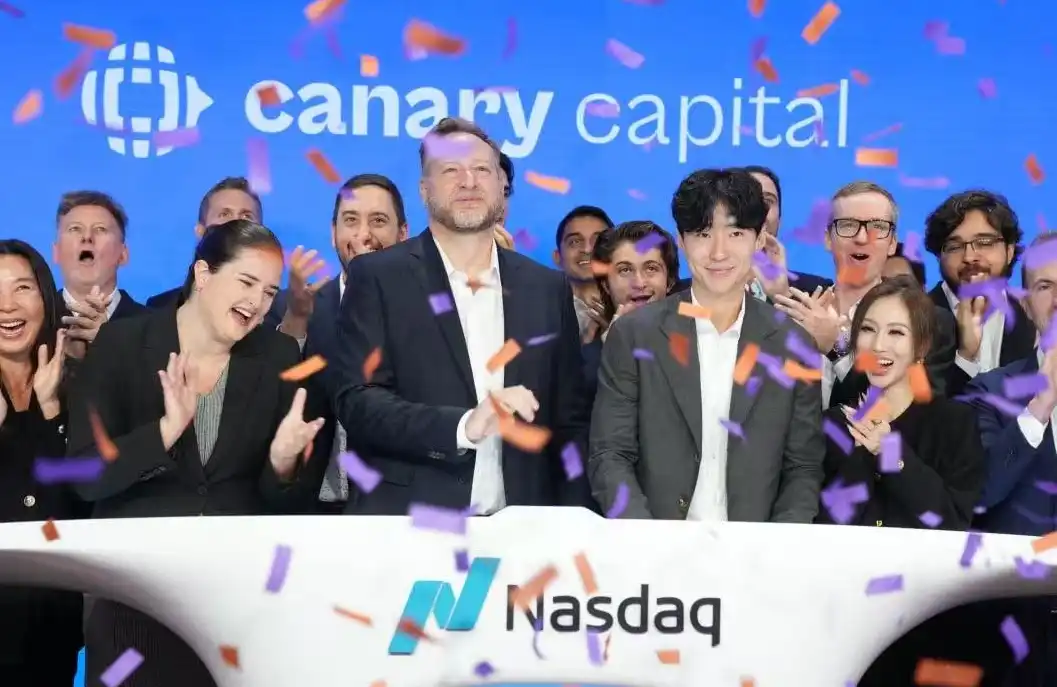
Injective founder Eric Chen stood at the center of the frame. In a suit, with the team that had been with him all along beside him, Canary Capital and a host of partners standing on either side. Cameras packed the area below the stage, yet the surroundings were eerily quiet.
Ten, nine, eight...
He placed his hand on the button.
The bell rang.
$INJC, the Injective ETF, officially listed on Nasdaq.
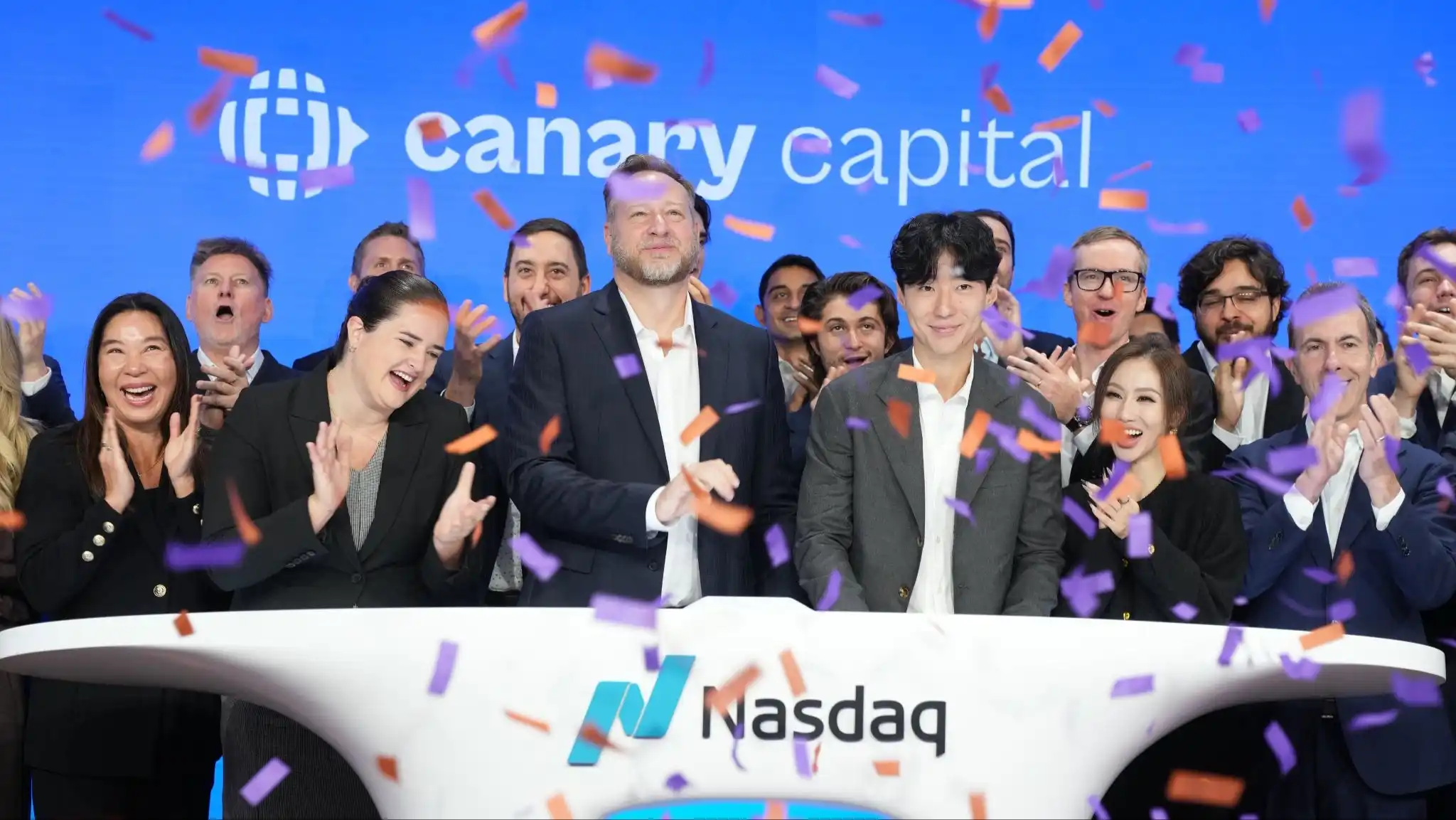
Injective, together with Canary Capital and a host of partners, gathered at Nasdaq to ring the bell in celebration of INJC's listing.Image source: Injective official Twitter, November 6, 2026
Eight years ago that winter, at the end of 2018, 19-year-old Eric Chen was still crammed with three roommates into a seven-square-meter room in New York, watching Bitcoin plunge below $6,000 overnight. He had just come out of the first cohort of the Binance Labs incubation program, clutching a white paper bearing his own name, wanting to build a trading protocol with no centralized matching party that could never be front-run.
Back then, the word DeFi did not even exist yet.
And on November 8 this year, the Injective mainnet marked its fifth anniversary. From a crypto protocol born initially to eliminate the "middleman," it has grown into a public chain built for finance and tokenization. From a seven-square-meter room in New York, it went all the way to Capitol Hill, registered itself as a Wall Street transfer agent, and in the end even its token was packaged into an ETF and listed on Nasdaq.
A Desk Space Scrounged Up
When Eric Chen studied at New York University, he majored in business and minored in computer science. Recalling those years later, he said he had always been searching for what he was truly good at. His classmates in finance were dead set on investment banks and hedge funds, while those in computer science were grinding through coding problems to get into Google. Neither path interested him.
To some extent, his sense of alienation from the "mainstream path" was innate.
Eric grew up in Colorado, experiencing an American small-town childhood; later, the whole family moved to Hong Kong. Switching abruptly from a quiet inland town to a highly compressed financial metropolis, it took him a long time to adapt. It was also in Hong Kong that he experienced a certain information lag—the latest tech products always arrived late, and some couldn't even get in, so as a teenager he had to find ways online himself.
By high school, he returned to the US, to Northern California. This was the heart of Silicon Valley, where classmates' parents worked at tech companies, and peers had been doing hackathons on weekends since high school. By his account, he was purely forced to learn to code just so he could chat with his new classmates.
This wavering continued through college. He found the tech circle too crowded, with software engineers everywhere, and wanted a different angle on the world, so he chose finance; he took a few courses at business school, found the teaching too shallow, and after going in circles returned to the tech path.

Eric Chen, co-founder and CEO of Injective. Photo published in a 2023 profile interview. Image source: Authority Magazine, March 20, 2023 profile interview.
What truly quieted him down was cryptography.
He found the threshold for this discipline wasn't as high as imagined—about a year of college math foundation was enough. Once he delved in, he could forget to eat for days, devouring an entire cryptography textbook alone. Before long, this undergraduate was already doing research alongside first- and second-year PhDs.
That was a typical double-sided life of a precocious tech youth. By day, he derived formulas with PhD students in the lab and worked part-time doing research and trading at a fund called Innovating Capital; by night, back in his NYU dorm, he mined crypto using the school's free electricity.
At the time, he was studying a cryptographic tool called verifiable delay functions, and a professor he had followed happened to have participated in early research. From an engineering mindset, any beautiful mathematical tool needs a landing point. The target he picked was "front-running" of on-chain transactions.
At that time, on-chain trading platforms were extremely rudimentary. You would post a buy order on-chain, and arbitrage bots in the mempool would see it first. As long as they paid a higher gas fee, they could jump ahead of you to buy, then turn around and sell to you at an inflated price. In traditional financial markets, brokers using client orders to trade ahead is called front-running and is explicitly prohibited; but in the early crypto world, this was the law of the jungle happening every day.
Eric felt that since the problem stemmed from the physical time gap of "who sees the order first," it should be solvable with mathematics—and the solution could be elegant.
He stood at a crossroads in life. One path was to transfer schools and change majors, heading toward cryptography research and a PhD; the other was to go into industry and build this thing. After talking with several senior scholars, he realized he didn't want to stay in the ivory tower for another ten years.
But he also had no intention of starting a company. In his own words, at the time he at most wanted to build an open-source product that people actually used, and accumulate some end-to-end engineering experience.
This idea eventually took shape at a desk in a shared office space he had wrangled from a friend. Many years later, recalling it in a documentary, he said there was nothing dramatic about that moment—he just felt that "maybe this could solve something."
Such restraint was rare at the time. In 2017 and 2018, the crypto industry was full of grand narratives about changing the world, and the air was thick with hot money, yet he felt that the vast majority of white papers had already become disconnected from reality.
The person who wrote the proposal together with him was Albert Chon, a Stanford computer science graduate and former Amazon engineer. The two later became CEO and CTO respectively.
In the fall of 2018, Binance Labs launched its first incubation program. More than 500 projects applied, and only 8 were ultimately accepted. They were brought to San Francisco for a 10-week intensive incubation, with each team receiving $500,000 in exchange for equity or equivalent tokens. Injective was among those 8. According to the team's later recollection, less than a month passed from submitting the application to receiving the acceptance notice.
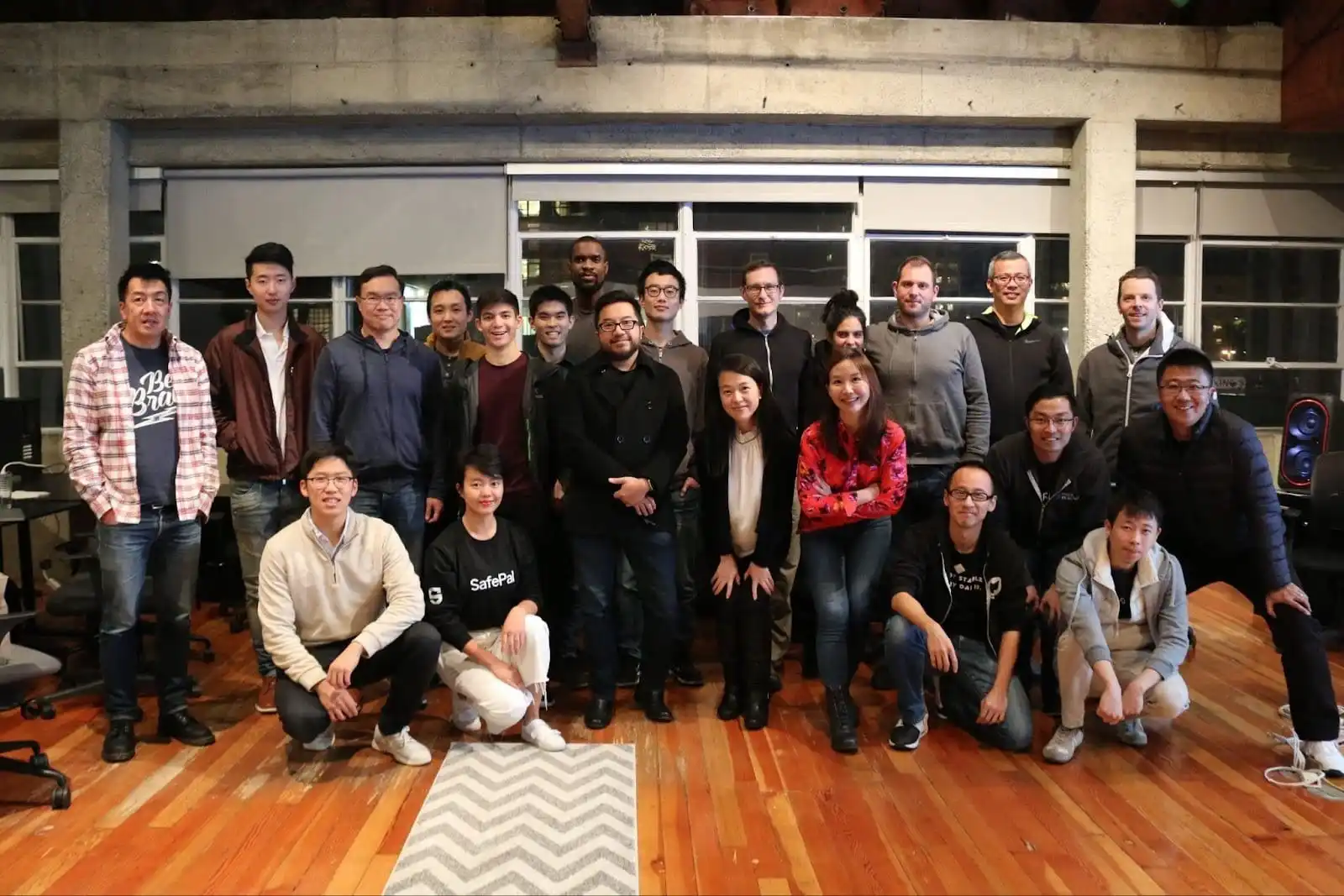
In 2018, a group photo of the first Binance Labs incubation program. Injective was one of the projects selected for this cohort.Image source: YZi Labs (formerly Binance Labs), official historical retrospective article, October 14, 2025.
That December, the first whitepaper, authored by Eric Chen and Albert Chon, was released with a highly academic title: "Injective Protocol: A Collision Resistant Decentralized Exchange Protocol." Their vision was to build a decentralized trading protocol on Ethereum, where order conflicts within the same block would all be resolved by verifiable delay functions.
The two young men thought they had secured a ticket to the game. But by the time they walked out of the San Francisco incubator, the music had stopped.
Seventy Square Feet
The bear market of late 2018 arrived in an almost frozen manner.
Bitcoin kept sliding, and altcoins routinely wiped out 90% of their market value. Eric later said that in the early days, they actually had decent conversations with many top-tier institutions; but once the winter hit, VCs lost interest, and the previously enthusiastic institutions suddenly went silent.
The $500,000 from the incubator suddenly became life-saving money with no telling how many years it would need to last. During that period, the pressure was immense, and he was constantly worried about what to do if the money in the account ran out tomorrow.
He and three other roommates were crammed into a 70 to 80 square foot room in New York.
Seventy to eighty square feet, roughly 7 square meters, was just about enough for a bed and a desk. He and Albert pushed their personal living costs to the limit, scouring the world for cheap but capable developers. In his words, there were no shortcuts at that stage—every user and every dollar had to be earned through their own hard work.
He brought in the first 100 users one by one.
He dove into every crypto-related group chat, specifically picking out the most outspoken people and asking them to try Injective's trading platform—feel free to share any thoughts, and if they thought the idea was terrible, they wouldn't pursue it.
As a result, many people immediately lashed out, questioning why this feature needed to exist and saying no one needed this thing at all.
Dealing with this group was extremely stressful, but Eric still listened to them one by one and incorporated their feedback into the product. Strangely enough, the very people who criticized the hardest back then later became Injective's most loyal early seed users. Eric said these people are equally critical of everyone—being critical means they care.
This tough period left Eric with an iron rule that he has never changed since: regardless of market conditions, the company's runway on the books must be enough to survive for more than five years. Be conservative in bull markets, optimistic in times of panic.
His exact words were, "Plan for the future, ignore the present conditions."
Instead, he felt that experiencing the 2019 bear market early was a blessing for the team. Since then, whenever the team does any financial planning, they assume the next round of funding might not come for a long time. He also said that if they had been lucky enough to secure a multi-million-dollar seed round right away, he would have told his past self: even if you raise $2 million, spend it as if you only have $200,000.
The turning point came in the summer of 2020.
DeFi Summer erupted suddenly, and on-chain finance, previously overlooked, became the hottest narrative in the entire industry. Injective, which already had a working demo, successfully closed its seed round; in October of that year, it became the first Binance Incubation Camp project to launch on Binance Launchpad.
Two months later, the testnet went live. They had gained a firm foothold.
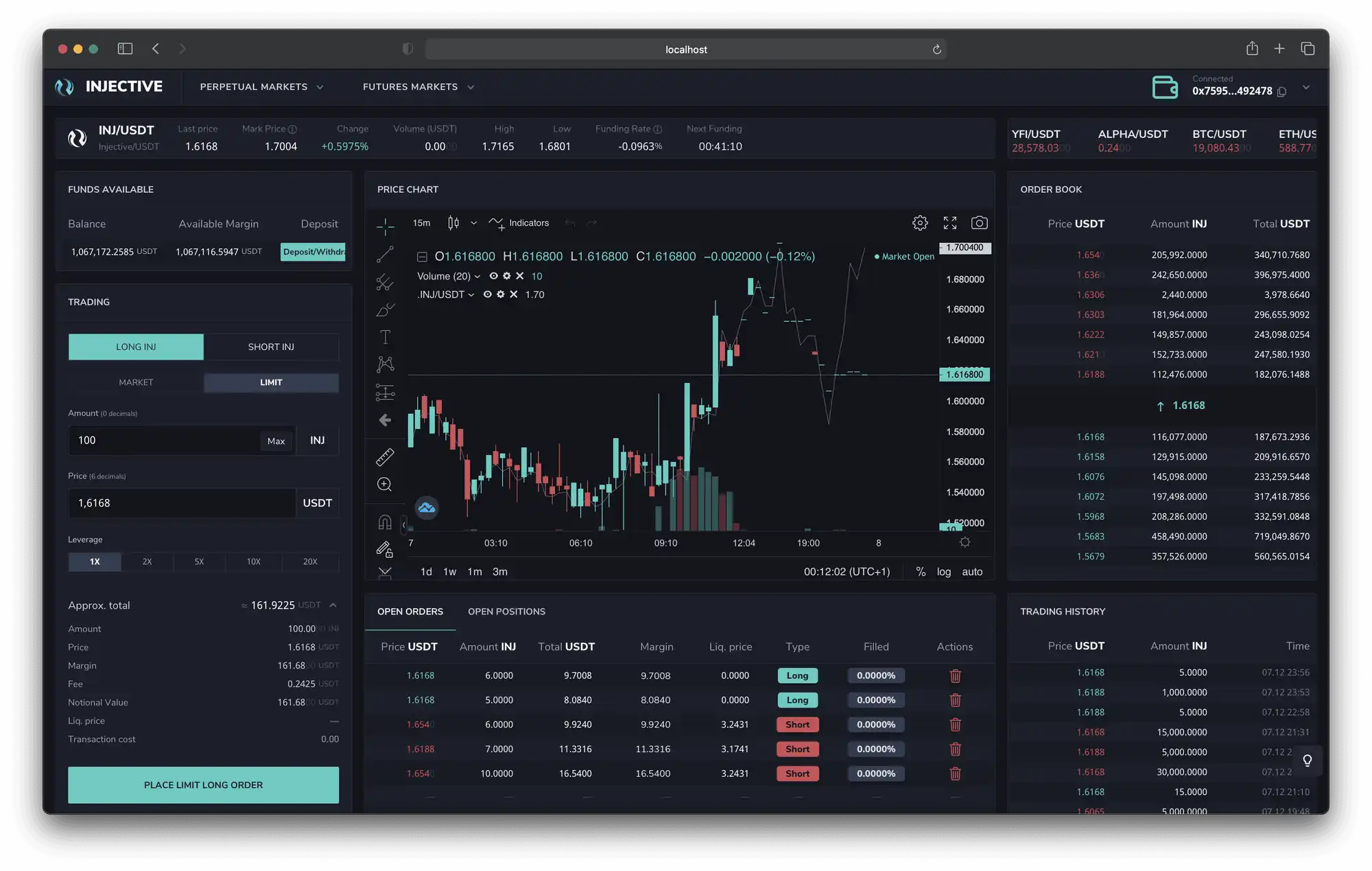
In December 2020, the Solstice V2 testnet trading interface officially showcased by Injective. Image source: Injective · Solstice V2 launch article.
Canary and the Bench
What truly made the mainstream financial world grasp the weight of the words "decentralized trading" for the first time was a pulled network cable.
On January 28, 2021, as the retail investor short squeeze on Wall Street institutions reached its climax, Robinhood, the zero-commission brokerage that claimed to "democratize finance," suddenly disabled the buy button for retail investors on stocks like GameStop.
The reason was not complicated: under the traditional T+2 settlement system, surging trading volume and volatility meant brokerages had to post massive margins to clearinghouses. Robinhood's book capital could not withstand the two-day settlement gap, so it had no choice but to cut off trading.
Three months later, billionaire Mark Cuban, who had publicly discussed Robinhood during the GameStop saga, invested in Injective. He said Robinhood restricted trading because it lacked capital, had too many customers, and would have gone bankrupt if it had held on; with a decentralized approach, every investor can see exactly how much Injective holds—nothing can be hidden.
That $10 million funding round included Pantera, BlockTower, Hashed, and QCP, pushing the valuation past the $1 billion mark. In TechCrunch's headline at the time, Injective was directly dubbed the "DeFi Robinhood."
That was also a moment of youthful ambition. Eric, then 22, said in the funding announcement that the old financial system had created a pile of "artificial delays and middlemen," and he wanted to let retail investors around the world, for the first time, enter unlimited markets without paying predatory fees or enduring slow transactions. At that time, Injective was already testing on-chain synthetic assets for Apple stock and the S&P 500 on its testnet.
It was also in this year that Injective truly began running its own chain.
On June 30, the Canary Chain launched first. The software industry habitually calls this kind of small-scale trial-run version "canary," and any non-INJ asset bridged in was subject to a hard cap of $100. After running for more than four months, on November 8, on-chain governance proposal #65 passed, the Canary Chain halted at block 435200, and the official mainnet seamlessly took over.
This chain looked very different from its peers at the time.
In those two years, the logic of most public chains was to be a "world computer," with the underlying layer only handling bookkeeping and running smart contracts. As for the exchanges that grew on top, everyone built their own liquidity pools, and liquidity was sliced to pieces. Injective welded a central limit order book directly into the chain's underlying code. Any developer building a trading application on it could, from Day 1, directly call on the same pool of liquidity shared across the entire chain.
As for the front-running prevention problem that had fascinated Eric back then, there was also a solution at the underlying layer. They brought onto the chain the "Frequent Batch Auction" that University of Chicago economists had originally used to counter Wall Street's high-frequency trading arms race. Each block is an independent auction, and orders in the same block are executed at a uniform clearing price, so arriving a few milliseconds earlier confers no advantage.
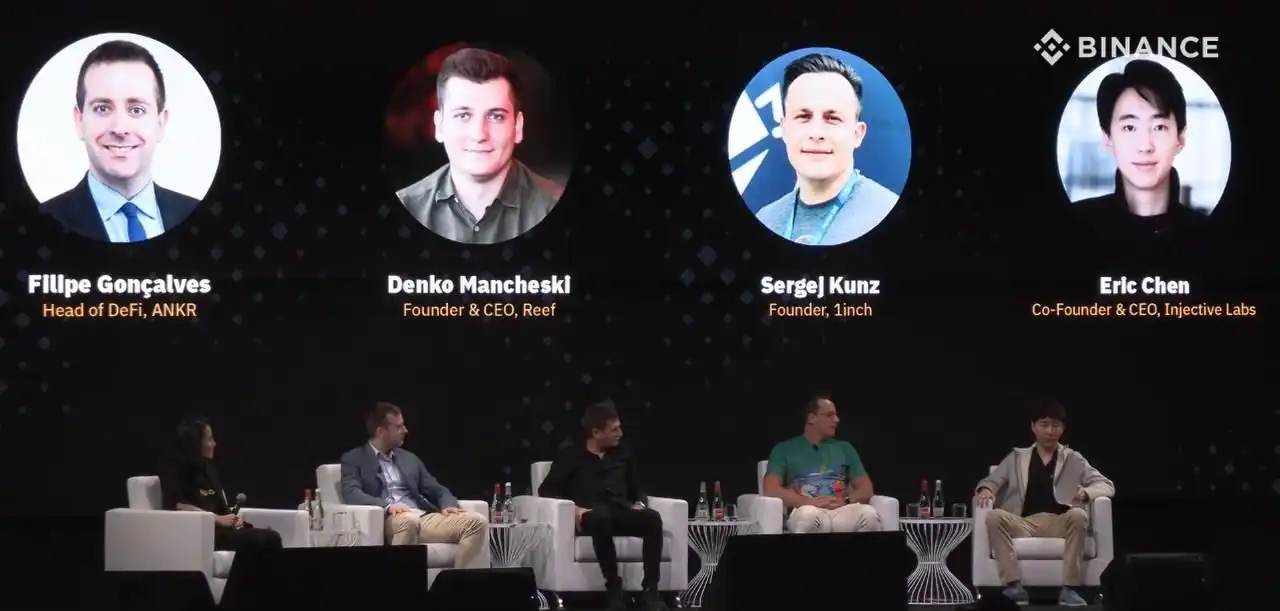
In March 2022, Eric Chen (first from right) participated in a discussion on decentralized finance at Binance Blockchain Week in Dubai. Image source: Injective official blog "A Week of Conferences: Injective Labs Recap," April 19, 2022.
But interestingly, just when the mainnet launched and was basking in the spotlight as the "DeFi Robinhood," Eric's "7-square-meter cabin syndrome" kicked in again.
In August 2022, with Bitcoin already halved from its peak and falling below $25,000, Injective bucked the trend and announced a $40 million funding round led by high-frequency trading giant Jump Crypto, with participation from BH Digital, the digital asset arm of top macro hedge fund Brevan Howard.
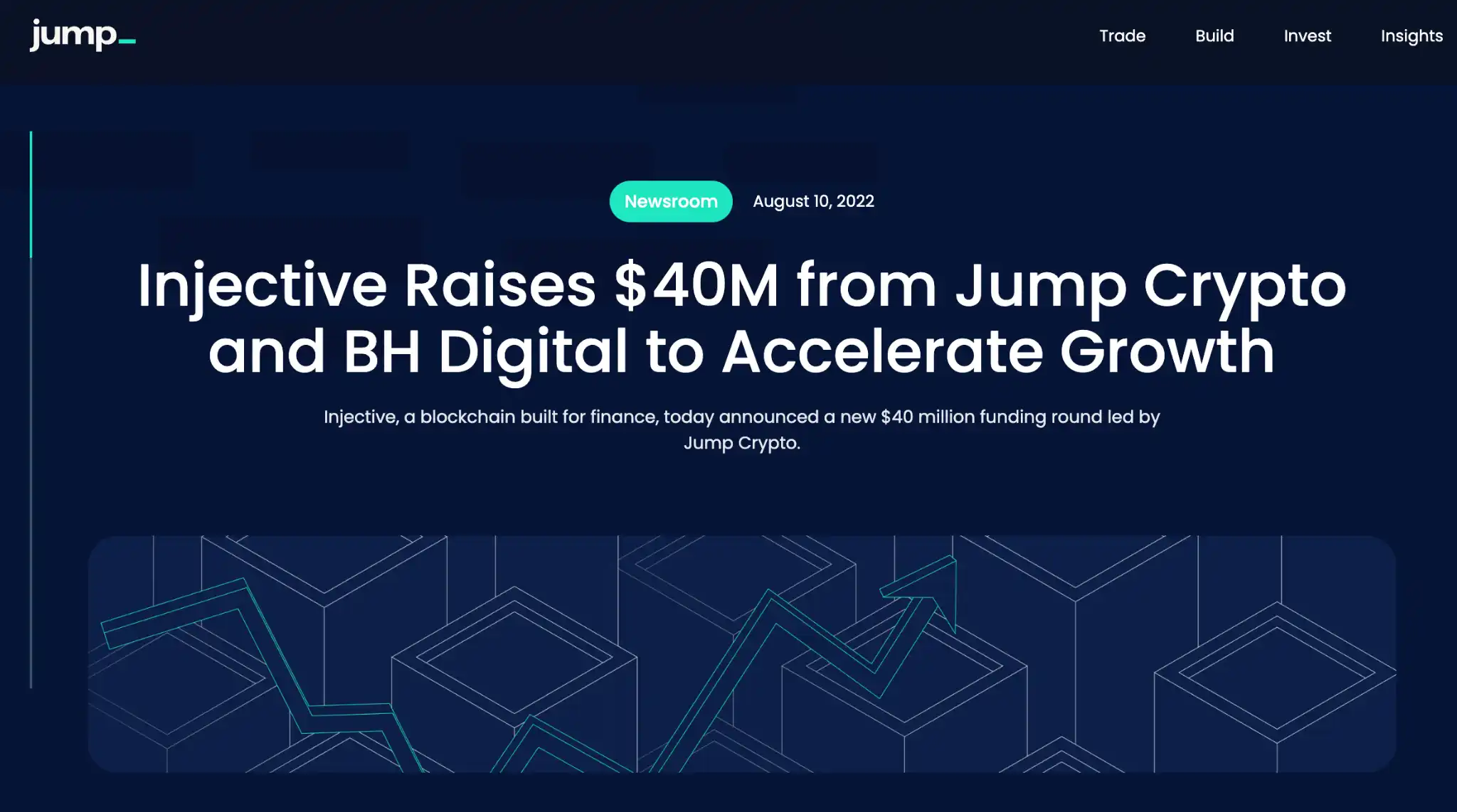
Image source: Jump Crypto official blog, August 10, 2022.
Just three months later, FTX collapsed.
That crash drained liquidity from the entire crypto industry, and a large number of star projects that had aggressively expanded hiring and bought stadium naming rights during the bull market burned through their treasuries overnight. Yet Injective never laid off staff because it ran short of money, nor did it ever shrink or cut projects due to funding issues.
Eric later revealed that every time they raised new money, their budget spreadsheet was built on an almost obsessive extreme assumption: that starting tomorrow, the company would never raise another cent and would have zero protocol revenue. Until 2024, this public chain with a network value approaching $3 billion still had a core team of just over 50 people.
In 2023, the secondary market rewarded this conservatism in an extraordinarily exaggerated way. As external developers began building various trading applications on their modular foundation, catalyzed by a $150 million ecosystem fund, INJ surged nearly 30x for the year, hitting what was then an all-time high by year-end. Later, some in the community even wrote Injective's story as a Japanese Warring States history, likening the company that survived a long cycle by stockpiling grain to Tokugawa Ieyasu.
But when the coin price was rising the most violently, Eric's reaction was the opposite of most people's.
He said that in a bull market he actually becomes increasingly paranoid and suspicious, like a primal instinct, always feeling that something is about to go wrong. He and his team kept asking themselves an old question: "Have you earned it?"
In his view, success often diverges from effort and fundamentals, so they constantly doubt whether they deserve the success before them.
Mortgages
If the story stopped at "a young man who traversed cycles through extreme restraint," Injective would at most be just another crypto public chain doing reasonably well.
The real turning point came between 2024 and 2025. It was also from this time that a hidden rift began to emerge between the original "crypto fundamentalism" and the real business world.
The biggest illusion of early DeFi was the belief that as long as the code was elegant enough and there were no intermediaries, capital from around the world would automatically flow in. But reality quickly provided counterevidence: if only crypto-native assets are circulating on-chain from left hand to right hand, even the most sophisticated order book is just an idle casino. For financial infrastructure to truly generate commercial value, it must bring in the heavy, regulated real-world assets from the old world.
In January 2024, Injective added something to the Volan mainnet upgrade that seemed to defy the crypto ethos: a native RWA module specifically serving "permissioned assets." Who is eligible to buy, who is on the whitelist, which jurisdictions cannot transfer — institutions can write the rules directly into the asset's underlying layer.
A year and a half later, the first player emerged that truly made people understand the intent of this design. Shubha Dasgupta has been deeply involved in the mortgage industry since the 2008 subprime crisis. As co-founder and CEO of Toronto-based mortgage technology company Pineapple (recently rebranded as Pentiv), he manages hundreds of mortgage brokers. The company is not only listed on NYSE American (ticker PAPL) but has also become a true practitioner of Injective's design.
On September 2, 2025, this traditional mortgage company suddenly announced a $100 million private placement — they wanted to become the world's first publicly listed company to hold INJ, using INJ as the company's core treasury reserve asset. Looking at the participant list, it included FalconX, Kraken, Blockchain.com, Canary Capital, and Injective Foundation.
A month later, Pineapple bought its first batch of 678,000 INJ on the open market with real money, all placed into node staking; by February 2026, they had added another 560,000 INJ at an average price of $3.567. At the time, Pineapple's own secondary market capitalization was only about $18 million, while the reserve assets sitting on its books were already worth more than $41 million.
A publicly listed mortgage lender—why would it buy the token of a public blockchain?
If it were just about riding the crypto hype, this would be yet another financial-engineering story about a small-cap U.S. stock. But Shubha Dasgupta's next moves show he had something else in mind.
In December 2025, Pineapple began turning the mortgage files it had handled into on-chain records, one by one, each carrying more than 500 data points, without altering the original loan contracts or servicing relationships. By September 2026, the mortgage records moved on-chain had exceeded $1 billion, totaling 2,079 loans, making it the largest real estate on-chain asset on the data platform rwa.xyz—and their stated goal is 29,000 loans and $10 billion.
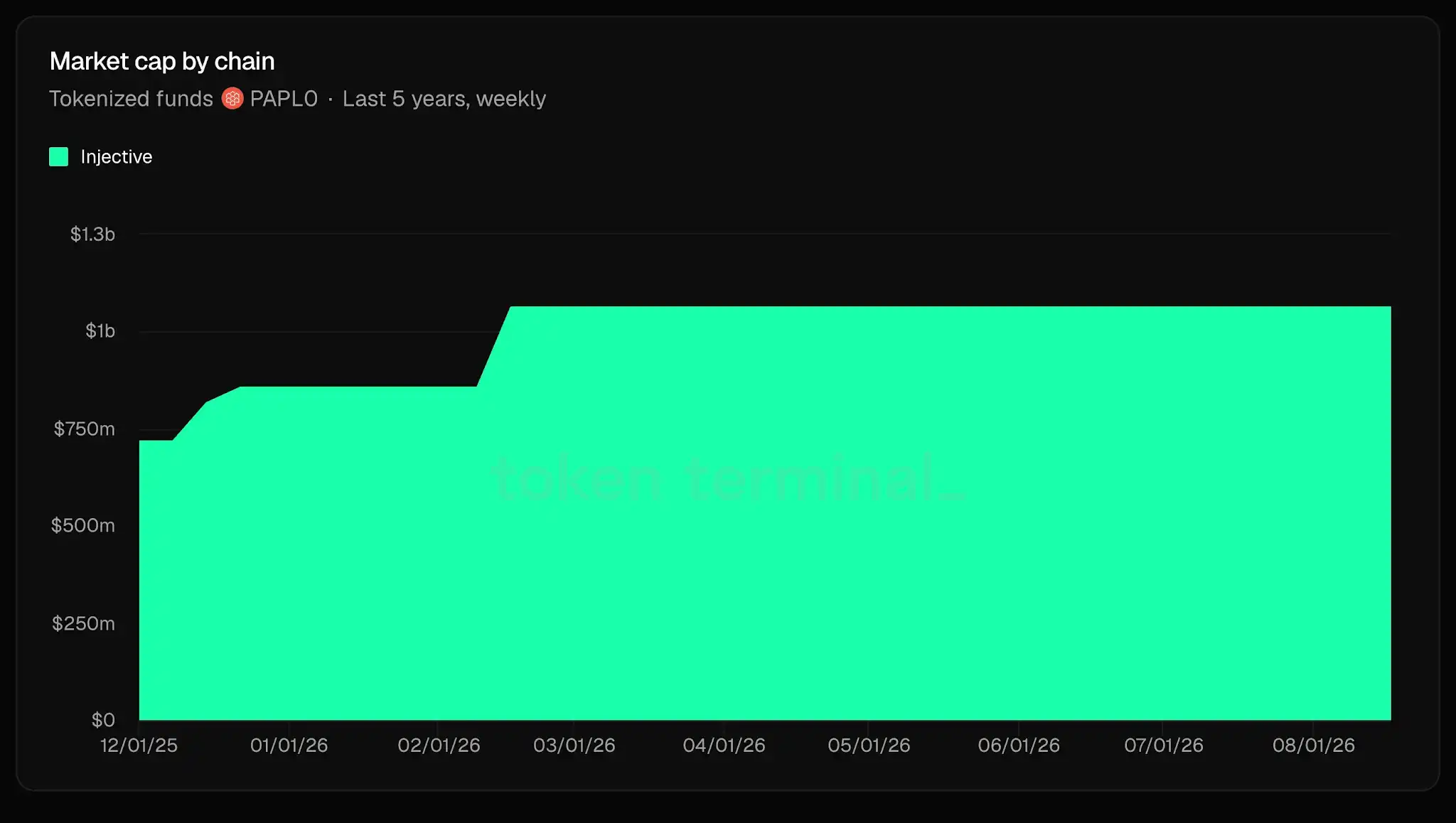
Changes in the scale of PAPL0, the on-chain asset corresponding to Pineapple's mortgage records. A chart published by Injective in September 2026 shows its scale has exceeded $1 billion. Source: Token Terminal, cited from Injective's official blog, September 4, 2026.
Shubha Dasgupta's argument is that traditional finance relies on access to capital, and INJ may be the best path to move the entire financial industry onto blockchain rails. Putting mortgage records on-chain makes them more transparent and efficient, and also enables new financial products built on top of them, from data markets to mortgage yield platforms.
In the two years from 2025 to 2026, a group of seemingly unrelated traditional giants lined up to enter Injective. What they brought on-chain happened to form three tiers of digitizing old-world assets.
The first to move were standardized financial chips.
In March 2025, Libre, together with Nomura's digital asset company Laser Digital, landed on Injective, bringing on-chain fund shares from top asset managers such as BlackRock and Hamilton Lane; Libre had already issued $90 million in assets at the time. Shortly after, Injective used its iAssets framework to turn the stock of Ethereum treasury company SharpLink into an on-chain asset, and even super-unicorns not yet public at the time, such as OpenAI and SpaceX, had Pre-IPO derivatives trading in real time on-chain.
Close on its heels: non-standard cash flows and corporate partnerships.
By July 2026, even POSCO International, South Korea's largest trading company, along with LG's IT giant LG CNS, chose Injective for a proof of concept, minting real cross-border trade receivables from overseas subsidiaries into tokens, with AI Agents automatically reading letters of credit and trade documents before settlement to catch errors during the preliminary review stage. POSCO plans to finalize a pilot operation plan in the second half of the year.
By September this year, Injective simply turned this process into a standardized product, Injective Mint, and opened it for private testing. Traditional financial institutions can issue tokenized stocks and funds themselves, with compliance clauses hardcoded directly into the underlying code—any transfer that violates jurisdictional rules will be rejected on the spot by the underlying network.
Assets are onboarded, but dollars are still missing.
In May 2026, Circle's native USDC landed on Injective. Noble, which had previously issued USDC on Cosmos, announced its withdrawal, and Cosmos Hub, Cosmos Labs, and Skip chose Injective to take over. USDC on Injective became the stablecoin standard for the entire Cosmos ecosystem, with decentralized derivatives leader dYdX being the first chain to begin migrating.
Looking back, this scene carries a sense of destiny. Injective was originally built with the Cosmos SDK, and for years it was merely an application chain within Cosmos's vast galaxy; now, over $100 million in native USDC from across the galaxy is, in turn, being issued on it.
Beyond dollars, there's also the Korean won.
South Korea is eager for an on-chain Korean won because money has been flowing out. Since early 2025, stablecoins on South Korea's top five exchanges have seen net outflows overseas for 18 consecutive months, totaling approximately KRW 14.9 trillion, roughly $10.4 billion.
After POSCO International and LG CNS chose Injective in July, on October 20, Injective signed a memorandum of understanding with BDACS, South Korea's digital asset custody institution. KRW1, the Korean won stablecoin issued by BDACS, will become the Korean won settlement asset for RWA and tokenized assets on Injective. Going forward, Korean institutions buying and selling tokenized assets on-chain can settle directly in Korean won without first converting to dollar stablecoins.
Roster
When what runs on-chain is no longer anonymous meme coins, but BlackRock's funds, POSCO's bills of lading, and tens of thousands of Canadian mortgages, an unavoidable question surfaces.
Code can guarantee that transactions aren't front-run, but who guarantees that the address on-chain legally owns that stock?
On Wall Street, exchanges only handle the first half—order matching and execution. After the trade, whose name the securities are registered under depends on a role that rarely steps into the spotlight: the transfer agent.
Whose name a company's directly registered shares are under, which account dividends go into, and who holds voting rights—all are determined by the shareholder register held by the transfer agent.
Over the past few years, the vast majority of so-called "asset tokenization" has been a castrated mapping game: find a custodian off-chain to lock up real shares, and issue a receipt token on-chain. The two ledgers are disconnected, with a layer of traditional intermediaries still in between.
Injective decided to register its own transfer agent.
This story starts in Washington.
On July 16, 2026, Injective brought its annual summit to Washington.
It was the summer of America's 250th anniversary. As the industry association Injective belongs to, Dan Spuller of the Blockchain Association gave the event a distinctly American-politician-style description when announcing it: "once-in-250-years moment." Looking at the agenda that day, four U.S. federal congressmen were seated on stage, along with the deputy director of the White House Presidential Council on Digital Assets.
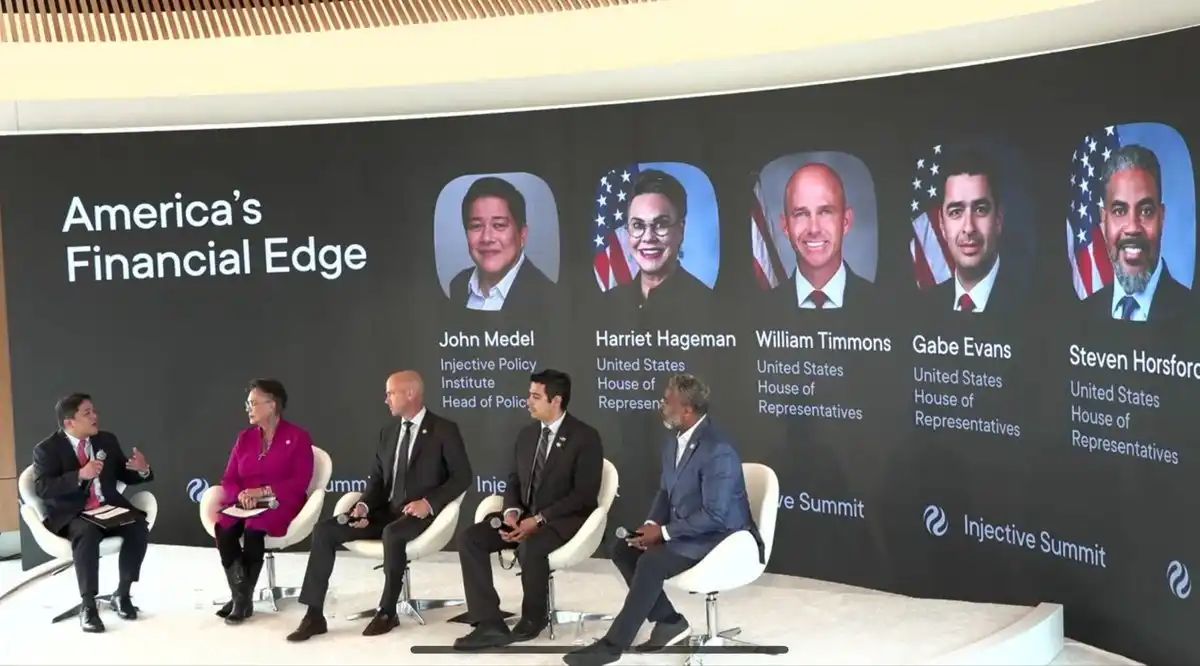
In July 2026, four U.S. congressmen attended the "America's Financial Edge" roundtable at the Washington Injective Summit. Image source: Injective official X, screenshot from the summit.
On the same day, Injective announced that INJ's MiCA whitepaper in Europe had completed notification, and Robinhood also listed INJ.
A public blockchain's annual meeting—why hold it in Washington?
Because this is no ordinary annual meeting. It is the most conspicuous stop in a year-long, interlocking plan, and we can break down this timeline in reverse.
First, handing a microphone to regulators.
As early as July and October 2025, Injective Labs submitted two written comments to the SEC Crypto Task Force, one of which was titled outright "DeFi Lending Is Not Securities Trading"; on January 13, 2026, the team met with the task force again, with transfer agents already on the agenda; in May, they simply formally established the Injective Policy Institute in Washington, led by Injective's policy chief John Medel, who previously worked on policy at Coinbase and Goldman Sachs, dedicated to engaging with members of Congress and regulatory agencies.
Second, syncing to the stopwatch of the rules.
In September 2025, the SEC voted to approve generic listing standards for crypto asset ETFs, including a key fast-track provision: as long as a digital asset has traded in a CFTC-regulated futures market for six months, it can bypass the lengthy case-by-case approval process. On April 15, 2026, derivatives trading platform Bitnomial launched on schedule the first CFTC-regulated INJ futures contract in the United States.
Six months from April 15 lands exactly on October 15.
The three INJ ETF applications from Canary Capital, 21Shares—one of Europe's largest crypto asset managers—and REX-Osprey were already filed in 2025. During this six-month countdown, 21Shares and Canary each updated their prospectuses in September.
Canary's staking ETF (ticker INJC) plans to stake at least 90% of the fund's INJ on-chain to generate yield. According to the final prospectus dated November 4, the tokens will be custodied with BitGo, with an annual management fee of 1.1%. Staking rewards are first split—30% going to the staking service provider, custodian, and sponsor—with the remaining 70% accruing to the fund's net asset value. This INJ ETF officially listed and began trading on Nasdaq on November 5.
In Asia, Thailand's first licensed digital asset fund institution, Merkle Capital, launched M-INJ as early as June 4. This is Asia's first regulated fund designed around INJ, overseen by the Thai SEC, available to both retail and institutional investors, though the minimum investment threshold is 500,000 Thai baht. The fund holds only INJ and USDC, increasing the USDC allocation when market conditions deteriorate, with an average of at least 80% of the position kept in digital assets throughout the year, and subscriptions and redemptions available on any business day. Merkle has over a dozen strategies on hand, and apart from Bitcoin, it rarely creates a dedicated fund for a single token.
The third step is where the dagger is truly revealed.
Piece all these foreshadowing elements together, and then look at the seating chart at the July 16 Washington summit, and you'll understand why this group of people were sitting in the same room.
In the morning, immediately following Eric's fireside chat, was Blockchain Association CEO Summer Mersinger, whose previous role was CFTC Commissioner; at the midday panel, one side was Joseph Chalom, who spent twenty years at BlackRock and now heads Ethereum treasury company SharpLink, and the other side was precisely Canary Capital CEO Steven McClurg, who filed the first INJ ETF application; the closing fireside chat with Injective's General Counsel was Harry Jung, Deputy Director of the White House Digital Assets Advisory Council.
One month later, on August 19, the other shoe dropped. The registration application filed on the day of the summit took effect, and Injective's Injective Institutional Services became an SEC-registered transfer agent. According to Injective, no other Layer 1 blockchain has its own transfer agent.
From then on, for tokenized securities issued on Injective, ownership records can be recorded directly on-chain, and the chain itself can serve as that shareholder register.
And on October 15, exactly six months after the futures launch, Eric Chen appeared in Washington again with the General Counsel, Head of Policy, and Head of Research, knocking intensively on the doors of White House, SEC, and CFTC officials' offices. Ten days earlier, in an interview with The Block, he had not concealed his ambitions, saying that the transfer agent was just the beginning and that more licenses would be pursued next.
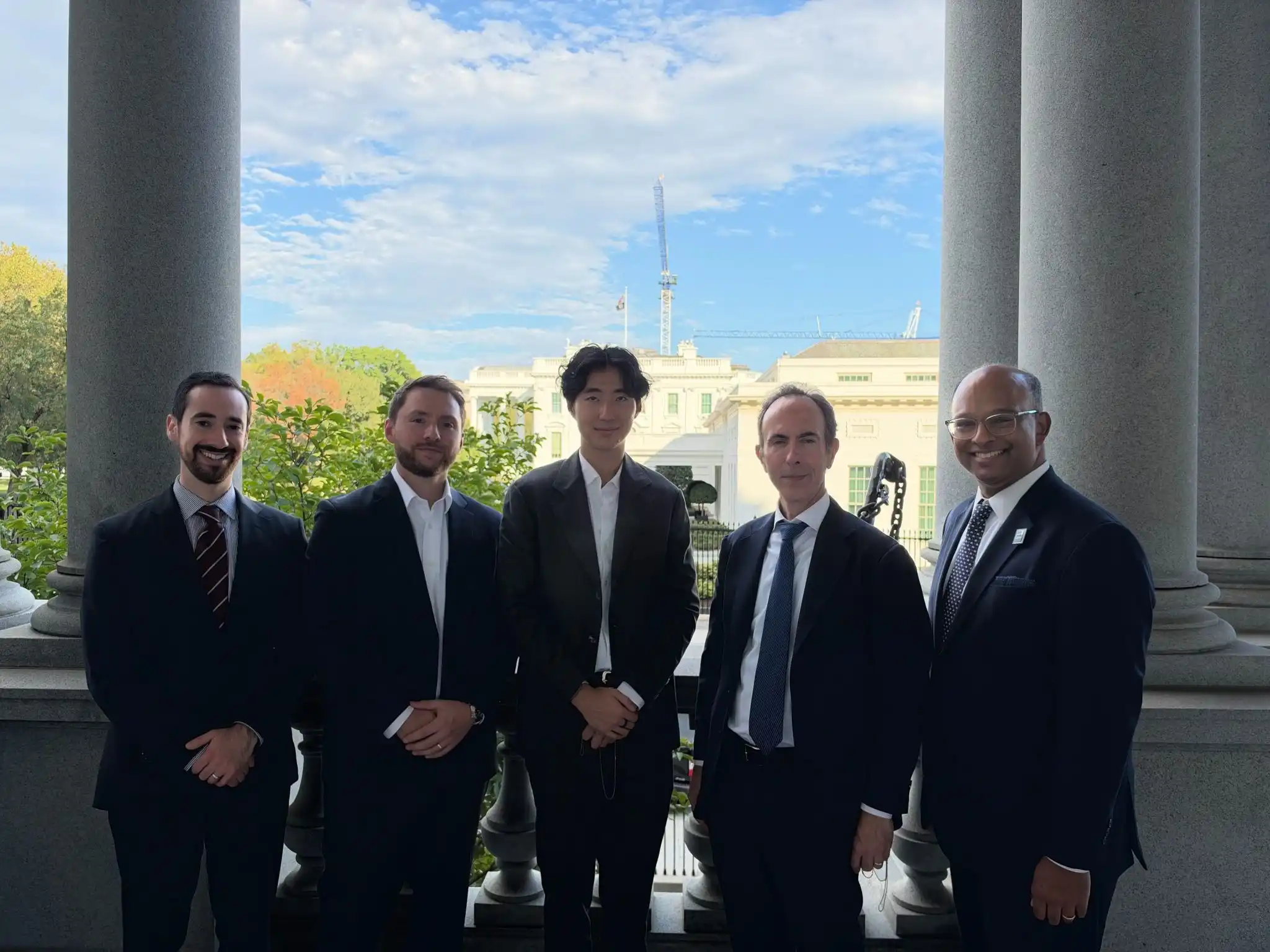
The Injective team met with officials from the White House, SEC, and CFTC in Washington. October 16, 2026. Image source: Injective official Twitter
Five years ago, when he had just received that check from Mark Cuban, this young man was still questioning the old financial system for being riddled with "artificial delays and middlemen"; five years later, he himself owns a transfer agent registered with the SEC. Two years ago, he said on a podcast that he hoped one day traditional exchanges like the NYSE, Nasdaq, and Cboe would somehow run on top of Injective; now, the listing venue for the first INJ ETF is none other than Nasdaq.
Has the dragon-slaying youth finally put on a Wall Street suit?
Perhaps we can look at it from another angle. In that podcast episode back then, Eric actually left another remark. He said the most exciting thing about this kind of technology is precisely that it will eventually become very "boring"—traditional financial institutions will gradually plug it into their back offices, it will slowly seep into ordinary people's daily lives, until the vast majority of people don't even realize they are using blockchain.
The path Injective chose is to first register as a middleman in the old world, and then use a piece of self-executing code to replace that position.
One foot on Capitol Hill, one foot in the trenches
But the crypto world has a cruel law of gravity: when a public chain becomes increasingly compliant and increasingly favored by Wall Street, it often also rapidly loses retail investors' affection, turning into a zombie chain with only institutional news and no real trading pulse.
Injective has clearly recognized this risk. While walking into Washington in a suit and tie, its other foot remains firmly planted in the muddiest, most savage ground where retail investors are most concentrated.
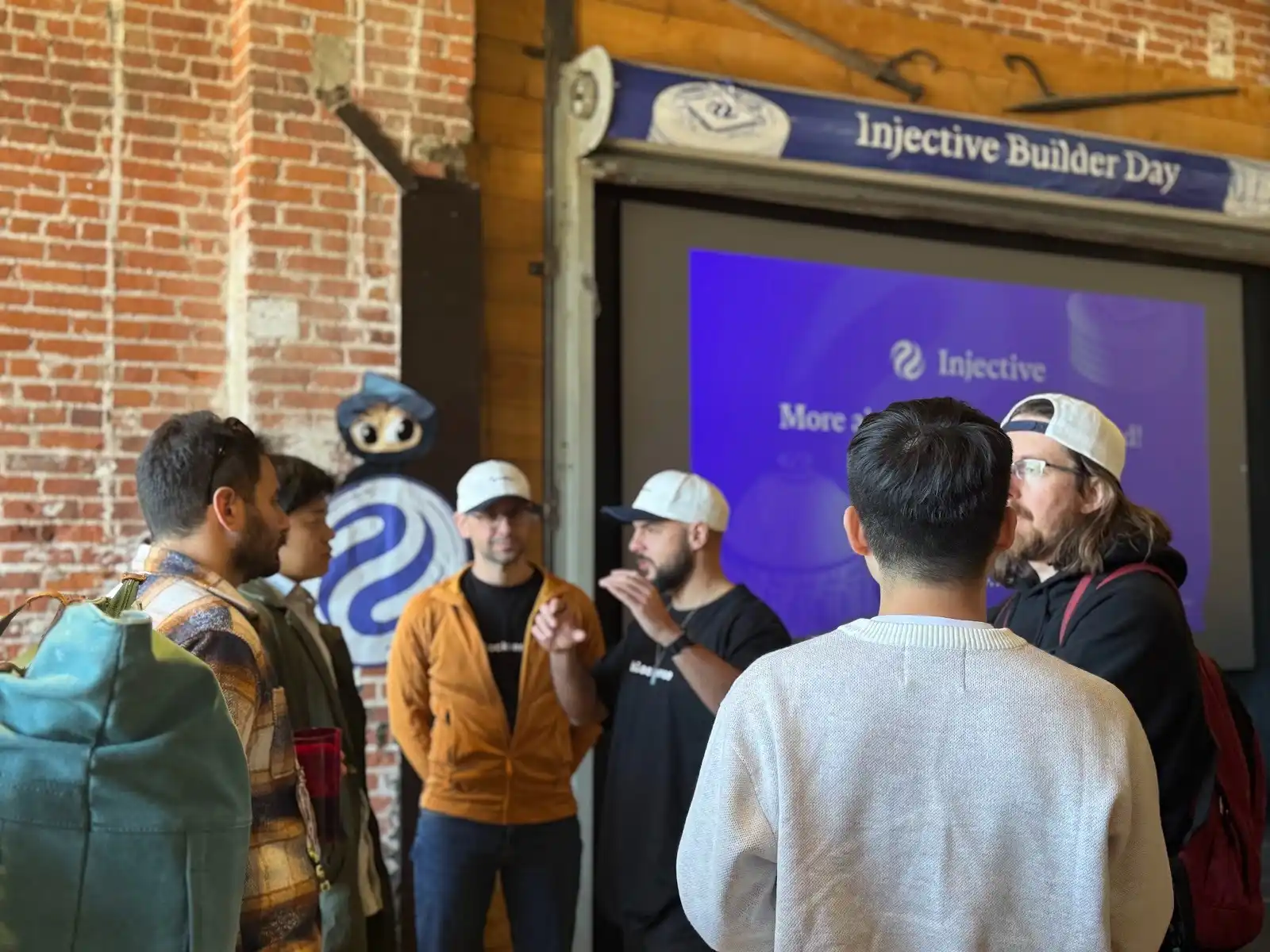
During ETHDenver 2025, Injective held Builder Day at a brewery in Denver, where participants mingled after project demos. Image source: Injective official blog "ETH Denver 2025: Injective Recap."
In crypto slang, "trenches" refers to the front lines of on-chain retail trading where individual traders engage in close-quarters combat. In October of this year, Injective allocated a dedicated fund to establish the Trench Treasury, which does not invest in glamorous institutional projects but specifically supports grassroots community projects with sufficiently dispersed token holdings, and directly rewards community members who have consistently supported ecosystem projects; in mid-September, they pushed INJ directly into Solana's ecosystem, the hottest arena for retail trading, and by the end of the month had integrated with more than 15 mainstream applications including Jupiter, Raydium, and pump.fun.
What best embodies this "welding Wall Street and the retail trenches together" is the community buyback at the end of September this year.
Since late 2021, Injective has been running a weekly burn auction mechanism, which by October 2025 was transformed into a monthly Community BuyBack, where the protocol takes its real earned revenue and any token holder can contribute INJ to the pool for burning, receiving a proportional share of protocol revenue.
Stockdrop is built on top of this buyback model. In addition to regular yields, each participating address has a chance to receive an extra tokenized stock, one per address per round.
The first round was issued on Robinhood Chain, with some receiving Nvidia and others Meta. The second round in October moved to Solana, issuing xStocks, with names including Nvidia, Tesla, Meta, Micron, and AMC; this round's buyback pool contained over $247,000 in ecosystem revenue.
Burn some tokens, get some US stocks in return. The protocol that once sought to bypass Wall Street now distributes Wall Street stocks as benefits.
Beyond retail traders, they have also brought in two new types of players.
One is developers and enterprise validators. On the developer ecosystem side, Injective partnered with Microsoft and Web3Labs to launch an incubation program for Chinese-speaking developers, providing Azure credits as rewards to winning teams; on the network validator side, they successfully attracted Google Cloud, Japanese telecom giant NTT Docomo Global, and Gulf Labs under Thailand's energy infrastructure giant GULF Group as validators participating in network operations.
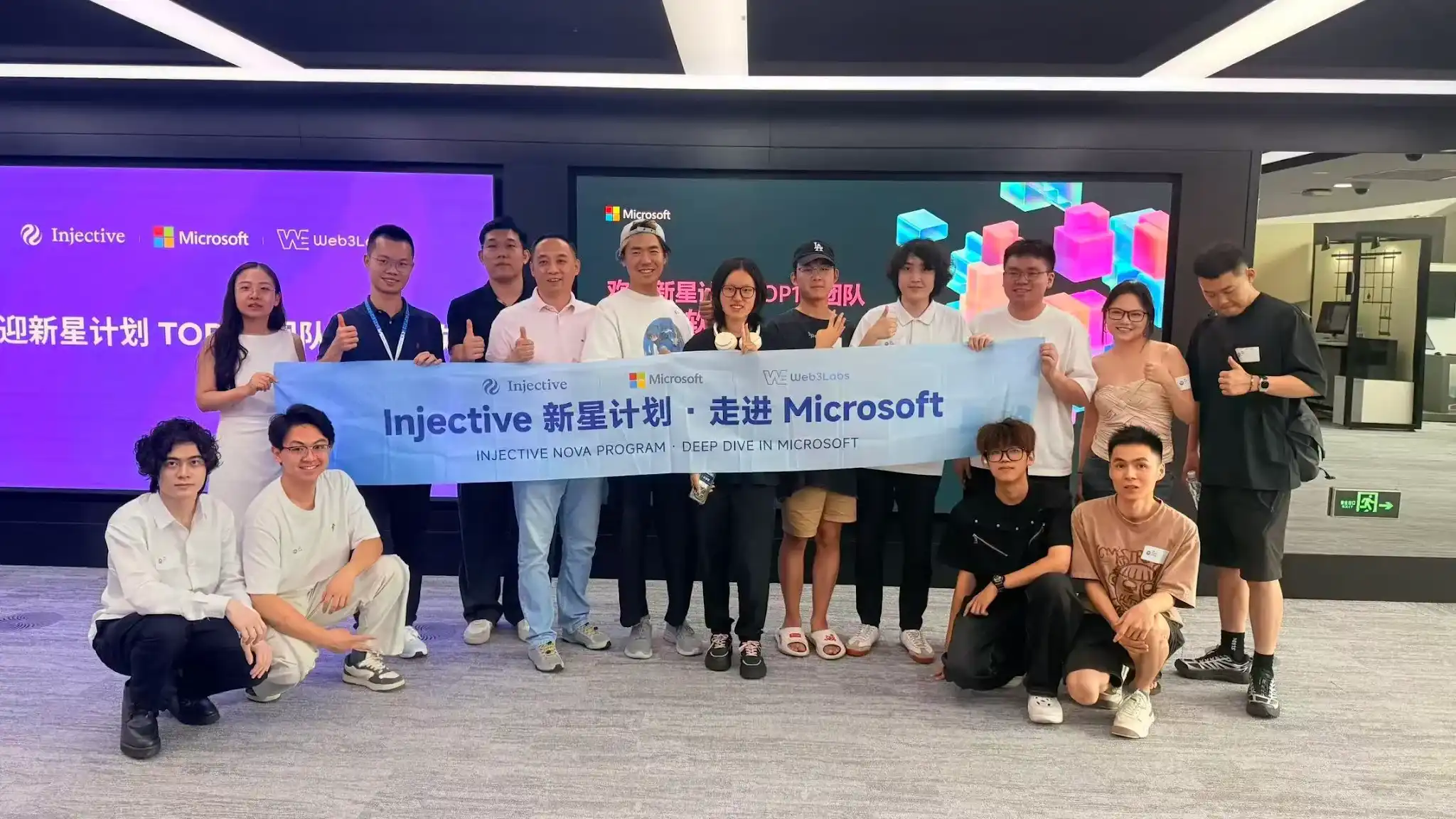
On July 16, 2026, finalist teams of the Injective Nova Program visited Microsoft's Beijing headquarters for exchange.Image source: Injective official Nova Program recap.
Another, more radical group of players are AI Agents that don't need humans at all.
In February of this year, Injective released the official MCP Server. In clients such as Anthropic's Claude, you only need to type a natural language command, and the AI Agent can go to Injective on its own to open perpetual contract positions and monitor the market in real time, while the private key always stays on your local computer.
By June, as Injective integrated x402, a micropayment protocol based on the HTTP 402 status code, every time code and Agents call an external API interface, they can automatically complete a micropayment in native USDC within 650 milliseconds, with no need for humans to register an account, let alone bind a credit card. Injective subsequently became a member of the x402 Foundation under the Linux Foundation alongside Google, Visa, Stripe, and Circle.
By October 1, Injective demonstrated the privacy trading platform CypherOS for the first time, with the official launch set for the fourth quarter. After all, whether it is on-chain AI high-frequency traders or the Wall Street mega-institutions moving tens of billions in assets onto the chain, no one wants to swim naked in a completely transparent fish tank.
Eight Years
In the summer of 2025, Eric Chen was 27 years old. That year, 1.4 billion transactions ran on-chain, more than the total of all previous years combined.
Fortune magazine published a profile of his daily life in August of that year. This founder, who no longer had to worry about money, still lived in New York and walked to the office every day; he tried to leave his desk to eat lunch in the company kitchen, and when things got busy he made do in front of the computer; the Red Bull he drank during late nights in college had now been replaced by Celsius energy drinks or double espressos. He played tennis, and there was a racing simulator at home.
He described himself as "24/7 terminally online" and could no longer remember the last time he was truly away from work. When the reporter asked him what had been his most worthwhile personal investment to date, his answer was not some token that had surged, but an Eight Sleep smart temperature-controlled mattress cover that cost about $2,900.
After the article was published, his early investor Mark Cuban specifically reposted it on X to cheer for this NYU dropout.
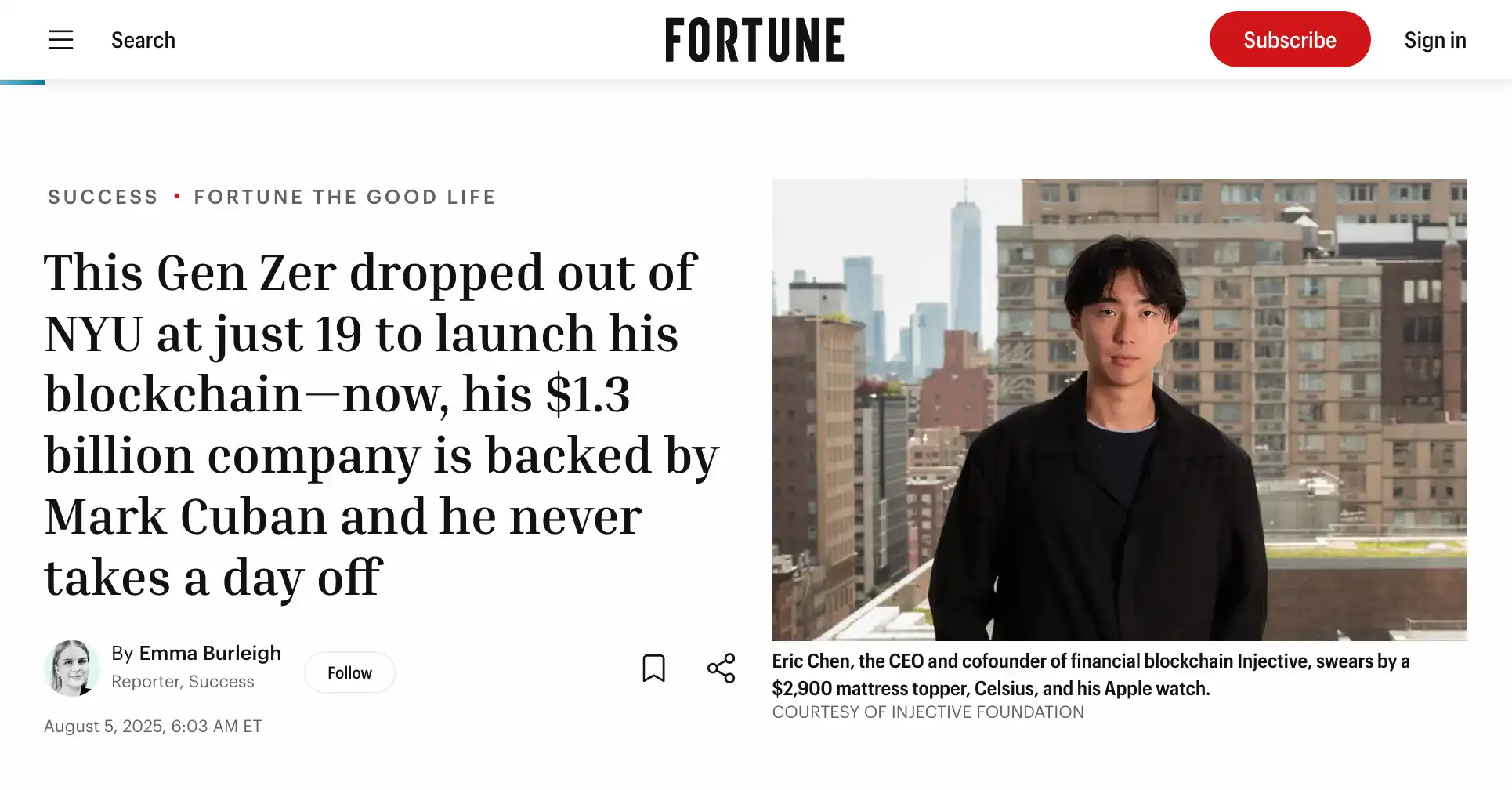
Eric gave an exclusive interview to Fortune, published on August 5, 2025. Image source: Fortune website.
On November 8, 2026, the Injective mainnet turned five years old.
Over five years, the chain has processed more than 3 billion transactions, with matched trading volume surpassing $80 billion; over 57 million INJ are locked in staking nodes, and more than 7.1 million INJ have been permanently burned through weekly auctions and community buybacks. As of June this year, its protocol revenue over the past 12 months was $3.41 million, ranking in the top 10 among all L1s.
In October 2026, Injective released a brand-new whitepaper, replacing the 2018 version.
This is the first rewrite in eight years. The 2018 version had only one question to answer: how to build an exchange on Ethereum that cannot be front-run.
The new one is titled "Injective: A Finance-Native Layer-1 Blockchain." Injective now defines itself as a layer-1 built for institutional finance and tokenization.
The entire document is about one thing: how the chain issues real-world assets and how those assets can actually be used across markets, applications, and AI Agents.
Who can mint, who can transfer out, who can receive, who can burn — permissions are written into the issuance layer; assets go on-chain, trade on the order book, and settle in blocks of around 600 milliseconds; AI Agents operate them through MCP Server and policy-constrained signatures, paying with x402 and USDC. The revenue the protocol earns ultimately flows back to Community BuyBack.
The front-running problem that fascinated Eric back then is still here, except it has gone from being the protagonist of an entire white paper to just one component within it.
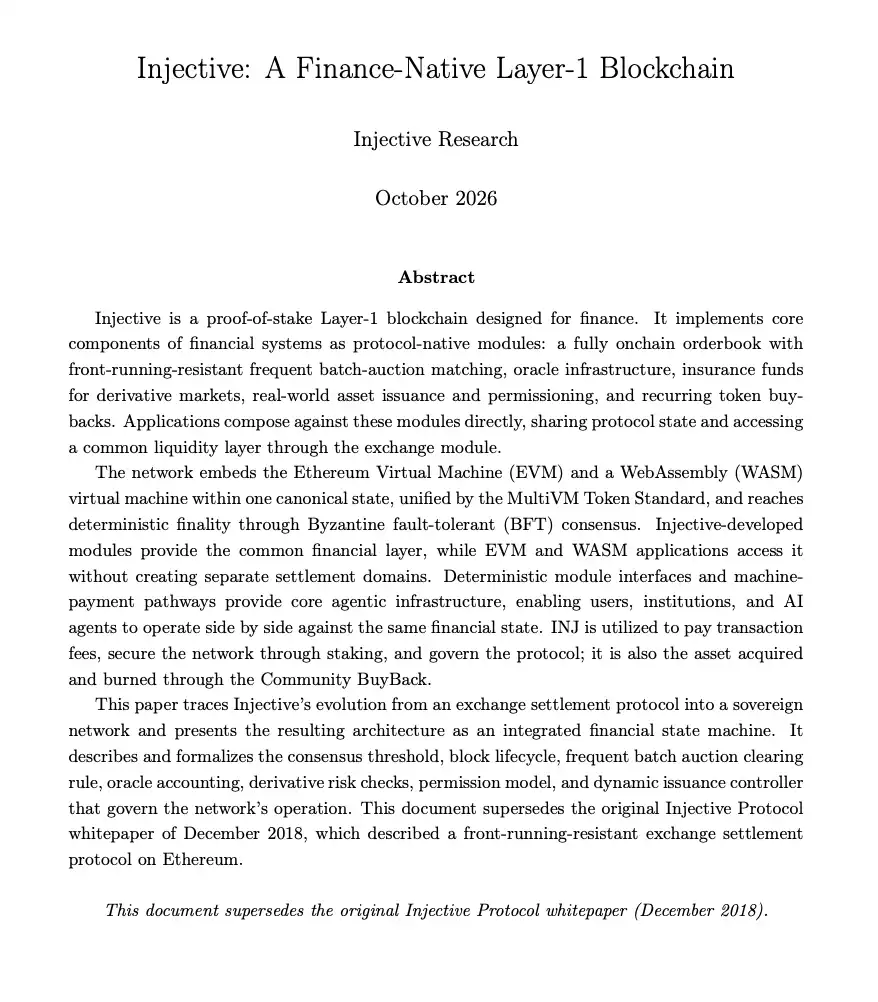
Injective's new white paper, published in October 2026. Image source: Injective Whitepaper
Two years ago on a podcast, the host asked Eric a somewhat clichéd question: if he could go back to the day he decided to drop out of NYU and sit down to give his younger self one piece of advice, what would he say?
He said he would probably lie and tell that young man "everything will be fine." Because he felt those grueling moments were all required courses—having someone spoil it in advance would be meaningless; you can only get through them yourself.
And at the end of that Fortune magazine interview, the reporter also asked this young man who stays online 24 hours a day a personal question: after flying to Seoul, London, Toronto, Abu Dhabi, and Singapore, where are you headed next?
Eric Chen said his next trip would be to North Macedonia on the Balkan Peninsula.
One of the earliest developers who wrote code alongside them during the bear market was getting married there.
Welcome to join the official BlockBeats community:
Telegram Subscription Group: https://t.me/theblockbeats
Telegram Discussion Group: https://t.me/BlockBeats_App
Official Twitter Account: https://twitter.com/BlockBeatsAsia
 Related Articles