



Optimism feast is coming? An overview of the OP Stack ecosystem projects.
Original Title: "Optimism Feast is Coming? Overview of OP Stack Ecological Projects"
Original Source: Foresight News
Since June, the expansion of the OP Stack ecosystem has accelerated significantly - in just two and a half months, 11 new projects have announced the launch of related L2 networks based on OP Stack, accounting for 57% of all 19 projects in the OP Stack ecosystem (not a complete count).
As an open-source modular toolkit launched by Optimism, OP Stack allows developers to assemble a customized Layer2 network based on their own needs and scenarios, thereby accessing the Ethereum network and sharing resources. It has also become the biggest dark horse of "one-click chain launch + modularization" since this year.
Currently, the circle of friends of OP Stack is quite large in the encryption industry. In addition to star projects such as Base, opBNB, and Worldcoin, there are also some veteran Layer1 public chains hoping to turn to the Ethereum Layer2 track through OP Stack.
OP Stack "Crazy Growth"
In order of project release time, this article has compiled the projects that have already joined or plan to join the OP Stack superchain ecosystem. Overall, OP Stack's expansion can be described as blossoming in all directions, with a total of 19 projects covering various fields such as exchanges, public chains, clients, NFTs, games, derivatives, and more.
OPCraft
On October 18, 2022, Lattice, a blockchain game developer, launched a dedicated blockchain for virtual world gaming called OPCraft, based on OP Stack. Developers can achieve higher throughput and shorter block times with simple debugging.
Base
On February 23rd of this year, Coinbase launched Base, a Layer2 network built on OP Stack. The mainnet was opened to builders on July 13th, and on August 9th, the Base mainnet was also launched and officially opened to everyone.
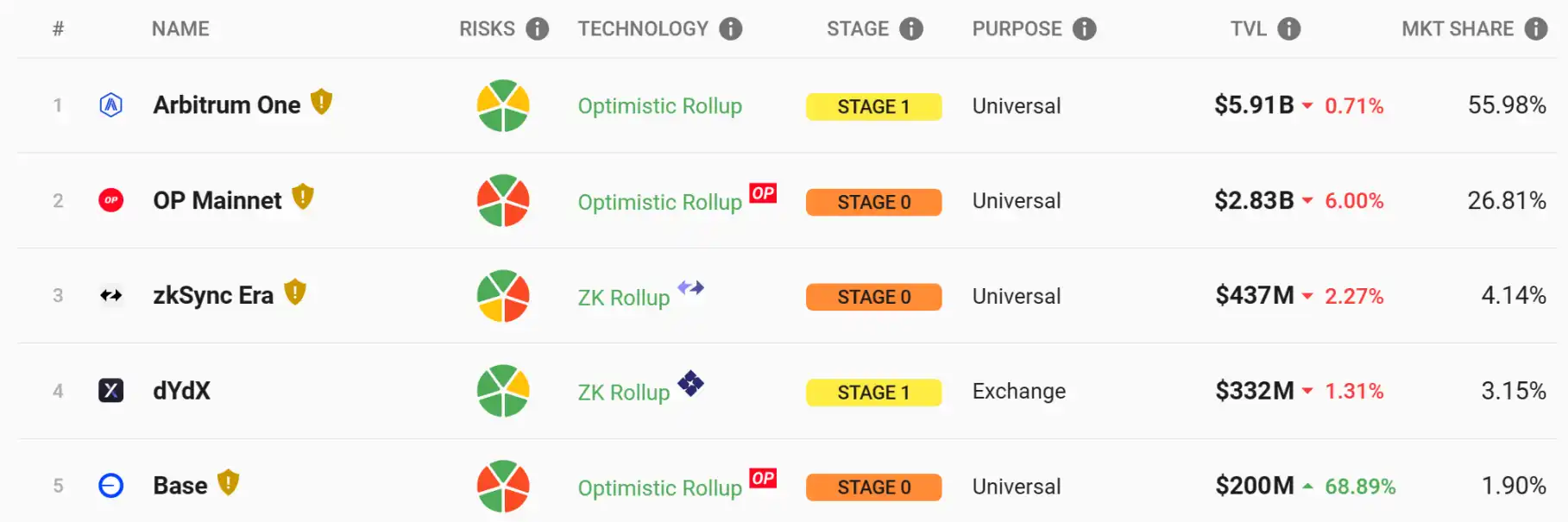
Currently, Base has more than 100 DApps and service providers, and has deep integration with the Coinbase product ecosystem. As of the time of writing, the total lock-up amount of the Base network has just reached $200 million, with a 68.89% surge in the past 7 days, accounting for 1.9% of the share in the Layer2 network.
This is only second to Arbitrum (55.98%), followed by Optimism (26.81%), zkSync (4.14%), and dYdX (3.15%), and ranks ahead of other popular Layer2 projects such as Starknet and Immutable X.
Currently, Base is undoubtedly the "leader" in the OP Stack superchain ecosystem of Optimism. It is estimated that Base alone can bring an additional $4.5 million in revenue to the OP treasury each year.
Kinto
On March 30th, Kinto, a KYC DeFi network built on OP Stack, was officially launched. It focuses on providing secure and insured decentralized financial services, and the testnet is currently running.
UniDex
On April 2nd, Unidex, a multi-chain aggregator, launched the Magma testnet built on OP Stack. The aim is to provide secure and fast transactions with low gas costs. Additionally, UniDex plans to gradually migrate its product ecosystem to the Magma network.
Magi
On April 19th, a16z Crypto launched the Rollup client "Magi" based on OP Stack. The client, written in Rust language, replaces the consensus client (Rollup client) in OP Stack and works together with execution clients (such as op-geth) for synchronization, aiming to improve the client diversity and resilience of the entire OP Stack ecosystem.
Currently, Magi is still in its very early stages and there is no further news on project progress. It may take several months of development time before it can become a viable alternative to op-nodes.
op-erigon
On April 20th, Test in Prod developed an alternative execution client op-erigon based on OP Stack, which is currently being tested on OP Goerli. It allows users to test on GitHub repositories or on the public RPC of OP Goerli in Prod, and will eventually be released on the OP mainnet.
Worldcoin
On May 11th, World App, the ecological wallet of the cryptocurrency project Worldcoin co-founded by OpenAI CEO Sam Altman, announced that it will migrate from Polygon to the Optimism mainnet, and the World ID protocol will also be available on the OP mainnet.
Subsequently, the Worldcoin Foundation and the main software contributor of Worldcoin, Tools for Humanity, announced a partnership with Optimism Collective to jointly build a scalable blockchain ecosystem based on the OP Stack. In addition, Worldcoin ID announced that it will build an application chain based on the OP Stack and build an ecosystem related to on-chain identity systems.

Therefore, after the distribution of WLD tokens on July 24th, the on-chain daily transaction volume of Optimism was directly boosted, reaching a peak of over 800,000 transactions, surpassing Arbitrum and setting a new historical record.
Keystone
On May 31st, Curio officially open-sourced the L2 chain Keystone, a full-chain game engine based on OP Stack customization. It uses custom pre-compilation to embed game tick and ECS into the chain, which can increase the speed of on-chain games by 100 times and provide a more powerful gaming experience.
opBNB
On June 19th, BNB Chain announced the launch of opBNB testnet, a Layer2 network based on OP Stack. By adopting OP Stack Rollup, opBNB can move computation and state storage off-chain, thereby alleviating congestion and reducing transaction costs.
Zora Network
On June 22nd, NFT trading platform Zora launched Zora Network, a Layer2 network based on OP Stack, and seamlessly integrated it with Zora's existing infrastructure.
Artists, brand owners, and collectors can seamlessly join the new Layer2 network, including 35 Web3 project entities and over 100,000 users, such as the music NFT platform Sound.XYZ, wallet application Rainbow Wallet, Web 3.0 innovation incubator Seed Club, and PleasrDAO.
Loot Chain
On June 28th, the Loot ecosystem project Adventure Gold DAO adopted OP Stack to build the Layer2 network Loot Chain in order to reduce Gas fees, and used their native token AGLD as Gas Token.
In addition, the chain also uses Polygon as a data availability layer, thereby reducing the construction, deployment, and operation costs of the Loot Chain.
Manta Pacific
On July 12th, Manta Network, a Layer1 public chain based on ZK, launched a Layer2 network called Manta Pacific, designed specifically for zero-knowledge proof (ZK) applications based on OP Stack. Manta Network also renamed its Layer1 network from Manta to Manta Atlantic.
Where Manta Pacific uses Celestia data availability layer to provide security, reduce gas fees, and achieve scalability through the improved OP Stack via Caldera.
Mantle Network
On July 17th, Mantle Network, a modular Ethereum Layer 2 network built on OP Stack and supported by BitDAO and Bybit, launched its mainnet Alpha version. Mantle Network underwent six months of development and testing, during which it processed over 14 million on-chain transactions.
Celo
On July 17th, cLabs, the development organization of Celo, proposed to transform Celo from an independent EVM-compatible Layer1 blockchain to an Ethereum Layer2 based on OP Stack. This includes a chain-off data availability layer supported by EigenLayer and EigenDA, operated by Ethereum node operators, and protected by re-collateralizing ETH, allowing Celo to maintain low fees.
Later on July 31st, the proposal for conducting a hot check governance to migrate Celo to Ethereum L2 architecture was voted and passed.
Aevo
The decentralized options exchange Aevo, developed by Ribbon, is built on the Aevo Chain, which runs on the OP Stack.
On July 25th, the proposal for Ribbon Finance to merge into Aevo was approved by vote. The plan is to merge Ribbon Finance into Aevo and designate Aevo as the sole brand name. In addition, the plan is to abolish the original token RBN and launch a new token AEVO.
Future Ribbon products will be integrated into Aevo's structured product suite, and the existing RBN token will also be exchanged for AEVO at a 1:1 ratio.
Public Goods Network
On July 25th, Public Goods Network (PGN), a Layer2 network based on OP Stack and supported by Gitcoin, launched its mainnet. According to the plan, PGN will evaluate and allocate fees based on accumulated data six months after the network's launch.
In addition, Gitcoin Grants 18 will run on PGN, and the donation round will take place from August 15th to 29th, 2023. Applications will open on August 1st.
Lyra Finance
On July 28th, Lyra Finance, an options protocol, announced the launch of its V2 version. The focus of this version includes the launch of a customized Ethereum Rollup called "Lyra Chain" built on the OP Stack, aimed at supporting high throughput, low latency, and low-cost transaction execution.
Mode Network
On August 7th, Mode Network launched a public testnet built on OP Stack. It has designed a contract revenue sharing incentive at the protocol layer, and applications and users of the Mode blockchain will directly receive a portion of the network sequencer's profits. The aim is to develop the Mode and superchain ecosystem by incentivizing and directly rewarding developers, users, and protocols.
Debank
On August 11th, DeBank launched the DeBank Chain testnet built on OP Stack and plans to release the mainnet in 2024. The DeBank Chain testnet has modified the consensus mechanism, which can reduce the gas fee for a single transaction by 100 to 400 times.
In addition, Metis and Boba are built on the underlying code of Optimism, and to some extent are also members of the Optimism ecosystem.
Optimism's "ultimate" growth point?
Optimism's narrative of the super chain is not actually a new thing. Projects like Cosmos have long been deeply involved in the direction of "one-click chain deployment + modularization". However, compared to the already launched OP Stack with its star-studded lineup, the Cosmos application chain has performed lukewarmly this year.
Whether from the perspective of the development of ecological partners or the actual performance of data in various dimensions on the chain, OP Stack seems to have become a new growth point for Optimism.
To know that in the early development of the Optimism network, it was almost dominated by the Synthetix ecosystem, which led to a lack of strong leverage in competition with Arbitrum, compared to always being significantly behind.
For example, in addition to Synthetix, there are derivative trading platforms based on Synthetix such as Kwenta (launched on July 30, 2021) and Lyra, an options protocol on the Synthetix ecosystem (launched on August 25, 2021). Other native top applications only have Velodrome at the forefront of the ecosystem (recommended reading "Optimism Data Inventory, does token issuance really make it 'OP'?").
And after Arbitrum went live on September 2, 2021, TVL surged to $1 billion to $3.5 billion within a month, leaving Optimism, which had been hovering around hundreds of millions of dollars, far behind in terms of magnitude.
However, Optimism subsequently seized two opportunities and made great strides in catching up:
Firstly, in May of last year, Optimism made a leap forward in terms of cross-chain bridge TVL, ecological TVL, top protocols, and community attention through the OP airdrop and incentive plan, narrowing the gap with Artibrum, but did not completely overturn the situation. Subsequently, Artibrum's issuance of coins also offset the "coin issuance bonus" to some extent.
Er is the new narrative of the OP Stack super chain this time. Optimism seems to have finally found an effective differentiated competitive path, which can truly stand firm and not fall behind in the competition with Arbitrum.
Especially with the support of partners like Base, opBNB, and Worldcoin, Optimism has not only received strong brand endorsement for its superchain ecosystem, but also a source of sustainable growth for its future users and transaction volume.
With the increasing attraction of developers, project parties, and communities to OP Stack, Optimism seems to have the hope of walking out a prosperous ecosystem with various use cases in DeFi applications, NFT, GameFi, etc.
The most direct data dimension, the TVL of Optimism network has grown from 1.9 billion US dollars to 3 billion US dollars since mid-June, an increase of more than 50%, which is about 50% lower than the approximately 5 billion US dollars of Arbitrum, and they are in the same order of magnitude. The distance between the two is no longer measured in "multiples".
"Relying on the Synthetix ecosystem in the early stages and leveraging the OP Stack universe in the later stages," OP Stack is building its own "superchain ecosystem narrative."
Original article link
Welcome to join the official BlockBeats community:
Telegram Subscription Group: https://t.me/theblockbeats
Telegram Discussion Group: https://t.me/BlockBeats_App
Official Twitter Account: https://twitter.com/BlockBeatsAsia







