Full-chain Bitcoin NFT exists on Github, sparking a debate over the authenticity of 'Recursive Punk'.
As one of the most iconic NFT characters on Ethereum, the Cryptopunk image represents a spirit and owning it is a symbol of identity, becoming an ever-attractive narrative. It seems that with the rise of every new chain, the Cryptopunk image becomes the first object to be transplanted, and thus we see various punk images on different chains, as well as numerous punk derivatives and synthetic characters.
With the rise of NFT narrative in the Bitcoin ecosystem, various types of crypto punks have also emerged in the BTC network and have been highly sought after by crypto collectors. As the first 10K collection of Bitcoin Punks to use Ordinals for free minting, it was sold out in less than a day, with its floor price once exceeding 4 BTC.
After Ordinals, the NFT infrastructure of the BTC ecosystem continues to grow, among which Recursive Inscriptions is worth mentioning.
As a new thing in the BTC ecosystem, Recursive Inscriptions launched its first Recursive Punk after its launch. With the community's enthusiasm, 10,000 Recursive Punks were quickly engraved and then quickly listed on the MagicEden market. The total daily trading volume on the platform reached 8.15 bitcoins, becoming the top series in terms of total trading volume on the platform. Its highest price once rose to 0.002 bitcoins, with the highest increase relative to the engraving cost reaching 30 times. In addition, multiple punks with rare attributes were sold at a price of 0.05 bitcoins, and the number of holders increased by more than 2,000 overnight.
Interestingly, users found that the recursive punk they burned was displaying as blank. After checking the code, it was discovered that this was due to the official developer of recursive punk using the wrong recursive inscription syntax, writing "/content/" as "/-/content/:" by mistake, resulting in users who previously burned the official SVG file receiving a version without images. As a result, the community launched a correct repair version, replacing "/-/content/:" in the original SVG file with "/content/", which sparked a debate about the authenticity of recursive punk.
True and False Punk Battle
On June 13th, Recursive Punks on Bitcoin officially launched and received a lot of attention from the community. A total of 10K Recursive Punks were quickly engraved in a short period of time. However, after the engraving was completed, some users claimed that their recursive punks were blank. Upon investigation, it was found that this was due to the official release of Recursive Punks using the deprecated old version syntax "/-/content/:". According to the code update released by developer Casey Rodarmor, the correct syntax should be "/-/content/:", which resulted in the inscription generated by users based on the official SVG file being a version without images.
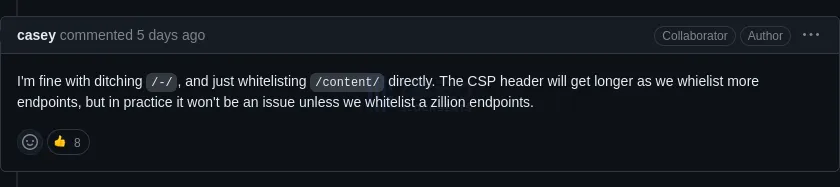
Recursive Inscriptions developer releases syntax update
Later, the community organization launched the v2 version of Recursive Punks, which corrected the syntax errors in the previous official version by replacing "/-/content/" in the original SVG file with the correct "/content/". The corrected version was burned relatively slowly but displayed the image of Recursive Punks correctly and clearly. The version was also burned after 24 hours. The community believed that the official version's data source was hosted on Github, which did not conform to the spirit of decentralization and misled the community. Therefore, the true Recursive Punks, which is the v2 version, was created.
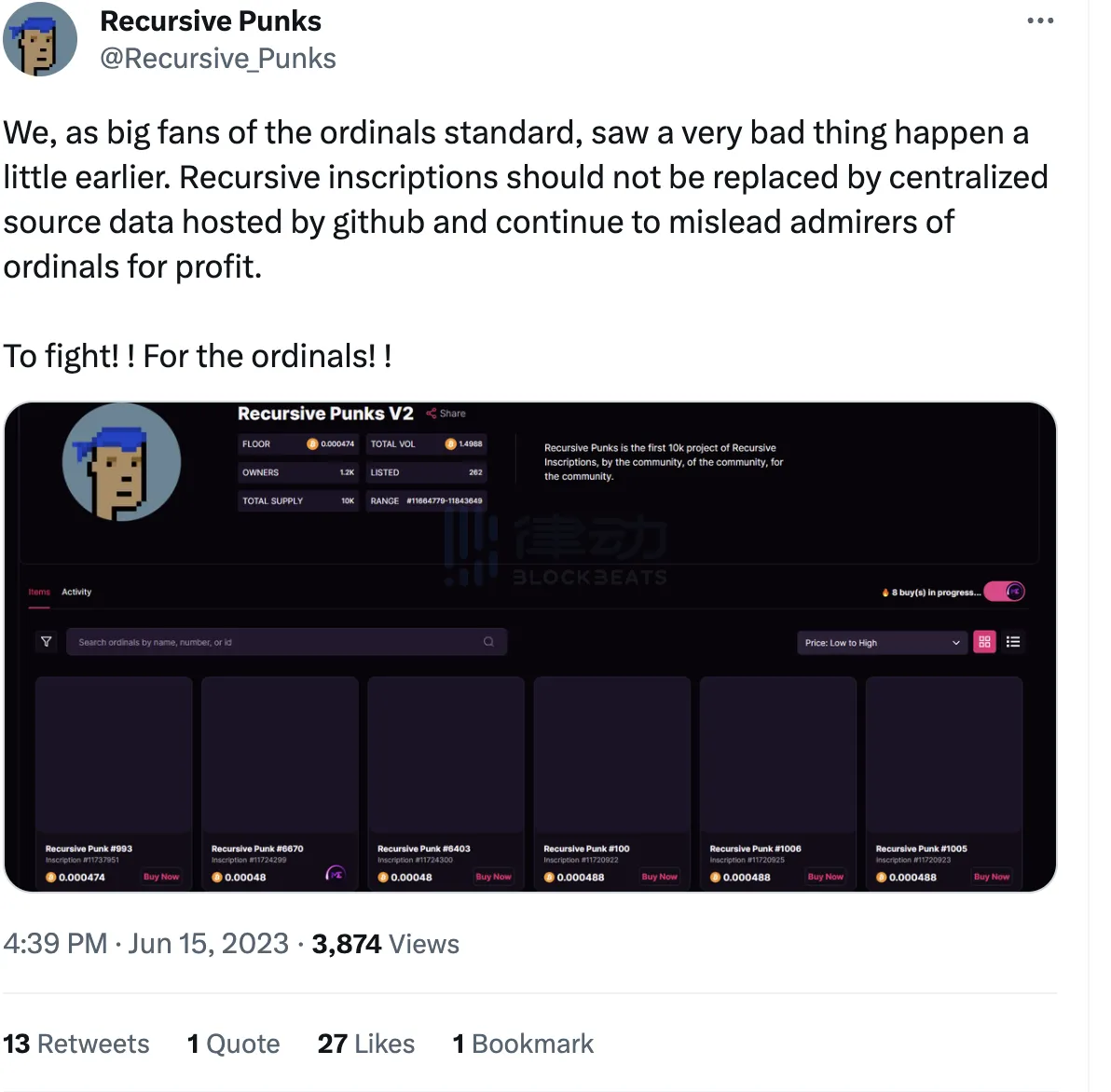
As a result, Recursive Punks now has two versions: the official release of version v1 and the community-initiated version v2. The v2 version has also been recognized by the official Recursive Punks, and in a tweet released by the official account, Recursive Punks expressed the hope that both the protocol developers and the community can recognize the imageless and image versions.
However, shortly thereafter, Recursive Punks deleted the tweet and promptly released a collection of imageless versions on MagicEden.
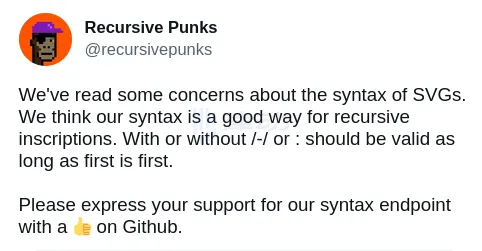
The official tweet that has been deleted
Surprisingly, Recursive Punks, which was originally unable to display images, now displays high-definition images on MagicEden. After code analysis, it was found that the official Recursive Punks website used front-end rendering instead of recursive inscription implementation.
However, as the debut project on the new protocol Recursive Inscriptions, the official release still has stronger and wider consensus. The following data speaks for itself.
MagicEden data shows that the Recursive Punks no-image series based on erroneous syntax burning had a total transaction volume of 8.15 bitcoins on the day of its launch, becoming the top-ranked series in terms of total transactions on the platform. Its highest price rose to 0.002 bitcoins, with the highest relative increase in burning cost reaching 30 times. In addition, multiple punks with rare attributes were sold at a price of 0.05 bitcoins. The number of holders also increased by more than 2,000 overnight.
In contrast, the community-initiated graphic version has been launched on the NFT platform Ordyssey. Although the number of holding addresses is constantly increasing, the total transaction amount is only 1.3 Bitcoin, ranking third in daily transaction volume.
Although criticized by some members of the community as fake recursive punk, stored on GitHub, and strictly speaking, this collection is not a recursive inscription, but it was officially released on the protocol earlier and was launched on the MagicEden market earlier. In the early stage of the Bitcoin ecosystem, when the NFT infrastructure was not mature and complete, whether it can be listed on the secondary market and whether it can be indexed will determine the development speed of the series and even become a key factor for its survival.
This further prompts us to ask, what is the true standard for being a real punk? Is it on the v1 of "first is first" or on the v2 that uses the correct recursive inscription code?
Pure on-chain recursive punk stored on Github?
Interesting enough, the first project on the so-called "Recursive Inscription" has nothing to do with recursion punk or the "Recursive Inscription" itself.
So, what is "recursive inscription"?
In fact, "Recursive Inscription" is based on the Ordinals protocol of the Bitcoin ecosystem. The Ordinals protocol was initiated by software engineer Casey Rodarmor in January 2023. It supports the engraving of data on Bitcoin in a unique way using the smallest unit of satoshis (or sats), generating Ordinals inscriptions similar to NFTs.
The rise of Ordinals has brought new possibilities to the Bitcoin network. Compared to Ethereum, images in the Bitcoin network are completely stored on the chain, making them permanent. The narrative of "permanently stored on the chain" is not only romantic, but also fills the Bitcoin ecosystem with unlimited imagination.
And Recursive Inscriptions, also initiated by the founder of Ordinals, is further developed on top of Ordinals.
Due to objective constraints, the inscriptions on Ordinals have an upper limit - they can only accommodate up to 4MB of capacity. However, recursive inscriptions can achieve higher storage efficiency while achieving interoperability, allowing the size of inscriptions to exceed the 4MB capacity limit of the Bitcoin block. This means that a large number of files, such as video games, movies, or complex software, can be directly hosted on the Bitcoin blockchain without relying on off-chain parsing. This innovation brings unlimited creativity to the Ordinals ecosystem and inspires people's imagination.
However, as the first recursive project "Recursive Punk" launched on Recursive Inscriptions, a mistake in the syntax format was made due to negligence, resulting in the Recursive Punks engraved by users showing up as blank. This means that this version of the punk is not truly a recursive inscription project, and therefore has nothing to do with the Bitcoin permanent chain storage represented by recursive inscriptions.
After the launch of Magic Eden, the front-end code was modified to display images properly. The code is not stored on the Bitcoin network or even on IPFS, but rather on a centralized hosting repository on GitHub. This is ironic for a project that emphasizes "storing on the Bitcoin permanent chain".
Despite this, as the first recursive project on Recursive Inscriptions, the "Recursive Punks v1" version was quite successful when launched. Not only was it forged in a short period of time, but its popularity even caused the website to crash at one point. After being listed on Magic Eden, the total transaction volume reached 8.15 bitcoins within a day, becoming the top series in terms of total transactions on the platform. Its highest price once rose to 0.002 bitcoins, with the highest increase relative to the engraving cost being 30 times. In addition, multiple punks with rare attributes were sold for 0.05 bitcoins, and the number of holders increased by more than 2,000 overnight. As of today, the trading volume is 13 bitcoins. The V2 version of Recursive Punks, which is also listed on MagicEden, has much less trading volume.
New things give birth to potential opportunities, but also mean huge risks, especially in the early stages when infrastructure is not yet complete. For the Bitcoin ecosystem, although NFT narrative injects new vitality into it, its immature infrastructure and unresolved disputes may cause the encrypted assets minted on it to be cleared instantly.
Especially for new projects launched on top of this emerging protocol, regardless of the legitimacy of the project itself, which depends on the community's judgment of the standards of true and false punks and the promotion and development of future community consensus, not to mention the underlying protocol "Recursive Inscription" protocol layer on which it relies, as well as the more controversial underlying Ordinals, have been resisted by Bitcoin core developers, who believe that the new use cases supported by these protocols will occupy the block space of the Bitcoin network, thus excluding more people from the Bitcoin network and hindering the adoption of encryption, which deviates from Satoshi Nakamoto's vision of Bitcoin as a peer-to-peer cash system.
The dependence on underlying protocols may lead developers to modify the original protocol, which can affect the functionality of the software and result in incorrect file storage hashes. Cryptocurrencies are a highly risky investment, especially when all underlying infrastructure is not yet fully developed and community consensus has not been reached. Blocktempo reminds everyone to think independently before investing and to DYOR (do your own research).
Source:
https://www.panewslab.com/zh/articledetails/v05mnz61.html
Welcome to join the official BlockBeats community:
Telegram Subscription Group: https://t.me/theblockbeats
Telegram Discussion Group: https://t.me/BlockBeats_App
Official Twitter Account: https://twitter.com/BlockBeatsAsia