Why does everyone want to regulate crypto?

Within less than a week, two of the world's largest cryptocurrency trading platforms were successively sued by the SEC, and more than ten mainstream cryptocurrencies were designated as securities and brought under SEC supervision. The SEC's strong "Power Move" against the cryptocurrency industry has shocked everyone, and SEC's current chairman, Gary Gensler, who is actually in charge, has become a veritable "Master of Destruction" in the cryptocurrency field.
In 2021, the appointment of Gary Gensler as the new SEC chairman was widely praised by the cryptocurrency industry. As a former MIT professor who taught blockchain courses, he was generally regarded as an ally of the crypto world in high-level positions. However, after taking office, Gensler has "changed his tune" and issued a series of strong regulatory signals against cryptocurrencies, making him the "culprit" of the crackdown on the crypto industry.
Why was there such a big difference before and after Gensler took office? "Lost money in speculation", "has a personal grudge with Binance" and other speculations often appear in the chat conversations of practitioners. On Wednesday night, a hearing in the US House of Representatives caught BlockBeats' attention. This was originally a hunt by regulatory agencies for cryptocurrency platforms, but unexpectedly turned into a condemnation of the SEC. It turns out that even in the "strictest" regulatory environment, there are obvious differences between regulatory agencies.
Looking back at the history of cryptocurrency regulation, we can see that behind Gensler's relentless attack on the coin circle is the escalating power struggle and endless infighting among US regulatory agencies. As a result, crypto has become a victim of the struggle and is facing unprecedented uncertainty and challenges from all sides.
变味的围猎
->
变味的围猎
After filing a lawsuit against the world's largest cryptocurrency exchange Binance on June 5th, the SEC did not give the industry even a day's breathing room. The next day, they filed the same lawsuit against Coinbase, which is listed on NASDAQ, and classified more than ten mainstream cryptocurrencies such as SOL, ADA, and MATIC as securities. From any perspective, this lightning strike against the cryptocurrency industry is a "Power Move" that the SEC is showing to the world.
As for the effect, this attack undoubtedly satisfied the SEC. Under regulatory threats, Robinhood immediately announced that it would delist Tokens defined as securities within a week. Binance.US, which faced additional asset freeze applications from the SEC, delisted hundreds of Token trading pairs in one night. However, in reality, it is difficult for the two lawsuits themselves to achieve any substantive results in the short term. The SEC is also very clear about this, after all, even the Ripple case has been dragging on for several years, let alone this time it is a showdown between the industry's top two players.
Interestingly, it's not just the practitioners in the encryption industry who are panicking after seeing the SEC's heavy-handed approach, but also their "peers" from the regulatory side. Perhaps the SEC is very clear that the target of its attack this time is actually someone else.
Hours after the SEC accused Coinbase of violating securities laws, the US House Agriculture Committee held a dual-panel hearing on the regulation of the cryptocurrency spot market. Rostin Behnam, Chairman of the Commodity Futures Trading Commission (CFTC), Paul Grewal, Chief Legal Officer of Coinbase, and Dan Gallagher, Chief Legal and Compliance Officer and General Counsel of Robinhood, all attended the meeting. However, the SEC became the target of everyone's criticism at the hearing.
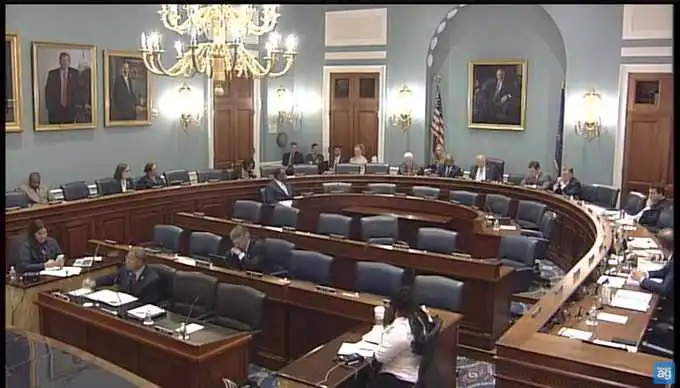
The committee straightforwardly asked the CFTC chairman whether the SEC should have complete control over digital assets, and Behnam's response was thought-provoking.
"This is not a zero-sum game, and the legislative or legal authority that the CFTC may obtain is not taken away from others," Behnam said. "But there is a regulatory vacuum, and there is a gap in the regulation of digital commodity assets." "The SEC has authority over assets classified as securities. However, in fact, the largest token, Bitcoin, is a commodity, as determined by US courts. And under US law, it is unregulated... Given that most of the cryptocurrency assets listed on trading platforms are rarely formally classified as commodities, there is an urgent need to give regulatory agencies additional power in the field of cryptocurrency commodities."
In this speech, the most noteworthy thing is Behnam's wording on cryptocurrency. He did not use the term "Digital Asset", but "Digital Commodity Asset". Behnam acknowledges that the SEC has regulatory authority over all assets classified as securities, but he does not believe that cryptocurrencies should be classified as securities. In his speech, Behnam also repeatedly hinted that only by allowing the CFTC to regulate cryptocurrencies as commodities can the regulatory vacuum in the industry be resolved.
Aside from the battle over the classification of cryptographic assets, the current regulatory enforcement mode of the SEC has also come under fierce criticism. Glenn Thompson, Chairman of the House Agriculture Committee, has taken a stand with the CFTC, stating clearly that "regulating through enforcement is not an appropriate way to manage the market, fully protect consumers, or promote innovation."
For Crypto, CFTC and SEC have torn their faces apart
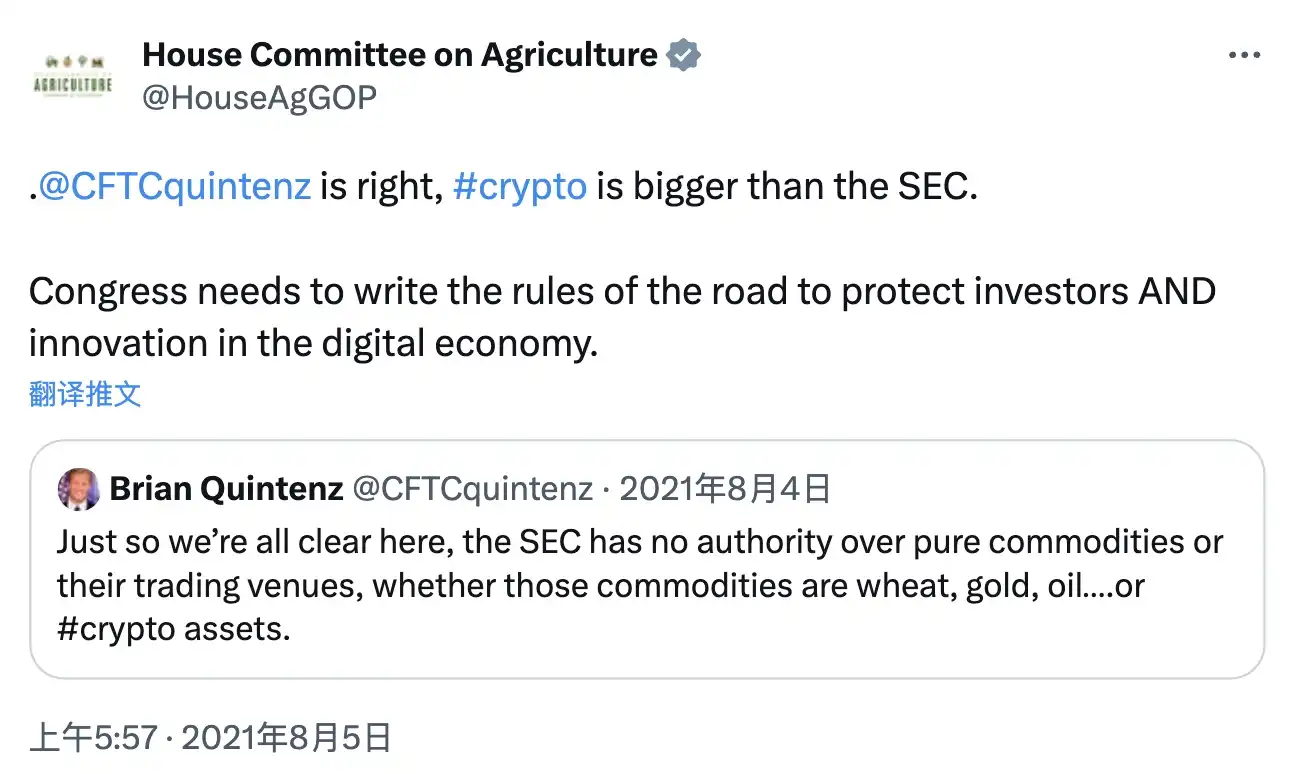
In fact, the confrontation between CFTC and SEC over cryptocurrency regulation has occurred more than once. In August 2021, when SEC called for an expansion of the regulatory scope of the cryptocurrency industry, Brian Quintenz, the then-chairman of CFTC, tweeted that cryptocurrencies are commodities and should be regulated by CFTC instead of SEC. He wrote in the tweet: "SEC has no jurisdiction over pure commodities or their trading venues, whether they are wheat, gold, oil, or crypto assets." Subsequently, the US House Agriculture Committee also immediately supported CFTC, stating that cryptocurrencies are beyond the jurisdiction of SEC.
Earlier, former CFTC Chairman Christopher Giancarlo also tweeted that CFTC has more experience in regulating Bitcoin and the crypto market than SEC. Giancarlo wrote: "If the Biden administration really wants to regulate the cryptocurrency industry reasonably, it needs to nominate a CFTC chairman."
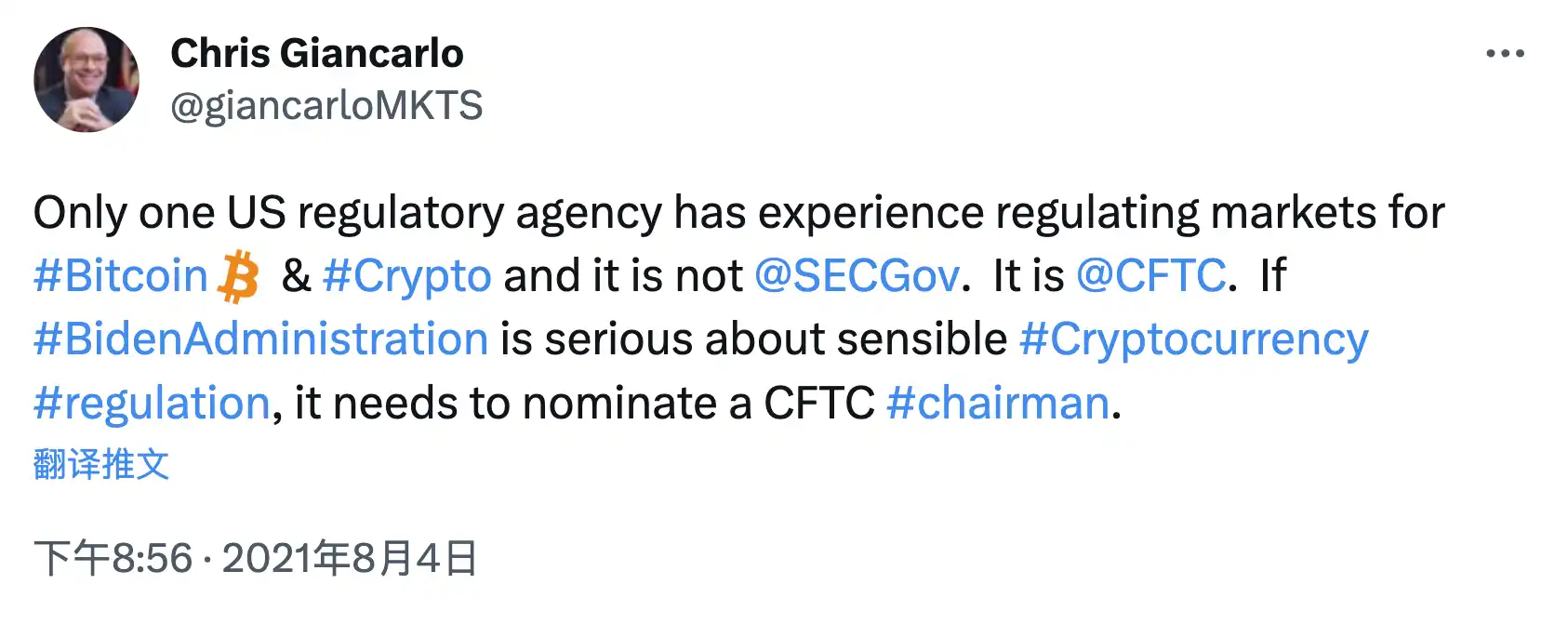
To some extent, Giancarlo's remarks are not problematic. In terms of jurisdiction over cryptocurrencies, CFTC's legal basis is indeed much clearer than SEC's. CFTC has always regarded cryptocurrencies as commodities under Section 1(a)(9) of the Commodity Exchange Act (CEA), within its regulatory scope. This interpretation has also been recognized by federal courts, so CFTC exercises regulatory authority over cryptocurrency derivatives and anti-fraud and anti-manipulation enforcement authority over spot cryptocurrency trading. Since 2016, many cryptocurrency giants, including Bitfinex, Tether, BitMEX, and Binance, have received fines from CFTC. From this perspective, CFTC does have more experience in regulating cryptocurrency platforms. (BlockBeats note, for more information on CFTC's fine records against cryptocurrency companies, please read "CFTC fines against cryptocurrency companies over the years".)
Looking at the SEC, its consistency in regulating cryptocurrencies is much lower. Before Gary Gensler took office, the SEC seemed uninterested in cryptocurrencies. The only clear action taken was against projects involved in initial coin offerings (ICOs), as this behavior clearly falls under unregistered securities issuance. However, the SEC has always been evasive in its attempts to regulate cryptocurrencies more broadly. Therefore, although the SEC's total fines in the cryptocurrency industry exceed $100 million, the fined entities are projects that have conducted token financing, such as Tezos, Block one (EOS), and Ripple, which seem to pose no threat in the eyes of the cryptocurrency industry.
After Gensler took over the SEC, there was a noticeable change in the situation, and the SEC's regulation of cryptocurrencies became more aggressive. In August 2021, Gensler, as the chairman of the SEC, spoke at the Aspen Security Forum, stating that many areas of cryptocurrencies are subject to securities laws and need to be regulated by the SEC. This statement immediately provoked a strong reaction from the CFTC, leading to the confrontation mentioned earlier. Gensler, however, remained unyielding and subsequently stated on multiple public occasions that the vast majority of tokens are securities and need to be placed under the SEC's regulatory jurisdiction.
On this basis, Gensler's "enforcement team" began a series of investigations into different tokens, and provided complex explanations of "investment contracts" based on the Howey Test, trying to push the narrative that "cryptocurrencies are securities" into the mainstream. On November 8, 2022, the US District Court in New Hampshire ruled in favor of the SEC in the case of accusing LBRY of issuing unregistered securities, and determined that the cryptocurrency LBC issued by LBRY is a security. The SEC has won an important victory in the "cryptocurrency securitization" battle and added new chips to its protracted tug-of-war with Ripple (XRP).
And then, the day after LBRY's victory, FTX collapsed. A super unicorn worth tens of billions of dollars disappeared in just 48 hours, which directly led to a regulatory battle between the CFTC and SEC. Both agencies took enforcement actions against SBF, accusing him of violating securities and commodity trading laws.
When accusing FTX executives Caroline Ellison and Gary Wang, the SEC believed that they manipulated the FTT token and explicitly described FTT as a "cryptocurrency security." The CFTC did not specifically state the legal status of FTT, but used examples of Bitcoin, Ethereum, and Tether as "digital commodity assets," implying the asset properties of FTT. The struggle for the interpretation of token properties is extremely intense, and CFTC Commissioner Caroline D. Pham even directly issued a statement condemning the SEC's actions as "an example of law enforcement regulation" and encouraging the CFTC to use all possible means to enforce commodity trading laws in the cryptocurrency field.
Supervision's "Cash Cow"
Why are regulatory agencies making a big fuss about cryptocurrencies?
Before the FTX crash, the authoritative community seemed to have reached a "new consensus" that Congress should establish a comprehensive regulatory framework for the cryptocurrency industry. For example, the Financial Stability Oversight Council (FSOC) recommended to Congress in October 2022 that legislation be enacted to provide regulatory agencies with the authority to develop rules for "non-security cryptocurrency assets". However, the committee did not provide a clear direction as to whether it should be the CFTC or the SEC.
Senator Debbie Stabenow and John Boozman introduced the "Digital Goods Consumer Protection Act" in August of the same year, defining cryptocurrencies such as Bitcoin as commodities, but did not provide detailed guidance on which encrypted assets should be classified as "securities". Obviously, this gives the CFTC more jurisdiction over encryption. The "Financial Innovation Act" launched by Senator Cynthia Lummis and others subsequently pointed out that the similarity between most digital assets and commodities is much higher than that of securities, further supporting the CFTC as the main regulatory agency for cryptocurrencies.
The two bills mentioned above have one very important thing in common, which is that both will allow the CFTC to raise funds by charging fees to cryptocurrency companies. And the "fee-raising" approach is exactly the power that the SEC has long held in the securities market. It should be noted that the fees charged by the SEC for securities trading and other market activities are the main source of its budget.
Since the US Congress significantly expanded the CFTC's responsibilities in 2009 to include swaps trading, its budget has not kept up with its expanded jurisdiction and still relies on appropriations from Congress. Therefore, compared to the SEC's budget of about $2 billion, the CFTC's budget of $300 million is a whole order of magnitude less. For an agency with a budget shortfall, the ability to have the right to "collect protection fees" is an absolute game changer.
Take SEC for example, a large part of its annual budget comes from fees charged by the securities market. These fees include registration fees (paid by companies when they publicly issue stocks or bonds), transaction fees (paid by securities exchanges and other market participants during transactions), and many other small fees. Of course, there are also various fines. Therefore, although its budget must be approved by Congress, SEC seems to never rely on appropriations from Congress.
Undoubtedly, the ability to collect user fees will greatly ensure the CFTC's effective fulfillment of its mission. The CFTC previously fined Bitfinex and Tether $1.5 million and $41 million, respectively. In 2021, the CFTC reached a settlement with BitMEX, which directly paid a $100 million fine to the CFTC, accounting for one-third of the CFTC's budget for that year.
As CFTC Chairman Rostin Behnam said, the regulation of cryptocurrency assets is in a vacuum state. Therefore, regulatory agencies that gain the upper hand can not only take the initiative and gain more power, but also obtain obvious benefits. For regulatory agencies, in the context of the serious fiscal deficit in the United States and the national discussion of the debt ceiling, finding their own "cash cow" is becoming increasingly important.
Welcome to join the official BlockBeats community:
Telegram Subscription Group: https://t.me/theblockbeats
Telegram Discussion Group: https://t.me/BlockBeats_App
Official Twitter Account: https://twitter.com/BlockBeatsAsia

 Related Articles