4D Long Article: The History of Cryptocurrency Regulation in the United States
Author of the original article: yikiiiii.eth

Preface
With Bitcoin The price fell below $30,000, half of its peak last November, and another round of the cryptocurrency bull market came to an end. As the saying goes: One day in the currency circle, one year in the world. Today, the encryption industry with a market value of more than 1 trillion has a history of less than 15 years, and each cycle is a combination of new technologies and new narratives, attracting new blood to join.
This round of bull market ended in the narrative of web3. The so-called web3 refers to the next generation of the Internet. Its content is not only readable and writable, but also owned by users. Just a few weeks before the market crash, Internet employees in the media were still discussing whether they should resign and devote themselves to web3, and college students were chatting about whether they should drop out of school, all in crypto (all in crypto)—and so on, It all sounds like the last bash before the party ends.
Blockchain and cryptocurrencies have actually had a long and difficult journey from their infamous beginnings to what is now called the future of the internet. Looking back at history, from the birth of Bitcoin to the present, the blockchain has gone through three historical forks:
The first is to choose Bitcoin or Ethereum;
The second The first is to choose a consortium chain or a public chain;
The third is the choice of regulators in different countries: to ban cryptocurrencies, or to support them as a potential source of growth.
Why is Ethereum ushering in the dawn of the encryption world? Why did the market finally choose the public chain instead of the consortium chain? What is the greatest value of blockchain or Crypto?
How did cryptocurrency go from the ground to the surface and finally become a national development strategy?
In order to answer these questions, let us review the history of blockchain development and the accompanying dramatic changes in US regulatory policies. This is not only about new technology and its application, but also a game between regulators and innovators.
Genesis Block": The Creation and Early History of Bitcoin and Ethereum
< /p>
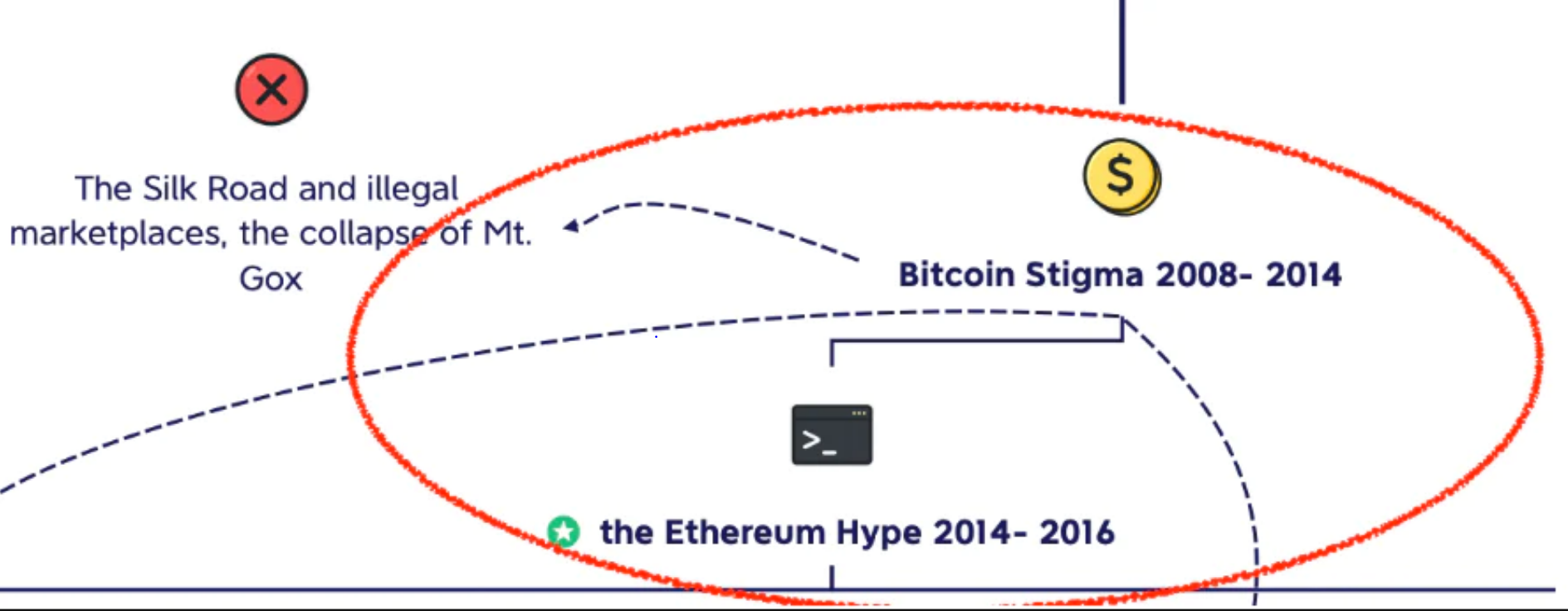
The Stigma of Bitcoin: Illegal Markets and Broken Exchanges (2008-2014)

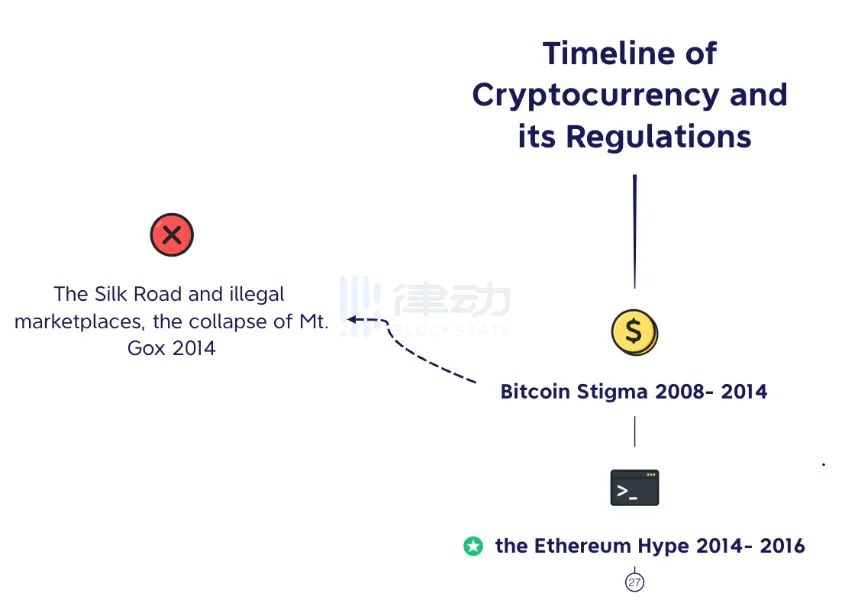
In the financial crisis of 2008, Satoshi Nakamoto invented Bitcoin. Initially In those days, Bitcoin was mostly used in the illegal market and drug trade, so it was surrounded by doubts, and no serious person would take a look at it.
The underlying technology of Bitcoin is the blockchain, which is a peer-to-peer network that uses cryptography and proof-of-work mechanisms for public bookkeeping. This mechanism makes all records valid without third-party supervision , while preventing double payment.Blockchain technology has created a digital currency like Bitcoin, which not only does not require any third-party financial institutions, but is also completely digital, beyond the boundaries of countries or companies.
< /p>
At the time, very few people were optimistic about Bitcoin. Such a permissionless financial vision sounded too radical. However, the absence of third-party institutions also means the absence of supervision. Some people began to use This feature of Bitcoin is for illegal profit.
Silk Road is a typical representative of the illegal market for Bitcoin transactions. It is an anonymous website launched in 2011 , used to trade drugs and other illegal items. In March 2013, the site had 10,000 products for sale by vendors, generating millions of dollars in revenue. And these transactions were all conducted in Bitcoin, making them almost impossible to trace. These The black market, populated by money launderers and drug dealers, has raised public concerns about the misuse of cryptocurrencies. It has also drawn the attention of regulators. Silk Road was shut down twice by the FBI in 2013 and 2014, and its founder Sentenced to life imprisonment.
This is the beginning of the game between cryptocurrency and regulation. This shows that a so-called decentralized network will never live in a vacuum, it must deal with the real legal system.
When people were still worried about the black market and money laundering, Bitcoin was hit hard again. In 2014, Mt. Gox, the largest Bitcoin exchange at the time, which once accounted for more than 80% of global Bitcoin trading volume, collapsed. On February 7, 2014, the Japan-based company announced it was halting all bitcoin withdrawals after it discovered that hackers had stolen millions of its assets through a software bug. When Mt. Gox filed for bankruptcy at the end of the month, it had lost nearly 750,000 customers' bitcoins, as well as about 100,000 of its own bitcoins, a total of about 7% of all bitcoins, worth about 473 million at the time of filing Dollar.
Bitcoin prices plummeted as the largest exchange platform halted trading activity. The incident has drawn public attention to bitcoin and has drawn harsh criticism for the cryptocurrency's insecurity and opacity. What's more, some critics began to question the necessity of Bitcoin's creation - its promise of decentralization and trustlessness. If for non-developers, Bitcoin is destined to need to rely on a centralized exchange, and these exchanges lack supervision and bring such huge losses to investors compared with traditional finance, then the meaning of its existence is what?
This is what it was like in the early days of Bitcoin, filled with dark stories and notorious gossip. At the same time, as Bitcoin has grown, regulators have paid closer attention to it. However, the main goal of regulators is to prevent damage to society, just like catching thieves. Blockchain technology seemed to only bring about digital currency for circumventing the existing legal system, and nothing useful for the real world—until Ethereum came along.
Ethereum Mania: Beyond a Single Financial Function (2014-2016)
Inspired by Bitcoin and blockchain technology, many developers began to think about how to popularize distributed The concept of the ledger allows it to be used in more valuable places other than currency.
These so-called "Bitcoin 2.0" include colored coins that allow users to create their currency on the Bitcoin network. Some protocols such as Mastercoin also provide specific functions such as financial derivatives. At the same time, the centralized transaction problem exposed in the Mt.gox incident also promoted the development of the blockchain, and developers launched Ricardian contracts ('smart contracts') to make peer-to-peer transactions possible. However, some developers are beginning to realize that the real key to solving these problems lies in innovating the entire Bitcoin infrastructure.
During 2013 and 2014, Russian-born 19-year-old Vitalik Buterin introduced the world to his project - Ethereum, as he described it , which is "a cryptocurrency network intended to be as ubiquitous as possible, allowing anyone to create specialized applications on it for nearly any purpose imaginable". Vitalik has big ambitions.
The Bitcoin protocol is not advanced enough to create usable applications and is limited to specialized financial applications. The revolution of Bitcoin should not be Bitcoin 2.0, which is simulated or built on the Bitcoin protocol, but a brand new idea of creating a Turing-complete scripting language, making it general enough to do any blockchain-based encryption Things that money might do.
Ethereum aims to be a superior underlying protocol and allow other decentralized applications to be built on top of it, not Bitcoin. Ethereum gives developers more tools to reap the full benefits of Ethereum’s scalability and efficiency,’ Vitalik said. Ethereum was created to capture all imaginations. Just like Javascript is a programming language that supports writing any kind of arbitrarily complex application, Ethereum is such a general-purpose scripting language that can use the blockchain to create anything.
For the first time, blockchain enthusiasts see a whole new future for this technology outside of finance. With Ethereum, it can be anything. When Ethereum began selling its first cryptocurrency in July 2014, investors who had been waiting for more than a year bought $2.6 million worth of "Ethereum" tokens overnight. Ethereum is reportedly the "most hyped digital currency since Bitcoin," while Vitalik Buterin is considered the most important figure in cryptocurrency since Satoshi Nakamoto. In 2016, 22-year-old Vitalik was named to Fortune magazine's "40 Under 40" list, which recognizes the year's most influential young leaders.
A tale of two blockchain cities: IBM's consortium chain and DCG's public chain
IBM and alliance chain: a brave but unsuccessful attempt (2015) :

Although Bitcoin and Ethereum the blockchain As the (programmable) financial infrastructure of the future society, big companies and conservatives still have reservations about these tokens outside the law. However, they also acknowledge the value of blockchain technology as a public ledger that can enhance efficiency.
In late 2015, IBM, Intel, JPMorgan Chase and several other big banks announced their intention to form the Open Ledger Project with the Linux Foundation . The goal is to use blockchain to "reimagine how supply chains, contracts and other information about ownership and value are exchanged in the digital economy."
Soon in February 2016, the Linux Foundation announced the launch of the Hyperledger Project, an open source project to advance blockchains for recording and verifying transactions technology. The 30 founding corporate members include IBM, Intel, JP Morgan, Accenture, Blockchain, CME Group, ConsenSys, and more. IBM's Hyperledger Fabric and Intel Hyperledger Sawtooth were the first projects incubated by Hyperledger. There are two main differences between Hyperledger and other blockchains such as Bitcoin and Ethereum.
First of all, Hyperledger does not launch a cryptocurrency, but wants to use blockchain technology to create tools to build a distributed ledger for real-world industrial needs. For example, exchanging car titles in seconds or paying retail suppliers on sale. Second, Hyperledger technology is not open to everyone. Only companies selected by the user community can access the ledger, generate transactions, and even do authentication work. In contrast, in the Bitcoin network, every miner can generate transactions, and there is no option to reject them.
This kind of blockchain is called alliance chain, only pre-approved nodes can participate in it, and it is usually used to establish a consensus system between organizations. The public chain, on the other hand, is Bitcoin, which can be accessed by anyone with an internet connection. This is how big corporations are cautiously embracing blockchain while opposing Bitcoin. "I don't have a strong opinion on cryptocurrencies, but I do endorse blockchain as a solution for contracts and supply chains and the Internet of Things," said IBM researcher Jerry Cuomo. "I think bitcoin is an interesting application of blockchain, but there are thousands of applications and wider use cases beyond that."
However, contrary to the rapidly growing market value of public chains, alliance chains struggle to earn revenue and are gradually abandoned by the market. More than 15 members reduced their funding for Hyperledger or left the project in 2017, including the CME Group and Deutsche Börse, the stock exchange operator. In December 2017, with the price of Bitcoin hitting a record $18,000, funding for cryptocurrency and blockchain startups increased rapidly. In contrast, the alliance chain has not yet had a successful large-scale project, which may explain the reason for Hyperledger's financing and members' departure.
DCG and public chain: Open the door for institutional investors to buy coins (2012-).

In addition to the alliance chain, large companies Also looking for other ways to participate in this new trend. In 2015, Visa, American Express and Nasdaq all expressed interest in blockchain and invested in related companies such as Chain, an enterprise platform for developers to build on top of blockchain.
MasterCard has taken a more radical step. In October 2015, it invested in Digital Currency Group, a firm led by SecondMarket founder Barry Silbert that invests in bitcoin and digital currency companies. This is the first time MasterCard has invested in digital currency, and it will prove to be a successful decision in the future, reaping huge profits.
Digital Currency Group (DCG) and its founder Barry Silbert are starting to take the blockchain stage. Since 2012, they have built and even led the industry, working tirelessly to convince regulators and educate the public.
How Barry Jumped Down the Rabbit Hole
As a banker in the traditional financial field, Barry Silbert founded Restricted Stock Partners in 2004 and changed its name to SecondMarket in 2008 to trade various types of illiquidity Secondary markets for assets, including bankruptcy claims, startup stocks, private company stocks, government IOUs, and more. It wasn't until 2012 that Barry made up his mind to expand his portfolio into Bitcoin. Barry first heard about Bitcoin in 2011 in an article about Silk Road. As a fintech entrepreneur, he didn’t initially look at Bitcoin from a technical perspective, but decided to do research on it after reading Charles’ book, The Unconventional Guide to Investing in Difficult Times. In the shadow of the post-financial crisis (Lehman Brothers in 2008 and the Greek debt crisis in 2010), Barry believes there will be uncorrelated alternative assets that will do well in a possible round of another financial disaster.
While he believes Bitcoin may be a promising alternative asset, Barry remains skeptical about its lack of regulation and many other flaws . It took him 6 months to accept Bitcoin. At first it was dismissive, then skeptical, then curious, and after ample research and actual investment, finally concluded in 2012 that Bitcoin might actually have the potential to save the world. He then started working as an evangelist, helping to spread the use of Bitcoin. He made friends and employees use bitcoin as much as possible, such as using bitcoin to buy Amazon gift cards.
However, this is clearly not enough. Barry quickly realized that in order for Bitcoin to be successful, you had to have wallets, exchanges, and many other things in the cryptocurrency ecosystem. So he switched from Bitcoin to investing in related companies, including CoinLab, Bitpay and more.
For Barry, investing the money earned from investing in BTC to invest in Bitcoin infrastructure is the most important and wise decision. This is not only because the infrastructure is crucial to the success of Bitcoin, but also because investing in a good digital currency company can not only enjoy the dividends of Bitcoin, but also diversify the risk of only investing in Bitcoin. Even if the final success is not Bitcoin but other coins, he can also benefit from it.
Attracting Big Money: Making Cryptocurrency Investing Easy and Safe
In 2013, Barry founded the Bitcoin Investment Trust (GBTC) with SecondMarket, along with Chamath Palihapitiya from Social Capital, Lawrence Lenihan from FirstMark and former Congressional Councilman Scott Murphy. They bought $3 million in bitcoin for around $100, and ended up making hundreds of millions of dollars on that investment.
In 2015, SecondMarket was sold to Nasdaq, and Barry resigned from SecondMarket to form Digital Currency Group (DCG). The goal of DCG is to invest in companies in the digital currency and blockchain ecosystem to promote a better financial system. It originally consisted of two businesses: Genesis, an over-the-counter bitcoin trading firm, and Grayscale Investments, a digital currency asset manager that manages a diversified portfolio of GBTC and other digital currencies. DCG’s first round of investors are well-known large institutions, including CME Ventures, FirstMark Capital, which has invested in the blockchain, and Bain Capital Ventures, CIBC, MasterCard, New York, which has never touched the blockchain. Life and many other traditional companies, for whom DCG is the first investment in the digital currency and blockchain space.
In 2016, DCG began to make its debut. Of all the 1.3 billion financing in the blockchain industry that year, 70% were raised by companies invested by DCG. In addition to venture capital, the more important value of DCG is to solve problems for institutional investors in terms of compliance. Few people know how difficult it is for institutional investors to buy Bitcoin. From registration, purchase, transfer to storing cryptocurrency, each step requires a lot of compliance work. However, DCG, through Grayscale Investments, offers businesses an easy way to get involved in the industry. By investing in Grayscale Bitcoin Trust, Ethereum Trust, or any other Grayscale product, businesses can purchase digital currencies indirectly, legally, and securely, with every filing or service they need. Grayscale opens the door for traditional investors to buy crypto assets. It not only makes it possible to invest huge sums of cryptocurrency, but also provides an active two-sided market OTCQX for all kinds of investors to buy or sell.
In 2015, GTBC was listed on OTCQX, the most regulated OTC exchange in the United States. Since 2017, GBTC has been continuously rated as the top 50 best-performing target in the OTCQX market, with a return rate of 26,293% from 2013 to 2021. With the entry of large companies, Grayscale has also ushered in an astonishing growth rate. Its asset management scale will reach 31 billion in 2021, which is 6 times that before 2020. One of the most important things we can learn from DCG’s history is the importance of regulation and compliance to cryptocurrency promotion. Then we'll see how DCG, its partners and portfolio continue to convince regulators, and how lawmakers gradually change their minds.
The Path to Mainstream: USDC, Blockchain Associations and Warnings from Venezuela
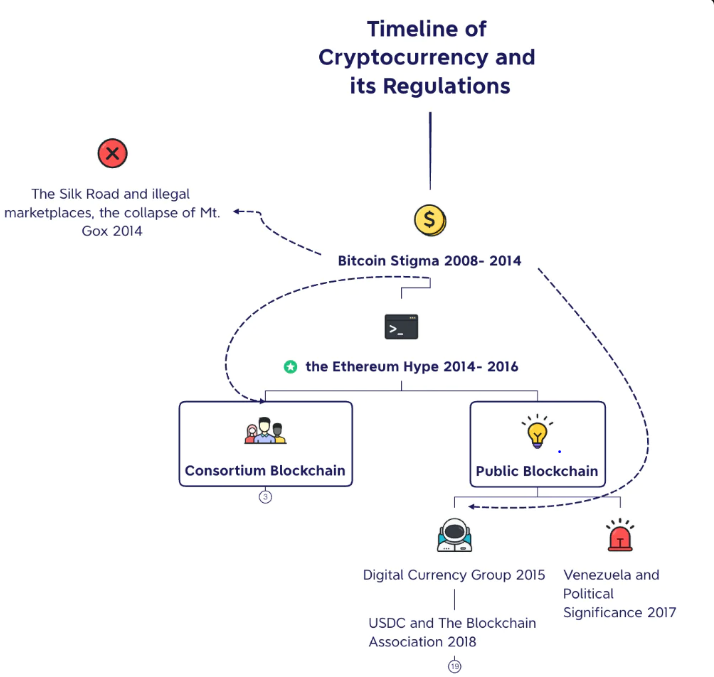
USDC and the Blockchain Association: Proactive compliance and lobbying, and therefore business opportunities (2018)
< br>
In March 2014, DCG invested in Circle, a peer-to-peer payments company for easily exchanging, storing, sending and receiving Bitcoin. At that time, mobile payment was just beginning to become popular, and many companies, such as PayPal's Venmo, were doing business in linking bank accounts with user personal information. And Circle cut into the bitcoin transfer business, providing a more convenient option for international remittances. But compared with the stable price of fiat currency, paying with bitcoin is too volatile. Not only that, but fiat-to-crypto conversions are also a problem.
These are exactly the problems Circle wants to solve. In 2018, Circle launched the U.S. Dollar Stablecoin (USDC), a fiat-collateralized digital currency that can be redeemed for $1 at any time with 1 USDC. USDC has both the efficiency of digital currency and the stability of legal currency. As a programmable digital currency, it can be circulated frictionlessly and safely converted to fiat currency, driving the development of projects and businesses around the world. At the same time, it provides functions such as on-chain transactions, lending, risk hedging, etc., giving developers a choice to use real-world currencies in blockchain applications. All of these benefits, though, are based on its soundness in terms of regulation and compliance. Therefore, from the beginning, Circle realized that sound governance and transparent compliance were its primary concerns.
Circle’s predecessor, Tether (USDT), was investigated for being suspected of having insufficient reserves. Following its lessons, USDC is required to maintain a full reserve of corresponding fiat currencies and operate in cooperation with various financial institutions. Circle and Coinbase created the Center Alliance to develop open standards for stablecoins. The conditions for becoming an issuer include licensing, compliance, technology, operations, custody of fiat currency reserves, and many other audits.
During 2020 and 2021, as the price of Bitcoin rises from $7,000 to over $60,000, compliant stablecoins will continue to grow with institutional investors. Influx and increased demand. The market value of USDC has grown from 500 million in 2020 to 53 billion in 2022, second only to USDT. One of the most important factors in USDC's success is its awareness of how critical compliance is in the so-called decentralized cryptocurrency market, because compliance can greatly stimulate cryptocurrency adoption and market expansion. In addition to its own business, Circle has also worked hard to persuade lawmakers, calling for clear standards for the industry.
In 2018, the Blockchain Association was formed, whose members include Circle, Coinbase, Protocol Labs, DCG, and Polychain Capital. This is a non-profit trade association based in Washington, D.C. that aims to engage policymakers in dialogue and drive meaningful change in the blockchain ecosystem. In 2019, Circle CEO Jeremy Allaire was the only cryptocurrency industry representative to testify before the Senate Banking, Housing and Urban Affairs Committee on the industry's need for regulatory clarity. Some of his points include that it is impossible for governments to ban cryptocurrencies because they exist everywhere the internet exists. Second, clear regulations are very important for the promotion of cryptocurrencies, and policies should keep up with the pace of innovation, otherwise the United States will fall behind and will not be able to reap the economic benefits of blockchain technology.
Through the efforts of entrepreneurs and their conversations with policymakers, regulators from Congress to the SEC are gradually changing their minds about cryptocurrencies. Bitcoin emerges from the stigma of illicit transactions as a noteworthy innovation that could benefit the country and even the world.
Cryptocurrency as a Weapon: Helping Venezuela Escape U.S. Economic Sanctions (2017)
International conflicts take cryptocurrencies out of the fintech industry, show their political significance, and make regulators realize they have to act.
Venezuela is a resource-rich country in South America. Sitting on huge oil reserves. Oil has fueled Venezuela's rise and largely underpins its exports and government revenue. However, due to poor policies and political instability, the country struggles with hyperinflation, shortages of basic goods, serious crime and corruption, and other livelihood crises. In 2016, the Venezuelan economy shrank by 8%, and inflation was as high as 481.5%. U.S. sanctions have made the situation worse. Since 2017, the United States has announced sanctions in and outside Venezuela against people, businesses, and oil entities associated with the Maduro regime, which later became Venezuelan president in 2018.
In 2018, the United States further imposed broader economic sanctions and a financial embargo on Venezuela, including banning the export of crude oil from Venezuela and excluding the country’s financial system from Outside of SWIFT. As hyperinflation and U.S. sanctions roiled Venezuela’s economy, cryptocurrencies emerged as a weapon and a tool. People use it to send remittances, protect wages from inflation and help businesses manage cash flow in rapidly devaluing currencies.
In 2017, Venezuelan President Maduro announced the launch of the state-backed cryptocurrency petro, which can be used to pay retirees in small amounts and was promoted by the government as Currency exchanged for oil and gold. In addition to petro, other mainstream cryptocurrencies are also used as daily payment tools. Even restaurants and supermarkets accept Bitcoin as a payment method. "No one is going to tell you 'every night when we do the accounts, we convert bolivars [Venezuela's base currency] into bitcoins,' but that's what's happening," said the economist interviewed by Reuters. and financial expert Olmos said.
In 2020, the United States amended its executive order to add cryptocurrencies to the list, further prohibiting Americans from transacting with any digital currency issued by the former Maduro regime . Meanwhile, businesses paying with Bitcoin, Ethereum, or any other cryptocurrency could also be sanctioned by the U.S. government. However, can it succeed? Contrary to the big banks, cryptocurrency is borderless, decentralized, a virtual space not controlled by a single government. In June 2021, Bolivar's business was up 75% on Binance, the world's largest cryptocurrency exchange with employees in 40 countries and no headquarters. For the first time, the U.S. government has encountered its own economic sanctions against other countries being circumvented, and it is still through cryptocurrency. Venezuela has sounded the alarm for the U.S. government that cryptocurrencies are not just a business or a technology, but a weapon that has the potential to undermine its political power on the global stage.
Embrace supervision and strive for legal status. Regulatory Outbreak, FTX, Solana & Biden's Big Donor SB

After a regulatory crackdown, the fight for legality (2019)
After the Mt.gox exchange hack in 2014 and the ICO (Initial Coin Offering) scam in 2017, the world of cryptocurrencies has become increasingly Many people are trying to figure out how to ensure the existence of basic rules in a space without government.
Cryptocurrency exchanges jumped at the chance. In January 2019, along with other exchanges such as OKEx and KuCoin, Binance reopened its platform for IEOs (Initial Exchange Offerings), providing additional security and reliability for tokens on its platform to be traded and bought and sold . IEOs are the hottest token fundraising trend of early 2019. Through commissions and transaction fees, exchanges earn huge profits as intermediaries between buyers and sellers, and act as judges when listing new startup tokens.
Exchanges face a trade-off: List more tokens for high fees, or list fewer tokens for higher fees High reliability. While Binance CEO Changpeng Zhao said they have been working hard to be the most ethical exchange in cryptocurrency, regulators do not believe that a private company driven by profit can bear public responsibility.
Unsurprisingly, regulators were quick to act.
In July 2019, Binance was banned from operating in the US and opened Binance.US to comply with local laws. After announcing that it was reviewing user accounts to ensure they complied with Binance's terms of use and know-your-customer (KYC) procedures, it then said, "Binance cannot provide services to any U.S. person." Meanwhile, cryptocurrency exchange Bitfinex and the largest New York's stablecoin Tether has been charged by top New York lawyers investigating whether it held a dollar in cash for every tether token it issued. Bitfinex used at least $700 million from Tether's cash reserves to cover up $850 million in losses, New York's attorney general said.
Cryptocurrency issuers are also concerned about whether U.S. regulators will consider their token a security - subject to the Strong constraints of securities laws.
On April 3, 2019, the SEC published a framework in which the criteria for a token to be considered a security is to pass the Howey test. To be considered a utility token rather than a security, the token must be used only for consumption, greatly limiting the usefulness of utility tokens. According to the Howey test, tokens are considered securities by regulators when there are funds invested, a common enterprise, and a reasonable expectation of profits from the effort.
Under the severe crackdown of regulation, American cryptocurrency entrepreneurs have a deeper understanding of the value of compliance. They are constantly lobbying regulators, explaining the benefits of cryptocurrencies and their irreversible trends. As they press for regulatory certainty to ensure American leadership in finance and technology, they are also fighting for their own legitimacy.
At the end of July 2019, representatives of the cryptocurrency industry, finance, and law testified before a Senate committee, introducing the types, infrastructure, applications, and Potential advantages and disadvantages of a currency. While Circle's CEO argues for its innovations in payment systems and calls for regulatory clarity the industry needs, the senator's main concern is if these public-good financial infrastructures are handed over to Wall Street or some tech firms. , could give them the opportunity to squeeze even more profit out of ordinary Americans, and would destroy this critical public infrastructure.
However, this is not to say that regulations can only be black and white, or that there should be as many regulations as possible. Instead, the immediate priority is to clarify and adapt regulations to a new asset class, thereby providing regulatory certainty to consumers and businesses in the cryptocurrency market. Especially given international competition, some countries like Singapore have embraced enlightened regulation as a way to attract cryptocurrency businesses and tech talent.
For these digital assets that cannot be banned, US regulators are beginning to realize that this is a problem they must solve, because if they, as a country, are not in this Technologically ahead, China or other countries will do the same.
Institutional Investors Influx, Cryptocurrencies Explode (2021)
After Years Cryptocurrency enthusiasts have made their voices heard by regulators. More importantly, a large number of institutional investors have poured into this field, and therefore joined the team of lobbying for regulation out of their own interests.

In Q2 2019, institutional trading volume on Coinbase surpassed retail volume for the first time. In every quarter since then, the exchange’s institutional trading volume has surpassed its retail volume. In 2021, with another bull market on the horizon, there will be a positive turning point in U.S. cryptocurrency policy.
In February, U.S. President Joe Biden nominated Gary Gensler as chairman of the U.S. Securities and Exchange Commission (SEC). Before working at the SEC, Gensler was a professor at the Massachusetts Institute of Technology, teaching a class on "Blockchain and Currency." He is considered an expert on digital monetary policy and is relatively friendly to cryptocurrencies.
Shortly after, there were several milestones in the cryptocurrency industry, which expanded the participation of institutional investors to Grayscale (GBTC, etc.) products and the CME futures market outside.
In April, Coinbase, the largest cryptocurrency exchange in the United States at the time, was listed on the NASDAQ stock exchange, marking the first major cryptocurrency companies. The listing of Coinbase opened the door for traditional investors to invest in digital currencies in an indirect way, which is a landmark moment in the field of cryptocurrency.
In October 2021, the first official Bitcoin-linked ETF (Exchange Traded Fund) - Proshares Bitcoin Strategy ETF (BITO) to acquire US securities Exchange Commission approved and listed on the New York Stock Exchange. As a Bitcoin ETF, BITO buys and holds Bitcoin against Bitcoin performance, which not only provides a familiar way to earn Bitcoin returns, but also provides the liquidity and transparency of an ETF.
In addition to the SEC, many other politicians and regulators are focused on strengthening market integrity and fostering innovation. CME has added to their stablecoin futures, launching ETH futures and micro BTC futures for smaller investors.
The New York Attorney General's Office reached a settlement with Bitfinex and Tether, ending a closely watched two-year investigation into the stablecoin issuer's reserves that has implications for the cryptocurrency industry had a major impact. Under the terms of the settlement, Bitfinex and Tether will not admit to any wrongdoing, but will pay $18.5 million and provide quarterly reports on their reserves over the next two years, a verdict that bodes well for Tether. The mayor of Miami is even marketing his city as a hub for cryptocurrency innovation, offering to pay public employees and receive taxes in cryptocurrencies. Cryptocurrency exchange FTX has also won the naming rights to the home of the Miami Heat.
Crypto ushers in a Cambrian explosion in 2021 as regulations provide more access and certainty to the market. Many traditional financial services firms have resumed cryptocurrency trading jobs that had been put on hold since the ICO bubble burst in 2017, including Goldman Sachs, Morgan Stanley and BNY Mellon. At the same time, Tesla, Microstrategy, Meitu, Paypal, Visa and many more enterprises and merchants adopt cryptocurrencies as their asset reserves.
Institutional investors as a group traded $1.14 trillion in cryptocurrencies in 2021, up from $120 billion the year before, according to Coinbase , more than double the $535 billion held by individual investors. What's more, mainstream hedge funds have also started pouring billions of dollars into cryptocurrencies.
Regulators are actively investing energy in researching this new market and proposing regulations that both regulate and foster a promising industry. Like every advancement society makes, this won't be fixed once and for all. Regulators will always keep pace with technology as it evolves and new issues arise. In 2022, with the collapse of the stablecoins UST and LUNA and the volatility of USDT, the US Securities and Exchange Commission revealed plans to double the size of its encrypted assets and network division, and expressed its determination to promote more cryptocurrency regulation, especially for Regulation of stablecoins.
Win-win cooperation: mainstream funds invest in FTX and Solana
In addition to promoting supervision, The government can also deeply participate in the development of the industry in the form of investment. Throughout the process of the rise of cryptocurrency, the United States has carried out in-depth participation and cultivation, and finally benefited from this industry.
FTX is how the United States invests An example of new technology to extend its dominance. At the same time that Binance was ousted by the U.S. government in 2019, another cryptocurrency exchange, FTX, was established and subsequently overtook Coinbase to become the second-largest cryptocurrency exchange by trading volume in just two years.

Bahamas-based FTX was founded by Samuel Bankman-Fried (SBF), a former trader at quantitative trading firm Jane Street. FTX has developed extremely rapidly, and its valuation has soared from 1.2 billion in 2020 to $25 billion in October 2021, an increase of nearly 40% from the last round of financing in July.
While FTX is celebrating its fundraise, Binance is in a tussle with regulators, leading to multiple European payment processors ceasing business with the cryptocurrency exchange exchanges, seriously affecting the operation of key functions of Binance.
Compared to Binance's historical grudges with regulators, FTX appears to be more comfortable building relationships with regulators. SBF's parents are law professors at Stanford University.
In July 2021, when asked about the strategy of government relations, SBF said that he believes that the goal of many regulators is not to bring down companies, but to find ways to help the industry develop while at the same time Also secure their control in industries they deem important. This is exactly what the U.S. government is looking for: to have control and grow its own great businesses in this strategically important industry.
FTX has made huge strides in cooperating with US regulators as Binance was expelled to Singapore and the United Arab Emirates. In 2020, SBF contributed $5.22 million to Biden, making it one of the largest contributors to his presidential campaign. FTX has also been attracting larger mainstream investors. According to The Information, its latest round of funding includes the Ontario Teachers' Pension Plan Board, Tiger Global Management and BlackRock, all of which received huge sums as FTX's valuation soared 25-fold in less than three years. return. Some large funds also doubled down. Singapore government-owned Temasek Holdings and Sequoia Capital have investments in a July Series B round and an October 2021 round. The success of FTX in the US shows that the relationship between cryptocurrencies and regulators is not a zero-sum game, but a potential win-win cooperation.
Mainstream investors in the U.S. have also benefited from investing in some successful cryptocurrency businesses and start-ups. USV is one of the best venture capital firms in the US established in 2003, and its LPs (Limited Partners) are some of the largest mainstream investors in the US, such as Massachusetts State Pension Reserve, University of Texas/Texas A&M , and the Washington State Board of Investments.
USV dabbled in cryptocurrencies earlier than most. It invested in Coinbase in 2013 and owns 8.2% of its Class B shares when it launches a direct offering in 2021. Other firms betting on cryptocurrencies include Polygon, Algorand, Dapper Labs, Protocol Labs and Multicoin Capital, a cryptocurrency startup fund that was an early investor in Solana.
According to the data, Multicoin Capital, together with the founder of Race Capital, 500 Startups and other early supporters, has obtained huge benefits from Solana’s investment, and its value About 4,300 times the original sale price, with some getting as much as $1 billion in return. The incredible surge in the price of some tokens explains why more venture capital funds want to hold these assets, and traditional venture capital firms such as Andreessen Horowitz and Sequoia Capital are even changing their legal structures to hold There are more digital assets.
As the domestic cryptocurrency market booms, U.S. regulators are increasingly aware that they should take further action, either regulation or investment, to strengthen U.S. competitiveness in the global financial system as well as in technology and the economy leading position.
In March 2022, President Biden signed a cryptocurrency executive order on "ensuring the responsible development of digital assets." He emphasized the strategic importance of developing cryptocurrencies so that "'continued U.S. leadership in the global financial system will maintain U.S. financial strength and advance U.S. economic interests.
Three forks in history: what is the value of blockchain

Looking back at history, the blockchain has gone through three forks.
First One is to choose Bitcoin or Ethereum. Although Ethereum was created inspired by Bitcoin, people have different opinions on which one will flourish in the future. History has gradually shown that there is no alternative to Bitcoin that provides a single purpose. In contrast, the dynamism of programmable assets introduced by Ethereum is endless.
In other words, Ethereum opens a door of possibilities for the blockchain , its use and value far exceed currency. We can see that all subsequent innovations and digital assets, such as DeFi and NFT, are realized based on Ethereum’s permissionless digital infrastructure.
The second is to choose the alliance chain or the public chain.
Initially, the United States and China and other countries are trying to encourage and explore the alliance chain Use case, think of it as a way to improve efficiency in traditional industries. However, when China is still insisting on the alliance chain, the Hyperledger project has gradually disintegrated, and the US market has clearly turned to the promising public chain.
Why does the alliance chain fail?
Some people may think that this is because blockchain technology has not yet found real applications in traditional industries such as supply chains. But these are effects not causes. In order to answer this question, we need to explore where the real value of the blockchain lies.
The two keywords of cryptocurrency, one is digitization and the other is permissionless. These two characteristics make him a financial institution that creates assets in the digital world infrastructure. By creating a new kind of digital asset, cryptocurrencies and the tokenized economy revolutionize production relations (such as platforms and users in Web2), thus liberating productivity and facilitating capital flows.
Everyone can create or own digital assets in a permissionless way, and conduct frictionless transfers, financing in virtual communities without borders. All these opportunities for wealth and innovation have led to a huge stimulus for innovation and are reshaping the traditional financial system. In other words, the blockchain was born to create new assets, not just improve information and efficiency.
The history of blockchain also shows that it will only become a flashpoint when it is used to create assets or improve such financial systems, such as encryption The craze for currencies and NFTs. As far as the lack of supervision is concerned, on the basis of not requiring permission at the bottom, you can also try your best to prevent fraud through KYC or other regulatory procedures. At the same time, although it started with digital assets, the new trend of x-to-earn this year also means that digital currencies are also penetrating into the real world.
On the contrary, when the alliance chain needs permission and supervision at the bottom, no one will use it. Such products, which do not lead to more innovation and new assets, end up as financial services businesses sold to corporations and governments, struggling. For example, while some companies are working to integrate blockchain with real-world supply chains or real estate, it is Bored Ape and its native digital land in the metaverse that really shines. Cryptocurrencies only make sense if they are ground floor. Adding cryptocurrencies on top of traditional assets might even make them less efficient.

The final fork in the road is the choice of different national regulators: ban cryptocurrencies, or support them as a potential source of growth.
Some countries, such as Malta, Singapore and Switzerland, are pioneers in their efforts to become cryptocurrency hubs. Other countries stand in the middle of a crossroads, allowing the development of cryptocurrencies while creating regulations to minimize risks.
With the huge investment and rapid growth of cryptocurrencies, more and more countries have accepted this trend and made decisions. Regulators in the U.S. are a good example of those who are starting to change attitudes, from being skeptical to helping and controlling the industry. For example, in the case of Tether and USDT, U.S. regulators ended up settling Tether with a fine instead of blocking it forever.
Conversely, China still insists on its strict ban on cryptocurrencies, only supporting alliance chains, possible concerns include government control of the financial industry, financial stability and consumption protection and so on. With no firm regulations in place, some Chinese cryptocurrency investors and entrepreneurs are migrating abroad, into Singapore and other countries that are actively attracting cryptocurrencies.
Innovators always go forward. Only those who choose to embrace new things will be chosen by it; only countries that strive to catch up with the wave will be able to define it.
Welcome to join the official BlockBeats community:
Telegram Subscription Group: https://t.me/theblockbeats
Telegram Discussion Group: https://t.me/BlockBeats_App
Official Twitter Account: https://twitter.com/BlockBeatsAsia

 Related Articles