Omni Network, an Ethereum interoperability infrastructure, connects Rollups and creates liquidity.

Article Title: Ethereum Interoperability Infrastructure Omni Network: Connecting Rollups, Creating Liquidity
Article Source: veDAO
With the development of the Ethereum ecosystem, it has become increasingly difficult to expand transaction throughput and reduce costs on Ethereum Layer1 while maintaining its high security. Over time, various proposals have attempted to solve this problem, such as payment channels, state channels, and Plasma, among others. However, these proposals often sacrifice security to achieve their goals, but it is precisely the emergence of these proposals that has continuously improved the Rollup solution.
Omni Network aims to connect different Rollup solutions by integrating the Ethereum re-staking protocol EigenLayer and Cosmos SDK into a unified platform, aggregating Ethereum's modular ecosystem, allowing developers to build global applications on all Layer2s on Ethereum while obtaining security from ETH itself. In this way, both Ethereum's security and Cosmos' speed and programmability are taken into account, allowing developers to access more users and making it easier for users themselves to access new innovative applications.
Omni Network Features
Currently, the blockchain ecosystem tends to be highly decentralized. As more and more Layer 2 projects are deployed on the mainnet, the network effect of Ethereum's liquidity is continuously decreasing as user funds are isolated in isolated environments. In addition, many Layer 2 projects plan to establish their own Layer 3 ecosystems, which will further decentralize liquidity and users.
What sets Omni Network apart from other cross-chain protocols is that it believes the scalability issue of Ethereum has been solved by the Rollup solutions in the Ethereum Layer2 track. However, the lack of interoperability between different Rollups has led to fragmentation of liquidity across different L2 networks, resulting in a poor user experience and further division of Ethereum than ever before.
Therefore, Omni Network aims to become the "Ethereum interoperability infrastructure" to provide interoperability for Rollup networks such as Optimism, Arbitrum, zkSync, and Starkware, and become the core infrastructure for all Rollup networks and modular applications on Ethereum, achieving seamless and secure cross-Rollup user experience. Overall, it has the following three characteristics.
Security: Ethereum Re-Staking
Omni Network uses the EigenLayer protocol for Ethereum re-staking to achieve security from Ethereum itself while meeting interoperability requirements. Omni Network is composed of validators who run both Ethereum nodes and integrated Rollup nodes. Validators re-stake ETH and prove Rollup state updates to facilitate global interoperability.
Omni Network has set a new standard for cross-modular blockchain security. By utilizing the re-staking mechanism, Omni Network is the first blockchain that can achieve fully customizable functionality while still obtaining security from Ethereum.
Efficiency: Tendermint Consensus
By utilizing Tendermint PoS consensus, validators on the Omni Network can achieve Rollup state consistency faster than Ethereum Layer 1 by an order of magnitude.
Omni Network uses Tendermint and ETH's re-collateralization framework to ensure fast settlement of Rollups. By layering on a programmable/stateful layer that is compatible with EVM, developers can build applications that access state, transactions, users, and encrypted assets from all Rollups. In this way, Omni Network achieves high speed provided by Tendermint while ensuring security.
Functionality: Fully EVM compatible
Additionally, Omni itself is a programmable and stateful platform, allowing developers to leverage its fast settlement and secure interoperability to build local cross-rollup applications. Compared to applications deployed on different networks that result in isolation from each other, Omni Network's programmable interoperability will provide economically advantageous cross-rollup applications through properties such as multi-rollup liquidity aggregation.
Omni's execution layer is compatible with EVM and is implemented by Ethermint (an EVM module) on Cosmos, so developers can use their familiar Solidity tools for development. The execution layer includes built-in functionality that can access the state, messages, and applications from integrated Rollups, creating a seamless experience for accessing users and liquidity. By building a programmable interoperability layer, Omni authorizes developers to create applications that are globally applicable by default, reducing the complexity of developer operations.
Project Progress

Omni Network announced on April 26th that it has completed a $18 million financing round, with participation from Pantera Capital, Two Sigma Ventures, Jump Crypto, Hashed, The Spartan Group, and others. Omni Network stated that its core technology partners include Ethereum-based re-staking protocol EigenLayer, as well as Ethereum Layer2 scaling networks Arbitrum, Polygon, StarkWare, Scroll, Linea, and more.
Omni Network will launch its public testnet in Q3 2023 and plans to collaborate with major Rollup partners such as Arbitrum, Polygon zkEVM, Scroll, ConsenSys' Linea, and Starkware to release the first version of the mainnet in 2024.
Omni Network Application Scenario Outlook
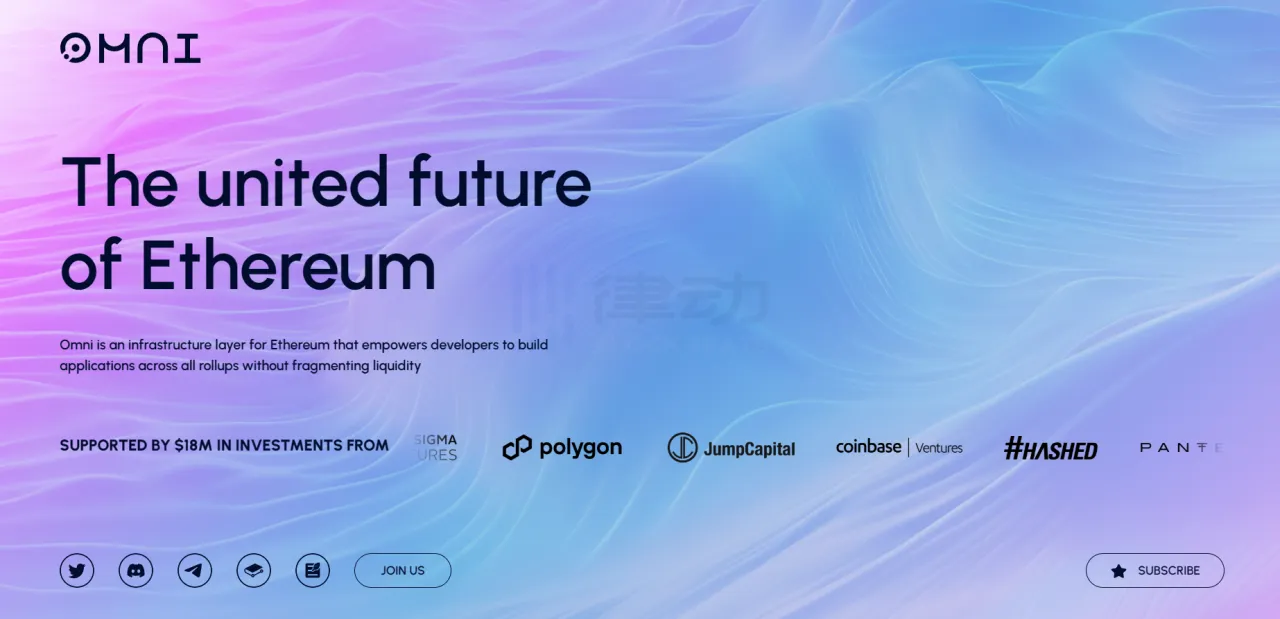
Although Omni Network has not yet launched its testnet, it has attracted a lot of attention with its core infrastructure of modular applications aimed at achieving seamless and secure cross-rollup user experience.
On May 3rd, Omni Network, Starkware, and the Kakarot team held an AMA to discuss the Omni Network's plans to expand Starknet liquidity and other related issues. Omni Network stated that Starknet applications will be able to leverage Omni Network's interoperability infrastructure to bring more liquidity into the Starknet ecosystem from the rest of Ethereum, without increasing the complexity of the end-user experience. This means that developers will be able to offer their applications throughout the Ethereum ecosystem while still maintaining the performance advantages of Cairo.
除此之外,对于 Omni Network 未来的应用场景还有很多,例如:
Translation:In addition, there are many future application scenarios for Omni Network, such as:
- Cross-rollup margin account and leveraged trading: publish margin on one domain and use that margin for trading on a separate domain;
- Multi-rollup NFT minting factory: NFT project users are no longer limited to a single ecosystem and can mint NFTs from any domain.- Cross-rollup lending: Deposit collateral in one domain and borrow against that collateral in another domain.
- Cross-rollup liquidity mining: Coordinate all liquidity operations from Omni, transfer funds across protocols and domains from one place.
By obtaining security from ETH, the Omni Network intends to reconnect the Ethereum ecosystem as a whole, allowing projects on Ethereum to seek users and liquidity throughout the entire ecosystem rather than being limited to a single Rollup. This approach is highly anticipated for its potential impact on the overall Ethereum network.
Original Link
Welcome to join the official BlockBeats community:
Telegram Subscription Group: https://t.me/theblockbeats
Telegram Discussion Group: https://t.me/BlockBeats_App
Official Twitter Account: https://twitter.com/BlockBeatsAsia
 Related Articles