Former Web3 head at Adidas: Building the brand's new growth Flywheel with Web3
原文标题:《 Adidas 前 Web3 负责人: 用 Web3 构建品牌的新增长飞轮 》
Original article by starzq.eth, SevenUp DAO
TL; DR
In an interview with NFT's header podcast Overpriced JPEGs, Tareq, Adidas's former Web3 head, is priced to launch SMS, a web3 brand consulting agency, on his own this year Share the Loyalty 3.0 theory and how brands can build a new growth flywheel through web3
Here are three insights distilled from nearly 10,000 words of notes. It was a learning and summary for me, and worthy of the attention of all brands and IP
1. The transition from shop-to-earn to participate-to-earn is essentially a transition from consumer economy to cultural economy
2. Sports brand x Participate-to-Earn = Wear-to-Earn
3. Loyalty 3.0: Complete the final link in the brand's new growth flywheel with Web3
1. From shop-to-earn to participate-to-earn
Tareq strongly agrees with the Forum3 methodology (shop-to-earn to participate-to-earn, see tweet below) and takes it to a higher level:
This is essentially a transition from a consumer economy to a cultural economy (this is also on the SMS website)
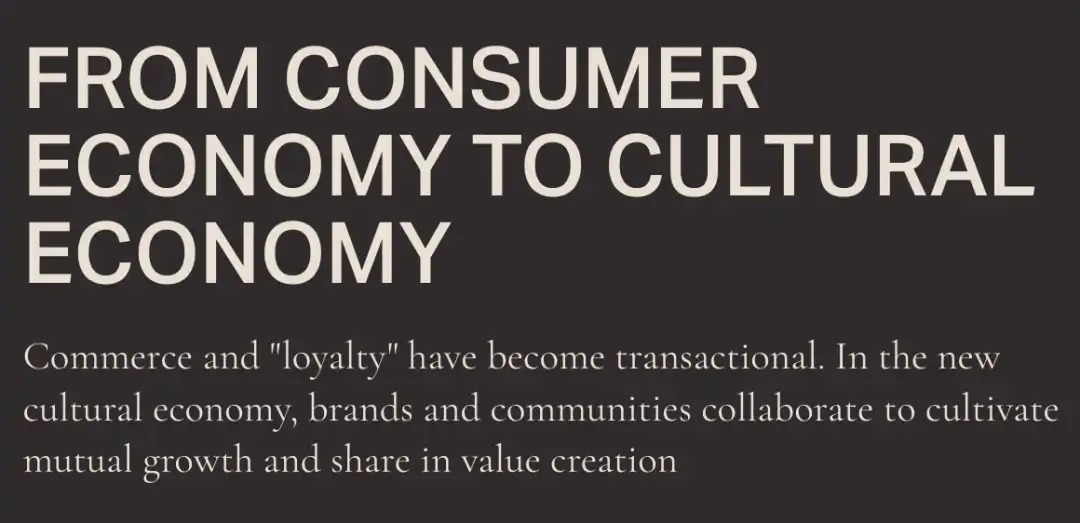
Consumer economy:
Consumption is meaning, and users are eager to fill themselves with consumption, and the corresponding loyalty program is shop-to-earn. You give me more frequency, I give you more discount, very transactional oriented. The shop-to-earn problem has been analyzed before and will not be covered here
Cultural economy:
What young users need is not only goods and consumption, but also the sense of identity and belonging brought by brand culture. In this case, the corresponding loyalty program is participate-to-earn: brands encourage users to engage in certain behaviors that strengthen their identification with the brand culture, resulting in higher loyalty and longer-term consumption investment.
At the same time, the behavior that the brand hopes users to complete is essentially a micro-transaction. The addition of NFT can have more imagination space, making the brand and the community win-win.
Inspiration for the brand:
A brand's web3 strategy should start by thinking about what user interaction and behavior it really expects, and then think about how to encourage user engagement and create a larger cultural economy. And then how does web3 and NFT [digital assets] help us get there
2. Sports brand x Participate-to-Earn = Wear-to-Earn
Before the NFT, Tareq always wondered if we could encourage people to wear sneakers instead of just buying them. Because when people wear it, it's part of the marketing (whether it's on the street or on the court).
A common approach for Web2 is to pay the right people to endorse the brand. But given brand budgets and incentives, which are typically limited to single-digit celebrity endorsements, the impact on real users is hard to measure. With the introduction of tokens in Web3, people participate more actively, interact more deeply, and have a feeling of participating in the game.
Tareq throws out a bold idea: The best way to wear digital is when your clothes and shoes know you're wearing it (Carly wow on the spot).
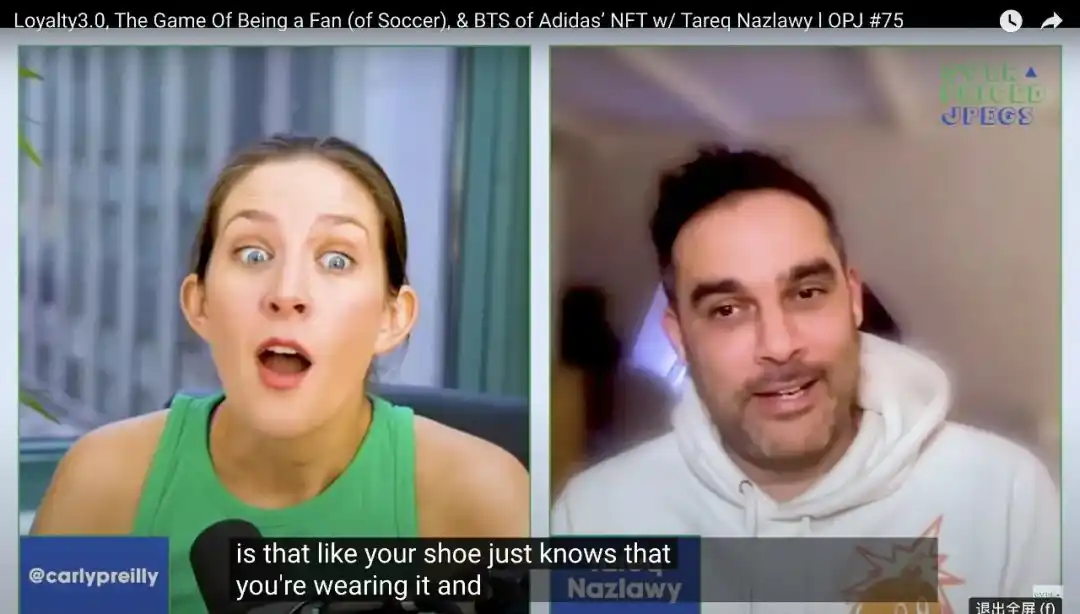
If you're a fan of the Dallas Mavericks, for example, wearing their uniform at the stadium is an act of support, an act that amplifies the voice of the brand. If the outfit has an NFC chip, you can check in and get a special edition NFT ticket or POAP to prove you wore a team jersey
Because of the openness of on-chain data in NFT, it's easy to get the entire brand ecosystem (including partners) to work together to motivate these user behaviors that contribute to the brand.
Not only do you buy the item, but if you know to wear it on a particular occasion, the team's brand partners can also encourage and reward your participation through the on-chain proof earned by the behavior.
Here's an example:
A jersey can be checked in the NFC format for offline games. If the shirt has been to 10 games, do you get special treatment when you wear it to the team souvenir shop? There are better gamified interactions and so on.
This Wear-to-Earn model is especially suitable for sports brands and makes the entire ecosystem more complete. Ordinary membership system and ticket system cannot achieve such a complete closed-loop scene.
Now imagine if I could link up and link down and know that I wore a virtual version of this dress to the game 10 times? The garment is no longer the one you bought, it has a special identity, and the owner can gain more recognition (not necessarily financial).
What makes an X-to-Earn good?
X-to-earn is over-designed and distorts your motivation to do something in the first place. So it should be designed to reinforce the motivational behavior that is already there. It's something you're going to do, and adding incentives can make you more willing to do it. In addition, the brand needs to promote the behavior that can bring positive culture to the brand ecology, and harvest this value can be distributed to the participants
Inspiration for the brand:
1.Wear-to-Earn models are particularly suitable for sports brands, making the entire ecosystem more complete
2. The combination of virtual and real, on and off the chain, makes the user journey more interesting and makes users more willing to participate
3.X-to-Earn design should reinforce intrinsic motivational behaviors and bring positive culture to brand ecology
3. Loyalty 3.0: Use Web3 to fill the last link of the brand's new growth flywheel
Sports brands must be inseparable from sports events and fans. Tareq ends with a profound question: What is the real "game" at a sporting event? Directly post the original text
The game is not soccer. The game is being a fan of soccer
How do you make it a game to be a fan of your club and not just be a fan of your club and watch the game? global fandom vs small stadium, make it truly global
It can be broadened to all kinds of sports or other activities
The game is not the game itself, the real game is to be a fan of the game
Just sitting in the stands watching a game and participating in a global fandom are two different types of energy
This recognition applies to all types of sports and activities in relation to fans.
When we recognize this, what happens on the field is a small subset of this club culture. There are countless other things that can be played off the field, such as baseball card trading and video games, to enhance fan engagement, amplify their sense of identity and identity, create more valuable fan relationships, and bring religious fervor
As a fan, I want to be more connected to brands and clubs, but the playability and attention that most sports events and clubs have previously given fans is not enough. Tareq said he watched so many F1 events and bought a lot of peripheral. Does F1 know about this?
Traditional sports brands, firstly, do not directly connect with fans, secondly, they do not have a comprehensive identification and incentive of fans, both of which are not conducive to the construction of loyalty programs.
The introduction of web3 and token can better solve these two problems. Based on this, Tareq proposed loyalty 3.0
1. playability
2. community
3. creativity
4. ownership
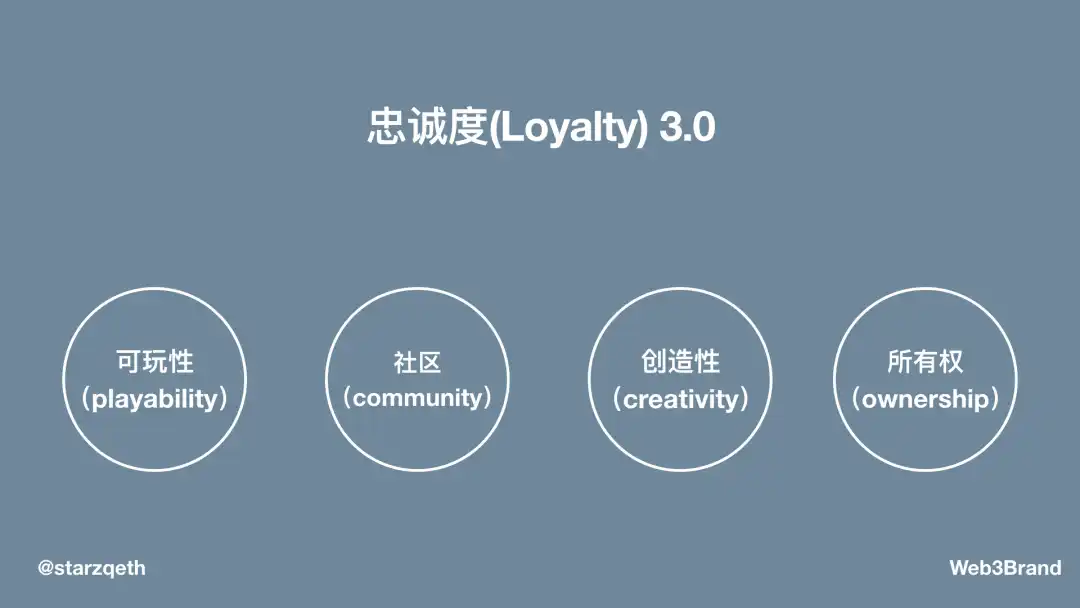
These four points are explained in detail below
playability
Firstly, brands should attract users to participate with playful content and gamification to build direct connection and engagement with users. The more playable it is, the more engaged the user will be. Some brands, like Peloton, have done a great job of engaging users in fitness entirely through gamified content.
community
Users form communities by playing together. A sense of identity and identity in a community converts users into more valuable fans. A good example of this is the gaming-based community. Tareq has three children, and almost all of the children on his Christmas shopping list want are spin-offs of Roblox's virtual IP. It is no longer clear whether Robux (Token of Roblox) is worth more than real money
creativity
In the community, through playability + human connection, people can create something new together that adds value to the community as a whole. Instead of trying to come up with ideas, just provide a good toolkit and the right incentives, and the community will spontaneously create and even turn it into a new physical product (as dot swoosh is doing). The community contributes to the design of the product and then captures the value generated through smart contracts, which is very different from web2. This is where the final piece of the puzzle, ownership, comes in.
ownership
In web2, the incentive rules for users' input and creation in the community are set by a centralized organization. First, the implementation of the rules is not transparent; second, users' assets cannot be guaranteed (points will be cleared and props can be recovered). Ownership of digital assets, rather than centralized rules, guarantees greater returns after creation, and provides greater incentives for users to participate and create.
Then, based on the on-chain data openness of NFT, it is easy to get the whole ecology of the brand (including partners) together to motivate these user behaviors that contribute to the brand; Cross-community contributions can also be better measured based on interoperability. One community can give NFT to members of another community (like Legos), and users can build on that to increase the value of NFT by creating and contributing.
web2 doesn't have the new value-capture medium, or canvas for gameplay, of NFT, which can only do the first few steps in the loyalty flywheel. NFT makes the flywheel spin
Based on these four parts, the brand forms a new growth flywheel: creating more playability, building community, gaining more fans, self-generated fan growth, and ownership is the foundation that keeps this flywheel spinning
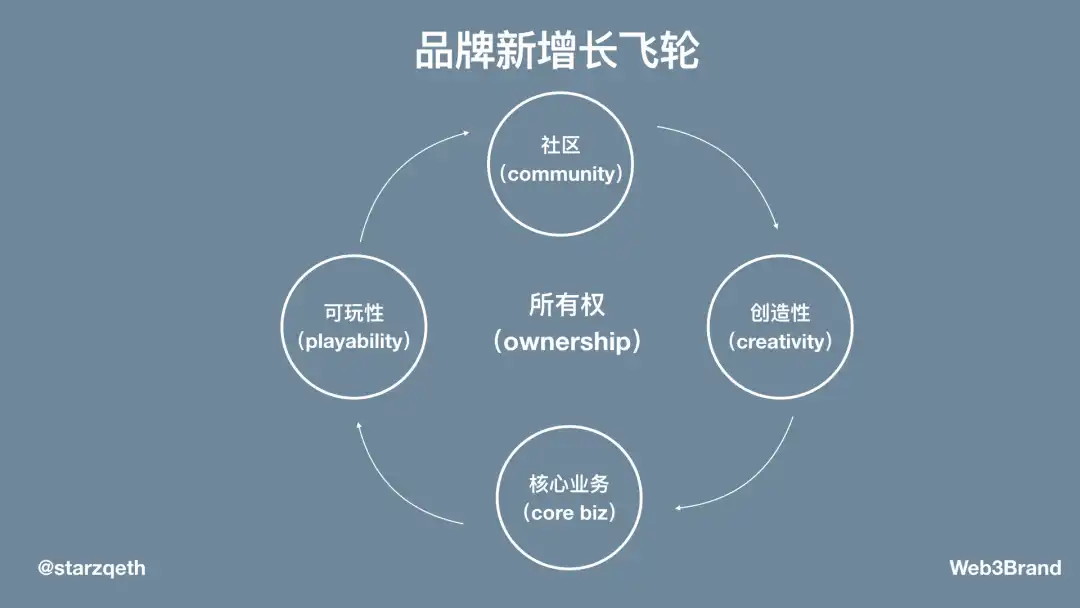
Loyalty 3.0 emphasizes playability and creativity, especially for the sports brands in the example above. Forum3's first customer is Starbucks, who will SMS's first customer be and what kind of gameplay will be created
Reference link
SMS website:
https://www.sciencemagicstudios.xyz/
@ tareqnazlawy in Overpriced JPEGs interview: https://youtu.be/oICIy9qwmXI
Original link
Welcome to join the official BlockBeats community:
Telegram Subscription Group: https://t.me/theblockbeats
Telegram Discussion Group: https://t.me/BlockBeats_App
Official Twitter Account: https://twitter.com/BlockBeatsAsia
 Related Articles