Optimism of Cash Withdrawal on Ethereum Mainnet: Why Optimism of Cash Withdrawal on Ethereum Mainnet?
yyy
Bullish on Optimism was bullish on optimism when Coinbase announced an OP Stack-based L2 -- @BuildOnBase -- last night. This is an opportunity to talk about Optimism and optimism.
It is well known that Optimism of second-tier cash withdrawals to the Ethereum mainnet has a challenging 7-day period.
So why seven days? Three days? What about five days?
Before we answer that question, let's understand why we have a challenge period.
Rollups improves the performance of the Ethereum main network by separating the execution layer from Ethereum. This means that the transactions are executed at Layer 2, but in order to inherit the security of the Ethereum main network, the transactions occurring at Layer 2 must be verified on the main network.
In short, the main network of Ethereum needs to confirm that the transaction submitted by the sequester is actually occurring at the second layer, that is, the validity of the transaction.
Rollup is divided into zk-Rollup and Optimistic Rollup due to different ways of verifying the validity of transactions.
There are two main types of verification methods: zero knowledge proof and fraud proof. Under the zero-knowledge proof mechanism, the transaction has near immediate finality.
With ORUs, which is based on proof of fraud, the finality of the transaction depends on the length of the Optimism period, which explains why it takes seven days for optimism money to be transferred from the second floor to the main net.
Under the ORUs mechanism, the Rollup transaction submitted by the sequencer is optimistically valid. Then, during the challenge period, if the verifier finds invalid transaction, it can initiate fraud proof.
If no one challenges the transaction after the challenge period, it is assumed that the transaction is valid and the transaction is final.
But does the challenge period really take seven days? Let's simplify the challenge process: the verifier finds the invalid transaction by reconstructing the state root and issues the fraud certificate. This sequence takes time, which means the challenge period cannot be zero.
Let's assume the challenge is quick, 10 blocks (about 2 minutes).
Of course, that's not possible, so let's slow down the time by a factor of 10 to 100 blocks (about 20 minutes), which is much less than 50,400 blocks (7 days).
This is based on the best case scenario, but what if there are evil people in the network? How long does it take to detect wrongdoing?
Or to put it another way, at least how long does the challenge period need to be extended before evil behavior is eradicated? The malpractice referred to here is to post a large number of transactions that cause gas to spike for a period of time, thus preventing the verifier from receiving the fraudulent proof.
Let's assume that there is a $2 billion Optimism exposure and that the perpetrator is willing to put up $1 million per block in gas tips (priority fees) to "jump start" transactions that contain proof of fraud.
The maximum amount of time you can "hijack" the network is 2,000 blocks (6.67 hours). Of course, the previous examples are based on some very simple and crude assumptions.
It seems that the challenge period does not need to be as long as seven days on any level. It's hard to figure out what the nonlinear relationship is between challenge duration and safety.
Perhaps seven Optimism is a significant number for the founder of optimism, like Satoshi Nakamoto's optimism that bitcoin optimism has halved in four years.
So, can you reduce ORUs's challenge period to 3-5 days without compromising security? Yes, but it doesn't add much to the user experience.
What if the challenge is reduced to 1-2 days? It seems to make sense to say that you can effectively optimize the user experience.
@0xMantle, an ORU hatched by BitDAO, can shorten the challenge period to 1-2 days. The optimization logic of challenge period is based on MPC scheme.
In simple terms, the sequester does not directly submit the transaction batch to Ethereum. Instead, the sequester first submits the transaction batch to the MPC network, which is co-signed by MPC nodes to confirm that the transaction is valid before submitting it to Ethereum.
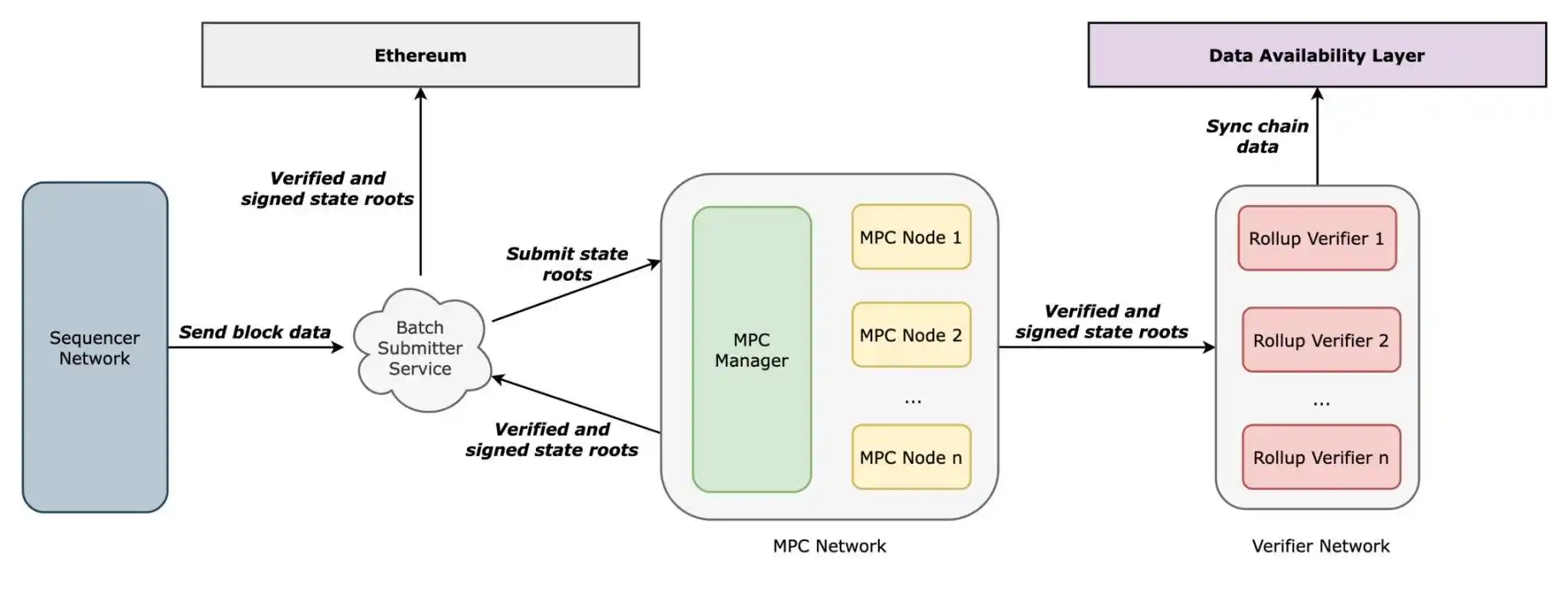
So the core difference is:
Optimism commits the batch containing the state root to Ethereum as an execution result;
Mantle submits the batch containing the co-signed status root of MPC nodes to Ethereum as execution result.
The purpose is to reduce trust risk for Rollup execution results.
But MPC verification in the final analysis is the verification scheme under the chain, better than nothing, for the user is more than a psychological comfort.
To put it inappropriately, MPC authentication schemes are like a decentralized zk scheme, with the former based on economic assumptions and the latter on cryptographic verification.
Above are some thoughts and discussions about ORUs challenge period, not too strong logic, let me throw out. BTW, still very much looking forward to seeing a significantly shorter challenge period for ORUs in the future.
Original link
Welcome to join the official BlockBeats community:
Telegram Subscription Group: https://t.me/theblockbeats
Telegram Discussion Group: https://t.me/BlockBeats_App
Official Twitter Account: https://twitter.com/BlockBeatsAsia

 Related Articles