Optimism: Create an optimistic future for Ethereum
Optimism: Paving An Optimistic Future for Ethereum
原文作者: Nansen
Unitimes
Everyone has heard about Ethereum 2.0 and how it solves the problem of ethereum scaling up. What if I told you that Ethereum is already expanding with or without Ethereum 2.0? Ethereum's transition from proof-of-work (PoW) to proof-of-equity (PoS) consensus model is just the tip of the iceberg. The real endgame is to create an entirely new framework for blockchain scalability, moving from monolithic to modular blockchains. This is Ethereum's answer to the blockchain trilemma, which aims to increase throughput while maintaining decentralization and security. The blockchain trilemma is the concept that a blockchain must balance three core principles (decentralization, speed, security) and is unlikely to improve one without sacrificing the other.
A monolithic blockchain is a fancy way of describing a blockchain that does all its computing and processing on a single chain. Most layer 1 (L1) builds today follow this structure and are monolithic blockchains. Modular blockchains, on the other hand, divide the chain into an enforcement layer, a security layer, and a data availability layer. Each chain has a specific role and is built on top of the other to inherit the qualities of the underlying blockchain. In ethereum's case, Ethereum L1 becomes the security and data availability layer, while layer 2 (L2), built on top of it, acts as the enforcement layer.
Modular architecture promises to be orders of magnitude better than a monolithic blockchain at every level. The goal is for L2 to do everything a monolithic L1 can do, but better, and to interoperate seamlessly with other L2S. Optimism Is an example of ethereum L2, which aims to do just that.
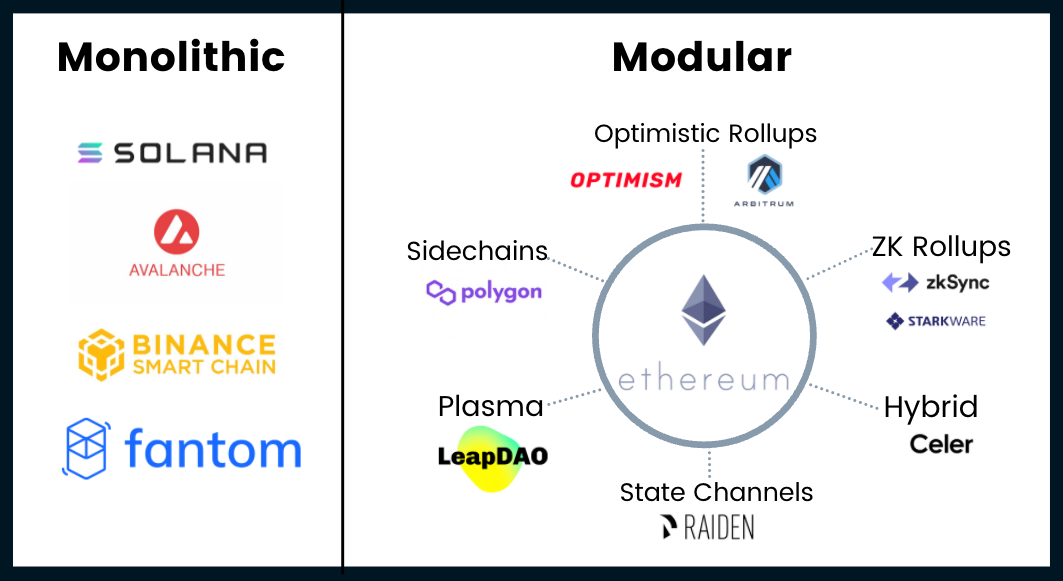
Above: Monolithic blockchain network (left) vs. ethereum's modular architecture
What is Optimism?
Optimism is the first Ethereum L2 to develop an Optimistic Rollup solution compatible with the Ethereum Virtual Machine (EVM). In parallel with Ethereum, Optimism can process transactions on a large scale while inheriting ethereum's security.
Optimistic Rollup gets its name from the way transactions are processed. By default, transactions are optimistically assumed to be accurate and no calculations are performed. It relies on anti-fraud mechanisms to ensure that transactions are legitimate. The validator (anyone running a "full node" of Optimism) is able to challenge the validity of the transaction proposal submitted by the Sequencer, which Rollup will then check by performing the calculation of the transaction on Ethereum. Transaction proposals can be challenged during a challenge period, with Optimism set to 1 week, before they are finalized and submitted to the Ethereum main network.
If the proposal turns out to be fraudulent, the validator will be rewarded and the Sequencer penalized. Rewards are taken from the binding ERC-20 token pool that Sequencer needs to bind. In the Optimism case, the token required is ETH. This creates an incentive structure in which the validators are incentivizes to catch bad actors and the Sequencer is incentivizes to submit only accurate trade proposals. The fraudulent proposal is removed and the correct proposal is finalized. The transaction itself is not restored, only the fraudulent offer result of the transaction is removed.
A simplified overview of how proof of fraud works
Source: https://ethereum.org/ about Optimistic Rollup fraud proof
Aside from its technical prowess, an interesting fact about Optimism is that the organization behind it is a nonprofit company whose goal is to support nonprofit projects. Since the project is not yet fully decentralized, the team is using all of its profits from running a centralized Sequencer to extend and sustain public goods built on Ethereum. The team donated $1 million to such projects in 2021.
What good does Optimism do?
Optimism has four main benefits: EVM equivalence, data security, speed, and cost.
Optimism is one of the most EVM compatible chains, with a focus on going one step further and being EVM equivalent. Optimism can support any Ethereum application using its Optimistic virtual machine (OVM), which is an EVM-compatible VIRTUAL machine. Developers can deploy any Ethereum-based dApp to Optimism with little architectural change. This allows decentralized applications (dApps) built on Ethereum to integrate seamlessly into Optimism.
Unlike side chains like Ronin (used by Axie Infinity) that have their own security when run independently, rollups like Optimism derive security from the Ethereum main network. Transactions are handled in Optimism, but the transaction data is written to and stored on Ethereum. This allows Optimism to inherit ethereum's security while remaining scalable.
Computing is the slow and expensive part of using Ethereum. By defaulting to not counting transactions, Optimism can achieve a 10-100fold scalability improvement depending on the nature of the transaction.
Optimism has near-instant transaction finality, allowing users to check the results of their transactions almost immediately. Optimism transactions are also cheap, costing a fraction of ethereum transaction costs. Currently, Optimism's base transfer fee is $1.66, while Ethereum's base transfer fee is $8.77 (see real-time fees here). The Optimism team estimates that it saved more than $335 million in gas bills over the transactions it processed over the network.
Gas fees paid by Ethereum vs. Optimism
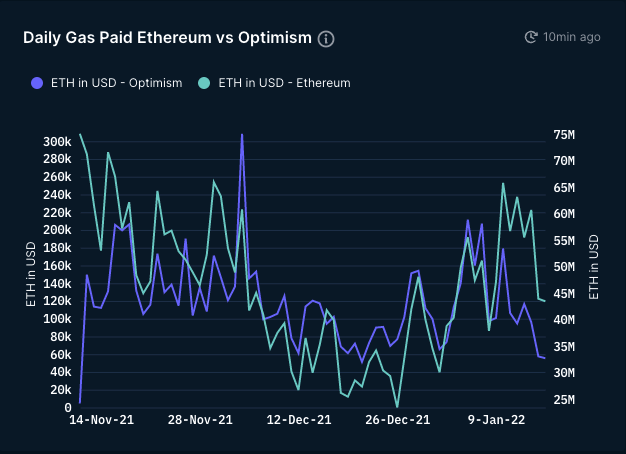
Source: Nansen.ai, as of 17 January 2022
Are there any downsides to Optimism?
Optimism has three main drawbacks: long and costly withdrawal times, potential incentive misalignment between network participants, and the underlying L1 review transaction.
Since there is a one-week challenge period for proof of fraud, there is a one-week waiting period for withdrawals through the official Optimism bridge. An important point to note when using the network, as withdrawals through the main bridge cannot be cancelled once they are submitted. Withdrawals through the main bridge are expensive and can cost more than $100 due to the security measures implemented there. Such a long and costly exit period can have a negative impact on adoption and composability. To solve this problem, third-party Bridges such as Hop Exchange have emerged. These Bridges offer instant withdrawals and are usually cheaper than the main bridge. Optimism is working to reduce withdrawal fees, but is still months away from making the necessary updates.
The network relies on motivated validators to challenge fraudulent proposals and Sequencers to submit the correct proposal. If there are few or no fraudulent proposals, the verifier receives little or no reward from the action node because they only receive a reward if they successfully challenge the fraudulent proposal. This inhibits the verifier from running the node. Without validators, Sequencer can submit fraudulent transactions at will, resulting in network failure. But that is unlikely to happen. In addition to the potential online rewards, there is an incentive for users to act as honest validators. Applications built in Optimism (for example, third-party Bridges, DeFi protocols) have an incentive to be honest validators to maintain the functionality of their protocols.
If a particular transaction has sufficient value, Sequencer may bribe Ethereum miners to allow fraudulent offers to pass at a very low cost during calculation checks. This will break any trust in the network and cause it to fail. Since miners are incentivized in the same way as the Ethereum network, such an attack is unlikely. If such an attack were to occur, the value of the Ethereum network itself would be negatively affected. Miners will reduce the long-term value of being an Ethereum miner in exchange for a one-time reward. Honest Sequencer and verifiers tend to bribe miners with higher payouts because the total value involved may be higher than the total value of a single transaction.
How does Optimism compare with Arbitrum?
Optimism was the first solution to invent EVM compatible Optimistic Rollup protocol, but the delay in mainnet startup gave Arbitrum an advantage. For example, Uniswap would have preferred to be released on Optimism, but due to delays, the Uniswap community came up with a proposal to have Uniswap integrate into Arbitrum while waiting for Optimism to be released.
Optimism and Arbitrum are both Optimistic Rollups, so they are similar in many aspects. Their main difference lies in their anti-fraud logic. Optimism selects non-interactive proof of fraud, which re-executes the entire transaction and performs the required calculations on L1 to find out the truth. Arbitrum, on the other hand, chooses interactive fraud proof, which only performs specific steps that are disputed on L1. Disputes are dissected and broken down until the exact steps that led to the disagreement surface. Profiling is performed by Sequencer and validator, and only specific steps that narrow down the dispute are computed on L1 to determine the correct final state.
The benefit of non-interactive fraud proof is that it is simpler to design and does not require coordination among the parties involved, which in turn makes fraud proof real-time. Interactive fraud proof requires two or more parties to work together to dissect the challenge and takes longer to resolve. The disadvantage is that the cost of calculating the entire transaction on L1 is much higher than a single step. There is also a limit to the size of blocks and transactions (based on L1) that can be validated effectively in non-interactive methods, which interactive methods do not face because only a single step is validated.
Optimism is currently working to move to an interactive fraud prevention model equivalent to EVM, consistent with their overall vision. The difference between EVM equivalence and EVM compatibility is that the former is processed on EVM, while the latter is processed on compatible virtual machines, such as Arbitrum virtual machines (AVM), as is currently done on Arbitrum.
Arbitrum team is also trying to achieve EVM equivalence. It's clear that both projects are pushing the boundaries of Optimistic Rollups, innovating and learning from each other.
In terms of unique active addresses in the last 30 days, Optimism had 45.2 K, while Arbitrum was slightly more at 66.8 K. Optimism and Abitrum both handle approximately 2-3% of total Ethereum transactions, handling 21K and 34K transactions, respectively. It's only a few months since the two chains' main network was publicly released, and as time goes on, we'll likely see more DApps and users participating in both chains.
Number of Daily transactions:
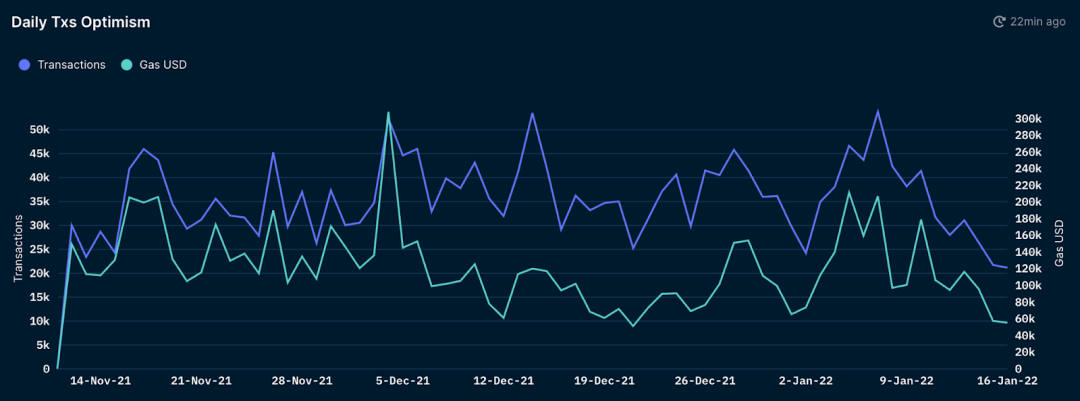
Source: Nansen.ai, as of 17 January 2022
Arbitrum Number of daily transactions:
Source: Nansen.ai, as of 17 January 2022
How do I interact with Optimism?
Large Ethereum-based Dapps like Uniswap and Synthetix are already deployed on the chain and working. The chain has a growing native ecosystem that includes DeFi projects such as Rubicon Finance and a NFT market Quixotic, which is up and running. There were several NFT collectibles in Optimism, with OptiPunk (a CryptoPunks derivative), Optimistic Bunnies and OldEnglish topping the list. By far the most popular dApp is the DeFi dApp, with four of the top 10 applications in log occurrences being DeFi apps. The number of log occurrences is the number of successful execution of the entity smart contract.
DApps log events on Optimism:
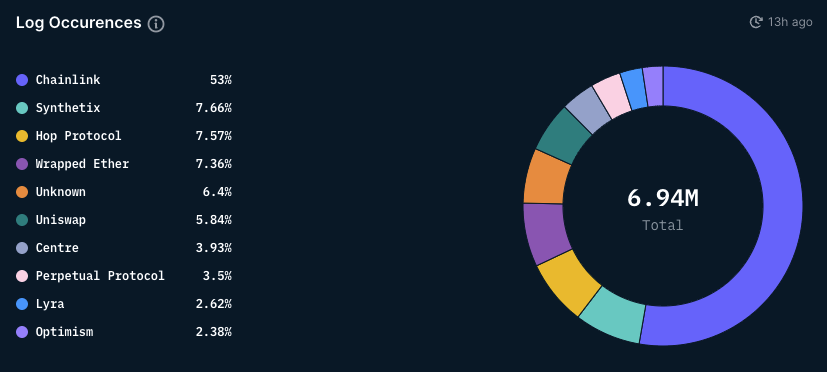
Source: Nansen.ai, as of 17 January 2022
You need an Ethereum wallet, such as MetaMask, to connect to various platforms and Dapps, similar to how you would on Ethereum. Erc-20 assets must be connected to the Optimism chain before you can use them. You can do this through Optimism with your own bridge or a third party bridge. For most transactions, a third party bridge is sufficient and the recommended choice. It's usually cheaper than the one-week wait period when You use Optimism's own bridge, and has the added benefit of instant withdrawal.
What will be the future of Optimism?
Optimism doesn't have a native token and there are no plans to release one any time soon, but it's worth watching for the future. Centralized exchanges may plug directly into Optimism, similar to what exchanges such as Binance and Huobi do for Arbitrum. This allows users to bypass the bridging process and put assets directly into Optimism, thereby reducing the costs associated with bridging.
The team will gradually decentralize the network, which we will likely start to see happen once critical network upgrades and improvements begin. Currently, the team disables fraud proof when building the new and improved interactive fraud prevention model.
The Optimism ecosystem is growing, with governance recommendations on major DeFi applications, such as Aave, to be deployed on the chain. The ease of deploying ethereum-based DApps to Optimism removes barriers to entry for existing DApps. We see a wave of DApps being deployed on the chain, and it's only a matter of time before a vibrant ecosystem is created. Given the low transaction costs of Optimism, we may see more DeFi, NFT and GameFi projects built on blockchain in time.
Smart money and Optimism:
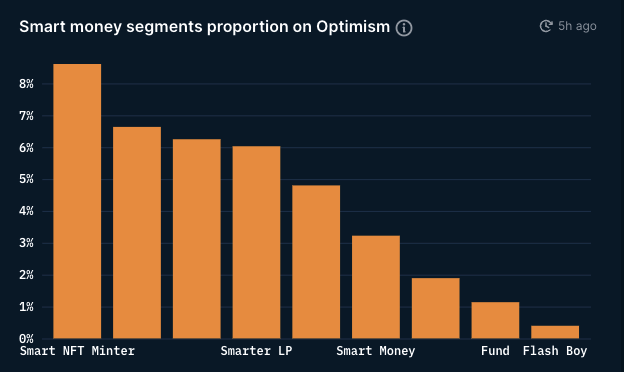
Source: Nansen.ai, as of 17 January 2022
The Smart money seems to have yet to explore the chain, with Smart NFT minters having the most overlap with Ethereum at 8.6%. This suggests that Optimism is still in its early stages and that there is still a lot of potential and room for the ecosystem to continue to develop and thrive.
Current L2 solutions are not interoperable and exist in isolated islands. Interoperability is an important factor that needs to be addressed in order to create a truly scalable Ethereum. Once key upgrades are rolled out and the chain is more decentralized, Optimism may try to achieve this goal.
The launch of Ethereum 2.0 will enhance Optimism. Having a faster, more efficient Ethereum L1 means that everything that's built on top of ethereum and depends on it becomes more efficient as well. Ethereum 2.0 alone may not be enough to meet the growing demand for block space, and L2 will be needed to meet this demand.
conclusion
L2 solutions are here to stay and will be where most transactions on Ethereum will take place in the future. L2 has been criticized for introducing additional complexity to the user because the user must take additional steps to acquire assets both on and off the chain. Such criticism is justified given the current state of affairs, but will be addressed over time by third-party applications that streamline the process or by the L2 team itself. ETH 2.0 does not make them obsolete, but makes them more scalable and efficient.
Optimism is an L2 that will play an integral role in ethereum's scalability going forward. They set a high bar for themselves by working hard to achieve EVM equivalence, and they continued to deliver despite their early release delays. The ease of deploying to Optimism will be a huge pull factor for many existing Dapps to give Optimism a chance, and as the ecosystem builds, low gas costs will entice users to make on-chain transactions. In addition to building software, they actively support and grow high-impact projects in the Ethereum ecosystem by funding them.
We are only at the beginning of a blockchain-driven world, and Ethereum's modular structure could be the key to opening up a whole new realm of possibilities. Most of us subscribe to the idea of a multi-linked future, but perhaps a more accurate description is a multi-layered future.
The original link
Welcome to join the official BlockBeats community:
Telegram Subscription Group: https://t.me/theblockbeats
Telegram Discussion Group: https://t.me/BlockBeats_App
Official Twitter Account: https://twitter.com/BlockBeatsAsia

 Related Articles