Messari: The L2 war has begun, analyzing the Optimism valuation model

Original title: "Messari: In-depth analysis of the Optimism valuation model, the market value is about 9 billion US dollars"
Original source: Messari
Original compilation: The way of DeFi
Key Points of This Article:
- Optimism Airdrop and Ecosystem Incentive Program to Unlock Ethereum Scaling Solutions new era.
- Perpetual Protocol, Uniswap and Synthetix are the largest applications on Optimism dominating trading activity and TVL.
- The Optimism Network generates revenue through its rankers. OPToken holders share governance rights with Citizen House, but maintain sufficient control over the network to generate value.
- Based on our valuation model, Optimism should be a top 20 crypto asset at listing with a market cap of ~$9B.
The Optimism airdrop plan has been officially announced, marking the start of the L2 war.
Last week, Optimism announced a retroactive token airdrop for active users and community members. The project has generated a lot of interest from the community as it promises to bring much-needed scalability to the Ethereum ecosystem. Currently, it is TVL's second largest Rollup scaling proposal, and likely the largest Rollup by market capitalization at the time of Token launch.
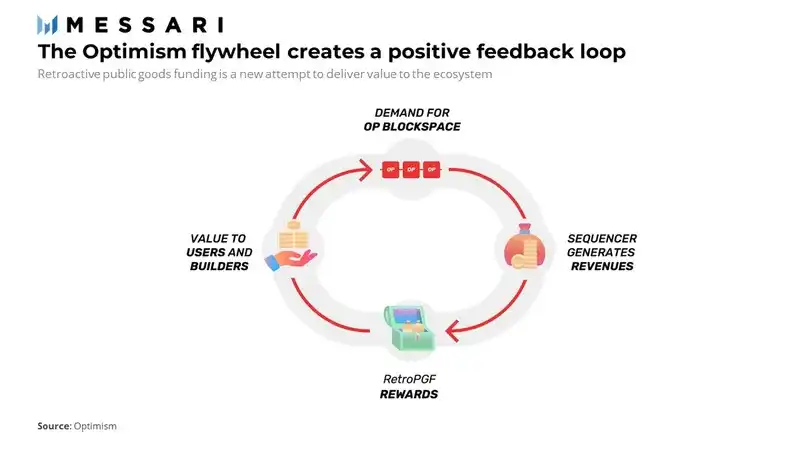
Optimism's vision is to create a positive growth flywheel that delivers value to all participants within the ecosystem. The Sequencer is responsible for adding and ordering transactions to Optimism. It generates revenue by selling block space. Currently, that revenue goes to the Optimism Foundation, a nonprofit that donates all surplus to public goods on the web. As more developers and users get incentivized through this funding, activity on the network should increase, increasing demand for block space and making the flywheel spin faster.
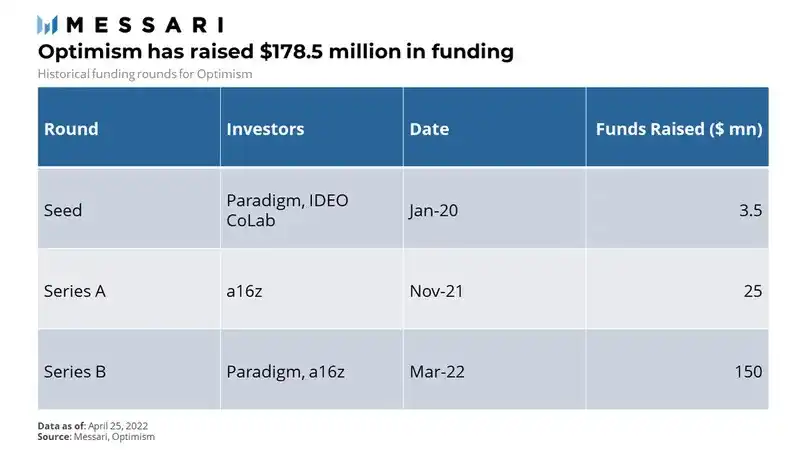
Optimism PBC, later OP Labs PBC, was born from Plasma Group in January 2020. Plasma Group contributors include such giants as the Ethereum Foundation, Uniswap, Gitcoin, Consensys, and Polygon . Since the transition, the team has raised $178.5 million in funding across three rounds from notable investors including Paradigm and a16z. The latest round, in March 2022, was valued at $1.65 billion.
Optimism Network
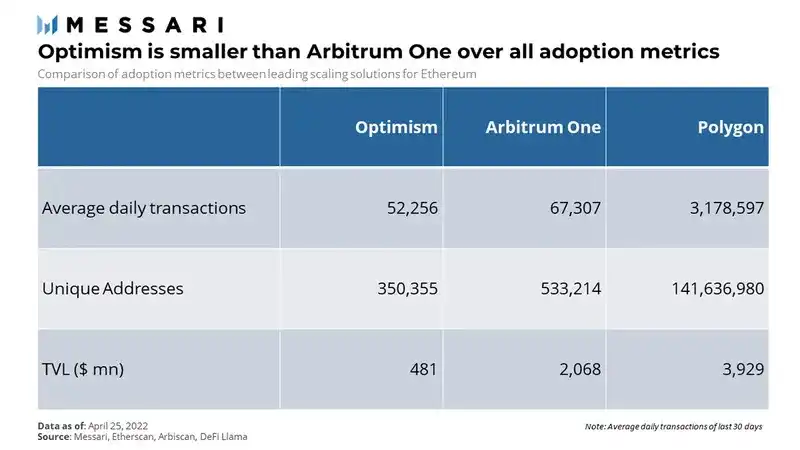
Optimism mainnet launched in January 2021, And have had moderate success in terms of adoption. It is second only to the leading Optimistic Rollup solution Arbitrum One in most metrics. Still, the two Rollups pale in comparison to Polygon’s proof-of-stake (PoS) chain, a sidechain scaling solution for Ethereum, in terms of adoption metrics.
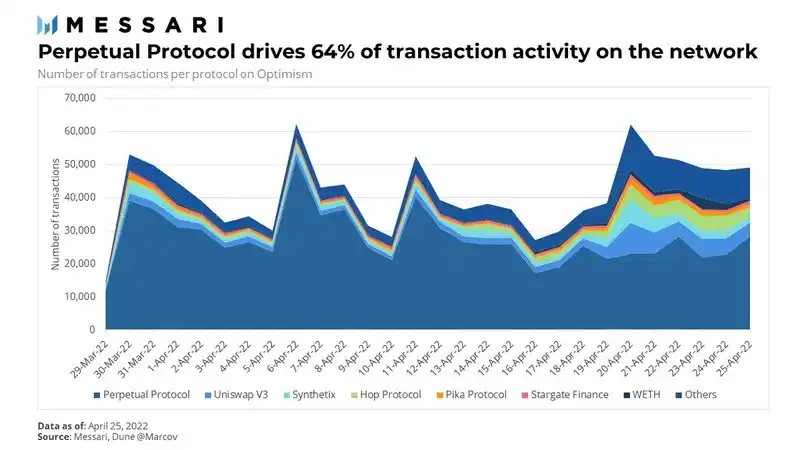
On Optimism, Perpetual Protocol facilitates the largest number of transactions, about 27,000 transactions per day, accounting for 64% of the market share. It is followed by Uniswap V3 and Synthetix, which execute ~3,000 and ~2,000 trades per day.
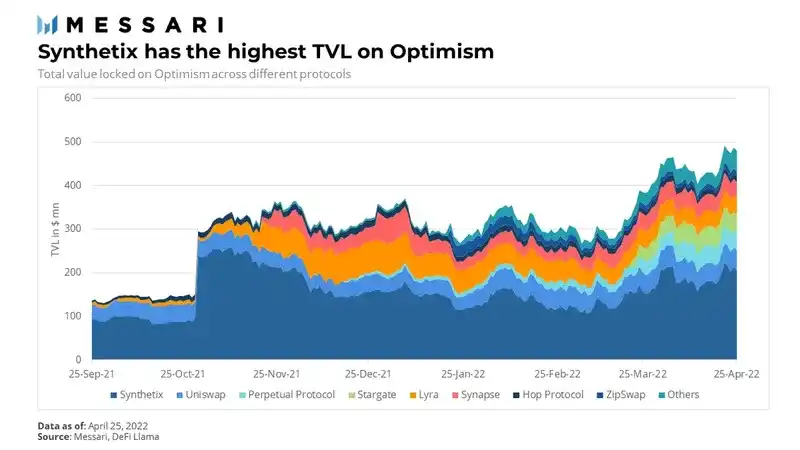
Synthetix is the dominant protocol on Optimism in terms of TVL, with ~$200m locked up, or a 43% share. Uniswap ranks second with a TVL of $45 million. Perpetual Protocol came in third with a TVL of $41 million, up 33% over the past 30 days.
Optimism is the main driver of growth EVM
Equivalent< /h4>
Optimism goes beyond simple EVM compatibility to EVM equivalence. On EVM-compatible chains, developers will still need to modify their Web3 applications to use a different architecture. Additionally, tools built for Ethereum over time may not necessarily work for other EVM-compatible chains. EVM equivalence on Optimism solves this problem by performing almost identically on the Ethereum mainnet, allowing one-click porting of applications and all tooling to work. This approach will help Optimism grow its developer community faster and with fewer bugs than other scaling solutions.
Ecosystem Incentives
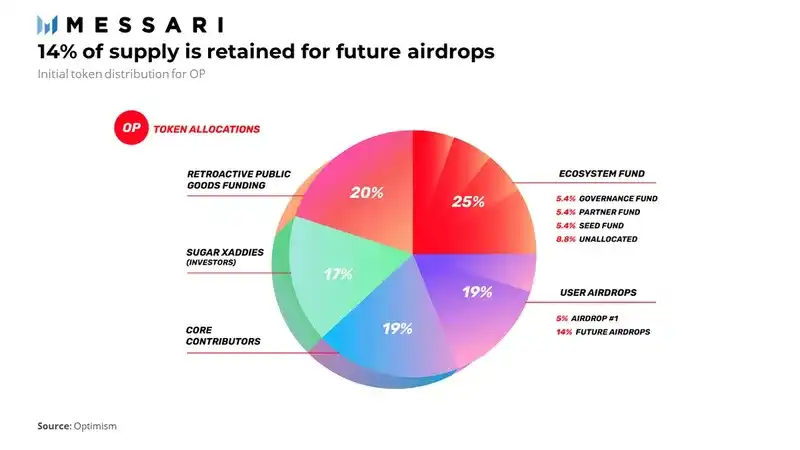
Optimism is very cautious about its own airdrop plan; 14% of pledges Only 5% of the airdrops are confirmed. With more airdrops promised in the future, users are incentivized to be active on the platform.
The Retrospective Public Goods Fund (RPGF) also provides long-term incentives for developers to contribute to Optimism. Optimism also recently announced a “Stimipack” that dedicates 5.4% of the token supply to developer incentives.
Ecosystem incentives create another flywheel. The larger the market cap of Optimism at launch, the more funds will be available for incentives, potentially resulting in more user and developer activity. However, as any part of the flywheel slows down, a negative feedback loop is also created.
Industry Attractiveness – Porter’s Five Forces Model
Since coming from other platform chains and With fierce competition for scaling solutions, the Rollups industry looks obscure.
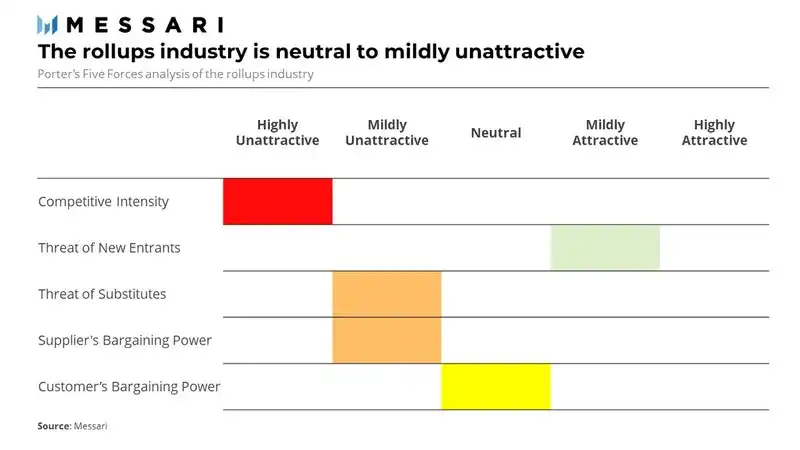
Competition intensity - very high
The intensity of competition between Rollups is very high. Optimism not only competes with other Optimism Rollups such as Arbitrum, but also with other scaling solutions such as Polygon’s PoS chains and ZK rollups such as Starknet. Vitalik Buterin expects ZK Rollups to outperform Optimistic Rollups in the medium to long term because they provide a better experience. ZK rollups have better security through proof of validity, and there is no long waiting period for withdrawals.
Threat of New Entrants - Low
THREAT OF ALTERNATIVE OPTIONS - HIGH
Threat of alternatives is high, monolithic and interoperable blockchains becoming a reality. A monolithic architecture also has the advantage of a consistent overall experience compared to a modular architecture.
Parachains on Polkadot , Appchains on Cosmos and subnets on Avalanche are also working to increase adoption.
Supplier Bargaining Power - High
Customer's Bargaining Power - Neutral
Revenue Model
Optimism Foundation runs a single centralized Layer 2 (L2) blocks and add transactions to Ethereum’s Layer 1 (L1). The orderer fee consists of two parts, the L2 execution fee and the L1 data fee.
The L2 execution fee is similar to Ethereum's gas fee. The amount of fees to be paid depends on the complexity of the transaction, i.e. its computational and storage requirements. That's roughly 1% of what users pay.
The L1 data fee is the cost of publishing batch transactions to Ethereum. The sorter uses a cost-plus approach, charging users a price above the L1 cost. It currently charges 1.24 times the sum of gas required to submit a transaction and 2,100 gas. This generates a surplus that will be used to fund the growth of the ecosystem. It’s worth noting that 99% of the fees charged by Optimism are L1 data charges.
These user payments have generated $24.5 million in revenue for Optimism so far.
Sequencers can also capture Maximum Extractable Value (MEV) in the future. To recap, MEV refers to the value that privileged actors (such as miners, validators, or orderers) extract by including, reordering, inserting, or ignoring transactions in the blocks they produce. Since there is only one sequencer on Optimism, only it can capture MEV. The Optimism team came up with a system for MEV auctions, under which they would sell other parties the ability to reorder or insert transactions in a block. Revenue generated from the MEV auction will also flow back to fund Optimism’s public goods.
OPToken
OPToken is a new type of governance token. Token holders do not have sole governance rights over the protocol; they share it with designated citizens. This governance process and structure is based on its working charter and will evolve according to the needs of the protocol.
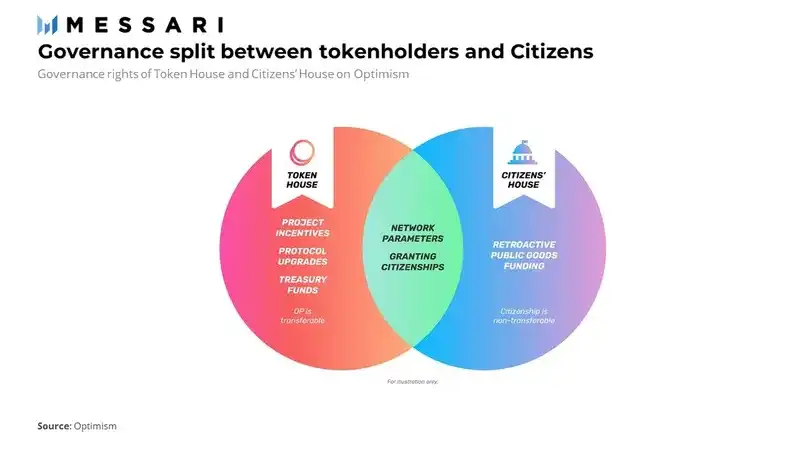
For our purposes, it is critical to understand whether the power held by token holders gives them effective control over revenue. According to the diagram above, Token holders have control over all aspects of the protocol, with the exception of distributing revenue funds. However, the governance document says token holders will have input on how citizens are appointed. The working charter also gives token holders some control over the Optimism Foundation board, including the ability to remove directors and veto changes to foundation documents if they reduce their rights. While not absolute control, token holders do have enough control over the protocol that it is fair to assume that sequencer profits go to them.
The total supply of OP at launch is 4,294,967,296, with an annual inflation rate of 2%. In our model, we assume that all tokens held in the vault are distributed. While the document doesn’t explicitly state this, annual inflation is likely to move in the direction of the RPGF and generate at least as much value for the protocol as its market price. Therefore, we can ignore inflation in the calculation.
Valuation Model
In the still immature crypto-economy, Optimism is a very young protocol. It reinvests all flows into ecosystem participants and does not distribute cash flow to token holders. However, we assume that profits go to token holders under the assumption that control over protocol parameters will allow token holders to extract some value indefinitely in the future. Seeking a portion of traffic as rent is one way. Another example is "selling" their votes during governance decisions.
Revenue calculation and profit
As mentioned earlier, there are two types of income: explicit Sexual income and MEV.
Explicit income
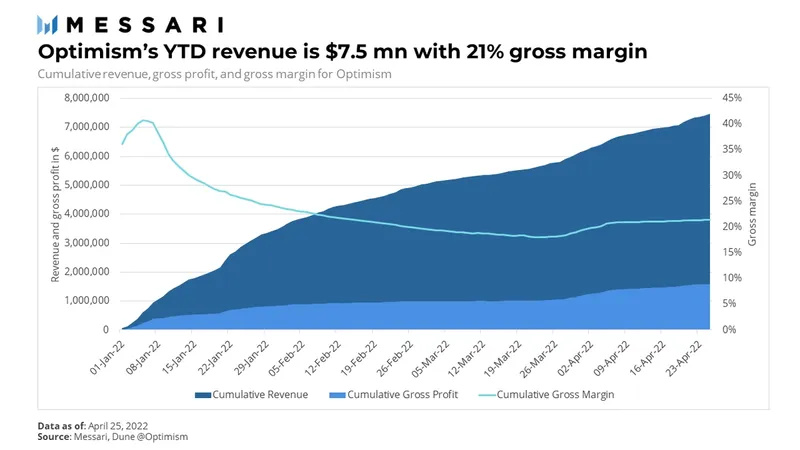
By analyzing the transaction data, we found that Optimism A total of $7.5 million has been collected from users to date. To post the transaction to L1, they paid $5.9M in transaction fees, bringing their gross profit to $1.6M for a gross margin of 21%.
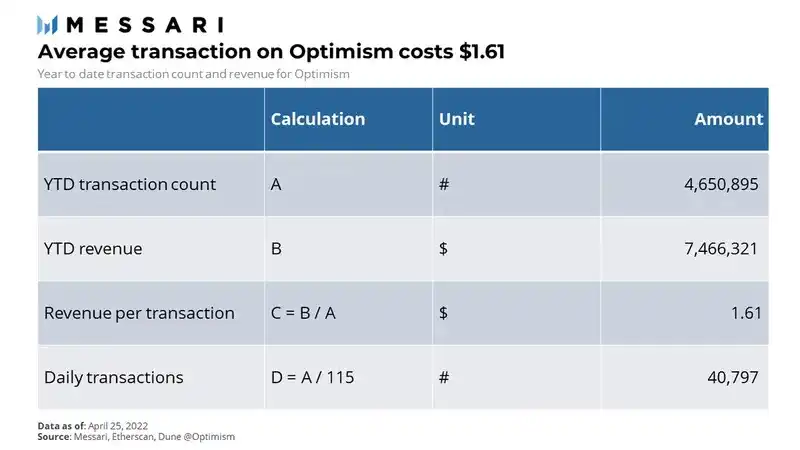
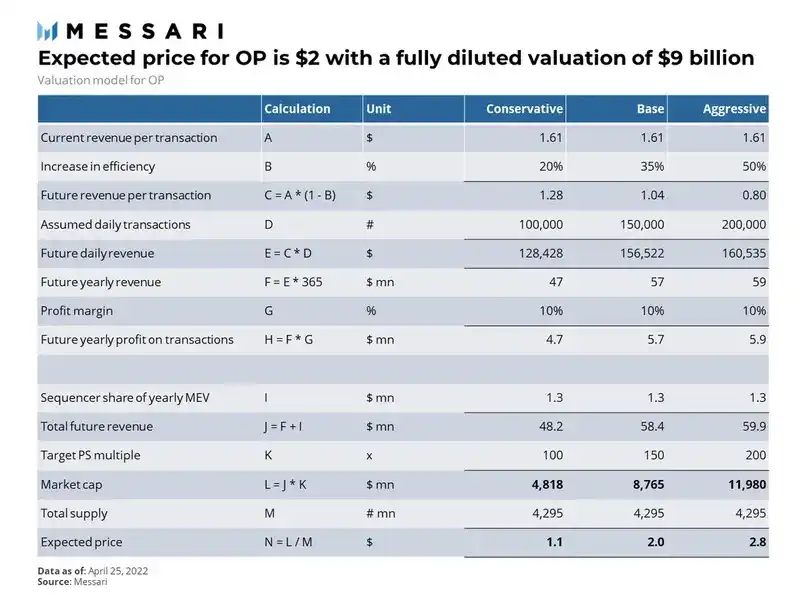
A key driver of revenue is Optimism's deal volume. Year-to-date, Optimism has averaged 40,000 transactions per day, but this number is likely to increase as adoption increases. One-click application deployment through EVM equivalence, ecosystem incentives, and post-airdrop excitement will drive growth in the short term. The ceiling for transaction growth is very high; Polygon’s PoS chain averages over 3 million transactions per day. We assume a 150-400% increase in transaction activity on Optimism, with an average daily transaction volume of 100,000 to 200,000 transactions.
YTD, Optimism's average revenue per transaction is $1.61. However, the growth of transactions reduces the L1 data fee per transaction, as it becomes more efficient to publish batches to L1. We assume a 20-50% reduction in revenue per transaction based on average daily transaction volume.
According to the Optimism Foundation post, the protocol has a target profit margin of 10%. We assume our calculations are the same.
MEV
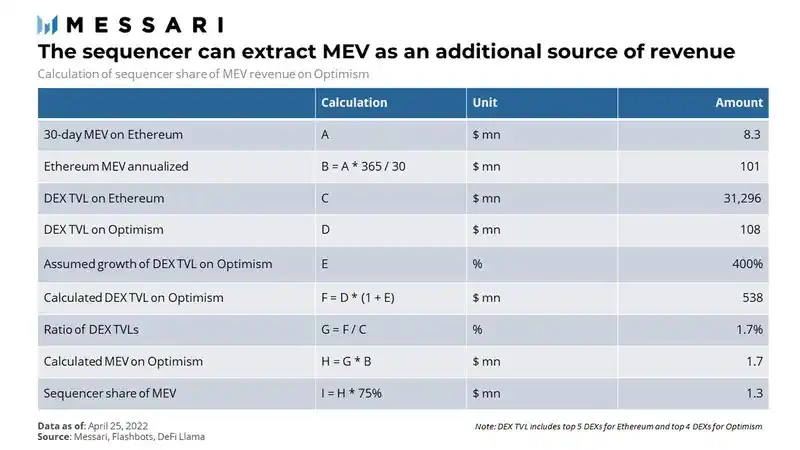
Currently, the sorter does not collect MEV. We use the information available on Ethereum to predict future MEV. The amount of MEV withdrawn on ethereum over the past 30 days was roughly $8.3 million, according to data from Flashbots, an MEV-focused research outfit. It’s worth noting that 99% of Ethereum’s historical MEV has been arbitraged through decentralized exchanges (DEXs). Therefore, we hypothesize that MEV is positively correlated with the depth of DEX liquidity. We assume that the ratio of future MEV on Optimism to MEV on Ethereum will be the same as their DEX liquidity ratio. We assume 5x liquidity for Optimism as OP Token goes live and increases liquidity and trading activity.
However, none of these MEVs count towards the sequencer. Part of it is held by entities called Seekers who find MEVs. According to Flashbots, 60% of the MEV on Ethereum in the past 30 days is retained by searchers, while miners get 40%. The Optimism sorter should have a larger MEV split since it is monopolized. Even after decentralization, competitive public auctions should minimize the profits retained by searchers and sorters. We assume that the protocol acquires 75% of future MEV.
We should note that this calculation gives a lower bound on MEV. Flashbots only track a few types of transactions. It cannot track multi-transaction MEV or MEV with off-chain components.
Assign a multiple
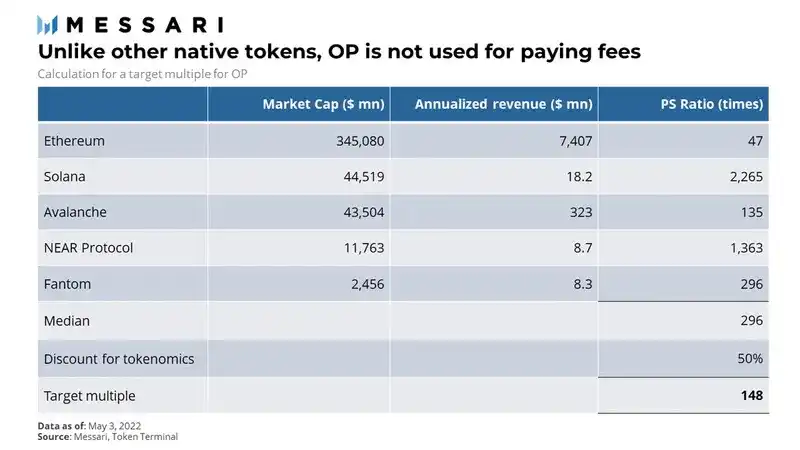
The security cost of most chain payments is higher than Transaction costs; therefore, true P/E comparability is not available. Instead, we first obtain the median price-to-sales ratio of five large platform chains from Token Terminal. However, OP's token economics are different from other native tokens. Optimism is not paid for in the OP and should be discounted. We assume native Token 50% of the value comes from utility and 50% from governance, discounting the calculated multiples accordingly. We assume a P/S multiple of 100-200 under different market conditions.
The final model
Valuates OPToken, which is expressed as "basic With a probability of 50% for "Scenario" and 25% each for "Conservative" and "Aggressive," we get a target price of about $2 and a target market cap of about $9 billion. Such a valuation would place Optimism in the top 20 cryptoassets, above Polygon.
Centralization of risk factors
The Optimism Foundation is solely responsible for leading protocol development, Run the sorter and select the first citizens. They have the power to act on the interests of OPToken holders and further centralize power.
TokenChanges in Economics
< /p>
The model calculates the value of a token based on its current token economics. Tokens from other L2 projects such as Immutable X, Boba Network, and Metis have different use cases, such as gas payments for fee shares and utility. If the economics of OPToken change in the future, it may affect the way Token is valued.
Unproven Technology
Optimism Rollups are cutting edge technology and are still under active research and development. Core components of the technology, including fraud proofs, are not yet available for Optimism.
Fierce competition
As before As mentioned above, the competition at the platform layer is very fierce. There are viable threats to current monoliths and interoperability chains. ZK Rollup, generally considered a superior solution, is also being developed and may surpass Optimistic Rollup. Competition from Arbitrum One could also heat up. Under the leadership of Optimism, it may launch its own Token and incentive plan. Competition can significantly affect revenue and profits.
Protocol Control
OPToken Holder Shared governance with Citizens' House and Optimism Foundation. The governance framework may evolve, and may evolve against the interests of OPToken holders.
Final Thoughts
Optimism is a crucial piece of infrastructure in the Ethereum scaling story part. According to our estimates, it will be a top 20 protocol and will create a huge buzz upon launch. This airdrop may just be the wheels of L2 2022. Cross-chain bridge Hop Protocol, a bridge connecting various EVM networks (including L2), has announced its own airdrop plan. Looking forward to more follow-up.
Original linka>
Welcome to join the official BlockBeats community:
Telegram Subscription Group: https://t.me/theblockbeats
Telegram Discussion Group: https://t.me/BlockBeats_App
Official Twitter Account: https://twitter.com/BlockBeatsAsia
 Related Articles