The famous brand of "grabbing projects", the L2 cake has begun to involute before it has grown bigger.

Author: Luccy, BlockBeats
Editor: Jack, BlockBeats
From Fellowship to Stack and then to RaaS, the competition between L2 has now reached the gaming industry.
Yesterday, Optimism co-founder and Chief Scientist Ben Jones proposed that Treasure join the Optimism Superchain and build the Treasure Chain based on the OP Stack. Shortly thereafter, Omar, the BD Manager of Matter Labs, the developer of zkSync, proposed in the TreasureDAO community today that Treasure Chain use ZK Stack as Layer2.
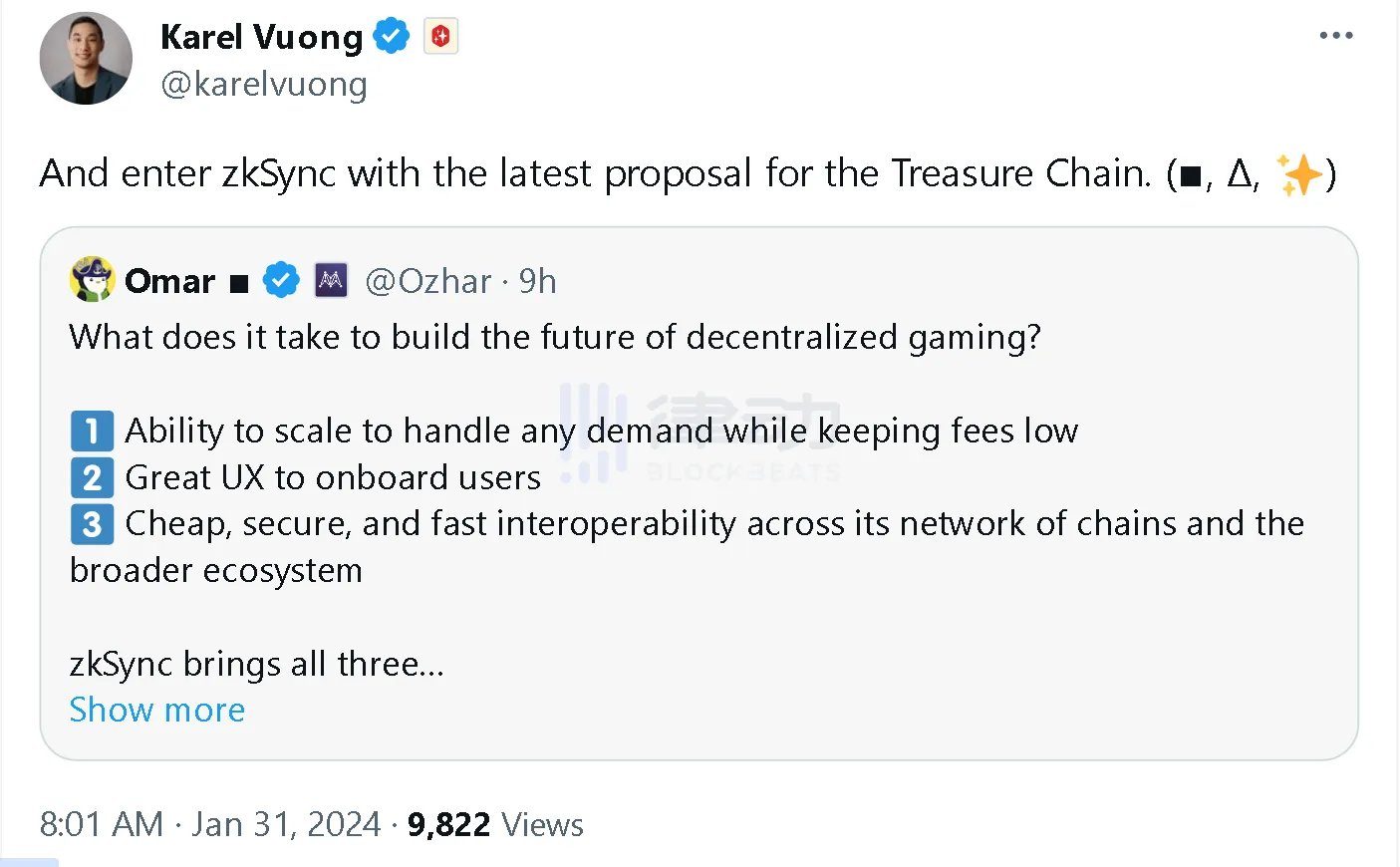
It is reported that in the Treasure ecosystem, a noteworthy game is called "灯塔" (Lighthouse). Currently, it is a diamond partner of TreasureDAO. In the future, "灯塔" game has a high probability of becoming a harvester for TreasureDAO to harvest 6 million MAGIC Tokens. This harvester sponsorship will be used to pay players for their gold-making profits.
Related reading: "Observing TreasureDAO through the lens of Lighthouse Game."
As early as November 25th last year, Karel Vuong, co-founder of TreasureDAO, made it clear that TreasureDAO is building a gaming chain and plans to use MAGIC as the Gas token, which may be based on the Arbitrum chain or Cosmos chain. Subsequently, TreasureDAO team member Sambino revealed in the Discord community that the Treasure Chain Litepaper would be released one week later. However, after Optimism intervened in the competition for Treasure Chain, Karel Vuong announced that the release of the Treasure Chain Litepaper would be postponed until February 5th.
Interestingly, in this Treasure competition, the first participant was Arbitrum.
As early as before the proposal of Optimism, Treasure was already listed as a member of its L3 track. In addition, early TreasureDAO and Arbitrum have repeatedly promoted and held multiple AMA activities for Lighthouse Games. As a relatively large community, TreasureDAO has a certain mass base, and TreasureDAO occupies the leading position of games in the Arbitrum ecosystem, with a certain degree of discourse power in the entire Arbitrum ecosystem.
The competition in the L2 space has entered a white-hot stage since last year's bear market.
The L2 War refers to the protocol and user war of establishing important infrastructure and collecting initial critical mass. It is not just about Treasure. Due to the numerous star projects, the fierce competition in the L2 track has become a well-known fact throughout the entire cryptocurrency industry.
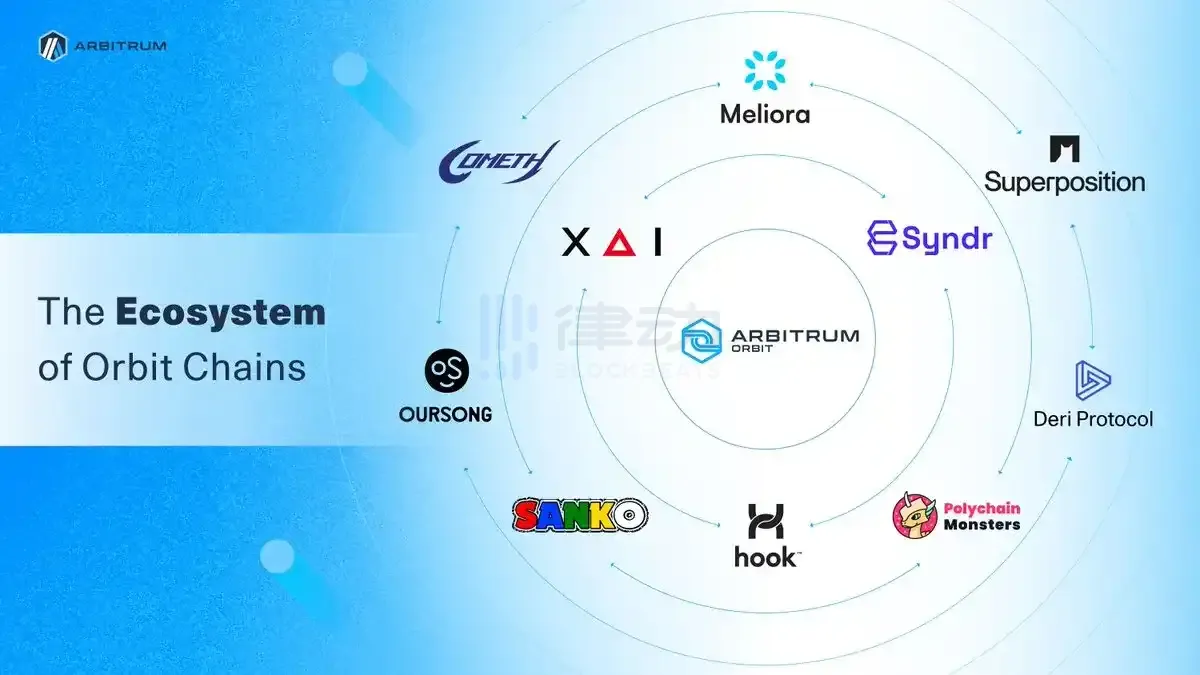
Except for the OP Stack and ZK Stack launched by Optimism and zkSync, respectively, the competition between the OP Rollup camp and the ZK Rollup camp in the RaaS field includes Orbit launched by Arbitrum and Appchain launched by Starknet. In the zkEVM field, the tense relationship between the two "domestic champions" projects, Scroll and Taiko, has also become an open secret in the industry.
「Stack Wars」
When it comes to zkSync in the L2 competition, Optimism comes to mind. Last June, the release of ZK Stack by zkSync shortly after OP Stack sparked lively discussions in the community.
OP Stack, which has a first-mover advantage, has not only collaborated with Coinbase to create a super chain structure and Layer 2 solution called Base, but also gained favor from "leading public chain" BNB Chain, and has launched a new scaling solution called opBNB for BNB Chain.
In addition, many application development teams have also chosen to develop their own application chains based on the OP Stack. For example, the game digital economy platform Cocos-BCX and NodeReal have cooperated to jointly develop the first Web3 game-centered Rollup Layer2 on the BNB Chain based on the OP Stack; a16z Crypto has launched the Optimism Stack rollup client Mag; on June 22, the NFT trading market Zora launched the Layer 2 network ZORA NETWORK based on the OP Stack.
Related reading: "zkSync's OP Stack competitor, can it win the L2 scaling battle?"
Compared to OP Stack, which has attracted multiple development teams due to its first-mover advantage, ZK Stack has more technological advantages. However, just like its performance in this scaling war, zkSync seems to always lack a bit of innovation.
Last August, Polygon's zero-knowledge proof team, Polygon Zero, publicly criticized zkSync in an article titled "Protecting the Open Source Spirit". The article accused zkSync of copying Polygon's open source code without permission and making misleading statements, which caused widespread attention in the industry.
Later, zkSync also imitated Consensys and launched the Fellowship program. Unlike the impressive technological advantages before, this imitation seems "rougher". Compared with the well-prepared Consensys, the entire plan only has a theme list and an article introduction.
Related reading: "Consensys and zkSync launch Fellowship programs one after another, is the competition for L2 entering the "melee stage"?"

Four companies compete for ApeChain
In March 2022, ApeCoin, the native token of the BAYC NFT ecosystem, was launched. Along with it, a decentralized autonomous organization (DAO) called ApeCoin DAO was also established to handle token-related affairs. Subsequently, multiple Layer 2 (L2) networks competed for the development and maintenance rights of ApeChain.
Polygon is the earliest to propose the development and maintenance of ApeChain's L2. On October 11th last year, Sandeep Nailwal, co-founder of Polygon Labs, proposed that ApeCoin DAO use the Polygon Chain Development Kit (CDK) to develop and maintain its L2 network ApeChain. A month later, Optimism joined in, and its co-founder and chief scientist Ben Jones proposed that ApeCoin DAO develop and maintain its L2 network ApeChain on the Optimism Superchain.
Following that, Nina Rong, the ecosystem development lead of the Arbitrum Foundation, also proposed that "ApeChain be developed using Arbitrum technology and led in growth by Horizen Labs." This proposal was also marked as "High Importance" by Messari. Horizen Labs, mentioned in the proposal, has helped the ApeCoin DAO community launch several major initiatives, including ApeCoin, Otherside, and ApeStake within the Ape ecosystem.
Related reading: "Will APE become a Gas token? ApeChain's latest proposal draws attention."
After seeing the efforts of Polygon, Optimism, and Arbitrum, zkSync has also joined the battle. On December 16th, zkSync proposed in the ApeCoin DAO community to "build ApeChain using the fastest and cheapest ZK technology in production."
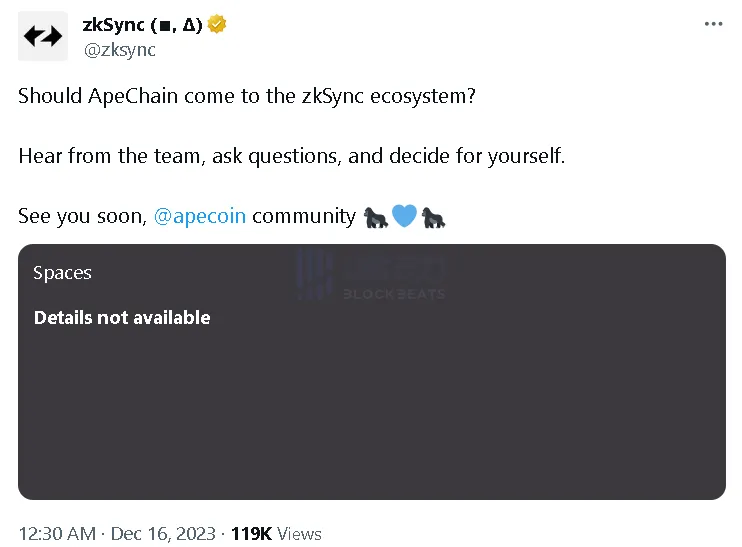
Finally, WebSlinger, the administrator of ApeCoin DAO, announced the establishment of a Request for Proposal (RFP) process, and anyone who wants to build an ApeChain for the DAO can participate. After the community feedback period ends on January 31st, a round or two of voting will be conducted based on the number of submitted ApeChain AIPs to determine who will build ApeCoin DAO's ApeChain. According to the solicitation proposal, the first round of voting is planned to take place from February 1st to February 7th.
New and old L2 show their strengths, RaaS enters halfway
Airdrop was originally a strategy used by Uniswap to deal with SushiSwap's vampire attack, but it ultimately became the biggest shortcut for ordinary people to gain wealth in the cryptocurrency field, which also indirectly provided a new idea for L2 competition.
Blast activates "head rolling" mode
Welcome to join the official BlockBeats community:
Telegram Subscription Group: https://t.me/theblockbeats
Telegram Discussion Group: https://t.me/BlockBeats_App
Official Twitter Account: https://twitter.com/BlockBeatsAsia

 Related Articles