Messari: Six EVM ecological inventory, who can break through the siege?

原文标题:《 Messari:盘点 6 大 EVM 生态,谁是 ETH 用户外溢的最大赢家? 》
原文作者: Messari - Ally Zach
原文编译: BlockTurbo
In 2022, it's nbsp. Layer 2 The narrative heats up across the year, replacing the highly competitive Layer 1 Pattern. Arbitrum And Optimism And has attracted hundreds of thousands of loyal users and created a thriving. DeFi The ecosystem. Because each of these chains is trying to carve out its own place in the broader cryptographic environment, they arguably create a test that can be used to determine which user acquisition strategies work best.
The Rise of L2 Ecosystem
Due to a number of black swan events, the major chains of ecology in. 2022 Has suffered a major setback, with activity and user base declining across the industry. However, in the second half of 2022, as FTX Crash, users began to return to the EVM chain. Today, we're going to focus on six. EVM Chains: ETH, BNB, Polygon, Arbitrum, Avalanche, Optimism.
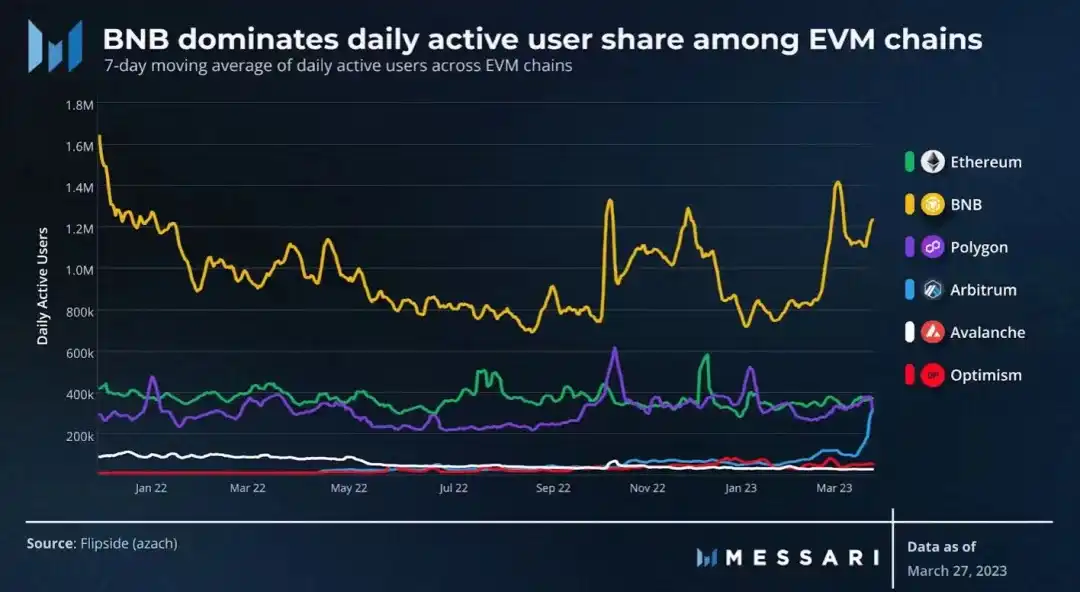
以太坊和 BNB 拥有两个最大的加密用户群,分别拥有 2.26 亿和 2.74 亿累计独立用户。BNB Chain 在过去 12 个月中的平均月增长率为 6% ,但以太坊的新用户采用率平均下降了 5% 。
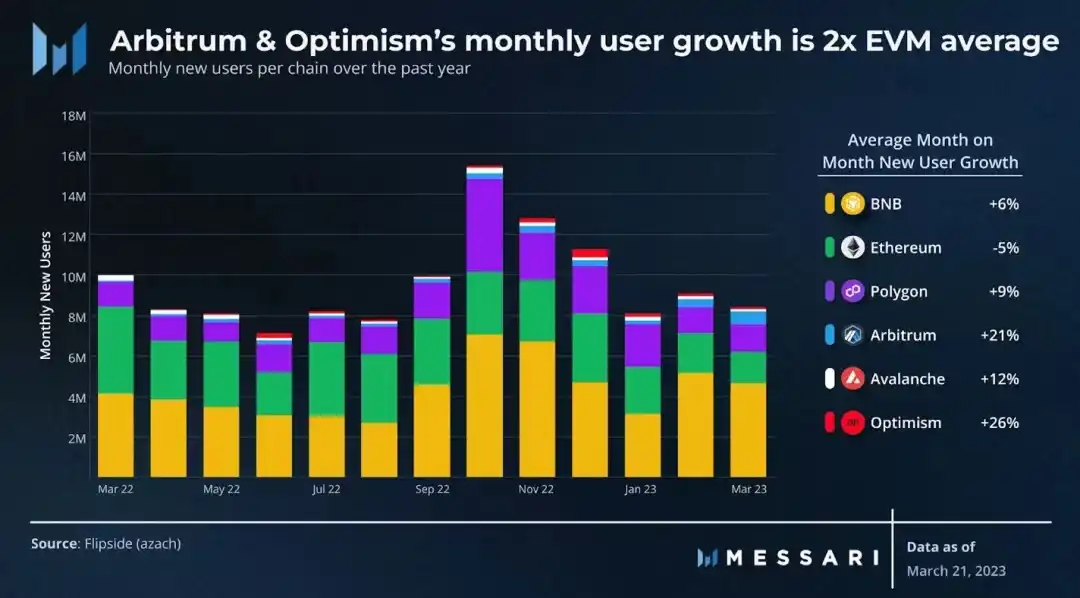
Part of the reason for Ethereum's stagnant user growth is the popularity of its L2 expansion solutions, Arbitrum and Optimism. Over the past 12 months, the number of active addresses in both ecosystems has increased nearly fivefold, helped by the fact that 20% Month-on-month user growth. In addition, these two ecosystems retain more users than any other. 12-month retention rates are 30-40%. While the industry average retention rate is below 20%. .
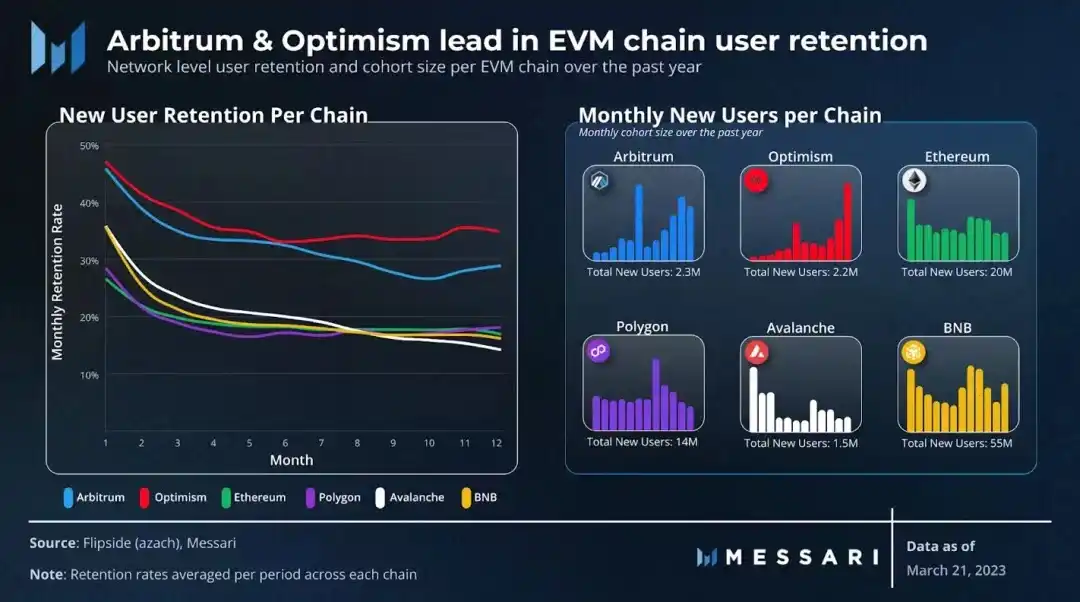
While the user group size of mature EVM chain systems has generally decreased over time, Arbitrum and Optimism have steadily increased. The largest group sizes have come in recent months, suggesting that both networks may continue to grow -- especially if retention rates hold up.
While there has been a recent increase in L2 network activity, the alternative L1 remains relevant for its proficiency in acquiring and retaining users. Historically, some projects have found that focusing on niche industries can be a profitable and viable long-term strategy. Typically, the networks that build the strongest industry ecosystems enjoy higher retention rates.
However, finding a niche does not guarantee long-term success, as user loyalty can be unpredictable. As applications forked and redeployed across chains, users jumped ship without hesitation. Moreover, some crypto narratives can become a fad, with investment values disappearing overnight as interests shift.
In the L2 ecosystem era, it is important to identify which specific blockchain ecosystems demonstrate successful user acquisition and retention models and which employ ineffective strategies. To further assess the sustainability of each EVM chain, the impact of these strategies on retention engagement at different domain levels should be assessed.
Different track
When it comes to on-chain transactions, most fall into four broad categories:
DEX transaction
Derivatives trading
Borrowing and borrowing
NFT
All six EVM chains mentioned above have some degree of presence in each of these domains. In addition to looking at pure transactions and user numbers, we can also get a deeper look at the health of different areas on each chain by looking at adoption rates and retention of new users over time.
DEX
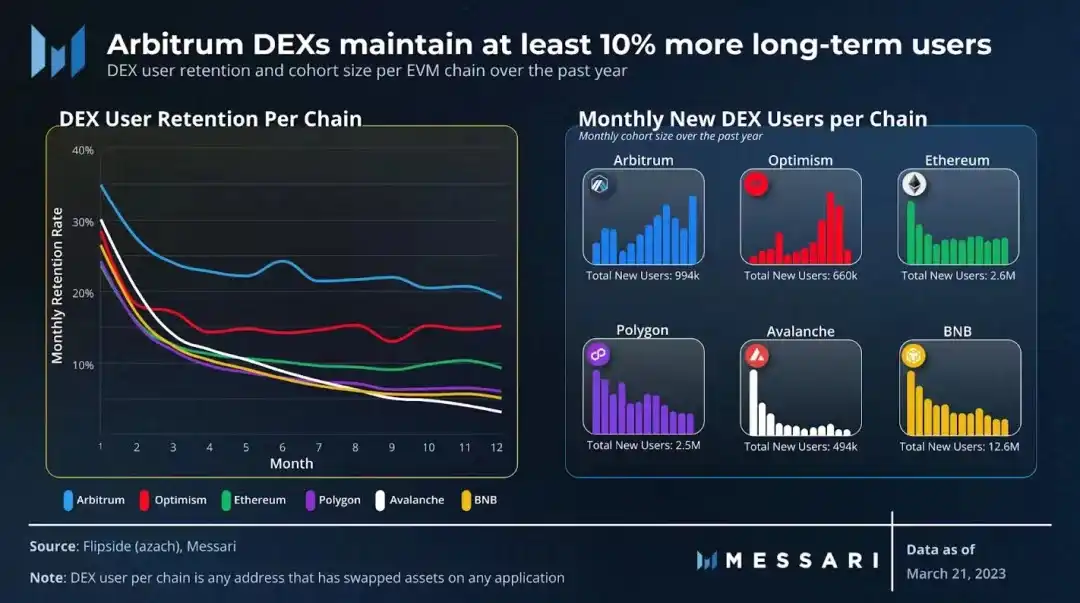
Over the past year, the initial user base of DEX for mature EVM chains such as Ethereum, Polygon, Avalanche and Binance Smart Chain has decreased. Part of the decrease may be due to multiple black swan events and the resulting loss of confidence in the crypto ecosystem. In addition, from Arbitrum and Optimism on the emerging DeFi ecosystem pair competition may have taken user market share away from the foundation chain.
Among these mature EVM chains, long-term user retention rates for Ethereum tend to be about 5% higher. , mainly because its native DEX is more liquid. For example, Uniswap Has been deployed on most other EVM chains and has been forked more than any other application, creating SushiSwap, Trader Joe, and PancakeSwap. Although its top DEX was deployed on other chains and forked, Ethereum has built enough trust with its community to continue to attract more liquidity and trading volumes than its peers.
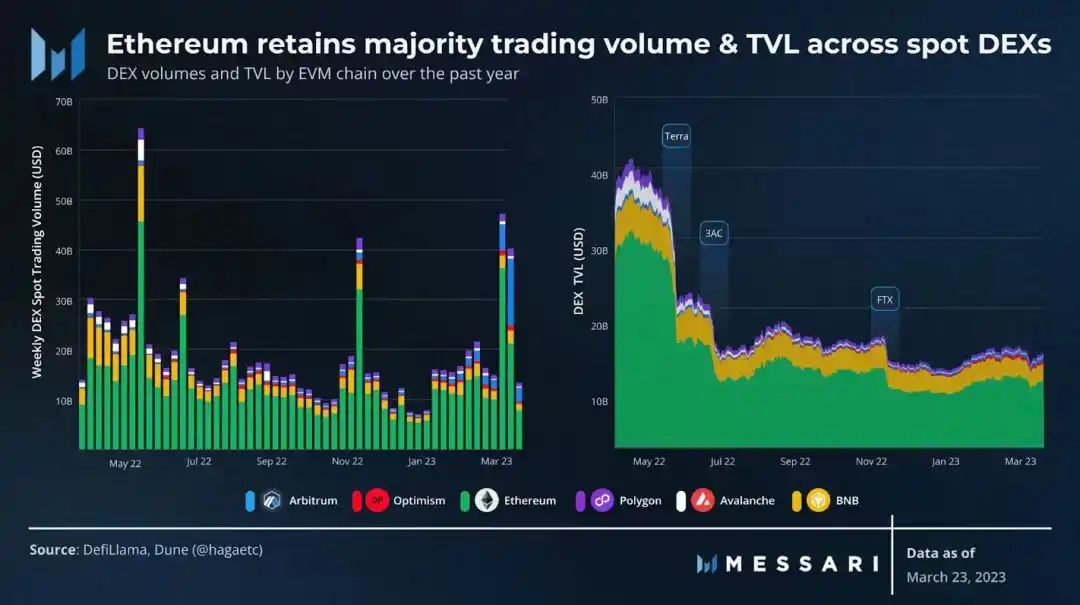
Much of Ethereum's success comes from its robust DeFi ecosystem. It has some of the most widely used apps for trading, lending, pledging and liquidity mining. The respective tokens and stablecoins of many of these apps make up some of the deepest pools of liquidity -- not just on the Ethereum native app, but in the larger crypto environment.
Fundamentally, DEX depends on the surrounding ecosystem to produce the assets needed for trading; It also relies on established ecosystems, such as Ethereum, which are preferred by high-quality new projects over other emerging ecosystems.
Arbitrum and Optimism has an above-average long-term user retention rate compared to its competitors. Their success may be attributed to their rapidly expanding DeFi ecosystem and DEFI-focused motivational activities. In Arbitrum's case, the most active DEX pool (by an overwhelming margin) came from its top derivatives trading platform, GMX, and Gains Network. On the other hand, after the completion of the Optimism Quests incentive program, Optimism's top mining pools have yielded to mostly non-native assets.
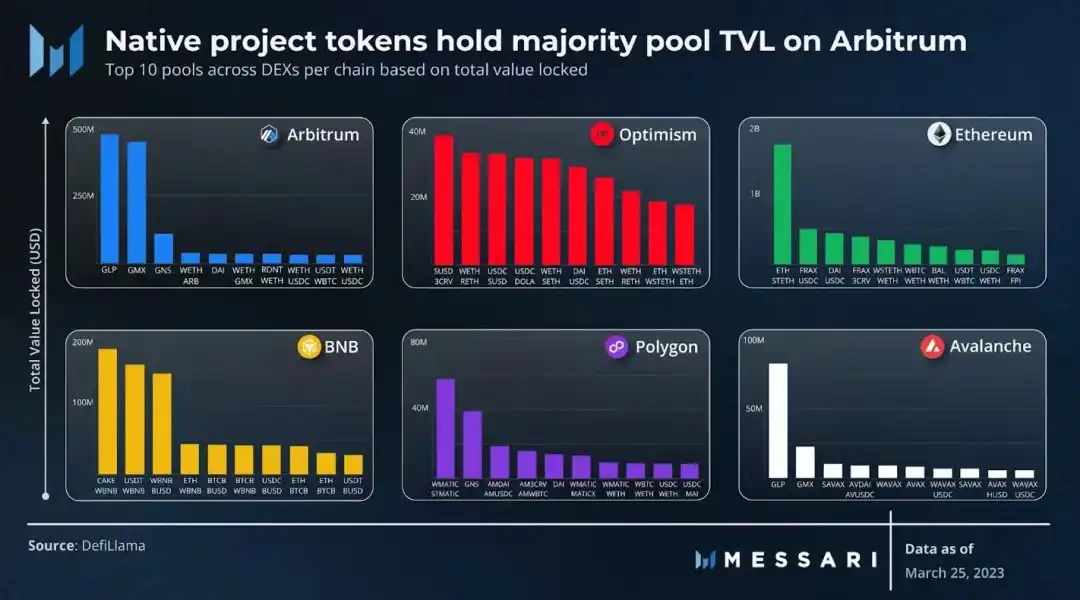
The distribution of Arbitrum's top DEX pools may indicate that its emerging DeFi ecosystem is similar to the development of Ethereum, with users actively participating in the use of native tokens throughout the ecosystem, strongly suggesting that the recent activity will continue.
For Arbitrum and Optimism, their largest group size is also recent. If they can maintain their above-average retention rate for a few more months, they may see further significant gains. However, as the downward trend in each chain above shows, it may be difficult to maintain these retention rates. In order to continue to grow, each chain needs to establish a niche within the global DeFi ecosystem and continue to roll out new native projects.
Derivatives Trading
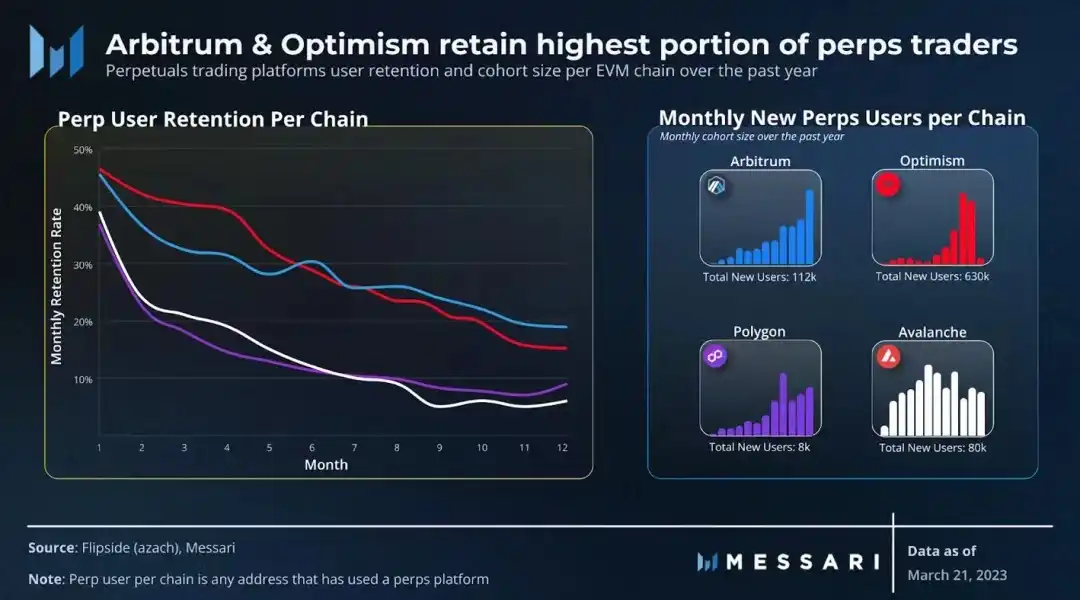
Because of its high-frequency trading nature, derivatives DEX has flourished on low-gas networks. In the EVM chain, Arbitrum and Optimism account for most of the trading, although Polygon and Avalanche entered the field well before they did. L2's long-term user retention rate on its derivatives platform is now 10 per cent higher on average. And the new user base is growing rapidly.
During the Optimism mission activity, Perpetual Protocol, Kwenta Original perpetuity trading platforms such as Pika and Pika have rapidly accumulated perpetuity traders. Once the event was over, however, most of the traders on these incentive platforms disappeared altogether. In order for Optimism to capture its share of sustainable trading volumes organically, it will have to rely on unique models and markets, such as Synthetix's (Kwenta) new perpetual trading product.
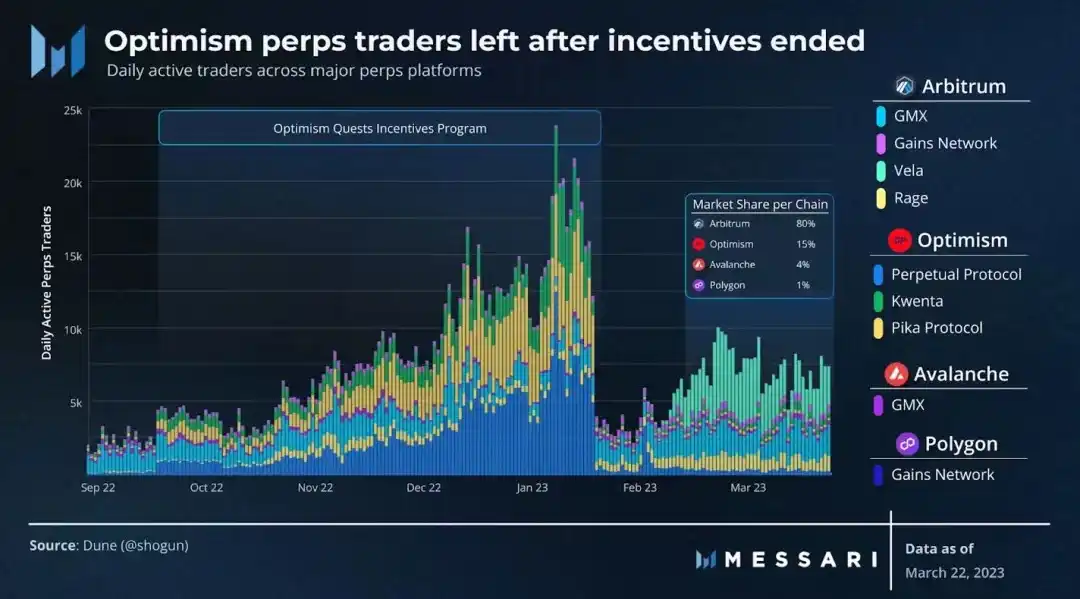
In contrast to Optimism, Arbitrum has maintained steady and arguably more organic user growth over the past year. Every time a derivatives platform is added, its new users grow. Following the conclusion of Optimism's mission campaign, Arbitrum dominated about 80% of derivative traders on the EVM chain. GMX started getting attention as a single derivatives trading platform on Arbitrum, but the ecosystem only took off once competition emerged. Because derivatives traders are already on Arbitrum, there is little friction switching between similar platforms, creating a healthy form of competition.
With this in mind, the key differentiator between emerging DeFi ecosystems may be the diverse competitive landscape, which is both compostable and widely adopted in the larger ecosystem. For example, derivative platforms like Gains and GMX exist on Polygon and Avalanche, respectively. But it was not until their recent boom in Arbitrum and Optimism that they gained significant traction. In addition, once GMX's liquidity token (GLP) is accepted as collateral for the entire Arbitrum ecosystem, it enhances the utility of providing liquidity and enables GMX to attract larger traders.
As these emerging chains continue to grow, they should seek to establish sustainable niches within the larger DeFi ecosystem to develop lasting user retention rates and sustained revenue streams.
Loan
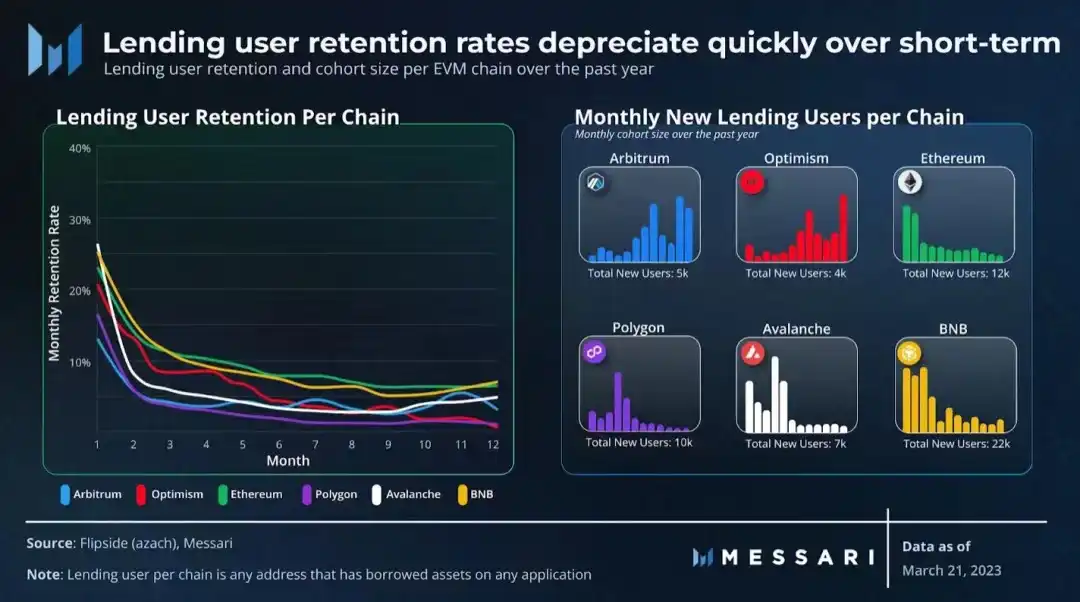
In all EVM chains, loan retention rates drop sharply within 1-3 months, and loan retention rates are generally low over the long term compared to other areas. In general, users borrow assets at different rates than they trade them; Instead, lending activity is associated with high market volatility. Users seek leverage when it suits them and generally do not want to hold assets for the long term.
Cross-chain lending platforms have seen a decline in new users, which can partly be attributed to the rise of alternative forms of leverage. For example, with derivatives gaining popularity on chains such as Arbitrum and Optimism, users can trade more frequently using high leverage. In fact, over the past year, there has been a negative correlation between derivatives volumes and borrowers on lending platforms.
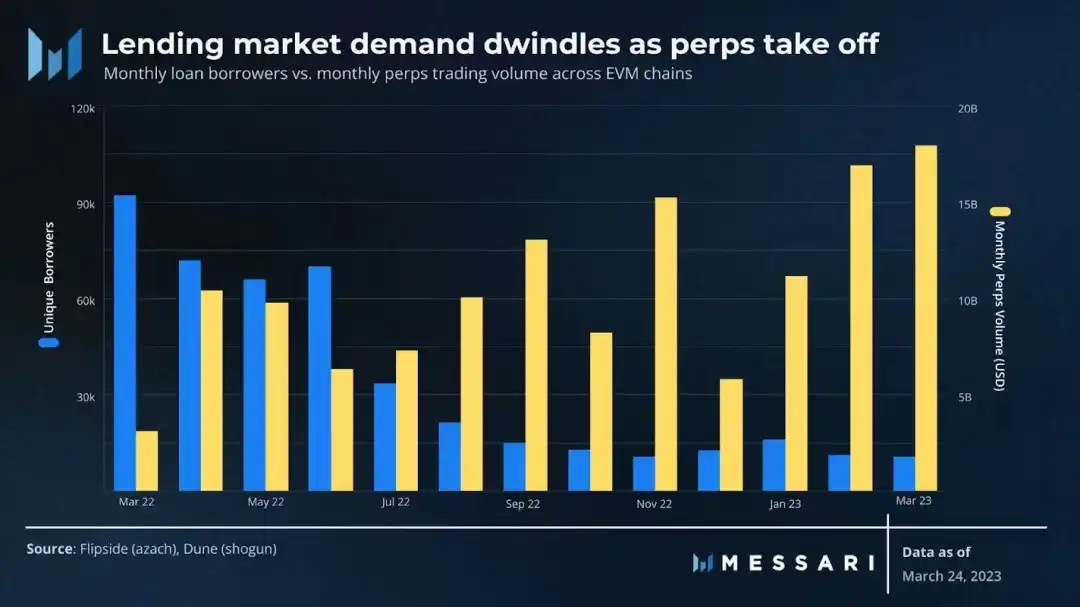
It seems likely that derivatives will continue to grow, especially given their recent activity on L2. Lending apps need innovative ways to attract users to stay competitive. Historically, most borrowing needs on the mature chain have been secured by the chain's original tokens. For emerging markets, primary tokens need to mature after a period of super-accumulation and selling before they can be used in large numbers for loans. Once the dust settles on their respective token launches, the Arbitrum and Optimism markets may begin to see more rapid adoption in the coming months.
Lending activity in mature markets should pick up once markets move away from the stable sideways period. In addition, new app innovations and further expansion of collateral and bond issuance could inject some life into their respective markets.
NFT
Although self - nbsp; 2021 Year NFT Since the boom, Trading as a whole has been on a steady downward trend, but the bear market has spawned a wave of innovation. It brings new market mechanisms and even extends NFT use cases beyond still images. Decentralized social media, on-chain identities, and new forms of in-game assets have emerged in the past year, fostering value across different chains.
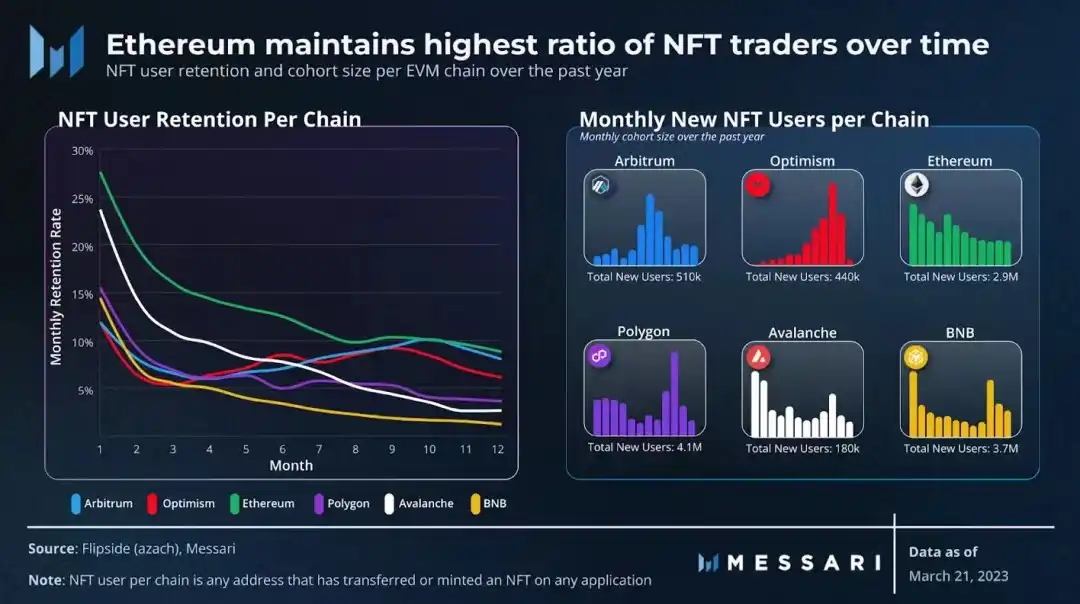
Ethereum has been home to a number of viral blue chip NFT series. It is also. OpenSea And Blur, among others. NFT The original chain of the market, both of which lead to its higher long-term user adoption rate.
PFP and the market
While Ethereum was not the first chain to support NFT, it did carry the NFT boom cycle starting in 2021.
The Ethereum blue chip series, such as CryptoPunks, BAYC, and Pudgy Penguins, have established high value in the cryptocurrency space, most likely due to their early stage, implied social status, and rampant virality. The blue-chip NFT collection accounts for about half of the total trading volume in Ethereum's top NFT market, resulting in relatively high global trading volume for other chains.
In addition, Ethereum has 10 times more retail NFT traders than its next largest competitor, Polygon. Overall, these blue-chip collections keep users coming back to Ethereum despite relatively high gas bills, resulting in high long-term retention.
In terms of overall NFT market transactions, Ethereum markets such as Blur and OpenSea lead the EVM chain with nearly 100 times the volume of transactions. New entrant Blur has held on to its share of Ethereum NFT dealers, retaining 62% of the chain's total sales. . Much of its success is due to novel advanced trading features and a continuous airdrop mechanism. In addition, Blur's user retention rate is on average 15% higher than that of its core competitor OpenSea. This is likely due to its lowest transaction costs and airdrops.
While Ethereum has found the market for its product suitable for high-value collectibles, Polygon, Avalanche, and BNB are holistic. gas Lower cost chains are home to lower value NFT collectibles. When gas It is more efficient for traders to flip the NFT when the price is far below the actual value of the asset.
Arbitrum has started to keep pace with these more established chains, with much of its activity coming from the Treasure Trove gaming market. On the other hand, Optimism No substantial NFT traction has been seen. Much of Optimism Optimism's motivational activity to date has revolved around DeFi applications, with the exception of Galxe's credentials, which may explain its lagging adoption in the current NFT market.
GameFi
Due to the high-frequency trading nature of in-game assets, gaming applications require high throughput and minimal gas costs. Cheap gas rates and a large selection of gaming applications are priorities. Polygon and BNB, become destinations in the EVM chain for Web3 gamers. Currently, there are more than 300 different active gaming apps on both chains, and each retains about 50% of EVM gamers.
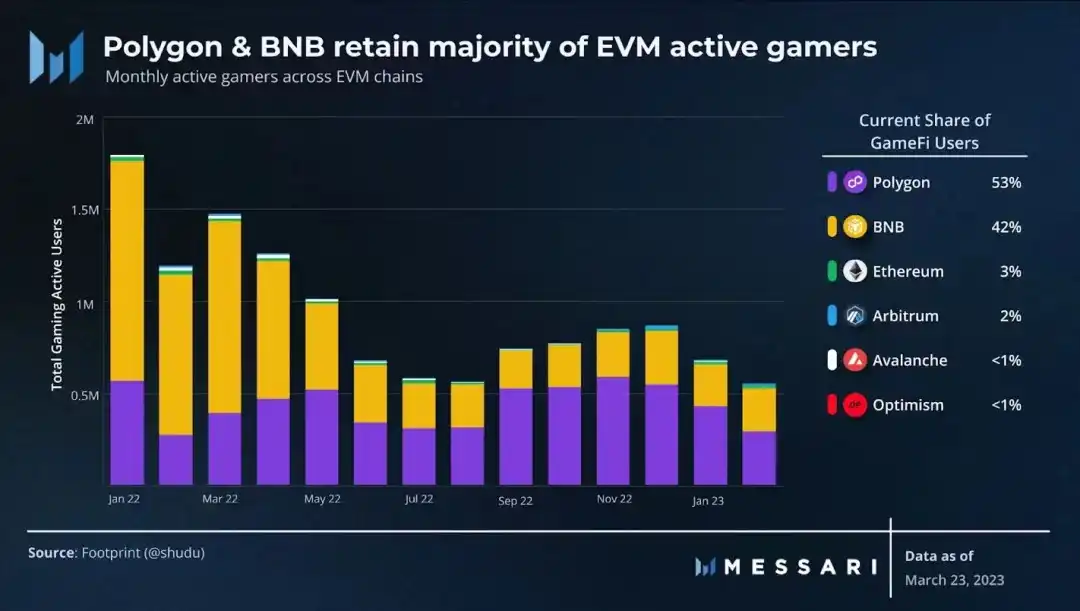
The current gaming landscape is pretty saturated, with the same money-making, quick-reward games deployed all over the place. So far, no on-chain game has built a lasting relationship with its users. As a result, even the top gaming apps on Polygon (Alien Worlds) and BNB (Mobox Farmer) have relatively low user retention rates compared to traditional PFP deals. In addition, GameFi's total active users are down more than 50% year-to-date, and the size of its new user base is down about 55% each. .
The gaming space is relatively unique among encrypted applications in that it only takes one killer game to deploy to attract a large number of users. While games may generally take more time to build, they are more self-contained than other applications. They do not necessarily rely on the same network effects as other consumer applications for adoption, nor do they depend on the deployment of other applications such as DeFi. In that sense, the first low-cost chain to launch the next big game may succeed in taking over the industry.
Utility extension
In the last NFT boom, Arbitrum and Optimism were in their infancy and had yet to gain a foothold in the GameFi space. Despite their low gas bills, growing user base, and some basic NFT applications, they have yet to find their niche in the consumer space.
In both cases, one of the most widely used consumer applications for each network is the Galxe authentication platform. It is used for corresponding incentive programs: Arbitrum's Odyssey activities and Optimism Quests. In both cases, users are incentivized to participate in the applications within each ecosystem in exchange for Galxe NFT and possible financial incentives. Outside of these activities, however, the application has yet to find its place in any ecosystem, possibly due to a lack of cross-application utilities.
Polygon, on the other hand, has been able to foster a modern Web3 social ecosystem through partnerships with Web2-based companies like Starbucks and Reddit. It also hosts some of the most widely used decentralized social applications, such as Lens. However, neither niche has found traction at scale, leaving room for another low-cost chain to have a competitive advantage.
The use case for NFT has been expanded to include new forms of on-chain physical and digital content. Emerging use cases in areas such as social media, on-chain identity, music, and physical assets are growing within the larger crypto ecosystem. Because it takes time to build a robust, cutting-edge Web3 ecosystem, if a new ecosystem is executed correctly, it is overall less likely to be replicated on other chains. Establishing a niche in one of these areas has the potential to be a major driver of adoption and fee revenue for almost all low-cost chains.
Expense income
Most of the profit revenue comes from high-frequency trading in DeFi and consumer applications. For the above EVM chains, each chain appears to be in the short term (1-2 months after initial entry) and the long term (+ After 9 months) to get the most value per user. Quite simply, the longer a network keeps users, the more revenue they get from fees. Note that fee-based revenue is skewed in part because the price of original tokens has changed so much over the past 12 months.
For most EVM chains, the majority of fee income comes from DeFi based applications, such as DEX and derivatives platforms. In terms of Optimism, BNB, and Avalanche, there is a considerable difference between DeFi's total fee revenue and that of NFT-based apps.
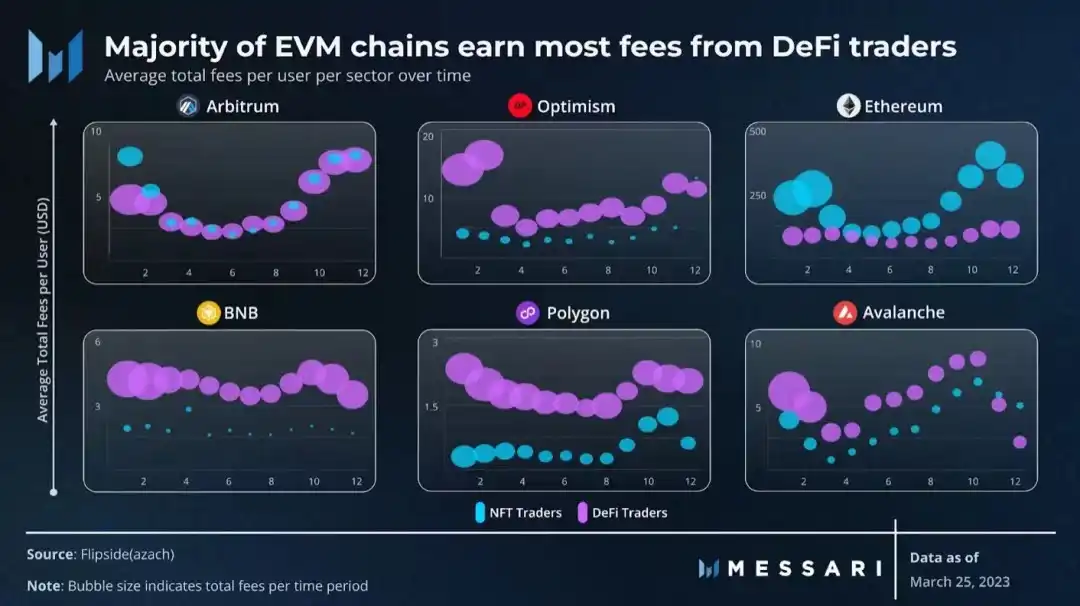
Ethereum's consumer-based applications, on the other hand, have a higher average total cost per user. This is not surprising given that the Ethereum-based NFT market handles close to 100 times the average transaction volume compared to other chains. While Ethereum has a wide range of applications, it has still developed a niche expertise in the high-value blue-chip NFT market, which has become one of its strongest revenue streams.
summarize
The "know-it-all" multi-domain mastery pioneered by Ethereum is no longer a viable strategy for emerging ecosystems. In today's competitive environment, establishing a niche in one area seems to be the most profitable and retention strategy.
As more L2 continue to launch on the main network, it will be important to watch their organic user growth and the types of applications that attract new users. While there will almost certainly be a DEX and NFT market included, the key differentiator between L2 will be the native applications built on top of them. These apps need to be sticky enough to attract new users, and comprehensive enough to carve out a new niche in their chosen field.
Source of original text
Welcome to join the official BlockBeats community:
Telegram Subscription Group: https://t.me/theblockbeats
Telegram Discussion Group: https://t.me/BlockBeats_App
Official Twitter Account: https://twitter.com/BlockBeatsAsia

 Related Articles