Mint Ventures: Who is the better choice for upgrading Cancun, OP or ARB?

Original Title: "Layout Cancun Upgrade, OP or ARB, Who is the Better Choice?"
Original Author: Alex Xu, Mint Ventures
In 2023, the upgrade of Cancun is undoubtedly one of the most critical industry events after the upgrade of Shanghai. The L2 project that benefits from it is also a key track we are focusing on this year.
According to current news, the Cancun upgrade included in EIP4844 is expected to take place between October 2023 and January 2024. The token prices of the two main L2 projects, Arbitrum (referred to as ARB) and Optimism (referred to as OP), experienced significant declines after reaching new highs in the first half of the year, and now may still be a good time to position oneself.
Of course, if we look at market capitalization, the circulating market value of OP has been hitting new highs since 2023, while ARB has been in a low consolidation phase. In this article, the author attempts to sort out the following content:
· The value source and business model of L2
· Comparison of OP and ARB competitiveness and business data
· How Can Cancun Upgrade Significantly Improve the Fundamentals of L2
· Potential Risks of OP
The following article represents the author's current perspective at the time of publication, with more evaluation and interpretation from a business perspective. There is less emphasis on the technical details of L2. This article may contain factual errors and biases, and is only intended for discussion. We also welcome corrections from other investment research professionals.
1. The value source and business model of L2
1.1 Value Proposition and Moat of L2
The products provided by L2 and L1 are similar, that is: stable, anti-censorship, and open block space. We can also consider it as a specialized on-chain cloud service. Compared with L1, the main advantage of L2 block space is its lower cost. Taking OP as an example, the average gas cost is only 1.56% of Ethereum's.
Because block space is a specialized cloud service, it means that its needs are not universal. Most internet services do not need to run on L1 or L2. However, in the traditional world, financial services are heavily constrained and lack transparency. On the blockchain, they have the most abundant application practices.
The needs of service builders and users for L2 block space determine the upper limit of the value of L2.
L2, like L1, can build a moat based on network effects.
On L2, the larger and more diverse the user base, the lower the difficulty for people to cooperate on L2. This makes it easier for new service models to emerge and further satisfy and introduce users into this network. Each new user that enters and resides on the L2 network increases the potential value of this network for other users.
In the Web3 world, the network effect of L1&L2 is second only to stablecoins represented by USDT. The higher the barrier of the top L1&L2, the higher the valuation premium they often enjoy.
1.2 L2 Profit Model
The profit model of L2 is clear and simple. On one hand, it purchases storage space from trusted Data Availability (DA) providers to backup its L2 data (so that when there are problems with L2 operation, data can be restored from backup). On the other hand, it provides users with cheaper block space services and charges fees accordingly. Its profit comes from L2 fees (basic fees + MEV income) minus the cost paid to DA service providers.
Take OP and ARB as examples. The DA layer they choose is Ethereum, which has the highest degree of decentralization and the strongest credibility as L1. By paying Gas to Ethereum, they store their compressed L2 data on Ethereum. The fees they charge are the Gas paid by users (including ordinary users and developers) when using their L2, as well as MEV income. The difference between the latter and the former is their gross profit.
The reason why it is called gross profit is because this part of the profit has not yet deducted other expenses of the project, such as labor costs, rewards for the ecosystem, marketing expenses, and so on.
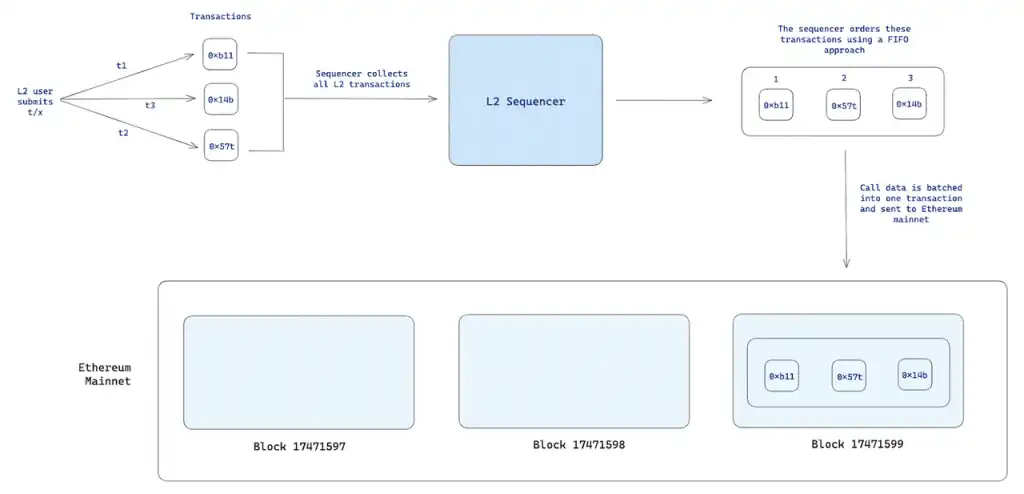
The role of the sorter in the L2 business process
The fee collection for L2 and cost payment for L1 are both executed by the sequencer of L2, and the profits also belong to the sequencer. Currently, the sequencers for OP and ARB are both operated by the official government, and the profits also belong to the official treasury. Of course, centralized sequencers mean extremely high single-point risks, and both OP and ARB have promised to decentralize their sequencers in the long term.
It is highly likely that the mechanism of decentralized sorters will operate on a POS mechanism, which means that decentralized sorters need to stake L2 native tokens such as ARB or OP as collateral. When they fail to fulfill their responsibilities, the collateral will be slashed. Ordinary users can stake their own tokens as sorters, or use staking services provided by platforms like Lido, where users provide collateral tokens and professional, decentralized sorter operators perform sorting and uploading services. Staking users can receive the majority of L2 fees and MEV rewards from the sorters (90% in the case of Lido's mechanism).
At that time, ARB and OP tokens will receive economic value empowerment in addition to pure governance.
1.3 ARB VS OP
OP Competitive Advantages
Since its launch, ARB has consistently outperformed OP in various business data on L2. According to the L2 network effect mentioned earlier, as a leading L2, ARB has stronger competitiveness than OP and should enjoy a higher valuation premium.
However, this has gradually changed since OP proposed the Superchain strategy in February this year and began to vigorously promote the OP stack.
Op stack is an open-source L2 technology stack, which means that other projects that want to run L2 can use it for free to quickly deploy their own L2, greatly reducing the cost of development and testing. Superchain is the future blueprint described by OP, which uses the L2s of OP stack. Due to the consistency of the technical architecture, they can achieve secure, efficient, atomic-level communication and interaction of information and assets with each other, similar to Cosmos' "Interchain", which is called Superchain.
After the launch of OP stack and Superchain, they were first adopted by Coinbase. The L2 Base built with OP stack and the Superchain strategy were announced in February and officially launched on August 10th. With the demonstration effect of Coinbase, OP stack has been adopted by more and more projects, such as Binance's opBNB, NFT project ZORA invested by Paradigm, Loot ecological project Adventure Gold DAO, Public Goods Network (PGN) supported by Gitcoin, top option project Lyra, well-known on-chain data dashboard Debank, and even Celo, which was originally L1, chose OP stack as its L2 solution.
The service target of the former L2 project was users who used their own block space, while Superchain and OP stack expanded the definition of users to L2 operators, transforming it from a 2C business (here, L2 developers are also defined as C) to a 2B2C business. This has created new sources of value and protection for OP.
1. Multi-chain network effect. By extending the definition of "network" in the network effect from a single chain to a "multi-chain network", cross-chain links of funds and information are established between multiple chains through a standard and consistent OP stack. L2 operators are responsible for user introduction and operation, expanding the total user population of the "multi-chain network", and increasing the value of each user and each L2 within the network with the increase of the total population.
2. Scale effect. The fixed technical infrastructure costs (such as the upgrade and maintenance of OP stack) are borne by OP, but the feedback and improvements provided by other users of OP stack further improve the quality of OP stack, which reduces the cost of technical maintenance and upgrading of single chains, sorter and index incentives, and enhances the attractiveness to potential L2 adopters.
3. Community of interests. By bringing more Web3 industry giants into the OP ecosystem, it is easier to gain their support in various aspects such as technology, users, developers, and investment due to the consistency of interests.
From a single-chain ecosystem to an interconnected chain ecosystem, OP not only benefits from the expected growth in the number of users and developers across the entire chain, but its main business data on the OP main chain is also continuously approaching or even surpassing ARB, which was once far ahead of it, for example:
a. Monthly active addresses: The weekly active addresses of OP/ARB have increased from 32.1% to 73.6%.
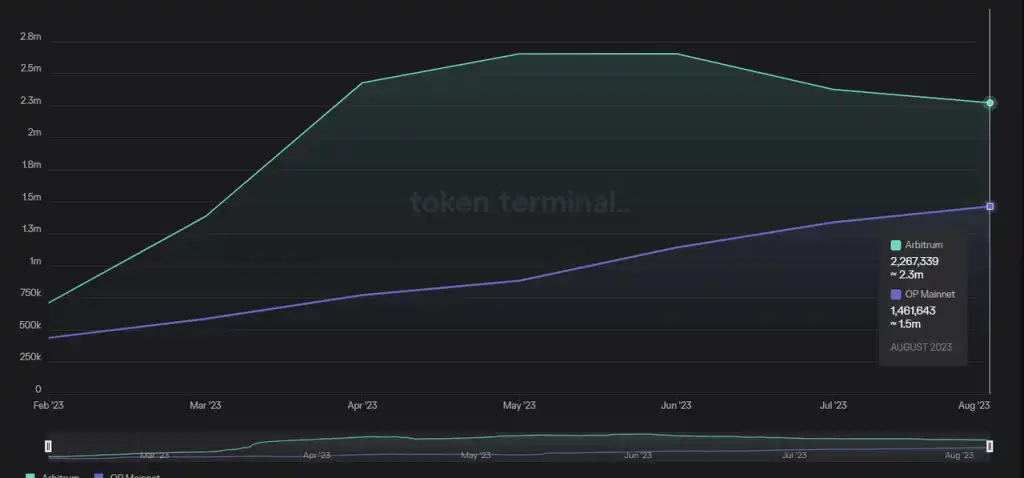
Data source: tokenterminal
b. Monthly L2 Profit: OP/ARB's L2 profit has risen from a low of 16.4% to its current level of 100.2% (overtaking)
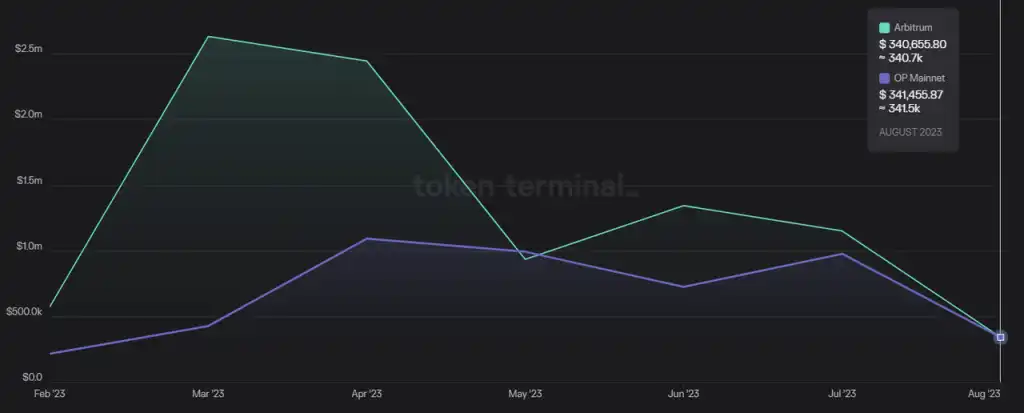
Data source: tokenterminal
c. Monthly Interaction Frequency: The monthly interaction frequency of OP/ARB has increased from a low of 22.4% to the current 106.5% (overtaking).

Data source: tokenterminal
d. On-chain funds: The on-chain TVL of OP/ARB has risen from 1/3 of the low point to 1/2 of the current level.
OP on-chain funds TVL, around 2 billion in March, currently around 3 billion.
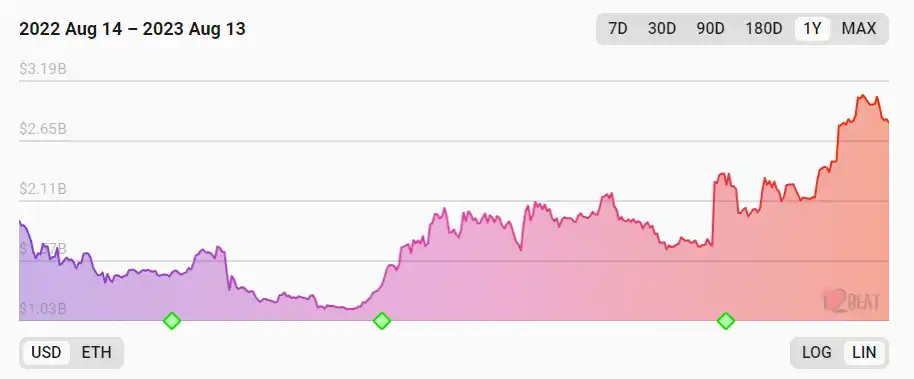
ARB on-chain funds TVL was around 6 billion (peaking at 7 billion) in March, and currently remains at around 6 billion.

Data source: https://l2beat.com/
Valuation Comparison between OP and ARB
Corresponding to the rapidly rising business data of OP, the valuation of OP main chain is becoming more and more attractive compared to ARB.
P/E (Market Cap/L2 Annualized Profit): Based on the latest week's revenue as the calculation base, OP's PE has dropped below 80, while ARB is at 113. This is achieved even with the significant strength of OP's price in recent months and the continuous increase in unlocked circulation.

Data source: tokenterminal
OP's new force in the ecology is developing rapidly.
OP's main chain business data has been continuously catching up with ARB, which has been influenced by the warming of its own ecosystem, but the new business partners joining the OP camp have made a greater contribution. For example, among the projects that have contributed the most to the number of transactions on the OP main chain in the past 30 days, the Gnosis Safe contract operation ranks first and Worldcoin ranks fourth.
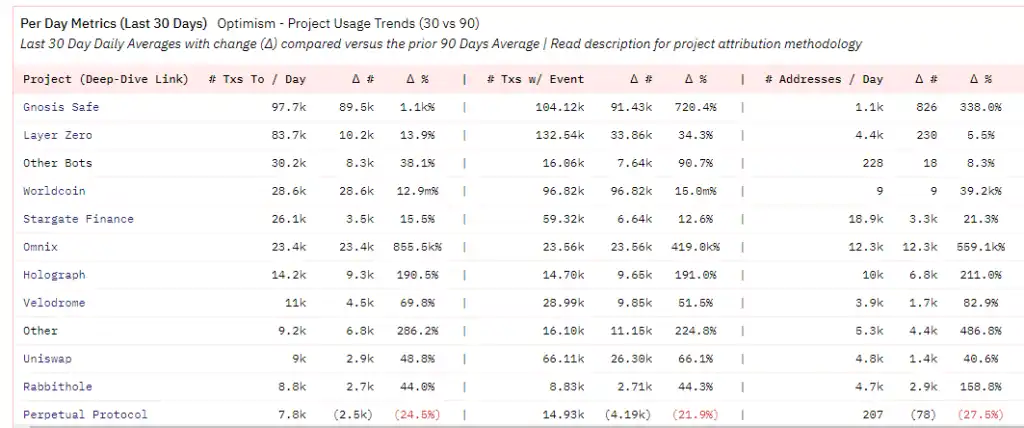
Data source: https://dune.com/optimismfnd/Optimism
In fact, a large number of transactions on Gnosis Safe are contributed by the Worldcoin team. As early as the end of June this year, the World App had deployed more than 300,000 Gnosis Safe accounts, which was caused by the migration of World App accounts to the Optimism mainnet.
According to the official website data of Worldcoin on August 11th, the registered users have exceeded 2.2 million, and there were 257,000 new accounts created in the past 7 days. The average daily transfer volume of World app is as high as 126,000, which is about 21% of the daily transfer volume of OP and ARB mainnets.
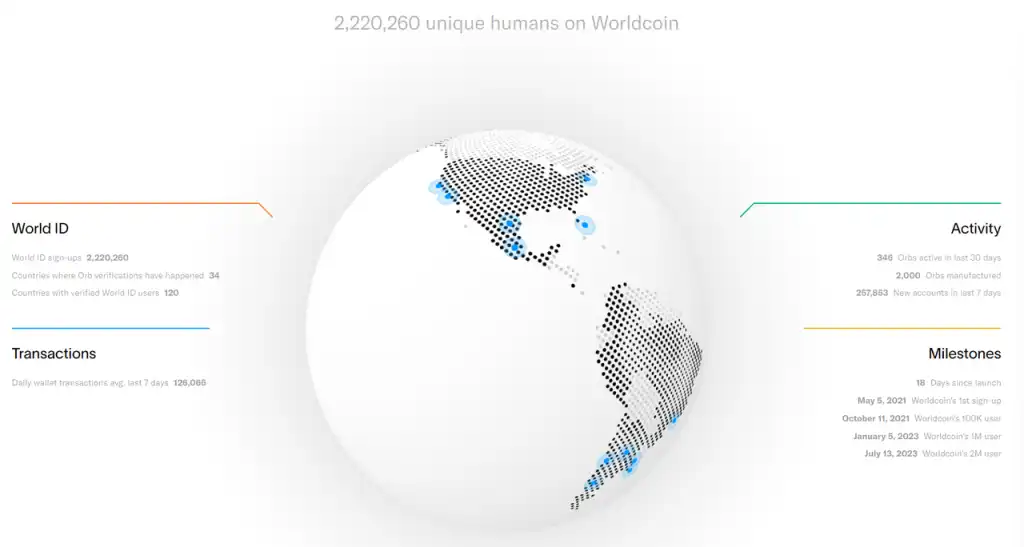
Data source: https://worldcoin.org/
Currently, Worldcoin has only migrated its ID system and tokens to the mainnet. In the future, they will also develop an application chain based on the OP stack, which is expected to bring more active users and developers.
除了 Worldcoin 对 OP 的主网贡献,OP stack L2 的第一个也是最大的支持方 Coinbase 的 Base L2 上线后的数据增长也非常强劲,其 8 月 10 日的活跃地址数达到 13.6 万,距离 L2 TOP1 的 ARB 的 14.7 万仅一步之遥。
Apart from Worldcoin's contribution to OP's mainnet, the first and largest supporter of OP stack L2, Coinbase, has also seen strong growth in data since the launch of Base L2. On August 10th, the number of active addresses reached 136,000, just one step away from ARB, the L2 TOP1 with 147,000.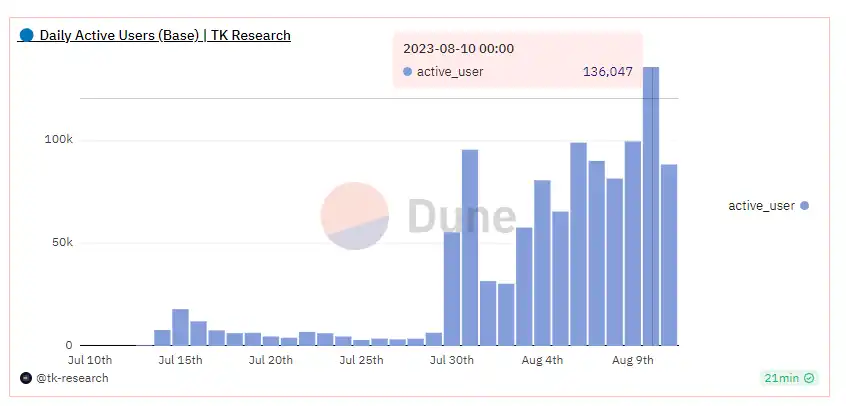
Data source: https://dune.com/tk-research/base
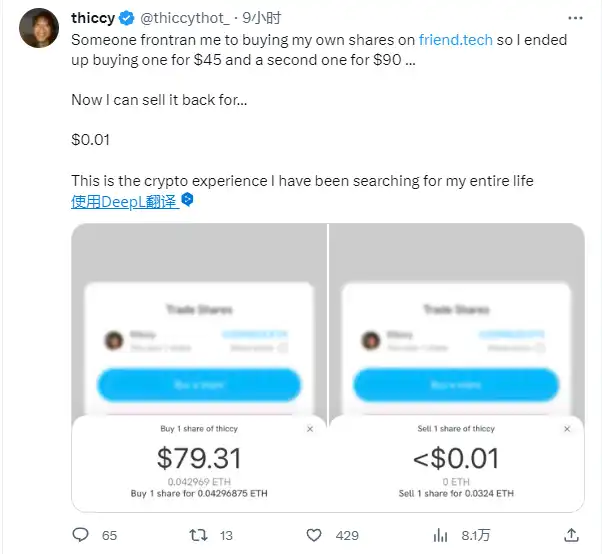
Among all the smart contracts in L1&L2, this data ranks only after Tron (1.5M), BNBchain (1.04M), Polygon (0.37M), and Arbitrum (0.14M). In addition, after Base officially launched on August 10th, the first popular application that went viral was not the traditional DeFi or Meme, but a social application called friend.tech, which was even more surprising.
ARB's dilemma
ARB's dilemma is that, although it has a strong L2 main chain, Arbitrum one, and a higher performance Arbitrum nova, as well as the Orbiter L3 stack that competes with OP stack, it is willing to define itself as L3 and focus on Arbitrum one as its DA layer in the stage where L2 is still in its infancy. Projects with better industry resources (users, developers, IP content) tend to build L2, which means a higher valuation ceiling and a wider user orientation.
Meanwhile, in the smaller Rollup project market, Arbitrum's Orbiter faces competition from RaaS (Rollup as a service) projects represented by ALTLayer. ALTLayer offers low-threshold, low-code rollup construction and operation solutions, integrating various modules of rollup on the market for users to mix and match like building with Lego blocks.

ALTLayer provides RaaS modular solutions
In the Rollup menu provided by the RaaS project, the Orbiter provided by Arbitrum is just one of the optional solutions. Small users may also choose an economically affordable L2 solution after comparing solutions, instead of defining themselves as L3.
Under this situation, although Arbitrum one, as an L2 single chain, still maintains a slight lead in business data compared to other L2s, its user share in the entire L2 market is actually rapidly declining, as a large number of new and old users are flowing towards OP and hybrid L2s.
Overall, OP introduces network effects formed by partner users in a B2B2C model through an open-source L2 suite, which in the long run has significant advantages over the strong single-chain approach of Arbirtum in business. If ARB does not adjust its strategy in the future, its position as the L2 single-chain king is also in jeopardy.
2. How to improve the fundamentals of L2 projects through Cancun upgrade
2.1 ARB and OP Current Project Valuation Estimation
We calculate the valuation level of ARB and OP based on their revenue data from the past 3 months and current prices.
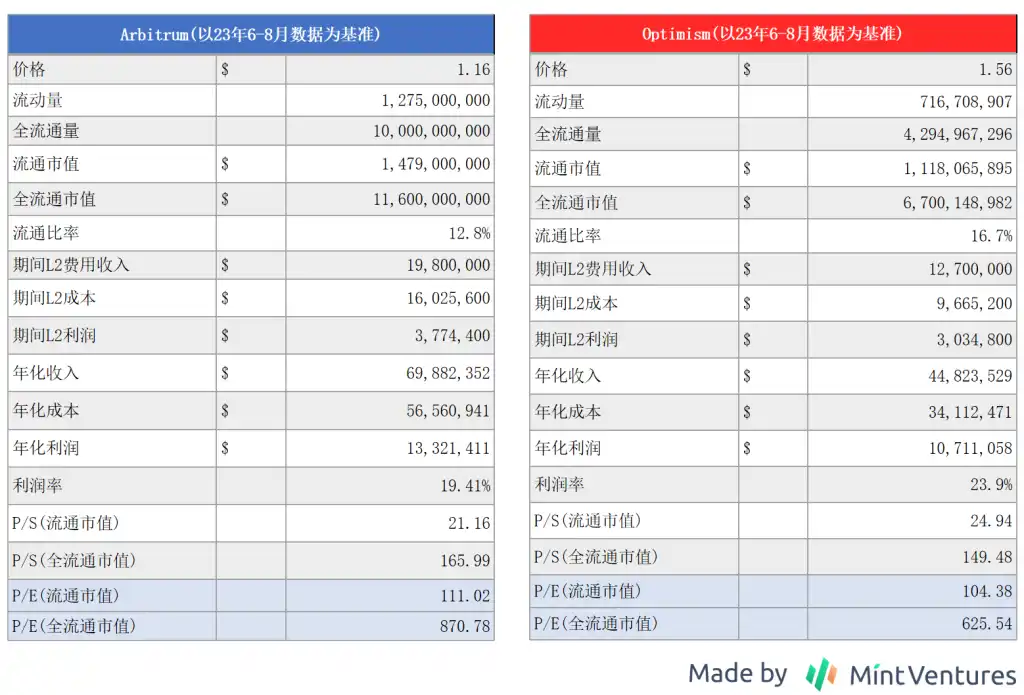
If we assume that the P/E ratio remains unchanged, after the Cancun upgrade, the L1 cost of ARB and OP will decrease by 90% (EIP4844 is expected to reduce L1 costs by 90-99% for L2, and we take a conservative value here, see reference materials for details), while the charging standard for L2 remains unchanged. The prices of ARB and OP can be calculated as follows:
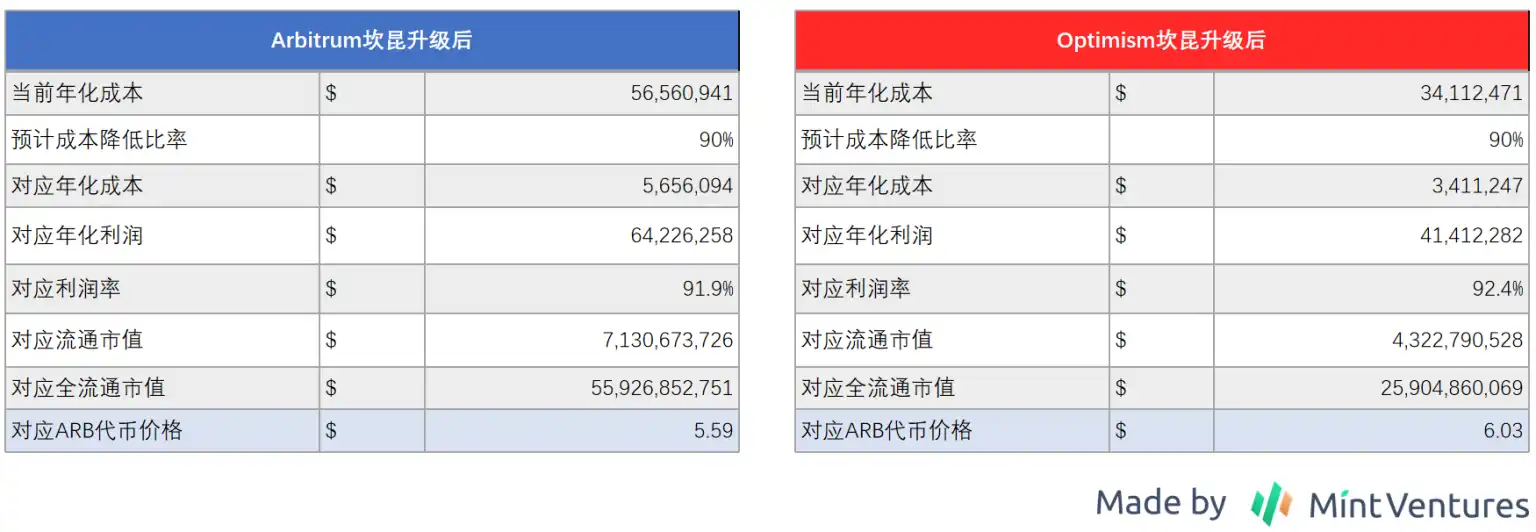
The upgrade of Cancun reduces L1 cost expenses, the direct impact is increased profits, corresponding to an increase in valuation.
2.2 Impact of Cancun Upgrade on L2 Valuation
Of course, with the upgrade of Cancun, the cost of L1 will decrease, so both ARB and OP cannot avoid reducing the corresponding fees of L2. Therefore, when estimating the valuation, we also need to take these two variable factors into consideration:
1. ARB and OP will reduce costs by what ratio, benefiting users by reducing L2 costs.
2. With the decrease in the cost of L2, how much ratio of L2 transaction activity will be increased?
Based on the premise of a constant P/E ratio, the author extrapolates the prices of the upgraded ARB and OP tokens in Cancun by considering the changes in the ratio of cost reduction to expense reduction and the increase in transaction volume resulting from expense reduction.
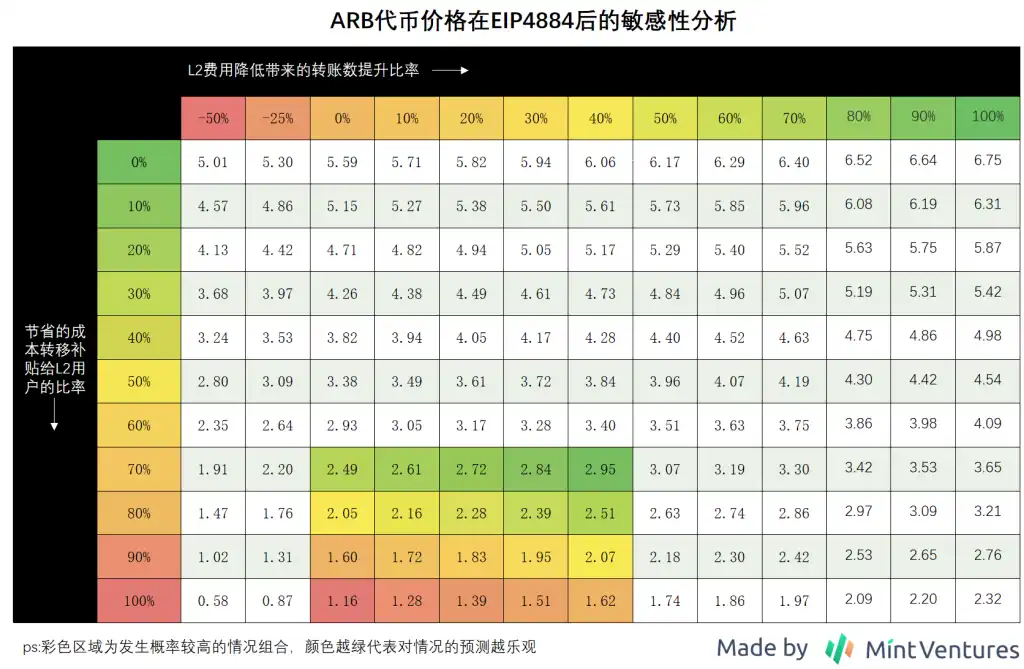
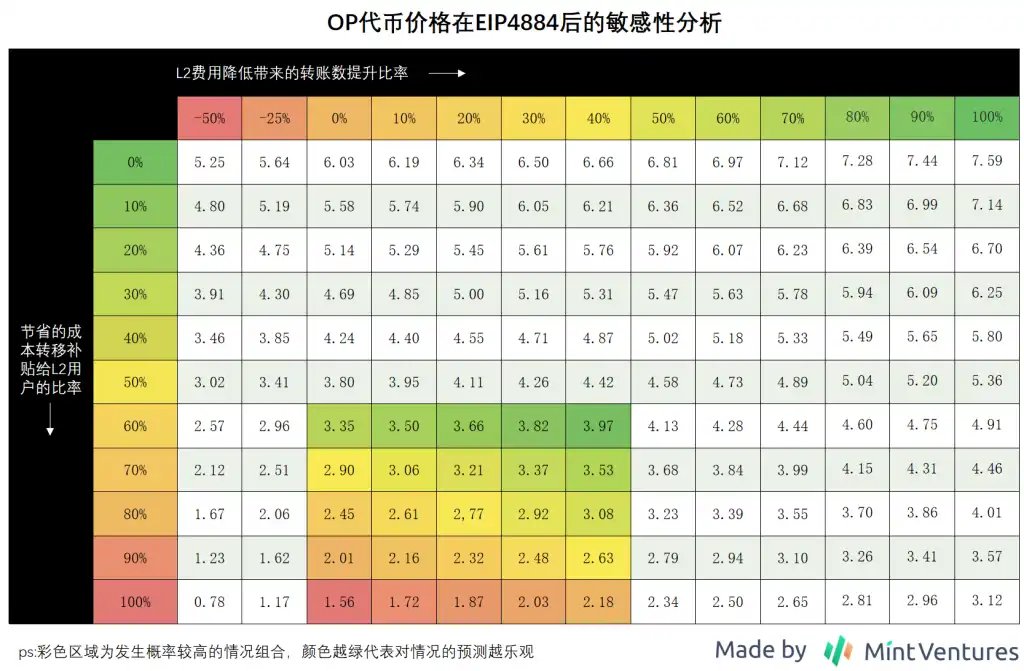
The core logic of the two token price estimation tables above is:
1. After the upgrade of Cancun, the lower the ratio of cost reduction for L2, the higher the operating profit of L2 will benefit its users.
2. The higher the ratio of increased transaction activity brought about by the reduction of second-layer costs by L2, the higher the L2 operating profit.
In addition, because the current gas fees for OP are approximately 30-50% lower than ARB, as the cost of L1 decreases, OP has more room to retain the saved costs. Therefore, the author believes that OP will have a space of 60-100% to transfer the saved costs to users, while ARB is 70-100%.
Only by upgrading from Cancun can we infer the impact on the single chains of OP and ARB. The current upward potential of OP and ARB is relatively similar.
Of course, the above price sensitivity analysis of ARB and OP after the Cancun upgrade is relatively mechanical, and there are at least some factors that were not considered in the calculation.
· The above calculation is based on the current PE of the project, which already includes expectations for the upgrade of Cancun.
· When Cancun is upgraded, there will be more token emissions for OP compared to the current situation. Assuming the circulating market value remains the same, the token price should be lower.
However, the unchanged logic is that the higher the L2 operating profit, the higher the intrinsic value of its tokens, and the easier it is to obtain a higher market valuation. The upgrade of Cancun can bring significant marginal improvements to L2 projects in both cost savings and increasing on-chain activity.
3.OP Potential Risks
As mentioned above, OP has upgraded from a single-chain L2 to an L2 interconnected chain ecosystem, relying on Superchain's narrative and the widespread adoption of OP stack. Through B2B2C cooperation with OP stack partners, more ecological populations have been introduced, which in the long run will have stronger network effects, scale effects, and allies with common interests, making it a better business model than ARB. In addition, the main business data of the OP mainnet has been catching up with or even surpassing ARB in the past few months, and other OP stack L2s such as BASE are also developing rapidly, further squeezing ARB's market share.
Considering that the L2 main chains of OP and ARB benefit from the similar expectation of the appreciation of token prices due to the upgrade of Cancun, but OP has the blessing of Superchain narrative, it may currently be a better investment target.
However, the competition in the L2 track is still fierce. I believe it is necessary to pay attention to the following risks of OP:
3.1 ARB chooses to open its own L2 license and compete for the total network population of L2 in a way similar to that of OP.
Currently, Arbitrum still uses a commercial code license (BSL). Other partners who want to use the Arbitrum stack to build the Rollup ecosystem need to obtain formal authorization from Arbitrum DAO or Offchain Labs (Arbitrum's development company), or develop L3 based on Arbitrum one. However, with the rapid expansion of the OP stack in recent months and the surge in network population, the Arbitrum community has become a bit restless. On August 8th, team member stonecoldpat posted a discussion on the governance forum, hoping that the community can participate in the discussion on "the conditions and timing of Arbitrum issuing code usage licenses to partners", including:
· Understand the community's attitude towards granting code usage licenses for Arbitrum to other partners.
· Discuss whether additional conditions should be added to the license granting for the code.
· How to establish an evaluation mechanism to determine whether to issue a license to the other party.
· Short-term and medium-term roadmap for the above content
1) In the short term, it is determined which qualified partners can be issued licenses.
2) In the medium term, it is necessary to clarify the standards. As long as the standards are met, any partner can obtain a license.
The discussion thread also summarizes the official feedback received on this topic, which mentions:
"The Arbitrum Foundation or Offchain Labs has not yet issued licenses for the Arbitrum software stack to major strategic partners, which seems to be a strategic mistake. This hesitation could actually harm the Arbitrum ecosystem."
"We have not received any feedback and believe that the Arbitrum Foundation should not issue licenses for the Arbitrum technology stack to strategic partners. Most of the attention is on the standards for issuing licenses and the conditions that should be attached, and DAOs should be allowed to provide preliminary opinions on the process."
Based on the above situation, the OP optimization of Arbitrum's future strategy is a trend that is already set in stone. Soon, it will join the competition in the "L2 interconnected chain" market. This will inevitably pose a threat to the current comprehensive development of the OP stack.
On August 9th, Andre Cronje, co-founder and architect of Fantom Foundation, stated in an interview with The Block that they are considering the Optimism L2 solution, which includes both the Op stack and the Arbitrum stack. In my opinion, as a former first-tier L1, it is unlikely for Fantom to consider operating as an Arbitrum L3. AC's reference to the "Arbitrum stack" should be interpreted as a reference to the L2 solution.
However, the problem lies in how long it will take for the Arbitrum community and partners to reach an agreement and for licenses to begin being issued. During this time, how many core customers will still be available in the market to compete for? The longer this time drags on, the more collaborators will join the OP stack ecosystem, which will be increasingly detrimental to ARB.
3.2 Intense Competition in the L2 Service Market
Except for ARB and OP, the ZK series of L2 is also rapidly developing or waiting to go online. ZKsync with impressive business data (although there is a large bubble due to airdrop hunters), Linea backed by Consensys (Metamask, which has 30 million monthly active users, and Infura, which has over 400,000 developers), and the highly anticipated Scroll, etc. In addition, Rollup as a Service platforms represented by Altlayer provide modular assembly and operation services with extremely low thresholds for Rollup developers and operators through service aggregators, directly entering the upstream of the OP stack, which will also squeeze the bargaining power of the OP ecosystem.
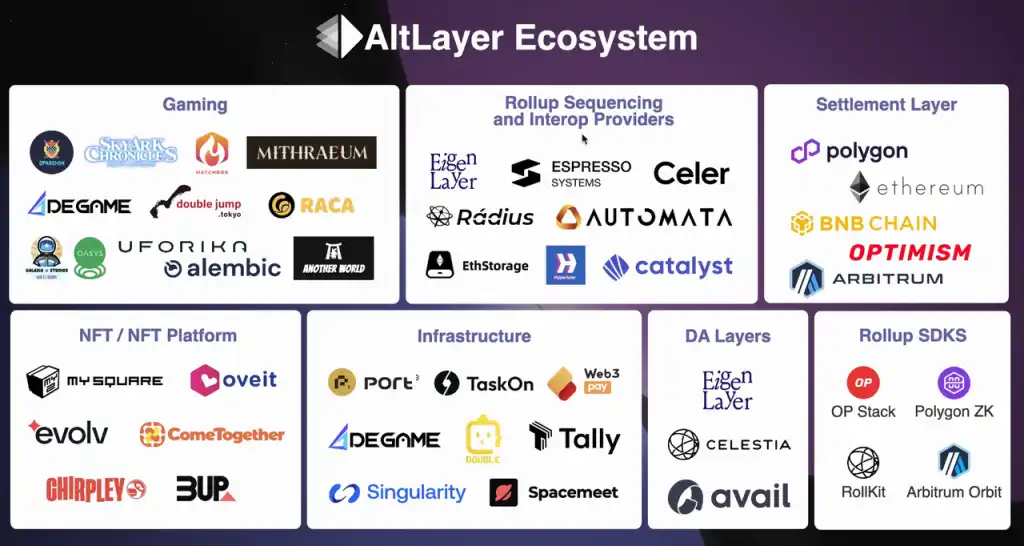
Altlayer's products and customer ecosystem
3.3 Superchain's overall ecosystem development, can the value be transmitted to the OP Foundation and OP token
The OP token currently does not have a direct means of capturing value, and among the many adopters of OP stack, except for BASE explicitly donating 10% of its L2 profits to the OP Foundation, other cooperative projects have not yet made similar commitments. The validation of OP token value capture may have to wait until the official launch of its decentralized sorter protocol, and observe the acceptance of various OP stacks to know. If everyone can support and adopt a decentralized sorter system with OP as collateral, there will inevitably be a direct demand for OP, completing value transmission. However, if each L2 still executes its own sorter standard or runs on its own node system, it will not only make OP unable to capture value, but also weaken the synergistic effect between L2 within the OP ecosystem.
3.4 Valuation Risk
As mentioned in the previous section on the valuation of OP, the calculation of the price increase brought by the upgrade of Cancun is based on the premise that "the PE of OP L2 after the upgrade remains consistent with the current level." Considering that the upgrade of Cancun is one of the most anticipated events in the market this year, the current OP PE valuation has more or less priced in this expectation. For those who hold a pessimistic attitude, they may even believe that the current PE has already overdrawn the benefits of Cancun.
Reference content.
ASXN:EIP-4844 Research Report
The Block:Fantom is exploring adding optimistic rollups to connect to Ethereum
Supporting EIP-4844: Reducing Fees for Ethereum Layer 2 Rollups
原文链接Translation:
Original article link
Welcome to join the official BlockBeats community:
Telegram Subscription Group: https://t.me/theblockbeats
Telegram Discussion Group: https://t.me/BlockBeats_App
Official Twitter Account: https://twitter.com/BlockBeatsAsia

 Related Articles