Which other L2 projects are worth paying attention to as ARB continues to break new historical highs?

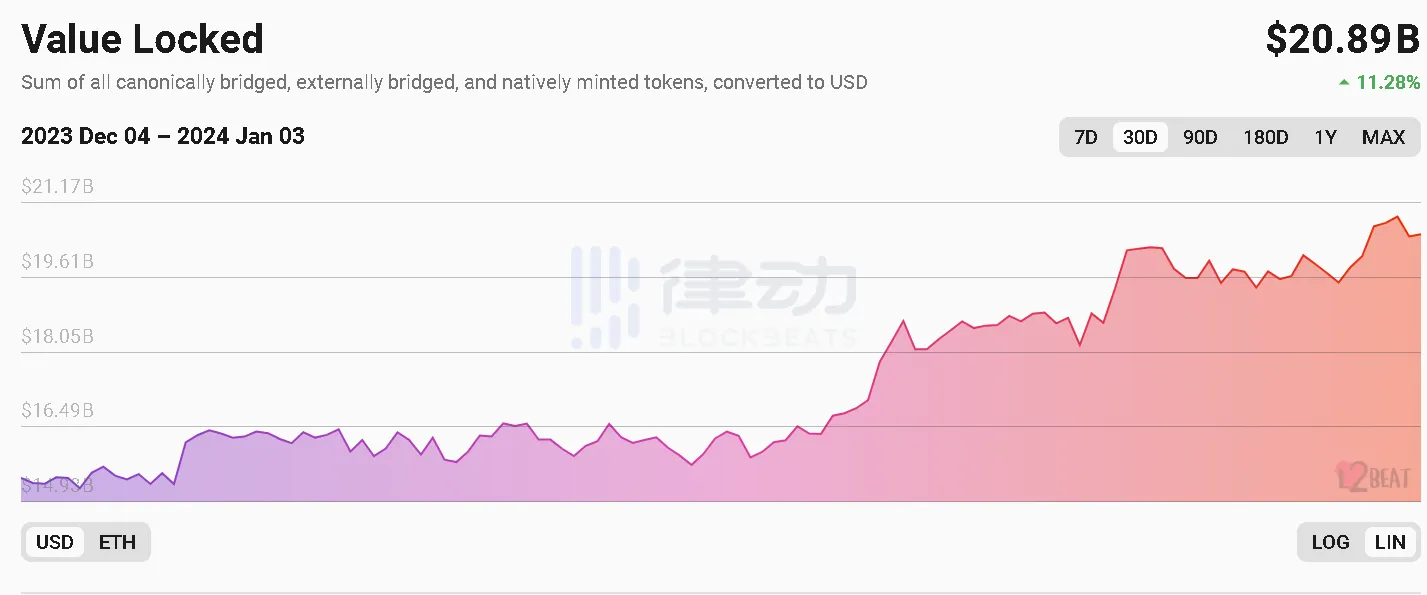
The native governance token ARB of Arbitrum continues to break new highs. On January 3rd, according to OKX market data displayed, as of the time of writing, ARB has broken through $1.94 in the short term, once again reaching a new high, with a 24-hour increase of 10.33%. According to data from L2BEAT displayed, Arbitrum's value lock has exceeded $20 billion, making it the largest L2 Rollup.
ARB has risen 60% since December
On July 7th, 2023, the Arbitrum community passed two proposals, AIP-1.1 and AIP-1.2. Proposal AIP-1.1 suggests placing the remaining 700 million ARB tokens of the foundation in "smart contract-controlled lockup" for four years. Proposal AIP-1.2 aims to modify several governance documents of the Arbitrum ecosystem, including lowering the threshold of ARB tokens required to publish improvement proposals on-chain from 5 million to 1 million.
The massive unlocking caused a brief surge in ARB price, but then the price continued to fall. It only started to recover after hitting a low of $0.74 on September 11th.
From a timing perspective, ARB followed the price increase of OP. According to The Block data, starting from Q4 2023, Arbitrum's daily transaction volume increased from 670,000 to 926,000, a growth of 38%. The daily transaction volume of the OP mainnet increased by 20%, from 354,000 to 431,000. After hitting a historical high of $4.10, OP has been trading near its peak.
As the second largest Optimistic Rollup in terms of TVL, OP has surged nearly 69% weekly, a development consistent with OP's TVL exceeding $5 billion. Despite criticism of Optimism's inaction on decentralization issues, Optimism's market success with OP-Stack seems to be able to reverse the situation. However, a more reasonable market trend is that the success of OP-Stack will be further amplified, and there will naturally be other relay players to fill the gaps in OP-Stack.
The key point of OP-Stack's stack promotion is to implement a shared Sequencer. The more OP strategic alliances in the future, the greater the benefits it can capture through Sequencer. Conversely, the multiple interests it receives will also increase. This social consensus will become a new constraint outside of technology, stabilizing Optimism in a dominant position.
As both belong to the Ethereum ecosystem, it can be seen that a major factor driving the trend of ARB is ETH. As Arbitrum is the fundamental layer 2 solution for Ethereum, it means that ARB may be closely related to ETH. If ETH slows down its momentum, ARB may also slow down. Similarly, if ETH moves towards $2500, many cryptocurrency researchers predict that ARB may rise to $2.
In addition, the surge of ARB is partly due to the market's expectations for Ethereum Improvement Proposal (EIP) 4844, and partly due to Vitalik's post celebrating the first phase of Rollup implementation on Arbitrum.
Cancun Upgrade Expectations
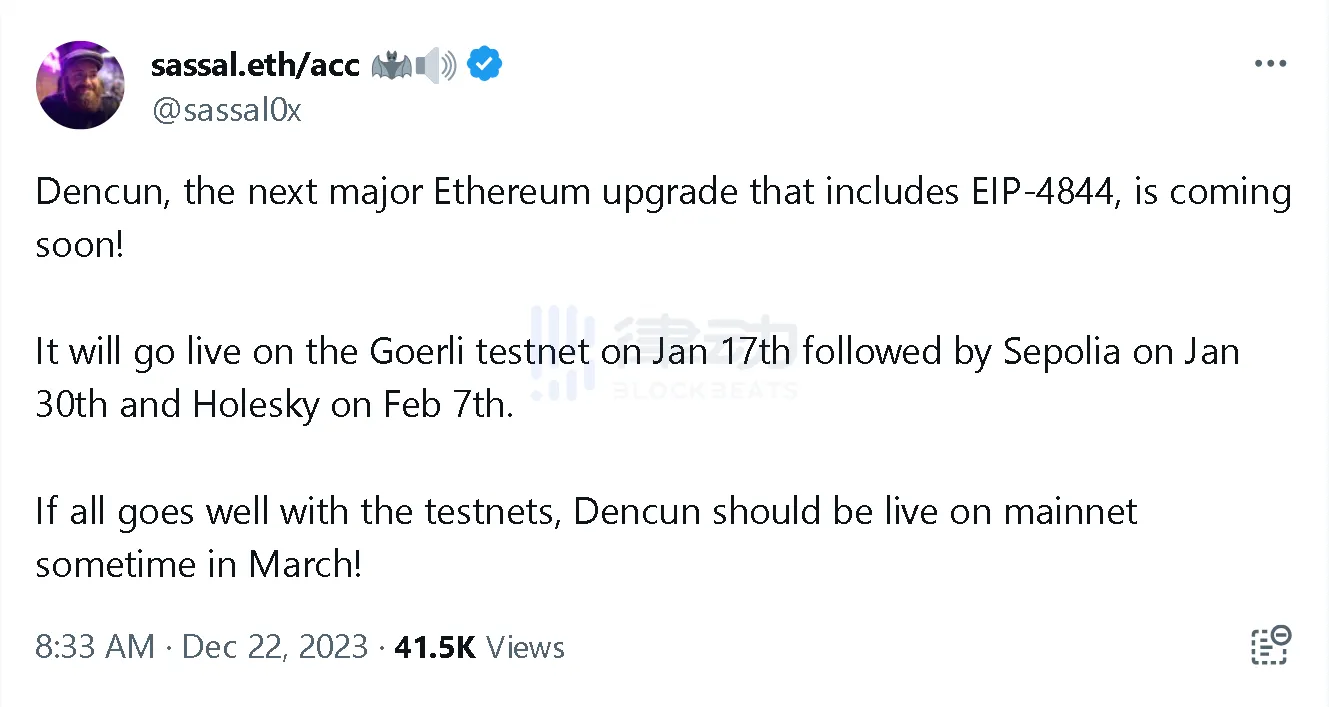
On December 22nd, Ethereum educator Anthony Sassal announced on social media platform that Ethereum developers will implement EIP-4844 on January 17th. The next major upgrade of Ethereum, Dencun, will be launched on the test network Goerli.
EIP-4844 was jointly created by Ethereum researcher Dankrad Feist and Ethereum co-founder Vitalik Buterin. It is also a core component of the Cancun upgrade, which serves as a mid-term transitional solution to improve the performance of Ethereum L1+L2 and address gas fee issues.
EIP-4844 will adopt the original danksharding, which is a concept named after Feist and aims to increase the total number of transactions that Ethereum can handle. Danksharding is a complete implementation of Rollup extension, which will bring a lot of space for Ethereum to compress transaction data dumped by Rollup. It introduces a new transaction type (blob carrying transaction) to reduce Ethereum transaction fees.
Compared to the calldata full node storage structure, Blob is designed for temporary storage of partial nodes, which can greatly increase the data submission limit for Layer2 to the main network, expand its TPS, and improve data storage efficiency and reduce storage costs. The improvement in DA capability is due to the one-month temporary storage, which is more than enough to cope with the 7-day fraud proof time window of OP-Rollup.
Related reading: "How will the market pattern of Layer2 evolve after the upgrade of Cancun?"
This means that EIP-4844 can increase the TPS (transactions per second) of Rollup while reducing gas fees. Simply put, after EIP-4844, Rollup does not have to compete with ETH native applications to use ETH block space, which is bullish for L2.
Rollup Phase One
In March 2023, Arbitrum officially announced the first Rollup to enter Phase 1.
At the end of the year, Vitalik gave a positive evaluation of Arbitrum in a post on Warpcast without translation. "This is a real decentralized progress. I hope to see ten Rollups enter the first stage next year and achieve a certain degree of sequencer decentralization." A few hours after the comment was posted, the price of ARB rose by 22%.

As the first stage of Rollup, Arbitrum has met all five requirements for complete decentralization. According to data from L2BEAT, at the time of writing, Arbitrum is the only L2 that has completed all five requirements of the first stage.
According to Vitalik's preliminary proposal on the Ethereum Magicians forum, there are five requirements: 1. Deployment of a complete and fully functional proof system; 2. At least 5 external participants can submit fraud proofs; 3. Users can exit without the help of authorized operators; 4. If more centralized participants than the Security Council implement unnecessary upgrades, users have at least 7 days to exit; 5. The Security Council should be properly established.
Additionally, it is worth noting that on December 29th, the Arbitrum ecosystem game Layer3 Xai will distribute the first season airdrop. Currently, the airdrop snapshot has been taken for Xai Odyssey legends and pioneers, as well as Sentry Node Key holders.
Low Valuation, High "Odds"
除了 ARB 外,以太坊上涨及对坎昆升级的预期也推动着其他 L2 代币上涨,12 月 27 日,据 OKX 行情数据显示,Layer 2 项目代币出现普涨行情,其中,OP 24 小时涨幅 19.38%; MATIC 24 小时涨幅 18.34%; METIS 24 小时涨幅 17.1%。
Translation:Except for ARB, the rise of Ethereum and the expectation of the upgrade of Kankan are also driving the rise of other L2 tokens. On December 27th, according to OKX market data, Layer 2 project tokens showed a general rise, among which OP rose by 19.38% in 24 hours; MATIC rose by 18.34% in 24 hours; METIS rose by 17.1% in 24 hours.
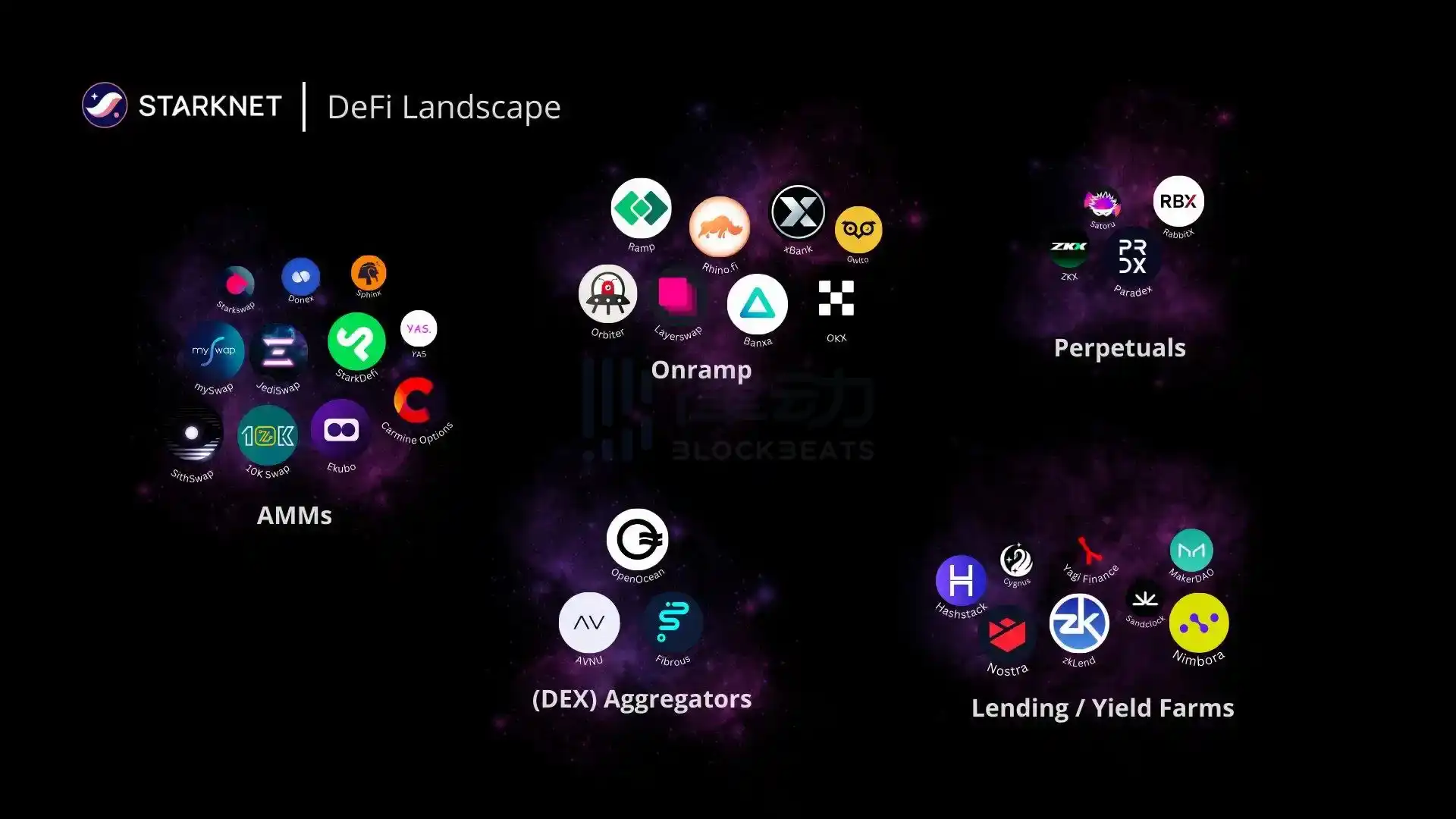
Among them, in addition to well-known projects such as Starknet and Zksync, there are also some undervalued but high "odds" projects such as Metis and ZK Fair.
Metis
Metis is an Ethereum Layer 2 scaling solution developed based on Optimistic Rollup. It is a Layer 2 scaling and general infrastructure project co-founded by Elena Sinelnikova, Kevin Liu, and Yuan Su in 2018. The price of its native token METIS has surged from $20 to $90, a 350% increase in just two weeks.
ZKFair
Starknet
zkSync
taiko
Taiko is a type of Basic Rollup, which is the first of its kind among competitors. It does not have a centralized sorter, but relies on Ethereum validators to sort transactions and blocks. As a controversial Rollup, Taiko allows application chains to define their own proof systems and adopt updated, more efficient validity proofs as technology advances without modifying Taiko's core protocol.
Related reading: "In-depth analysis of Ethereum's zkRollup leading project Taiko proposes a new scaling solution - controversial basic Rollup (BCR)".
On December 5th, Taiko announced the launch of Taiko Grants Cycle 2 developer incentive program, with a total incentive pool of 30 million US dollars. On December 8th, Taiko announced the launch of community education activities on Galxe, which mainly includes three tasks: creating a wallet driven by account abstraction using Particle, creating a .taiko domain name, and reading official articles and participating in tests. Users who complete the tasks will receive loyalty points.
Taiko is currently fine-tuning the new design and Rollup contract codebase. Once completed, this will be deployed as Taiko's Alpha-6 testnet with a four-layer proof system. In the upcoming A6 testnet, Taiko will adopt a 24-hour cooldown period for all levels. Ultimately, Taiko's main goal is to combine the advantages of Optimistic Rollup and ZK-Rollup in a controversial Rollup.
Manta
Manta is the first public chain built on Celeasita's ETH L2, which raised $60 million. 5% of the airdropped token supply is available. It provides native revenue for ETH and stables.
Manta has launched a liquidity incentive program called New Paradigm within its ecosystem. Similar to Blur's Blast liquidity staking program, the basic logic is that all rewards are 3% (basic reward) + 2% (additional reward) + 1.5% (ecosystem reward) = 6.5%. Users can stake ETH or USDC to receive blind box fragment rewards, which can be exchanged for blind boxes. The NFTs obtained from the blind boxes can be exchanged for future token airdrops.
As early as January 2024, users can exchange the obtained NFT for token rewards. After receiving the token rewards for 69 days, users can unlock and transfer the pledged ETH and USDC from the Manta ecosystem. Currently, an invitation link is required to access the activity page.
Related reading: "Manta blockchain popular airdrop event New Paradigm participation strategy".
Welcome to join the official BlockBeats community:
Telegram Subscription Group: https://t.me/theblockbeats
Telegram Discussion Group: https://t.me/BlockBeats_App
Official Twitter Account: https://twitter.com/BlockBeatsAsia

 Related Articles