LSD didn't get it, and the "repledge" narrative came
原文标题:《 LSD 没整明白,「再质押」叙事就来了 》
Original author: chengshutong, SevenUp DAO
Eigenlayer is a new narrative that can last for at least 24 years. As a major innovation of ETH's "shared security", EigenLayer proposes a repledge scheme of LSD liquidity Token, which is supported by multiple narrative logics, and is placed in an important position by many institutions in the year-end review of the year of 22:
1. Expand the ETH consensus layer
2. Revitalize LSD assets, Lego to a higher level, three layers of income
3. Value capture of real income is an important driving force for the next bull market of ETH ecology.
4. LSD midstream Red Sea (volume)+ stock (0.5B$), more attention should be paid to upstream DVT, downstream aggregator, lsdETH repledge scheme
5. ETH "Consensus layer expansion" new narrative, relay implementation layer expansion
I. Project Introduction:
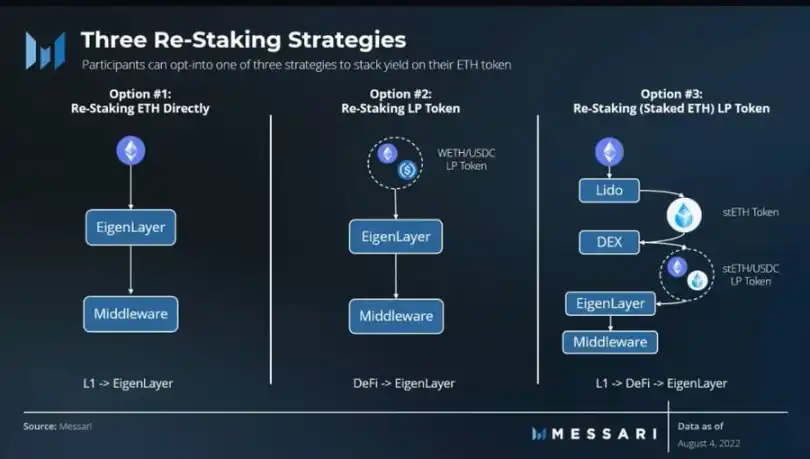
Eigenlayer 提出的再质押(Re-staking)方案,允许用户将 ETH、lsdETH 及 LP Token 质押在其他公链、预言机、中间件等,作为节点并得到验证奖励,这样第三方项目可以借用 ETH 主网的安全性,ETH 共识层的安全性得到释放。
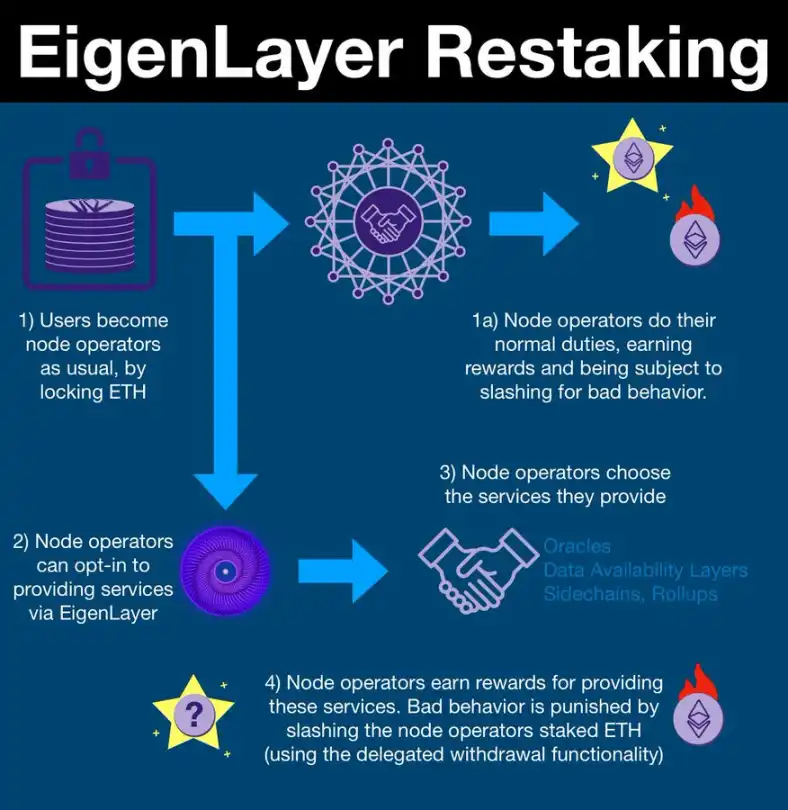
Node network security comes from three aspects: asset value, attack cost, and number of nodes. ETH network consensus layer security is guaranteed by "potential forfeiture risk" of pledged funds, which is often referred to as violent means to maintain security.
L2 feeds back transaction data to the main network for inspection to inherit security, and Eigenlayer becomes a verification node by pledging "ETH like value assets" to borrow security from the main network through "violent means" of pledge and forfeiture.
Ii. Narrative Direction:
Modular Narrative: Exploring New Directions in the Consensus Layer
The module layering of blockchain can be divided into four parts:
Consensus Layer addresses security and trust and determines the order, validity and consistency of transactions between nodes. Data Availability Layer stores and verifies data. The Settlement Layer ensures that the transaction data can be used. The settlement Layer guarantees the correctness of the Execution of orders. The Execution Layer calculates the state transition
Consensus Layer Modular narrative: Eigenlayer is really doing the modular thing too, but in the opposite direction, avoiding the shortcomings of the executive or data availability layers, and not trying to do L1 or L2 in an improved way (too bulky!). Instead, it makes full use of the biggest advantage of Ethereum -- security, increases the malleability of Ethereum consensus layer, and enables the verification node of consensus layer to gain more benefits and connect with more project parties.
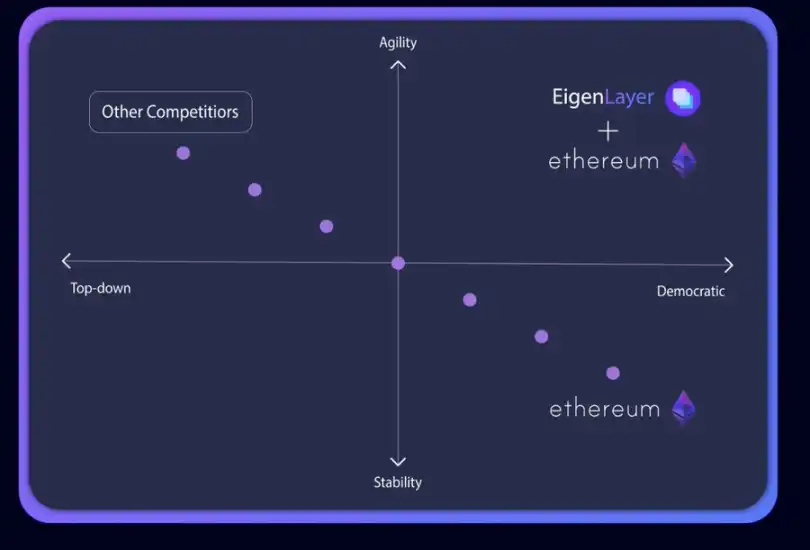
Build authentication platforms and pledge platforms on top of the Ethereum Trust Layer network (or Ethereum's massive pledge capital) to give infrastructure/middleware providers a way to build consensus trust and Eigenlayer's security to their project partners.
从两个方面,一个是增加攻击作恶成本(相比于质押原生 Token 有更强的价值稳定性),惩罚成本更具有威慑力;一个是节点本身的可信程度,以太坊质押者更成熟、更倾向于不会「贪图小利」。当然,还需要看能否得到众多以太坊验证节点的支持,否则的话很难继承主网的安全性。
Analogies to COSMOS consensus-layer shared security: For a long time (until today) ATOM had almost no use. But once 2.0 sharing is safely online, ATOM can be used to validate application chains in the expanding IBC ecosystem. It is also a good way to extend the benefits of validation nodes, a genius move that may become the core mechanism of the cosmos ecosystem. Or maybe shared security, which cosmos failed to achieve, will work fine on Ethereum...
Lower the threshold of project side
For new projects, whether Layer-1 or the Prophet Network or the cross-chain project, they have to build their own security base, or EigenLayer calls it a "trust Layer." For example, Bitcoin's layer of security and trust comes from proof-of-work (PoW) mining, which keeps the data authentic.
Many project parties need to build verification nodes from 0. Frankly, projects that need to ensure the security of information and funds need verification nodes. For example, cross-chain bridge needs the committee to manage the private key.

The trust between blockchains and Dapps is cut off from each other, and the trust to maintain the ecology pays high capital cost. The construction node is the biggest threshold for many project parties to enter the blockchain, which is similar to an arms race. Many project parties constantly delay the launch of the main network construction problems. Ethereum beacon chain now has more than 13 million ETH pledges. If the huge volume can be used as the trust layer of another project side in a way, the operation cost of a new project side can be greatly reduced. Focus more on core functionality and user experience.
另外缓冲质押 Token 的 staking 解锁的死亡螺旋。
Relay LSD track, pledge, income flywheel to a higher level
Eigenlayer can be used as a continuation of LSD narrative, although the upgrade of Shanghai will bring the increase of ETH total pledge, but it cannot be avoided that it is the stock market, 1500(ETH daily output)3651W$(assuming ETH price) *0.1 (LSD track revenue sharing) =0.5B$. Red Sea (volume)+ stock (0.5B$), should pay more attention to its upstream and downstream circuits, upstream DVT, downstream aggregator, lsdETH repledge program.
LSD assets, Lego to a higher level, real income value capture, if the ETH main network pledge rate reaches 50%, the overall DeFi warehouse is expected to expand by 10X, lsdETH acts as a lending asset in DeFi. For trading assets, the upper limit of their returns after leverage is also limited, and the return rate will gradually decline with the scale of TVL. Therefore, external income is needed to support such a large lock-up volume.
Trinity earnings boost
透过 Eigenlayer 提出的再质押方案,流动性 Token 除了在以太坊系统捕获收益外,在其他跨链桥、预言机等也能获得收益,如果后续推出 lsdETH 的 LP 质押,可以做到收益三位一体。
Pledge Ethereum earnings
合作项目方节点构建、验证的 Token 奖励
Liquidity Token Pledge DeFi group LP reward
Three, nodes are done, DA layer of course to rub
EigenLayer began internal beta testing last April, EigenLayer was featured at the Ethereum DevConnect Developer Conference road Show and the ZK Summit Road Show in May, and more recently at the Bogota Hackathon. The opportunity to feature EigenLayer also got a lot of VCS to take note of the project, which Messari recommended.
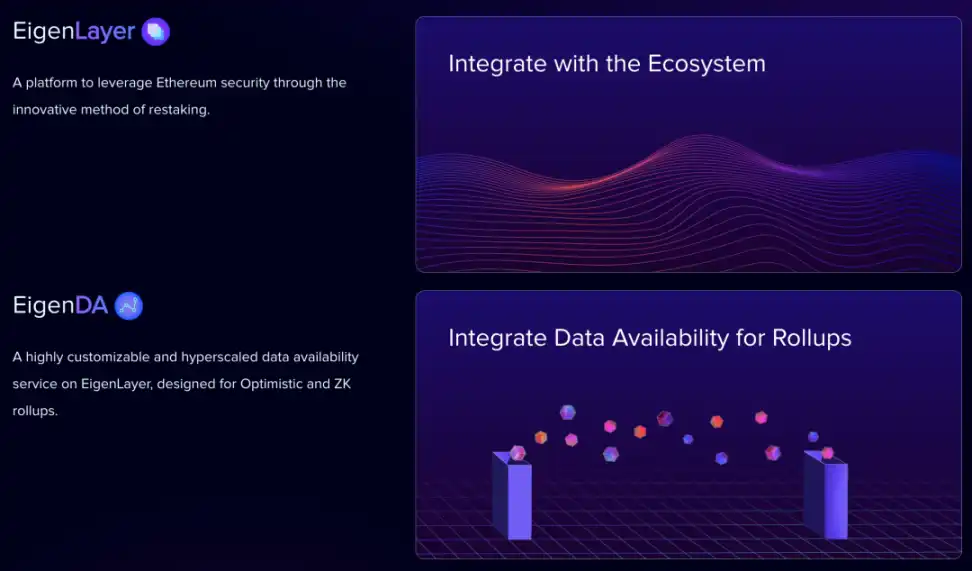
EigenLayer could be a contender for Celestia. One of EigenLayer's flagship products is a data availability module.
Compared with Celestia, the advantages of EigenDA are that there is no need to set up the main network node itself, which is what Ei is already doing. The verification nodes on the main network of Ethereum are attracted to Ei in an incentive way for parallel verification of multiple projects.
From the perspective of legitimacy, the integration of a good consensus of ethereum nodes is only "borrowing" rather than replacing Ethereum nodes and security. At the same time, as nodes undertake verification channels in different projects, their responsibilities and potential "forfeiture benefits" for evil are greater. From this point of view, it can increase the credibility of nodes. In the future, the security of Ethereum can also be increased from the side. After adding the Da layer, the node income may be expanded again? Fully stimulating Ei can produce synergies with Ethereum.
Also, unlike Celestia, EigenDA is not a consensus layer, so it will cost less and have more throughput.
What Ei has to do is to "entice" Ethereum miners to complete joint construction through multiple and differentiated incentives.
Four, security issues
1. Add a layer of trust, hacker attacks are inevitable
2. Increased value capture of Ethereum and decreased value capture capability of cooperative projects
3. The sovereignty of the project side is lost, and the consensus layer is directly "outsourced".
4. Centralized risk, but the founder explains that Tai Fang is only indirectly pledged on Eigenlayer and directly pledged on various projects
5. The project is still in test development and the mainnet is expected to be launched between May and July this year.
Original link
Welcome to join the official BlockBeats community:
Telegram Subscription Group: https://t.me/theblockbeats
Telegram Discussion Group: https://t.me/BlockBeats_App
Official Twitter Account: https://twitter.com/BlockBeatsAsia

 Related Articles