Shanghai's upgraded LSD ecosystem: an in-depth analysis and outlook on regulation, investment, and opportunities in the field.
Original Title: "2023 First Narrative: Pangu Explains the LSD Ecosystem Upgrade on Ethereum Shanghai in Detail"
Original Source: Shield
Lecture 1: Who can participate in staking investment? Starting from the joint staking model
Jerry: Tonight, my topic for sharing is "Who can participate in staking investment? Starting from the joint staking model."
I am Jerry, the current head of Lido CN. Lido is a multi-chain liquidity staking protocol with "Ethereum staking" as its core. In addition to Ethereum, it also supports several public chains such as Polygon. If you want to learn more about Lido's news or updates, you can follow Lido's official Twitter account and Lido CN.
一. 质押的基本逻辑
One. Basic logic of pledging.
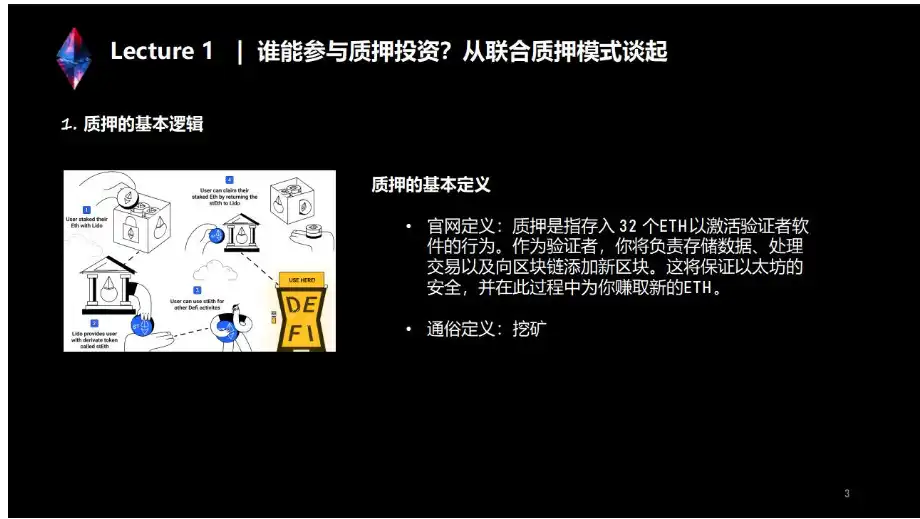
First of all, let me explain "what is collateral" - "the basic logic and definition of collateral".
The official website defines staking as the act of depositing 32 Ethereum to activate validator software. As a validator, you will be responsible for storing data, processing transactions, and adding new blocks to the blockchain. This will ensure the security of Ethereum, and you can earn new ETH in the process.
The above is a very official definition, while a more understandable definition is: mining, in the era of POW or the current Bitcoin network, miners complete consensus tasks by purchasing or running computing power equipment, while in the era of POS in Ethereum, validators replace the role or responsibility of miners, complete consensus tasks by staking Ethereum or running validation nodes, and receive certain rewards.
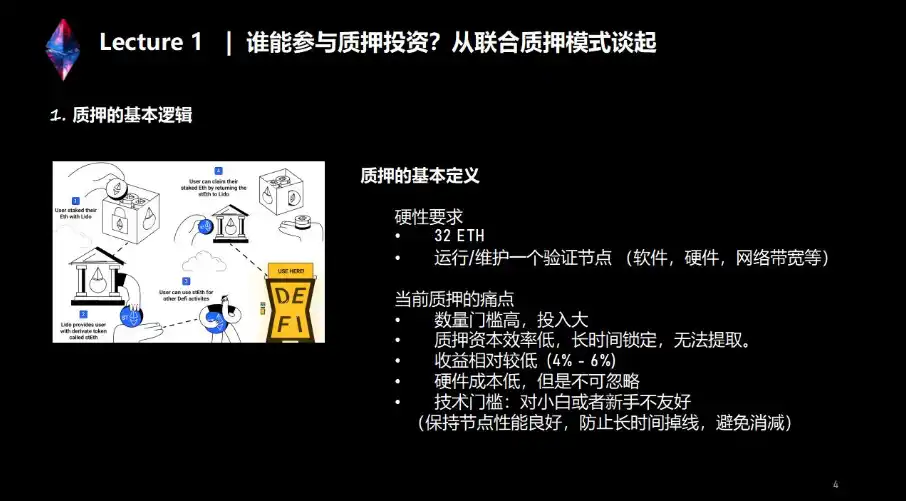
From the "basic definition of collateralization", several important points can be extracted:
Firstly, if you want to participate in staking, you must have 32 ETH. Each validator node needs to deposit 32 ETH to be activated.
Secondly, if you want to run a validation node, you need to build your own infrastructure:
1. In terms of software, you need to execute nodes at the execution layer and nodes at the consensus layer.
2. Hardware-wise, you need a computer with good performance and sufficient hard disk capacity.
3. Network broadband (this will be further elaborated in the following course content).
Through the above mentioned requirements, we can summarize some pain points of running a verification node:
1. Ethereum has a quantity threshold. It requires a validating node to have at least 32 ETH, which is a significant amount. The quantity restriction prevents many friends who do not have 32 ETH from participating in staking.
2. For friends who are already running validation nodes, their 32 ETH and the earnings on the beacon chain are currently completely locked on the beacon chain and cannot be withdrawn or transferred. The beacon chain has been online for over two years, and the ETH staked by the first node has been locked for over two years.
3. Profit. In bear markets, the profit is only 4%-6%, while in bull markets, it may reach 8% or higher. However, we have not yet experienced that time, so compared to some other DeFi projects, the profit is relatively low, but the risk is also relatively low.
4. About hardware costs. Currently, the hardware investment cost for 32 Ethereum inputs is relatively low compared to mining machines in the POW era.
5. Technical barriers or operational costs. For friends who want to run nodes, you need to have some knowledge of computers, such as how to interact with nodes using command lines; how to keep your nodes online 24 hours a day without dropping; whether to back up nodes; and how to troubleshoot nodes if problems occur. Another point is to understand the overall mechanism of Ethereum staking, including how its profits are calculated, which situations will result in punishment or slash.
II. Various Types of Collateral
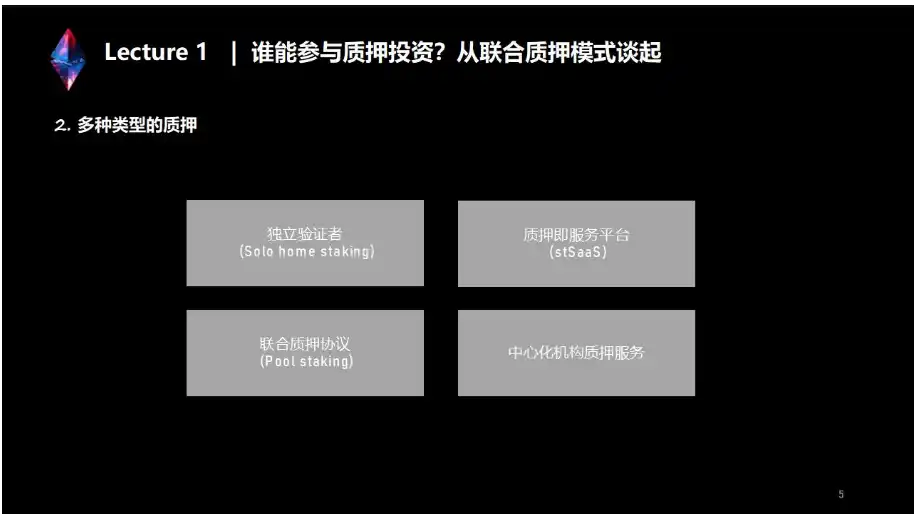
With pain points, various solutions will emerge in the industry:
The first type is solo staking; the second type is staking-as-a-service platform (stSaaS); the third type is pool staking mechanism (which can be understood as a type of joint staking protocol); and the fourth type is centralized institution's staking service.
I believe that "existence is reasonable". Each type of pledging scheme has its own advantages and disadvantages, and can solve the problems of current pledging from different perspectives. People who want to participate in pledging or evaluate pledging projects need to realize that the scheme is not "black or white", and each solution involves certain trade-offs. More importantly, it is necessary to start from the problems to be solved, and see whether the proposed scheme of the project is sustainable and long-term, and whether it meets regulatory and market demands.
Next, I will analyze the advantages and disadvantages of each type of collateral scheme to help everyone gain a deeper understanding of these four types of collateral.
(I) Independent Validator (Solo Home Staking)
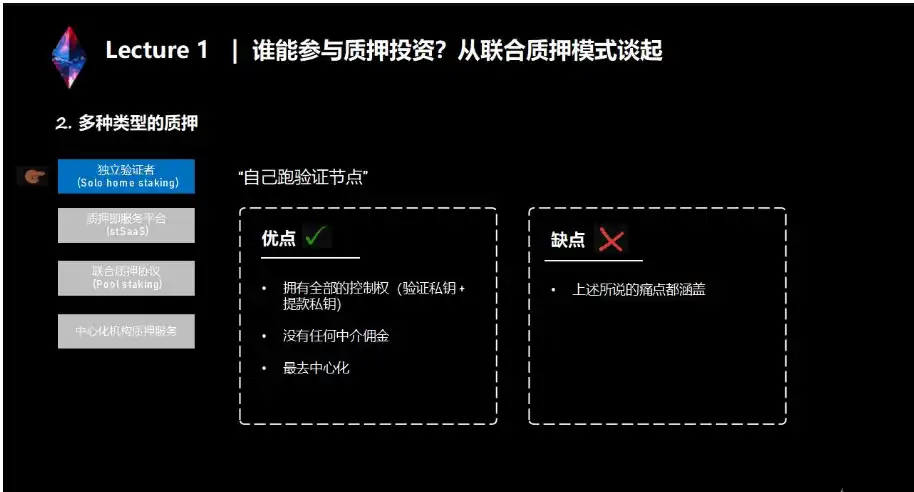
The essence of an independent validator is to run their own validation node. They are the most native type of staking participant in Ethereum.
Advantages:
1. Having full control means having control over the validator's own validation private key and withdrawal private key. When the node performs consensus tasks, it needs to use the validation private key for signature confirmation (similar to when you complete a task, you need to sign your name on the task list to tell others that you completed the task). During the operation of the node, this private key is often used. As for the withdrawal private key, it corresponds to the withdrawal address. When the staking reward can be withdrawn, it will automatically transfer to your withdrawal address. When you want to transfer your reward from this address, you need to use the withdrawal private key.
2. No platform or third party will charge any commission, because you have all the rights to the earnings of the node.
3. Possess the most decentralized nature that Ethereum pursues.
Disadvantages: The aforementioned pain points are summarized from independent verification nodes, such as high quantity threshold, large investment, low capital efficiency of pledge, inability to withdraw after long-term lock-in, relatively low returns, hardware costs, and technical barriers, which are not very friendly to novices or beginners. The following three types will introduce the concept of third parties or platforms.
Generally speaking, the advantages of independent validators are complete control and profit rights, as well as compliance with the concept of decentralization. However, their disadvantages are also obvious, including high quantity thresholds, low staking efficiency, and long-term lockups.
(II) Pledge as a Service Platform (stSaaS)
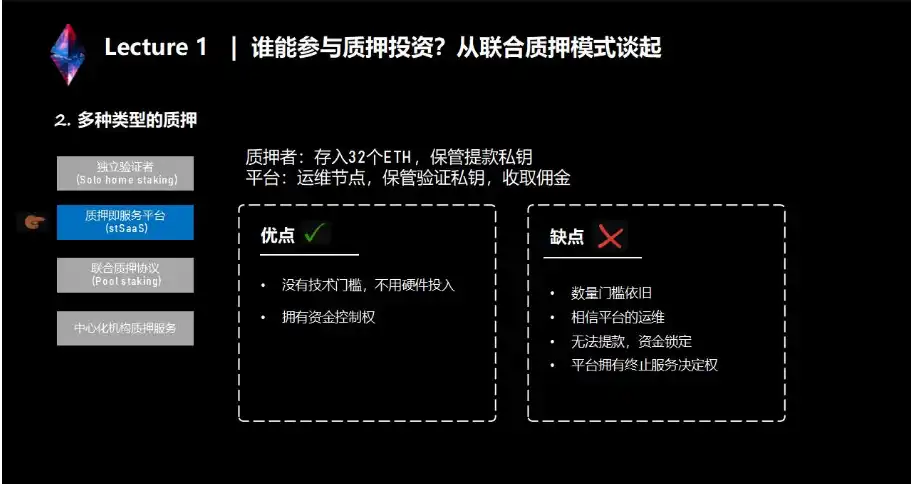
For users who own 32 ETH and want to participate in staking but do not want to build such infrastructure or maintain nodes, stSaaS is a relatively reasonable cooperation model. Its cooperation model is that users provide 32 ETH, keep their own withdrawal private key, and the staking-as-a-service platform helps users operate and verify nodes and keep the verification private key of the nodes, and finally charge some commission.
Advantages: There is no technical threshold for stakers to participate in staking in this way, and users do not need to pay any infrastructure costs. Users hold the withdrawal private key and still have control over the staked funds, so if the staking node service stops, ETH will be directly transferred to the address controlled by the user.
Disadvantages:
1. The quantity threshold is still 32 ETH; 2. Your 32 ETH will still be locked for a long time and cannot be transferred; thirdly, you need to distinguish the platform's operational capability because the verification of private keys is controlled by the platform, and the profits you can obtain depend on the platform's operational capability; the last point is that if you want to exit the verification node service, the platform needs to use its verification and sign the exit agreement, so the platform has the right to terminate the service to some extent.
(III) Pool Staking
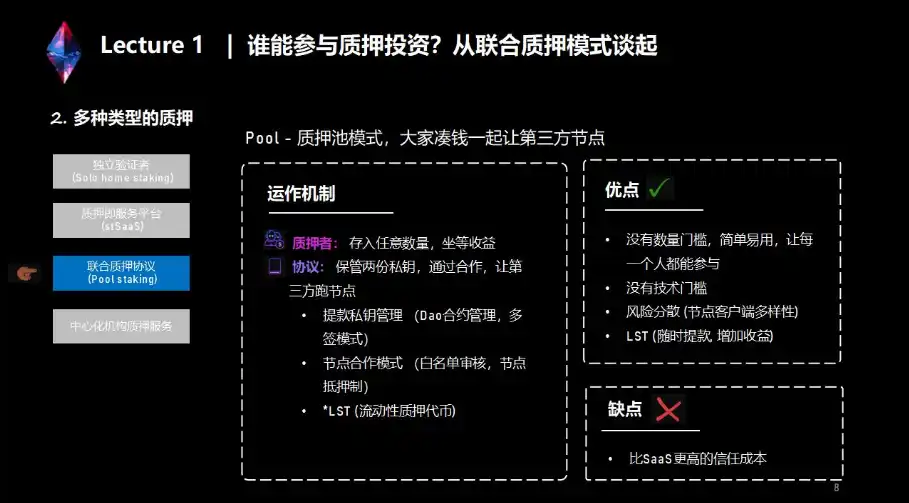
If you don't have 32 ETH and want to participate in staking, what should you do? One way is to pool together with others to reach 32 ETH and have a third-party service provider operate the node. Another way is for the platform or staking pool protocol to allow users to pool their scattered ETH to reach 32 ETH and deposit it into the staking pool. The staking pool will then deposit the user's ETH into the Ethereum staking contract and activate a third-party validation node, managing the withdrawal private key through the contract or multi-signature mode. In this mode, stakers can stake any amount of ETH, such as 0.01 ETH, and enjoy the benefits while only paying a small commission, without holding any private keys.
There are two ways to add nodes to the staking pool protocol: the first is the DAO whitelist mechanism, where professional node operators elected by the DAO are added to these network protocols to help with node verification and maintenance; the second is similar to a mortgage system, where for each validation node, the operator needs to provide 16/8 of the corresponding 32 ETH, and then pair the remaining half from the staking pool to form 32 ETH.
Its advantages are:
1. There is no quantity threshold, even 0.1 ETH (or less) can participate;
2. No technical threshold, let the people who run the nodes handle the operation and maintenance;
3. The risk of collateral can be further diversified through the collateral pool. The validation node group of this collateral pool will include a variety of client nodes, which are also diverse in terms of geography and hardware equipment. It can be understood that the ETH you pledged is actually distributed among multiple nodes. If a node is punished or slashed, the impact on the Ethereum you pledged is minimal.
4. The agreement for joint collateral usually also issues its own LST Token (Liquid Staking Tokens), which represents the pledger's stake. This Token can be traded on the secondary market. If there is good liquidity, your collateral deposit and rewards do not need to be locked and can be traded at any time, as they are reflected in the LST Token. This Token can be traded well on the secondary market, so you can cash out your pledge at any time by selling LST Token, achieving a kind of "soft exit". In addition, some LSD Tokens can also be used to participate in DeFi projects. In addition to earning collateral income, you can also earn additional rewards, such as providing liquidity or using LST Token as collateral for borrowing, making asset utilization very efficient. (Note: This only represents objectively existing re-pledging methods and does not constitute investment advice. Please consider the risks carefully.)
The shortcomings still lie in the perspective of private key management, as current stakers do not own any private keys. Later, we will explain how protocols like Lido solve this type of problem.
(4) Centralized Institution Pledge Service
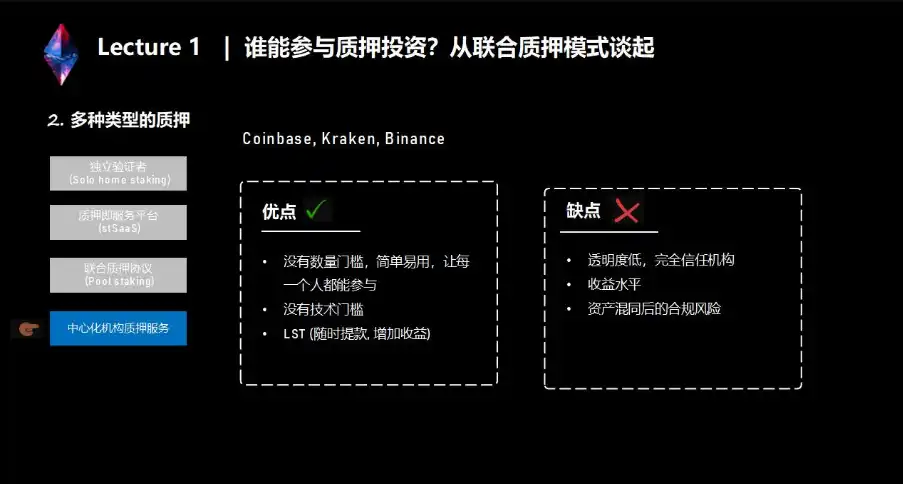
This type of service belongs to custody services, similar to centralized trading platforms.
Disadvantages:
These institutions provide pledge services, and transparency may be reduced. Users need to fully trust these institutions because, for users, this service is somewhat of a "black box". Users cannot determine whether these institutions are really using their ETH for pledge, nor can they determine the commission collection situation. For users who use Lido for pledge, the Lido protocol will charge a 10% pledge reward as commission. These centralized platforms may charge higher commissions, such as 20% or 25%. There are even some platforms whose commission collection situation is unknown.
In addition, compliance issues also need to be considered. Centralized trading platforms have a large amount of ETH reserves, which may be used for quick withdrawals. That is to say, when users want to withdraw, institutions will first borrow these reserves to meet their needs, and then retrieve their Ethereum from the Ethereum beacon chain. This method is completely "black box" for users and may pose certain compliance risks.
Finally, although these institutions also issue Tokens like LST, the contract permissions are owned by the institutions.
III. Detailed Explanation of the Joint Staking Model Represented by Lido

Lido is a decentralized liquidity staking protocol that can be classified as a joint staking type.
First, let's take a look at the entire workflow of Lido, and then break it down into smaller segments for a more in-depth analysis.
Step 1: Users stake ETH through Lido.
Step2: Users receive 1:1 stETH.
Step3: Lido integrates fragmented ETH into 32 pieces and uses them to activate pre-configured nodes.
Step4: Reward, Lido will use an oracle to report the total amount of ETH on the beacon chain every day, and summarize the total amount of ETH held by Lido.
Step 5: Update the amount of stETH on each staker's address using the formula.
Step 6: After the upgrade in Shanghai, the pledger can withdraw the pledge.
Step7: Wait for Lido to process and retrieve ETH.
Next, we will look at some details from one to seven, step by step.
Step1: Pledge ETH - Market Size of Pledge and Liquidity Pledge
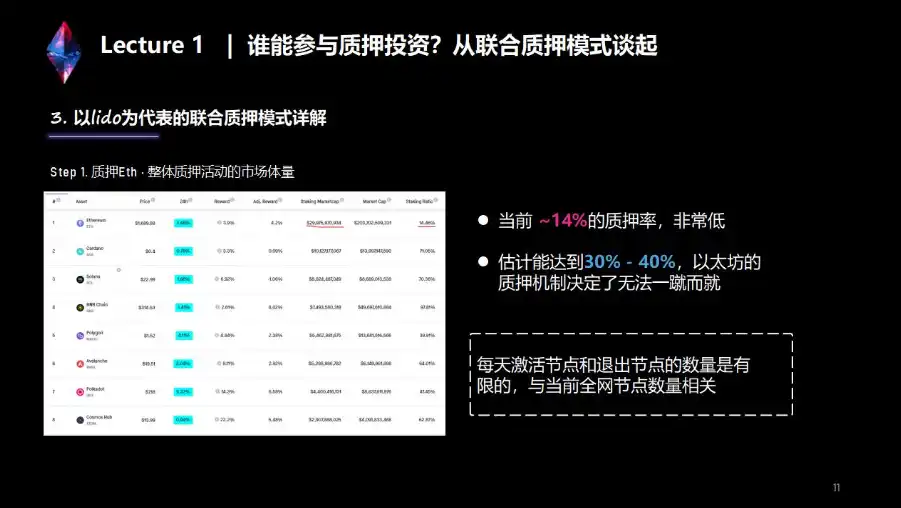
Lido's goal is to encourage more people to participate in staking, making it simpler and more equitable, so that more users can contribute to the security of the Ethereum network. This involves the market size of staking and the market structure of liquidity staking.
The market size of the overall staking activity:
In comparison, the current total amount of ETH staked on Ethereum is approximately 16.9 million, with a market value of 27 billion USD. The staking rate is only about 14%, indicating a very low staking penetration rate. By looking at the chart on the left, we can see the staking rates of other POS public chains, such as Solana reaching 70%, BNB Chain reaching 97%, Avalanche reaching 64%, Cosmos hub reaching 62%, and Polygon reaching a relatively lower but still significant 40%.
The current low staking rate of Ethereum has certain reasons: firstly, withdrawals are currently not available; secondly, the entire staking process still has systemic imperfections, so many people have the intention to participate in staking, but are still observing. With the improvement of the industry ecology and the upgrade of Shanghai, the staking volume on Ethereum will see a considerable increase. Personally, I hope that the staking rate of Ethereum can reach 30%, and in optimistic scenarios, it may reach 40%. If the price of ETH can return to a high level, a trillion-dollar scale in the staking market can also be expected.
However, it must be declared that this process cannot be completed within a few months, and it is not an overnight success. The rules of Ethereum limit the number of nodes that can join or exit the network each day, which is positively correlated with the number of validators in the entire network. The more validators in the network, the more validators are allowed to enter the network each day. This indirectly limits the amount of ETH that can be activated each day: currently, at most, a little over 50,000 ETH can be activated per day, and approximately 18 million ETH can be added to the network each year. Assuming no nodes exit, the maximum increase is 18% per year.
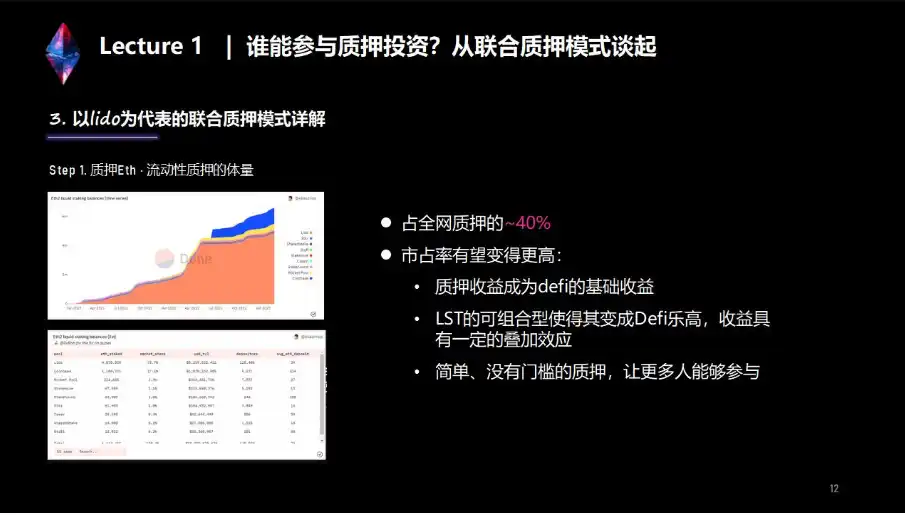
What is the current situation of the liquidity collateral market?
The liquidity collateral discussed here refers to the "liquidity collateral protocol", that is, when you deposit ETH, the platform or protocol gives you liquidity collateral tokens and completely stores your ETH in the collateral deposit contract to activate validators to participate in consensus tasks. There are currently many players in the liquidity collateral protocol, and there are many new players who have recently gone online or are preparing to go online. The liquidity collateral protocol accounts for about 40% of the overall collateral market, and Lido's share of the current liquidity collateral market is about 75%.
The market share of the liquidity collateralization market is expected to continue to rise for several reasons: firstly, the collateralization yield belongs to real income; secondly, the liquidity collateralization token can be easily integrated into various DeFi new gameplay, with good composability. Some believe that it can be regarded as the basic income of future DeFi, helping users to obtain stacked income (DeFi income + collateralization income); finally, the advantage of liquidity collateralization protocol is that there is no threshold for collateralization, and anyone can participate, especially those who cannot afford 32 ETH.
Step2: Obtain stETH - Analysis of the Value and Liquidity of stETH

stETH is the staking certificate of Lido, which has the following characteristics:
Firstly, it is a rebasing Token. "Rebasing" can be translated into Chinese as "变基". It means that the Token you hold has a feature: the amount of stETH on your address will automatically increase every day, and the extra part is actually a reflection of your staking rewards for that day. However, there will be no relevant transaction for the reward distribution on your address.
Secondly, the supply of stETH is exactly equal to the amount of ETH in the Lido staking pool, with a 1:1 backup ratio.
Thirdly, when pledging, Lido will issue stETH to you at a 1:1 ratio. However, the secondary market has the pricing power for stETH, which may experience some discount or premium depending on how the market prices it. This is not related to Lido's protocol, which remains at a 1:1 ratio.
Fourth, stETH has good liquidity, and stakers can smoothly withdraw their stakes through the secondary market before the upgrade in Shanghai. For example, the current exchange rate of stETH to ETH is 0.9999, with only a slight discount in case of emergency, which is very low.
It is worth noting that there is an encapsulated version of stETH called wstETH. Holders of wstETH can also earn staking rewards just like stETH. For example, if stETH has an annual yield of 5%, wstETH holders will also receive an annual yield of 5%. However, the amount of wstETH held by the holder will not change. The 5% yield is reflected in the exchange rate of wstETH to ETH, which increases every day. Therefore, if you hold wstETH, you will find that the price in fiat currency is becoming higher and more valuable.
stETH or wstETH both have great composability, similar to the properties of DeFi Lego. Currently, there are two popular ways to play in the market:
The first gameplay is to provide liquidity under Curve balance, and while earning a portion of the staking rewards, also receive LDO rewards. Overall earnings are typically higher than holding stETH alone.
The second gameplay is borrowing and lending. Currently, multiple platforms such as AAVE and Maker DAO support borrowing and lending of stETH or wstETH. In AAVE's recently launched V3 version on the mainnet, the borrowing rate of wstETH can reach as high as 90% in efficient mode. Based on this, it is not difficult to imagine that borrowing and lending can lead to the gameplay of circular pledging, further increasing the overall pledge yield. There are also projects (such as DefiSaver, InstaDapp, Oasis.app, IndexCoop) that have turned circular pledging into a product, allowing users to complete circular pledging with just one click.
Brief introduction to "Looping Staking": It refers to users using stETH as collateral to borrow Ethereum on AAVE V2, then staking the borrowed ETH on Lido, and finally depositing stETH into lending platforms such as AAVE V2 to borrow more ETH, and so on. This method can achieve leverage of approximately 3.2 times, and in the efficient mode of AAVE V3, it can even reach a maximum leverage of 10 times. However, please note the risks involved in looping borrowing, including but not limited to the risk of stETH and ETH depreciation. If there is a significant depreciation, there is a possibility of liquidation for users. Although this situation is an extreme event, users still need to do their own research and consider it carefully.
Finally, I would like to talk about the imagination of liquidity collateralization Token. I often wonder if there are any possibilities for certain things that were previously completed using ETH to be replaced by stETH in the future. For example, a new project requires liquidity provision, and the current mainstream approach is to open a trading pair related to ETH on a decentralized trading platform. Is it possible to use stETH to initialize this liquidity so that liquidity providers can still receive a portion of the collateralization rewards? Why not?
Step3: Binding 32 ETH·Lido Contract Permission Management and Node Management
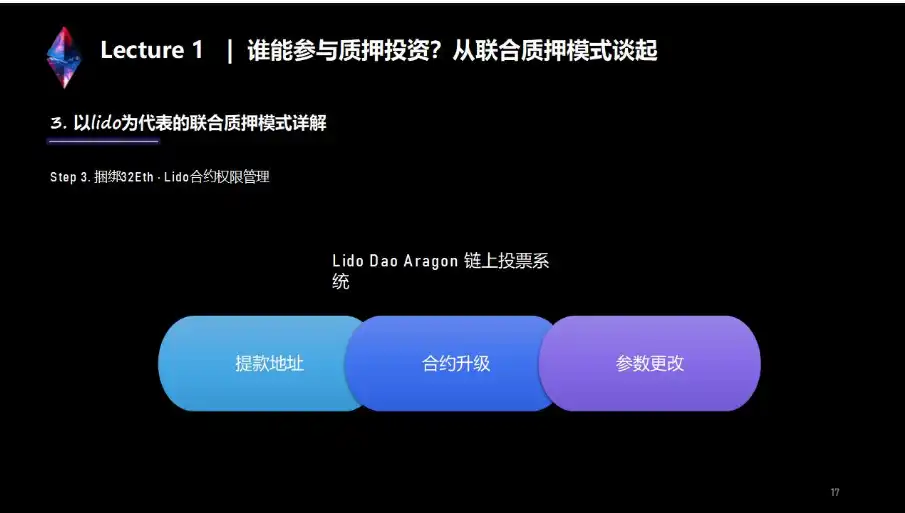
There are two aspects worth paying attention to in this step: the management of contract permissions and the management of nodes.
(I) Contract Authorization Management:
The relevant contract permissions of Lido are managed through the Lido Dao Aragon on-chain voting system:
Currently, anyone can initiate a vote, which lasts for three days. During the first two days, votes can be freely cast, while in the last 24 hours, only opposing votes or changing from supporting to opposing votes are allowed. This two-stage approach is similar to a time lock, which is used to prevent issues with flash governance. Whether it is a contract upgrade or a parameter update, it must first be approved through on-chain voting. Therefore, the contract permissions of Lido are not held by a few individuals or multi-signature wallets, but by all LDO holders.
Some people may be concerned about the security of Ethereum pledged to Lido. This involves the management of withdrawal private keys. After July 2021, the withdrawal private keys of all validation nodes point to a contract address controlled by Lido DAO. Therefore, the security of the contract is guaranteed, and the possibility of the withdrawal private key being compromised is very small. The upgrade of the contract also needs to be voted on the Aragon chain before it can be executed.
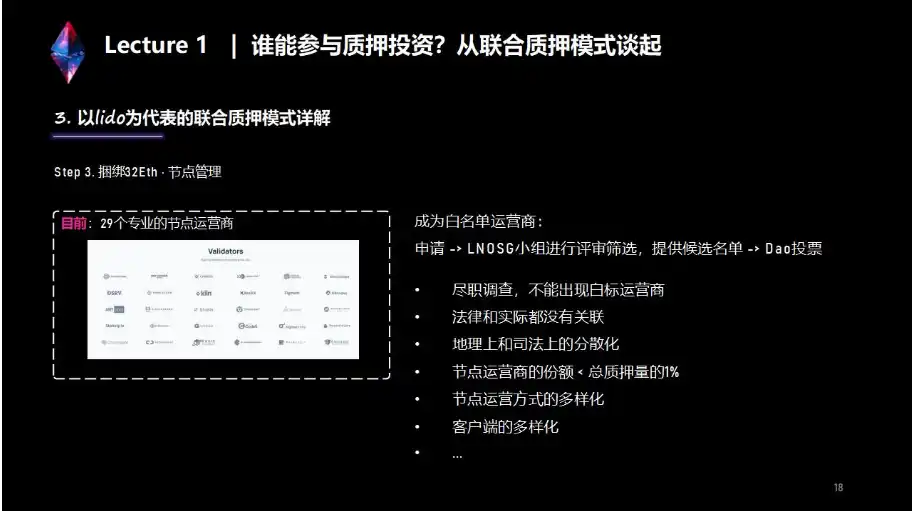
(II) Node Management:
Operator:
In terms of node management, Lido currently has 29 whitelisted node operators (institutions have merged their businesses). These 29 operators include development teams of Ethereum clients such as Prismatic Labs, ChainSafe, and Nethermind.
Node share:
Currently, each node's share does not exceed 2% of the total network staking amount. The nodes are more like a node alliance, working on node maintenance based on the Lido framework. They have enough autonomy, such as the choice of client usage and MEV relay selection.
White list mode:
Currently, we can see that Lido has adopted a whitelist model. In this model, you need to apply to join the Lido node first. Then, a dedicated group responsible for node selection in Lido will screen the candidates and provide a list of candidates. Finally, all DAO or LDO holders can vote on the list. If the vote is passed, you can enter the Lido network.
The filtering process:
1. Due diligence must be conducted to avoid white-label operators: (the nodes behind them are not your own entities).
2. There is no legal or practical association: There is no legal or physical association between nodes or operators. A good example is BlockDaemon and AnyBlock, which are treated as one operator after their business merger.
3. Geographic and judicial decentralization: Lido hopes to have some node operators in a larger geographic area (seven continents or around the world) to be sufficiently dispersed geographically; judicial decentralization means that Lido does not want some countries to directly shut down the entire Lido network by verifying nodes. For this situation, only by making it sufficiently decentralized can the impact be minimized.
4. Node operators' share < 1% of total staked amount: Lido has a principle that after Shanghai upgrade, the share of each node operator should not exceed 1% of the total staked amount on the network.
5. Diversification of node operation methods: For example, some people may choose cloud service, some may build their own data centers, and others may choose to host their machines. Lido hopes to make the operation methods more diversified, so as to minimize the impact of any one method.
6. Client diversification: Lido released the usage statistics of the current client in the fourth quarter, and the diversity of Lido consensus layer clients is actually better than that of the entire network.
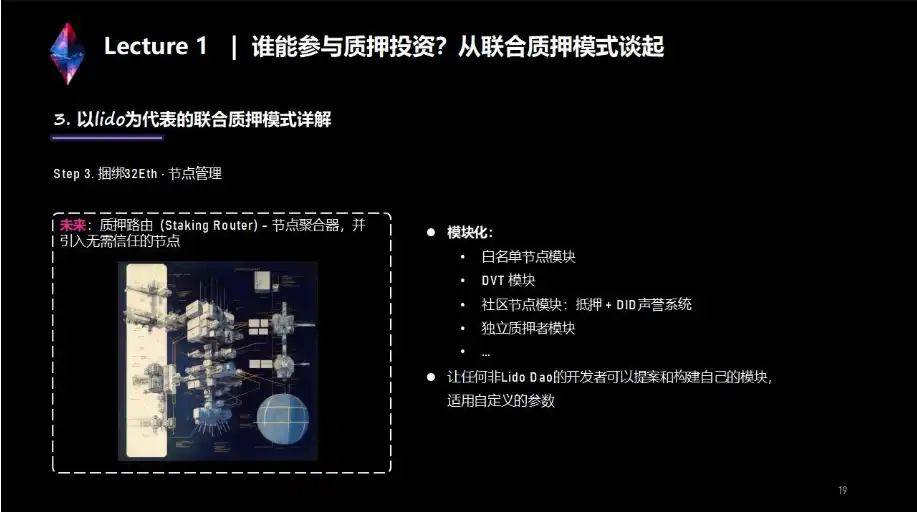
The current whitelist node management mode prevents nodes from joining Lido's network without trust, and Lido is committed to improving this. In the recently released V2 version, Lido introduced the concept or architecture of "staking routing" to introduce this kind of architectural adjustment for nodes that do not require trust.
Pledge routing: Using a modular approach to isolate and manage node clusters, Lido becomes an aggregator of validation nodes. Based on pledge routing, anyone can design or develop corresponding node modules, as long as they are approved by DAO voting, they can go online.
Recently, Lido has been testing the integration of Obol and SSV's DVT. Some people may ask the question: which DVT technology will Lido ultimately adopt?
This modular or staking routing has provided a good solution. If both parties' DVT technologies are good enough, Obol can apply for its own DVT module, and SSV can also apply for its own staking module. This will further enhance the decentralization of Lido. Not only DVT technology, but developers can also design node modules based on this mortgage or on-chain reputation system. Finally, through the combination of these multiple modules, Lido can be further decentralized, while strengthening the resilience of the Lido network.
Step4/5: Reward Generation and User Reward Distribution
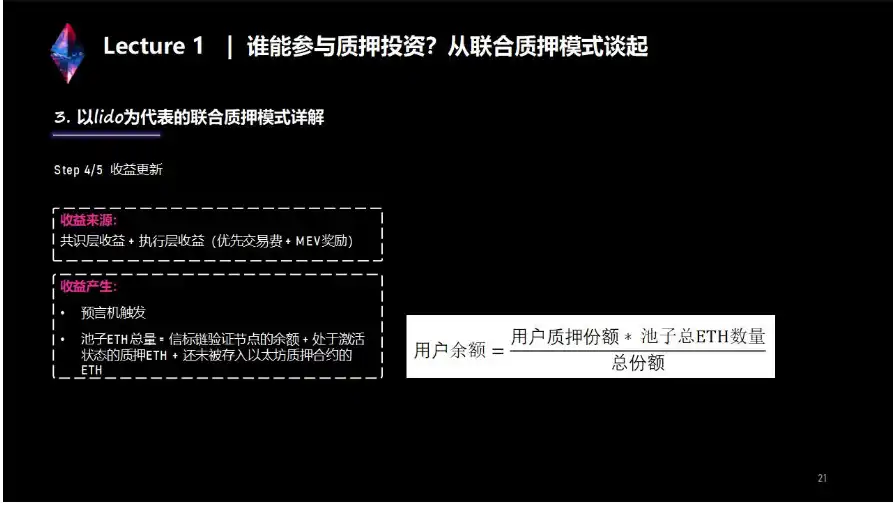
1. Source of income
The current source of income for stakers includes two parts: one is the income from the consensus layer, and the other is the income from the execution layer.
The revenue of the execution layer is prioritized transaction fees or MEV rewards; the revenue of the consensus layer is the amount of ETH issuance.
For the consensus layer, as the total staking amount of the entire network increases, the rewards for the consensus layer decrease. As for the execution layer, if the Lido-related validation nodes produce blocks, they will receive priority transaction fees, excluding EIP1559, and there may also be MEV rewards. Currently, Lido designates both parts of the execution layer rewards to a single address, and at a fixed time each day, the balance on this address is re-staked to the Lido protocol, allowing users to share this income. This income currently accounts for approximately 20% of the staking rewards for Lido users.
Regarding the revenue of MEV, Lido has developed a framework for MEV rewards that every validator operator adheres to, making the MEV rewards transparent enough. If a validation node produces a block, it can also be traced back to find out the specific amount of MEV rewards received.
2. 发放收益
translates to
2. Distributing Profits
When Lido distributes profits, there is a network of oracles that will collect the balances of Lido-related nodes on the Beacon Chain around 8:00 Beijing time. This will determine the total amount of ETH in the Lido pool and update the amount of stETH for each staker.
So why do we need to use an oracle?
Due to the current balance state of the beacon chain, it is not possible to synchronize directly with the execution layer, so a third party is needed. Introducing a third party will create some trust issues, so the Lido community is also exploring the use of ZK, i.e. zero-knowledge proof technology, to optimize the oracle level and make it trustless.
3. User Balance Formula
When a user stakes, for example, stakes one ETH, the Lido contract records not that the user has staked one ETH, but immediately calculates the stake share that the user will receive for staking one ETH and records it in the Lido contract. Therefore, when the oracle aggregates the total amount of ETH in the pool every day, it updates the user's balance based on this formula. When a user opens their wallet after 9:00 AM, they will notice that their stETH has changed. By calculating the stake share, the current and latest quantity of stETH can be determined.
Step6/7: About redeeming ETH after Shanghai upgrade
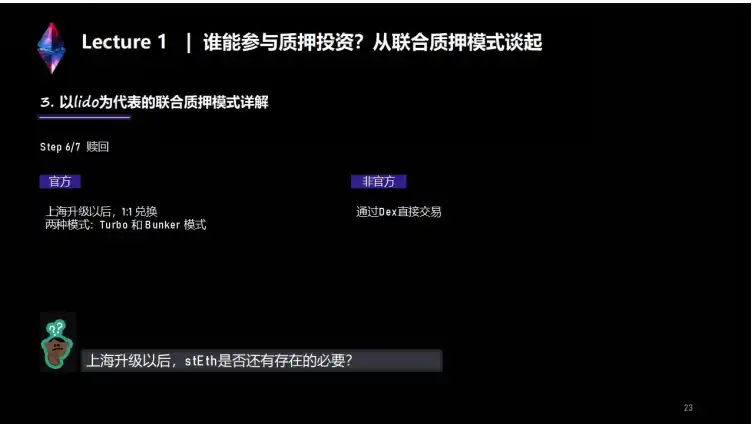
Currently, you can "redeem" your ETH through unofficial means, such as through the secondary market like Curve, or by directly exchanging stETH for ETH or other tokens to withdraw your pledge.
Lido has released some designs for withdrawals, which will be launched after the Shanghai upgrade. According to the official design, the withdrawal module for the Shanghai upgrade will be divided into two modes:
The first mode is called Turbo mode, which can be understood as a regular mode. When a user initiates a withdrawal, Lido will exchange the user's funds for ETH at a 1:1 ratio within a few hours or one to two days after obtaining enough ETH. The user can then retrieve their ETH.
The second mode is a mode called Bunker, which is designed to protect the interests of most stakers in extreme situations. The calculation of the Slashing mechanism is very complex and takes some time to determine. Therefore, if there is a large-scale Slashing (Lido has been running for more than two years without encountering any Slashing), the withdrawal function of the stakers will be suspended. Lido needs some time to calculate these losses, and in the end, the stakers will jointly bear this part of the losses. Lido will activate the Bunker mode to prevent some stakers from evading the recognition of this loss by immediately applying for withdrawal due to their ability to obtain chain information or information priority during the Slashing period. This loss will ultimately be shared among other stakers, leading to some unfairness.
Lecture 2: Who can become a verification node? Another possibility brought by stSaaS
Kenway:
I am a co-founder of XHash. XHash's main business is Ethereum POS non-custodial staking service, mainly serving customers who are willing to participate in Ethereum staking and create Ethereum consensus.
In this lesson, we will explore who can become a validation node? Another possibility brought by stSaaS.
一、作为 validator 的「权利和义务」
One, the "rights and obligations" of validators
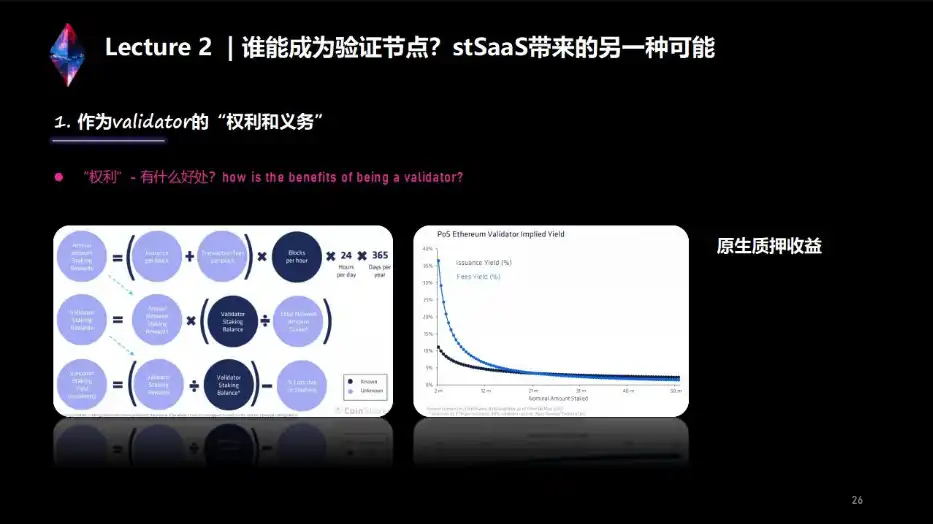
1. "Rights" - What are the benefits?
First of all, you have contributed to the decentralization of the Ethereum ecosystem. As a solo staker, you hold the power to vote and create blocks in your own hands, which decentralizes the power of validators in the entire Ethereum network and contributes to the decentralization of the entire Ethereum ecosystem.
Next is the ability to obtain all profits. This is because there is no need to find a third party to cooperate and collect a portion of the fees. From a more technical and underlying perspective, let's discuss the parts of the earnings during the staking process:
Firstly, the underlying layer is divided into two parts: one part is called execution layer revenue, and the other part is called consensus layer revenue.
The execution layer yield refers to the fees earned from all transactions included in a block if your validator is selected to produce the block. This includes the Transaction Fee shown in the second column of the first row in the left image.
The consensus layer yield is that even if your validator is not selected as a block producer, you can still vote on the blocks on your relevant chain. As long as you participate in these votes correctly, you can receive a small yield from the consensus layer. Although this yield is relatively small, it occurs once every four minutes and accumulates to a large portion of the entire staking income.
From the formula, we can see:
1) Consensus layer income (Issuance) + Execution layer income (Transaction Fee) = all income in a block. Multiply all income in this block by the number of blocks produced per year to get the annual network staking rewards for participating in staking every year.
2) After factoring in this profit, take a look at the proportion of your Validator's earnings to the entire network's earnings, which is your Validator Staking Balance (for example, if you only have 32 ETH) divided by the total amount staked on the entire network (Total Network Amount Staked); this is your proportion. Multiply this proportion by the network's total earnings (Annual Network Staking Rewards) to get your validator earnings (Validator Staking Rewards).
3) The yield (Validator Staking Rewards) divided by the principal amount you staked (Validator Staking Balance) is your annualized yield (Validator Staking Yields).
However, at this time, there may be some losses: such as losses caused by offline time or losses caused by Slash. Subtracting this percentage gives you the annualized percentage of income that a validator earns in a year.
The percentage of earnings will continuously decrease as the number of stakers on the entire network increases. Currently, there are approximately 16 million Ethereum staked on the network, which is roughly a 14% staking rate. Therefore, the current earnings should be between 5% to 6%. As a solo staker, if your operation runs smoothly, you can receive all of these earnings.
2. "Obligation" - What Should a qualified Validator do?
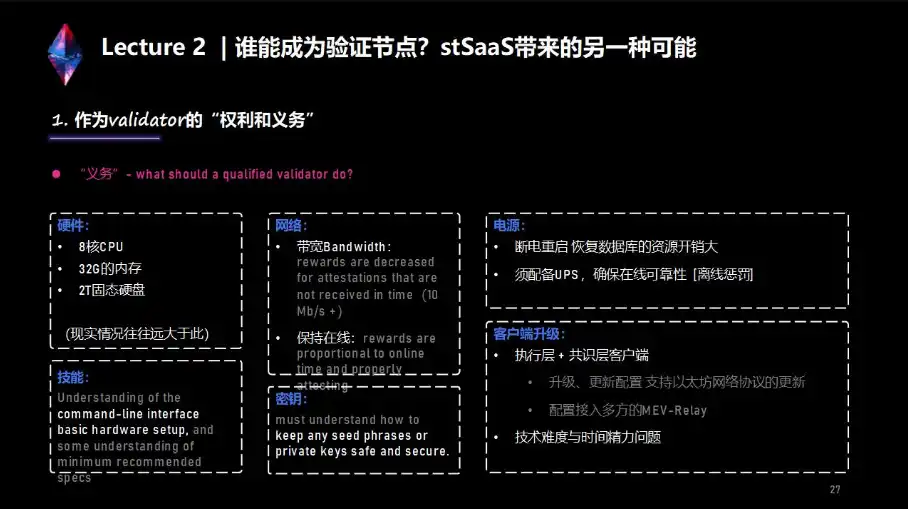
As a solo staker, there are some obligations that you need to fulfill - you need to run your hardware, which means running your node. There is a hardware requirement.
Hardware requirements: The client requires an 8-core CPU, approximately 32GB of memory, and a 2TB solid-state drive. This is just a basic requirement, and if greater stability is desired, hardware configuration needs to be increased. In reality, the required hardware configuration is often much higher than these specifications.
Skills: First, you need to understand what Ethereum staking is all about. In the process of generating these stakes, you need to operate some GUI programs and also some command-line programs. It is important to understand these basic operations.
Network: It is necessary to ensure that the nodes are online, which requires a relatively good network. According to current observations, maintaining normal node synchronization may require a bandwidth of ten megabytes, and it needs to be online all the time. If you are a solo staker, such as using your own server at home, you need a relatively stable network. However, in most cases, this home network may not be so stable, and there may be situations where the network is disconnected, and sometimes the disconnection time may be relatively long, which will affect your online rate. Once your online rate is affected, your yield will also be affected.
Power supply: As servers need to be online 24/7, the power supply must be reliable. If possible, it is best to have a UPS to ensure uptime. Another situation is that if the node is writing to the database or writing software on the hard drive when the power is cut, there may be issues. If the node cannot resynchronize after a power outage, it may take some time to resynchronize, which could take two to three days based on current conditions.
Client upgrade: Because the client will constantly release new versions, and the Ethereum network will also have continuous hard forks, you need to continuously pay attention to these client upgrade situations in order to upgrade your execution layer client and consensus layer client normally. For MEV, if you want to get more MEV income, you need to configure multiple MEV-Relays, access some trusted and relatively stable MEV-Relays on the network, and maximize the income of Relay. This involves a technical difficulty and time and energy issue.
二、stSaaS does what: make it possible for "non-self-operating nodes" to become a reality
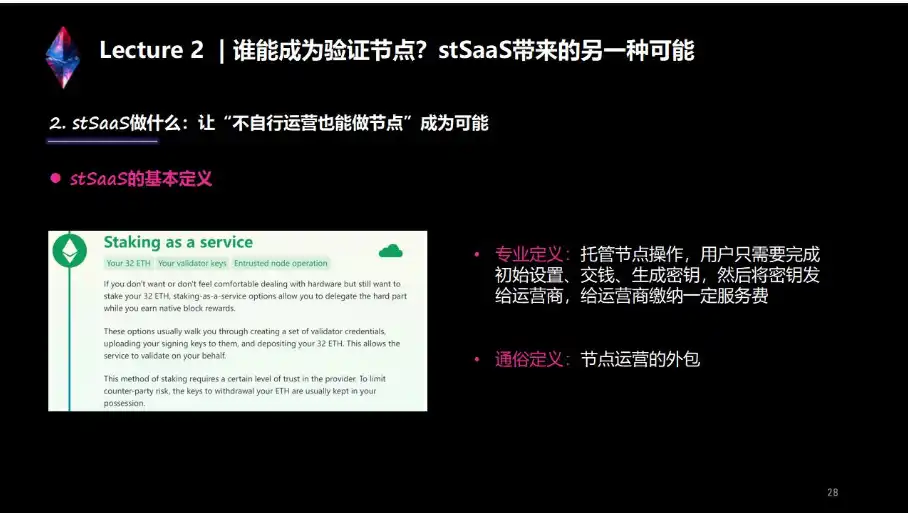
1. Basic Definition of stSaaS
If some friends have 32 ETH and want to participate in Ethereum staking but do not have the time or energy to operate, Staking as a Service (stSaaS) may be a good option. In definition, it is a node hosting service. Customers need to download the staking key generation program from the Ethereum official website and generate two keys - one for withdrawing and one for staking.
After generating these private keys, you need to keep your withdrawal private key, which corresponds to the mnemonic, safe and deposit 32 ETH to the Ethereum deposit contract.
Finally, the pledge fee needs to be paid to the stSaaS operator, and a certain service fee needs to be paid to the operator. There may be several ways to charge the service fee, such as monthly payment or a fixed amount of dollars per month; most of them charge a percentage of the income as the fee.
After the operator receives your pledge fee, they will start the pledger to help you operate on their backend server. You only need to keep your private key safe and don't have to worry about any hardware maintenance, upgrades, network, and power issues. The common definition is outsourcing service for node operation.
2. stSaaS: The trade-off between controllability and node operation obligations

During the staking process of Ethereum, two sets of keys will be generated.
One of the keys is the withdrawal key, which corresponds to the mnemonic phrase. As long as you protect your mnemonic phrase, your withdrawal key will not be leaked, and only this mnemonic phrase can extract your staked principal (i.e. 32 ETH). During the process of generating your staking private key, you can also directly specify a withdrawal address for ETH. Once specified, this withdrawal address cannot be changed, which means that the withdrawal can only be made to this address, ensuring maximum security.
The ETH pledged will be visible on your validator. Your consensus layer earnings can now be seen on the validator as well. After the upgrade in Shanghai, the entire network will periodically rotate all validators. If your validator meets the conditions - meaning you have designated a withdrawal address - the network will rotate these validators and deposit your consensus layer earnings into your designated withdrawal address. Based on the current validation time, this process is estimated to take about five days to complete one rotation, which means that your consensus layer earnings will be automatically deposited into your designated withdrawal address in about five days. However, this is only after the upgrade in Shanghai, and currently, your principal and consensus layer earnings cannot be withdrawn.
Another one is the staking key. Why did Ethereum official separate the withdrawal key from the staking key? Because the staking key needs to perform the rights of validators such as voting and block production, so it requires an online key. Separating the withdrawal key from the staking key ensures that the withdrawal key is offline and not connected to the internet, which maximizes security. The staking key needs to be online all the time to perform the rights of validators, but it does not have the right to withdraw ETH, it only has the right to execute the rights of validators.
The withdrawal key and the pledge key are separated, giving these stSaaS service providers a possibility - as a solo staker, you only need to give the pledge key to these pledge service providers, and the service providers will start the node for operation and maintenance. Compared with solo stakers, finding stSaaS service providers is a less secure solution. Because the pledge key is given to the service provider, but this transfers the obligation of operation and the risk of punishment to the validator. If you choose a not-so-good pledge service provider, there may be losses, such as losses caused by server offline, or if they operate poorly, even the problem of double voting, which will bear the risk of a slash. Therefore, choosing a safe and reliable pledge service provider is a very important issue compared to solo staking.
Another question is, as an Ethereum supporter, is it better to choose a top ten ranked service provider or a provider with better quality but possibly lower ranking?
There has been a lot of discussion about this issue within the entire Ethereum ecosystem. The current consensus in the industry is to choose a provider that may not have many nodes or a high ranking, but has a reliable staking service with guaranteed quality, which is a better choice. This can achieve a greater degree of decentralization for Ethereum stakers.
Three, Ethereum official website: What to consider to pick a atSaaS provider
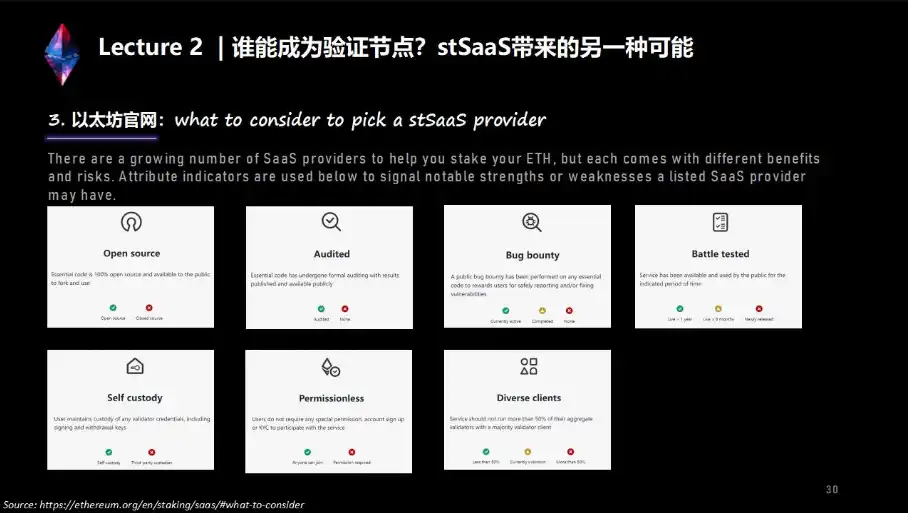
1. Open source: Open source refers to necessary programs, such as a possible fast staking program. If it is not 100% open source, there may be a risk of stealing some of your staking private keys. If it is open source, the level of trust is relatively higher.
2. Audited: For example, whether the code for his profit distribution and some of the backend operation codes for the entire pledge have been audited. If there are some large auditing companies involved, it will be relatively safer.
3. Bug bounty: If there is a mechanism that publicly allows others to report bugs, this service provider may be considered a more trusted provider.
4. Battle tested: Is there a reliable and stable staking service provider that has been operating for a long time and has been proven over time?
5. Self custody: Is it really yourself who is staking, because there are many white-label staking service providers on the market who are not really acting as validator nodes, but rather renting servers from others and taking a portion of the profits, which is not a choice.
6. Permissionless: Whether it is not required to obtain permission, that is, it does not undergo KYC audits, and certain specific customers cannot access it, because Ethereum also emphasizes the feature of permissionless and anti-censorship on consensus.
7. Diverse client: The diversity of pledged nodes, everyone can take a look at what kind of pledged nodes are used by the service provider behind the scenes. Because everyone knows that now each node actually has multiple development teams working on it. If everyone uses a mainstream client developed by the same development team, if this client has problems on the network, it may cause the entire Ethereum network to crash. But if two to three development teams are selected to develop the client, it may greatly increase the diversity of the client and make a certain contribution to the security of the entire Ethereum.
Lecture3: Potential Crisis and Pathway of Pledge Mode

Robert:
I am Robert.Hu, the SSV Ambassador in China. My topic is mainly about the potential crisis and future development space of the pledge mode. Today, my theme is to solve the potential crisis of Ethereum's pledge mode with a development perspective and approach.
A quick warm up: Summary of various staking methods
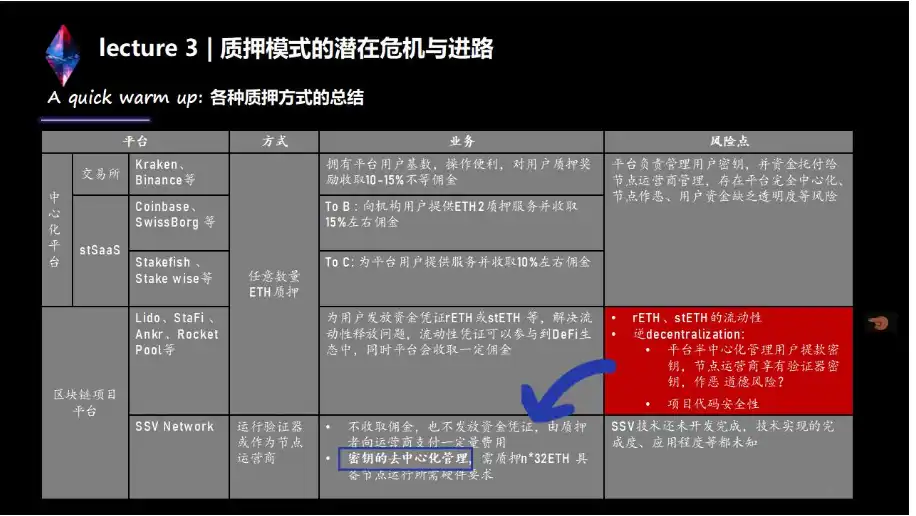
Currently, there are four main types of pledging methods, with three core logics.
1. Trading platform model: The trading platform model, such as Kraken, has been banned. Basically, you give them your coins, and they help you do staking. After staking, they give you a certain percentage of profit, but the profit margin is often inflated and the actual profit may not match the stated profit. Therefore, this is very opaque. My position is actually very opposed to this centralized staking method. Regarding the SEC's ruling, I personally think there should not be a big problem, it is a relatively fair punishment.
2. Similar to trust model: The second method is similar to the trust model. Both domestic and foreign users are familiar with this type of trust. It is called "信托" in China and "trust" overseas. In this model, you give them the currency, and they will give the profits to the trust. Later, you can withdraw your share from the trust. This method is also OK and is more suitable for large funds. After Kraken was banned, we can see that Coinbase was also very excited, especially their CEO who almost tweeted three times a day to explain why they did not do what Kraken did.
We can see through in-depth research that they are different, but their pattern is the same as Kraken's, except for the way profits are distributed. Its transparency is the same as Kraken's.
3. Blockchain project platform: such as existing platforms like Lido, Ankr, and Rocket Pool. In fact, SSV has already granted more than a dozen projects that are similar to these platforms. They are all TOC, and the core problem they solve is liquidity. LSD's track, liquid staking derivatives, can be understood as a derivative of liquidity. The core problem of liquidity derivatives is that they lock your liquidity, but provide a solution when you need liquidity. This solution can be called an "emergency plan" in Chinese, or it may be temporary. I personally have a skeptical attitude towards whether this approach will become mainstream after the Ethereum upgrade to Shanghai in the future.
Two logics: The first logic is that with the development of the market, new products and projects continue to emerge. This is also why, before the upgrade in Shanghai, Ethereum only had 13.77% (slightly higher these days). Because someone who doesn't want to be named deposited some ETH, which raised the staking rate slightly. The problem is that it still hasn't reached 14% or above, which is very unsafe for a POS, and its robustness is very low. The logic is that if Ethereum wants to solve its centralization problem, after the Shanghai upgrade, it must further decentralize its nodes, which requires a product called ssv.network.
One core logic here is to hope that in this market, after upgrading in Shanghai, there will be 100, 1000, 10,000 LSD protocols in the future, entering a state of competition among hundreds of companies. If we use DVT technology like SSV, we are also very welcome. If not, I think there will be other solutions in the future market, and we can make a comparison.
I also welcome everyone to participate in our ssv network's testnet. You can experience it by selecting four nodes from tens of thousands of nodes and staking your 32 ETH to receive relevant rewards. Moreover, all the rewards will be given to you. You don't need to set up nodes or manage them anymore. You just need to use the DKG's distributed private key fragmentation technology to split your private key into four pieces and give them to four operators. Then they will use your Validator Key to sign, and you no longer have to worry about losing your private key or coins (but you need to keep your withdrawal private key safe). You also don't have to worry about being slashed because the possibility of being slashed is very low.
一、Why we need SSV?
一、Why we need SSV?
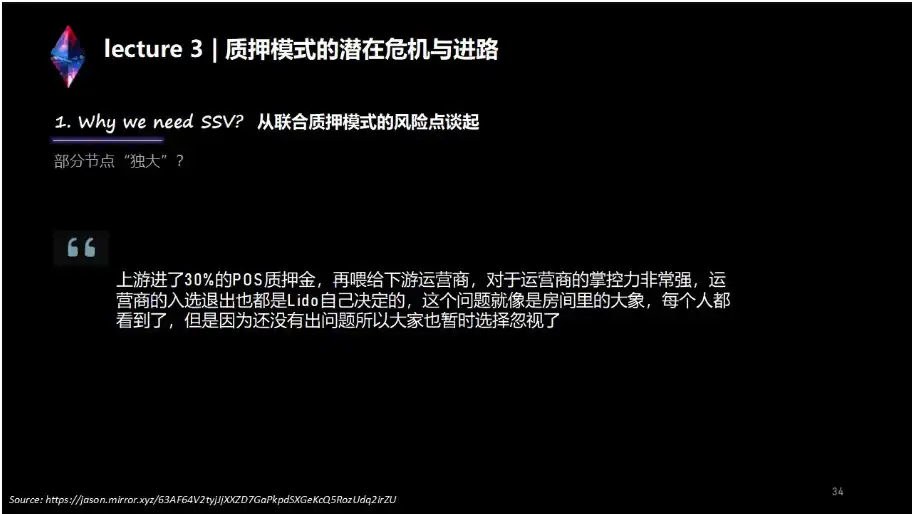
Why do we need SSV after upgrading in Shanghai? Personally, I think "it's not that SSV needs Ethereum, but that Ethereum needs SSV."
Two logics: The first logic is that the current Ethereum staking rate is around 13.77% or 14%. Everyone needs to think deeply about why this is the case and there are two layers of logic. We call it "first principles", which means that conclusions can be deduced from reasons and processes. The "conclusion" is that Ethereum has only a 13.77% staking rate, why? The core reason is that its liquidity is insufficient and cannot be freely entered and exited.
After the upgrade in Shanghai, it has the freedom to come and go. I think if Ethereum wants to maintain its anti-censorship and distributed nature, then it needs SSV's DVT technology to increase the breadth of its node distribution, so that there can be Ethereum nodes all over the world.
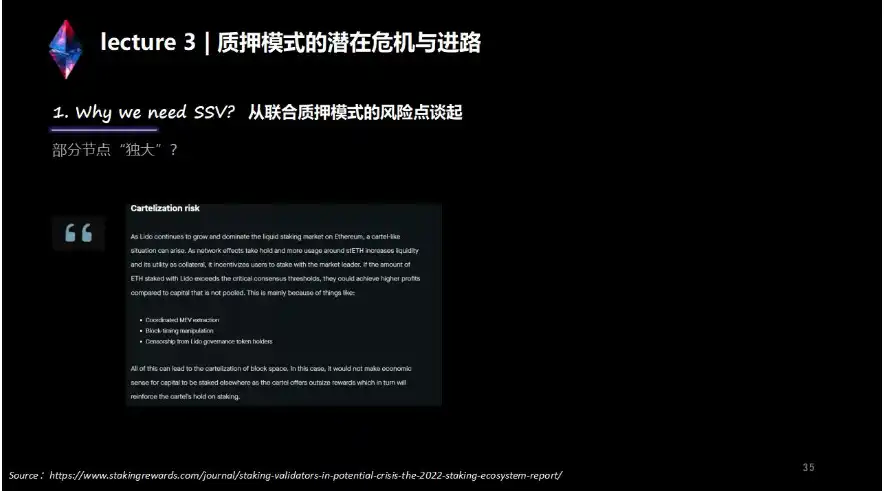
Another point is the risk of Ethereum's joint staking model. We can call it a monopoly or dominance. Monopolies need innovation to solve, and innovation comes from diversity. After the upgrade in Shanghai, we need hundreds, thousands, or even tens of thousands of LSD track projects to emerge and serve us as customers, while they are just one of the merchants. If the market share remains the same in the future, I personally believe that Ethereum will not have a particularly good development, which is the core risk.
II. Technical Principles of the Solution: SSV as a Technical Term
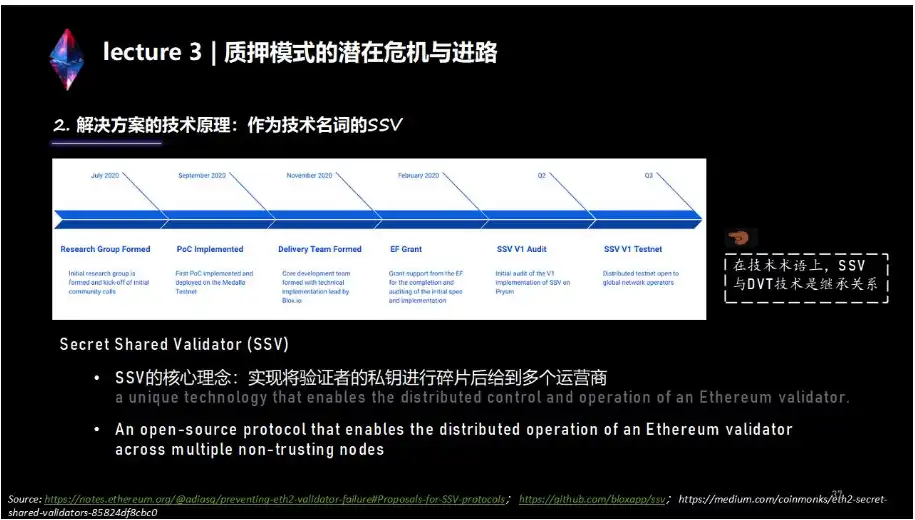
Another point is the solution to the risk of the pledge mode. From the perspective of SSV, we hope to solve this problem. If the private key is not in your own hands, you will not sleep well at night. The problem solved by SSV is to keep your withdrawal private key in your own hands. If your private key is not lost, your coins will not be lost. This is the core of "don't trust, just verify".
The three core technologies of SSV are very simple in logic, but it is difficult to achieve them.
1. Secret Shared Validator(SSV)
It is a technology that shards your private key. After Ethereum switches to POS, it has two layers of chains. The first layer can be called the consensus chain, and the second layer can be understood as the execution chain. Based on this, its POS logic is divided into two layers. In the future, after adopting the DVD technology, your private key can be split into two parts. If you have 32 ETH and want to participate in the Ethereum POS node, your private key can be split into withdrawal private key and signature private key. SSV only does one thing, which is to give your withdrawal private key to you to save, and split your signature private key into four parts using SSV technology. We give these four parts to four nodes, and these four nodes have a 3/4 online rate, so your signature can be successful.
2. DKG Technology. The second technology is actually DKG Technology, which can be understood as a signature private key generation technology. If this node technology of SSV is used, one key of the node can be split into four shards and these four shards are given to four nodes. These four nodes can be selected from tens of thousands of nodes according to your own risk preference, reward, or cost considerations. You can choose not to select it if you think it is too expensive or you can choose it if you think it is more secure and expensive. You can even choose one from China, the United States, Japan, Singapore, or even Europe, and then we can do 3/4 verification with these four nodes. This can solve the Byzantine attack problem.
3. The third point is the technology of multi-signature wallets. The technology of MPC wallets is also very difficult, but once it is implemented, it is a very simple technology for users.
III. Specific Implementation of the Solution: SSV.network as a POS Ecosystem Participant
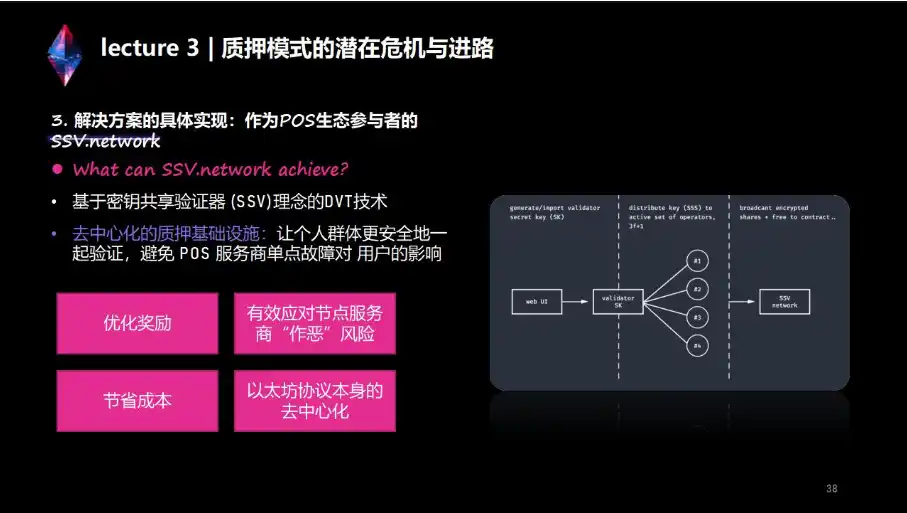
The core technologies of DVT are three: SSV, DKG, and MPC. These three technologies are the core technologies of SSV, which is the foundation of our survival and the technical basis for providing services to Ethereum or any of you who want to participate in the LSD track in the future.
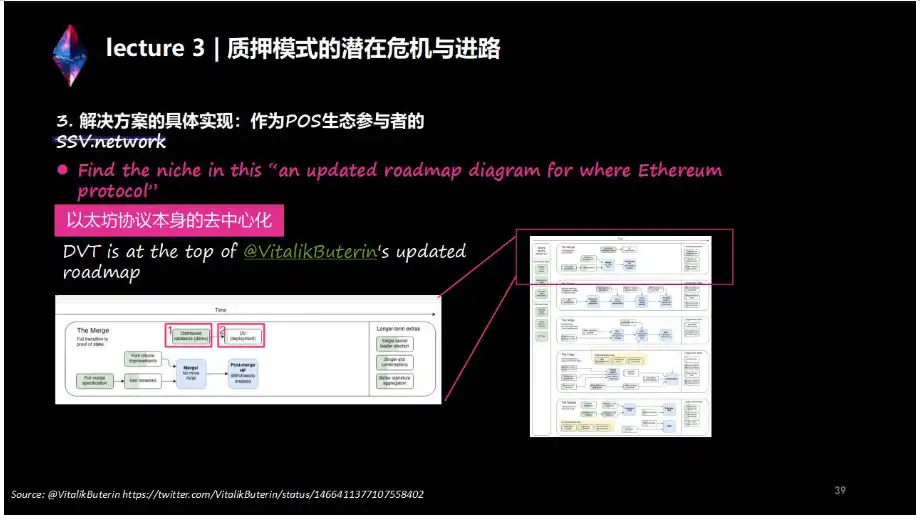
We can take a look at the DVT plan. DVT was originally named SSV, but later changed its name and became the SSV network. After the name change, it was called DVT.
In the first document where V God turned to POS, this place was DVT. Personally, I understand that V God is able to realize that the security of Ethereum is based on the sufficient distribution of his own nodes. We can recall the recent strict scrutiny of blockchain by the chairman of SEC. SEC found a traditional financial person who knows blockchain best to join SEC, and now he is regulating our decentralized blockchain technology. Personally, I think he understands what blockchain is better than me, and his regulation is very neutral and precise. In the LSD track, he chose the most accurate Kraken to regulate. This also indirectly indicates that the staking model needs to be more decentralized.
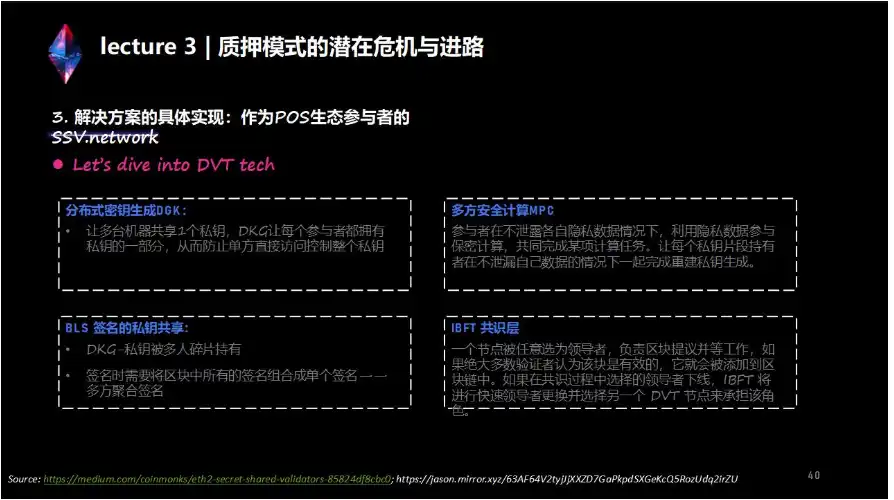
The DKG technology allows four machines to share a private key, keeping your withdrawal private key in your hands and your validator key stored and verified by four nodes together. Each node only holds a shard of your validation private key.
Multi-party secure computing technology is a very important technology in the industry, and it is also a technology that Vitalik Buterin values very much. Multi-signature wallets are very useful for some Web3 dApps, which can make your fund transfers more secure and convenient.
The technical teams of SSV and the Ethereum Foundation often communicate together, and SSV and Ethereum have a very good symbiotic relationship. We hope that in the future there will be some intermediate layer products that can be provided to all of our users to experience, and SSV can also provide services to everyone.
Lecture 4: The Emergence of "National Debt" in the Cryptographic World and the Genesis Opportunity of LSD Application Layer
BlueWharf:
I am BlueWharf, a Contributor of Shield. I want to explain from a financial perspective what the Ethereum mining under POS is as a product.
Recap: Comprehensive Analysis of ETH 2.0 Staking Platforms/Products
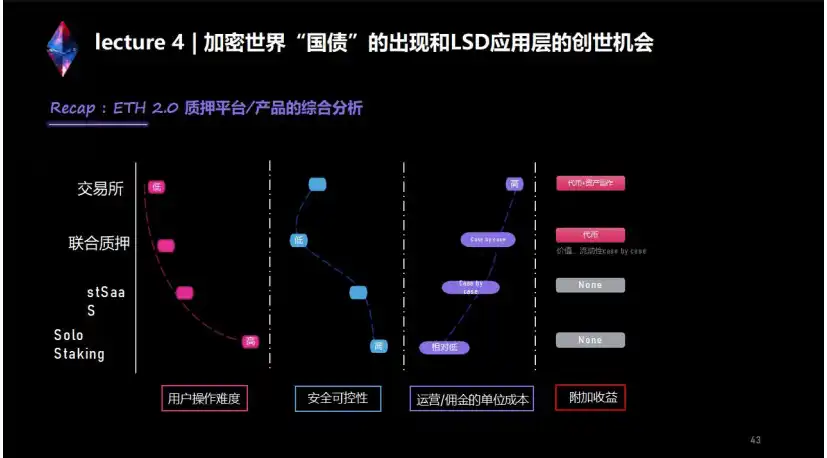
1. The Birth of Risk-Free Assets in the Cryptocurrency World
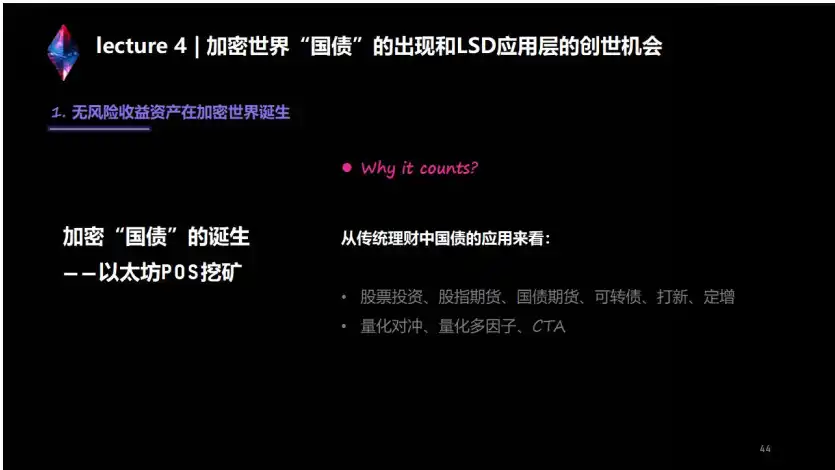
In the era of POW, your money needed to be invested in buying machines, maintaining mining farms and mining machines, and due to a series of factors such as policies, unstable electricity, and local relationships, we believe that mining BTC or Ethereum in the era of POW was a risky investment rather than a very suitable underlying asset.
However, after reaching POS, your principal no longer needs to be spent on any tangible assets, and you will no longer face any risk of recovering your investment. At the same time, once you invest, the mining yield is very stable, the entire process is very transparent and clean, and you do not need to bear any operational risks such as data center maintenance.
In the traditional world, there is a very large risk-free asset, namely the government bonds of various countries. We believe that the emergence of Ethereum's POS mining has actually introduced a large-scale risk-free underlying asset similar to government bonds in the traditional world for the entire crypto world.
What kind of significant impact will this matter bring? Let's first take a look at the role played by government bonds in the traditional world, especially in the traditional financial market.
In the traditional investment market, we often see two very common bank investment products. One is a fixed income product, where you deposit 100 yuan and receive 102 yuan at the end of the year, with the 2 yuan being the interest.
However, you may also come across another product called "Fixed Income +". Your 100 yuan is still 100 yuan, but your 2 yuan may become 3 yuan, 4 yuan, 5 yuan, or 6 yuan. How does this happen? In fact, around 2019, due to the high development speed of the Chinese economy, the interest rate was also high. You could earn 5.6 points through fixed income, but as the GDP declined, the loan interest rate could not go up, and the space for fixed income was basically within 4 points. Therefore, if you still want to earn more than 5 points of return, "Fixed Income +" products have become very popular financial products in the market since around 2019. The global scale of "Fixed Income +" is very large, possibly tens of trillions of US dollars.
Now we need to understand how traditional world government bonds play an important role in the "fixed income +" product. Usually, when you buy this financial product and give the broker 100 yuan, he will first use your 100 yuan to buy risk-free products like government bonds. However, there are many types of government bonds here, such as US government bonds, RMB government bonds, and other very large categories of bonds that are considered relatively safe. After investing in government bonds, he will give you the first government bond yield, such as an annualized yield of 3%. What will everyone do after receiving this 3% annualized return?
The mainstream destinations we see in banks are often used to invest in the primary and secondary markets, including stock investments, stock index futures, government bond futures, convertible bond investments, etc., with the annualized interest rate of 3%. Previously, there was a high demand for new stock offerings and private placements in the Hong Kong stock market to increase the interest rate beyond 3%.
Of course, there is also a common destination in the traditional market, which we collectively refer to as quantitative trading. However, in reality, it is divided into many types, such as some quantitative hedge trades, which are likely to be mostly low-risk; and some term arbitrage or CTA strategies mixed with subjective market judgments.
This is how the current traditional "fixed income +" products came into being and the role of government bonds here. Without such safe underlying assets as government bonds, many "fixed income +" products would not be able to be implemented.
二、加密世界实现固收+所需要解决的问题
Translation:
II. Achieving Fixed Income in the Cryptocurrency World and the Problems that Need to be Solved
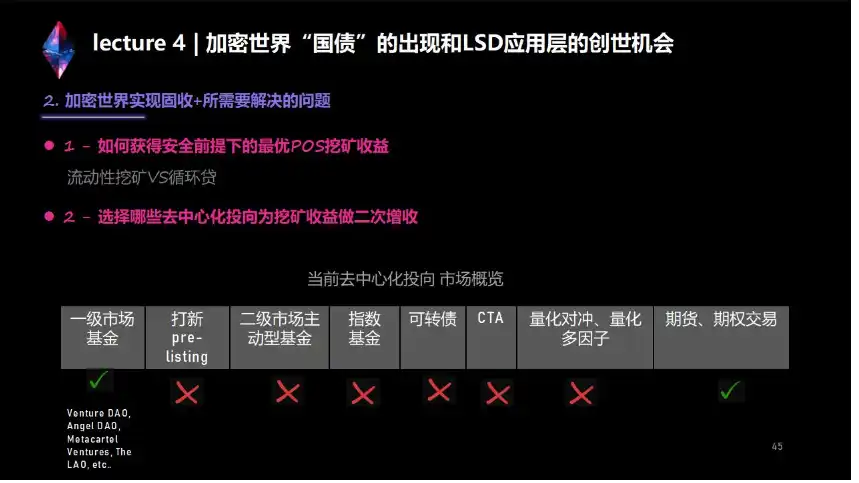
We have just finished introducing the traditional world, but in the Crypto world, POS mining brings a national debt-level, large-scale risk-free asset. Replicating the entire "fixed income +" in the traditional world is a huge application scenario in the Crypto industry. How should we design this? There are usually two unavoidable questions: the first question is how to obtain the income of the first layer of fixed income. The second question is how to consider secondary income after obtaining this fixed income.
1. How to obtain the optimal POS mining revenue under the premise of security
In the current environment before the upgrade in Shanghai, Shield believes that the optimal POS mining has a very important prerequisite, which is called the security prerequisite. Because if we want to deliver such a Protocol, it cannot be easily manipulated. Because all of your data is on the chain and transparent, it can calculate your current position and various situations. If the Protocol you design can be easily calculated by others, we believe that such a Protocol has security risks.
In this case, there are currently two common strategies in the market.
First strategy: Use the earnings from Lido to participate in this, and use the earnings from staking protocol to participate in liquidity mining on Curve. This is a common strategy.
Second strategy: Use lending agreements for circular borrowing and lending, because circular borrowing and lending can add higher leverage, which means that from the perspective of yield, the yield of circular borrowing and lending will be higher than the yield of liquidity mining just mentioned. However, its higher yield actually comes from the situation where you add leverage. There are two risks in this matter. One risk is that the price difference between stETH and ETH mentioned earlier will lead to liquidation, mainly depending on whether you are greedy or not. If you are very greedy, then there is a chance of being hit and liquidated under the current situation. If you are not greedy, and your leverage ratio is low, it will be difficult to be hit and liquidated.
But we believe that the greater risk here comes from the fact that the essence of your loop lending is leverage, and if you want to earn it back, you have to deleverage. The point now is that even the liquidity of the wstETH trading pair on AAVE, which is approximately $110 million, may have a relatively large proportion of loop lending in the AAVE pool. That is to say, looking at its $100 million liquidity, it is likely that $50 million of it is actually loop lending, and it does not have such a large liquidity in reality. This also means that the biggest risk here is that if someone lends out $50 million or $70 million at once, the pool will not be enough, and then everyone will rush to deleverage, but it is difficult to deleverage during the process of rushing to deleverage.
Shield believes that in this situation, implementing a large-scale revolving loan strategy may face the risk of being unable to escape from deleveraging. Therefore, Shield currently provides a strategy that may not have the highest yield, but allows you to sleep comfortably, which is a dynamic adjustment of staking mining and liquidity mining strategy.
Before the upgrade in Shanghai, these are the points we are currently involved in to find the optimal mining revenue. With the upgrade in Shanghai, there may be some bigger changes in the market and the mining route will increase. But before the upgrade in Shanghai, our main concern is the safety range.
2. How to use the optimal returns to further increase value
Because the money in DeFi projects must flow to DeFi destinations, let's explore whether the traditional financial scenarios can be applied to the DeFi world. Currently, the only scenarios in the DeFi world that are similar to those in the traditional world are first-market funds and futures/options trading. However, the governance level and return on investment of Venture DAO-type first-market funds may still be influenced by various subjective factors. In addition, income-enhancing strategies such as Pre-listing, active secondary market funds, index funds, convertible bonds, CTA, quantitative hedging, and quantitative multi-factor have not yet formed solid solutions in the crypto industry, or are not suitable for governance and decision-making in a decentralized organization, and therefore have not achieved scale.
Futures trading and options trading can now be done. The problem with futures trading is that it involves complex position management issues and may have the risk of liquidation, especially the on-chain liquidation risk. Moreover, it is highly subjective, and we believe it is not the direction that should be prioritized at present.
The rest is about options trading strategies, which determine how to buy and sell. The whole process can be recorded on the blockchain, making it the most transparent and relatively more controllable value-added solution in terms of risk.
Three, Exploration and Practice of Shield Staking Vault in the Field of Fixed Income Products for Cryptocurrency Assets
After conducting these analyses, Shield has launched a product called Shield Staking Vault, which is mainly used to solve the two problems mentioned earlier:
The first question: Focusing on "fixed income", which means discovering and aggregating the best mining returns based on market dynamics, after the upgrade in Shanghai, this protocol may become the entry point for mining throughout Ethereum. We will continue to search for the optimal mining path for users who want to participate in ETH POS mining based on underlying protocols such as Lido.
Second question: To further implement "fixed income +", based on the analysis just now, we will select a high probability option strategy to help everyone achieve secondary value-added income for ETH POS mining.
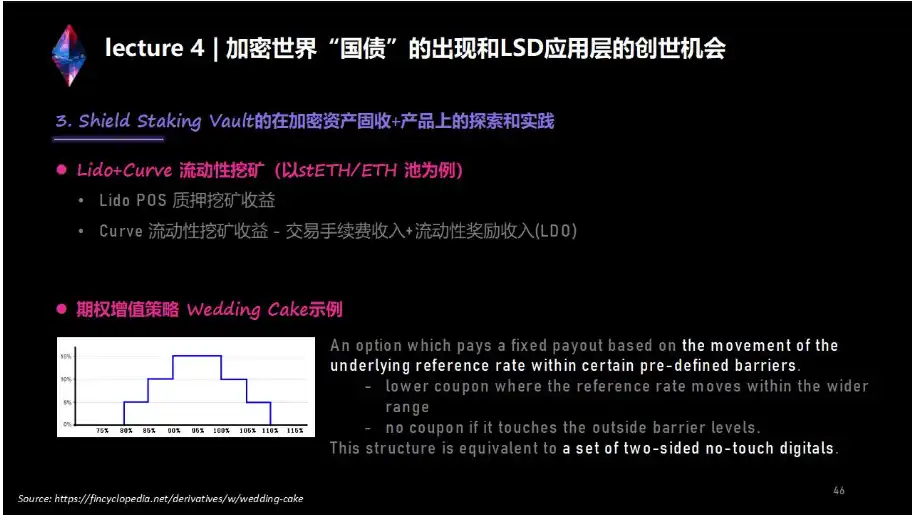
Liquidity mining is a simple strategy. We first do staking mining on Lido for staking rewards, and then do liquidity mining on Curve with the stETH-ETH trading pair. This will result in three layers of rewards: the first layer is transaction fee rewards, the second layer is liquidity rewards, and the third layer is Curve rewards (which are relatively low and can be ignored). The rewards from staking mining on Lido, transaction fee rewards, and liquidity rewards from liquidity mining on Curve are all dynamic and constantly changing. Shield monitors the data and adjusts dynamically to achieve the highest possible rewards.
After obtaining profits, we will ask everyone to make a second selection. There are also multiple levels to choose from.
Firstly: If you are a conservative person, you can simply participate in the aforementioned staking and liquidity mining.
Secondly: If you are someone who is okay with a guaranteed return, and you are willing to take some risks to potentially earn more from market trends, then you fall into the second category. We call this the "moderate" type of product, where the interest earned can be used as a value-added strategy for options trading.
Thirdly: If you want to achieve higher annualized returns, you may have to bear some pressure on your principal, for example, guaranteeing 90% of the principal and using the remaining 10% of the principal, combined with mining income, to engage in options trading based on market conditions.
During the last two stages, the option appreciation strategy mentioned earlier will be introduced. Currently, we have selected an option strategy called "wedding cake", as shown in the diagram. Its shape looks like a cake, and simply put, there is money to be made within the blue line range. As long as the market trend falls within the blue line range, there is money to be made. This is a weekly strategy with such a return rate every week. If the price in the second week reaches the highest layer of the cake, an annualized return rate of 15% can be obtained. However, this is based on the assumption that the current price starts from the middle of the cake. If the price starts from the left or right side of the cake and the choice is to go long or short, then the middle layer of the cake is not an annualized return rate of 15%, but an annualized return rate of 200%.
In this strategy, as long as it falls within the blue line range, it is profitable. For ETH, our strategy is roughly that only if it falls by 25% in a single week or rises above 25% in a single week, it may fall outside the blue line. If you expect this probability to occur, just don't buy this week. As long as you discard this low probability event, most of the time, the price of ETH will fall within the range of this blue line, so this strategy is a relatively stable option income strategy. However, it should be clarified that there is no absolute in trading, and there is still a risk of extreme situations, which investors need to consider carefully.
Four, Outlook on the Application Layer Opportunities of LSD in Shanghai after Upgrading
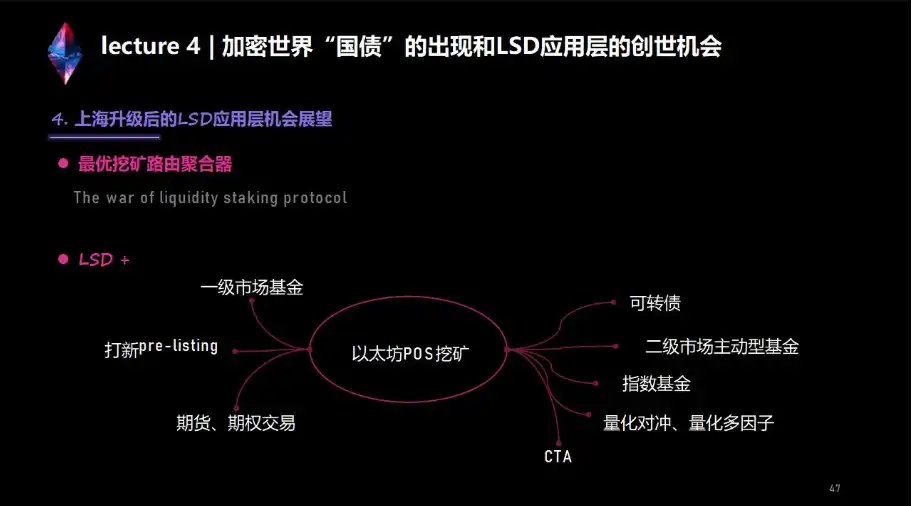
We just talked about how important government bonds are, as well as large-scale risk-free assets, which have huge applications in the traditional world. We also see that as one of the earlier projects in the industry, there are some difficulties encountered. As Jack Ma said, all the complaints and difficulties we are facing now are actually the main opportunities in the future.
So, finally, let me talk about what significant opportunities will arise in these two areas as Shanghai upgrades. Because the infrastructure mentioned by the previous three speakers is already very solid and the fundamentals are already very stable. My understanding is that people in the industry are looking for areas of growth with alpha.
I believe that there is still a lot of untapped alpha in the application layer of the entire LSD track, because many pain points have not been solved yet, so there are still many areas where alpha could have significant growth potential.
The first major opportunity is to find the optimal mining route that prioritizes security and to do secure aggregated mining. After the upgrade of the entire Shanghai, although the consensus in the industry is that Lido's market share is still the largest, it is inevitable that the War of Liquidity Staking Protocol will occur during this process. It is hard to say how the market will change in this War and what new opportunities will arise, but at least Shield will always pay attention to the progress of this War and do a good job of finding the best entry point for everyone in this War.
The second opportunity is the entire LSD+ section. As I mentioned earlier, Shield currently chooses to use options to do the value-added part because we believe that other parts that exist in the traditional world have not yet existed or are not very solid. Due to the emergence of Ethereum's POS mining, there is a corresponding demand for finding secondary value-added opportunities, which will drive the corresponding track to produce large-scale or more solid products. For example, there may be Venture DAOs with complete transparency and very robust operations, or actively managed funds with very orderly management in the secondary market. The index fund project invested by a16z may also become larger and larger. There may be people who specialize in establishing corresponding DAO organizations to create corresponding products for pre-listing opportunities, quantitative strategies, and CTA strategies. I think there are many incremental possibilities in the above areas.
With the scale-up of LSD in Shanghai, Jerry just mentioned that the current scale is approximately over 27 billion yuan. If we expect to increase the pledge rate from around 14% to near 30%, the volume will already be close to 60 billion yuan. However, the 60 billion yuan volume is clearly not the endgame of this matter, and it is likely to eventually surpass a total volume of 100 billion US dollars.
With a total volume of 100 billion US dollars in fixed income, there are many potential directions to explore. So when I talk about the opportunity for the application layer's genesis, it means that there may be another DeFi Summer-like explosion in the LSD application layer, which is actually a genesis-level opportunity.

This article is from a submission and does not represent the views of BlockBeats.
Welcome to join the official BlockBeats community:
Telegram Subscription Group: https://t.me/theblockbeats
Telegram Discussion Group: https://t.me/BlockBeats_App
Official Twitter Account: https://twitter.com/BlockBeatsAsia

 Related Articles