Arthur Hayes: I misjudged the market before, now is the time to enter

Original title: "Arthur Hayes Blog: I predicted wrong, I decided to enter the market!"
Original author: Arthur Hayes
Original translation: Wu said blockchain
Live in the present
We modern people engage in many activities and live more in the present. In a global society addicted to endless internet-connected devices, mental clarity and inner peace have become extremely important.
One way I keep my mind clear and live in the present is skiing. As old readers know, I am an avid skier. In a dense forest, add a steep slope, pile on a few feet of fresh snow, and I am in heaven. Although this setup brings me pure joy, it is not without risks.
Sliding downhill quickly in the woods requires 100% concentration. If your focus slackens a bit, you might find yourself playing the age-old game of man vs. tree. At my speed, the tree always wins—and hitting my butt is the best outcome.
Last week, on a cat-ski, I learned a lesson. Cats are snow groomers, and cat-skiing involves riding a cat up a mountain. The resort I was at was accessible only by a cat. The resort featured a snow bowl called the E Bowl. Once you reach the top of the bowl, it’s a 5-10 minute move before dropping into deep snow. I picked my route, threw myself in, and loved it.
The gullies of the bowl were full of windswept rolling slopes that were fun to jump off. As I skied my way to meet the rest of the group I was skiing with, I turned my attention away from my current skiing mission and began to think about the cold beer and burger I had for lunch. As I approached what I thought was a normal soft powder pile, I looked down and saw dirt. It was a crack in the snow.
I quickly jumped up, then pushed my board and legs forward like a long jump in order to catch the other side of the crevasse.
Bang... I crashed awkwardly into the opposite snowbank, using my momentum to tumble over on my skis. I nearly fell into the crevasse. If I had fallen into the crevasse, I would have probably broken my board, possibly twisted my knee, and in the best case, it would have ended my day, and in the worst case, my season. All because I wasn't paying 100% attention to the task at hand: skiing.
I made a similar mistake in my recent financial market predictions.
You Can Sell
In my last article, “The Bouncy Castle”, I laid out my thoughts on scenarios where the Fed could pivot. I am concerned that the Fed will pivot because of market dysfunction. If the Fed does decide to flip the switch on the “printing press”, there will be a nasty correction in all risk asset prices, including cryptocurrencies, before such a move is made.
Fearing that this potential outcome is likely to occur later in 2023, I put my idle funds into money market funds and short-term U.S. Treasury bills. As a result, the portion of my liquidity that I intended to eventually use to buy cryptocurrencies missed out on the massive rally from the lows that we are currently seeing. Bitcoin has rebounded nearly 50% from the $16,000 lows that we saw during the FTX event. This rally also did not happen in a vacuum, as a variety of risky assets are rallying.
One day last week, while I was relaxing in a cable car, I chatted with my hedge fund bro who wants to be a K-pop star. I asked him what he thought of the Fed’s recent meeting and policy decision. He thought it was super dovish and revealed that he was fully invested in the market. In December, he decided to exit short-term Treasuries and go long stocks.
I asked him if he was afraid of the potential impact of quantitative tightening (or “QT” – where the Fed reduces the money supply and reduces its balance sheet by $100 billion per month). It is well known that risk markets move in sync with the balance sheets of central banks, especially the Fed.
Fed Balance Sheet (White) vs. S&P 500 (Yellow)
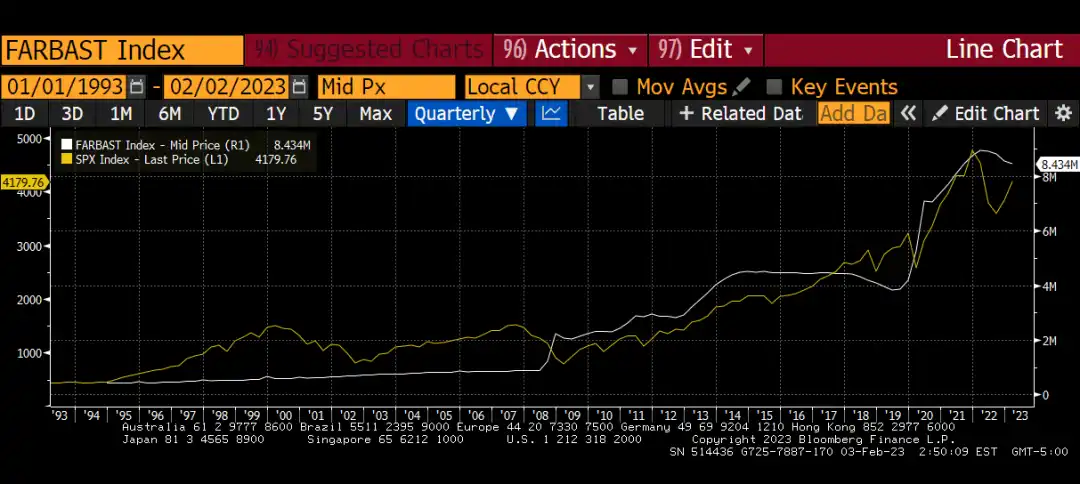
He said he was not worried because he thought the US government hitting the debt ceiling would lead to a reduction in the Treasury General Account (TGA). TL;DR: The US Treasury has about $500 billion in the TGA (i.e., its checking account). The US Treasury can roll over maturing debt, but it cannot issue new debt — debt that would add to the total balance of US Treasury bills, notes, and bonds outstanding. So if the Treasury wants to incur new spending, it has to do it out of pocket. This means the Treasury could potentially pump all $500 billion of the TGA into the US economy, adding liquidity to the system and pushing up risk asset prices.
I counter that the TGA bust will be temporary. At some point in the summer, the Treasury will run out of TGA money, Congress will vote to raise the debt ceiling, and the Treasury will flood the market with debt again. At that point, the Fed will continue to shrink its balance sheet through QT, keeping the liquidity tap running and offsetting any market upside that a possible pause in rate hikes might bring.
His answer was to the point. He saw it as a future problem and he could always sell. But right now — and I couldn’t agree more with him — the dollar and global central bank liquidity conditions were bullish for risk assets. So he said he planned to live in the present and ride this potential wave of short-term easing monetary policy.
I thought carefully about what he said and emailed my banker to start pulling money out of my money market funds and US Treasury portfolio. All in on Bitcoin and head to the last port of call in Shitcoin City.
Is it too late?
Buying Bitcoin when it’s already up 50% from its lows is dangerous. Has the market already priced in all the easing in the coming months?
Remember when the Fed started buying bonds as part of its quantitative easing (QE) money printing operation in March 2009?
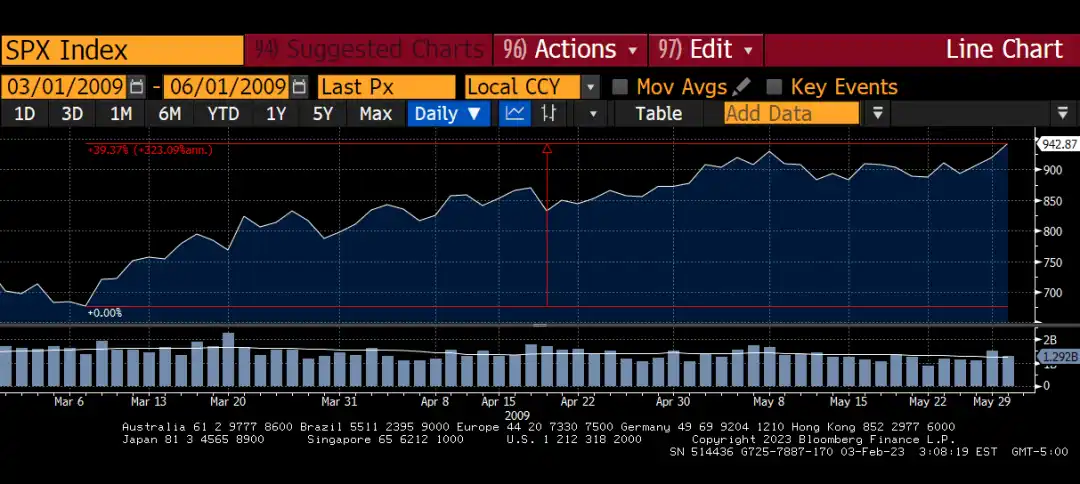
The S&P 500 rebounded 40% from its lows. That’s a huge move in just 3 months for the world’s most traded stock index. The market surged because it anticipated future easing. If you refused to participate after June 2009 because you thought everything was solved… well, I’m sorry for your losses.
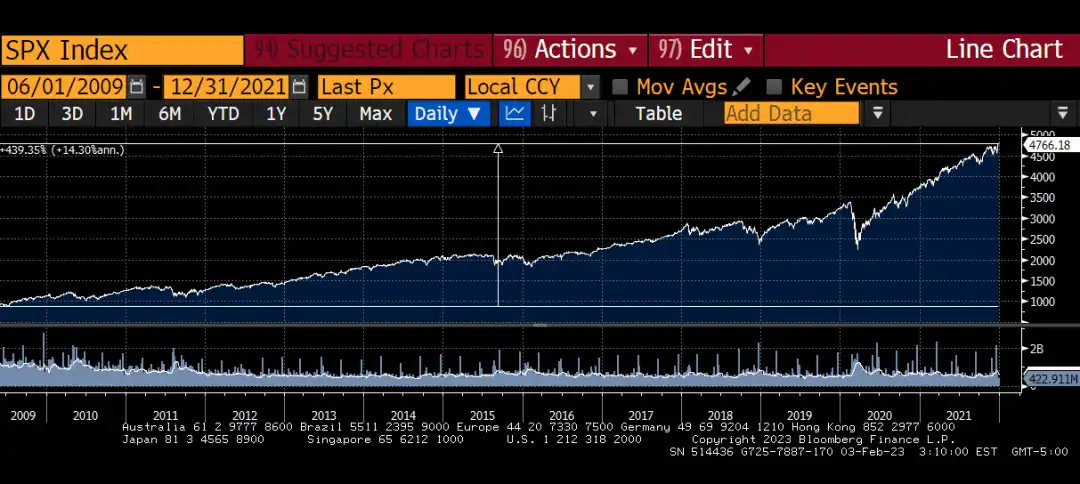
The S&P 500 went on to gain 440% from June 2009 to December 2021. It continues to rally because the Fed continues to provide free money to the market (via QE).
Similarly, part of my portfolio missed the early innings of Bitcoin’s recent rally – which was also driven by expectations of imminent monetary easing – but that doesn’t mean I should be stubborn and refuse to participate in the next part of the rally, which is driven by reverse repo inflows and (as mentioned earlier) TGA spending. Let me explain.
My USD Liquidity Index has three main components: the size of the Fed’s balance sheet; the size of the Fed’s TGA holdings; and the size of the Fed’s reverse repo (RRP) facility.
We know that the Fed’s balance sheet is shrinking by $100 billion per month, which is risk negative. But at the same time, the Treasury is cutting TGA to zero due to the debt ceiling hit. TGA is currently around $500 billion. This means that the downside to the Fed’s QT over the next 5 months will likely be offset by TGA spending in the US economy.
Before I get to the expected direction of the RRP, I need to first make an assumption about market sentiment: Risk assets. At the most recent Fed meeting, Powell acknowledged that inflationary pressures are easing and that, depending on the data, the Fed could continue to slow the pace of rate hikes or even pause altogether. The rate of change in rate hikes is slowing, which is a significant improvement in market sentiment toward risk assets compared to 2022. My assumption is that others - like myself - will pull money out of money market funds and go long risk assets, causing RRP balances to shrink. When RRP balances shrink, it adds liquidity to the system, which is good for risk assets.
Money market funds make up the majority of participants in the RRP program because it offers a risk-free way to earn a yield. It's even less risky than holding short-term Treasuries. That's because the Fed pays interest on RRP balances every day, while short-term Treasuries are zero-coupon fixed-income instruments - and there's always the risk that the U.S. government decides to default.
Money market funds make up the majority of participants in the RRP program because it offers a risk-free way to earn a yield. It's even less risky than holding short-term Treasuries. That's because the Fed pays interest on RRP balances every day, while short-term Treasuries are zero-coupon fixed-income instruments - and there's always the risk that the U.S. government decides to default. And, given that the yield differential between the two options isn’t that big, the prevailing sentiment is “why take on more risk than you need?” So money market funds are flooding into RRPs – and when people like me pull money out of money market funds to invest in asset markets, this causes RRP balances to shrink, which increases market liquidity and naturally drives prices up.
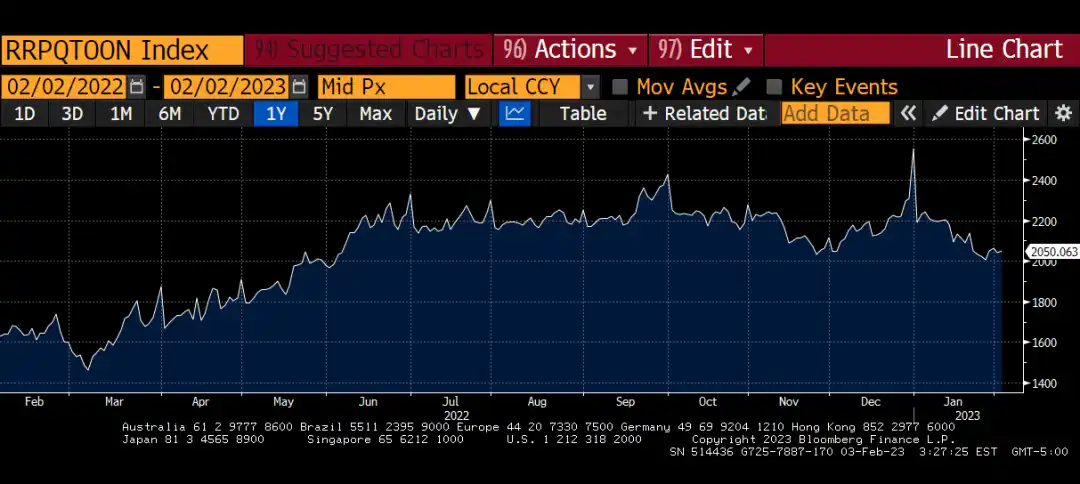
Thus, the TGA reduction and the reduction in the Fed’s balance sheet will offset each other, but as the Fed’s pace of rate hikes begins to slow and market sentiment begins to become more optimistic, RRP balances will shrink – a positive for marginal risk, all else being equal. There is currently a little over $2 trillion parked in RRPs, and if you strip out the window dressing effect at the end of 2021, it has fallen by about $200 billion so far this year.
New York Fed Overnight Reverse Repo
The Party Is On
What are the rest of the world’s major central banks doing in terms of money printing? The chart below from NDR Research suggests that after a dismal 2022, central bankers are returning to business as usual – that is, printing money by expanding their balance sheets.
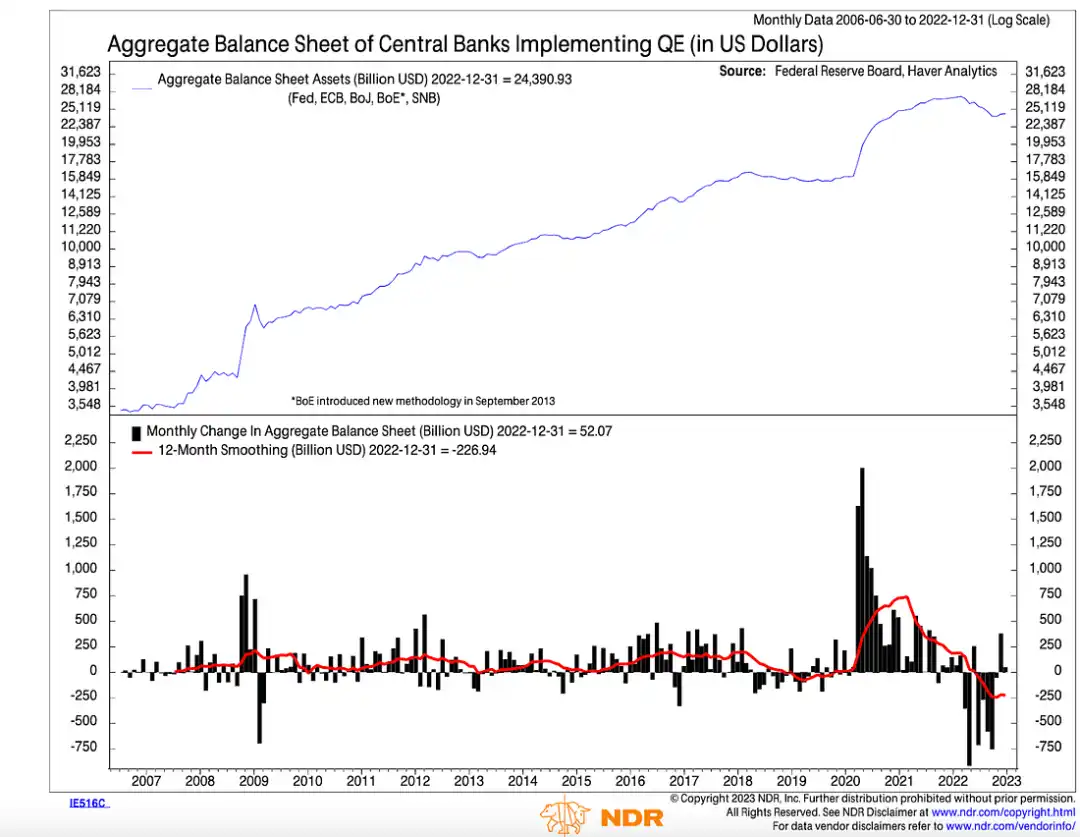
I’m working on a piece on how the Bank of Japan (BOJ) is taking money printing to the next level. But for now, all you need to know is that the BOJ seems determined to ensure hyperinflation takes root in the land of the setting sun.
As this shift plays out across the globe, all signs point to “Go Go Go!” – but this, like everything in the universe, is a temporary phenomenon.
The Terrifying Future
The TGA will run out sometime in the middle of the year. Immediately after it runs out, the US will engage in a political circus around raising the debt ceiling. Given that the Western-dominated fiat financial system would collapse overnight if the US government decided to forgo raising the debt ceiling and instead default on the assets that underpin the system, it is safe to assume that the debt ceiling will be raised. And once the debt ceiling is raised, the US Treasury will have some work to do.
The Congressional Budget Office (CBO) estimates that the US federal deficit will be between $1.1 and $1.2 trillion in 2023. The US Treasury will have to issue bonds to finance the deficit. Given that it cannot do so in the first half of this year, this means having to sell a huge amount of debt for fiscal 2023 in half the time.
While the Treasury is busy selling bonds, the Fed's current policy is to continue to reduce its holdings of US Treasuries by $100 billion per month. This is double trouble for risky assets. This will mean that a lot of liquidity is being withdrawn from the market. The question then becomes – if inflation, the US labor market, and the US economy in general weaken in the second half of 2023, will the Fed pause rate hikes (or even cut them) on the one hand, while tightening monetary conditions via QT and continuing to shrink the balance sheet?
I asked Danielle DiMartino Booth (DDM) and the team at Quill Intelligence what they thought Powell would do in this scenario. DDM is a former Fed staffer and is very familiar with the Fed’s view of the market. She told me that she believes Powell would actually cut rates while continuing QT. If this happens, then it becomes a little unclear what would have a greater impact on USD liquidity – the price of money (which would fall due to slower rate hikes and liquidity would be positive) or the quantity of money (which would fall due to the shrinking of the Fed’s balance sheet and liquidity would become negative). I fall into the camp that thinks the quantity of money is more important, but we won’t know for sure until Powell actually starts this program.
I also asked my macro dad Felix Zulauf the same question. He acknowledged that financial conditions are easing and will continue to ease due to the reduction in TGA. In his view, if Powell is really a Paul Walker follower and he wants to continue tightening financial conditions, he should speed up the pace of QT to offset the decline in TGA and RRP. However, he did not change the pace of the Fed's QT, nor did he indicate any changes in the pace of QT. (However, if Powell decides to ease financial conditions at the next Fed meeting and speed up the pace of QT, my optimism will disappear.)
Anyway, with the Treasury dumping tons of debt on the market and the Fed talking both ways, I would say this future is marginally negative for risk assets. This means that if you plan to buy risk assets now, you need to be prepared to watch the market closely and be ready to hit the sell button as soon as the TGA drops completely to zero but before the debt ceiling.
Next Steps
1. Think Right
I can’t always wait for the perfect setup. It’s time to get in.
2. Raise Cash
I move some of the liquid fiat I’m willing to risk from money market funds/short-term US Treasuries into USD cash, which I can then quickly deploy into the risk asset of my choice.
3. Buy Bitcoin
I will be deploying this over the next few days. I wish the size of my bet really mattered, but it doesn’t – so please don’t assume that it will have any noticeable impact on the price of Bitcoin when this happens.
4. Shitcoining Together
I believe there is a narrative that is currently motivating a ton of shitcoin projects to launch. I’ll update you once I do more research on the shitcoin space — but if Bitcoin and Ethereum continue to rise, there will definitely be a shitcoin vertical that goes crazy in the next few months.
The key to shitcoining is to understand that they move in waves. First there is a rally in the crypto reserve assets — namely Bitcoin and Ethereum. The rally in these stalwarts eventually stalls, and then prices fall slightly. Meanwhile, the shitcoin complex stages an aggressive rally. Then the shitcoin trend goes to zero, and interest returns to Bitcoin and Ethereum. This stair-step process continues until the secular bull run ends.
5. Unwind
When TGA hits zero, exit the market. At this point, I have to sell everything I’ve purchased between now and then, no questions asked. I have to avoid falling in love with the bunch of shitcoins I own and instead be a cold, hard market operator.
Of course, there could be some global political events that spark a risk-off movement. I've thought of a few and am currently considering how much they could affect the price of Bitcoin if they hold up. Expect a detailed post to communicate my findings as I keep thinking about these issues.
For now, I am very mindful of the fact that nothing will go as planned and I have to remain flexible. We are all Bayesians now!
Original link
Welcome to join the official BlockBeats community:
Telegram Subscription Group: https://t.me/theblockbeats
Telegram Discussion Group: https://t.me/BlockBeats_App
Official Twitter Account: https://twitter.com/BlockBeatsAsia

 Related Articles