Arthur Hayes: Why is HYPE a 5x Moonshot?

Original Title: $HYPE Man
Original Author: Arthur Hayes, BitMEX Co-Founder
Original Translation: Saoirse, Foresight News
We entered the frozen forest, climbed the steep volcano. It was just another day of skiing and hiking meditation. In the quiet snow-covered forest, my thoughts roamed freely. When you are fully focused, slowly climbing the volcano step by step, placing one ski in front of the other thousands of times, the creativity you can unleash is astounding. I cherish this three months of tranquility.
Body and mind both crave rest and recovery, and in the ski season, this means going to a real ski resort. On the day at the ski resort, I took off the ski skins, sat on the mechanical cable car, and in just a few minutes, it could take you hundreds of meters above the ground. Both chairlifts and cable cars are great, but sometimes I have to share this tranquility with others.
I am not very talkative in the cable car, sitting quietly in the corner, but there are always some lively people at the ski resort who like to chat with strangers to pass the time.
The questions are harmless, but they allow the other person to categorize me in their mind. We always end up talking about professions - me, a person who skis every day, neither a guide nor an instructor, seems quite strange. I politely respond, saying only, "I work with computers." The advantage of the tech industry is that everyone assumes you've made some money, but they can't inquire further because they don't even understand what electricity is, let alone the fancy things you can do with a "computer." The conversation naturally cools here, thankfully, and I can finally get off the cable car and ski.
What exactly do I, or our Maelstrom team, do?
We are traffic conductors, making money by monetizing attention. The main way to monetize is to go long on Bitcoin and various altcoins, rarely short. By directing market attention to our views, we believe that in the long run, the market will validate our judgment.
Now, please focus on Hyperliquid (HYPE).
I don’t like to short because without leverage, your maximum gain is only 100%, while your maximum loss is unlimited. I always pursue convexity on the long side, not the short side, so I am always net long in the market.
In this challenging phase, with Bitcoin decisively breaking its previous high, are there any truly high-quality altcoins that can achieve absolute gains?
The answer is: yes. Because in cryptocurrency, during every period of consolidation or bear market, the best-performing altcoins are always exchange platform tokens. Even as prices drop, exchanges continue to earn fees, sometimes even more than during bullish times, especially when they benefit from the long-term growth in decentralized exchange (DEX) trading volume.
During the period of market consolidation to decline in early 2023, the most sought-after exchange platform token was GMX. In April 2023, GMX reached a historical high of $90. Why? Because at that time, it was dominating the perpetual contract DEX trading volume, with a surge in open interest and trading volume, driving protocol revenue up significantly. More importantly, the majority of the revenue was distributed to GMX holders.
Which exchange platform token will see a massive surge when the consensus on fiat credit expansion shifts from growth to contraction?

Data sourced from DefiLlama on March 7, 2026
Hyperliquid is currently the leading perpetual contract DEX and the project with the highest revenue aside from stablecoins. 97% of its revenue is used to buy back HYPE from the market. In the entire crypto industry, no project returns such a high percentage of money to token holders as Hyperliquid does.
Unfortunately, if you hold stablecoins like USDT or USDC, you do not benefit from their net interest margin income. Therefore, if the market believes in HYPE, it can achieve significant upside. My target price for HYPE in August 2026 is $150, approximately a 5x from around $30 when I wrote this article.
To transition from "hell" to "Valhalla," Hyperliquid needs to restore its 30-day revenue to a $14 billion annualized level, a level it reached in August of last year. To make the following sections easier to understand, I will first present the financial model.
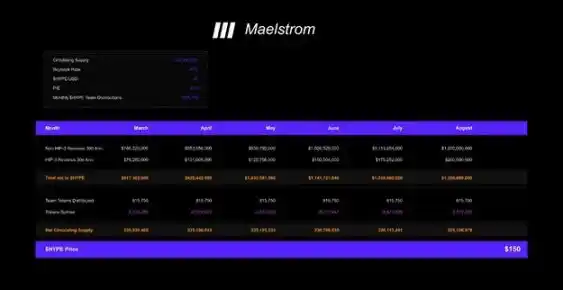
The key assumptions I need to validate are: the Price/Earnings ratio (P/E), and the team's monthly release amount of HYPE tokens. P/E Ratio Formula:
P/E = (Circulating Supply × Price) ÷ (30-Day Annualized Revenue × Buyback Ratio)
My model predicts: Total revenue from HIP-3 and non-HIP-3 will grow from $843 million in March to $1.4 billion in August.
I will explain how, against the backdrop of intensified competition in the perpetual contract DEX space, Hyperliquid is poised to reclaim its historical peak 30-day annualized revenue.
Lastly, based on the data from the past three months, I will estimate how many HYPE tokens the team will receive each month.
By stress-testing the model in different scenarios, the credibility of the assumptions can be significantly enhanced. I will test some assumptions from a pessimistic perspective to see how much convincing it would take to believe my $150 price target.
CEX vs DEX
One of Hyperliquid's greatest strengths is this: its volume growth does not need to rely on a global increase in cryptocurrency perpetual contract trading volume. As long as a few percentage points of the centralized exchange platform's perpetual contract trading volume shift to Hyperliquid, it can easily double its 30-day annualized revenue within a few months. By capturing just a 3.97% market share increase, Hyperliquid can reach its $1.4 billion annualized revenue target. Considering that Hyperliquid didn't even exist less than three years ago, this is entirely achievable.
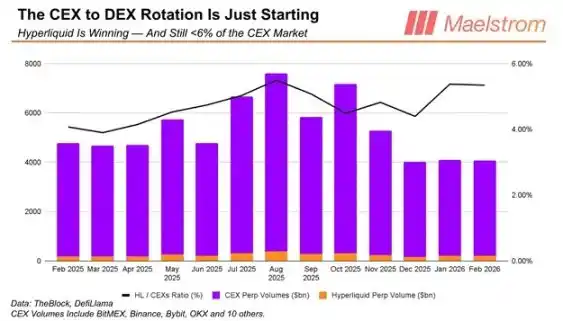
Hyperliquid can effectively take trading volume from CEXs, but which crypto derivatives will attract users to make the switch? People come for stock perpetual contracts and binary options, but they stay for Bitcoin, Ethereum, and Solana trading.
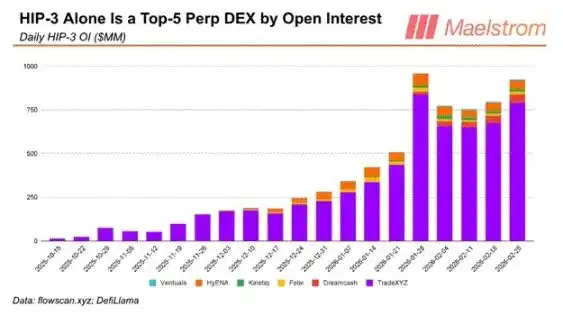
HIP-3 allows anyone to list perpetual contracts without permission. By staking 500,000 HYPE, you can leverage Hyperliquid's matching and margining engine to create any trading pair you desire. TradeXYZ did just that, with its flagship products being perpetual contracts for silver, gold, Nasdaq 100, and S&P 500.
On a side note, within less than three months of launching silver and gold markets, the daily trading volumes have already reached the billions. In a world where the dirty fiat financial system arbitrarily alters rules and suppresses people's desire to escape centralized currencies, this will be the new venue for price discovery.
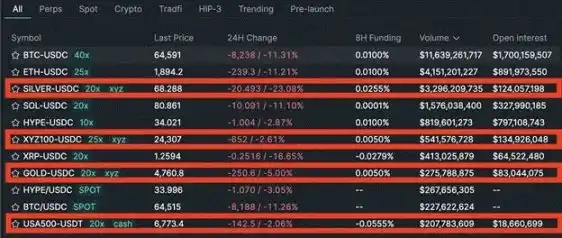
Screenshot taken on February 5, 2026, 11:20:00 UTC
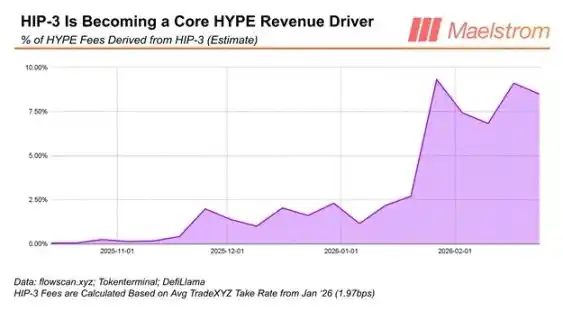
In just four months, the transaction volume of HIP-3 has contributed to nearly 10% of Hyperliquid's total revenue. Permissionless listing has always been the holy grail of DEX, and the rapid growth in transaction volume has proven to be the key for Hyperliquid to outpace its competitors.
For Hyperliquid's revenue to grow by 66% from March to August, HIP-3 must lead the way. Especially considering the overall cryptocurrency market cap remains at its current low levels, Hyperliquid must provide traders with fresh, exciting on-chain trading assets. Precious metals, AI concept stocks, crude oil—these are exactly what retail traders want to trade. Now, through perpetual contracts, anyone worldwide can trade 24/7 with higher leverage than traditional financial trading platforms.
Based on these reasons, my model predicts that HIP-3 revenue will increase by 160% within 6 months.
The icing on the cake is the prediction market. Hyperliquid recently announced that HIP-4 will support a permissionless online prediction market. I anticipate that HIP-4 will go live within the next three months. Traders will flock to Hyperliquid's prediction market to trade binary options and 0DTE (zero-day-to-expiration) options. It's difficult to predict the revenue growth rate before the launch, so I haven't included it in the model. If the Hyperliquid team delivers high-quality code as usual, significantly boosting revenue almost immediately, that would be an added bonus.
Unfortunately, Hyperliquid is not the only perpetual contract DEX. The competition is fierce as this is the next battleground for trading. By the end of last year, the emergence of numerous low-fee or zero-fee DEX platforms had dampened Hyperliquid's projected valuation.
So, what has happened since then to make me believe once again that Hyperliquid's dominant position is unshakable?
Is It True?
For a crypto CEX or DEX, faking trading volume is a piece of cake.
During my time at BitMEX, we often joked about having a "volume booster"—an in-house tool to generate fake trades and boost activity on the platform.
Today, many top-tier exchanges often use wash trading bots to claim they are the "largest" in a routine manner, leading traders to believe there is genuine liquidity. For DEXs, wallet creation makes wash trading even easier, being a primary source of wash trading.
Liquidity mining is also a common method to boost activity: DEXs award points or platform tokens based on trading volume, and traders wash trade between wallets.
Wash trading and liquidity mining do not deepen real liquidity. We cannot precisely determine the proportion of these activities in trading volume. The sole objective measure of assessing exchange quality is calculating the ADV/OI ratio (Average Daily Volume / Open Interest).
Because traders must commit real funds as initial margin, Open Interest (OI) can reflect the extent of actual user utilization of the platform. Average Daily Volume (ADV) is easily inflated by wash trading and mining, but when adjusted by OI, we can derive organic trading volume primarily driven by genuine risk-taking traders. Thus: the lower the ADV/OI ratio, the better.
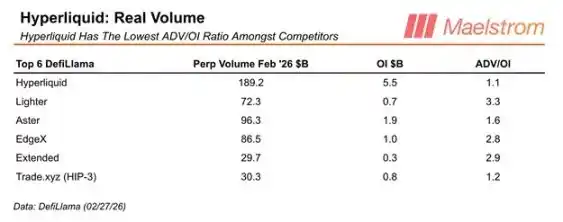
Among the top 5 perpetual swap DEXs, Hyperliquid has the most genuine trading volume because it has the lowest ADV/OI ratio. When traders realize that much of the liquidity on competitor platforms is artificial, or if the points/token mining has ended, they will flow back to Hyperliquid.
In the long run, the proportion of Hyperliquid's genuine trading volume will continue to increase. This will solidify HYPE's narrative of "fear no competition."
Many people remember that I was previously tactically bearish on HYPE, with a key reason being the competition from low-fee DEXs. Now, I believe Hyperliquid leads in "genuine trading volume," and at least for the next six months, I am no longer concerned about competition.
Regarding competition, the next consideration is: After factoring in slippage, which DEX truly has the best liquidity?
I took a snapshot of the order books for Bitcoin/USD perpetual swaps on five platforms and calculated the slippage for market buys/sells of nominal amounts of $100,000, $1 million, $10 million.
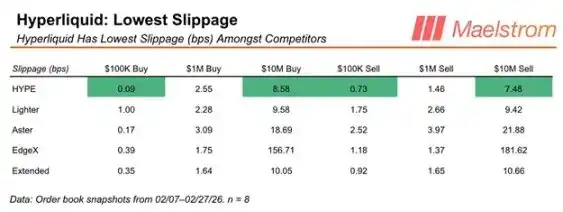
You can see that on Hyperliquid, most of the time, large trades have the lowest costs. Therefore, even if competitors have explicit fees lower by 1–2 basis points, genuine large traders will still flock to Hyperliquid because they can trade at a larger scale with minimal market impact.
I'm Rich
The 11-person Hyperliquid team has created the best DEX product ever. Wealth should flow to them through locked HYPE tokens.
When Maelstrom expressed bearish sentiments about HYPE at the end of last year, he raised a concern: how much would the team monthly dump into the market, creating uncertainty. Given that Hyperliquid did not take any venture capital investment, whether the team voluntarily refrains from selling newly unlocked tokens is essentially a political decision within Jeff and the team. They have restricted token sales.
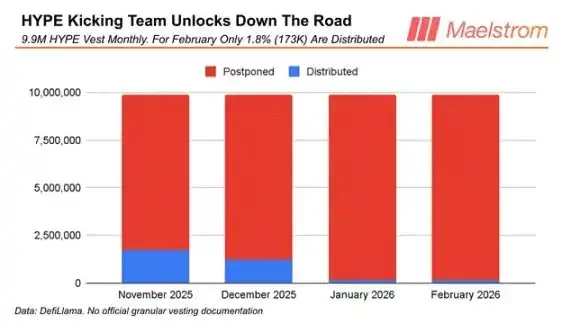
Following the distribution of nearly 20% of bonus tokens in November and December last year, the team only distributed about 1% of bonus tokens in January and February. I speculate that the initial high distribution was to cover taxes and improve living conditions. After addressing these needs, the team significantly reduced releases to help HYPE rebound. This is just my speculation.
History doesn't repeat itself, but it often rhymes. Based on this, I assume the monthly release amount will be the average of these four months: 815,750 tokens.
Looking Ahead
The market is forward-looking. How much are players willing to pay for the future gains of Hyperliquid? Currently, HYPE's price-earnings ratio is about 12x. How does this compare to traditional financial trading platforms?
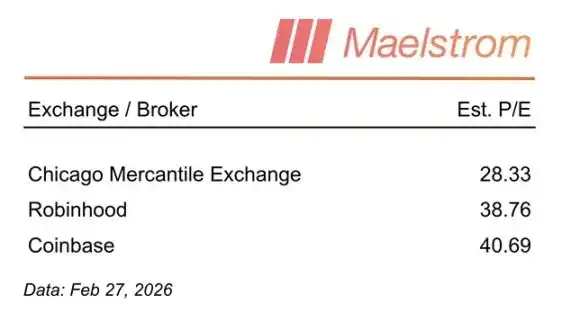
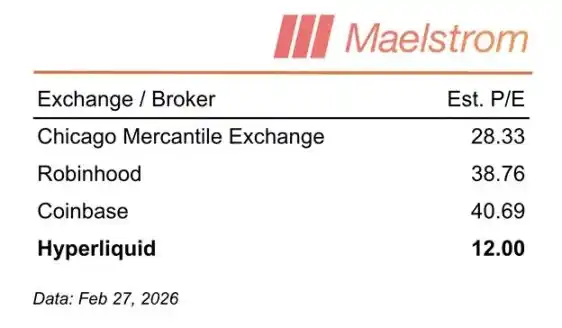
To determine a reasonable valuation level, I have looked at the current price-earnings ratios of the world's top trading platform, the Chicago Mercantile Exchange (CME), the new brokerage Robinhood targeting young and aggressive investors, and the crypto exchange Coinbase, which is deeply influenced by U.S. regulations. The price-earnings ratios of these institutions vary widely, roughly between 26 and 40. In contrast, $HYPE's PE ratio of only 12x is significantly undervalued.
Part of the reason for the undervaluation is that Hyperliquid is not a publicly traded company, which naturally leads to lower valuation multiples due to smart contract and counterparty risks. Additionally, most mainstream centralized spot exchanges do not support $HYPE trading, making it difficult for retail investors to purchase, preventing it from being pumped to extremely high valuations like many meme coins. Nevertheless, a 12x P/E ratio is still absurdly low.
In just a few months, Hyperliquid's HIP-3 stock index and precious metals trading market have become key price discovery venues during weekends when traditional financial trading platforms such as CME are closed. I don't know about you, but I don't think computers need to go golfing on weekends.
At the very least, from an industry trends perspective, there is a higher valuation premium for HYPE.
On the explanation of Market Cap vs. Fully Diluted Valuation (FDV):
I use Market Cap rather than FDV, as there is a difference between the two due to circulating supply. Market Cap only accounts for currently circulating tokens, not the entire future token supply represented by FDV. Given that this is a 6-month trading cycle, using the current Market Cap is reasonable. Indeed, Hyperliquid may open up airdrops again in the future, thereby expanding the circulating supply. However, as of now, the team has not hinted at an upcoming airdrop, so I am not considering this potential risk and the resulting impact on circulating supply.
Stress Test
Assuming the team unlocks 9.91 million HYPE tokens monthly, with the market only assigning a 12x forward price-to-earnings ratio, but Hyperliquid's 30-day annualized revenue rebounds to a historical high of $1.4 billion, what would be the outcome?
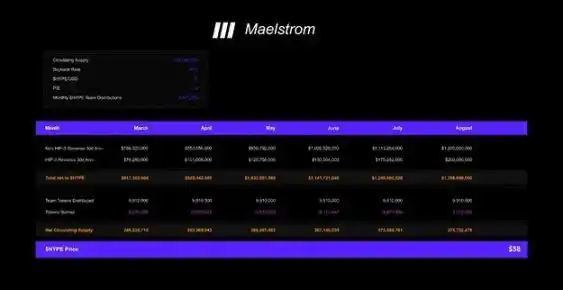
The target price would drop to $58, still about 75% higher than the current $30. Not a bad result.
I did not make a pessimistic assumption about revenue for one simple reason: if Hyperliquid's revenue cannot grow from its current level, the token will not rise. If you hold this view, then do not buy HYPE under any circumstances.
HYPE Enthusiast
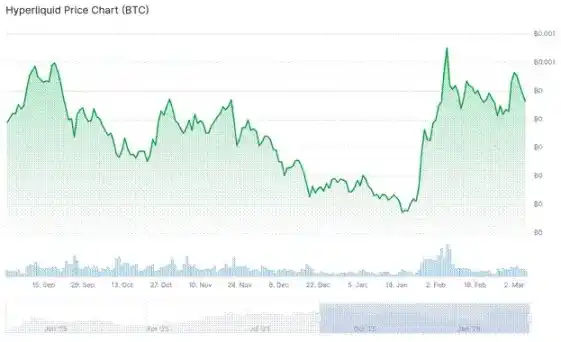
Source: CoinGecko
I charted HYPE/BTC to illustrate that the market has already recognized the value of this token.
We all painfully know that unless you are shorting, Bitcoin went from last September's HYPE peak to around $20. I believe the catalyst for HYPE's resurgence is the team's token release dropping from 9.91 million in January to a mere 140,000.
Furthermore, competitors' DEX points and token incentives are expiring rapidly, diminishing their attractiveness to traders. The remaining volume they have may be illusory, but as I have demonstrated earlier, in terms of order book liquidity, Hyperliquid is the cheapest place to transact.
Our Maelstrom team started small positions just above $20. On the ski touring journey, I kept thinking: if the macroeconomic environment continues to stagnate in the short term, what positions should I take? What kind of project can be truly high-quality—having real users, real revenue, and can give back returns to token holders?
From these perspectives, Hyperliquid is the highest-quality project in the entire crypto industry. After deep research and writing this article, my confidence is even stronger.
As macro investor Drew Koenig Miller said, "Invest first, research later."
Therefore, HYPE quickly became our largest meme coin position in terms of liquidity. We plan to continue selling all other low-quality assets and accumulating more HYPE in this price range.

Welcome to join the official BlockBeats community:
Telegram Subscription Group: https://t.me/theblockbeats
Telegram Discussion Group: https://t.me/BlockBeats_App
Official Twitter Account: https://twitter.com/BlockBeatsAsia