About Google, ChatGPT and the future of search
Original title: Google Search: The Potential for Disruption by ChatGPT
原文作者:Mario Gabriele
原文编译:阿法兔
The Generalist recently posted an article about Google, ChatGPT, and the future of search. Several questions were addressed: Since ChatGPT launched late last year, the OpenAI product has been hailed as the future of search and a potential Google killer. So will Google follow Britannica and the Yellow Pages into a gradual disruption, or will ChatGPT merely transform Google?
"The reason for Google's success is simple: it shortens the distance from the question to the answer and finds a way to monetize it."
* This article is for your study only. Please follow the relevant rules, indicate the source, and attach all references to this article.
Content outline & Bright spot
* This article is about 9000 words, relatively long, but very useful, you can read in wechat reading mode, combined with the outline reading
"The history of human information --
The distance between the question and the answer shrinks."
1. The history of mankind is the history of the constant search for the most accurate information
2. Google and sorting algorithms
The power of Google's sorting algorithm
Whether AI will disrupt Google search
Why did Google win?
How big is Google's search business?
3. New competitor: ChatGPT's game break
Could ChatGPT disrupt search?
Limitations of ChatGPT
ChatGPT's strengths and weaknesses
Understanding search scenarios
4. Looking ahead: What will happen?
How do AI companies make money?
Abstract:
The $1.4 trillion company generated $163 billion in revenue from search last year, and after more than two decades in business, Google maintained a whopping 91 percent market share in the search business -- until ChatGPT came along. Many competitors have tried to compete head-on with Google, but they all failed. But by the end of 2022, OpenAI's ChatGPT was released, putting it in direct battle with Google.
Of course, although ChatGPT is not a pure search engine, it can provide more precise answers to many complex questions, and in a few months ChatGPT has attracted more than 100 million users. However, ChatGPT's knowledge of events beyond 2021 is limited due to the time frame of its data, so it cannot answer the world's latest search requests.
There's another problem, which we mentioned in our previous post: ChatGPT's answers sometimes seem serious and authentic, but they're actually made up and not necessarily accurate.
However, it looks like most of ChatGPT's flaws are fixable. Of course, advertising is still a viable model. Although ChatGPT is accepting a $20 monthly subscription model, other conversational search products may be available through advertising. The large amount of unused space, and the direct nature of the chat, makes for an effective business channel.
ChatGPT sparked the tech world's interest in conversational interfaces, which encouraged a wave of search start-ups.
The history of mankind is the history of the constant search for the most accurate information
How much effort has been put into getting a precise answer?
Here we begin with a story: The Lydian king Croesus, in search of the true oracle, sent seven envoys across the land. When the Delphi oracle correctly guessed that Croesus was making mutton soup, the king was shocked. Delphi is both a god and an adviser, with mystical powers and the ability to weigh in on practical matters such as military strategy.
Because even for the richest people in the ancient world, it took days to gather the best information.
The search for information is almost all human dilemmas: our ancestors crossed oceans, climbed mountains, and risked disease to visit places full of light. Whether it's to see the wisdom of the Library of Alexandria or to attend an institution of higher learning, there is a cost of time and travel.
Because of the human quest for knowledge, the business of providing answers is a good choice.
Note that the Yellow Pages and Encyclopaedia Britannica were once famous businesses. For decades in the 20th century, these two companies were businesses that everyone needed to use every day. Whether it's the Yellow Pages or the Encyclopaedia Britannica, they offer basically the same value:
That is, faster access to information. For most transactions, consumers who need to be practical and transactional are able to get the value they need from their products.
This model represents a kind of aggregation: packaging the answers to our most common questions into convenient modules. In other words, problems that you might have had to go to the library or walk into town to solve suddenly can be solved in a matter of minutes. Seen from one perspective, this is the history of human information: the distance between questions and answers is shrinking.
Google and sorting algorithms
In 1996, that assumption -- the narrowing of the distance between the question and the answer -- was validated in business history. Sergey Brin and Larry Page, PhD students at Stanford University, officially launched the first version of BackRub. Although other Internet search engines existed before, none of them organized information by the number of backlinks they received through sources.
Today, Google is worth $1.4 trillion, and at its peak in 2021, it was worth $2 trillion. Google generated $283 billion in revenue in 2022, up 10 percent from the previous year, with search contributing 57 percent.
Although Google is best known for its financial prowess, in essence, Google search represents a kind of secular omnipotent science, capable of producing answers in fractions of a second that even the ancient Greek omnipotent gods could not possibly match.
For humanity's relationship with Google: Google is the place where we go to look for almost every problem we can think of, whether sacred, profane or otherwise.
Google is a destination for almost every kind of human whimsy:
For example, where should I work? Am I being paid too little? Why do I have a headache? What happened in 1813? Is Messi handsome or not? Did the Knicks win? Google's advantage is that it has all the answers. But recently, for the first time, the tech world looked at the company's search business and asked questions. The renewed focus on search has been driven by ChatGPT and other AI models.
Google and sorting algorithms
Since ChatGPT launched late last year, the OpenAI product has been hailed as the future of search and a potential Google killer. Balaji, the former chief technology officer of Coinbase, praised ChatGPT as a "historic achievement" that is "already better than Google for many queries." Paul Buchheit, a partner at Y Combinator and the creator of Gmail, declared that Google was "a year or two away from being completely disrupted." So will Google follow Britannica and the Yellow Pages in being gradually disrupted, or is this simply an opportunity for Google to transform itself? This article will explore: the possibility of Google being disrupted.
So will AI disrupt Google search?
In many ways, Google Search looks like an unassailable product that can't be replaced.
Its revenue and financials are stellar, its market share is leading, and its users are recognizing it. But, we're talking about Will AI disrupt Google Search? To make this argument, one needs to examine the past and present lives of Google search: if we look back, it wouldn't have been possible to see that Google would become a multi-trillion dollar business. For example, when Google was founded in 2002, it was met with skepticism:
a New York Times article that year, titled "Google's Toughest Search Is for a Business Model, "summed up the market's concerns. Analyst Salomon Smith Barney put Wall Street's verdict on Google directly:
Here's what the article says: "For all the praise for Google, as a business I think it will take a lot for Google to catch up to Overture."
Overture, the creator of the GoTo search engine, is not Google's only competitor. Companies such as Lycos, Excite, AltaVista and AskJeeves jockeying for share in the aftermath of dot.com's dotcom crash in the mid-2000s. So why did Google win? Google has better technology. Sergey Brin and Page believe that "the popularity of the results of a search" is a sign of the quality of the search results. And they were proved right.
The search-inspired "PageRank "was developed by Larry Page in 1997 when he was a PhD student at Stanford. Page's innovative idea was to copy the entire Internet into a local database and then analyze all the links on the web. Rating a page's popularity based on the number and importance of incoming links and anchor text, using the collective wisdom of the Web to determine which sites are most useful.) The fact that algorithms allow Google to deliver better and more precise results than its competitors is a testament to Google's technological prowess and has played a big role in its growth.
This technology, which was sharp at the time, led to excellent products: in other words, Google was not only the most useful search engine, it was also fast and intuitive. Brin and Page, on the other hand, did not waver in the face of commercial temptation, sticking to their strengths.
For example, while other search engines allow advertisers to use images in their published messages, Google does not. Quite simply, images slow down the load of the web page and reduce the user experience.
Google then introduced its own advertising model, which eschewed images and allowed only small text ads. Crucially, Messrs Brin and Page only provide AD space above and to the side of search results. Google's choice represents a significant shift from search companies like Overture:
That is, Google only offers sponsored search results, B-side clients pay to rank certain search terms, and the company with the highest bid gets the top spot. Google borrowed from this auction-based system.
Of course, Google's success doesn't just depend on better technology, superior products, and a more structured business model. Without Eric Schmidt as CEO in 2001, Google might be a very different company than it is today.
But, standing today and looking back, these factors are only the foundation. From the perspective of the other information innovations we've mentioned, the reason for Google's success is simple: it has shortened the distance from the question to the answer and found a way to monetize it.
Perhaps not even Messrs Brin and Page could have imagined that their search engine would become as profitable as it is today. Google Search today is not only a giant enterprise, but one of the most powerful in the world.
Google search, the economic engine behind the entire Alphabet group, is Alphabe's organizing principle and reason for being. Google's other businesses, such as the Chrome browser, Maps and Android, exist in large part to enhance the power of Google search, and its business plans, such as biotechnology, self-driving cars and satellites, are built on the basis of Google's search productivity.
How big is Google's search business? In 2022, Google search generated $163 billion in revenue, accounting for 57 percent of Google's total revenue. Google's entire advertising division generated $224 billion, or 79 percent of all revenue.
The question is, is it healthy for a business to be so dependent on one product (Google search)? Should a $1.4 trillion business put most of its weight on a single source of revenue? Historically, search looked like an impregnable business because all Internet users around the world needed it, but over time, Google has moved to reduce its reliance on search. For example, in 2017, search accounted for 63% of revenue, which has declined in recent years. While search remains Google's most important business line, the company's cloud services and growth in its YouTube advertising unit have helped diversify revenue across the enterprise.
Google's share of the market is equally impressive. Google has between 84 and 91 percent of the market, while other search engines are in the single digits. Of course, depending on the statistics, this share may have declined slightly over the years, but not by much overall. Google has done a very good job of building other ecological advantages around search. For example, every time a user downloads the Chrome browser or buys an Android phone, Google essentially fixes the inevitability of using its own search engine.
Perhaps it is because services such as Google Search are free to consumers. As a result, it's easy to forget how much we value them. In 2018, three economists tried to quantify how much consumers valued various free Internet services and asked them how much they would have to pay to complete them within a year.
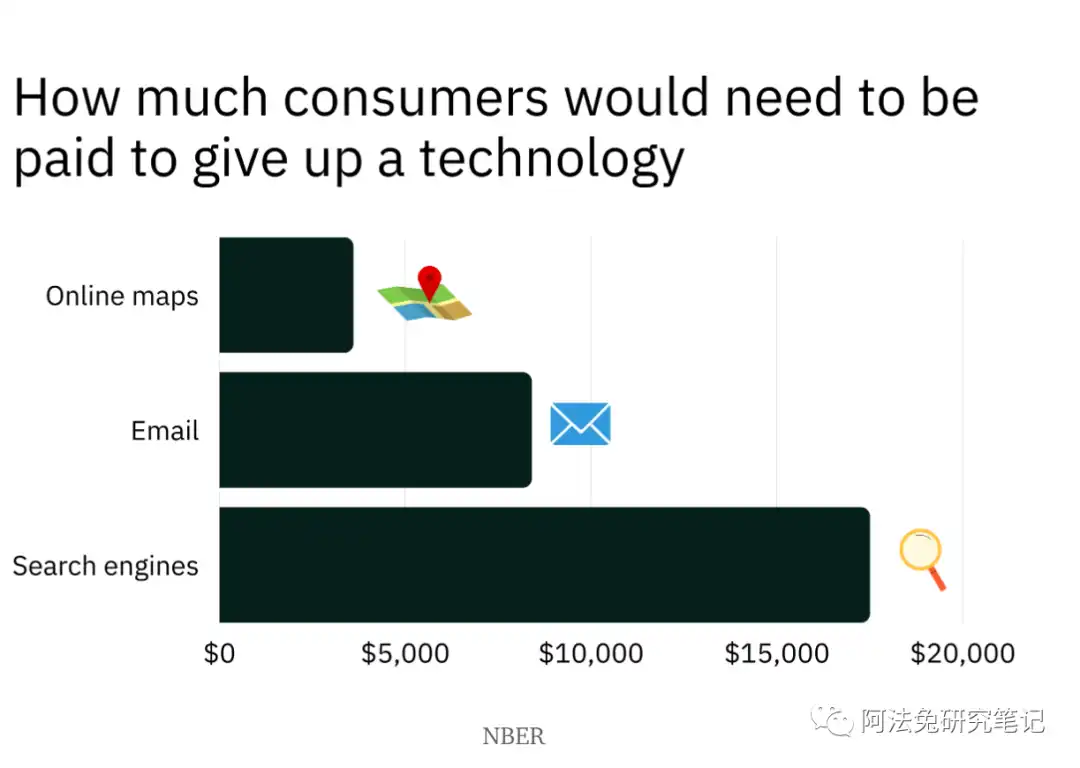
In theory, consumers show a high willingness to pay for the digital experience of modern life. For example, surveys show that people would have to pay $3,600 to give up online maps, $8,400 to give up email and $17,500 to give up search engines. (Ben Rabbit voiceover: Give me how much money can't give up ah...) That's despite the fact that the data represents perceived product categories, not specific technology companies. Still, the numbers are indicative of how important Google products are in people's lives.
Sure, Google's products may be considered degraded by many, but it is still the world's search engine of choice. Of course, many of Google's degradations are for a reason, either to make more money or to thwart its competitors.
The most obvious example: increased search + AD placement. Today, users may have to go through 42% of the results without scrolling to get the results they think they should get. The Google of today, which is nothing like what it was around 2000, which is to say, minimalist and efficient, has morphed into a page of sponsored links and misinformation and distractions.
The whole search product went from being a great work of art to a mess.
Google has increased the number of ads and camouflaged them, but users are not fools: if they see how many pages are consumed by commercial activity, they will choose suppliers with cleaner products. More spam comes from links generated by Google's internal products for promotion purposes. For example, Google hotels, flights and shopping often come first in relevant queries, and while that can sometimes improve the user experience, it also means Google competes with the advertisers it serves. All of this today is a far cry from Brin and Page's original willingness to put the needs of consumers first and forgo the easy money of ubiquitous advertising.
Google did find ways to make more money from the distance between the question and the answer, but those moves made the journey longer and more tortuous.
Today, when we evaluate the strength of Google search, we need to point out that Google spends a lot on research and development. Google invests tens of billions of dollars in cutting-edge technologies every year. In 2022, it spent $39.5 billion on research and development, an increase of nearly $8 billion over 2021.
Much of that investment is focused on artificial intelligence, which has long been a priority for Google, which formed Google Brain in 2011 and acquired startup DeepMind for $500 million in 2014. There is no doubt that Google has recruited many of the top minds in the entire AI industry.
New entrant: ChatGPT's break
Continuing the previous story: Afterwards, Lydian King Croesus asks Delphi "If you should attack Persia, Delphi replies: you will" destroy a great empire "; Croesus took this reply as good news, a sign of Persia's impending decline.
Then the question arose: which empire was the oracle replying to? It says empires will be destroyed, but it doesn't say which empires will be destroyed. When the Lydian army was wiped out by the Persian army, and King Croesus, who had ruled the world, was burned at the stake, he might have had a moment to reflect on what information was being sent to him, and what quality information it was.
Over the years, Google has triumphed head-on against many of its rivals, vanquishing them all. Whether it's Bing, Yahoo or Yandex, Baidu or DuckDuckGo. Although these companies have good revenues, such as Bing with $11.6 billion in revenue, Yahoo was acquired for $5 billion in 2021, and Baidu and Yandex are the regional leaders, on a global scale, it's hard for these companies to compete head-on with Google in search.

We've found that generative AI, as a technology, will improve the way we create and consume content. But what if when ChatGPT upends search? The idea that ChatGPT could upend the search industry, for example, was seen as a threat by Paul Buchcht, a key figure in building the Google empire. Why? Because within a few short days of ChatGPT's release: all sorts of examples of ChatGPT's abilities as a poet, historian, programmer, teacher and mathematician were popping up on Twitter.
Many people are addicted to ChatGPT. But to examine just how much of a threat ChatGPT poses to Google, you need to take a closer look at ChatGP's strengths and weaknesses: The strengths and weaknesses of ChatGP: The simplicity of using ChatGPT, which feels like you're typing your requirements into a box of wisdom and receiving a thoughtful written response that isn't influenced by images, ads, and other links, is appealing. From a pure interface design point of view, ChatGPT people feel a return to a simple and free interface that is clear, focused and simple.
In addition to a cleaner interface, ChatGPT can answer some queries more efficiently than Google. Given the new nature of ChatGPT technology and its iterations, it is difficult to fully describe its advantages in this article, but here are some considerations:
1. Creating original content
ChatGPT does not simply search the network and return a response. Its AI power is that it "thinks" and generates what it thinks will answer your question. Whether that counts as a search engine's job is another matter, but let's admit that ChatGPT's functionality is useful for generating original content like snippets of code, blog posts, email drafts, or social media posts.
2. Modifying delivery style of iteration information.
For example, ChatGPT lets users control how they want answers to be delivered, and whether or not the generated answers are embellished depends on the purpose of the answers. For example, writing a trademark application in the Old English style sounds interesting, but not particularly valuable. But if it is to generate a legal document trademark application, it has practical use.
3. Query background questions.
For example, ChatGPT is particularly good at answering questions that rely on immediate context. For example, if I post an article on ChatGPT, ask it questions about the work. For example, did I make any mistakes in my essay? Is this article happy or sad? Can I create a summary of this article? Of course, while ChatGPT may not be able to do all of these things perfectly, Google Search, at least for now, doesn't seem to be making a dent in this area. GPTalia Goldberg of Bessemer Venture Partners wrote an article on the future of search (Redefining Search: The Opportunity presented by AI + Search). The article mentions several features of ChatGPT, including: Specific non-subjective queries require pattern recognition queries based on NLP natural language queries: such as translation, summary, emotional assessment, etc. Over time, we will see ChatGPT clustered around specific use cases.
Limitations of ChatGPT
But ChatGPT, like any intelligence, has limitations. First, it's not clear what ChatGPT's search pattern is:
For example, part of ChatGPT's function will be search, which can be the primary destination for certain types of search behavior, but search won't necessarily be ChatGPT's primary application scenario.
From Google's point of view, whether ChatGPT works as a search engine is very important. Because if that were the case, ChatGPT would build its own product to serve this use case and compete head-on with Google.
But if ChatGPT's focus is elsewhere, it may neglect search and focus on other parts of the business. As ChatGPT moves out of the lab and into the business world, Google will be watching closely to see where it goes.
But if ChatGPT really is a new kind of search engine, there will be more issues to work out. The main one is the AI's information, which is limited aggregation over a certain period of time.
(So far, for example, ChatGPT is mostly looking at 2021. ChatGPT has no way of knowing who won the midterm elections, whether the World Cup team won or lost, or whether Elon Musk is the CEO of Twitter.) Of course, the whole world didn't start in 2022, Previous information also makes sense, but if we look back at the world's most popular Google searches, we see that humans need up-to-date information, including various hot spots.
Here are the 15 most popular Google searches in the United States: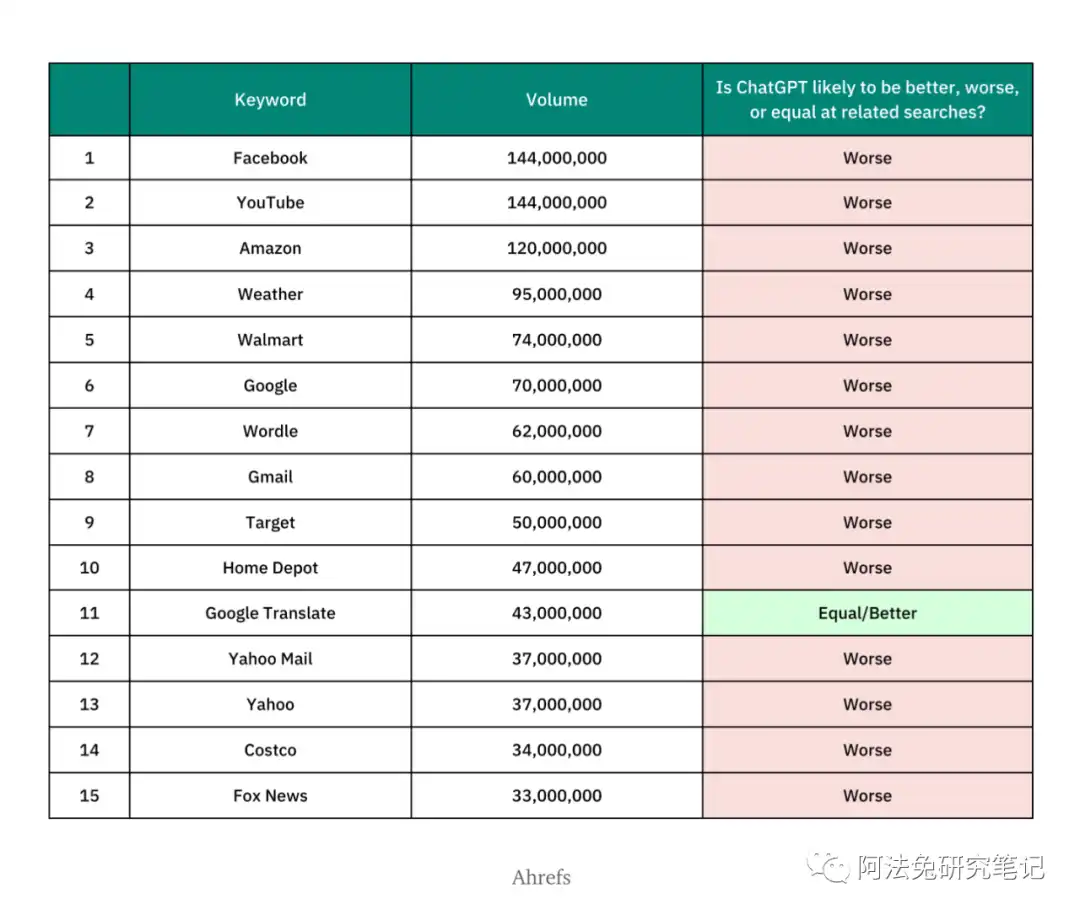
In what ways does ChatGPT beat Google? It can't provide maps or current events at the moment, but it can provide links to some websites and has some advantages in translation. ChatGPT shines with complex problems, but simple ones.
Another question about ChatGPT is whether it is reliable at all.
ChatGPT spends a lot of time rumbling, and it's estimated that 20% of its answers are made up out of thin air, such as making up lists of academic papers or devising a theorem that doesn't exist.
This, of course, is the mapping given by our current era: when news is consumed by countless fake news, consumed by pure fabrication, and while Google also gives wrong search results, the two results are structurally completely different: specifically:
Google sometimes shows users a List of fabricated answers; ChatGPT, on the other hand, sometimes offers po-faced nonsense and minor product problems:
First, ChatGPT does not support image search. Second, it does not attempt to link the request to the user's potential actions, and it does not cite much. One example: People are often used to including a link to a reservation in a restaurant recommendation. However, ChatGPT does not display any source of support and does not provide any citations. And ChatGPT is expensive: While traditional search engines spend $1 billion a year to index the Web, AI companies like ChatGPT are more expensive, which is why OpenAI has no restrictions on product use and is seeking further investment.
(The previous Rabbit article mentioned that it had risen in price)
So ChatGPT's shortcomings are permanent? Or is it temporary? Will this product be as good or better than Google where it matters? Given that Google itself has recently been experimenting with its own home chatbot (covering current events), ChatGPT has the potential to do the same. Over time, we can expect ChatGPT to reduce the probability of serious nonsense, and adding photo + news sources of corroboration seems feasible.
Of course, ChatGPT isn't going to be able to build maps, reservations or shopping any time soon compared to Google. While ChatGPT can be integrated with other players, doing so is likely to have an impact on users.
It is not clear that a more restrictive chat interface could combine these commercial services. Basically, chat-based search means that users can't click through to a new page or easily switch back and forth between multiple Windows.
How to understand the nature of these scenarios? In this case, when users need a more dimensional experience, that is, when you want to search for the new clothes to buy, or the mini-supermarket near your dentist's office, this pattern of behavior is when you are researching, rather than looking for an immediate and certain answer.
Over time, AI may become personalised enough that perhaps it will emerge with customised options better than the results of human browsing. More modular interfaces will soon become popular over the next few years.
In terms of cost, ChatGPT will remain unaffordable for the foreseeable future, and the price will likely limit its use.
Looking ahead: What will happen?
1998 Google founders Sergey Brin and Larry Page received their first venture capital funding. Today, we are swamped with information, and what we need is insight.
The world of the future will be controlled by synthesizers, humans able to put together the right information at the right time, think about it critically, and make important choices wisely. Google's success is that it is a special synthesis of the information world, and ChatGPT takes that to a new level (though it leaves a lot to be desired).
So where does ChatGPT go from here, in terms of market composition, Google's history and its power, to the fact that Chatgpt is now surprisingly powerful?
First, you can expect Google to react and act on how it will respond to the current "it will be revolutionized" situation. Google's current CEO, Sundar Pichai, has to make sure that Google doesn't fall behind. Google has been working on AI for more than a decade, and it's time to show the fruits of that labor.
In fact, inside Google, management calls the release "code red" and has moved quickly to start and accelerate the project. During the company's recent investor call, the CEO emphasized the importance of AI to Google, saying that users will "soon" be able to masque with Google's LaMDA, a language model for conversational apps, and Google's "Apprentice Bard "chatbot, which is being tested.
A product like Bard could redefine how users view ChatGPT. Yann LeCun, head of AI at Meta, says OpenAI's product is "nothing revolutionary," and while that may be peer-to-peer, it could also be true.
Beyond showmanship, Google has to make sure it doesn't cede the bottom of the market to OpenAI.
One of Sam Altman's shrewdest moves was to invest aggressively in startups in the AI industry. (I note: Here are the companies that OpenAI has invested in so they can apply OpenAI's models early on.)
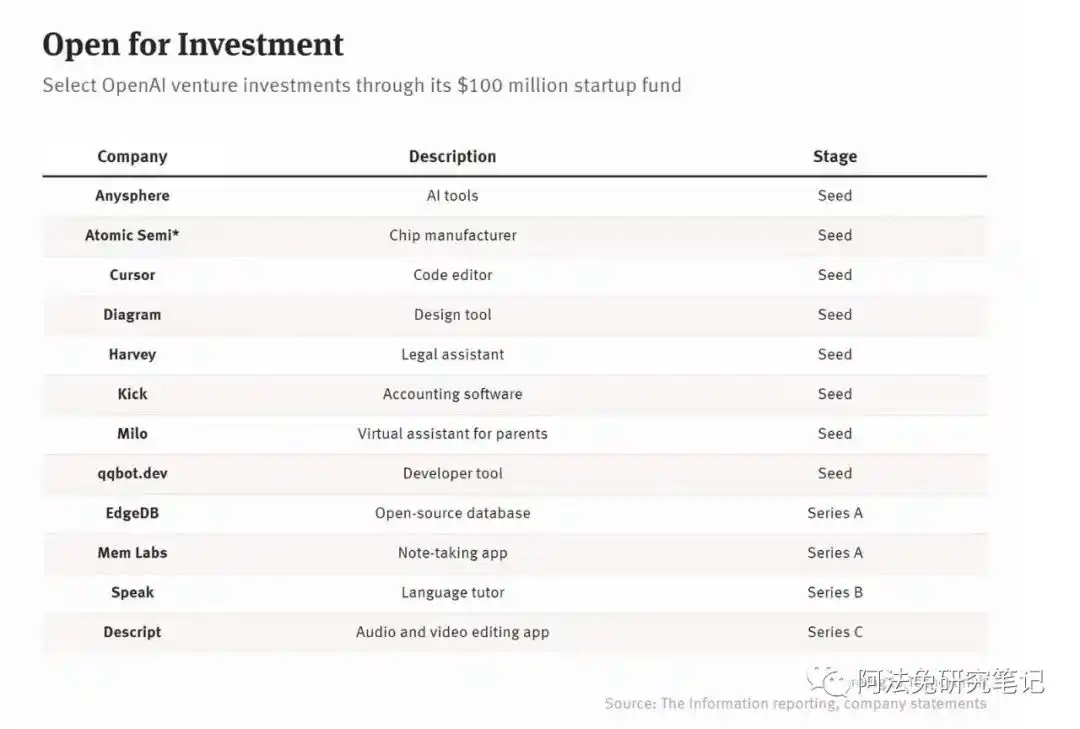
Photo credit: Information
Not only will this build relationships with other AI companies in the industry, it will also put OpenAI in a good position: because start-ups use its models first, OpenAI can hear the innovation and related consumer demands elsewhere in the market. Anthropic, the AI company that Google just announced an investment in, could be seeing a return to the "AI and chatbot "craze that dominated the tech world in 2016 and 2017. ChatGPT's success proves the usefulness of the interface, and there are already several startups on the market offering chat-based Search engines, You, Andi Search and Perplexity, Neeva, and more. Dachang is also getting in on the action, with Microsoft expected to bring ChatGPT's technology to Bing (see Integrating ChatGPT: Microsoft's search battle with Google) and Baidu developing its own chatbot.
The question is, how will these AI companies make money?
There is a basic premise behind the argument that ChatGPT will render Google obsolete:
Based on the advertising model, it doesn't work or is very difficult to work in a chat-based world. What could hurt [Google] is a potential shift in the interface, that is, away from pay-per-click advertising and links.
This may be it: the innovator's dilemma -- a response to competitive threats that kills its own core business. It may take time to fully replicate the complexity of Google ads and revenue-generating links in a new interface, and the different space constraints of the chat interface are likely to reduce the total amount of advertising.
Still, chat interfaces don't seem entirely at odds with sophisticated advertising models. There is room to run ads, for example by introducing a pay-per-click system in conversational interfaces. Here, chatbots have an even greater advantage, because if a direct conversation feels like a real person, there's an even higher business conversion rate.
In addition, users turning to chatbot help areas for more complex queries may provide additional context to improve targeting. A ChatGPT version of the silver-toned "Wolf of Wall Street", for example, tricks consumers into making purchases.
ChatGPT has taken the subscription-based route and is testing a premium service for $20 a month, which, while a shrewd way to monetize its power users, is not a price point aimed at a mass market audience.
Of course, a ChatGPT at this price, or a similar AI, would have great appeal to an enterprise audience, even if it was more expensive: vertical chatbots for law, medicine, engineering, software development, sales, real estate, and other industries would be very valuable. While ChatGPT does a good job on a range of topics, providing more up-front background and training can iterate its utility to a higher level.
While chat meets some needs for now, it's likely that we'll see further innovation around search interfaces in the coming years. By leveraging universal labor intelligence, we'll see new vertical search engines combined with apps like YouTube, Pinterest, and Reddit.
And the voice assistants of the future may become more useful beyond their inability to understand even basic compounding problems.
We can summon our word processor to help us find the right quote, find the latest financial results in our spreadsheet, or find the right words in our email inbox...
Author Neil Gaiman says, "Google can give you 100,000 answers, but a librarian can give you the most accurate answer."
For the past two decades, Google has triumphed by providing the shortest path between questions and answers, becoming the king of search with its vast network of resources and advanced ranking algorithms, which seems unbeatable.
But ChatGPT's recent success shows that disrupting Google isn't hard to do. OpenAI's products transform Google's sea of data into clear answers that are easier to answer.
ChatGPT= Librarian for the Information age, which can draw on vast amounts of human knowledge to provide a definitive answer (even if it is currently wrong)
ChatGPT's talent and speed at distilling, generating, and condensing text are particularly valuable in this vast information age.
Original link
Welcome to join the official BlockBeats community:
Telegram Subscription Group: https://t.me/theblockbeats
Telegram Discussion Group: https://t.me/BlockBeats_App
Official Twitter Account: https://twitter.com/BlockBeatsAsia

 Related Articles