Bernstein Analysis: ChatGPT's Share Drops to 64%, the Consumer AI Battle Is Shifting Toward Agents

TL;DR:
· ChatGPT remains the undisputed leader in consumer AI, with approximately 64% of global AI App MAU share and about 60% in the US, also leading significantly in user engagement and retention rates.
· But the incremental market is being carved up by competitors. Over the past year, ChatGPT's global MAU share dropped from 78% to 64%, while Gemini rose from 19% to 26%; in the US market, Claude's share climbed from 2% to 9%.
· Downloads have already shown a more pronounced inflection point: ChatGPT has posted negative year-over-year growth since April this year, while Gemini, Claude, and Meta AI continue to grow at a rapid pace.
· Bernstein believes the industry is entering a new Agent competition phase. Meta Muse topped the US App Store within 10 days of launch, and competitive metrics are shifting from "downloads" to DAU, retention rates, and actual task completion capabilities.
· AI is also becoming a new entry point for e-commerce search and discovery, but traffic referrals from GenAI currently account for less than 1.5% of total retail and e-commerce website traffic, with commercialization impact still in its early stages.
On September 23, Bernstein released the latest edition of its "Consumer AI Usage Tracker," monitoring downloads, MAU, DAU, user retention, and web traffic changes across major consumer AI products including ChatGPT, Gemini, Claude, Meta AI, and Grok.
The trends presented in the report are clear: ChatGPT's leading position has not yet been shaken, but the consumer AI market is gradually shifting from "one dominant player" to multi-platform competition; at the same time, competition itself is shifting from chatbots to Agents.
ChatGPT is still No. 1, but competitors are eating into the incremental growth
In terms of user scale, ChatGPT still holds an overwhelming advantage.
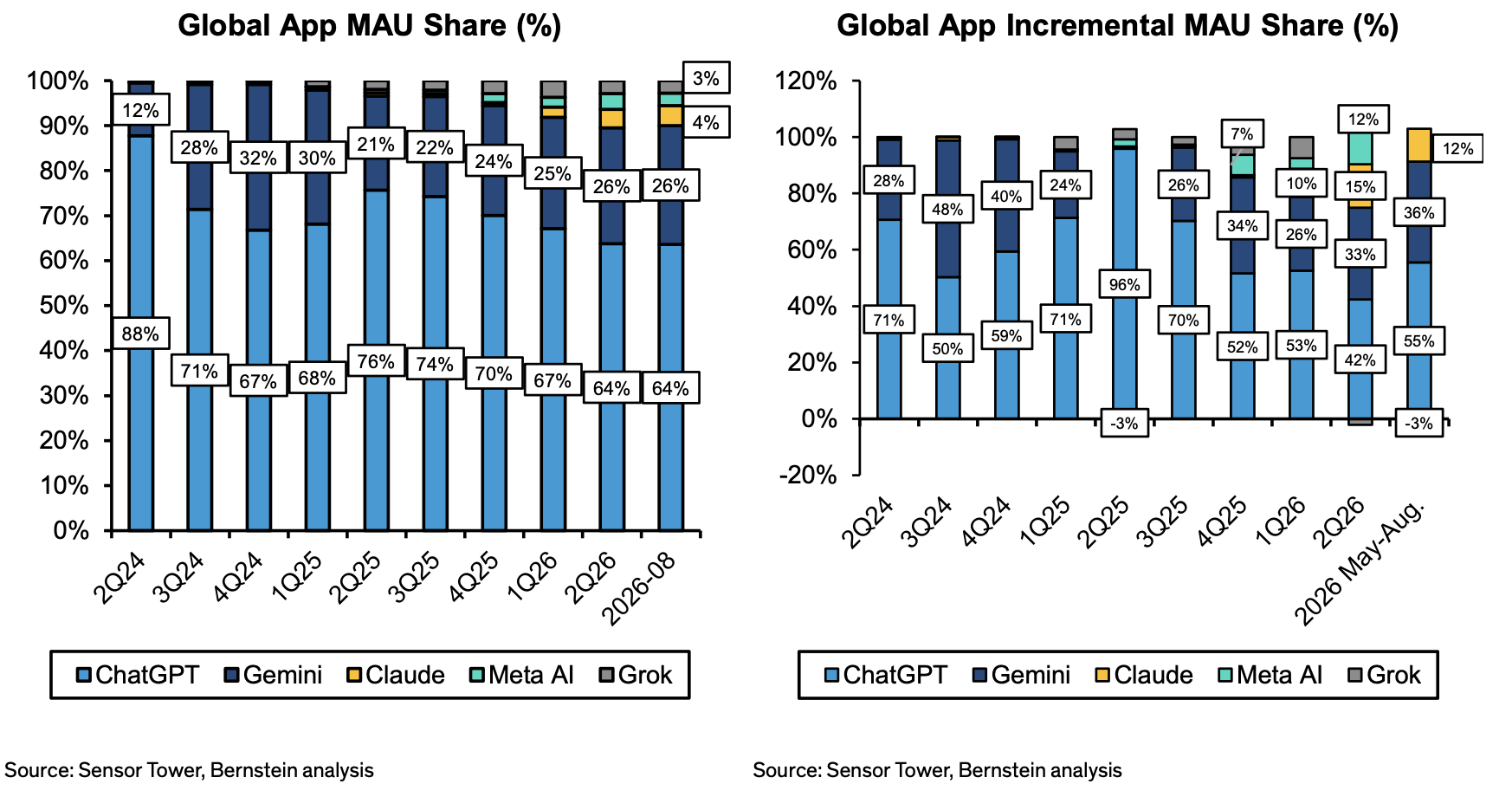
Bernstein data shows that ChatGPT currently accounts for approximately 64% of global major AI App MAU and about 60% of the US market share. More importantly, it not only has the most users but also the highest usage frequency: its DAU/MAU ratio is approximately 40%-45%, and its 7-day retention rate is approximately 25%-30%, both higher than major competitors.
In other words, ChatGPT's advantage is not just its "installed base," but that it has already penetrated more deeply into users' daily habits.
But if you look at the speed of change, the landscape has already begun to loosen.
From August 2025 to August 2026, ChatGPT's global MAU share fell from 78% to 64%, while Gemini rose from 19% to 26%. The shift was even more pronounced in the U.S. market: ChatGPT's share dropped from 79% to 60%, Gemini rose from 13% to 19%, and Claude surged from 2% to 9%.
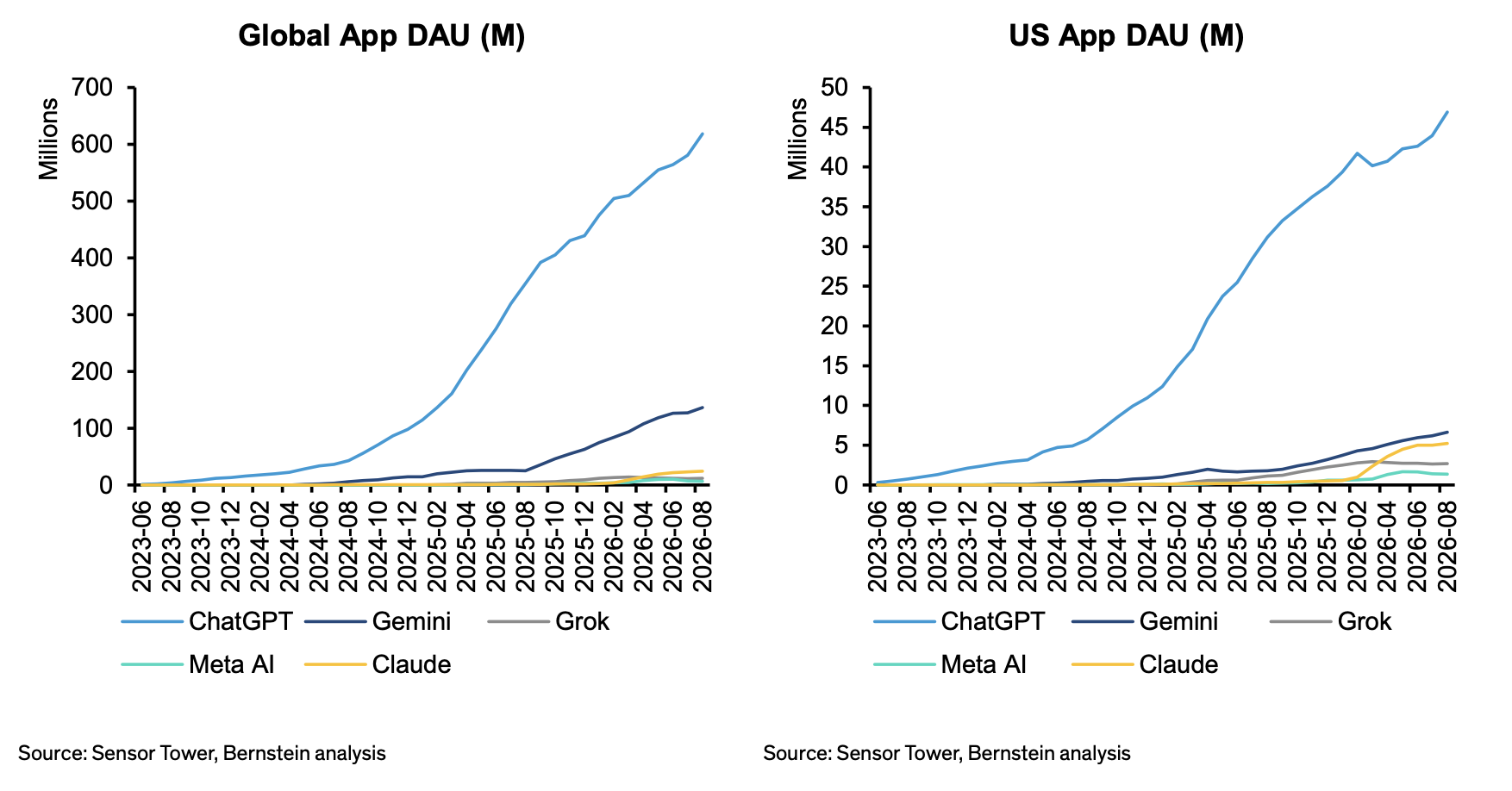
This does not mean ChatGPT users are churning on a massive scale. In fact, as of August this year, ChatGPT's global MAU was still up 70% year over year, and up 49% in the U.S.
The real change is that the overall AI user pool is growing faster, and more and more new users are flowing to other platforms.
Bernstein data shows that from May to August this year, ChatGPT captured about 55% of global net new MAU, while Gemini took 36%; in the U.S., ChatGPT's share of net new users fell further to about 44%, with Gemini and Claude taking 32% and 18%, respectively.
The download dividend is receding, and competition is shifting to "who can retain users"
Compared with MAU, downloads send an even clearer signal.
Since April this year, ChatGPT's global and U.S. App downloads have both entered year-over-year negative growth. In August, ChatGPT's global downloads fell 27% year over year, and U.S. downloads fell 9%.
Over the same period, Gemini's global downloads rose 79% year over year, Claude surged 754%, and Meta AI grew 363%; in the U.S. market, the three grew 29%, 421%, and 471%, respectively.
Of course, there is an obvious base effect here: ChatGPT's absolute scale is far larger than that of other competitors, so its growth rate would naturally decline earlier.
But more notably, the total global downloads of the five AI Apps tracked by Bernstein grew only 6% year over year in August. This means that the first round of the consumer AI "download dividend" may be gradually maturing.
The truly important question going forward is no longer just how many more people are downloading AI for the first time, but rather: which product can become a tool users open every day.
From a user behavior perspective, this shift is already underway.
Bernstein found that usage patterns among mainstream AI apps are rapidly converging: users spend an average of about 14-17 minutes per day, open the app 8-9 times daily, and each session lasts about 1.5-2 minutes.
This means AI chatbots are gradually evolving from "an occasional new tool to try" into a high-frequency consumer internet product akin to search, social media, or instant messaging.
ChatGPT remains the leader on this metric. But as download growth gradually slows, the competitive focus will increasingly shift from "who can bring in more new users" to who can improve retention, usage frequency, and daily dependence.
And Bernstein believes the product form most likely to reshape this competitive landscape next is the Agent.
Muse Explodes, AI Battle Shifts from "Answering Questions" to "Doing Things for You"
On September 8, Meta launched Muse, a standalone consumer AI Agent.
Compared to traditional chatbots, its goal is no longer limited to "answering questions" but directly helping users complete real-world tasks.
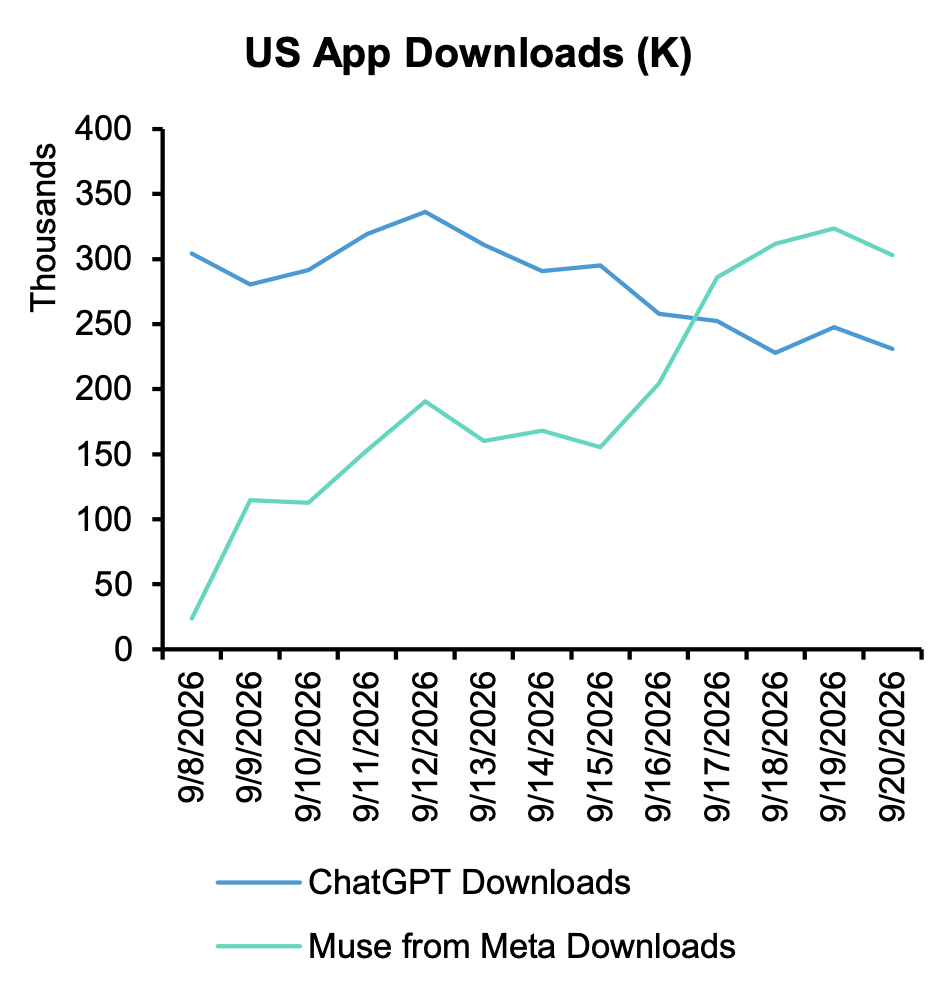
Just 10 days after launch, Muse hit No. 1 on the U.S. App Store and surpassed ChatGPT on September 17. Compared at the same number of days post-launch, Muse's early download curve even exceeds that of the ChatGPT app when it first launched in 2023.
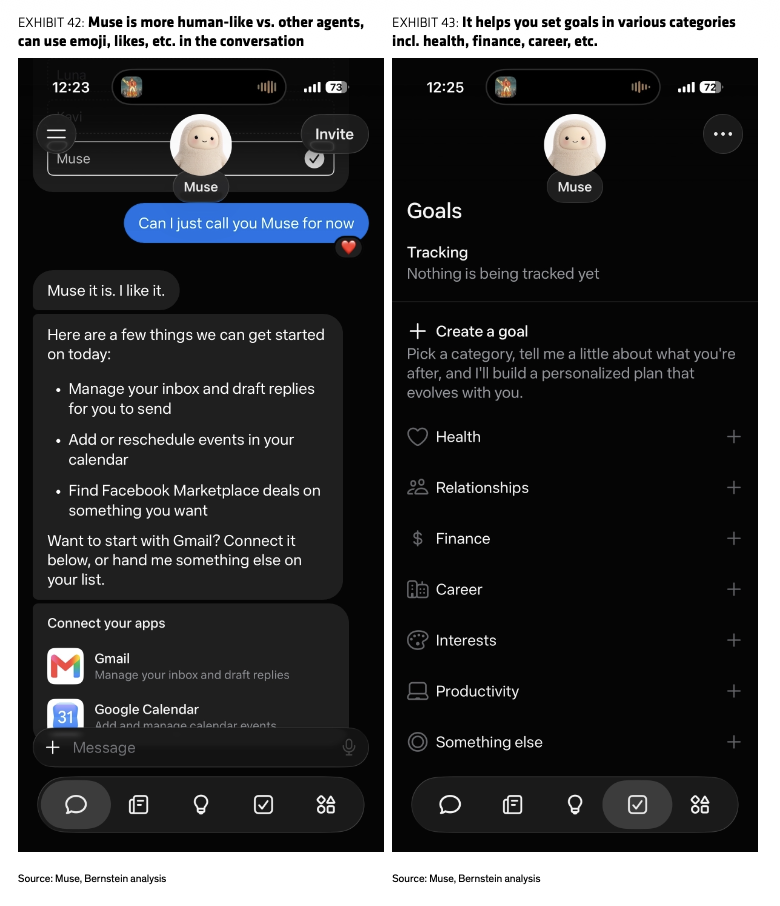
Bernstein's testing found that Muse can already handle tasks such as booking doctor's appointments, setting reminders and personal goals, monitoring flight prices, contacting customer service, and canceling subscriptions; meanwhile, because it can integrate social data from Instagram and Threads, it also has unique advantages in scenarios like travel planning, local discovery, and restaurant recommendations.
Behind this is actually a shift in the logic of consumer AI products.
Over the past two years, ChatGPT, Gemini, and Claude have primarily competed on model capabilities and answer quality. Agents push the competition further into the execution layer: not just telling users "what to do," but directly doing it for them.
However, Bernstein also cautioned that it is still too early to judge whether Muse will succeed. Some seemingly simple tasks, such as hotel bookings, still lack execution reliability; meanwhile, for an Agent to truly complete tasks, it needs deeper access to accounts, personal data, and applications, which directly raises privacy concerns.
Therefore, the most important data for Muse going forward is not App Store rankings, but 7-day/28-day retention, DAU, and DAU/MAU.
Getting a user to try an Agent once is not difficult; the hard part is getting users to willingly hand over their tasks to it every day.
And Meta is not the only company entering this market. The report notes that Google has already built its own 24/7 personal Agent through Gemini Spark, which can monitor email, organize information, execute workflows across Workspace products such as Gmail and Docs, and run continuously in the background; Amazon, meanwhile, relies on Alexa+ and a hardware distribution base of over 600 million devices to extend its Agent into smart home, services, and shopping scenarios.
Therefore, the next phase of competition in consumer AI is likely no longer just a pure model leaderboard race.
Meta has social relationships and user data, Google has Search, Android, and Workspace, Amazon has shopping, payments, logistics, and hardware entry points, while OpenAI has the strongest standalone AI product mindshare at present.
Whoever can turn these entry points into Agents that continuously execute tasks may control a key gateway to the next generation of the consumer internet.
From personal assistant to transaction gateway, AI is redistributing internet traffic
Another layer of value in Agents is that they could change how internet traffic is allocated.
Currently, referral traffic from generative AI is still very small. Bernstein data shows that visits generated by AI recommendations currently account for generally less than 1.5% of total traffic on e-commerce and retail websites.
But the direction has already begun to emerge.
Booking has acknowledged that AI is affecting some search-dependent user discovery processes; Reddit's CEO said that Google AI Overviews has not become a significant source of traffic, which also raises another question: when AI provides answers directly on the search page, do users still need to click through to the original website?
This means that AI's biggest impact on the internet may ultimately not be adding a new chat tool, but rather becoming a new intermediary layer between consumers and internet services.
In the past, users would "search for a hotel—open Booking—filter—book." In the future, users may only need to say to an Agent: "Find me a hotel in Tokyo next week and book it."
Once an Agent can complete the full chain from search and comparison to transaction, whoever controls the Agent will have the opportunity to control search, recommendations, transactions, and even the payment gateway.
This is also what truly deserves attention in Bernstein's report: ChatGPT's lead is still substantial, but the battlefield for consumer-grade AI has already begun to change. The focus of the next round of competition is shifting from who has the most users to who can become the personal Agent that users truly rely on.
Welcome to join the official BlockBeats community:
Telegram Subscription Group: https://t.me/theblockbeats
Telegram Discussion Group: https://t.me/BlockBeats_App
Official Twitter Account: https://twitter.com/BlockBeatsAsia